You will need: a timer, a printed manuscript grid of at least 700 squares (원고지, wongoji) or a typing screen if you take the computer test, one past question 54 prompt from the official TOPIK past papers, and a pen. The time plan on this page is editorial, built from the official 50-minute writing section.
What Is the TOPIK 54 Essay?
The TOPIK 54 essay is an opinion essay in which you discuss a social topic by answering two or three guiding questions printed in the prompt. It is question 54 of the TOPIK II writing section, which has four questions and 50 minutes in the paper test. The essay alone is worth 50 points, half of the writing section and one sixth of the TOPIK II total of 300.
The prompt has three parts:
- An instruction line. It asks you to write your own view on the topic in 600 to 700 characters and warns you not to copy the prompt text into your answer.
- A short topic text. Two or three sentences introduce an issue, such as a change in society.
- Guiding questions. Two or three bullet questions, for example why something matters, what problems it causes and what should be done.
| Feature | Question 53 | Question 54 |
|---|---|---|
| Task | describe a chart or survey | argue a view on a topic |
| Length | 200-300 characters | 600-700 characters |
| Points | 30 | 50 |
| Your opinion | not wanted | required |
| Paragraphs | usually one | usually four |
| Style | plain written -다 | plain written -다 |
The point values and lengths follow the breakdown published with the test; the current details are on topik.go.kr, the official TOPIK site run by the National Institute for International Education (NIIED, 국립국제교육원). The TOPIK writing hub shows all four writing tasks side by side. With the task clear, the next question is how to fit it into the clock.
How Should You Plan the 25 Minutes?

Plan the TOPIK 54 essay as 3 minutes of planning, 20 minutes of writing and 2 minutes of checking. Twenty-five minutes is what remains of the 50-minute writing section if you finish questions 51 and 52 in about 5 minutes each and question 53 in about 15. This is the same split as the TOPIK writing hub.
| Minutes | Step | Target length |
|---|---|---|
| 0-3 | Read the prompt, write a four-line outline | none |
| 3-6 | Introduction | about 100-140 characters |
| 6-16 | Two body paragraphs | about 170-190 characters each |
| 16-23 | Conclusion | about 150-170 characters |
| 23-25 | Check endings, spacing and length | none |
If questions 51 to 53 take you less than 25 minutes, add the spare minutes to the check. The plan is editorial, and the official rules set only the 50-minute total. On the paper test, the writing period begins when the listening audio ends, so the clock is running from the moment you turn to question 51. Knowing the time, you can choose the shape the essay will take.
What Structure Works Best?
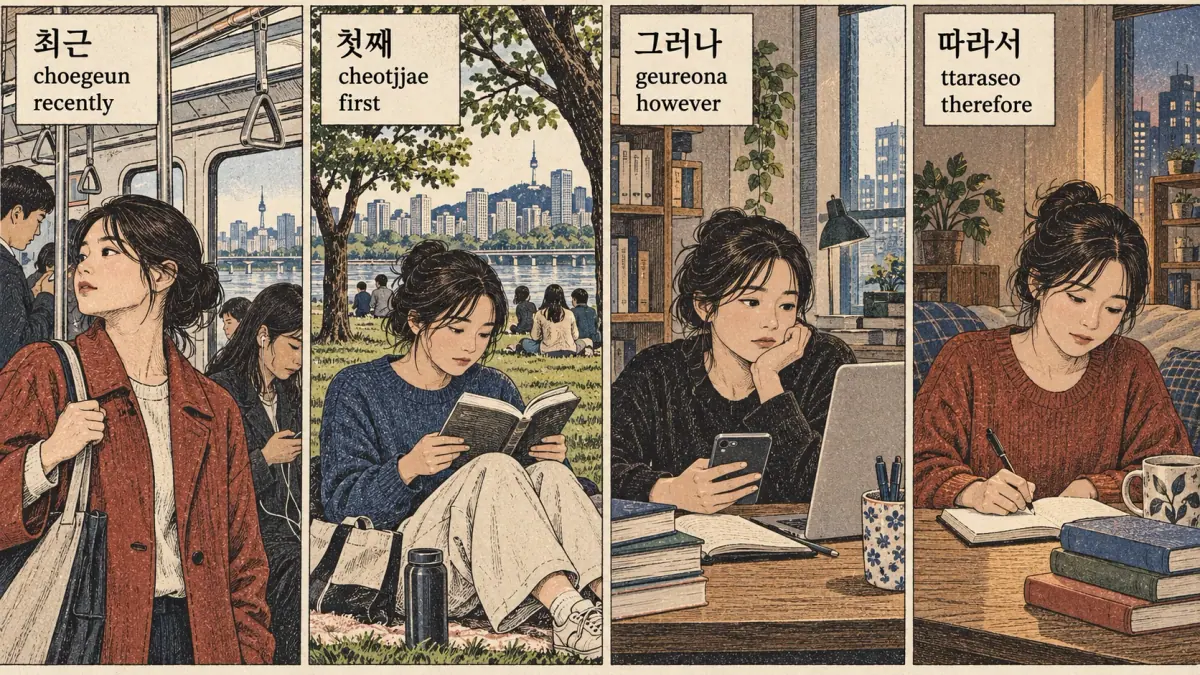
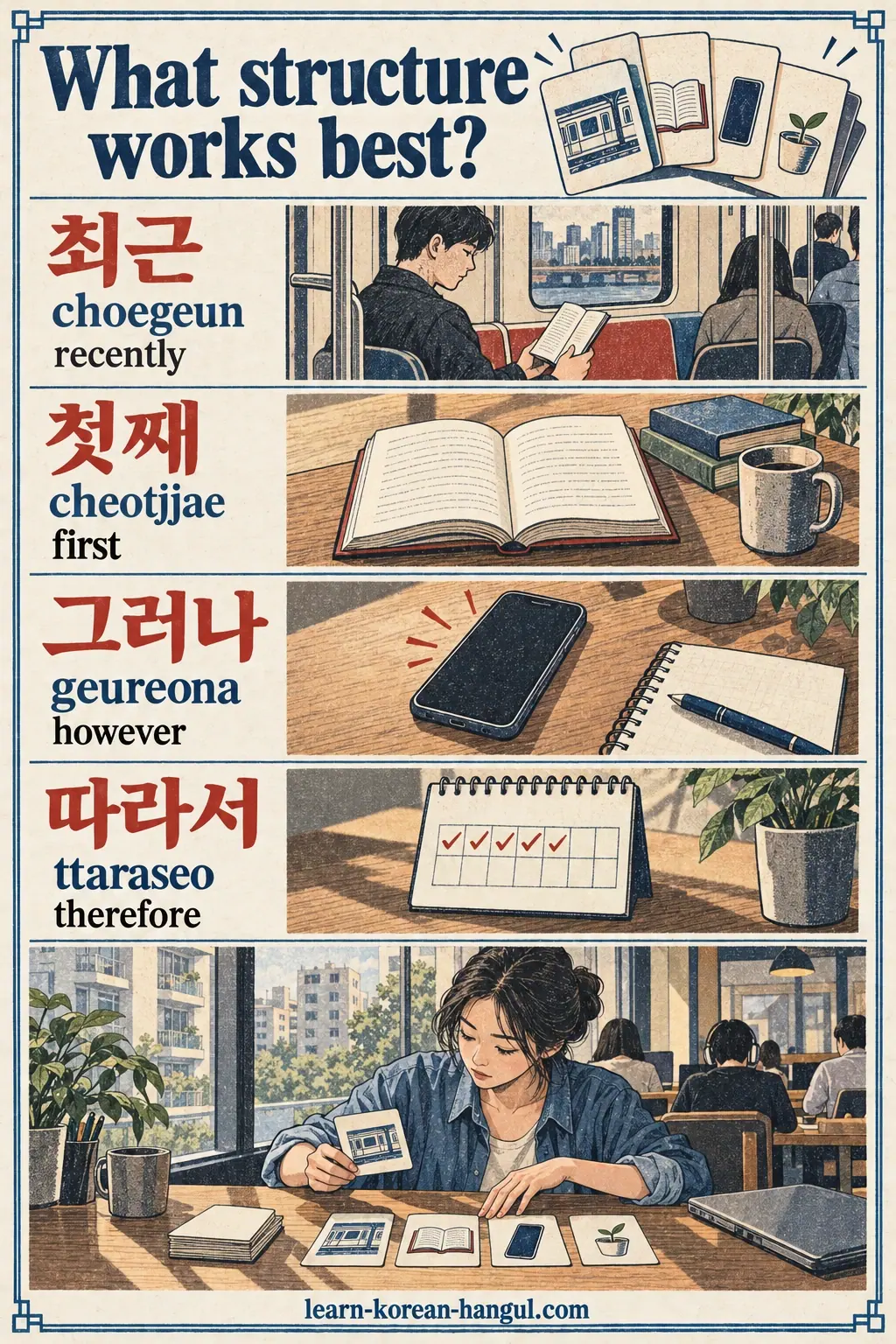
A four-paragraph frame works best for most TOPIK 54 prompts: an introduction, two body paragraphs and a conclusion, with each guiding question answered in its own paragraph. Raters can then find your answer to every question without searching.
| Paragraph | Job | Typical opening | Answers |
|---|---|---|---|
| 1. Introduction | background and your position | 최근 (choegeun, "recently") | the topic text |
| 2. Body 1 | first guiding question, reason plus example | 첫째 (cheotjjae, "first") or 우선 (useon, "first of all") | question 1 |
| 3. Body 2 | second guiding question, problem or other side | 그러나 (geureona, "however") or 그렇다면 (geureotamyeon, "then") | question 2 |
| 4. Conclusion | third guiding question, solution or summary | 따라서 (ttaraseo, "therefore") | question 3 |
When a prompt has only two guiding questions, give each one a body paragraph and keep the conclusion short. When a prompt asks you to choose a side, state the side in the introduction and repeat it in the conclusion in different words.
The frame tells you what goes where. The steps below turn it into a timed routine.
How Do You Write the TOPIK 54 Essay, Step by Step?
Write the essay in five timed steps: plan, introduce, argue twice, conclude and check. Each step below gives the action, how to do it, a checkpoint and the mistake to avoid.
Step 1: Outline the Prompt in Three Minutes
Action: underline the guiding questions and write a four-line outline in the margin.
How: number the guiding questions 1, 2 and 3. Next to each, write two or three key words in Korean for your answer, for example 생각하는 힘 (saenggakaneun him, "the ability to think") for "why is it needed?". Add one example you can use.
Checkpoint: you know it worked when every guiding question has a key word and an example beside it.
Mistake to avoid: starting to write straight away. On grid paper, a paragraph written in the wrong order cannot be moved, and rewriting costs minutes you do not have.
Step 2: Write the Introduction
Action: describe the situation in your own words, then state your position.
How: write two or three sentences, about 100 to 140 characters. Paraphrase the topic text instead of copying it. If the prompt says 책을 읽는 사람이 줄어들고 있다 ("fewer people are reading books"), write about what you see instead: 지하철에서 책을 읽는 사람을 보기가 어려워지고 있다 ("it is getting hard to see people reading books on the subway").
Checkpoint: the last sentence of the paragraph says what you think, for example with -다고 생각한다 (-dago saenggakanda, "I think that").
Mistake to avoid: copying the topic sentences. Copied text does not show your own writing, and the instruction line asks you not to do it.
Step 3: Answer the First Guiding Question
Action: give one or two reasons, each with a short example.
How: open with 첫째 or 우선, state the reason in one sentence, explain it with -기 때문이다 (-gi ttaemunida, "it is because"), then add 예를 들어 (yereul deureo, "for example"). Aim for 170 to 190 characters.
Checkpoint: a reader could underline the sentence that answers question 1.
Mistake to avoid: listing many reasons without explaining any. Two reasons with an example score better than five bare claims.
Step 4: Answer the Second Guiding Question
Action: turn to the problem, cause or opposing view the second question asks about.
How: open with a contrast word such as 그러나 or a question such as 그렇다면 왜 ...? ("then why ...?"), and finish with a sentence that leads into your solution.
Checkpoint: the paragraph opens with a clear signal that the essay is changing direction.
Mistake to avoid: repeating paragraph 2 in different words. Each body paragraph must answer a different question.
Step 5: Conclude, Then Check for Two Minutes
Action: answer the last guiding question and close with a forward-looking sentence, then check the whole essay.
How: open with 따라서 or 이처럼 (icheoreom, "in this way"). Suggest one or two concrete actions with -아/어야 한다 (-a/eoya handa, "should"). Finish with a prediction using -(으)ㄹ 것이다 (-(eu)l geosida, "will"). Then check four things in order: every sentence ends in -다; there is a space after each particle-word group; the text reaches at least the 600 mark; no sentence is copied from the prompt.
Checkpoint: you finish checking before time is called, with every ending read once.
Mistake to avoid: writing the conclusion so long that you skip the check. A check often catches a polite -요 ending that would cost language points. The checks are only as good as the language you write, so the next section gives you patterns to use.
Which Patterns Raise the Language Score?

Patterns that link ideas in the written style raise the language score most, because raters look for a range of accurate grammar beyond basic sentences. Learn one or two patterns for each function below rather than twenty for one function.
| Function | Pattern | Example in written style |
|---|---|---|
| Opinion | -다고 생각한다 | 독서가 꼭 필요하다고 생각한다. (dokseoga kkok piryohadago saenggakanda.) "I think reading is essential." |
| Cause | -기 때문이다 | 시간이 부족하기 때문이다. (sigani bujokagi ttaemunida.) "It is because people lack time." |
| Contrast | -(으)ㄴ/는 반면에 | 도시는 편리한 반면에 공기가 나쁘다. (dosineun pyeollihan banmyeone gonggiga nappeuda.) "Cities are convenient, whereas the air is bad." |
| Concession | 물론 -지만 | 물론 영상도 도움이 되지만 한계가 있다. (mullon yeongsangdo doumi doejiman hangyega itda.) "Of course videos help too, but they have limits." |
| Example | 예를 들어 | 예를 들어 하루에 10분씩 읽을 수 있다. (yereul deureo harue sipbunssik ilgeul su itda.) "For example, you can read for 10 minutes a day." |
| Necessity | -아/어야 한다 | 모두가 함께 노력해야 한다. (moduga hamkke noryeokaeya handa.) "Everyone must make an effort together." |
| Condition | -(으)ㄴ/는다면 | 이러한 노력이 계속된다면 상황이 나아질 것이다. (ireohan noryeogi gyesokdoendamyeon sanghwangi naajil geosida.) "If such efforts continue, the situation will improve." |
| Conclusion | 따라서 / 이처럼 | 따라서 작은 목표부터 세우는 것이 좋다. (ttaraseo jageun mokpyobuteo seuuneun geosi jota.) "Therefore it is best to start with small goals." |
Pronunciation notes for the audio: 필요하다고 is said [피료하다고], 10분씩 is read 십분씩 and said [십뿐씩], and 한계가 is said [한계가], with [한게가] also allowed by the standard rules and usual in everyday speech. The examples use the plain written style throughout; how to convert spoken forms into it is explained on TOPIK writing style.
독서가 꼭 필요하다고 생각한다.
dokseoga kkok piryohadago saenggakanda.
I think reading is essential.
물론 영상도 도움이 되지만 한계가 있다.
mullon yeongsangdo doumi doejiman hangyega itda.
Of course videos help too, but they have limits.
A pattern used wrongly costs more than a simple sentence used correctly, so practise each one in three sentences of your own before the test. More advanced connectors for levels 5 and 6 are listed under TOPIK 2 grammar advanced. Patterns count, but they are only one of the things raters score.
How Is Q54 Scored?

Question 54 is scored by trained raters against three groups of criteria: content and task completion, the structure of the writing, and language use. The scoring criteria commonly cited from NIIED materials give language use the largest share, but check the current version on topik.go.kr, because candidates do not see the raters' detailed marking scheme.
| Criterion | Korean name | What raters look for | How to earn it |
|---|---|---|---|
| Content and task | 내용 및 과제 수행 | every guiding question answered, ideas relevant and developed | one paragraph per question, a reason and an example each |
| Structure | 글의 전개 구조 | clear introduction, body and conclusion; logical links | paragraph openers such as 첫째, 그러나, 따라서 |
| Language use | 언어 사용 | range and accuracy of grammar and vocabulary, written style | varied patterns, -다 endings throughout, correct spelling and spacing |
Two practical rules follow from the criteria. First, length is part of the task: an essay well under 600 characters usually cannot complete the task, so it loses content marks before language is even considered. Second, register is part of language use: an essay in polite -요 or formal -습니다 endings is in the wrong style for this task, and teachers report that it costs language points. The exact deductions are not published for candidates. To see how the criteria apply to a real answer, look at the model below.
What Does a Model Answer Look Like?

A model answer covers every guiding question in its own paragraph, stays between 600 and 700 characters and uses the written style throughout. The prompt and answer below were written for this site; they are not taken from a real exam.
Prompt (original):
다음을 주제로 하여 자신의 생각을 600~700자로 글을 쓰십시오. 단, 문제를 그대로 옮겨 쓰지 마십시오.
최근 책을 읽는 사람이 점점 줄어들고 있다. 독서의 필요성에 대해 아래의 내용을 중심으로 자신의 생각을 쓰라.
- 독서가 필요한 이유는 무엇인가?
- 사람들이 책을 읽지 않는 이유는 무엇인가?
- 독서 습관을 기르려면 어떤 노력이 필요한가?
In English: "Write your own view on the following topic in 600-700 characters. Do not copy the question as it is. Fewer and fewer people read books these days. Write about the need for reading, covering: why reading is needed; why people do not read; what effort is needed to build a reading habit."
Model answer (642 characters including spaces):
지하철에서 책을 읽는 사람을 보기가 점점 어려워지고 있다. 많은 사람들이 짧은 영상이나 인터넷 기사로 필요한 정보를 얻기 때문이다. 그러나 나는 독서가 여전히 꼭 필요한 활동이라고 생각한다.
"It is getting harder to see people reading books on the subway, because many people get the information they need from short videos or online articles. However, I think reading is still an essential activity."
독서가 필요한 이유는 두 가지이다. 첫째, 책을 읽으면 생각하는 힘이 길러진다. 긴 글을 따라가면서 내용을 이해하고 판단해야 하기 때문이다. 둘째, 독서를 통해 직접 경험할 수 없는 세계를 만날 수 있다. 다른 시대나 다른 나라 사람들의 삶을 읽으면 다른 사람을 이해하는 폭이 넓어진다. 이는 다른 사람과 함께 살아가는 데 큰 도움이 된다.
"There are two reasons reading is needed. First, reading builds the ability to think, because you must follow a long text, understand it and judge it. Second, reading lets you meet worlds you cannot experience directly. Reading about the lives of people from other times and countries widens your understanding of others, which helps a great deal in living together."
그렇다면 사람들은 왜 책을 읽지 않는 것일까? 가장 큰 이유는 시간이 부족하다고 느끼기 때문이다. 일과 공부에 지친 사람들은 쉬는 시간에 쉽고 빠르게 즐길 수 있는 영상을 선택한다. 게다가 스마트폰 알림 때문에 한 가지 일에 오래 집중하기도 어렵다. 또한 어릴 때부터 독서를 즐거운 일이 아니라 숙제로 경험한 사람도 많다.
"Then why do people not read? The biggest reason is that they feel short of time. People tired from work and study choose videos they can enjoy quickly and easily in their free time. On top of that, phone notifications make it hard to focus on one thing for long. Many people also experienced reading as homework rather than a pleasure from childhood."
따라서 독서 습관을 기르기 위해서는 작은 목표부터 세우는 것이 좋다. 예를 들어 하루에 10분씩 읽거나 관심 있는 분야의 얇은 책부터 시작할 수 있다. 가정과 학교에서도 독서를 평가가 아니라 즐거움으로 느낄 수 있도록 도와야 한다. 이러한 노력이 쌓이면 독서는 다시 우리 생활의 일부가 될 것이다.
"Therefore, to build a reading habit it is best to start with small goals. For example, you can read for 10 minutes a day or begin with thin books in a field that interests you. Homes and schools should also help people feel reading as a pleasure, not as something graded. As such efforts build up, reading will become part of our lives again."
Notes on the Model Answer
- Task: paragraphs 2, 3 and 4 answer guiding questions 1, 2 and 3 in order, and each gives a reason with an example.
- Structure: each paragraph opens with a signal (첫째 and 둘째, 그렇다면, 따라서), so the logic is visible at a glance.
- Language: the answer uses more than ten different grammar patterns, including -기 때문이다, -(으)면, -(으)ㄹ 수 있다, -도록 and -아/어야 한다, and every sentence ends in -다 or the question form -(으)ㄹ까.
- Own words: the topic sentence 책을 읽는 사람이 줄어들고 있다 is never copied; the introduction describes a scene instead.
- Length: 642 characters including spaces, or about 645 squares on the grid once the four paragraph indents are added, with room to spare below 700.
More annotated answers, including a weak and a strong version of the same essay, are on TOPIK writing examples. The model also shows by contrast what a weak essay does, which the next section lists.
Common Mistakes and How to Fix Them

These six mistakes cost the most marks on question 54, and each has a simple fix.
- Copying the prompt. Fix: reuse the key nouns, such as 독서 (dokseo, "reading"), but build your own sentences around them.
- Skipping a guiding question. Fix: tick each question in your outline when its paragraph is done.
- Speaking endings. 독서가 필요해요 or 필요합니다 instead of 필요하다. Fix: in the final check, read only the last word of every sentence.
- Spoken words. 근데, 진짜 and 너무 많이 sound like conversation. Fix: use 그런데 or 그러나, 매우 and 지나치게 instead.
- Too short. An essay that stops near 500 characters cannot complete the task. Fix: practise until you know how full the grid looks at 600.
- One long block. Without paragraphs, raters cannot see the structure. Fix: start each paragraph on a new line, with the first square left empty on paper.
The rules for squares, spacing and punctuation are on TOPIK writing rules, and a wider list of exam errors is on TOPIK common mistakes. Mistakes are easier to avoid when you recognise the type of prompt you face.
How Do You Handle Different Prompt Types?
Handle each prompt type with the same four paragraphs, changing only what the body paragraphs do. Three types cover most question 54 prompts seen in published past papers.
| Prompt type | Example topic (original) | Body paragraph 1 | Body paragraph 2 |
|---|---|---|---|
| Why, problems, solutions | the need for reading | why it matters | why it is hard or what goes wrong |
| Advantages and disadvantages, then your view | working from home | advantages | disadvantages, then your side |
| Conditions or qualities | what makes a good leader | first quality with an example | second quality with an example |
For an advantages-and-disadvantages prompt, make your side clear in the conclusion with -다고 생각한다, so the essay is an argument and not only a list. Typical topics are social and general, such as education, technology, communication, the environment or work; no specialist knowledge is needed, but you need the vocabulary to discuss them.
How Long Does It Take to Prepare for Question 54?
Most learners need several weeks of regular timed practice before the four-paragraph routine becomes automatic. A realistic editorial plan is one timed essay a week for 8 to 12 weeks, each followed by a rewrite of the weakest paragraph.
- Weeks 1-2: write without a timer, focusing on the frame and the -다 style.
- Weeks 3-6: one timed essay a week at 25 minutes; mark it with the three criteria above.
- Weeks 7-12: full writing sections of 50 minutes, so question 54 is practised after 51 to 53.
Use full papers in this phase: the TOPIK mock test page explains how to run one at home. If you cannot reach 600 characters in 25 minutes by week 6, practise typing or handwriting speed separately, or consider the other test format on TOPIK IBT vs PBT.
Practice: Check Your TOPIK 54 Essay Knowledge
Practice · 5
How many points is the TOPIK 54 essay worth?
Show answer
50
Question 54 is worth 50 of the 100 writing points.
Which ending should most sentences in a question 54 essay use?
Show answer
-ㄴ/는다 and -다
Questions 53 and 54 expect the plain written style that ends in -다.
In the 25-minute plan on this page, how long is the final check?
Show answer
2 minutes
3 minutes planning, 20 writing and 2 checking.
A prompt has three guiding questions. Where should the answer to the third one go?
Show answer
In the conclusion
In the four-paragraph frame, the conclusion answers the last guiding question.
Which word is the written-style choice for 'however'?
Show answer
그러나
그러나 is the written connector; 근데 is a spoken contraction of 그런데.
TOPIK 54 Essay: Where to Go Next
The TOPIK 54 essay rewards the same habits every time: plan for three minutes, give each guiding question its own paragraph, write in the -다 style and keep two minutes for checking. Before this page, work through TOPIK question 53, the shorter data-description task. After it, study the TOPIK writing tips for the whole 50-minute section, and return to the TOPIK writing hub for the other questions.
About this page. Last updated 2026-10-09. The prompt and model answer were written for this site and are not taken from a real exam. The Korean was drafted with AI assistance and cross-checked with the site's rule-based conjugation engine; a Korean reviewer checks every lesson before it is marked as reviewed. Exam facts follow the commonly published format; confirm the current rules on topik.go.kr before your test.
Frequently Asked Questions
What If I Write Fewer than 600 Characters?
You will usually lose marks. The length is part of the task, so an essay well under 600 characters cannot fully answer the guiding questions and scores lower on content before language is considered. The exact deduction is not published for candidates, so aim for 620 to 680 characters and check the current guide on topik.go.kr.
Do Spaces Count in the TOPIK 54 Essay Length?
On the paper test, yes in practice: each space between words fills its own square on the manuscript grid, so the 600 and 700 marks on the sheet include spaces. Punctuation marks also take squares. Count your practice essays the same way, with spaces, so that your sense of length matches the sheet.
How Many Paragraphs Should a TOPIK 54 Essay Have?
Four paragraphs suit most prompts: an introduction, two body paragraphs and a conclusion, with each guiding question answered in its own paragraph. Three paragraphs can work when a prompt has only two guiding questions. More than five paragraphs usually makes each one too thin to develop a reason and an example.
Which Topics Appear in TOPIK 54?
Question 54 topics are general social issues that any adult can discuss, such as education, technology, communication, the environment, work and personal values. No specialist knowledge is needed. Past prompts are published on topik.go.kr, and reading several of them shows the range better than any list. Learn vocabulary for these themes in advance.
Can I Use -습니다 in Question 54?
Avoid it. Questions 53 and 54 expect the plain written style ending in -다, and the formal -습니다 style, although polite and correct in speeches and emails, is the wrong register for this essay. Teachers report that it costs language points. Switch every ending to -ㄴ/는다 or -다, and never mix the two styles.
Should I Write Question 54 First?
Some candidates do, because it carries 50 points and running out of time on it is costly. Writing it first protects the essay but can leave questions 51 to 53 rushed at the end. Try both orders in timed practice and keep the one that gives the higher total across all four questions.