What you will be able to do after this lesson
- Use 18 personality adjectives in the polite present and as modifiers.
- Describe a person in six sentences with 성격이 + adjective.
- Tell a safe compliment from a risky remark.
- Form 게으르다 (게을러요) and 예의 바르다 (예의 발라요) correctly.
Before you start: read the lesson on common Korean adjectives. Time: about 40 minutes. Level: A2.
Which Korean Adjectives Describe Personality?
Korean personality adjectives are descriptive verbs that say what a person is like, such as 착하다 (good-natured), 똑똑하다 (smart) and 게으르다 (lazy). Because they are adjectives, they conjugate like verbs (착해요, 게을러요) and become modifiers before a noun (착한 사람). Most end in 하다, so they follow the regular 하다 pattern.
The 18 words on this page are split in two groups. The table counts them.
| Group | Words | Idea |
|---|---|---|
| Positive and neutral | 12 | kind, smart, diligent, honest, brave, humble, polite, quiet |
| Negative or risky | 6 | lazy, rude, stupid, selfish, timid, picky |
The groups matter more than the English glosses. A Korean speaker chooses a personality word with the listener in mind, so the page marks which words are safe praise and which are criticism. The Korean personality words page lists more nouns and expressions without the grammar. The first group is the safest to use.
Positive and Neutral Personality Adjectives
These twelve adjectives describe qualities most speakers praise or accept. Eleven follow the 하다 pattern, where 하다 becomes 해요, and one, 예의 바르다, is a 르 irregular.
| Word | RR | Meaning | Polite present | Modifier | Class |
|---|---|---|---|---|---|
| 착하다 | chakada | kind-hearted, good-natured | 착해요 | 착한 | 하다 |
| 친절하다 | chinjeolhada | kind, helpful to others | 친절해요 | 친절한 | 하다 |
| 상냥하다 | sangnyanghada | gentle, sweet-tempered | 상냥해요 | 상냥한 | 하다 |
| 똑똑하다 | ttokttokada | smart, bright | 똑똑해요 | 똑똑한 | 하다 |
| 영리하다 | yeongnihada | clever, quick-witted | 영리해요 | 영리한 | 하다 |
| 부지런하다 | bujireonhada | diligent, hardworking by habit | 부지런해요 | 부지런한 | 하다 |
| 성실하다 | seongsilhada | sincere and reliable | 성실해요 | 성실한 | 하다 |
| 솔직하다 | soljikada | honest, frank | 솔직해요 | 솔직한 | 하다 |
| 용감하다 | yonggamhada | brave | 용감해요 | 용감한 | 하다 |
| 겸손하다 | gyeomsonhada | humble, modest | 겸손해요 | 겸손한 | 하다 |
| 예의 바르다 | yeui bareuda | polite, well-mannered | 예의 발라요 | 예의 바른 | 르 irregular |
| 조용하다 | joyonghada | quiet, reserved | 조용해요 | 조용한 | 하다 |
- 제 친구는 성격이 착해요. (My friend has a kind-hearted personality.)
- 이 가게 직원은 친절해요. (The staff at this shop are kind.)
- 우리 선생님은 상냥하세요. (Our teacher is gentle.)
- 동생은 아주 똑똑해요. (My younger sibling is very smart.)
- 그 강아지는 영리해요. (That puppy is clever.)
- 아버지는 부지런하세요. (My father is diligent.)
- 이 학생은 성실해요. (This student is sincere and reliable.)
- 제 친구는 솔직해요. (My friend is frank.)
- 소방관은 용감해요. (Firefighters are brave.)
- 그 가수는 겸손해요. (That singer is humble.)
- 그 학생은 예의 발라요. (That student is well-mannered.)
- 저는 성격이 조용해요. (I have a quiet personality.)
Most of these words are used for children, friends and colleagues alike. For respected elders, use the honorific -(으)시- on the adjective: 선생님은 상냥하세요 and 아버지는 부지런하세요. The honorific respects the person you are talking about, and it is not used for yourself. The next group needs more care.
Negative Personality Adjectives
These six adjectives name qualities that most people do not want to hear about themselves. They are normal vocabulary, but they are used with care, usually about people who are not present or about yourself.
| Word | RR | Meaning | Polite present | Modifier | Class |
|---|---|---|---|---|---|
| 게으르다 | geeureuda | lazy | 게을러요 | 게으른 | 르 irregular |
| 무례하다 | muryehada | rude, disrespectful | 무례해요 | 무례한 | 하다 |
| 멍청하다 | meongcheonghada | stupid, foolish (an insult) | 멍청해요 | 멍청한 | 하다 |
| 이기적이다 | igijeogida | selfish | 이기적이에요 | 이기적인 | 이다 type |
| 소심하다 | sosimhada | timid, overly cautious | 소심해요 | 소심한 | 하다 |
| 까다롭다 | kkadaropda | picky, hard to please | 까다로워요 | 까다로운 | ㅂ irregular |
- 저는 조금 게을러요. (I am a bit lazy.)
- 그 사람은 무례해요. (That person is rude.)
- 제가 멍청했어요. (I was stupid.)
- 그 사람은 이기적이에요. (That person is selfish.)
- 동생은 조금 소심해요. (My younger sibling is a bit timid.)
- 제 친구는 입맛이 까다로워요. (My friend is picky about food.)
Three patterns appear here. 게으르다 is a 르 irregular adjective, 까다롭다 is ㅂ irregular, and 이기적이다 is built from a noun plus 이다, so it takes 이에요 after a consonant: 이기적이에요. The politeness section below explains how to use these words without causing offence.
How Do You Say What Someone Is Like?
You describe a person in Korean with two patterns. The first puts the personality in the subject: 성격이 착해요 means "(their) personality is kind". The second puts the person in the subject: 그 사람은 친절해요 means "that person is kind". Both are natural. The first is common when you say what someone is like in general.
| Pattern | Example | Meaning |
|---|---|---|
| 성격이 + adjective | 성격이 좋아요. | (Their) personality is good. |
| person + 은/는 + adjective | 그 사람은 친절해요. | That person is kind. |
| person + 은/는 + 성격이 + adjective | 언니는 성격이 착해요. | As for my sister, her personality is kind. |
| adjective + 은/ㄴ + 사람 | 착한 사람 | a kind person |
| 성격이 + adjective + 은/ㄴ + 사람 | 성격이 좋은 사람 | a person with a good personality |
| 성격이 어때요? | 그 사람은 성격이 어때요? | What is his or her personality like? |
| 어떤 사람이에요? | 그분은 어떤 사람이에요? | What kind of person is he or she? |
The third row is a double-subject sentence: 언니는 is the topic and 성격이 is the subject of the adjective. This pattern is common in Korean description, and the 은/는 vs 이/가 lesson explains it. The two questions in the table are wh-questions, so they do not end with a sharp rise. Put the weight on 어때요 or 어떤.
Which Personality Words Are Risky to Use?
Some personality words are safe compliments, some are judgments, and some are insults. The map below is teaching guidance based on common usage, not an official rule, and the line between praise and criticism shifts with age, relationship and tone of voice.
| Level | Words | How to use them |
|---|---|---|
| Safe praise | 착하다, 친절하다, 상냥하다, 겸손하다, 예의 바르다 | Fine for friends, family and colleagues |
| Praise with a judging tone | 똑똑하다, 성실하다, 부지런하다 | Fine for equals and younger people; with a boss or elder, the sentence can sound as if you are grading them |
| Risky to say to someone | 게으르다, 소심하다, 까다롭다, 이기적이다 | Usually said about people who are absent, or about yourself with a softener |
| Insult or sharp criticism | 멍청하다, 무례하다 | Avoid with people you do not know very well; 멍청하다 is an insult |
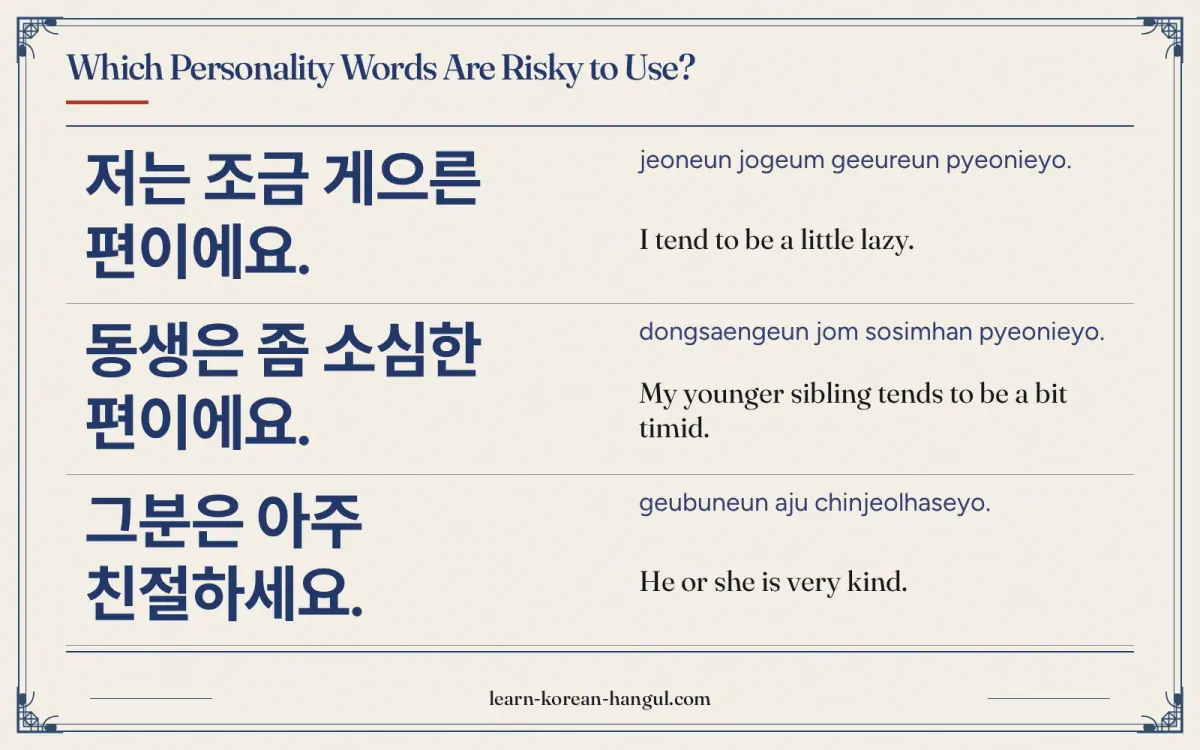
A softener makes a risky word gentler. The most useful one is the pattern adjective + 은/ㄴ 편이에요, which means "tends to be": 저는 조금 게으른 편이에요 means "I tend to be a little lazy". The word 조금 ("a little") softens it further. You can use the same pattern for other people: 동생은 좀 소심한 편이에요.
저는 조금 게으른 편이에요.
jeoneun jogeum geeureun pyeonieyo.
I tend to be a little lazy.
동생은 좀 소심한 편이에요.
dongsaengeun jom sosimhan pyeonieyo.
My younger sibling tends to be a bit timid.
그분은 아주 친절하세요.
geubuneun aju chinjeolhaseyo.
He or she is very kind.
Avoid saying someone else is 멍청하다. If you hear it in a drama, it is a harsh insult, and in real life it can end a friendship. Self-directed use, such as 제가 멍청했어요 ("I was stupid"), is mild, because you are the target. Next comes the difference between words that look alike.
What Is the Difference between near-Synonyms?
Several pairs of personality words look interchangeable in English but differ in Korean. The table gives a one-line difference for each. These notes reflect general usage, and some speakers use the pairs more loosely.
| Pair | Difference | Example |
|---|---|---|
| 착하다 vs 친절하다 | 착하다 is about a gentle heart; 친절하다 is about how you treat others, especially service | 착한 아이, 친절한 직원 |
| 똑똑하다 vs 영리하다 | 똑똑하다 is everyday "smart"; 영리하다 stresses quick, clever thinking and is common for children and animals | 똑똑한 학생, 영리한 강아지 |
| 부지런하다 vs 성실하다 | 부지런하다 is about active habits; 성실하다 is about being sincere and dependable in duty | 부지런한 사람, 성실한 직원 |
| 조용하다 vs 소심하다 | 조용하다 is neutral "quiet"; 소심하다 is negative "timid and overly careful" | 조용한 성격, 소심한 성격 |
The pairs show why a dictionary gloss is not enough. When you learn a word, write down one noun it usually modifies, such as 친절한 직원, so you remember the typical use.
Which Personality Adjectives Are Irregular or Special?
Most personality adjectives follow the 하다 pattern, but four words do not, and they are the ones learners get wrong. The forms below were generated with the site's conjugation engine.
| Word | Class | Polite present | Polite past | Modifier | Note |
|---|---|---|---|---|---|
| 게으르다 | 르 irregular | 게을러요 | 게을렀어요 | 게으른 | the 르 splits into 을러 |
| 예의 바르다 | 르 irregular | 예의 발라요 | 예의 발랐어요 | 예의 바른 | spaced; the 르 splits into 라 |
| 까다롭다 | ㅂ irregular | 까다로워요 | 까다로웠어요 | 까다로운 | ㅂ becomes 우 |
| 이기적이다 | 이다 type | 이기적이에요 | 이기적이었어요 | 이기적인 | noun + 이다 |
The 르 irregular pattern changes the stem when the next ending begins with 아 or 어. In 게으르다, the final 르 becomes 을러 and not 으러, so the form is 게을러요, and the modifier keeps 으: 게으른. In 예의 바르다, the 르 becomes 라 because the vowel before it is ㅏ, giving 발라요. The modifier 바른 is the same as the dictionary stem plus ㄴ. Both are covered on the 르 irregular page. In full sentences many speakers add the subject particle: 그 학생은 예의가 발라요.
Writing Practice: Describe a Family Member
Describe a family member in six sentences. Use this template: one sentence for personality in general, one that joins two good qualities, one softened weakness, one cause-and-effect sentence with -아/어서, one habit with 자주 and one feeling sentence. A model answer about an older sister follows.
| Step | Sentence type | Pattern |
|---|---|---|
| 1 | General personality | person은/는 성격이 + adjective |
| 2 | Two good qualities | adjective-고 adjective |
| 3 | A softened weakness | 조금 + adjective + 은/ㄴ 편이에요 |
| 4 | Cause and effect | adjective-아/어서 + result |
| 5 | A habit | 자주 + verb |
| 6 | Your feeling | person을/를 좋아해요 |
우리 언니는 성격이 좋아요.
uri eonnineun seonggyeogi joayo.
My older sister has a good personality.
언니는 친절하고 부지런해요.
eonnineun chinjeolhago bujireonhaeyo.
She is kind and diligent.
조금 소심한 편이에요.
jogeum sosimhan pyeonieyo.
She tends to be a little timid.
하지만 솔직해서 친구가 많아요.
hajiman soljikaeseo chinguga manayo.
But she is frank, so she has many friends.
언니는 자주 웃어요.
eonnineun jaju useoyo.
She often laughs.
저는 언니를 좋아해요.
jeoneun eonnireul joahaeyo.
I like my older sister.
Now write your own six sentences about a parent, a friend or a teacher. Check each adjective in the polite present, add 세요 to the adjective if the person is older than you and respected, and read the result aloud. The Korean writing prompts page has more tasks.
Practice: Choose the Right Word
Pick the best answer for each question, then check the explanation.
Practice · 6
Which word means "diligent"?
Show answer
부지런하다
부지런하다 means diligent. 게으르다 is its opposite, lazy.
What is the polite present of 게으르다?
Show answer
게을러요
게으르다 is 르 irregular. The 르 becomes 을러 before 어요, giving 게을러요.
How do you ask "What is his personality like?"
Show answer
그 사람은 성격이 어때요?
어때요 means "how is it". 성격이 어때요? asks what the personality is like.
Which softener makes "I am lazy" gentler?
Show answer
게으른 편이에요
Adjective + 은/ㄴ 편이에요 means "tend to be", so 조금 게으른 편이에요 sounds gentler.
Which word is a harsh insult?
Show answer
멍청하다
멍청하다 means stupid and is an insult when said about another person.
What is the modifier form of 예의 바르다?
Show answer
예의 바른
The modifier is 예의 바른, as in 예의 바른 학생.
Four mistakes cause most errors with personality adjectives.
- Writing 게으러요. The 르 splits: write 게을러요.
- Calling someone 멍청하다 to their face. It is an insult in most contexts.
- Using 똑똑하세요 as praise for a boss. It can sound as if you are grading them; many speakers choose another phrase.
- Stating a weakness flatly. 동생은 소심해요 sounds blunt, and 동생은 좀 소심한 편이에요 is gentler.
What this page does not cover. It covers 18 personality adjectives and does not list every word for character, such as idioms like 마음이 넓다. It does not cover emotion words, which are in Korean emotion adjectives, or the vocabulary page on Korean personality words.
What Should You Learn after Korean Personality Adjectives?
After Korean personality adjectives, learn Korean emotion adjectives, which gives 25 feeling words and the nuance between near-synonyms. Personality words describe what a person is like, and emotion words describe how a person feels at the moment.
Frequently Asked Questions
How do I say kind in Korean? Use 착하다 for a kind, gentle heart and 친절하다 for kindness in how you treat others. Say 착해요 or 친절해요 in the polite present. Example: 그 사람은 정말 친절해요 means "That person is really kind". For an elder, add the honorific: 친절하세요. Pick 친절하다 for staff and service, and 착하다 for character.
How do I say lazy in Korean? Say 게으르다. The polite present is 게을러요, not 게으러요, because it is a 르 irregular adjective. The modifier is 게으른, as in 게으른 사람 ("a lazy person"). To soften it about yourself, say 저는 조금 게으른 편이에요 ("I tend to be a little lazy"). Do not say it directly to another person.
Is 멍청하다 rude? Yes. 멍청하다 means stupid or foolish, and when said about another person it is an insult. Close friends may joke with it, but it is risky, and it is best avoided. You can use it about yourself in a mild way, such as 제가 멍청했어요 ("I was stupid"). For a polite complaint, describe the action, not the person.
How do I ask what someone is like? Ask 그 사람은 성격이 어때요? ("What is his or her personality like?") or 그분은 어떤 사람이에요? ("What kind of person is he or she?"). Both are wh-questions, so the pitch does not rise sharply at the end. Answer with 성격이 + adjective, such as 성격이 좋아요, or with the person as subject.
About this page. Last updated 2026-10-09. The Korean text on this page was machine-generated and reviewed and signed off by Min-ji Park on 15 October 2026. Forms were cross-checked with the site's rule-based conjugation engine. The politeness map is teaching guidance and not an official rule. Romanization follows the Revised Romanization of Korean and is shown only as a learning aid.