
At a glance
- Korean adjectives (형용사) end in 다 in the dictionary and take verb endings: 커요, 컸어요, 크고.
- No "be" verb is needed: 집이 커요 means "The house is big."
- This section has five parts: the concept, the modifier form, the 50-word list, size, shape and colour, and feelings.
- Pronunciation audio is on the example sentences throughout the section.
The first section defines the word class, because the English term and the Korean one do not match perfectly.
What Are Korean Adjectives?

Korean adjectives are 형용사 (hyeongyongsa), the words that describe a quality or a state: 크다 (big), 좋다 (good), 바쁘다 (busy), 맛있다 (delicious). Every adjective is listed in the dictionary with the ending 다. Removing 다 leaves the stem, and the stem takes endings the same way a verb stem does.
Three facts separate Korean adjectives from English ones.
- They are predicates. An adjective can end a sentence on its own: 날씨가 좋아요 ("The weather is good"). English needs "is"; Korean does not.
- They conjugate. The stem takes tense, politeness and connecting endings: 좋아요, 좋았어요, 좋습니다, 좋고, 좋으면.
- They change form before a noun. 좋다 becomes 좋은 in 좋은 날씨 ("good weather"). English keeps "good" unchanged.
Because of the first two facts, many grammars of Korean call these words descriptive verbs or stative verbs. The two names describe the same words, and this section uses "adjective" because that is the term in Korean dictionaries and the one learners search for.
| Dictionary form | Meaning | Polite present | Before a noun |
|---|---|---|---|
| 크다 | to be big | 커요 | 큰 집 |
| 좋다 | to be good | 좋아요 | 좋은 사람 |
| 예쁘다 | to be pretty | 예뻐요 | 예쁜 꽃 |
| 춥다 | to be cold (weather) | 추워요 | 추운 날 |
The next section shows what that conjugation looks like on a single word.
How Do Korean Adjectives Work?
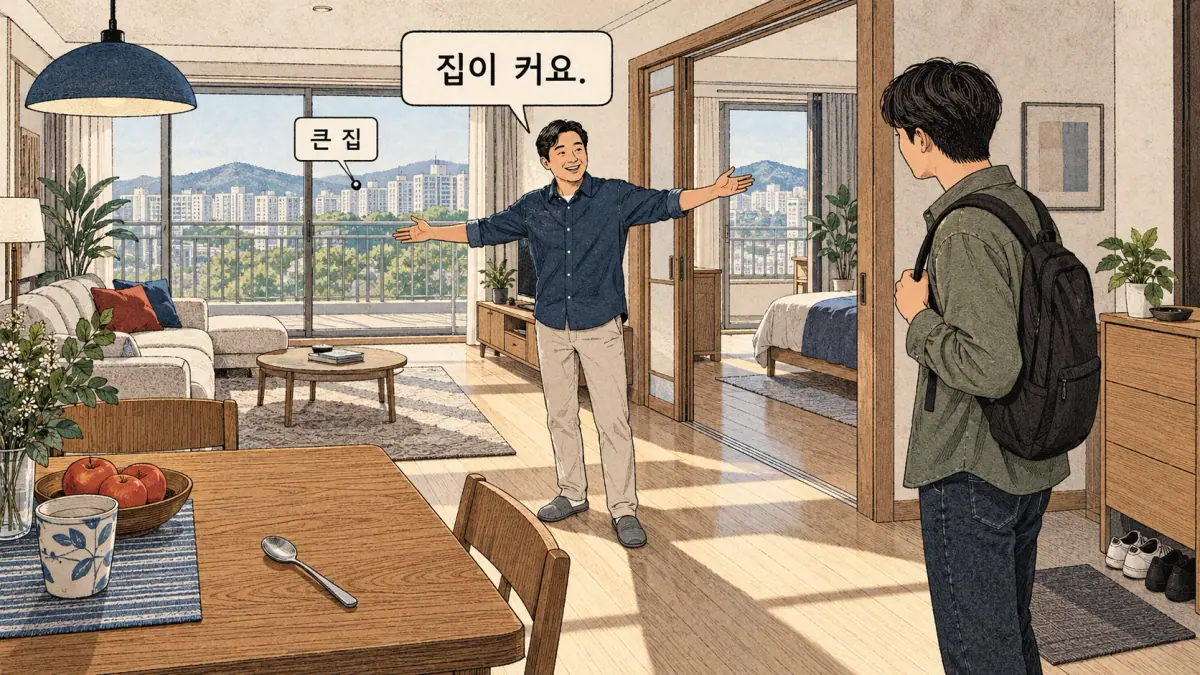
Korean adjectives work by adding endings to a stem, exactly as verbs do. Take 크다. Its stem is 크, and the ending 어요 makes the polite present. The vowel ㅡ drops before the ending, so 크 + 어요 becomes 커요. The result already means "is big": no extra word is needed.
Here is the same word in six common slots.
| Slot | Form | Meaning |
|---|---|---|
| Polite present | 집이 커요. | The house is big. |
| Polite past | 집이 컸어요. | The house was big. |
| Negative | 집이 안 커요. | The house is not big. |
| "and" | 집이 크고 좋아요. | The house is big and good. |
| Before a noun | 큰 집 | a big house |
| "if" | 집이 크면 좋아요. | It is good if the house is big. |
Two things stay different from verbs. The form before a noun uses -(으)ㄴ for adjectives and -는 for most verbs, and commands such as 가세요 ("please go") do not work with adjectives. Both points are covered in verbs vs adjectives, which is the first lesson to read after this hub. The conjugation steps themselves follow the present tense recipe. The next section helps you choose a starting point.
Which Korean Adjective Lesson Should You Start With?

Start with the lesson that answers your question. Learners usually arrive with one of three questions, and each has a matching page.
| Your question | Start here | You will learn |
|---|---|---|
| Why do adjectives behave like verbs? | Korean verb vs adjective | the -는 test and five differences |
| How do I put an adjective before a noun? | the adjective -(으)ㄴ form | 큰 집, 좋은 사람, 예쁜 꽃 and irregular stems |
| Which adjectives come first? | common Korean adjectives | 50 words with polite present and modifier |
| How do I describe a colour or a size? | size, shape and color adjectives | 키가 크다 versus 높다, 빨갛다 and the ㅎ class |
| How do I say how I feel? | feeling adjectives | 슬퍼요, 배고파요 and the first-person rule |
A reliable order for a beginner is concept first, then the modifier form, then the list. A learner who already knows how to conjugate verbs can jump straight to the list and treat the other pages as reference. The cards below describe each part of the section.
Adjective Sections and Lists

This section has five parts. Each card names what the page teaches, so you can pick without opening them all.
Descriptive Verbs
Explains why Korean adjectives behave like verbs, then collects the lessons on the 있다/없다 family, opposite pairs, taste, temperature and character. Six pages sit under it, and the verbs vs adjectives lesson comes first.
Korean Adjective -(으)ㄴ Form
Teaches how to put 28 adjectives before a noun. It covers vowel stems (큰), consonant stems (좋은), ㄹ stems (긴), ㅂ stems (추운), ㅎ stems (빨간) and 하다 adjectives (깨끗한), with audio for each phrase.
Common Korean Adjectives
Lists 50 beginner adjectives in eight groups. Each row gives the meaning, the polite present, the modifier and an example sentence, and flags the irregular ones.
Size, Shape and Color Adjectives
Covers big and small, long and short, tall and high, and the colour words. It teaches the pattern 키가 크다 for people and 높다 for buildings, and the ㅎ irregular class for 빨갛다 and 파랗다.
Feeling Adjectives
Covers emotions and body states: 슬프다, 행복하다, 배고프다, 피곤하다. It teaches the rule that a plain feeling adjective states the speaker's own feeling, and the -아/어하다 verbs for other people.
Several individual adjectives also have their own dictionary pages with every form: 크다, 작다, 좋다, 나쁘다, 아프다, 피곤하다, 필요하다 and 없다. The dictionary lists the other forms; this section teaches the patterns.
How Do Adjectives Relate to Adverbs and Comparison?
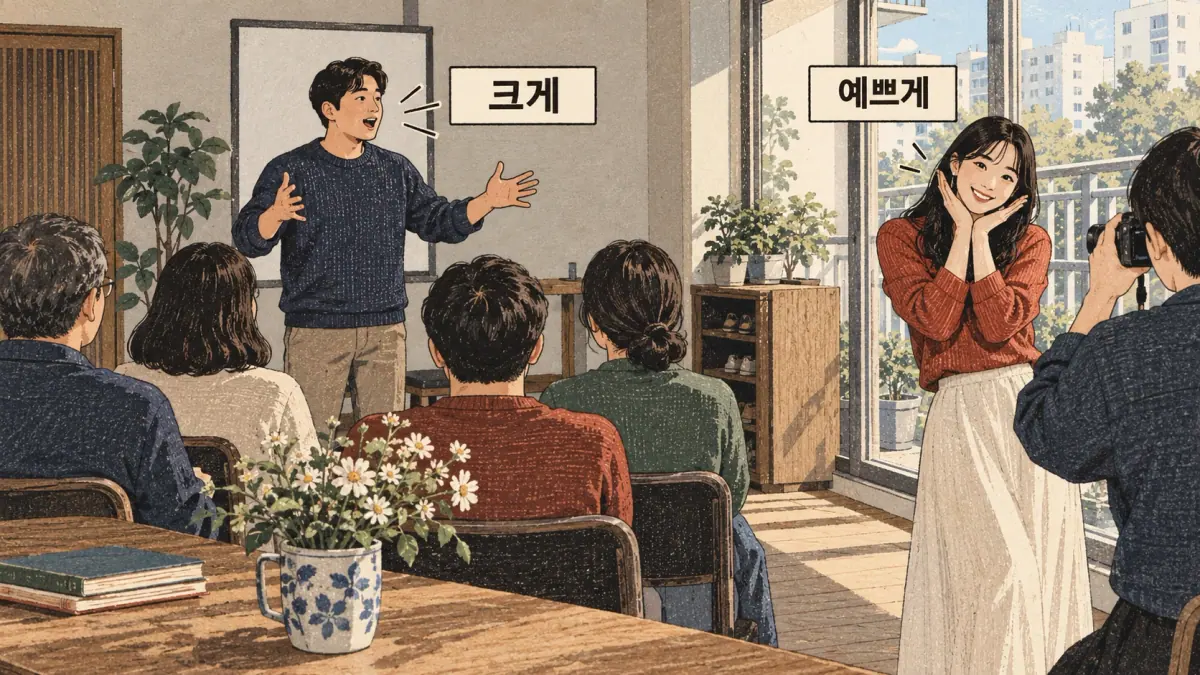
Adjectives describe nouns, and adverbs describe verbs and adjectives, so the two are taught in different places. An adjective can become an adverb with -게: 크게 ("in a big way, loudly") comes from 크다, and 예쁘게 ("prettily") from 예쁘다. The forms and uses are in Korean adverbs, and the wider system of modifiers is in Korean modifiers.
Comparison words such as 더 ("more") and 제일 ("most") are adverbs, so they belong to the grammar hub too. Adjective pages here mention them only when a pair of words depends on them. Use the nouns for feelings in Korean emotions vocabulary, and set phrases in Korean feelings phrases.
What this hub does not cover. It does not teach the full verb system, the 100 most common verbs (see 100 Korean verbs) or every irregular class. Its audio covers only the example phrases shown on the page.
About this page. Last updated 2026-10-09. The Korean text on this page was machine-generated and reviewed and signed off by Min-ji Park on 15 October 2026. Forms were cross-checked with the site's rule-based conjugation engine. Romanization follows the Revised Romanization of Korean and is shown only as a learning aid.
Frequently Asked Questions
Do Korean adjectives conjugate like verbs? Yes. A Korean adjective takes the same endings as a verb: 크다 ("to be big") becomes 커요 in the polite present, 컸어요 in the past, 크고 for "and" and 안 커요 for "not big". Only a few patterns differ, such as the plain present and the form before a noun, which the verbs vs adjectives lesson sets out.
Do I need a "be" verb with Korean adjectives? No. The adjective itself already means "to be" plus the quality, so 집이 커요 is a complete sentence meaning "The house is big". The verb 이다 ("to be") is used with nouns, as in 학생이에요 ("I am a student"), and never with an adjective such as 크다 or 예쁘다.
Where can I find Korean colour words? Colour words are split between adjectives and nouns. Five common colour words, 빨갛다, 파랗다, 노랗다, 하얗다 and 까맣다, are adjectives, covered on the colour adjectives page. Colours such as 초록색 and 보라색 are nouns that need 색. Both groups sit under size, shape and color adjectives.
Why are Korean adjectives also called descriptive verbs? English grammars of Korean call 형용사 "descriptive verbs" or "stative verbs" because they conjugate like verbs and describe a state instead of an action. Korean school grammar keeps 형용사 as its own part of speech. This site uses "adjective" for learners and "descriptive verb" when the verb-like behaviour matters.
Which Korean adjectives should a beginner learn first? Start with the 50 words on the common adjectives list, which are grouped into eight themes: size, speed, difficulty, temperature, appearance, feelings, character and distance. The list was chosen for learner need and level, not by corpus frequency. Learn 크다, 작다, 좋다, 많다, 예쁘다 and 맛있다 first.