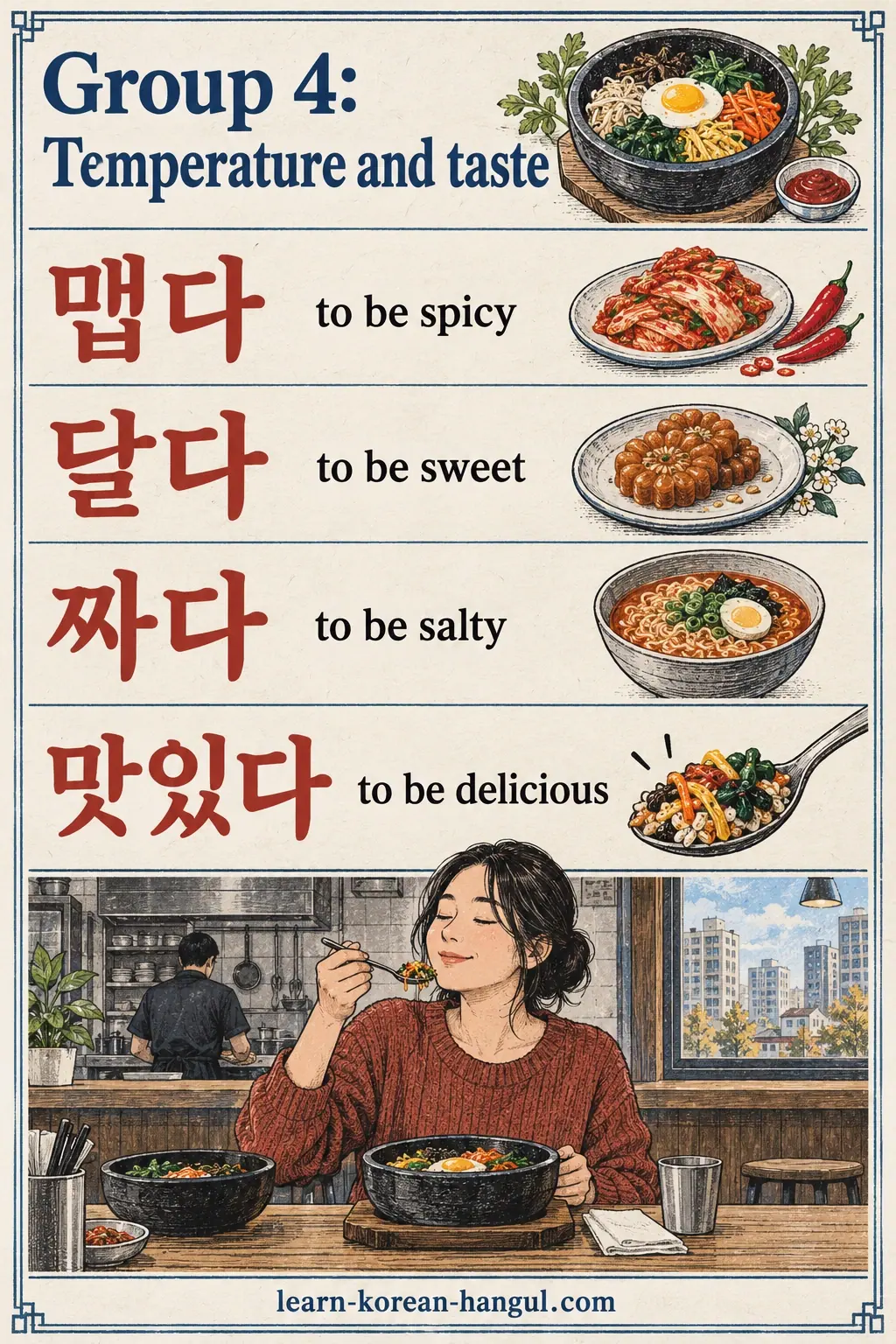
What you'll learn
- Recognise 50 adjectives in eight groups.
- Say the polite present and the modifier of each: 커요, 큰; 추워요, 추운.
- Spot the irregular ones from the class column.
- Use at least 15 of them in a sentence of the pattern N이/가 + adjective.
Prerequisites: verbs vs adjectives. Time: about 40 minutes, or one group a day.
Key facts
- 50 adjectives, eight groups of five to eight words.
- Every row shows the polite present, the modifier and an example sentence with audio.
- 25 of the 50 change their stem (ㅡ, ㅂ, ㄹ or 르), so the list is also irregular practice.
- The words were chosen for learner need and level, not by corpus frequency.
The first section explains what the list contains and how it was chosen.
What Are the Most Common Korean Adjectives?
The most common Korean adjectives for beginners are words for size (크다, 작다), quality (좋다, 나쁘다), price (싸다, 비싸다), weather and taste (덥다, 춥다, 맵다, 맛있다), feelings (기쁘다, 슬프다) and people (착하다, 똑똑하다). This page lists 50 such words in eight groups, sorted by use and not alphabetically.
How this list was chosen. The 50 words were selected for learner need and difficulty level: words that appear in everyday situations such as shopping, weather, food, school and health. The ranking is editorial. It is not a corpus frequency count, and no frequency numbers are claimed. For context only, interest in the search "adjectives in korean" was about 100 searches a month in the United States in 2023; that figure is historical and not a current measurement.
Every row has the same four parts, so you can compare words quickly.
- Polite present. The form for everyday speech, such as 커요. It shows stem changes that the dictionary form hides.
- Modifier. The form before a noun, such as 큰 in 큰 집. It is -(으)ㄴ for most adjectives and -는 for 맛있다, 멋있다, 재미있다 and 재미없다. See the adjective -(으)ㄴ form.
- Class. "Regular", "ㅡ-drop", "ㅂ irregular", "ㄹ-drop", "르 irregular" or "하다 type". The class tells you how the stem behaves.
- Example. A short sentence in the pattern N이/가 + adjective, with audio.
The first two groups cover size, amount, speed and time.
Which Are the Size, Amount, Speed and Time Adjectives?
Size and amount words describe how big, long or plentiful a thing is. Speed and time words describe how quick, slow, early or late it is. Both groups are among the first ones learners need, and they contain several opposite pairs.
Group 1: Size and Amount
| Word | Meaning | Polite present | Modifier | Class | Example |
|---|---|---|---|---|---|
| 크다 | to be big | 커요 | 큰 | ㅡ-drop | 집이 커요. (The house is big.) |
| 작다 | to be small | 작아요 | 작은 | regular | 가방이 작아요. (The bag is small.) |
| 많다 | to be many, much | 많아요 | 많은 | regular | 사람이 많아요. (There are many people.) |
| 적다 | to be few, little | 적어요 | 적은 | regular | 돈이 적어요. (There is little money.) |
| 길다 | to be long | 길어요 | 긴 | ㄹ-drop | 머리가 길어요. (The hair is long.) |
| 짧다 | to be short | 짧아요 | 짧은 | regular | 치마가 짧아요. (The skirt is short.) |
Note that 크다 and 작다 describe the size of objects. For a person's height Korean uses 키가 크다 (to be tall), a pattern taught in size, shape and color adjectives.
Group 2: Speed and Time
| Word | Meaning | Polite present | Modifier | Class | Example |
|---|---|---|---|---|---|
| 빠르다 | to be fast, quick | 빨라요 | 빠른 | 르 irregular | 버스가 빨라요. (The bus is fast.) |
| 느리다 | to be slow | 느려요 | 느린 | regular | 인터넷이 느려요. (The internet is slow.) |
| 이르다 | to be early | 일러요 | 이른 | 르 irregular | 아직 일러요. (It is still early.) |
| 늦다 | to be late | 늦어요 | 늦은 | regular | 버스가 늦어요. (The bus is late.) |
| 새롭다 | to be new, fresh | 새로워요 | 새로운 | ㅂ irregular | 이 방법은 새로워요. (This method is new.) |
이르다 means "early" in this list and is 르 irregular: 일러요. A different verb 이르다 means "to reach" and conjugates as 이르러요 (러 irregular), so check the meaning in context. The next two groups cover quality and the senses.
Which Are the Difficulty, Quality, Temperature and Taste Adjectives?
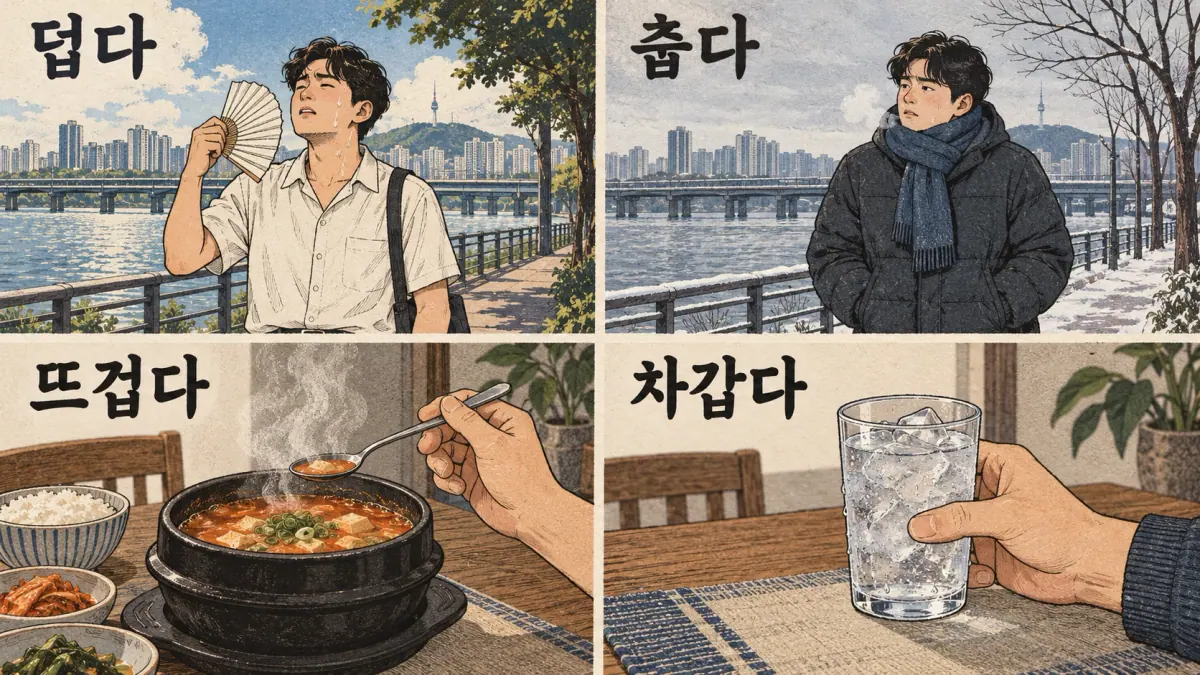
Difficulty and quality words give a judgement; temperature and taste words describe what the senses report. Learners use them in almost every conversation about food, weather and shopping.
Group 3: Difficulty and Quality
| Word | Meaning | Polite present | Modifier | Class | Example |
|---|---|---|---|---|---|
| 어렵다 | to be difficult | 어려워요 | 어려운 | ㅂ irregular | 한국어가 어려워요. (Korean is difficult.) |
| 쉽다 | to be easy | 쉬워요 | 쉬운 | ㅂ irregular | 이 문제는 쉬워요. (This problem is easy.) |
| 좋다 | to be good | 좋아요 | 좋은 | regular | 날씨가 좋아요. (The weather is good.) |
| 나쁘다 | to be bad | 나빠요 | 나쁜 | ㅡ-drop | 기분이 나빠요. (I feel bad.) |
| 싸다 | to be cheap | 싸요 | 싼 | regular | 이 옷은 싸요. (These clothes are cheap.) |
| 비싸다 | to be expensive | 비싸요 | 비싼 | regular | 이 가방은 비싸요. (This bag is expensive.) |
| 괜찮다 | to be fine, okay | 괜찮아요 | 괜찮은 | regular | 저는 괜찮아요. (I am fine.) |
Group 4: Temperature and Taste
| Word | Meaning | Polite present | Modifier | Class | Example |
|---|---|---|---|---|---|
| 덥다 | to be hot (weather) | 더워요 | 더운 | ㅂ irregular | 오늘은 더워요. (It is hot today.) |
| 춥다 | to be cold (weather) | 추워요 | 추운 | ㅂ irregular | 겨울에는 추워요. (It is cold in winter.) |
| 뜨겁다 | to be hot (to touch) | 뜨거워요 | 뜨거운 | ㅂ irregular | 국이 뜨거워요. (The soup is hot.) |
| 차갑다 | to be cold (to touch) | 차가워요 | 차가운 | ㅂ irregular | 물이 차가워요. (The water is cold.) |
| 맵다 | to be spicy | 매워요 | 매운 | ㅂ irregular | 김치가 매워요. (The kimchi is spicy.) |
| 달다 | to be sweet | 달아요 | 단 | ㄹ-drop | 이 과자는 달아요. (This snack is sweet.) |
| 짜다 | to be salty | 짜요 | 짠 | regular | 라면이 짜요. (The ramen is salty.) |
| 맛있다 | to be delicious | 맛있어요 | 맛있는 | regular | 비빔밥이 맛있어요. (The bibimbap is delicious.) |
덥다 and 춥다 describe weather and a person's feeling about it, while 뜨겁다 and 차갑다 describe things you touch or drink. The two sets are compared in hot and cold in Korean, and more taste words are in Korean taste adjectives. The last four groups describe people, places and how you feel.
Which Are the Appearance, Feeling, Character and Distance Adjectives?
These groups describe how things look, how you feel, what people are like and where things are. They contain the words that need extra care: 배고프다 is a compound, and 멋있다 takes -는.
Group 5: Appearance
| Word | Meaning | Polite present | Modifier | Class | Example |
|---|---|---|---|---|---|
| 예쁘다 | to be pretty | 예뻐요 | 예쁜 | ㅡ-drop | 꽃이 예뻐요. (The flower is pretty.) |
| 멋있다 | to be stylish, cool | 멋있어요 | 멋있는 | regular | 선생님이 멋있어요. (The teacher is stylish.) |
| 깨끗하다 | to be clean | 깨끗해요 | 깨끗한 | 하다 type | 방이 깨끗해요. (The room is clean.) |
| 더럽다 | to be dirty | 더러워요 | 더러운 | ㅂ irregular | 손이 더러워요. (The hands are dirty.) |
| 밝다 | to be bright | 밝아요 | 밝은 | regular | 방이 밝아요. (The room is bright.) |
| 어둡다 | to be dark | 어두워요 | 어두운 | ㅂ irregular | 밤에는 어두워요. (It is dark at night.) |
Group 6: Feelings and States
| Word | Meaning | Polite present | Modifier | Class | Example |
|---|---|---|---|---|---|
| 기쁘다 | to be glad | 기뻐요 | 기쁜 | ㅡ-drop | 저는 기뻐요. (I am glad.) |
| 슬프다 | to be sad | 슬퍼요 | 슬픈 | ㅡ-drop | 저는 슬퍼요. (I am sad.) |
| 피곤하다 | to be tired | 피곤해요 | 피곤한 | 하다 type | 오늘은 피곤해요. (I am tired today.) |
| 바쁘다 | to be busy | 바빠요 | 바쁜 | ㅡ-drop | 요즘 바빠요. (I am busy these days.) |
| 아프다 | to be sick, to hurt | 아파요 | 아픈 | ㅡ-drop | 머리가 아파요. (My head hurts.) |
| 배고프다 | to be hungry | 배고파요 | 배고픈 | ㅡ-drop | 배가 고파요. (I am hungry.) |
배고프다 is one word in the dictionary, but speakers often split it back into its parts, 배가 고프다 (literally "the stomach is hungry"), so 배가 고파요 in the example is as common as 배고파요. Feeling adjectives state the speaker's own feeling when used in the plain present. Talking about another person needs a different form, which is explained in Korean emotion adjectives and Korean physical state adjectives.
Group 7: Character and Manner
| Word | Meaning | Polite present | Modifier | Class | Example |
|---|---|---|---|---|---|
| 착하다 | to be kind, good-natured | 착해요 | 착한 | 하다 type | 동생이 착해요. (My younger sibling is kind.) |
| 똑똑하다 | to be smart | 똑똑해요 | 똑똑한 | 하다 type | 친구가 똑똑해요. (My friend is smart.) |
| 조용하다 | to be quiet | 조용해요 | 조용한 | 하다 type | 도서관은 조용해요. (The library is quiet.) |
| 시끄럽다 | to be noisy | 시끄러워요 | 시끄러운 | ㅂ irregular | 교실이 시끄러워요. (The classroom is noisy.) |
| 재미있다 | to be fun, interesting | 재미있어요 | 재미있는 | regular | 영화가 재미있어요. (The movie is fun.) |
| 재미없다 | to be boring | 재미없어요 | 재미없는 | regular | 이 책은 재미없어요. (This book is boring.) |
Group 8: Distance and Place
| Word | Meaning | Polite present | Modifier | Class | Example |
|---|---|---|---|---|---|
| 멀다 | to be far | 멀어요 | 먼 | ㄹ-drop | 학교가 멀어요. (The school is far.) |
| 가깝다 | to be near | 가까워요 | 가까운 | ㅂ irregular | 집이 가까워요. (The house is near.) |
| 높다 | to be high, tall (things) | 높아요 | 높은 | regular | 산이 높아요. (The mountain is high.) |
| 낮다 | to be low | 낮아요 | 낮은 | regular | 의자가 낮아요. (The chair is low.) |
| 넓다 | to be wide, spacious | 넓어요 | 넓은 | regular | 방이 넓어요. (The room is wide.) |
| 좁다 | to be narrow | 좁아요 | 좁은 | regular | 길이 좁아요. (The road is narrow.) |
The groups are done. The next section counts which of the 50 are irregular.
Which of the 50 Adjectives Are Irregular?
Of the 50 adjectives, 25 belong to an irregular or stem-changing class: ㅡ-drop, ㅂ-irregular, ㄹ-drop or 르-irregular. Five more are 하다 adjectives, which are regular but add 해. That leaves 20 plain regular stems, so a beginner meets a changing stem about as often as a plain one. The table counts each class in this list.
| Class | Count | Words |
|---|---|---|
| ㅡ-drop | 8 | 크다, 나쁘다, 예쁘다, 기쁘다, 슬프다, 바쁘다, 아프다, 배고프다 |
| ㅂ irregular | 12 | 새롭다, 어렵다, 쉽다, 덥다, 춥다, 뜨겁다, 차갑다, 맵다, 더럽다, 어둡다, 시끄럽다, 가깝다 |
| ㄹ-drop | 3 | 길다, 달다, 멀다 |
| 르 irregular | 2 | 빠르다, 이르다 |
| 하다 type | 5 | 깨끗하다, 피곤하다, 착하다, 똑똑하다, 조용하다 |
| regular | 20 | 작다, 많다, 적다, 짧다, 느리다, 늦다, 좋다, 싸다, 비싸다, 괜찮다, 짜다, 맛있다, 멋있다, 밝다, 재미있다, 재미없다, 높다, 낮다, 넓다, 좁다 |
What each class does in the polite present:
- ㅡ-drop. The ㅡ of the stem drops before 아/어: 크다 becomes 커요, 바쁘다 becomes 바빠요.
- ㅂ irregular. The ㅂ becomes 우 before a vowel ending: 춥다 becomes 추워요, 가깝다 becomes 가까워요. Note that 좁다 is regular: 좁아요.
- ㄹ-drop. The polite present is regular (길어요, 멀어요), but the ㄹ of the stem drops before ㄴ, ㅂ and ㅅ: 길다 gives 긴, 멀다 gives 먼, and 달다 gives 단.
- 르 irregular. An extra ㄹ is added: 빠르다 becomes 빨라요 and 이르다 becomes 일러요.
- 하다 type. 하 becomes 해 before 요: 깨끗하다 becomes 깨끗해요.
Look for the pattern in the table: the five ㅂ temperature and taste words (덥다, 춥다, 뜨겁다, 차갑다, 맵다) all end in 워요 in the polite present, so learning one teaches five. Korean school grammar counts the ㅡ and ㄹ drops as regular; this site teaches them with the irregulars because the stem still changes. Colour adjectives belong to a different class (ㅎ) and are not in this list. The rule for ㅂ stems is in ㅂ irregular. Next, use the words in sentences.
How Do You Use Adjectives in a Sentence?
Use an adjective as the predicate after the thing it describes, with 이/가 marking that thing: 집이 커요. This pattern, N이/가 + adjective, is how nearly all example sentences on this page are built. Four more patterns cover most beginner needs.
| Pattern | Example | Meaning |
|---|---|---|
| N이/가 + adjective | 날씨가 좋아요. | The weather is good. |
| N은/는 + adjective (contrast or topic) | 저는 바빠요. | I am busy (as for me). |
| 아주/너무 + adjective | 너무 비싸요. | It is too expensive. |
| 안 + adjective | 안 매워요. | It is not spicy. |
| adjective + 고 + adjective | 크고 좋아요. | It is big and good. |
| modifier + noun | 맛있는 비빔밥 | delicious bibimbap |
The word 너무 means "too" or "very" and is often used in the positive sense in speech; see Korean adverbs. When you want a pair of opposites in one sentence, the next section lists them.
Which of the 50 Are Opposites?
Thirty-four of the 50 adjectives form 17 opposite pairs inside this list, 맛있다 pairs with 맛없다 from outside it, and more pairs are on the Korean opposite adjectives page. Learn pairs together: remembering 크다 makes 작다 easy.
| Adjective | Opposite |
|---|---|
| 크다 | 작다 |
| 많다 | 적다 |
| 길다 | 짧다 |
| 빠르다 | 느리다 |
| 이르다 | 늦다 |
| 어렵다 | 쉽다 |
| 좋다 | 나쁘다 |
| 싸다 | 비싸다 |
| 덥다 | 춥다 |
| 뜨겁다 | 차갑다 |
| 밝다 | 어둡다 |
| 깨끗하다 | 더럽다 |
| 기쁘다 | 슬프다 |
| 시끄럽다 | 조용하다 |
| 재미있다 | 재미없다 |
| 맛있다 | 맛없다 |
| 멀다 | 가깝다 |
| 높다 | 낮다 |
Two pairs need care. 이르다 / 늦다 is the pair for "early / late", and 이르다 is 르 irregular while 늦다 is regular. 맛있다 has the opposite 맛없다 (polite present 맛없어요), which is not one of the 50 but takes -는 in the same way: 맛없는 음식.
Practice: Can You Finish the Contrast?
Fill in each blank with the opposite adjective in the polite present. Write your answer before you read the answer column.
| # | Sentence | Answer |
|---|---|---|
| 1 | 이 가방은 비싸요. 저 가방은 ___. | 싸요 |
| 2 | 한국어가 어려워요. 일본어는 ___? | 쉬워요 |
| 3 | 버스가 빨라요. 택시는 ___. | 느려요 |
| 4 | 여름에는 더워요. 겨울에는 ___. | 추워요 |
| 5 | 방이 밝아요. 밤에는 ___. | 어두워요 |
| 6 | 학교가 멀어요. 집은 ___. | 가까워요 |
| 7 | 교실이 시끄러워요. 도서관은 ___. | 조용해요 |
| 8 | 산이 높아요. 의자는 ___. | 낮아요 |
| 9 | 이 방은 넓어요. 그 방은 ___. | 좁아요 |
| 10 | 물이 뜨거워요. 주스는 ___. | 차가워요 |
| 11 | 머리가 길어요. 치마는 ___. | 짧아요 |
| 12 | 좋은 소식에는 기뻐요. 나쁜 소식에는 ___. | 슬퍼요 |
Practice · 59
- 01집이 커요.
Show answer
Size and amount, normal speed
- 02가방이 작아요.
Show answer
Size and amount, normal speed
- 03사람이 많아요.
Show answer
Size and amount, normal speed
- 04돈이 적어요.
Show answer
Size and amount, normal speed
- 05머리가 길어요.
Show answer
Size and amount, normal speed
- 06치마가 짧아요.
Show answer
Size and amount, normal speed
- 07버스가 빨라요.
Show answer
Speed and time, normal speed
- 08인터넷이 느려요.
Show answer
Speed and time, normal speed
- 09아직 일러요.
Show answer
Speed and time, normal speed
- 10버스가 늦어요.
Show answer
Speed and time, normal speed
- 11이 방법은 새로워요.
Show answer
Speed and time, normal speed
- 12한국어가 어려워요.
Show answer
Difficulty and quality, normal speed
- 13이 문제는 쉬워요.
Show answer
Difficulty and quality, normal speed
- 14날씨가 좋아요.
Show answer
Difficulty and quality, normal speed
- 15기분이 나빠요.
Show answer
Difficulty and quality, normal speed
- 16이 옷은 싸요.
Show answer
Difficulty and quality, normal speed
- 17이 가방은 비싸요.
Show answer
Difficulty and quality, normal speed
- 18저는 괜찮아요.
Show answer
Difficulty and quality, normal speed
- 19오늘은 더워요.
Show answer
Temperature and taste, normal speed
- 20겨울에는 추워요.
Show answer
Temperature and taste, normal speed
- 21국이 뜨거워요.
Show answer
Temperature and taste, normal speed
- 22물이 차가워요.
Show answer
Temperature and taste, normal speed
- 23김치가 매워요.
Show answer
Temperature and taste, normal speed
- 24이 과자는 달아요.
Show answer
Temperature and taste, normal speed
- 25라면이 짜요.
Show answer
Temperature and taste, normal speed
- 26비빔밥이 맛있어요.
Show answer
Temperature and taste, normal speed
- 27꽃이 예뻐요.
Show answer
Appearance, normal speed
- 28선생님이 멋있어요.
Show answer
Appearance, normal speed
- 29방이 깨끗해요.
Show answer
Appearance, normal speed
- 30손이 더러워요.
Show answer
Appearance, normal speed
- 31방이 밝아요.
Show answer
Appearance, normal speed
- 32밤에는 어두워요.
Show answer
Appearance, normal speed
- 33저는 기뻐요.
Show answer
Feelings and states, normal speed
- 34저는 슬퍼요.
Show answer
Feelings and states, normal speed
- 35오늘은 피곤해요.
Show answer
Feelings and states, normal speed
- 36요즘 바빠요.
Show answer
Feelings and states, normal speed
- 37머리가 아파요.
Show answer
Feelings and states, normal speed
- 38배가 고파요.
Show answer
Feelings and states, normal speed
- 39동생이 착해요.
Show answer
Character and manner, normal speed
- 40친구가 똑똑해요.
Show answer
Character and manner, normal speed
- 41도서관은 조용해요.
Show answer
Character and manner, normal speed
- 42교실이 시끄러워요.
Show answer
Character and manner, normal speed
- 43영화가 재미있어요.
Show answer
Character and manner, normal speed
- 44이 책은 재미없어요.
Show answer
Character and manner, normal speed
- 45학교가 멀어요.
Show answer
Distance and place, normal speed
- 46집이 가까워요.
Show answer
Distance and place, normal speed
- 47산이 높아요.
Show answer
Distance and place, normal speed
- 48의자가 낮아요.
Show answer
Distance and place, normal speed
- 49방이 넓어요.
Show answer
Distance and place, normal speed
- 50길이 좁아요.
Show answer
Distance and place, normal speed
- 51이 가방은 비싸요. 저 가방은 싸요.
Show answer
Practice: contrast drill, normal speed
- 52한국어가 어려워요. 일본어는 쉬워요?
Show answer
Practice: contrast drill, normal speed
- 53버스가 빨라요. 택시는 느려요.
Show answer
Practice: contrast drill, normal speed
- 54여름에는 더워요. 겨울에는 추워요.
Show answer
Practice: contrast drill, normal speed
- 55방이 밝아요. 밤에는 어두워요.
Show answer
Practice: contrast drill, normal speed
- 56학교가 멀어요. 집은 가까워요.
Show answer
Practice: contrast drill, normal speed
- 57날씨가 좋아요.
Show answer
How do you use adjectives in a sentence?, normal speed
- 58너무 비싸요.
Show answer
How do you use adjectives in a sentence?, normal speed
- 59크고 좋아요.
Show answer
How do you use adjectives in a sentence?, normal speed
Practice · 8
What is the polite present of 크다 (to be big)?
Show answer
커요
크다 is a ㅡ-drop adjective: the ㅡ drops before 어, so the polite present is 커요. 큰 is the modifier form used before a noun.
Which form of 맛있다 goes before a noun, as in ___ 비빔밥?
Show answer
맛있는
맛있다, 멋있다, 재미있다 and 재미없다 take -는 before a noun, so you say 맛있는 비빔밥.
Which of these adjectives is ㅂ irregular?
Show answer
가깝다
가깝다 changes its ㅂ to 우 before a vowel ending (가까워요). 좁다 looks similar but is regular: 좁아요.
What is the modifier form of 길다 (to be long) before a noun?
Show answer
긴
길다 is a ㄹ-drop adjective: the ㄹ drops before ㄴ, so the modifier is 긴.
Complete the contrast: 여름에는 더워요. 겨울에는 ___.
Show answer
추워요
Weather takes 덥다 and 춥다; 차갑다 and 뜨겁다 describe things you touch or drink. The opposite of 더워요 is 추워요.
Which adjective is the opposite of 이르다 (to be early)?
Show answer
늦다
The pair for early and late is 이르다 and 늦다. 느리다 (slow) is the opposite of 빠르다 (fast).
How many of the 50 adjectives have a changing stem (ㅡ, ㅂ, ㄹ or 르)?
Show answer
25
Exactly half, 25 of the 50, belong to a stem-changing class; 20 are plain regular and 5 are 하다 adjectives.
Which adjective goes with 키가 to say a person is tall?
Show answer
크다
For a person's height Korean uses 키가 크다; 높다 is for high things such as a mountain.
Score 10 or more and you can move on to the modifier form. For other word sets, see the vocabulary flashcards, and to see every form of a single word, open the Korean verb dictionary.
How Should You Study the 50 Adjectives?
Study one group a day and use a fixed routine; the eight groups then take eight days, with a ninth for review. The routine below keeps each session under 15 minutes.
- Listen first. Play each example sentence and repeat it aloud twice.
- Cover and recall. Hide the meaning column and say the English, then hide the Korean and say the polite present.
- Say the pair. For each word that has an opposite on this page, say both in one breath: 크다, 작다.
- Change the noun. Replace the subject: 집이 커요 becomes 방이 커요, 가방이 커요. This builds the pattern N이/가 + adjective.
- Mark the irregulars. Write the class column for the words you missed and review only those the next day.
A common trap is learning the dictionary form only. If you can say 춥다 but hesitate on 추워요, the word is not yet usable in speech, so test the polite present, not the dictionary form.
What Should You Learn after These Common Korean Adjectives?
After these common Korean adjectives, learn the adjective -(으)ㄴ form in full, then the 100 Korean verbs. This list covers 50 words and the polite present; it does not cover colour words, the plain present, or the -아/어하다 verbs for other people's feelings.
About this page. Last updated 2026-10-09. The Korean text on this page was machine-generated and reviewed and signed off by Min-ji Park on 15 October 2026. Forms were cross-checked with the site's rule-based conjugation engine. Romanization follows the Revised Romanization of Korean and is shown only as a learning aid.
Frequently Asked Questions
How many Korean adjectives should a beginner learn? Fifty is a practical first target, and this list is built for it. With these 50 and the verb patterns you already know, you can describe size, weather, taste, feelings and people. Learn five or six a day from one group, and say each in a full sentence rather than alone.
Which of the 50 adjectives are irregular? Exactly half, 25 of the 50, are not plain regular stems. The ㅂ group (춥다, 어렵다), the ㅡ group (크다, 바쁘다), the 르 group (빠르다, 이르다) and the ㄹ group (길다, 멀다) all differ from the plain pattern. The table in the irregular section flags each word, so the list doubles as irregular practice.
Is there a flashcard deck for these 50 adjectives? Yes. The deck below the practice section turns the list into flashcards with the dictionary form, meaning, polite present and audio. For other word sets, see the vocabulary flashcard decks. Use recognition mode first, then switch to active recall once you can read the polite present of every card.
Why does the list use polite present forms like 커요? The polite present is the form you use most in conversation, and it shows the stem change that dictionary forms hide. 크다 looks regular but gives 커요, and 춥다 gives 추워요. Learning the dictionary form and the polite present together prevents the common error of adding 어요 to the unchanged stem.
Does the list include colour words? No. The basic colours are a separate class, the ㅎ irregular adjectives 빨갛다, 파랗다, 노랗다, 하얗다 and 까맣다, with colour nouns that need 색. They have their own lesson in the size, shape and color subhub, which also explains why a red apple is 빨간 사과.