What you'll learn
- Explain in one sentence why Korean adjectives are called "descriptive verbs".
- Classify an unknown word as verb or adjective with the -는 test.
- Give the present modifier (먹는, 큰), the plain present (먹는다, 크다) and the -는데 form (먹는데, 큰데) for 20 common words.
- Translate "I am married" and "He looks like his father" without word-for-word errors.
Prerequisites: you know that a Korean verb is a stem plus an ending, as shown in How Korean verbs work. Time: about 25 minutes.
The first section settles the question in the page title.
Are Korean Adjectives Verbs?
Korean adjectives are a separate part of speech in Korean school grammar, called 형용사, but they behave like verbs: they end in 다, conjugate with the same endings, and finish a sentence without any be verb. That is why English-language grammars of Korean often call them descriptive verbs or stative verbs. Both labels describe the same words.
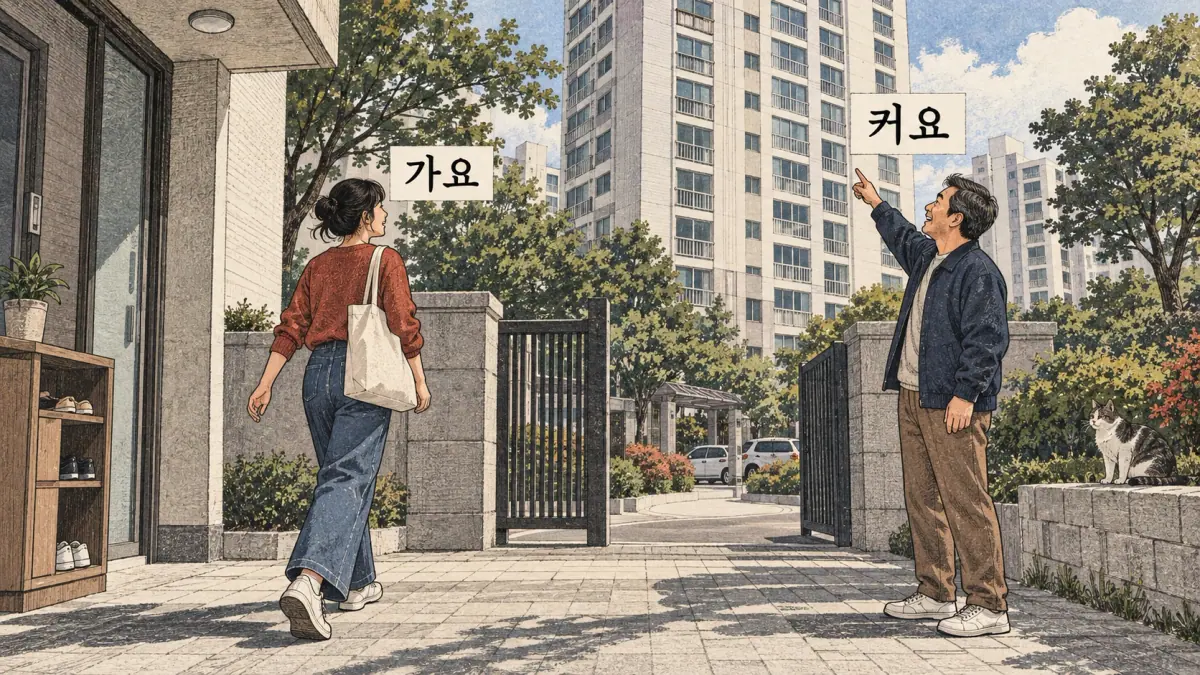
Compare English and Korean. English says "The house is big": the adjective "big" needs "is". Korean says 집이 커요: the adjective 크다 already means "to be big", and 커요 is its polite present form. There is no separate "is" to add. This page uses "adjective" for 형용사, because that is the term in Korean dictionaries, and "descriptive verb" when the verb-like behaviour matters.
Adjectives are a large class. Of the 474 words planned for this site's verb dictionary, 317 are verbs and 154 are adjectives (including 아니다, which 표준국어대사전 lists as an adjective), about two verbs for every adjective, with the copula 이다 and the existential pair 있다/없다 counted separately. Knowing which class a word belongs to matters for every grammar pattern marked "verb only" or "adjective only". The wider classification of Korean words is in Korean parts of speech.
The next section shows exactly how much the two classes share.
How Are Verbs and Adjectives Alike?

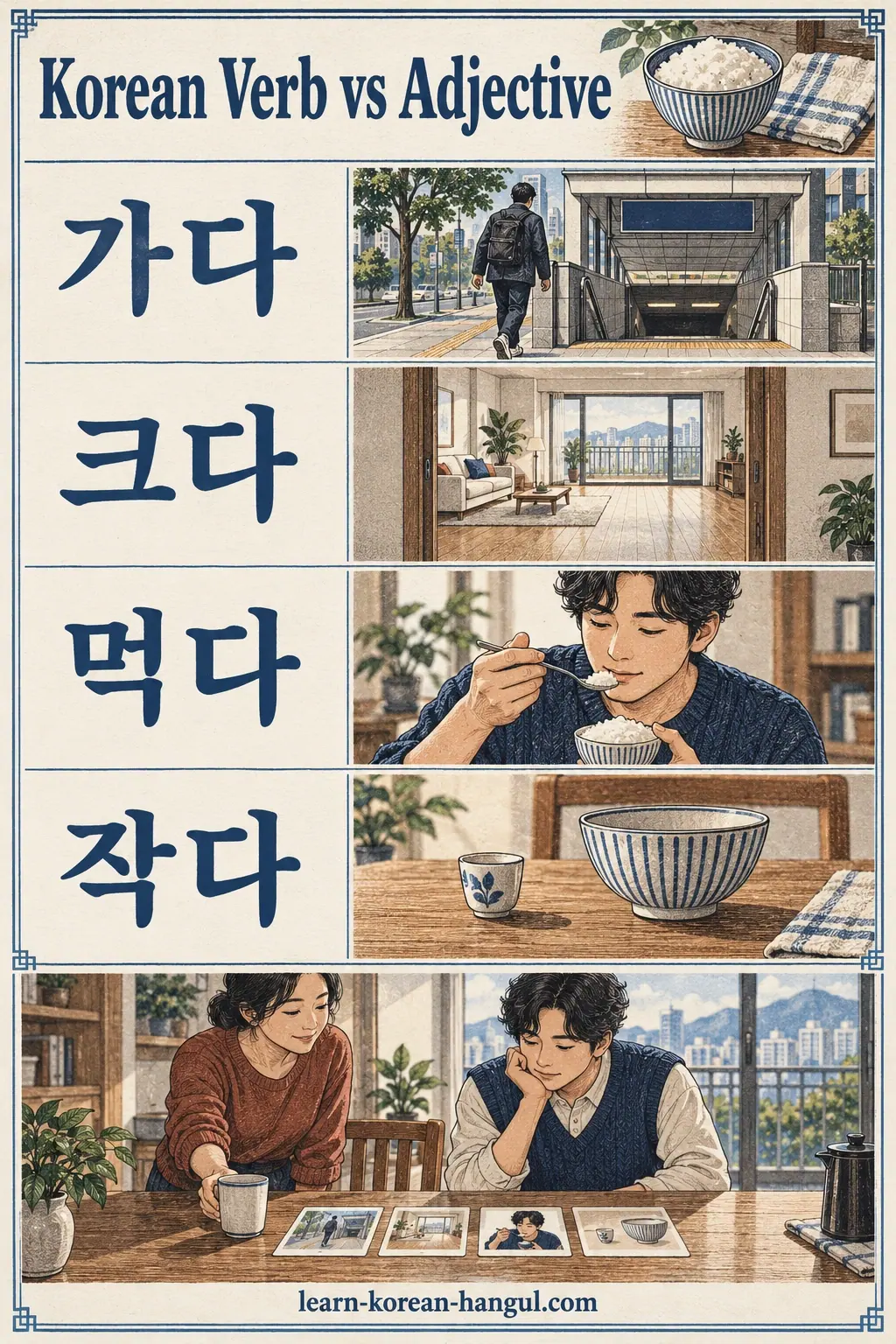
Verbs and adjectives share almost every sentence ending: polite, formal and casual speech, past and future, negation and most connectives. A learner who can conjugate 가다 can already conjugate 크다 in these slots. The table shows the shared forms side by side.
| Slot | Verb 가다 (go) | Adjective 크다 (be big) | Verb 먹다 (eat) | Adjective 작다 (be small) |
|---|---|---|---|---|
| Polite present | 가요 | 커요 | 먹어요 | 작아요 |
| Polite past | 갔어요 | 컸어요 | 먹었어요 | 작았어요 |
| Formal present | 갑니다 [감니다] | 큽니다 [큼니다] | 먹습니다 [먹씀니다] | 작습니다 [작씀니다] |
| Negation with 안 | 안 가요 | 안 커요 | 안 먹어요 | 안 작아요 |
| "and" -고 | 가고 | 크고 | 먹고 | 작고 |
| "if" -(으)면 | 가면 | 크면 | 먹으면 | 작으면 |
Vowel harmony, the rule that picks 아요 or 어요 from the stem's last vowel, applies to both. Irregular stems behave the same way too: the ㅂ-irregular adjective 춥다 gives 추워요, just as the ㅂ-irregular verb 돕다 gives 도와요. The full list of Korean verb classes is in types of Korean verbs. The shared ground ends at five patterns, which the next section lists.
Korean Verb vs Adjective: Five Differences

The Korean verb vs adjective distinction shows up in five patterns. Each one has a different ending for the two classes, or works for only one of them.
| Pattern | Verb 가다 | Adjective 크다 | Rule |
|---|---|---|---|
| 1. Plain present | 간다 | 크다 | verbs add -ㄴ다/-는다; adjectives stay in dictionary form |
| 2. Present modifier | 가는 사람 | 큰 사람 | verbs -는; adjectives -(으)ㄴ |
| 3. Command / suggestion | 가세요, 가자 | (none) | requests and "let's" need an action |
| 4. Background -는데 | 가는데 | 큰데 | verbs -는데; adjectives -(으)ㄴ데 |
| 5. Progressive | 가고 있어요 | (none) | -고 있다 and -는 중이다 need an action |
1. Plain Present
The plain present is the written, neutral style used in diaries, newspapers and quoted speech. Verbs add -ㄴ다 after a vowel and -는다 after a consonant: 간다 ("goes"), 먹는다 [멍는다] ("eats"). Adjectives do not change: 크다 ("is big") is both the dictionary form and the plain present. If a present-tense sentence ends in the bare dictionary form, with no -ㄴ다/-는다, the word is an adjective, 이다 or one of 있다/없다.
2. Present Modifier
A modifier is the form a word takes before a noun, like "big" in "big house". Verbs take -는: 가는 사람 ("a person who goes"), 먹는 음식 [멍는 음식] ("food that one eats"). Adjectives take -ㄴ after a vowel and -은 after a consonant: 큰 집 ("a big house"), 작은 방 [자근 방] ("a small room"). This is the pattern learners use most, and it is taught in full in the adjective -(으)ㄴ form lesson.
3. Commands and Suggestions
Commands and suggestions work only with verbs, because you can ask someone to do an action but not to "be big". 가세요 ("please go") and 가자 ("let's go") are normal; 크세요 and 크자 are not requests. The honorific form 크세요 does exist, but only as a description of a respected person: 선생님은 키가 크세요, "The teacher is tall."
4. Background -는데
The connective -는데 / -(으)ㄴ데 gives background before the main point, like "and" or "but" in English. Verbs take -는데: 비가 오는데 우산이 없어요 ("It's raining, and I have no umbrella"). Adjectives take -ㄴ데 or -은데: 이 집은 큰데 비싸요 ("This house is big, but it's expensive").
5. Progressive -고 있다
The progressive -고 있다 ("be doing") describes an action in progress, so it is verb-only: 지금 먹고 있어요, "I'm eating now." An adjective already describes an ongoing state, so it needs no progressive: 지금 바빠요 means "I'm busy now", and 바쁘고 있어요 is wrong.
These five patterns give you a test for any new word, which the next section turns into a procedure.
How Can I Tell If a Korean Word Is a Verb or an Adjective?
To tell a verb from an adjective, put the word before a noun in the present tense. If it takes -는 (먹는 사람), it is a verb. If it takes -(으)ㄴ (큰 사람), it is an adjective. This is the -는 test, and it works because the modifier ending is the most reliable split between the two classes.
Worked Example: 먹다 and 크다
Run the test step by step on two words.
- Remove 다. 먹다 → 먹; 크다 → 크.
- Try -는 + a noun. 먹는 사람 ("a person who eats") is natural. 크는 사람 does not mean "a big person".
- Try -(으)ㄴ + a noun. 큰 사람 ("a big person") is natural. 먹은 사람 means "a person who ate", which is past, not present.
- Conclude. 먹다 takes -는 in the present: verb. 크다 takes -ㄴ in the present: adjective.
- Check with the plain present. 먹는다 exists; 크다 stays bare in the sense "is big". The two tests agree.
You'll know it worked when the modifier and the plain present point the same way. If they disagree, you have probably found one of the special words in the next section. An edge case worth knowing: 크다 is also a verb meaning "to grow". In that sense it takes verb endings: 아이가 쑥쑥 큰다, "The child is growing fast." The NIKL Standard Korean Language Dictionary (표준국어대사전) lists both senses.
Why Are 있다 and 없다 Different?
있다 ("to exist, to have") and 없다 ("not to exist, not to have") take the verb ending -는 even though 없다 is classed as an adjective. They form a small class of their own, which some grammars call existential words (존재사). Every word built on them inherits the -는: 맛있다 ("delicious") gives 맛있는 [마신는], and 재미없다 ("boring") gives 재미없는 [재미엄는].
| Word | Class in the dictionary | Present modifier | -는데 form | Example |
|---|---|---|---|---|
| 있다 | verb and adjective | 있는 [인는] | 있는데 | 시간이 있는 사람 |
| 없다 | adjective | 없는 [엄는] | 없는데 | 돈이 없는 학생 |
| 맛있다 | adjective | 맛있는 [마신는] | 맛있는데 | 맛있는 음식 |
| 재미없다 | adjective | 재미없는 [재미엄는] | 재미없는데 | 재미없는 영화 |
The -는 test therefore misclassifies these words, so learn them as exceptions. The plain present helps: 맛있다 and 없다 stay bare in the plain present, like adjectives. The full family of 있다 and 없다 words, including 멋있다 and 재미있다, is in 있다 and 없다 adjectives. The next section turns to words that look like the opposite case.
Why Does Korean Say 결혼했어요 for "I Am Married"?

Korean says 결혼했어요, literally "I married", because 결혼하다 is a verb of change: the state "married" is the result of an event, and Korean describes the result with the past tense. Several common English adjectives work this way in Korean: the Korean word is a verb, and the present state is expressed in the past form.
| English (present state) | Korean | Dictionary form | Literal sense |
|---|---|---|---|
| I am married. | 결혼했어요. | 결혼하다 (verb) | I married. |
| He looks like his father. | 아버지를 닮았어요. [달마써요] | 닮다 (verb) | He has come to resemble his father. |
| He is old. | 늙었어요. [늘거써요] | 늙다 (verb) | He has aged. |
| He is handsome. | 잘생겼어요. | 잘생기다 (verb in 표준국어대사전) | He has turned out good-looking. |
| She is thin. | 말랐어요. | 마르다 (verb) | She has become thin. |
The present form of these verbs often means something else. 결혼해요 means "I'm getting married" (a future event), and 닮아요 is mostly used for general statements ("Children resemble their parents"). Their modifiers also use the past form: 결혼한 사람 ("a married person"), 잘생긴 배우 ("a handsome actor"). Translating word by word from English produces the error 결혼이에요 or 결혼한이에요; the fix is to ask whether Korean sees the state as the result of a change.
Words with Both an Adjective and a Verb Form

Several feeling words exist as a pair: an adjective for the feeling itself and a verb, made with -아/어하다, for showing or having that feeling toward something. The pair swaps the particles. With the adjective, the thing that causes the feeling takes 이/가. With the verb, it takes 을/를.
| Adjective | Verb (-아/어하다) | Adjective sentence | Verb sentence |
|---|---|---|---|
| 좋다 (be good, pleasing) | 좋아하다 (like) | 사과가 좋아요. | 사과를 좋아해요. |
| 싫다 (be disliked) | 싫어하다 (dislike) | 비가 싫어요. | 비를 싫어해요. |
| 아프다 (be painful) | 아파하다 (show pain) | 머리가 아파요. | 친구가 많이 아파해요. |
| 슬프다 (be sad) | 슬퍼하다 (grieve, show sadness) | 저는 슬퍼요. | 동생이 슬퍼해요. |
| 기쁘다 (be glad) | 기뻐하다 (rejoice) | 정말 기뻐요. | 엄마가 기뻐해요. |
A practical rule of thumb: use the adjective for your own feelings (저는 슬퍼요) and the -아/어하다 verb to report someone else's (동생이 슬퍼해요), because Korean treats another person's inner state as something you observe from outside. This rule and the full list of pairs are in Korean feeling verbs. The -하다 pairs conjugate with the 여 rule: 좋아하다 → 좋아해요.
Common Misconceptions
Four beliefs cause most verb-adjective errors.
Learners often assume adjectives need 이에요. Actually adjectives conjugate on their own. Wrong: 커피가 맛있는이에요. Right: 커피가 맛있어요.
Learners often assume English adjectives are Korean adjectives. Actually "married", "handsome" and "old" are verbs in Korean. Wrong: 저는 결혼이에요. Right: 저는 결혼했어요.
Learners often use -는 with every word before a noun. Actually -는 is for verbs (and 있다/없다 words). Wrong: 크는 집, 예쁘는 꽃. Right: 큰 집, 예쁜 꽃.
Learners often assume adjectives can never take -세요. Actually -(으)세요 works with adjectives as an honorific description (키가 크세요, "you are tall"), just not as a request. Fixed wishes such as 건강하세요 ("Stay healthy") and 행복하세요 ("Be happy") are very common in greetings, though some style guides prefer 건강하게 지내세요 because 건강하다 is an adjective.
An honest limit: the line between the classes is not perfectly sharp. A few words, such as 크다 and 있다, belong to both depending on the sense, and dictionaries record those cases one by one. The -는 test classifies the large majority of beginner words correctly.
Practice: Classify 20 Words
For each word, decide verb or adjective, then give the present modifier, the plain present and the -는데 form. Answers follow.
먹다, 크다 (be big), 가다, 작다, 마시다, 예쁘다, 읽다, 비싸다, 자다, 바쁘다, 배우다, 춥다, 살다, 길다, 공부하다, 깨끗하다, 알다, 멀다, 있다, 맛있다
Practice · 8
How do you say "a big house" with 크다?
Show answer
큰 집
In the present modifier, adjectives take -(으)ㄴ and verbs take -는. 크다 is an adjective with a vowel stem, so it takes -ㄴ.
What is the plain present of the verb 먹다 (to eat)?
Show answer
먹는다
Verbs add -ㄴ다/-는다 in the plain present (-는다 after a consonant); only adjectives stay in the bare dictionary form.
You put a new word before a noun and it takes -는 (먹는 사람). What does the -는 test tell you?
Show answer
It is a verb
Verbs take -는 in the present modifier, while adjectives take -(으)ㄴ, as in 큰 사람.
How do you say "I'm busy now"?
Show answer
지금 바빠요.
-고 있다 and -는 중이다 need an action; an adjective already describes an ongoing state.
How do you say "delicious food" with 맛있다?
Show answer
맛있는 음식
있다, 없다 and every word built on them take -는 in the modifier, even when they are adjectives.
How do you say "I am married"?
Show answer
저는 결혼했어요.
결혼하다 is a verb of change, so the present state is expressed in the past form; 결혼해요 means "I'm getting married".
Which sentence correctly says "This house is big, but it's expensive"?
Show answer
이 집은 큰데 비싸요.
Adjectives take -(으)ㄴ데 and verbs take -는데.
Which particle does the liked thing take with the verb 좋아하다?
Show answer
을/를: 사과를 좋아해요
With the adjective 좋다 the liked thing is the subject (사과가 좋아요); with the verb 좋아하다 it is the object.
Answer key
| Word | Class | Modifier | Plain present | -는데 form |
|---|---|---|---|---|
| 먹다 | verb | 먹는 | 먹는다 | 먹는데 |
| 크다 | adjective | 큰 | 크다 | 큰데 |
| 가다 | verb | 가는 | 간다 | 가는데 |
| 작다 | adjective | 작은 | 작다 | 작은데 |
| 마시다 | verb | 마시는 | 마신다 | 마시는데 |
| 예쁘다 | adjective | 예쁜 | 예쁘다 | 예쁜데 |
| 읽다 | verb | 읽는 [잉는] | 읽는다 [잉는다] | 읽는데 |
| 비싸다 | adjective | 비싼 | 비싸다 | 비싼데 |
| 자다 | verb | 자는 | 잔다 | 자는데 |
| 바쁘다 | adjective | 바쁜 | 바쁘다 | 바쁜데 |
| 배우다 | verb | 배우는 | 배운다 | 배우는데 |
| 춥다 | adjective (ㅂ-irregular) | 추운 | 춥다 | 추운데 |
| 살다 | verb (ㄹ stem) | 사는 | 산다 | 사는데 |
| 길다 | adjective (ㄹ stem) | 긴 | 길다 | 긴데 |
| 공부하다 | verb | 공부하는 | 공부한다 | 공부하는데 |
| 깨끗하다 | adjective | 깨끗한 [깨끄탄] | 깨끗하다 | 깨끗한데 |
| 알다 | verb (ㄹ stem) | 아는 | 안다 | 아는데 |
| 멀다 | adjective (ㄹ stem) | 먼 | 멀다 | 먼데 |
| 있다 | existential | 있는 [인는] | 있다 | 있는데 |
| 맛있다 | adjective (있다 word) | 맛있는 [마신는] | 맛있다 | 맛있는데 |
Stems ending in ㄹ drop the ㄹ before ㄴ: 살다 → 사는, 산다; 길다 → 긴. If you got 15 or more right, you can apply the test to new words.
What Should You Learn after Verbs vs Adjectives?
After the Korean verb vs adjective split, learn the adjective -(으)ㄴ form: how to put an adjective before a noun in 큰 집, 좋은 사람 and 예쁜 꽃, including vowel, consonant, ㄹ and irregular stems. Then read Korean feeling verbs for the 좋다 / 좋아하다 split in more depth.
What this page does not cover. It does not cover past and future modifiers (먹은, 먹을), every irregular class, or patterns used mainly with adjectives, such as -아/어지다 ("become"). About this page. Last updated 2026-10-09. The Korean text, spoken forms and audio on this page were machine-generated and reviewed and signed off by Min-ji Park on 15 October 2026. Forms were cross-checked with the site's rule-based conjugation engine. Romanization follows the Revised Romanization of Korean and is shown only as a learning aid.
Frequently Asked Questions
Do Korean adjectives conjugate? Yes. Korean adjectives conjugate exactly like verbs in most forms: 크다 becomes 커요 in the polite present, 컸어요 in the past and 큽니다 in formal speech, and it takes 안 for negation. That is why grammars call them descriptive verbs. They differ from action verbs only in modifiers, the plain present, commands, -는데 and -고 있다.
Is 있다 a verb or an adjective? Both, depending on the sense. The Standard Korean Language Dictionary lists 있다 as a verb ("to stay") and as an adjective ("to exist, to have"). In practice 있다 takes verb-style endings such as 있는 and 있는데, and so do 없다 and words built on them, such as 맛있다. Many grammars call them existential words.
Can I give a command with an adjective? Not in the usual sense. Requests with -(으)세요 and suggestions with -자 need an action, so 가세요 works but 크세요 is not a request. Set wishes such as 건강하세요 and 행복하세요 are common exceptions in greetings. To ask someone to be quiet, Korean uses an action form: 조용히 하세요.
Is 크다 always an adjective? No. 크다 is an adjective meaning "to be big" and also a verb meaning "to grow". In the "big" sense it gives 큰 집 and the plain present 크다. In the "grow" sense it takes verb endings: 아이가 쑥쑥 큰다, "The child is growing fast." Dictionaries list the two senses separately.
Why is 좋아요 an adjective form but 좋아해요 a verb form? 좋아요 comes from 좋다, an adjective meaning "to be good or pleasing", so the liked thing is its subject: 사과가 좋아요. 좋아해요 comes from 좋아하다, a verb built with -아하다, so the liked thing is its object: 사과를 좋아해요. Both can mean "I like apples", but the particles differ.