What you'll learn
- Split a Korean verb into stem and ending, and name the ending slots in order.
- Build six forms of one verb (먹다) from the same stem.
- Explain why Korean verbs do not change for I, you or they.
- Place the verb correctly at the end of a simple Korean sentence.
- Tell an action verb from a descriptive verb (adjective).
Prerequisites: none. If you can read Hangul, you are ready. Time: about 25 minutes.
The first section defines what counts as a verb in Korean.
What Is a Korean Verb?

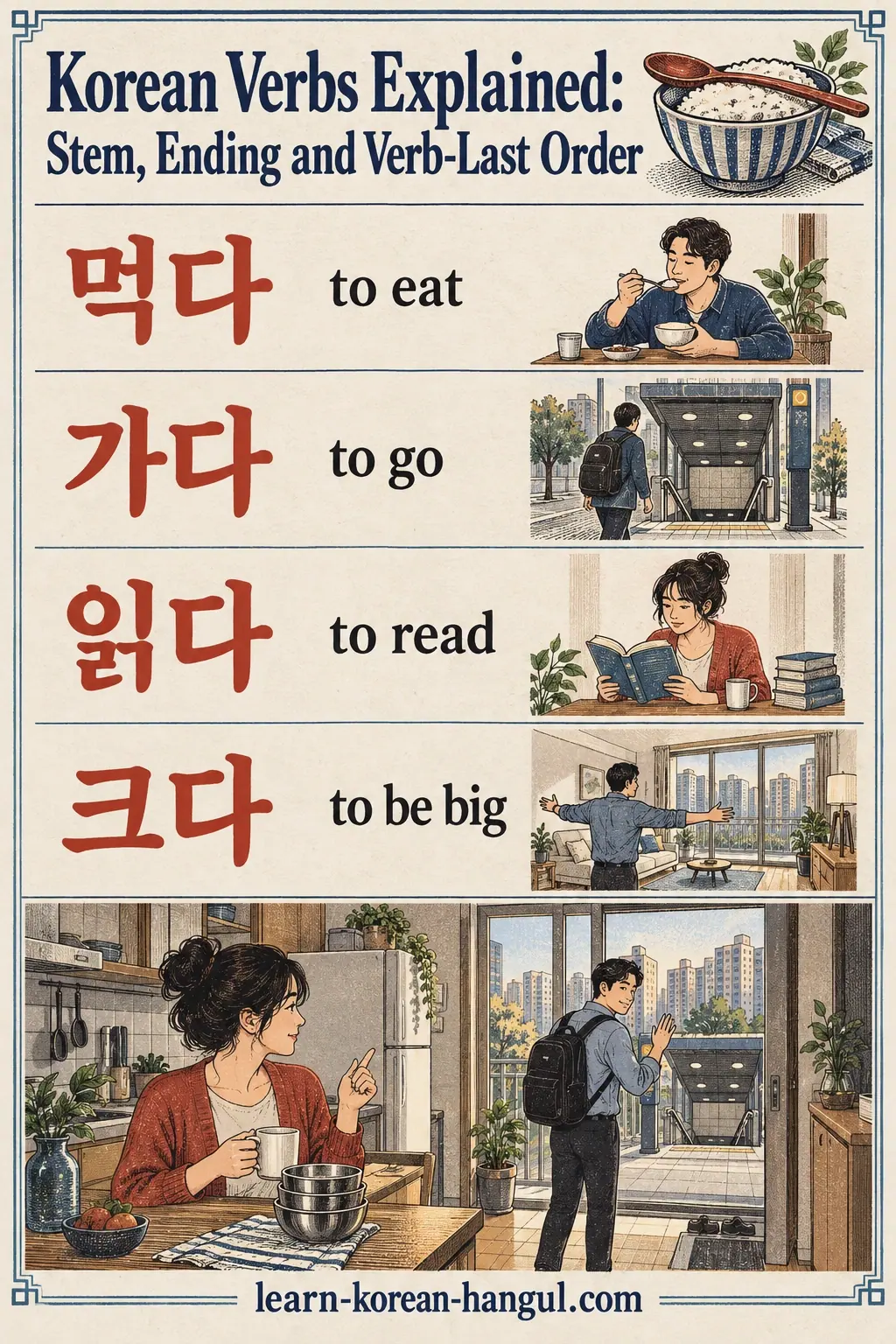
A Korean verb is a word that says what someone does or what state something is in, and that changes its ending to show tense, politeness and mood. Korean calls verbs and adjectives together 용언 (yongeon, "predicate words"). Both kinds are listed in the dictionary as stem + 다, and both take the same endings.
The dictionary form (기본형, gibonhyeong) is the version you look up. Compare the dictionary form with the form you use in a polite sentence:
| Dictionary form | Meaning | Polite sentence form |
|---|---|---|
| 먹다 | to eat | 먹어요 |
| 가다 | to go | 가요 |
| 읽다 | to read | 읽어요 |
| 크다 | to be big | 커요 |
The 다 is a label, not part of the meaning. When you speak politely, 다 disappears and an ending such as 어요 replaces it. The lesson on the Korean verb base form explains this in detail. Next, look at the parts that remain after 다 is removed.
The Three Parts of a Korean Verb
A Korean verb in a sentence has three kinds of parts: the stem, optional middle endings, and one final ending. The stem comes first and carries the meaning. The middle endings add honorific or tense. The final ending closes the word and sets the sentence type and politeness.
The parts always appear in the same order, like boxes on a shelf:
| Slot | 1. Stem | 2. Honorific (optional) | 3. Tense or attitude (optional) | 4. Final ending |
|---|---|---|---|---|
| Role | meaning | respect for the subject | past or guess | politeness, sentence type |
| Example | 먹 | 으시 | 었 | 어요 |
Reading the example from left to right: 먹 (eat) + 으시 (honorific) + 었 (past) + 어요 (polite) = 먹으셨어요, "(the respected person) ate." Each slot is optional except the stem and the final ending. English does something similar with helper words (is eating, has eaten, will have eaten), but those helpers are separate words placed before the main verb. Korean adds its pieces after the stem, inside one word, in a fixed order. The slot order is covered in full in Korean verb endings.
The next section shows the slot model working on a single verb.
One Verb Built into Six Forms
One stem can produce many forms. Starting from the stem 먹 (from 먹다), these six forms cover most beginner conversation.
| # | Form | Spoken | Built from | Use | Meaning |
|---|---|---|---|---|---|
| 1 | 먹어요 | [머거요] | 먹 + 어요 | polite present | I eat / I am eating |
| 2 | 먹었어요 | [머거써요] | 먹 + 었 + 어요 | polite past | I ate |
| 3 | 먹을 거예요 | [머글꺼예요] | 먹 + 을 거예요 | polite future | I will eat |
| 4 | 먹습니다 | [먹씀니다] | 먹 + 습니다 | formal | I eat (formal) |
| 5 | 드세요 | [드세요] | 드시 + 어요 | honorific, preview | please eat / (he) eats |
| 6 | 먹어 | [머거] | 먹 + 어 | casual | I eat (to a friend) |
The stem 먹 is the same in every form that has it. Only the endings change. That means a learner does not memorise six unrelated words; the learner memorises one stem and learns six endings that work with thousands of other stems.
Form 5 is a preview. 드세요 uses 드시다, which is a special respectful verb that replaces 먹다 when the eater deserves respect. The regular honorific 먹으세요 also exists and is also correct. Honorific forms are taught later in Korean honorifics. The sections that follow explain why none of these forms mention who is eating.
Why Do Korean Verbs Not Change for I, You or They?

Korean verbs do not change for person or number; the verb ending signals politeness instead. The sentence 먹어요 is correct whether the eater is "I", "you", "he", "we" or "they". English needs eat or eats to track the subject. Korean uses the same ending for every subject and lets context, or a noun, say who it is.
| Subject | Korean sentence | English |
|---|---|---|
| I | 저는 먹어요. | I eat. |
| You | 당신은 먹어요? | Do you eat? |
| My friend | 친구가 먹어요. | My friend eats. |
| We | 우리가 먹어요. | We eat. |
| The children | 아이들이 먹어요. | The children eat. |
What the ending does track is the relationship between speaker and listener. The ending 어요 is polite. The ending 습니다 is more formal. The ending 어 is casual. This is why learners say that Korean verbs are about "who you are talking to", where English verbs are about "who is doing the action". The word 당신 in the table is an unusual choice in real life, because it can sound cold or confrontational; Koreans usually use a name or title instead of "you". It appears here only to show the grammar.
That shift in focus also explains the next point: the subject is often missing altogether.
Can a Korean Sentence Be Only a Verb?

Yes. A Korean sentence can consist of a single conjugated verb, because the ending shows the sentence type and the context supplies the subject. 먹어요 alone can be a statement ("I'm eating"), a question with rising intonation ("Are you eating?") or an answer. The verb cannot disappear, but the subject often does.
A short exchange shows how natural this is:
| Speaker | Korean | Meaning |
|---|---|---|
| A | 밥 먹었어요? | Did you eat? (literally: rice, ate?) |
| B | 네, 먹었어요. | Yes, I ate. |
| B | 아직 안 먹었어요. | Not yet. (I haven't eaten.) |
Notice that neither speaker says "you" or "I". Dropping the subject is the default when it is obvious. When a subject is added, it is usually for contrast or clarity. The rules are in dropping the subject in Korean, so this lesson will not repeat them. The question that follows from a one-word sentence is where the verb goes when more words are added.
Where Does the Verb Go in the Sentence?
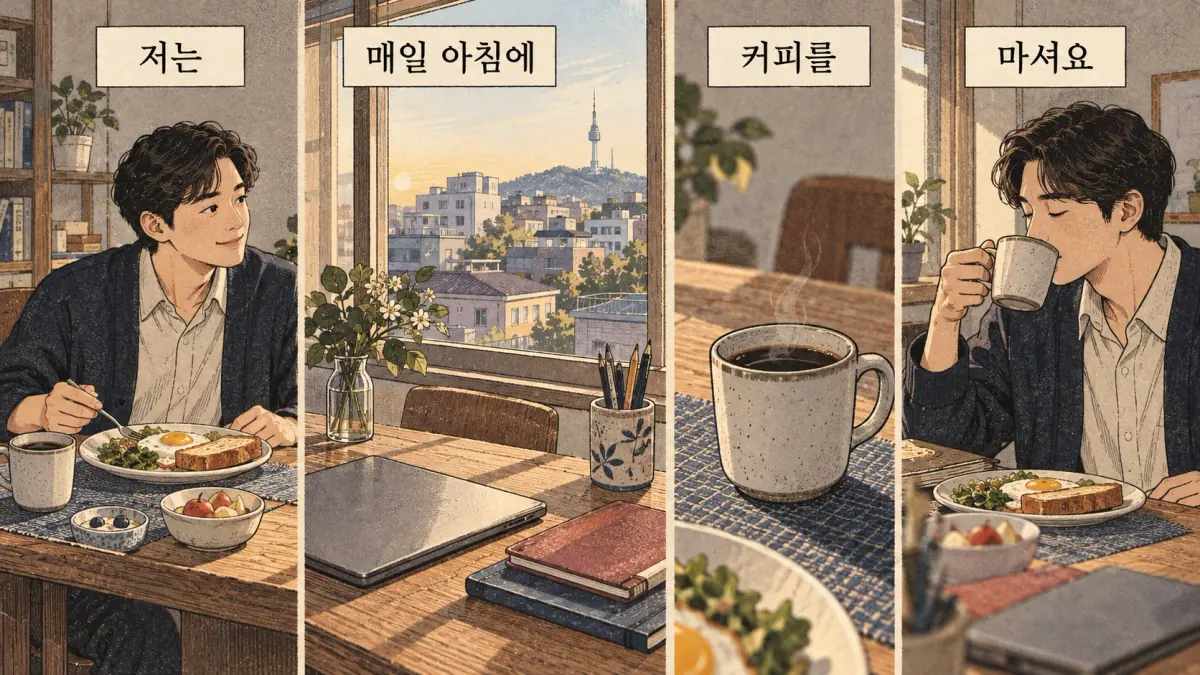
The verb goes at the end of the sentence. Korean is a verb-final language: the order is subject, object, verb (SOV), where English is subject, verb, object (SVO). Everything that describes the verb, such as time, place and object, comes before it.
| Order | English | Korean |
|---|---|---|
| Subject | I | 저는 |
| Time | every morning | 매일 아침에 |
| Object | coffee | 커피를 |
| Verb | drink | 마셔요 |
Putting the Korean row together gives 저는 매일 아침에 커피를 마셔요, "I drink coffee every morning." Particles (는, 에, 를) mark each word's job, so the order of the non-verb words is flexible: 커피를 저는 매일 아침에 마셔요 is also grammatical, with a different emphasis. The verb stays last.
Two small things attach to the verb at the end. A negative 안 goes directly before the verb: 커피를 안 마셔요, "I don't drink coffee." And a question is the same sentence with rising intonation, so the verb is still last. The full word-order rules are in Korean word order. The next section asks how Korean marks time.
Does Korean Have Verb Tenses?
Yes. Korean marks the past with the ending -았/었- and the future with -(으)ㄹ 거-, and the present has no marker of its own. The same four forms of 먹다 show the system at work.
| Time | Ending added to the stem 먹 | Form | Meaning |
|---|---|---|---|
| Present | -어요 (no tense marker) | 먹어요 | I eat / I am eating |
| Past | -었- + -어요 | 먹었어요 | I ate |
| Future | -을 거예요 | 먹을 거예요 | I will eat |
| Ongoing | -고 있- + -어요 | 먹고 있어요 | I am eating right now |
The present form also covers near-future plans: 내일 가요 means "I am going tomorrow", with the time word doing the work. Korean tenses are compared in full in Korean tenses. Each tense ending can combine with the honorific slot, which is why 먹으셨어요 exists. The next section shows how Korean joins several verbs into one idea.
Phrasal Verbs and Helping Verbs in Korean
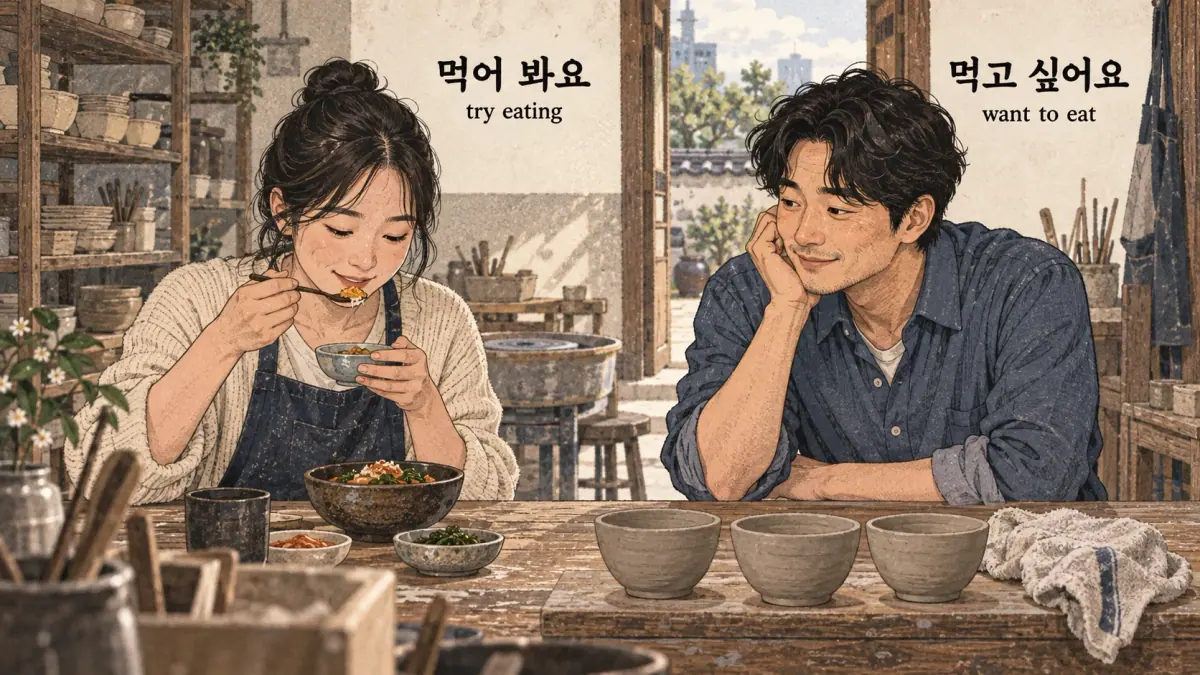
Korean builds the equivalent of English phrasal verbs by joining two verbs: the first verb carries the meaning and the second adds a nuance. The pattern is first verb + a connecting ending (아/어 or 고) + helping verb. The helping verb takes the final ending.
| Pattern | Example | Meaning | Built from |
|---|---|---|---|
| -아/어 보다 | 먹어 봐요 | try eating | 먹어 + 보다 (to see) |
| -아/어 버리다 | 먹어 버렸어요 | ate it all up | 먹어 + 버리다 (to throw away) |
| -고 있다 | 먹고 있어요 | is eating | 먹고 + 있다 (to be) |
| -고 싶다 | 먹고 싶어요 | want to eat | 먹고 + 싶다 (to want) |
In each example, the first verb 먹 stays the same and only the helper and the final ending change. English uses a different word for each nuance (try eating, eat up, be eating), but Korean reuses the pattern with many verbs: 가 보다, 읽어 보다, 마셔 보다 all mean "try [verb]-ing". Helping verbs are called 보조 용언 (bojo yongeon). The next section shows that verbs come in two main kinds.
Action Verbs Versus Descriptive Verbs
Korean verbs split into action verbs, such as 가다 "to go", and descriptive verbs, such as 크다 "to be big". English calls the second group adjectives; many Korean textbooks call them descriptive verbs because they conjugate like verbs. The distinction matters because a few endings work with only one group.
| Feature | Action verb (가다) | Descriptive verb (예쁘다) |
|---|---|---|
| Meaning | does something | is in a state |
| Polite present | 가요 | 예뻐요 |
| Past | 갔어요 | 예뻤어요 |
| Before a noun | 가는 사람 (person who goes) | 예쁜 사람 (pretty person) |
| "-고 있다" (is -ing) | 가고 있어요 (is going) | not used |
| Suggestion "-자" | 가자 (let's go) | not used |
Some stems serve both groups. The stem 크 is an adjective in 방이 커요 ("the room is big") and a verb in 아이가 커요 ("the child is growing up"); both are 커요. Context tells you which. For a verb you can add -고 있다 (크고 있어요, "is growing") but for the adjective sense you cannot. The page on types of Korean verbs sorts verbs into all six groups, and Korean parts of speech shows where verbs sit next to nouns and particles. Next comes a map of what to read after this lesson.
Where to Go Next in the Verbs Hub
After this lesson, choose the next page by the question you have, not by the grammar term. The table maps questions to pages.
| Your question | Read this |
|---|---|
| How do I change the form? | How Korean conjugation works |
| Which kinds of verbs exist? | Types of Korean verbs |
| Why does every verb end in 다? | The Korean verb base form |
| What do the tenses mean? | Korean tenses |
| What does this one verb look like in every form? | Korean verb dictionary |
| Where is the full conjugation system? | Korean verb conjugation |
If you want only one next step, read the base-form lesson, because it teaches the stem that every later rule starts from. These pages together make Korean verbs explained from the smallest part to the whole system. Before you move on, check four ideas that learners often get wrong.
Common Misconceptions
Learners often assume that Korean verbs work like English verbs. Four corrections come up repeatedly.
- "Korean verbs change for I, you and he." Actually they do not. The ending signals politeness, not person, so 가요 serves every subject.
- "요 is part of the verb." Actually 요 is the polite marker added to a casual ending (먹어 → 먹어요). Dropping it gives a casual sentence, not a broken one.
- "A sentence needs a subject." Actually the subject is dropped whenever context makes it clear. The verb is the only part that must stay.
- "There are only three tenses." Actually Korean marks past and future with endings, but present has no marker, and many other nuances (ongoing, finished, attempted) come from helping verbs rather than tense.
Practice comes next so that you can test the main ideas.
Practice
Try each item before reading the key.
- Remove 다 from 가다 and from 읽다. What are the two stems?
- Build the polite past of 먹다 from its parts.
- Is 저는 먹어요 or 먹어요 the shorter sentence? Which is also correct?
- Put these in Korean order: coffee / I / drink / every morning.
- Which verb is a descriptive verb: 읽다 or 예쁘다?
- Add -고 싶다 to the stem of 가다 and write the polite present.
Answer key
- 가 and 읽.
- 먹 + 었 + 어요 = 먹었어요.
- 먹어요 is shorter; both are correct. 먹어요 alone is the natural choice when the subject is clear.
- 저는 매일 아침에 커피를 마셔요 (the verb is last).
- 예쁘다.
- 가고 싶어요 ("I want to go").
If you got items 1 to 4 right, you have the basic structure. If you missed item 4, reread the verb-last section.
What this lesson does not cover. It does not teach the full conjugation rules, the irregular verbs, the honorific system or the individual endings; each has its own page. About this page. Last updated 2026-10-09. The Korean text, spoken forms and audio on this page were machine-generated and reviewed and signed off by Min-ji Park on 15 October 2026. Romanization follows the Revised Romanization of Korean and is shown only as a learning aid.
Frequently Asked Questions
Do all Korean verbs end in 다 in the dictionary? Yes. Every verb and adjective is listed as stem + 다, including 먹다, 가다, 크다 and 하다. The copulas 이다 and 아니다 end in 다 as well. The 다 is a citation ending that disappears when you conjugate, so you will rarely hear it in polite speech.
Is Korean verb conjugation the same as English conjugation? The idea is similar, but the system is different. English changes verbs for person (eats) and tense (ate). Korean never changes for person, and builds tense, politeness and mood by adding endings to a fixed stem. Korean conjugation is closer to adding labelled pieces than to changing a word's shape.
How many forms does a Korean verb have? In theory hundreds, because endings combine. In practice a beginner needs about six everyday forms: polite present, polite past, future, formal, honorific and casual. 먹다 gives 먹어요, 먹었어요, 먹을 거예요, 먹습니다, 드세요 and 먹어. Each is one stem plus one or two endings.
Do Korean verbs change for plural subjects? No. 우리가 먹어요 (we eat) and 저는 먹어요 (I eat) use the same verb form. Plural is shown on nouns with 들 (친구들이 먹어요, the friends eat), and even that is often left out. The verb carries politeness and tense but never number, so you do not need a separate plural table.
Does Korean have irregular verbs? Yes. Most Korean verbs follow regular patterns, but a small group changes the stem before certain endings, such as 듣다 (listen), which becomes 들어요. These are called irregular verbs (불규칙 활용). They follow fixed classes, so each class can be learned once and applied to every verb in it.