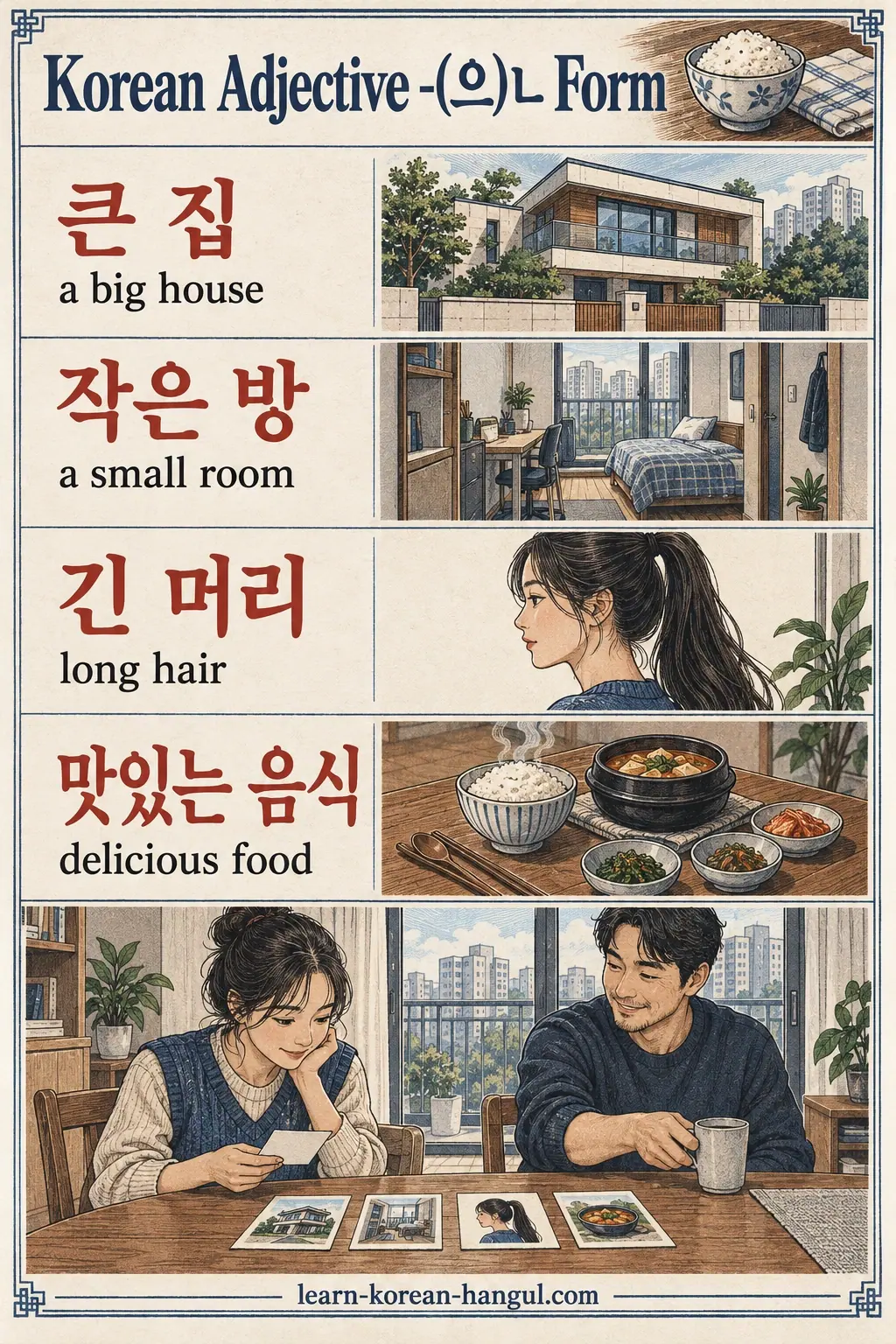
What you'll learn
- Form the -(으)ㄴ modifier of 28 adjectives from the stem type.
- Handle ㄹ, ㅂ, ㅎ, ㅡ, 르 and 하다 adjectives without guessing.
- Use -는 for 있다 and 없다 adjectives: 맛있는 음식.
- Tell 비싼 가방 from 산 가방, and say a remembered state with -았/었던.
Prerequisites: verbs vs adjectives and the present tense recipe. Time: about 30 minutes.
Key facts
- ㄹ stems drop the ㄹ: 길다 becomes 긴, 멀다 becomes 먼.
- ㅂ-irregular adjectives end in 운: 춥다 becomes 추운, 어렵다 becomes 어려운.
- 있다 and 없다 adjectives take -는: 맛있는, 재미없는.
The first section gives the basic recipe and the reason it exists.
How Do You Put an Adjective before a Noun in Korean?

To put an adjective before a noun in Korean, remove 다 from the dictionary form and add ㄴ after a vowel or 은 after a consonant. The new form is called a modifier (관형사형). It tells the listener which kind of noun you mean, like "big" in "big house", and it needs no particle.
Follow three steps.
- Remove 다. 크다 becomes the stem 크; 좋다 becomes 좋.
- Check the last sound of the stem. 크 ends in a vowel; 좋 ends in a consonant.
- Add the ending. Vowel stem + ㄴ gives 큰. Consonant stem + 은 gives 좋은.
Then put the noun after it, with a space: 큰 집, 좋은 사람. You know it worked when the phrase answers "which one?" or "what kind?" and can take a particle after the noun: 큰 집이 좋아요, "The big house is nice."
English moves "big" before "house" without changing it. Korean changes the adjective itself, because an adjective is a predicate word and needs an ending to describe a noun. The same stem gives 커요 at the end of a sentence and 큰 before a noun. The next section sorts stems into four regular types.
What Are the Endings for Each Stem Type?

Regular stems split into four types by their last sound: vowel, consonant, ㄹ and 하다. The ending depends on that last sound only, not on the meaning of the word. The tables show every type with two to six examples.
Vowel Stems: Add ㄴ
| Dictionary form | Modifier | Before a noun | Meaning |
|---|---|---|---|
| 크다 | 큰 | 큰 집 | a big house |
| 싸다 | 싼 | 싼 옷 [싼 옫] | cheap clothes |
| 비싸다 | 비싼 | 비싼 가방 | an expensive bag |
| 바쁘다 | 바쁜 | 바쁜 사람 | a busy person |
| 예쁘다 | 예쁜 | 예쁜 꽃 [예쁜 꼳] | a pretty flower |
| 나쁘다 | 나쁜 | 나쁜 날 | a bad day |
ㅡ stems such as 크다, 바쁘다, 예쁘다 and 나쁘다 belong here. Their ㅡ drops before 아/어 (커요, 바빠요), but the modifier ending starts with ㄴ, not a vowel, so the ㅡ stays: 큰, 바쁜.
Consonant Stems: Add 은
| Dictionary form | Modifier | Before a noun | Meaning |
|---|---|---|---|
| 좋다 | 좋은 [조은] | 좋은 사람 | a good person |
| 작다 | 작은 [자근] | 작은 방 | a small room |
| 많다 | 많은 [마는] | 많은 돈 | a lot of money |
| 높다 | 높은 [노픈] | 높은 산 | a high mountain |
| 넓다 | 넓은 [널븐] | 넓은 방 | a wide room |
The brackets show real pronunciation. The final consonant moves onto the vowel of 은, so 작은 is said [자근] and 넓은 [널븐]. A final ㅎ is dropped before a vowel instead, so 좋은 is said [조은]. This follows the standard pronunciation rules of the National Institute of Korean Language (국립국어원).
ㄹ Stems: Drop ㄹ, Add ㄴ
| Dictionary form | Modifier | Before a noun | Meaning |
|---|---|---|---|
| 길다 | 긴 | 긴 머리 | long hair |
| 멀다 | 먼 | 먼 곳 [먼 곧] | a far place |
| 달다 | 단 | 단 과자 | a sweet snack |
A stem ending in ㄹ loses the ㄹ before ㄴ, so 길 + ㄴ gives 긴 and not 길은. The same rule works for verbs such as 살다 (사는 사람). A common mistake is 길은 머리, which is wrong.
하다 Adjectives: Add ㄴ
| Dictionary form | Modifier | Before a noun | Meaning |
|---|---|---|---|
| 깨끗하다 | 깨끗한 [깨끄탄] | 깨끗한 방 | a clean room |
| 조용하다 | 조용한 | 조용한 곳 [조용한 곧] | a quiet place |
An adjective ending in 하다 is a vowel stem once 다 is gone, so the ending is ㄴ and the result ends in 한. Many adjectives follow this pattern, including 행복하다 (행복한) and 피곤하다 (피곤한).
Regular stems follow one rule each. The irregular stems in the next section need one extra step.
Which Irregular Stems Change the Form?

Four irregular classes appear among adjectives: ㅂ, ㅎ, 르 and ㅅ. In this form the ㅂ, ㅎ and ㅅ stems change, and learners must memorise them. The 르 class is irregular in the polite present but regular here.
| Class | Rule in this form | Dictionary form | Modifier | Before a noun |
|---|---|---|---|---|
| ㅂ irregular | ㅂ becomes 우, then ㄴ | 춥다 | 추운 | 추운 날 |
| ㅂ irregular | same | 어렵다 | 어려운 | 어려운 문제 |
| ㅂ irregular | same | 아름답다 | 아름다운 | 아름다운 꽃 |
| ㅎ irregular | ㅎ drops, vowel changes in the polite present only | 빨갛다 | 빨간 | 빨간 사과 |
| ㅎ irregular | same | 파랗다 | 파란 | 파란 하늘 |
| ㅎ irregular | same | 그렇다 | 그런 | 그런 사람 |
| 르 | no change; ㄹ stays with 르 | 다르다 | 다른 | 다른 사람 |
| 르 | no change | 빠르다 | 빠른 | 빠른 차 |
| ㅅ irregular | ㅅ drops before a vowel | 낫다 | 나은 | 나은 방법 |
Why do 르 stems stay regular? In the polite present 다르다 becomes 달라요, with an extra ㄹ. That extra ㄹ is added only before 아/어. The modifier ending starts with ㄴ, so 다른 and 빠른 keep the plain stem.
The ㅎ class (빨갛다, 파랗다, 노랗다, 하얗다, 까맣다) is the colour class. Its polite present is 빨개요 and its modifier is 빨간. The full rule and the colour words are in Korean color adjectives and the ㅎ irregular lesson, and ㅂ-irregular stems are covered in ㅂ irregular.
Two adjectives need a quick check. 그렇다 gives 그런 ("that kind of"), which learners meet constantly as 그런 사람. 낫다 ("to be better") gives 나은, as in 나은 방법 ("a better way"). Those are the last exceptions; the next section explains one more group of words that break the -(으)ㄴ rule.
Why Do 있다 and 없다 Adjectives Take -는?

Adjectives ending in 있다 or 없다 take the verb modifier -는, not -(으)ㄴ, because 있다 and 없다 behave as verbs in this slot. The rule covers 있다, 없다 and every word built on them. It does not matter that the word describes a state.
| Dictionary form | Wrong | Correct | Before a noun | Meaning |
|---|---|---|---|---|
| 맛있다 | 맛있은 | 맛있는 | 맛있는 음식 | delicious food |
| 재미없다 | 재미없은 | 재미없는 | 재미없는 영화 | a boring movie |
| 멋있다 | 멋있은 | 멋있는 | 멋있는 사람 | a stylish person |
The pattern covers 계시다 (honorific of 있다) too, and words such as 상관없다 and 관계없다. Pronunciation shifts the final sounds: 맛있는 is said [마신는] (the standard rules also list [마딘는]) and 재미없는 is said [재미엄는]. The 있다 and 없다 adjectives lesson lists the whole family. The next section compares adjective modifiers with verb modifiers.
How Do Adjective and Verb Modifiers Differ?

Adjective modifiers state a quality in the present, while verb modifiers add a time: past, present or future. The same noun shows the difference clearly. Take 가방 ("bag") and the verb 사다 ("to buy") against the adjective 비싸다 ("to be expensive").
| Modifier | Class | Meaning | Example |
|---|---|---|---|
| 비싼 | adjective, present | expensive | 비싼 가방: an expensive bag |
| 산 | verb, past | bought | 산 가방: the bag I bought |
| 살 | verb, future | will buy | 살 가방: the bag I will buy |
| 사는 | verb, present | buying | 사람들이 사는 가방: the bag people buy |
The same shape -(으)ㄴ means present after an adjective and past after an action verb. 작은 방 is "a small room", while 먹은 음식 is "food that was eaten". When you are unsure, ask whether the word describes a state or an action. For the -는 test that settles this, see Korean verb vs adjective. For verb modifiers in depth, read noun-modifying forms, and the page on the -(으)ㄴ adjective and past modifier compares the two uses of the ending. The next section adds past and negative adjective modifiers.
How Do You Make past and Negative Adjective Modifiers?

Add -았/었던 to the stem to describe a state you remember, and add 안 or -지 않은 for the negative. Both keep the same noun order. They extend the basic form, so learn the basic form first.
| Meaning | Pattern | Example | Translation |
|---|---|---|---|
| remembered past state | stem + 았/었던 | 예뻤던 사람 | the person who used to be pretty |
| remembered past state | stem + 았/었던 | 추웠던 날 | the day that was cold |
| remembered past state | stem + 았/었던 | 컸던 집 | the house that was big |
| negative present | 안 + modifier | 안 예쁜 옷 | clothes that are not pretty |
| negative present | stem + 지 않은 | 예쁘지 않은 옷 | clothes that are not pretty |
| negative present | stem + 지 않은 | 비싸지 않은 가방 | a bag that is not expensive |
The -던 ending marks a memory, as in "the day that was cold, as I recall". It is not the plain past. Future adjective modifiers are rare. The commonest one is -(으)ㄹ in set phrases such as 추울 때 ("when it is cold"). Next comes a note on a close neighbour, the adverb.
Can an Adjective Become an Adverb?
An adjective becomes an adverb with -게, which describes a verb instead of a noun. 크다 gives 크게 and 예쁘다 gives 예쁘게. The result answers "how?": 크게 말해요 ("I speak loudly"), 예쁘게 웃어요 ("She smiles prettily").
| Adjective | Adverb with -게 | Example |
|---|---|---|
| 크다 | 크게 | 크게 말해 주세요. (Please speak loudly.) |
| 예쁘다 | 예쁘게 | 예쁘게 웃어요. (She smiles prettily.) |
| 재미있다 | 재미있게 | 재미있게 놀았어요. (We had fun.) |
Do not confuse 큰 (before a noun) with 크게 (before a verb). Details and other adverb patterns are in Korean adverbs. The wider modifier system is in Korean modifiers.
Which Mistakes Do Learners Make with This Form?
Five mistakes cover most errors with this form. Each has a short fix.
- Writing 좋ㄴ or 크은. Use 은 after consonants and ㄴ after vowels: 좋은, 큰.
- Keeping the ㄹ. 길은 머리 is wrong. Write 긴 머리.
- Forgetting the ㅂ change. 춥은 날 is wrong. Write 추운 날.
- Using -(으)ㄴ with 있다 words. 맛있은 음식 is wrong. Write 맛있는 음식.
- Reading 먹은 as present. After verbs, -(으)ㄴ is past. Use 먹는 for the present.
This lesson covers the form and its main uses. It does not cover the verb modifiers (먹는, 먹은, 먹을) beyond the comparison above, the determiners 이런, 그런, 저런 and 어떤 in full, or the longer pattern -(으)ㄴ 것 같다. Practice comes next.
Practice: Can You Form the Modifier?
Combine each adjective with the noun to make a noun phrase. Write the answer before you look at the answer column.
| # | Adjective + noun | Answer |
|---|---|---|
| 1 | 비싸다 + 가방 | 비싼 가방 |
| 2 | 좋다 + 친구 | 좋은 친구 |
| 3 | 길다 + 머리 | 긴 머리 |
| 4 | 춥다 + 겨울 | 추운 겨울 |
| 5 | 빨갛다 + 장미 | 빨간 장미 |
| 6 | 맛있다 + 김치 | 맛있는 김치 |
| 7 | 조용하다 + 도서관 | 조용한 도서관 |
| 8 | 다르다 + 생각 | 다른 생각 |
| 9 | 쉽다 + 문제 | 쉬운 문제 |
| 10 | 멀다 + 나라 | 먼 나라 |
| 11 | 바쁘다 + 하루 | 바쁜 하루 |
| 12 | 재미없다 + 책 | 재미없는 책 |
Practice · 8
How do you say "a good friend" with 좋다 + 친구?
Show answer
좋은 친구
좋 ends in a consonant, so it takes 은; ㄴ alone attaches only to vowel stems.
How do you say "an expensive bag" with 비싸다 + 가방?
Show answer
비싼 가방
비싸 is a vowel stem, so it takes ㄴ, giving 비싼.
How do you say "long hair" with 길다 + 머리?
Show answer
긴 머리
An ㄹ stem drops the ㄹ before ㄴ: 길 + ㄴ gives 긴.
How do you say "a cold winter" with 춥다 + 겨울?
Show answer
추운 겨울
춥다 is ㅂ-irregular: the ㅂ becomes 우, then ㄴ is added, giving 추운.
How do you say "delicious kimchi" with 맛있다 + 김치?
Show answer
맛있는 김치
Adjectives built on 있다 and 없다 take the verb modifier -는, not -(으)ㄴ.
How do you say "a different idea" with 다르다 + 생각?
Show answer
다른 생각
The extra ㄹ of the 르 class appears only before 아/어; before ㄴ the plain stem is used.
How do you say "a red rose" with 빨갛다 + 장미?
Show answer
빨간 장미
빨갛다 is ㅎ-irregular: the ㅎ drops and ㄴ is added, giving 빨간.
What does 산 가방 mean, from the verb 사다 (to buy)?
Show answer
the bag I bought
After an action verb, -(으)ㄴ marks the past; after an adjective it is present, as in 비싼 가방. The future is 살 가방.
Score 10 or more and you can move on. If you missed phrases 4, 9 or 10, review the ㅂ and ㄹ rows above. For more words to practise on, use common Korean adjectives, where every row shows its modifier.
What Should You Learn after the Korean Adjective -(으)ㄴ Form?
After the Korean adjective -(으)ㄴ form, learn the vocabulary. The list of 50 common adjectives gives each word with its polite present and modifier, and 있다 and 없다 adjectives expands the -는 exception.
About this page. Last updated 2026-10-09. The Korean text on this page was machine-generated and reviewed and signed off by Min-ji Park on 15 October 2026. Forms were cross-checked with the site's rule-based conjugation engine. Romanization follows the Revised Romanization of Korean and is shown only as a learning aid.
Frequently Asked Questions
Why is it 좋은 and not 좋ㄴ? The ending is -(으)ㄴ, and the 으 appears only after a consonant stem so that the sounds can be said. 좋 ends in a consonant, so it takes 은: 좋은. A bare ㄴ cannot stand alone in Hangul, because every syllable needs a vowel. After a vowel stem the 으 is dropped: 크 becomes 큰.
What is the -(으)ㄴ form of 덥다? 덥다 is a ㅂ-irregular adjective. The ㅂ turns into 우 before a vowel ending, so 덥 + 은 becomes 더운, as in 더운 날씨 ("hot weather"). The same change gives 추운 from 춥다 and 어려운 from 어렵다. The form 덥은 is never used.
Is the -(으)ㄴ form the same as the past tense? The shape is the same, the meaning is not. After an adjective, -(으)ㄴ is present: 큰 집 is "a big house". After an action verb, -(으)ㄴ is past: 먹은 음식 is "food that was eaten". To say an adjective state was true in the past, use -았/었던, as in 컸던 집.
Do I need a particle between the adjective and the noun? No. The modifier sits directly before the noun, separated only by a space: 큰 집, 좋은 사람. A particle would split the phrase into two parts. Particles such as 이/가 attach to the whole noun phrase, as in 큰 집이 좋아요 ("The big house is nice").
How do adjectives ending in 하다 take the modifier? Drop 다 and add ㄴ to 하: 하다 becomes 한. 깨끗하다 gives 깨끗한 방 ("a clean room") and 조용하다 gives 조용한 곳 ("a quiet place"). These adjectives are regular, and 하 is a vowel stem, so no 은 is needed. Words such as 행복하다 and 피곤하다 follow the same rule.