
Korean parts of speech sort words into nouns, pronouns, verbs, descriptive verbs and pointing words, and the main surprise is that Korean adjectives conjugate like verbs. This hub lists five lessons in learning order, each with audio examples, a pattern table and practice with answers.
What Are Korean Parts of Speech?

Korean parts of speech are the word classes (품사, pumsa) that tell you how a word behaves in a sentence. Some words take particles, some change their endings, and some only point at other words. Knowing the class tells you which of these three things a new word will do.
Korean groups words into nine classes in school grammar. Beginners need five of them: nouns (명사), pronouns (대명사), action verbs (동사), descriptive verbs (형용사) and determiners (관형사). The biggest difference from English is the fourth: a Korean "adjective" is a kind of verb. The word 예쁘다 (to be pretty) conjugates like 먹다 (to eat), so 예뻐요 already means "is pretty".
The table below compares the five classes by the two questions that matter most when you build a sentence.
| Class | Korean term | Takes a particle? | Changes its ending? | Example |
|---|---|---|---|---|
| Noun | 명사 | yes: 친구가 | no | 친구 (friend) |
| Pronoun | 대명사 | yes: 저는 | no | 저 (I), 이것 (this thing) |
| Action verb | 동사 | no | yes: 먹어요, 먹었어요 | 먹다 (to eat) |
| Descriptive verb | 형용사 | no | yes: 예뻐요, 예뻤어요 | 예쁘다 (to be pretty) |
| Determiner | 관형사 | no | no | 이 (this) before a noun |
Words that take particles come first in a sentence, and words that change endings come last. Which lesson to open first depends on the next section.
Where Should You Start with Korean Parts of Speech?
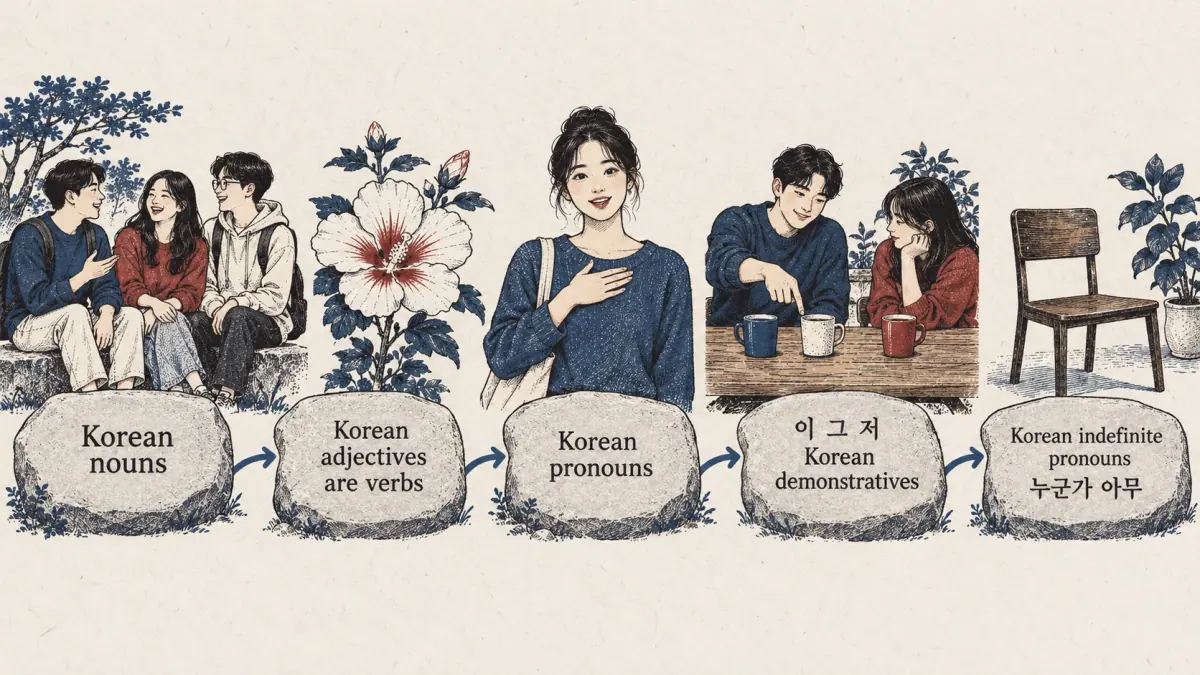
Start with Korean nouns, then follow the five lessons in this order. Each lesson uses what the previous one taught, so the order saves time.
- Korean nouns: particles, counters and the optional plural 들. Every later lesson uses nouns.
- Korean adjectives are verbs: why 예뻐요 needs no "is", and how modifiers differ.
- Korean pronouns: 저 versus 나, 우리, and how to avoid "you".
- 이 그 저 Korean demonstratives: three distances for "this" and "that".
- Korean indefinite pronouns 누군가 아무: "someone", "anything" and "nobody", and how question words become "some" and "any" forms.
The nouns lesson needs only the subject-object-verb sentence pattern as background. If you have not seen that yet, read it first.
Browse by Topic

Each published lesson below has a short summary, one example sentence with audio and a link. The summaries state what the lesson covers, so you can decide before you click.
Korean Nouns
Korean nouns (명사) have no gender, no articles and only an optional plural marker 들, so 사과 can mean "an apple", "the apple" or "apples". The lesson teaches particles by last sound, counters for people and things, and the rule of thumb for when to leave 들 out. Example: 친구가 많아요. (chinguga manayo.) "I have many friends."
Korean Adjectives Are Verbs
Korean adjectives are descriptive verbs (형용사) that end in 다, take tense endings and end a sentence alone. The lesson shows the conjugation table for five words, the modifier difference between 먹는 and 예쁜, and the mistake of adding -고 있다 to an adjective. Example: 이 꽃은 예뻐요. (i kkocheun yeppeoyo.) "This flower is pretty."
Open the lesson on Korean adjectives as verbs.
Korean Pronouns
Korean pronouns (대명사) carry politeness: 저 is the humble "I", 나 is the plain "I", and "you" is usually replaced by a name, a title or nothing. The lesson explains 우리 for "our" even with one owner and why 당신 sounds cold. Example: 저는 민수예요. (jeoneun minsuyeyo.) "I am Minsu."
Open the Korean pronouns lesson.
이 그 저 Korean Demonstratives
The demonstratives 이, 그 and 저 divide space into three zones: near the speaker, near the listener or already mentioned, and far from both. The lesson builds 이것, 여기 and 이분 from the three roots and covers contractions like 이건. Example: 이것은 뭐예요? (igeoseun mwoyeyo?) "What is this?"
Open the 이 그 저 demonstratives lesson.
Korean Indefinite Pronouns 누군가 아무
Indefinite pronouns such as 누군가 (someone) and 아무 (any, with a negative: none) refer to people or things without naming them. The lesson shows how the same question words become "some" and "any" forms. Example: 아무도 없어요. (amudo eopseoyo.) "There is nobody."
Open the indefinite pronouns lesson.
Which Lesson Fits Your Sentence?

Pick the lesson by what you want to say. The table maps six common goals to the lesson that solves them.
| You want to say | Open this lesson | First thing you will learn |
|---|---|---|
| "a friend", "two apples", "books" | Korean nouns | Add a particle for the role and a counter for the quantity |
| "the weather is nice", "it is big" | Korean adjectives are verbs | No word for "is" is needed |
| "I am a student", "our house" | Korean pronouns | Use 저 in polite speech and 우리 for "our" |
| "this book", "over there" | 이 그 저 Korean demonstratives | Choose by distance from speaker and listener |
| "someone came", "nobody is here" | Korean indefinite pronouns 누군가 아무 | Pair 아무 with a negative |
| "to study", "to exercise" | Korean 하다 verbs | Add 하다 to a noun |
The most common first mistake in this set is adding 들 to every plural noun, as in 두 사람들 or 학생들 세 명. Korean leaves the plural to context, so the plain forms 두 사람 and 학생 세 명 are right; with 많은, both 많은 친구 and 많은 친구들 are heard.
How Do You Practise This Set?

Practise by combining the lesson exercises with a quiz and a deck. Each published lesson ends with four practice items and an answer key, and most include a sentence builder for the example sentence.
- Take the Korean grammar quizzes to check word-class recognition and particle choice.
- Review the example words with the Korean flashcards.
- Follow with the sentence frames in Korean basic sentence patterns, where nouns, pronouns and verbs combine into full sentences.
A practical routine is one lesson per session: read, play every audio clip twice, do the practice items without looking, then check the answers.
What the Korean Parts of Speech Set Does Not Cover
The Korean parts of speech set covers the five beginner classes. It does not cover adverbs, conjunctions, interjections or numerals in depth. Particles have their own section in Korean particles, tenses are in Korean tenses, and sentence order is in Korean sentence structure. This hub belongs to the wider basic Korean grammar set.
Study the lessons in order, and the Korean parts of speech set gives you the vocabulary of grammar that the rest of the site assumes.
Frequently Asked Questions
Are Korean adjectives verbs? Yes, in how they behave: they are descriptive verbs (형용사). They end in 다 in the dictionary, take the same tense and politeness endings as action verbs, and need no word for 'is'. The one visible difference is the present modifier: 먹는 사람 for an action verb, 예쁜 꽃 for a descriptive verb.
How do I make a verb from a noun with 하다? Add 하다 after many nouns to make a verb: 공부 (study) becomes 공부하다 (to study), and 운동 (exercise) becomes 운동하다 (to exercise). The noun keeps its meaning and 하다 carries the tense ending, as in 공부해요. The details sit on the Korean 하다 verbs page.
Which lesson in Korean parts of speech should I read first? Start with Korean nouns, because particles and counters attach to nouns and every later lesson uses them. Then read why adjectives are verbs, pronouns, and the pointing words 이 그 저. The indefinite pronouns lesson comes last, since it builds on both pronouns and question words.
What level is Korean parts of speech? Level A1, the first stage for complete beginners. You need to read Hangul and have seen the basic subject-object-verb order, but no earlier grammar. Each lesson takes about 25 minutes, so the whole set takes roughly two hours with practice, and the order matters more than the pace.