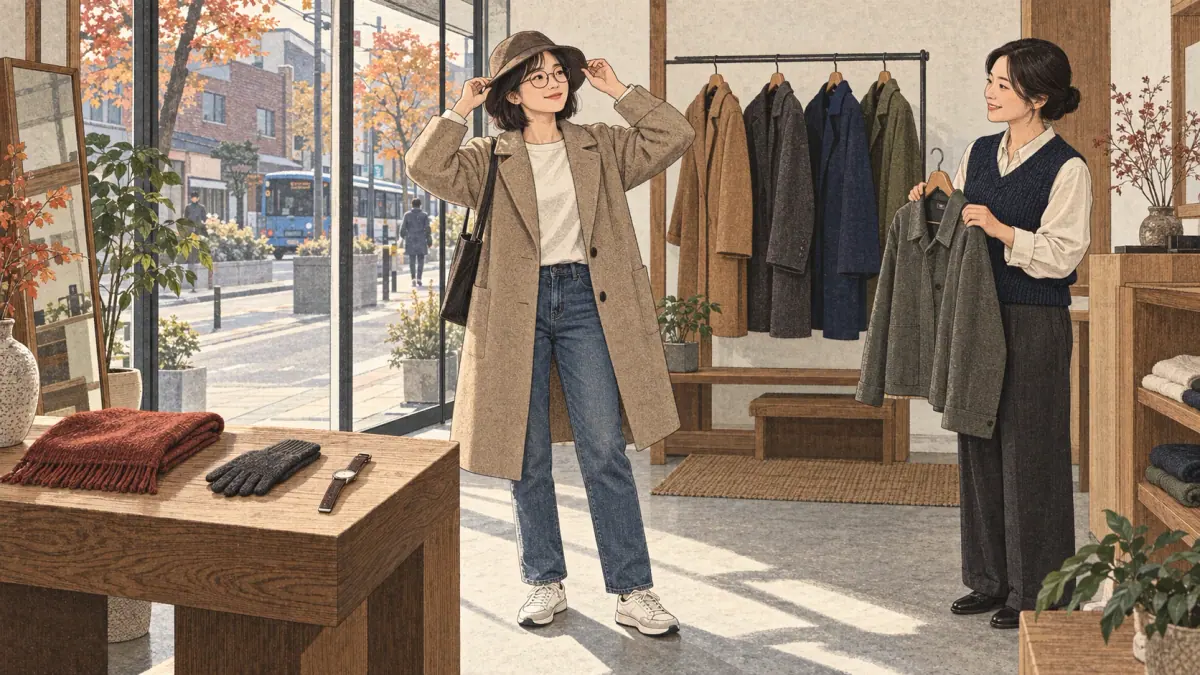
What you will be able to do after this lesson
- Choose the correct verb for 20 items, from shirts and shoes to rings and watches.
- Say the matching take-off verb for each item.
- Say what someone is wearing with -고 있다 and with a modifier (안경을 쓴 사람).
- Avoid the seven most common wearing-verb mistakes.
Before you start: read how Korean conjugation works. The item names are in Korean clothing vocabulary. Time: about 35 minutes. Level: A2.
How Do You Say Wear in Korean?
Korean has no single word for "wear". You choose the verb from the body part: 입다 for clothes on the body, 신다 for feet, 쓰다 for the head and face, 끼다 for fingers, hands and ears, 차다 for the wrist or waist, 매다 for ties and belts, 메다 for the shoulder and 하다 for accessories. The next table gives each verb its zone and its polite present.
| Verb | Where the item sits | Polite present | Modifier (present / past) |
|---|---|---|---|
| 입다 | body and legs: shirts, pants, skirts, coats, dresses | 입어요 | 입는 / 입은 |
| 신다 | feet: shoes, socks, sneakers, boots | 신어요 | 신는 / 신은 |
| 쓰다 | head and face: hats, glasses, masks, helmets | 써요 | 쓰는 / 쓴 |
| 끼다 | fingers, hands, ears: rings, gloves, earphones, contact lenses | 껴요 | 끼는 / 낀 |
| 차다 | wrist, waist: watches, bracelets with a clasp | 차요 | 차는 / 찬 |
| 매다 | tied or knotted: ties, belts, shoelaces | 매요 | 매는 / 맨 |
| 메다 | shoulder: shoulder bags, backpacks | 메요 | 메는 / 멘 |
| 두르다 | wrapped around: scarves, shawls | 둘러요 | 두르는 / 두른 |
| 하다 | accessories in general: necklaces, earrings | 해요 | 하는 / 한 |
The modifier column helps later in the lesson. The past modifier, such as 쓴 or 입은, is how Korean says "wearing X" before a noun. Revised Romanization is a reading aid only: ipda, sinda, sseuda, kkida, chada, maeda, meda. The key skill is deciding the verb for a given item, so the next section lists 20 of them.
Which of the Korean Verbs for Wearing Clothes Goes with Which Item?
Match the item to its zone. The table gives 20 common items. The final column is a ready sentence in the polite present, so you can learn item and verb as one chunk, the way Korean speakers do.
| Item | English | Verb | Sentence |
|---|---|---|---|
| 셔츠 | shirt | 입다 | 셔츠를 입어요. |
| 바지 | pants | 입다 | 바지를 입어요. |
| 치마 | skirt | 입다 | 치마를 입어요. |
| 코트 | coat | 입다 | 코트를 입어요. |
| 원피스 | dress | 입다 | 원피스를 입어요. |
| 신발 | shoes | 신다 | 신발을 신어요. |
| 양말 | socks | 신다 | 양말을 신어요. |
| 모자 | hat | 쓰다 | 모자를 써요. |
| 안경 | glasses | 쓰다 | 안경을 써요. |
| 마스크 | mask | 쓰다 | 마스크를 써요. |
| 장갑 | gloves | 끼다 | 장갑을 껴요. |
| 반지 | ring | 끼다 | 반지를 껴요. |
| 시계 | watch | 차다 | 시계를 차요. |
| 넥타이 | tie | 매다 | 넥타이를 매요. |
| 벨트 | belt | 매다 | 벨트를 매요. |
| 가방 | bag (on the shoulder) | 메다 | 가방을 메요. |
| 목도리 | scarf | 두르다 | 목도리를 둘러요. |
| 목걸이 | necklace | 하다 | 목걸이를 해요. |
| 귀걸이 | earrings | 하다 | 귀걸이를 해요. |
| 운동화 | sneakers | 신다 | 운동화를 신어요. |
Three patterns hold the table together.
- Garments that cover the body take 입다. That includes shirts, pants, skirts, coats and dresses.
- Anything on the feet takes 신다. That includes shoes, socks and sneakers.
- Things worn on the head or face take 쓰다. That includes hats, glasses and masks.
The remaining verbs describe how an accessory attaches: 끼다 for a snug fit, 차다 for something around the wrist, 매다 for a knot, 메다 for a strap on the shoulder, and 하다 for jewelry in general. Several items have more than one acceptable verb. Many speakers say 안경을 끼다 as well as 안경을 쓰다, and 목걸이를 걸다 and 목걸이를 하다 both occur, but the verbs in the table are the standard first choice. Wearing is half the story, since each item also has a verb for taking it off.
What Are the Take-off Verbs?
Most items use 벗다 to take off, rings use 빼다, and ties, belts and watches use 풀다. The put-on and take-off verbs come in pairs, so learn them together.
| Item | Put on | Polite present | Take off | Polite present | Example |
|---|---|---|---|---|---|
| 셔츠, 코트, 옷 | 입다 | 입어요 | 벗다 | 벗어요 | 옷을 벗어요. |
| 신발, 양말 | 신다 | 신어요 | 벗다 | 벗어요 | 신발을 벗어요. |
| 모자, 안경, 마스크 | 쓰다 | 써요 | 벗다 | 벗어요 | 모자를 벗어요. |
| 장갑 | 끼다 | 껴요 | 벗다 | 벗어요 | 장갑을 벗어요. |
| 반지 | 끼다 | 껴요 | 빼다 | 빼요 | 반지를 빼요. |
| 넥타이, 벨트 | 매다 | 매요 | 풀다 | 풀어요 | 넥타이를 풀어요. |
| 시계 | 차다 | 차요 | 풀다 | 풀어요 | 시계를 풀어요. |
| 목도리 | 두르다 | 둘러요 | 풀다 | 풀어요 | 목도리를 풀어요. |
The pair 끼다 and 빼다 shows the difference in logic. 빼다 means "to pull out", so it suits a ring that slides off a finger. 풀다 means "to untie or loosen", so it suits knots and clasps. For clothes you pull over your head or step out of, the verb is 벗다. 벗다 is a regular verb, and 끼다 has its own dictionary page. To change clothes, use 갈아입다: 옷을 갈아입어요 ("I change clothes"). The opposite pairs in this table appear again in Korean opposite verbs.
One verb in the put-on list needs its own section because it has four unrelated meanings.
What Does 쓰다 Mean When You Wear a Hat?
쓰다 means "to wear on the head or face" when the object is a hat, glasses or a mask. The same spelling also means to write, to use or spend, and (as an adjective) to be bitter. The polite present of all four is 써요, so context and the object decide the meaning.
| Sentence | Meaning of 쓰다 | Translation |
|---|---|---|
| 편지를 써요. | to write: write a letter | I write a letter. |
| 컴퓨터를 써요. | to use: use a computer | I use a computer. |
| 돈을 써요. | to spend: spend money | I spend money. |
| 모자를 써요. | to wear on the head: wear a hat | I wear a hat. |
| 커피가 써요. | to be bitter (adjective) | The coffee is bitter. |
쓰다 follows the ㅡ-drop pattern: 쓰 + 어요 = 써요, past 썼어요. The same rule is in ㅡ irregular. The dictionary page for 쓰다 lists every use. Because the object picks the meaning, never translate 쓰다 on its own. Learn 모자를 쓰다, 편지를 쓰다 and 돈을 쓰다 as separate chunks. With the verb choice settled, the next question is how to say what someone is wearing right now.
How Do You Say What Someone Is Wearing?
Add -고 있다 to the verb stem for the state of wearing: 모자를 쓰고 있어요 means "I am wearing a hat". For the person who wears something, use the past modifier before the noun: 안경을 쓴 사람 means "the person wearing glasses".
| Pattern | Example | Meaning |
|---|---|---|
| verb stem + 고 있다 | 모자를 쓰고 있어요. | I am wearing a hat. |
| verb stem + 고 있다 | 청바지를 입고 있어요. | I am wearing jeans. |
| verb stem + 고 있다 | 운동화를 신고 있어요. | I am wearing sneakers. |
| verb stem + 고 있다 | 반지를 끼고 있어요. | I am wearing a ring. |
| Past modifier + noun | Meaning |
|---|---|
| 안경을 쓴 사람 | a person wearing glasses |
| 청바지를 입은 사람 | a person wearing jeans |
| 빨간 구두를 신은 사람 | a person wearing red dress shoes |
| 반지를 낀 사람 | a person wearing a ring |
With wearing verbs, -고 있다 can mean either "putting on right now" or "has put on and is in that state". The meaning of 입고 있어요 is almost always the state of being dressed, "I am wearing". The page on wearing verbs 입다 신다 쓰다 -고 있다 explains why. This page is the vocabulary list, and that page is the grammar explanation. Beyond a single item, you will often want to describe a full outfit.
How Do You Describe a Whole Outfit?
Join the wearing verbs with the connective -고 ("and then" or "and"): attach -고 to the stem of every verb except the last, which takes the polite ending. The pattern lets you list an outfit in one sentence. Ask with 뭐 입었어요? ("What did you wear?"), which uses 입다 even when the answer includes shoes and hats.
| Sentence | Meaning |
|---|---|
| 청바지를 입고 운동화를 신어요. | I wear jeans and sneakers. |
| 셔츠를 입고 넥타이를 매요. | I wear a shirt and a tie. |
| 모자를 쓰고 마스크를 써요. | I wear a hat and a mask. |
| 코트를 입고 목도리를 두르고 장갑을 껴요. | I wear a coat, a scarf and gloves. |
| 오늘 뭐 입었어요? | What did you wear today? |
| 청바지를 입고 운동화를 신었어요. | I wore jeans and sneakers. |
Notice that each item keeps its own verb: you cannot write 청바지와 운동화를 입어요 to cover both jeans and sneakers. Sneakers need 신다. Say each item with its own verb and join the clauses with -고. In the past, only the last verb changes (입고 신었어요), and the earlier -고 forms stay the same.
Which Mistakes Do Learners Make with Wearing Verbs?
Learners most often use 입다 for everything, because "wear" translates to one verb in their language. The table shows the wrong sentence, the correct sentence and a reason.
| Wrong | Right | Why |
|---|---|---|
| 모자를 입어요. | 모자를 써요. | Hats go on the head: 쓰다. |
| 신발을 입어요. | 신발을 신어요. | Shoes and socks use 신다. |
| 안경을 입어요. | 안경을 써요. | Glasses are worn on the face: 쓰다. |
| 장갑을 신어요. | 장갑을 껴요. | Gloves fit tightly on the hand: 끼다. |
| 반지를 써요. | 반지를 껴요. | Rings go on a finger: 끼다. |
| 시계를 입어요. | 시계를 차요. | A watch goes on the wrist: 차다. |
| 넥타이를 입어요. | 넥타이를 매요. | A tie is knotted: 매다. |
Two more traps are worth knowing.
- 매다 and 메다 sound almost the same. Most Seoul speakers pronounce ㅐ and ㅔ alike, so context decides: 넥타이를 매요 (tie) and 가방을 메요 (shoulder bag). 가방 can also take 들다 (hold in the hand): 가방을 들어요.
- 차다 has other meanings. It can also mean "to kick" or "to be cold" or "to be full", and the object makes the meaning clear: 시계를 차요 (wear a watch), 공을 차요 (kick a ball).
How Do You Choose a Verb for a New Item?
Ask where the item sits and how it attaches. Use this four-question check for any item not in the table.
- Does it cover the body or legs? Use 입다.
- Does it go on the feet? Use 신다.
- Does it sit on the head or face? Use 쓰다.
- Is it small and snug on a finger, hand or ear? Use 끼다. Is it on the wrist or waist? Use 차다. Is it knotted? Use 매다. Is it carried on a shoulder strap? Use 메다.
If none fits, check a dictionary for the collocation, because Korean verbs are tied to their objects. New fashion words such as 후드티 (hoodie) follow the clothing rule: 후드티를 입어요.
Practice: Match the Item to Its Verb
Choose the correct verb for each item, then check the key.
- 선글라스 (sunglasses) ___
- 청바지 (jeans) ___
- 부츠 (boots) ___
- 귀걸이 (earrings) ___
- 장갑 (gloves) ___
- 마스크 (mask) ___
- 시계 (watch) ___
- 넥타이 (tie) ___
- 모자 (hat) ___
- 양말 (socks) ___
- 코트 (coat) ___
- 반지 (ring) ___
Practice · 6
신발을 ___
Show answer
신어요
모자를 ___
Show answer
써요
반지를 ___
Show answer
껴요
시계를 ___
Show answer
차요
Take off a ring
Show answer
빼요
Take off a tie
Show answer
풀어요
Answers to the Practice
- 선글라스를 써요.
- 청바지를 입어요.
- 부츠를 신어요.
- 귀걸이를 해요.
- 장갑을 껴요.
- 마스크를 써요.
- 시계를 차요.
- 넥타이를 매요.
- 모자를 써요.
- 양말을 신어요.
- 코트를 입어요.
- 반지를 껴요.
If you missed an item, return to the zone table. The next step is the grammar of the wearing state.
What to Learn Next
Korean verbs for wearing clothes follow the body: 입다 for clothes, 신다 for feet, 쓰다 for the head and face, 끼다 for rings and gloves, 차다 for a watch, 매다 for a tie, 메다 for a shoulder bag. Learn each item with its verb, learn the take-off verb in the same breath, and use -고 있다 or a past modifier to say what someone is wearing. Continue with Korean opposite verbs for more pairs, or return to the action verbs hub.
This page does not cover every accessory or the verbs for dressing another person (입히다 and 신기다). It also leaves out the honorific form 입으시다 and the grammar of -고 있다, which has its own page. The forms follow standard written Korean as described by the National Institute of Korean Language (국립국어원).
Frequently Asked Questions
How do I say wear in Korean? Korean has no single word for wear. Use 입다 for clothes on the body, 신다 for shoes and socks, 쓰다 for hats and glasses, 끼다 for rings and gloves, 차다 for a watch, 매다 for a tie and 메다 for a shoulder bag. Choose the verb from where the item sits on the body.
Which verb do I use for shoes? Use 신다 for shoes, socks, sneakers and boots. The polite present is 신어요, as in 신발을 신어요 ("I wear shoes"). The take-off verb is 벗다, so 신발을 벗어요 means "I take off my shoes". Do not use 입다 for shoes, which is the most common beginner mistake.
Which verb do I use for glasses? Use 쓰다 for glasses: 안경을 써요. The verb 쓰다 covers anything worn on the head or face, including hats, masks and sunglasses. Many speakers also say 안경을 끼다, which is widely accepted, but 쓰다 is the usual first choice. To take glasses off, say 안경을 벗어요.
How do I say take off in Korean? Use 벗다 for most clothes, shoes, hats, glasses and masks. Use 빼다 for rings and 풀다 for ties, belts, watches and scarves. The verb you pick depends on the item, just as the verb for putting it on does. To change clothes, say 갈아입다: 옷을 갈아입어요.