Key facts
- Topic: Korean clothing vocabulary.
Korean Clothing Vocabulary at a Glance
Korean clothing vocabulary leans heavily on loanwords. Of the 50 words here, 22 are English words with Korean spellings, such as 티셔츠 and 코트, so you can guess many of them. Most of the rest are native Korean words like 바지 and 치마, or Sino-Korean words like 정장. The page is a child of Daily Life.
| Group | Words | Use |
|---|---|---|
| Tops and dresses | 11 | Naming what you wear on the upper body |
| Bottoms | 6 | Trousers, jeans, shorts and skirts |
| Outerwear | 7 | Coats and jackets for each season |
| Shoes and socks | 8 | Footwear, including the indoor slippers |
| Underwear and sleepwear | 5 | Basic items for the shop and the suitcase |
| Sizes and fit | 6 | Asking for a size and trying things on |
| Hanbok and uniforms | 7 | Traditional dress and school or work uniforms |
Each section teaches the nouns first and then the verbs that go with them. The following section says what to learn first.
Which Clothing Words Should You Learn First?
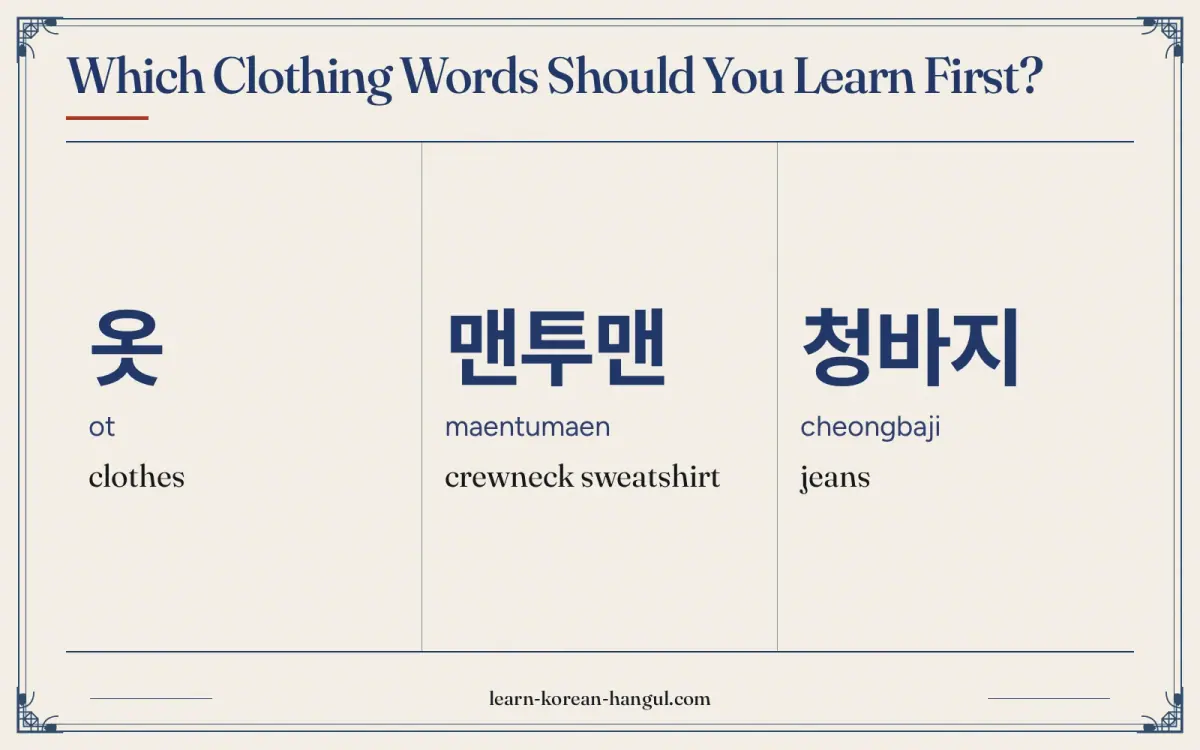
Learn 옷, 신발, 바지, 셔츠, 코트 and 양말 first, then the six size and fit words for shopping. They cover a day-to-day wardrobe and let you buy something. The hanbok words can wait unless you plan to wear one.
- Day one. 옷, 셔츠, 티셔츠, 바지, 치마, 신발 and 양말.
- Day two. The outerwear and the rest of the footwear.
- Day three. 사이즈, 큰 사이즈, 작은 사이즈, 헐렁하다, 꽉 끼다 and 입어 보다.
- Day four to five. Underwear, sleepwear and the remaining tops.
- Day six. The hanbok and uniform words.
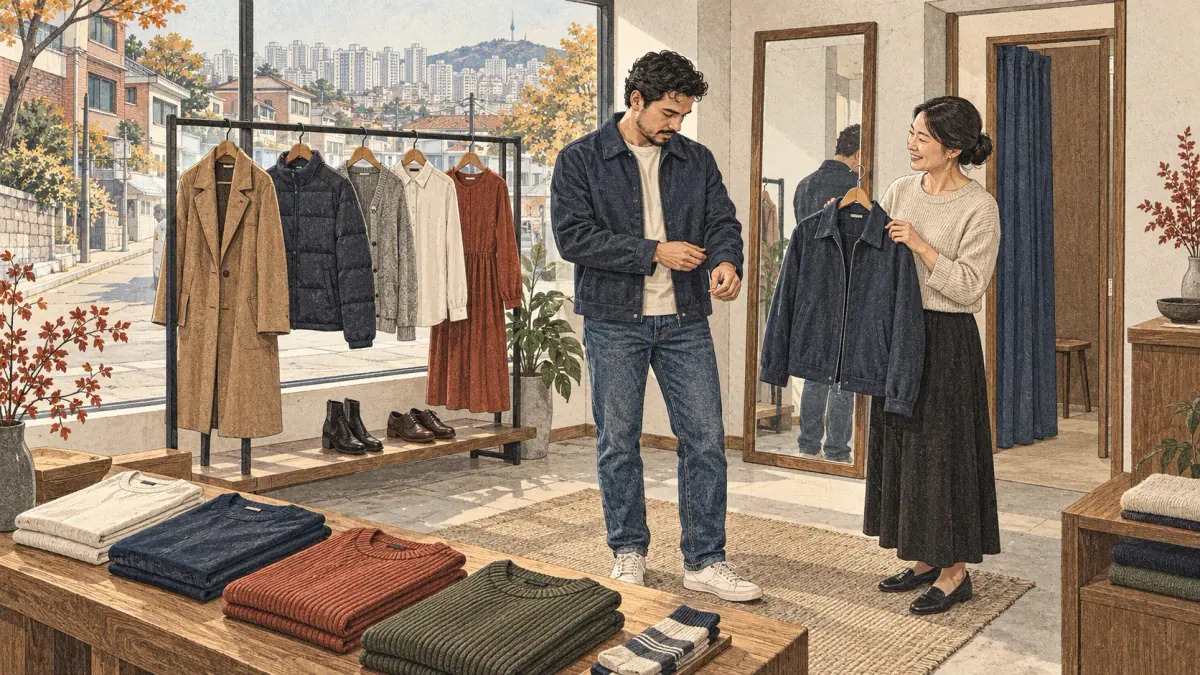
At 8 to 10 words a day, the list takes five to six days plus review. This scene puts eight of the words on one picture.
Word · 8
- 1
옷
ot
clothes
- 2
맨투맨
maentumaen
crewneck sweatshirt
- 3
청바지
cheongbaji
jeans
- 4
외투
oetu
overcoat
- 5
신발
sinbal
shoes
- 6
양말
yangmal
socks
- 7
운동복
undongbok
sportswear
- 8
입어 보다
ibeo boda
to try on
The first group is tops.
Tops and Dresses
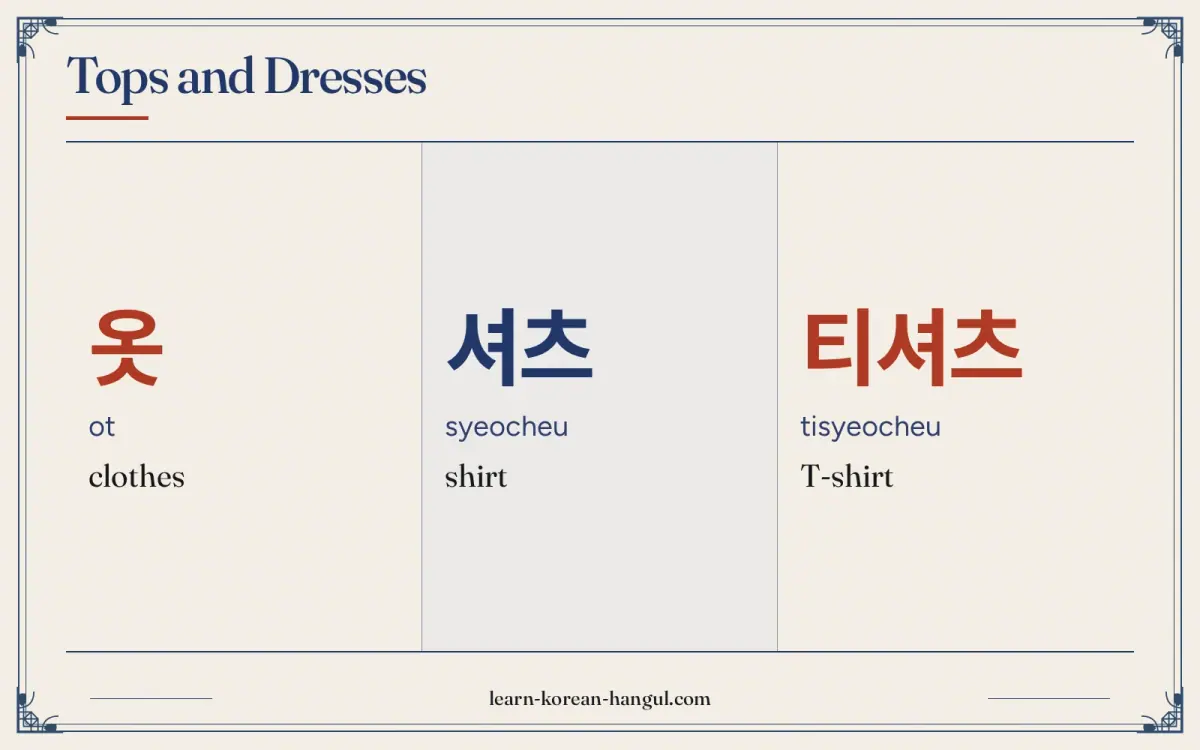
Tops are mostly loanwords: 셔츠, 티셔츠, 블라우스, 스웨터, 니트 and 후드티. The general word is 옷, and it means clothes in the plural sense: 옷이 많아요 means I have a lot of clothes. Native Korean gives you 조끼 (vest) and 민소매 (sleeveless top).
| No. | Hangul | Revised Romanization | Origin | Meaning | Example sentence | Audio assetId |
|---|---|---|---|---|---|---|
| 1 | 옷 | ot | native | clothes | 옷이 많아요. (I have a lot of clothes.) | au-pg-vocabulary-daily-life-clothing-1; example: au-pg-vocabulary-daily-life-clothing-51 |
| 2 | 셔츠 | syeocheu | loanword | shirt | 셔츠를 입어요. (I wear a shirt.) | au-pg-vocabulary-daily-life-clothing-2; example: au-pg-vocabulary-daily-life-clothing-52 |
| 3 | 티셔츠 | tisyeocheu | loanword | T-shirt | 티셔츠가 편해요. (The T-shirt is comfortable.) | au-pg-vocabulary-daily-life-clothing-3; example: au-pg-vocabulary-daily-life-clothing-53 |
| 4 | 블라우스 | beullauseu | loanword | blouse | 블라우스가 예뻐요. (The blouse is pretty.) | au-pg-vocabulary-daily-life-clothing-4; example: au-pg-vocabulary-daily-life-clothing-54 |
| 5 | 스웨터 | seuweteo | loanword | sweater | 스웨터가 따뜻해요. (The sweater is warm.) | au-pg-vocabulary-daily-life-clothing-5; example: au-pg-vocabulary-daily-life-clothing-55 |
| 6 | 니트 | niteu | loanword | knitwear | 니트가 부드러워요. (The knitwear is soft.) | au-pg-vocabulary-daily-life-clothing-6; example: au-pg-vocabulary-daily-life-clothing-56 |
| 7 | 맨투맨 | maentumaen | loanword | crewneck sweatshirt | 맨투맨을 자주 입어요. (I often wear a sweatshirt.) | au-pg-vocabulary-daily-life-clothing-7; example: au-pg-vocabulary-daily-life-clothing-57 |
| 8 | 후드티 | hudeuti | loanword | hoodie | 후드티를 입고 싶어요. (I want to wear a hoodie.) | au-pg-vocabulary-daily-life-clothing-8; example: au-pg-vocabulary-daily-life-clothing-58 |
| 9 | 조끼 | jokki | native | vest | 조끼를 입어요. (I wear a vest.) | au-pg-vocabulary-daily-life-clothing-9; example: au-pg-vocabulary-daily-life-clothing-59 |
| 10 | 민소매 | minsomae | native | sleeveless top | 여름에 민소매를 입어요. (I wear sleeveless tops in summer.) | au-pg-vocabulary-daily-life-clothing-10; example: au-pg-vocabulary-daily-life-clothing-60 |
| 11 | 원피스 | wonpiseu | loanword | dress (one-piece) | 원피스가 잘 어울려요. (The dress suits you well.) | au-pg-vocabulary-daily-life-clothing-11; example: au-pg-vocabulary-daily-life-clothing-61 |
Some of these words are Konglish, which means an English word that Korean has changed. 맨투맨 sounds like man-to-man, but it means a crewneck sweatshirt, and no English speaker would guess that. 후드티 is hood + T-shirt, and it means a hoodie.
Example Sentences
Each example is a short polite sentence. Most follow the pattern item + 을/를 + 입어요 (wear) or item + 이/가 + descriptive word. Say each sentence aloud and swap the item. Replace 셔츠 in 셔츠를 입어요 with 블라우스 and you get 블라우스를 입어요. Use 를 after a vowel and 을 after a final consonant, so 스웨터를 입어요 but 옷을 입어요.
Before the next group, the verb choice deserves its own table.
Which Verb Goes with Which Piece of Clothing?
Korean uses 입다 for clothes on the body, 신다 for things on the feet, 쓰다 for things on the head or face, 끼다 for tight-fitting things on the hands and 매다 for things that you tie. The opposite verb for taking clothes off is 벗다. English uses wear for all of these. Verbs are covered in full in the common verbs lesson, so the table gives only the polite present forms.
| Verb | Polite present | Used with | Example |
|---|---|---|---|
| 입다 | 입어요 | shirts, trousers, dresses, coats, hanbok | 코트를 입어요 (I wear a coat) |
| 신다 | 신어요 | shoes, socks, boots, slippers | 양말을 신어요 (I wear socks) |
| 쓰다 | 써요 | hats, glasses | 모자를 써요 (I wear a hat) |
| 끼다 | 껴요 | gloves, rings | 장갑을 껴요 (I wear gloves) |
| 매다 | 매요 | ties, belts | 넥타이를 매요 (I wear a tie) |
| 벗다 | 벗어요 | any of the above, to take off | 신발을 벗어요 (I take off my shoes) |
The accessory verbs 쓰다, 끼다 and 매다 are covered with their nouns on the Korean Accessories and Jewelry Vocabulary page. Take care with 입다 and 신다: both mean wear, but you must pick the right one for each item. The next group is bottoms.
How Do You Say Bottoms in Korean?
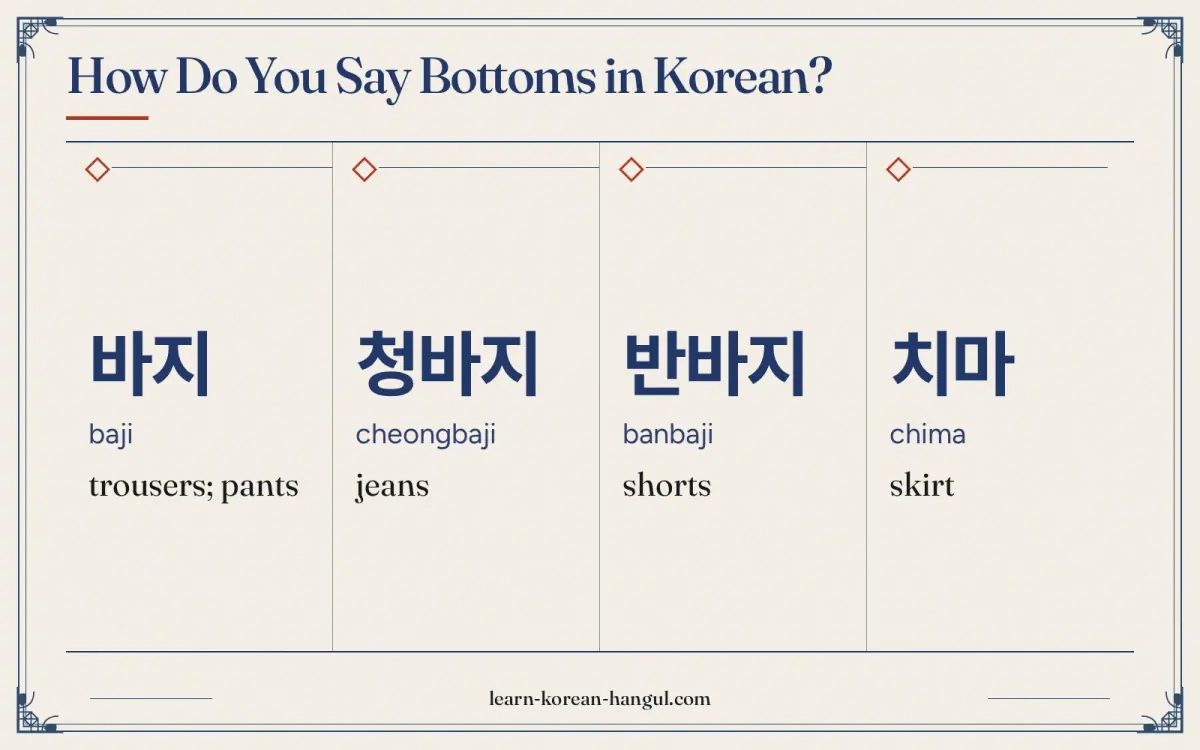
The general word for trousers is 바지, and a skirt is 치마. Add a first element to specify the type: 청바지 (jeans, from 청 for blue and 바지) and 반바지 (shorts, from 반 for half and 바지). Loanwords cover 레깅스 and 미니스커트.
| No. | Hangul | Revised Romanization | Origin | Meaning | Example sentence | Audio assetId |
|---|---|---|---|---|---|---|
| 12 | 바지 | baji | native | trousers; pants | 바지가 길어요. (The trousers are long.) | au-pg-vocabulary-daily-life-clothing-12; example: au-pg-vocabulary-daily-life-clothing-62 |
| 13 | 청바지 | cheongbaji | mixed | jeans | 청바지를 자주 입어요. (I often wear jeans.) | au-pg-vocabulary-daily-life-clothing-13; example: au-pg-vocabulary-daily-life-clothing-63 |
| 14 | 반바지 | banbaji | mixed | shorts | 여름에 반바지를 입어요. (I wear shorts in summer.) | au-pg-vocabulary-daily-life-clothing-14; example: au-pg-vocabulary-daily-life-clothing-64 |
| 15 | 치마 | chima | native | skirt | 치마가 짧아요. (The skirt is short.) | au-pg-vocabulary-daily-life-clothing-15; example: au-pg-vocabulary-daily-life-clothing-65 |
| 16 | 레깅스 | regingseu | loanword | leggings | 레깅스가 편해요. (The leggings are comfortable.) | au-pg-vocabulary-daily-life-clothing-16; example: au-pg-vocabulary-daily-life-clothing-66 |
| 17 | 미니스커트 | miniseukeoteu | loanword | miniskirt | 미니스커트는 짧아요. (A miniskirt is short.) | au-pg-vocabulary-daily-life-clothing-17; example: au-pg-vocabulary-daily-life-clothing-67 |
The pattern 반 + noun works for other items. A 반팔 is a short-sleeve top and a 긴팔 is a long-sleeve top. Both are useful when you shop for a shirt. The next group is clothing for the cold.
Outerwear
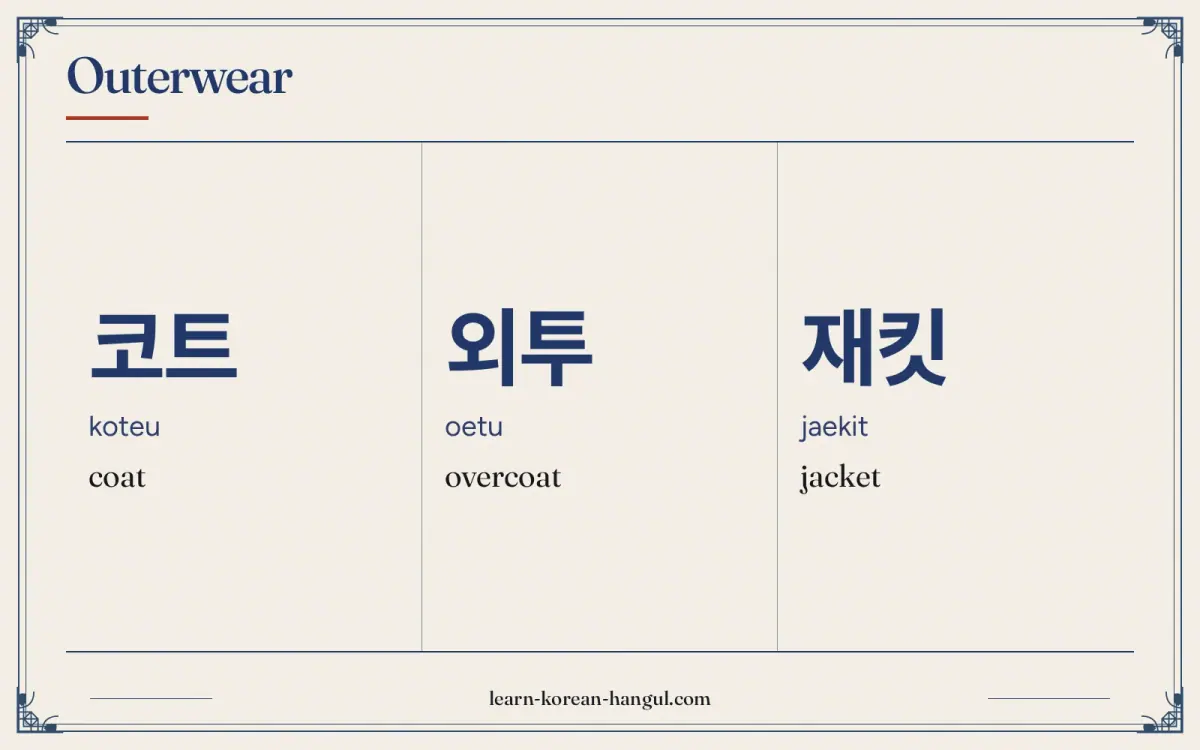
Outerwear words are almost all loanwords, so 코트, 재킷, 점퍼, 패딩 and 카디건 are easy to read. The Sino-Korean word 외투 also means overcoat and is more formal than 코트. A 정장 is a suit or formal wear, and Koreans wear one to interviews.
| No. | Hangul | Revised Romanization | Origin | Meaning | Example sentence | Audio assetId |
|---|---|---|---|---|---|---|
| 18 | 코트 | koteu | loanword | coat | 겨울에 코트를 입어요. (I wear a coat in winter.) | au-pg-vocabulary-daily-life-clothing-18; example: au-pg-vocabulary-daily-life-clothing-68 |
| 19 | 외투 | oetu | Sino-Korean | overcoat | 외투를 벗어요. (I take off my overcoat.) | au-pg-vocabulary-daily-life-clothing-19; example: au-pg-vocabulary-daily-life-clothing-69 |
| 20 | 재킷 | jaekit | loanword | jacket | 재킷이 잘 맞아요. (The jacket fits well.) | au-pg-vocabulary-daily-life-clothing-20; example: au-pg-vocabulary-daily-life-clothing-70 |
| 21 | 점퍼 | jeompeo | loanword | jumper; windbreaker | 점퍼가 가벼워요. (The jumper is light.) | au-pg-vocabulary-daily-life-clothing-21; example: au-pg-vocabulary-daily-life-clothing-71 |
| 22 | 패딩 | paeding | loanword | padded jacket | 패딩이 따뜻해요. (The padded jacket is warm.) | au-pg-vocabulary-daily-life-clothing-22; example: au-pg-vocabulary-daily-life-clothing-72 |
| 23 | 정장 | jeongjang | Sino-Korean | suit; formal wear | 면접에 정장을 입어요. (I wear a suit to an interview.) | au-pg-vocabulary-daily-life-clothing-23; example: au-pg-vocabulary-daily-life-clothing-73 |
| 24 | 카디건 | kadigeon | loanword | cardigan | 카디건을 걸쳐요. (I throw on a cardigan.) | au-pg-vocabulary-daily-life-clothing-24; example: au-pg-vocabulary-daily-life-clothing-74 |
Spelling is a trap here. 재킷 is the standard spelling of jacket in the National Institute of Korean Language rules, and you will also see 자켓 on signs. The same applies to 카디건, which is often written 가디건. The standard spelling is the one in school and exams. The next group is footwear.
How Do You Say Shoes and Socks in Korean?
The general word for shoes is 신발, and the word for socks is 양말. The nouns for each type are 운동화 (sneakers), 구두 (dress shoes), 샌들, 슬리퍼 and 부츠. The verb for putting them on is 신다, and the verb for taking them off is 벗다.
| No. | Hangul | Revised Romanization | Origin | Meaning | Example sentence | Audio assetId |
|---|---|---|---|---|---|---|
| 25 | 신발 | sinbal | native | shoes | 현관에서 신발을 벗어요. (I take off my shoes at the entrance.) | au-pg-vocabulary-daily-life-clothing-25; example: au-pg-vocabulary-daily-life-clothing-75 |
| 26 | 운동화 | undonghwa | Sino-Korean | sneakers | 운동화가 편해요. (The sneakers are comfortable.) | au-pg-vocabulary-daily-life-clothing-26; example: au-pg-vocabulary-daily-life-clothing-76 |
| 27 | 구두 | gudu | old loanword | dress shoes | 구두를 닦아요. (I polish my dress shoes.) | au-pg-vocabulary-daily-life-clothing-27; example: au-pg-vocabulary-daily-life-clothing-77 |
| 28 | 샌들 | saendeul | loanword | sandals | 여름에는 샌들이 시원해요. (Sandals are cool in summer.) | au-pg-vocabulary-daily-life-clothing-28; example: au-pg-vocabulary-daily-life-clothing-78 |
| 29 | 슬리퍼 | seullipeo | loanword | slippers | 집에서는 슬리퍼를 신어요. (I wear slippers at home.) | au-pg-vocabulary-daily-life-clothing-29; example: au-pg-vocabulary-daily-life-clothing-79 |
| 30 | 부츠 | bucheu | loanword | boots | 겨울에 부츠를 신어요. (I wear boots in winter.) | au-pg-vocabulary-daily-life-clothing-30; example: au-pg-vocabulary-daily-life-clothing-80 |
| 31 | 양말 | yangmal | Sino-Korean | socks | 양말이 젖었어요. (The socks got wet.) | au-pg-vocabulary-daily-life-clothing-31; example: au-pg-vocabulary-daily-life-clothing-81 |
| 32 | 스타킹 | seutaking | loanword | stockings; tights | 스타킹이 얇아요. (The tights are thin.) | au-pg-vocabulary-daily-life-clothing-32; example: au-pg-vocabulary-daily-life-clothing-82 |
Korean homes have a rule that shoes come off at the entrance, the 현관, and slippers or socks go on. That is why 슬리퍼 is a common word and why 신발을 벗어요 is one of the first sentences a visitor hears. The next group covers what is under your outer clothes.
Underwear and Sleepwear
속옷 is underwear and 잠옷 is pajamas. Both are native Korean words that end in 옷 (clothes). 수영복 and 운동복 are Sino-Korean words that end in the suffix 복 (clothes), the same suffix as in 한복 and 교복.
| No. | Hangul | Revised Romanization | Origin | Meaning | Example sentence | Audio assetId |
|---|---|---|---|---|---|---|
| 33 | 속옷 | sogot | native | underwear | 속옷을 사요. (I buy underwear.) | au-pg-vocabulary-daily-life-clothing-33; example: au-pg-vocabulary-daily-life-clothing-83 |
| 34 | 팬티 | paenti | loanword | underpants | 팬티는 속옷이에요. (Underpants are underwear.) | au-pg-vocabulary-daily-life-clothing-34; example: au-pg-vocabulary-daily-life-clothing-84 |
| 35 | 잠옷 | jamot | native | pajamas | 잠옷을 입고 자요. (I sleep in pajamas.) | au-pg-vocabulary-daily-life-clothing-35; example: au-pg-vocabulary-daily-life-clothing-85 |
| 36 | 수영복 | suyeongbok | Sino-Korean | swimsuit | 수영복을 챙겨요. (I pack my swimsuit.) | au-pg-vocabulary-daily-life-clothing-36; example: au-pg-vocabulary-daily-life-clothing-86 |
| 37 | 운동복 | undongbok | Sino-Korean | sportswear | 운동복으로 갈아입어요. (I change into sportswear.) | au-pg-vocabulary-daily-life-clothing-37; example: au-pg-vocabulary-daily-life-clothing-87 |
Notice that 옷 is a stand-alone word and 복 is a suffix. You can say 옷 alone, but you cannot say 복 alone for clothes. The suffix 복 forms the names of special clothes. The next group is for shopping.
How Do You Say Sizes and Fit in Korean?
Ask for a size with 사이즈 and a descriptive word: 큰 사이즈 (larger size) and 작은 사이즈 (smaller size). The full sentence in a shop is 이거 작은 사이즈 있어요?, which means do you have this in a smaller size. To try something on, say 입어 봐도 돼요?
| No. | Hangul | Revised Romanization | Origin | Meaning | Example sentence | Audio assetId |
|---|---|---|---|---|---|---|
| 38 | 사이즈 | saijeu | loanword | size | 사이즈가 어떻게 되세요? (What size are you?) | au-pg-vocabulary-daily-life-clothing-38; example: au-pg-vocabulary-daily-life-clothing-88 |
| 39 | 큰 사이즈 | keun saijeu | phrase | a larger size | 큰 사이즈 있어요? (Do you have a larger size?) | au-pg-vocabulary-daily-life-clothing-39; example: au-pg-vocabulary-daily-life-clothing-89 |
| 40 | 작은 사이즈 | jageun saijeu | phrase | a smaller size | 이거 작은 사이즈 있어요? (Do you have this in a smaller size?) | au-pg-vocabulary-daily-life-clothing-40; example: au-pg-vocabulary-daily-life-clothing-90 |
| 41 | 헐렁하다 | heolleonghada | adjective | to be loose | 바지가 헐렁해요. (The trousers are loose.) | au-pg-vocabulary-daily-life-clothing-41; example: au-pg-vocabulary-daily-life-clothing-91 |
| 42 | 꽉 끼다 | kkwak kkida | verb phrase | to be tight | 셔츠가 꽉 껴요. (The shirt is tight.) | au-pg-vocabulary-daily-life-clothing-42; example: au-pg-vocabulary-daily-life-clothing-92 |
| 43 | 입어 보다 | ibeo boda | verb phrase | to try on | 입어 봐도 돼요? (May I try it on?) | au-pg-vocabulary-daily-life-clothing-43; example: au-pg-vocabulary-daily-life-clothing-93 |
The two fit verbs are 헐렁하다 (loose) and 꽉 끼다 (tight). They end in 해요 and 껴요 when you speak: 바지가 헐렁해요 and 셔츠가 꽉 껴요. If you want a word for just right, use 맞아요, as in 사이즈가 잘 맞아요 (the size fits well). The phrases for shopping are on the shopping phrases page. The last group is traditional dress.
Hanbok and Uniforms
한복 is the traditional Korean dress. A woman's set is the 치마저고리, a skirt (치마) with a jacket (저고리), and a man's set has a 저고리 with 바지. A 두루마기 overcoat goes on top for going out, and 버선 are the cloth socks worn with hanbok. 교복 is a school uniform, and 유니폼 is a work or team uniform.
| No. | Hangul | Revised Romanization | Origin | Meaning | Example sentence | Audio assetId |
|---|---|---|---|---|---|---|
| 44 | 한복 | hanbok | Sino-Korean | hanbok (traditional Korean clothes) | 명절에 한복을 입어요. (I wear hanbok on traditional holidays.) | au-pg-vocabulary-daily-life-clothing-44; example: au-pg-vocabulary-daily-life-clothing-94 |
| 45 | 저고리 | jeogori | native | jeogori (hanbok jacket) | 저고리가 예뻐요. (The jeogori is pretty.) | au-pg-vocabulary-daily-life-clothing-45; example: au-pg-vocabulary-daily-life-clothing-95 |
| 46 | 치마저고리 | chimajeogori | native | women's hanbok set (skirt and jacket) | 치마저고리를 입어요. (I wear a skirt-and-jacket hanbok.) | au-pg-vocabulary-daily-life-clothing-46; example: au-pg-vocabulary-daily-life-clothing-96 |
| 47 | 두루마기 | durumagi | native | hanbok overcoat | 두루마기는 겨울에 입어요. (The durumagi is worn in winter.) | au-pg-vocabulary-daily-life-clothing-47; example: au-pg-vocabulary-daily-life-clothing-97 |
| 48 | 버선 | beoseon | native | traditional cloth socks | 버선을 신어요. (I wear beoseon socks.) | au-pg-vocabulary-daily-life-clothing-48; example: au-pg-vocabulary-daily-life-clothing-98 |
| 49 | 교복 | gyobok | Sino-Korean | school uniform | 학교에서 교복을 입어요. (I wear a school uniform at school.) | au-pg-vocabulary-daily-life-clothing-49; example: au-pg-vocabulary-daily-life-clothing-99 |
| 50 | 유니폼 | yunipom | loanword | uniform | 유니폼을 입고 일해요. (I work in a uniform.) | au-pg-vocabulary-daily-life-clothing-50; example: au-pg-vocabulary-daily-life-clothing-100 |
Koreans wear hanbok on 명절 (traditional holidays) such as Seollal and Chuseok, at weddings and when visiting palaces. The word 한복 can also be used for the modern, simplified style. See the hanbok vocabulary page for the full list of parts. The difference between 교복 (uniform for school) and 제복 (uniform for officials) is a fine point: 교복 means school uniform only.
How Do You Pronounce These Words?
Most clothing words follow the spelling, but the final ㅅ in 옷 and the way syllables link together change the sound. The table shows six cases.
| Spelling | Pronunciation | What happens |
|---|---|---|
| 옷 | [옫] | Final ㅅ is said as [ㄷ] when nothing follows |
| 속옷 | [소곧] | The final ㄱ links to the vowel of 옷, and final ㅅ becomes [ㄷ] |
| 잠옷 | [자몯] | The final ㅁ links to the vowel of 옷, and final ㅅ becomes [ㄷ] |
| 입어 보다 | [이버 보다] | The final ㅂ links to the vowel of 어 |
| 외투 | [외투/웨투] | The vowel ㅚ may be said as [we] |
| 꽉 끼다 | [꽉 끼다] | Both syllables start with tense ㄲ, and the final ㄱ of 꽉 is an unreleased [k] |
The rules come from the Standard Pronunciation rules (표준 발음법) of the 국립국어원. The audio is generated with text-to-speech and checked by a Korean teacher before publication.
Audio and Slow Playback
Each word has a normal clip, and 5 key words also have a slow clip at 0.8 times the speed: 옷, 티셔츠, 운동화, 잠옷 and 한복. Nothing plays until you press a button.
Listen to 옷 first. You should hear a short [옫] with the tongue stopping on the ridge behind the teeth.
What Mistakes Do Learners Make with Clothing Words?
- Using 입다 for everything. Say 모자를 써요, 신발을 신어요 and 장갑을 껴요. 입다 only fits clothes on the body.
- Pronouncing 옷 with the final ㅅ as s. The spoken form is [옫], and the ㅅ returns only when a vowel follows: 옷이 [오시].
- Trusting English meanings of Konglish words. 맨투맨 is a sweatshirt, and 원피스 is a dress, not a one-piece swimsuit.
- Writing 자켓. The standard spelling is 재킷.
- Mixing up 교복 and 제복. 교복 is a school uniform, and 제복 is an official's uniform.
The first mistake is the one that changes the meaning most, because English has no such division. The next section turns the list into practice.
Practice: Flashcards and Worksheet
Drill these words with the vocabulary flashcard decks. A printable worksheet for these words (word list, matching, writing practice, fill-in-the-blank exercises and answer key) is available in A4 and US Letter from the download card on this page. Progress in the decks is saved only in your browser.
Korean Clothing Worksheet
Try this five-question check, then say the 50 words aloud once more.
Practice · 5
What does 옷 mean?
Show answer
clothes
옷 (ot) means clothes.
What does 바지 mean?
Show answer
trousers; pants
바지 (baji) means trousers; pants.
What does 정장 mean?
Show answer
suit; formal wear
정장 (jeongjang) means suit; formal wear.
What does 양말 mean?
Show answer
socks
양말 (yangmal) means socks.
What does 꽉 끼다 mean?
Show answer
to be tight
꽉 끼다 (kkwak kkida) means to be tight.
Where to Go Next
After the Korean clothing vocabulary, open Korean Accessories and Jewelry Vocabulary to add rings, bags, hats and glasses. If you shop in Korea, the shopping phrases page puts the size words into whole questions. The House and Home and Daily Routines lists are the next daily-life topics.
Pages in This Section
One page sits below Clothing.
- Korean Accessories and Jewelry Vocabulary: 30 words in five groups for jewelry, bags, hats, glasses, watches and hair accessories. It has a table of the verbs that go with each item (끼다, 쓰다, 차다, 매다) and a note on 목도리 versus 스카프. Level A2.
Frequently Asked Questions
How Do You Say Clothes in Korean?
Clothes is 옷 (ot). It is said [옫], with a short stop at the end, and it becomes [오시] when a vowel follows, as in 옷이 예뻐요. To say you wear clothes, use 옷을 입어요 (oseul ibeoyo). For a particular item, name it and keep 입어요: 코트를 입어요 means I wear a coat.
How Do You Pronounce 코트 (koteu)?
코트 is said ko-teu, in two beats. The first syllable 코 starts with an aspirated ㅋ, a k with a puff of air. The second syllable 트 starts with an aspirated ㅌ and ends in the vowel ㅡ, which is said with the lips spread and not rounded. Press the audio button and repeat.
How Many Clothing Words Should I Learn First?
Learn about 20 first: 옷, the main tops and bottoms, 코트, 신발, 양말, 운동화 and the six sizes and fit words. That is two to three days at 8 to 10 words a day. Add underwear, sleepwear and hanbok afterwards, and then review all 50 with the flashcards.
Where Can I Practise Clothing Words with Flashcards?
Use the vocabulary flashcard decks, which list every deck with audio. A deck for these words is planned. Progress stays in your browser. The accessories page has a second list that overlaps with this one, so review the two lists together for the best result.
Is the Romanization on This Page Official?
It follows the Revised Romanization of Korean, which South Korea officially adopted on 7 July 2000 and whose rules the National Institute of Korean Language (국립국어원) publishes. It is a learning aid that does not mark every sound change, so learn the Hangul and use the audio to hear the real sound.
Is There a Printable Worksheet for Clothing Words?
A printable worksheet for these words (word list, matching, writing practice, fill-in-the-blank exercises and answer key) is available in A4 and US Letter from the download card on this page. For practice, copy the tables above by hand: write the Hangul, cover the English column, and check your answers against the page.