What you will be able to do after this lesson
- Say 25 verbs in pairs and give the polite present of each.
- Tell complementary pairs from pairs that depend on perspective, such as 가다 and 오다.
- Join a pair in one sentence with -고 or -아/어서.
- Spot the irregular verbs hiding in the pairs: 열다, 팔다, 울다, 끄다 and 묻다.
Before you start: read how Korean conjugation works, because the pair tables show the polite present. Time: about 35 minutes. Level: A1.
Which Korean Verbs Are Opposites?
Korean verbs are opposites when one undoes, reverses or mirrors the other: 열다 opens what 닫다 closes. Learning them as pairs helps, because the second verb arrives with a ready-made meaning contrast, and you review both every time you meet one. Not every pair is a perfect opposite, so the tables have a pair-type column.
The 25 pairs fall into four groups, and each group has its own section.
| Group | Pairs | Idea |
|---|---|---|
| Opening, closing and switching | 6 | Actions on objects: open, turn on, put in, raise, fill, start |
| Exchange | 5 | Two sides of one transaction: buy and sell, give and receive |
| Body, clothes and position | 5 | Wearing, sitting, waking, laughing, holding |
| Movement, meeting and results | 9 | Going, arriving, meeting, winning, finding |
The pair type tells you how strictly the two verbs oppose each other. A complementary pair has two states with nothing in between (열다 and 닫다). A converse pair describes one event from two sides (사다 and 팔다). A directional pair has two directions (올라가다 and 내려가다). A perspective pair depends on where the speaker stands (가다 and 오다). Partial and subject-dependent pairs are looser, and a later section explains them.
Every verb below is shown with its dictionary form, its Revised Romanization (a learning aid, not a spelling) and its polite present. Use the dictionary links where they exist to see every form of a verb. The first group is about doing things to objects.
Opening, Closing and Switching Pairs
These six pairs act on objects and have the clearest contrast. Most take an object marked with the particle 을/를 (문을, 불을), which is why the example sentences all contain an object.
| Pair | Meaning | Polite present | Class | Pair type |
|---|---|---|---|---|
| 열다 (yeolda) / 닫다 (datda) | to open / to close | 열어요 / 닫아요 | ㄹ-drop / regular | complementary |
| 켜다 (kyeoda) / 끄다 (kkeuda) | to turn on / to turn off | 켜요 / 꺼요 | regular / ㅡ-drop | complementary |
| 넣다 (neota) / 꺼내다 (kkeonaeda) | to put in / to take out | 넣어요 / 꺼내요 | regular / regular | directional |
| 올리다 (ollida) / 내리다 (naerida) | to raise / to lower | 올려요 / 내려요 | regular / regular | directional |
| 채우다 (chaeuda) / 비우다 (biuda) | to fill / to empty | 채워요 / 비워요 | regular / regular | complementary |
| 시작하다 (sijakada) / 끝내다 (kkeunnaeda) | to start / to finish | 시작해요 / 끝내요 | 하다 / regular | complementary |
Two pairs need extra care. First, 켜다 and 끄다 are the verbs for lights, screens and machines, so you say 불을 켜요, 텔레비전을 켜요 and 컴퓨터를 꺼요. The verb 끄다 drops its ㅡ before 어, which is why it becomes 꺼요 and not 끄어요. Second, 시작하다 has the 하다 pattern, while its partner 끝내다 does not, so the two verbs conjugate differently even though they are a pair.
- 문을 열어요. 문을 닫아요. (I open the door. I close the door.)
- 불을 켜요. 불을 꺼요. (I turn on the light. I turn off the light.)
- 가방에 책을 넣어요. 가방에서 책을 꺼내요. (I put a book in the bag. I take a book out of the bag.)
- 가게가 값을 올려요. 가게가 값을 내려요. (The shop raises the price. The shop lowers the price.)
- 컵을 채워요. 컵을 비워요. (I fill the cup. I empty the cup.)
- 수업을 시작해요. 수업을 끝내요. (I start the class. I finish the class.)
The verb 내리다 appears in this group as the partner of 올리다, and it appears again later as the partner of 타다. In the first pair it means "to lower" and takes an object (값을 내려요, "I lower the price"). In the second pair it means "to get off" and takes 에서 (버스에서 내려요). It also means "to fall" for rain and snow: 비가 내려요. The meaning is clear from the noun next to it. The next group moves from objects to people exchanging them.
Exchange Pairs
Exchange pairs describe the two sides of one transaction, and Korean uses a different verb for each side. English also has separate verbs for each side, but learners still mix up the sides, because in Korean the particles must match the verb. Borrowing and lending show this well: 빌리다 is to borrow and 빌려주다 is to lend.
| Pair | Meaning | Polite present | Class | Pair type |
|---|---|---|---|---|
| 사다 (sada) / 팔다 (palda) | to buy / to sell | 사요 / 팔아요 | regular / ㄹ-drop | converse |
| 주다 (juda) / 받다 (batda) | to give / to receive | 줘요 / 받아요 | regular / regular | converse |
| 빌리다 (billida) / 빌려주다 (billyeojuda) | to borrow / to lend | 빌려요 / 빌려줘요 | regular / regular | converse |
| 가르치다 (gareuchida) / 배우다 (baeuda) | to teach / to learn | 가르쳐요 / 배워요 | regular / regular | converse |
| 묻다 (mutda) / 대답하다 (daedapada) | to ask / to answer | 물어요 / 대답해요 | ㄷ irregular / 하다 | converse |
These pairs are called converse pairs, because the same event is described from the other person's side. If I sell you bread, you buy bread from me. The particles show the direction. In 친구에게 선물을 줘요, 에게 marks the person who receives. In 친구에게서 선물을 받아요, 에게서 marks the person the present comes from. For 빌리다 and 빌려주다, both sentences use 에게, so the verb carries the direction: borrowing is from a friend, and lending is to a friend.
- 가게에서 빵을 사요. 가게에서 빵을 팔아요. (I buy bread at the shop. They sell bread at the shop.)
- 친구에게 선물을 줘요. 친구에게서 선물을 받아요. (I give a present to a friend. I receive a present from a friend.)
- 친구에게 책을 빌려요. 친구에게 책을 빌려줘요. (I borrow a book from a friend. I lend a book to a friend.)
- 선생님이 한국어를 가르쳐요. 저는 한국어를 배워요. (The teacher teaches Korean. I learn Korean.)
- 선생님이 물어요. 학생이 대답해요. (The teacher asks. The student answers.)
Watch the ask and answer pair. The verb 묻다 means "to ask" and is a ㄷ-irregular verb, so its polite present is 물어요. A different verb with the same spelling, 묻다, means "to bury" and is regular (묻어요). The meaning comes from the sentence, and the ㄷ irregular page explains the rule. Next come the verbs of the body and of position.
Body, Clothes and Position Pairs
Body pairs name actions of the body that reverse each other or contrast. Three are neat opposites: 입다 and 벗다, 웃다 and 울다, 잡다 and 놓다. Two are looser: 앉다 and 서다, and 자다 and 일어나다.
| Pair | Meaning | Polite present | Class | Pair type |
|---|---|---|---|---|
| 입다 (ipda) / 벗다 (beotda) | to put on, to wear / to take off | 입어요 / 벗어요 | regular / regular | complementary |
| 앉다 (anda) / 서다 (seoda) | to sit / to stand | 앉아요 / 서요 | regular / regular | partial |
| 자다 (jada) / 일어나다 (ireonada) | to sleep / to get up | 자요 / 일어나요 | regular / regular | partial |
| 웃다 (utda) / 울다 (ulda) | to laugh, to smile / to cry | 웃어요 / 울어요 | regular / ㄹ-drop | complementary |
| 잡다 (japda) / 놓다 (nota) | to hold, to grab / to let go, to put down | 잡아요 / 놓아요 | regular / regular | complementary |
Choose the pair by the situation, not by a single word. 입다 and 벗다 cover clothes on the body, and for shoes, hats and rings the pair changes, as the verbs for wearing clothes page explains. The verb 울다 is a ㄹ-drop verb: the ㄹ disappears before ㄴ, ㅂ and ㅅ, so a crying baby is 우는 아기 ("a crying baby") and not 울는 아기. See the ㄹ irregular page for the full rule.
- 코트를 입어요. 코트를 벗어요. (I put on a coat. I take off a coat.)
- 의자에 앉아요. 문 앞에 서요. (I sit on the chair. I stand in front of the door.)
- 밤에 일찍 자요. 아침에 일찍 일어나요. (I go to bed early at night. I get up early in the morning.)
- 아기가 웃어요. 아기가 울어요. (The baby laughs. The baby cries.)
- 손을 잡아요. 손을 놓아요. (I hold his hand. I let go of his hand.)
Some of these verbs sound different from how they are spelled. After these final consonants, the plain ㄷ of 다 is tensed in speech: 닫다 is said [닫따], 앉다 [안따], 벗다 [벋따], 웃다 [욷따] and 입다 [입따]. Revised Romanization does not show the tensing, so the romanization is datda, anda, beotda, utda and ipda. This follows the standard pronunciation rules of the National Institute of Korean Language (국립국어원). The last group covers movement and results.
Movement, Meeting and Results Pairs
Movement pairs have a direction, and some depend on where the speaker is standing. This group has nine pairs, the largest, because it includes the verbs learners meet in every conversation.
| Pair | Meaning | Polite present | Class | Pair type |
|---|---|---|---|---|
| 가다 (gada) / 오다 (oda) | to go / to come | 가요 / 와요 | regular / regular | perspective |
| 들어가다 (deureogada) / 나오다 (naoda) | to go in / to come out | 들어가요 / 나와요 | regular / regular | perspective |
| 올라가다 (ollagada) / 내려가다 (naeryeogada) | to go up / to go down | 올라가요 / 내려가요 | regular / regular | directional |
| 타다 (tada) / 내리다 (naerida) | to ride, to get on / to get off | 타요 / 내려요 | regular / regular | directional |
| 출발하다 (chulbalhada) / 도착하다 (dochakada) | to depart / to arrive | 출발해요 / 도착해요 | 하다 / 하다 | complementary |
| 만나다 (mannada) / 헤어지다 (heeojida) | to meet / to part | 만나요 / 헤어져요 | regular / regular | complementary |
| 이기다 (igida) / 지다 (jida) | to win / to lose | 이겨요 / 져요 | regular / regular | subject-dependent |
| 찾다 (chatda) / 잃어버리다 (ireobeorida) | to find, to look for / to lose | 찾아요 / 잃어버려요 | regular / regular | partial |
| 가져오다 (gajyeooda) / 가져가다 (gajyeogada) | to bring / to take along | 가져와요 / 가져가요 | regular / regular | perspective |
The pair 가다 and 오다 is the best-known example of perspective. You go away from the speaker and come toward the speaker, so the same trip gets a different verb depending on who describes it. The go vs come page covers the rule in detail, including the cases where Korean says "come" and English says "go". The pairs 들어가다 and 나오다, and 가져오다 and 가져가다, follow the same logic.
- 학교에 가요. 우리 집에 와요. (I go to school. I come to our house.)
- 방에 들어가요. 방에서 나와요. (I go into the room. I come out of the room.)
- 계단을 올라가요. 계단을 내려가요. (I go up the stairs. I go down the stairs.)
- 버스를 타요. 버스에서 내려요. (I get on the bus. I get off the bus.)
- 기차가 열 시에 출발해요. 기차가 열한 시에 도착해요. (The train departs at ten. The train arrives at eleven.)
- 친구를 만나요. 친구와 헤어져요. (I meet a friend. I part from a friend.)
- 우리 팀이 이겨요. 상대 팀이 져요. (Our team wins. The other team loses.)
- 지갑을 찾았어요. 지갑을 잃어버렸어요. (I found my wallet. I lost my wallet.)
- 책을 가져와요. 책을 가져가요. (I bring the book here. I take the book away.)
Two items in this group deserve a closer look. The verb 찾다 means both "to look for" and "to find", and the past tense 찾았어요 is the natural word for "found". Its partner 잃어버리다 means "to lose by accident". The pair 이기다 and 지다 depends on the subject: in 우리 팀이 이겨요 the subject wins, and in 상대 팀이 져요 the subject loses, so you cannot swap the verbs without swapping the subject. A table of these looser pairs follows.
Are All Opposites True Opposites?
No. Some pairs reverse each other exactly, and others only contrast in one use. Knowing the type of pair prevents mistakes such as using 오다 where you need 가다. The table groups the 25 pairs by type and says what to watch.
| Pair type | What it means | Pairs on this page | What to watch |
|---|---|---|---|
| Complementary | Two states, nothing in between | 열다/닫다, 켜다/끄다, 채우다/비우다, 시작하다/끝내다, 입다/벗다, 웃다/울다, 잡다/놓다, 출발하다/도착하다, 만나다/헤어지다 | None; learn them as a unit |
| Converse | One event seen from two sides | 사다/팔다, 주다/받다, 빌리다/빌려주다, 가르치다/배우다, 묻다/대답하다 | The particle shows who gives and who receives |
| Directional | Opposite directions | 넣다/꺼내다, 올리다/내리다, 올라가다/내려가다, 타다/내리다 | The place particle changes: 에 or 에서 |
| Perspective | Depends on the speaker's position | 가다/오다, 들어가다/나오다, 가져오다/가져가다 | Which verb is right depends on where you are |
| Subject-dependent | Depends on which side is the subject | 이기다/지다 | Swap the subject when you swap the verb |
| Partial | The verbs oppose in one use only | 앉다/서다, 자다/일어나다, 찾다/잃어버리다 | 일어나다 also means "to stand up" and "to happen" |
A word about 앉다 and 서다. They are often taught as opposites because one is sitting and the other standing, but 눕다 (to lie down) is a third body position, so treat them as a contrast and not as a strict pair. The same care applies to 잊다 (to forget) and 기억하다 (to remember), which many lists give as opposites. They describe states of memory more than reversible actions, so this page leaves them out.
Which Pairs Have Irregular Forms?
Five of the verbs in these pairs are irregular, and they are worth practising because they show up in everyday sentences. The forms below were generated with the site's conjugation engine.
| Verb | Class | Polite present | Past | Present modifier | Why |
|---|---|---|---|---|---|
| 열다 | ㄹ-drop | 열어요 | 열었어요 | 여는 | ㄹ drops before ㄴ |
| 팔다 | ㄹ-drop | 팔아요 | 팔았어요 | 파는 | ㄹ drops before ㄴ |
| 울다 | ㄹ-drop | 울어요 | 울었어요 | 우는 | ㄹ drops before ㄴ |
| 끄다 | ㅡ-drop | 꺼요 | 껐어요 | 끄는 | ㅡ drops before 어 |
| 묻다 (ask) | ㄷ irregular | 물어요 | 물었어요 | 묻는 | ㄷ becomes ㄹ before a vowel |
The pair 열다 and 닫다 therefore has one irregular partner and one regular partner. You say 문을 여는 사람 ("a person who opens the door") but 문을 닫는 사람 ("a person who closes the door"). The ㅡ-drop rule is on the ㅡ irregular page. All other verbs in the pairs are regular or follow the 하다 pattern.
How Do You Use a Pair in One Sentence?
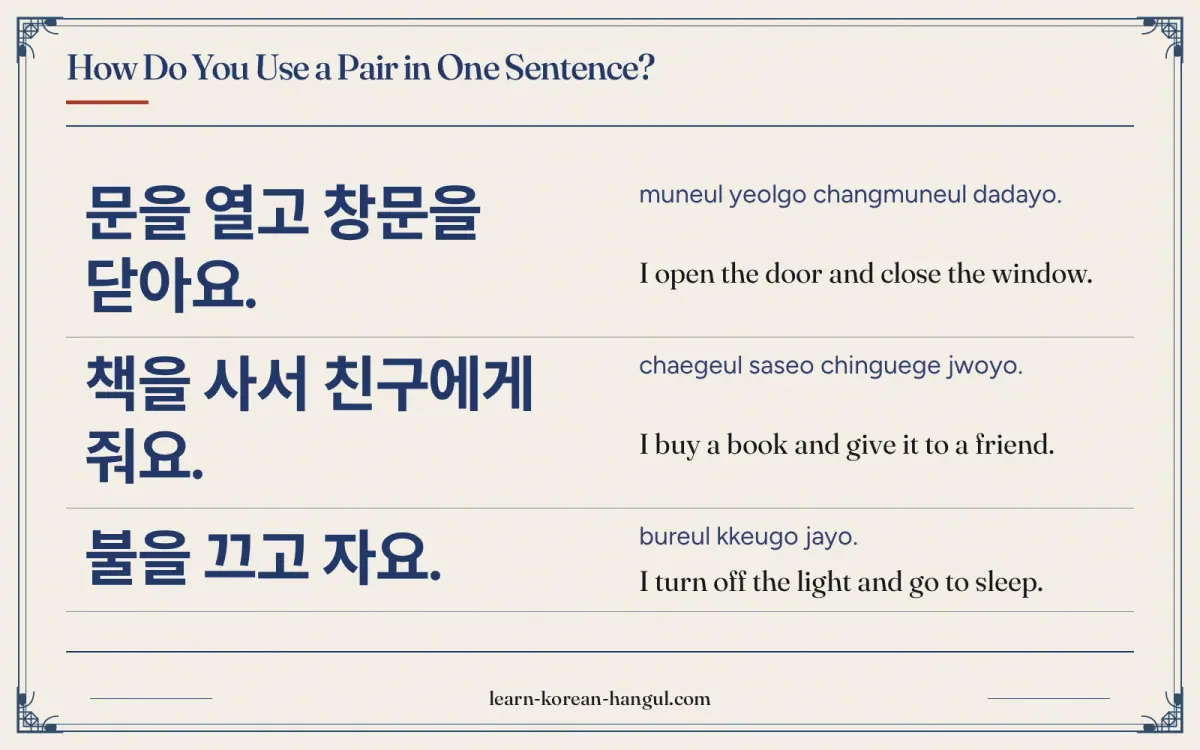
You can put both verbs of a pair in one sentence by joining them with -고 (and, then) or -아/어서 (and then, so). Use -고 for two actions of equal weight and -아/어서 when the first action leads into the second. Both attach to the verb stem, and -아/어서 takes the form from the polite present (사 + 서 = 사서). The -고 and -아/어서 pages explain each pattern.
문을 열고 창문을 닫아요.
muneul yeolgo changmuneul dadayo.
I open the door and close the window.
책을 사서 친구에게 줘요.
chaegeul saseo chinguege jwoyo.
I buy a book and give it to a friend.
불을 끄고 자요.
bureul kkeugo jayo.
I turn off the light and go to sleep.
가방에서 책을 꺼내서 의자에 앉아요.
gabangeseo chaegeul kkeonaeseo uija-e anjayo.
I take a book out of the bag and sit on the chair.
선생님이 한국어를 가르치고 저는 배워요.
seonsaengnimi hangugeoreul gareuchigo jeoneun baewoyo.
The teacher teaches Korean and I learn it.
친구를 만나서 같이 밥을 먹고 헤어져요.
chingureul mannaseo gachi babeul meokgo heeojyeoyo.
I meet a friend, we eat together and then part.
우리 팀은 이기고 상대 팀은 져요.
uri timeun igigo sangdae timeun jyeoyo.
Our team wins and the other team loses.
어제 지갑을 잃어버렸어요. 오늘 찾았어요.
eoje jigabeul ireobeoryeosseoyo. oneul chajasseoyo.
I lost my wallet yesterday. I found it today.
Notice the two uses of the pair. In the first sentence the verbs oppose each other on the same objects in the same moment (open the door, close the window). In the eighth, they mark a story over time (lost, then found). A good way to practise is to write one sentence for each pair, using both verbs and a different connector each time.
Drill the Pairs with Flashcards
A pair deck works best with one pair on each card. The table lists all 25 cards, and the deck below has the same cards. Say the first verb, guess the second, then flip the card to check. The audio plays both verbs in dictionary form. The vocabulary flashcards hub has more decks.
| # | Pair | Romanization | Meaning | Type |
|---|---|---|---|---|
| 1 | 열다 / 닫다 | yeolda / datda | to open / to close | Complementary pair |
| 2 | 켜다 / 끄다 | kyeoda / kkeuda | to turn on / to turn off | Complementary pair |
| 3 | 넣다 / 꺼내다 | neota / kkeonaeda | to put in / to take out | Directional pair |
| 4 | 올리다 / 내리다 | ollida / naerida | to raise / to lower | Directional pair |
| 5 | 채우다 / 비우다 | chaeuda / biuda | to fill / to empty | Complementary pair |
| 6 | 시작하다 / 끝내다 | sijakada / kkeunnaeda | to start / to finish | Complementary pair |
| 7 | 사다 / 팔다 | sada / palda | to buy / to sell | Converse pair |
| 8 | 주다 / 받다 | juda / batda | to give / to receive | Converse pair |
| 9 | 빌리다 / 빌려주다 | billida / billyeojuda | to borrow / to lend | Converse pair |
| 10 | 가르치다 / 배우다 | gareuchida / baeuda | to teach / to learn | Converse pair |
| 11 | 묻다 / 대답하다 | mutda / daedapada | to ask / to answer | Converse pair |
| 12 | 입다 / 벗다 | ipda / beotda | to put on, to wear / to take off | Complementary pair |
| 13 | 앉다 / 서다 | anda / seoda | to sit / to stand | Partial pair |
| 14 | 자다 / 일어나다 | jada / ireonada | to sleep / to get up | Partial pair |
| 15 | 웃다 / 울다 | utda / ulda | to laugh, to smile / to cry | Complementary pair |
| 16 | 잡다 / 놓다 | japda / nota | to hold, to grab / to let go, to put down | Complementary pair |
| 17 | 가다 / 오다 | gada / oda | to go / to come | Perspective pair |
| 18 | 들어가다 / 나오다 | deureogada / naoda | to go in / to come out | Perspective pair |
| 19 | 올라가다 / 내려가다 | ollagada / naeryeogada | to go up / to go down | Directional pair |
| 20 | 타다 / 내리다 | tada / naerida | to ride, to get on / to get off | Directional pair |
| 21 | 출발하다 / 도착하다 | chulbalhada / dochakada | to depart / to arrive | Complementary pair |
| 22 | 만나다 / 헤어지다 | mannada / heeojida | to meet / to part | Complementary pair |
| 23 | 이기다 / 지다 | igida / jida | to win / to lose | Subject-dependent pair |
| 24 | 찾다 / 잃어버리다 | chatda / ireobeorida | to find, to look for / to lose | Partial pair |
| 25 | 가져오다 / 가져가다 | gajyeooda / gajyeogada | to bring / to take along | Perspective pair |
Practice · 25
- 01열다 / 닫다
Show answer
yeolda / datda
to open / to close
- 02켜다 / 끄다
Show answer
kyeoda / kkeuda
to turn on / to turn off
- 03넣다 / 꺼내다
Show answer
neota / kkeonaeda
to put in / to take out
- 04올리다 / 내리다
Show answer
ollida / naerida
to raise / to lower
- 05채우다 / 비우다
Show answer
chaeuda / biuda
to fill / to empty
- 06시작하다 / 끝내다
Show answer
sijakada / kkeunnaeda
to start / to finish
- 07사다 / 팔다
Show answer
sada / palda
to buy / to sell
- 08주다 / 받다
Show answer
juda / batda
to give / to receive
- 09빌리다 / 빌려주다
Show answer
billida / billyeojuda
to borrow / to lend
- 10가르치다 / 배우다
Show answer
gareuchida / baeuda
to teach / to learn
- 11묻다 / 대답하다
Show answer
mutda / daedapada
to ask / to answer
- 12입다 / 벗다
Show answer
ipda / beotda
to put on, to wear / to take off
- 13앉다 / 서다
Show answer
anda / seoda
to sit / to stand
- 14자다 / 일어나다
Show answer
jada / ireonada
to sleep / to get up
- 15웃다 / 울다
Show answer
utda / ulda
to laugh, to smile / to cry
- 16잡다 / 놓다
Show answer
japda / nota
to hold, to grab / to let go, to put down
- 17가다 / 오다
Show answer
gada / oda
to go / to come
- 18들어가다 / 나오다
Show answer
deureogada / naoda
to go in / to come out
- 19올라가다 / 내려가다
Show answer
ollagada / naeryeogada
to go up / to go down
- 20타다 / 내리다
Show answer
tada / naerida
to ride, to get on / to get off
- 21출발하다 / 도착하다
Show answer
chulbalhada / dochakada
to depart / to arrive
- 22만나다 / 헤어지다
Show answer
mannada / heeojida
to meet / to part
- 23이기다 / 지다
Show answer
igida / jida
to win / to lose
- 24찾다 / 잃어버리다
Show answer
chatda / ireobeorida
to find, to look for / to lose
- 25가져오다 / 가져가다
Show answer
gajyeooda / gajyeogada
to bring / to take along
Practice: Which Verb Completes the Pair?
Choose the correct answer for each question, then read the explanation. Cover the answers first and say each answer aloud before you check.
Practice · 8
What is the opposite of 열다 (to open)?
Show answer
닫다
닫다 closes what 열다 opens: 문을 열어요 / 문을 닫아요. 켜다 and 끄다 are the pair for lights and machines.
Which verb completes the pair 켜다 / ___ for a light?
Show answer
끄다
끄다 turns things off. Its polite present is 꺼요, because ㅡ drops before 어.
Which pair describes two sides of one purchase?
Show answer
사다 / 팔다
사다 and 팔다 are converse verbs: when you sell, someone buys.
What is the polite present of 팔다 (to sell)?
Show answer
팔아요
팔다 is a regular-looking ㄹ verb in the polite present: 팔아요. The ㄹ drops only before ㄴ, ㅂ and ㅅ, as in 파는.
Which verb means "to get off" a bus?
Show answer
내리다
내리다 means to get off: 버스에서 내려요. 타다 is its partner for getting on.
In 우리 팀이 ___, the subject wins. Which verb fits?
Show answer
이겨요
이기다 means to win. 지다 would mean the team loses.
Which pair depends on where the speaker stands?
Show answer
가다 / 오다
가다 and 오다 depend on perspective: you go away from the speaker and come toward the speaker.
Which sentence is correct for "I lost my wallet"?
Show answer
지갑을 잃어버렸어요.
잃어버리다 means to lose by accident. 찾았어요 means "found".
Three mistakes cause most errors with verb pairs.
- Saying "I'm coming" with 와요. When you move toward the listener's place, Korean usually says 갈게요 ("I will go") where English says "I'm coming". The go-vs-come page explains the perspective.
- Writing 끄어요. The verb 끄다 contracts to 꺼요.
- Saying 찾아요 for "I found it" in the present. Use the past 찾았어요 for a completed find.
What this page does not cover. It lists 25 pairs and does not try to be a full dictionary of antonyms. It leaves out the pairs 잊다 and 기억하다, compound verbs not in the list, honorific forms and the polite endings other than the present. For adjective pairs, see Korean opposite adjectives, and for the wider set of themes see the action verbs hub.
What Should You Learn after Korean Opposite Verbs?
After Korean opposite verbs, continue with Korean opposite adjectives, which does the same job for descriptive words, then read go vs come in Korean for the perspective rule behind 가다 and 오다.
Frequently Asked Questions
What is the opposite of 열다? The opposite of 열다 (to open) is 닫다 (to close): 문을 열어요 means "I open the door" and 문을 닫아요 means "I close the door". For lights and machines, use 켜다 and 끄다 instead. The same pair works for a drawer, a window or a bag.
How many verb pairs should I learn? Start with ten, because ten pairs give you twenty verbs and the most useful contrasts: 열다/닫다, 켜다/끄다, 사다/팔다, 주다/받다, 입다/벗다, 가다/오다, 타다/내리다, 만나다/헤어지다, 자다/일어나다 and 앉다/서다. Add the rest in groups of five. This is an editorial suggestion, not an official list.
Is 가다 the opposite of 오다? Yes, but only by perspective. 가다 means moving away from the speaker or toward another place, and 오다 means moving toward the speaker. The same trip can be 가다 for one person and 오다 for another, so the pair is not fixed like 열다 and 닫다. The go-vs-come page explains it.
How do I use a pair in a sentence? Join the two verbs with -고 for two actions, as in 문을 열고 창문을 닫아요, or use -아/어서 when the first action leads to the second, as in 책을 사서 친구에게 줘요. For a contrast across two people, give each person their own verb and join with -고.
Do opposite verbs share the same irregular class? No. In a pair such as 열다 and 닫다, one verb is ㄹ-drop (열다) and the other is regular (닫다). Check each verb on its own. Among the verbs on this page, only 열다, 팔다, 울다, 끄다 and 묻다 are irregular, and the rest are regular or 하다 verbs.
About this page. Last updated 2026-10-09. The Korean text on this page was machine-generated and reviewed and signed off by Min-ji Park on 15 October 2026. Forms were cross-checked with the site's rule-based conjugation engine. Romanization follows the Revised Romanization of Korean and is shown only as a learning aid.