What you will be able to do after this lesson
- Turn 가다, 먹다 and 하다 into polite present and past forms by following three steps.
- Say which step changes for each of those verbs.
- Explain why Korean has conjugation but no agreement with a subject.
- Recognise the three speech levels in 가요, 갑니다 and 가.
Before you start: read How Korean verbs work, which introduces the parts of a verb. Time: about 30 minutes. Level: A1.
Korean Conjugation Explained: What Is Conjugation in Korean?

Conjugation in Korean (활용, hwaryong) is the process of attaching endings to a verb or adjective stem to show tense, politeness and mood. The stem carries the meaning. The ending carries the grammar. A dictionary lists a verb in its dictionary form, such as 먹다 (to eat), which is the stem 먹 plus the marker 다.
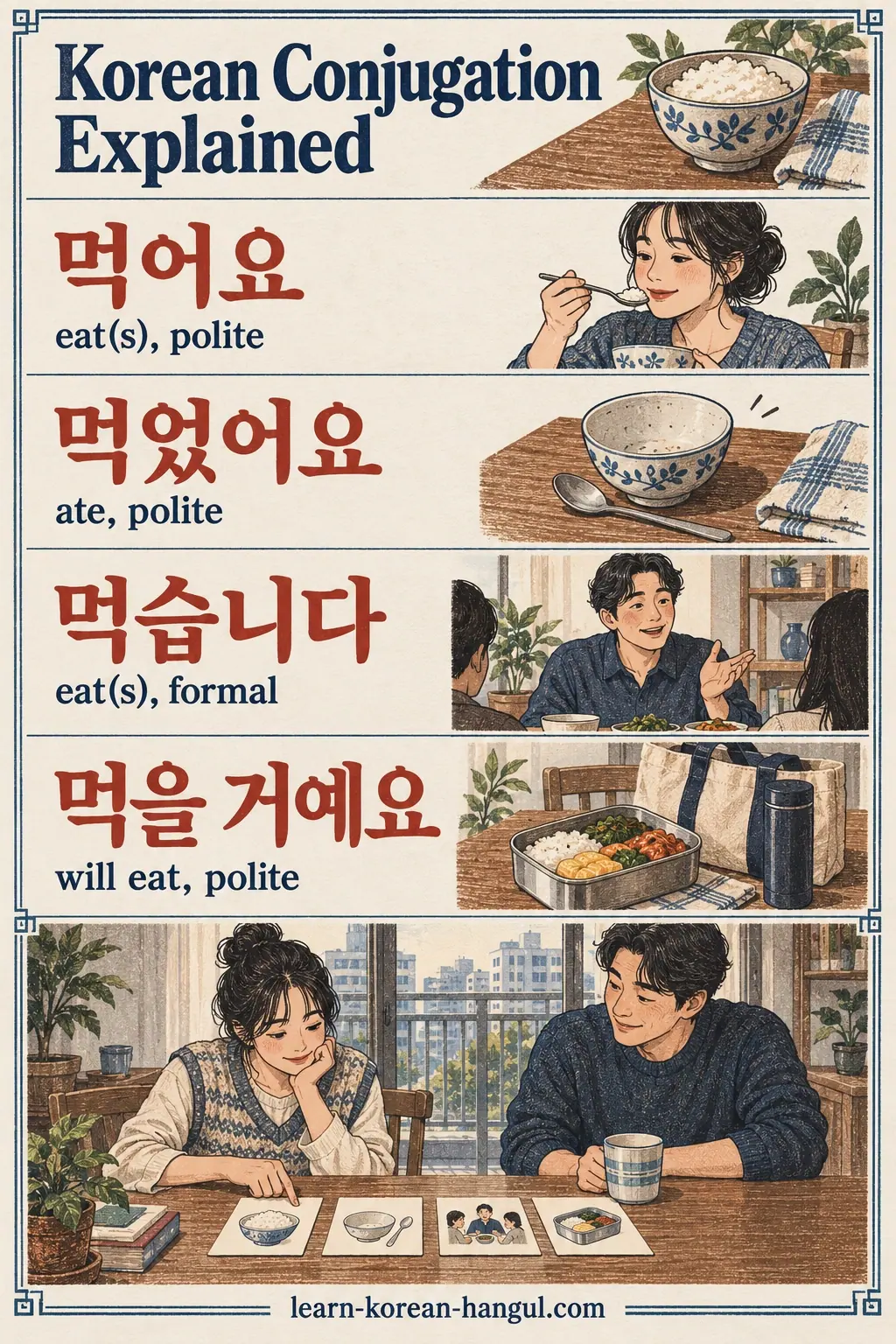
One stem can take many endings. Here is 먹 (eat) with five of them:
| Ending | Form | Meaning |
|---|---|---|
| -어요 | 먹어요 | eat(s), polite |
| -었어요 | 먹었어요 | ate, polite |
| -습니다 | 먹습니다 | eat(s), formal |
| -을 거예요 | 먹을 거예요 | will eat, polite |
| -고 | 먹고 | eat and... |
Korean words are built by stacking pieces in a row, a feature linguists call agglutination (교착, gyochak). Each piece does one job, so once you know the pieces you can build forms you have never met.
Revised Romanization (RR), the official Latin-letter system of South Korea, appears in parentheses as a reading aid only: meogeoyo is 먹어요. The question that follows naturally is how this differs from the conjugation in languages you may already know.
Does Korean Conjugate for Person and Number?

No, Korean does not change a verb for person, number or gender. The form 가요 means "I go", "you go", "he goes", "she goes", "we go" or "they go". The subject comes from context or from a separate word.
| Language | Verb changes with the subject? | Example |
|---|---|---|
| English | only in the third person singular | I go, he goes |
| Spanish | yes, for each person and number | voy, vas, va |
| Korean | no | 가요 for every subject |
What Korean marks instead is the relationship between speaker and listener. The ending of the verb says whether you are speaking politely, formally or casually. That is why politeness, not agreement, is the main axis a Korean learner must manage. The subject can also be dropped: 학교에 가요 can mean "I go to school" or "he goes to school", depending on the situation.
Two sentences prove the point. In 저는 학교에 가요 ("I go to school") and 친구는 학교에 가요 ("My friend goes to school"), the verb 가요 stays exactly the same. Only the subject words 저는 and 친구는 differ. An English speaker who tries to add endings for "I", "you" and "he" is working too hard: Korean has no such endings to learn, and that saves a large part of the memorisation other languages require.
A single stem therefore opens many forms. The three-step model below shows how to build any of them.
What Are the Three Steps of Korean Conjugation?
Korean conjugation has three steps: find the stem, choose the vowel, and add the ending. Later lessons on this site reuse the same three numbers, so learning them once helps with every form.
- Find the stem. Remove 다 from the dictionary form: 먹다 → 먹.
- Choose the vowel. Many endings start with 아 or 어, and the last vowel of the stem chooses between them (ㅏ or ㅗ gives 아, other vowels give 어). Other endings start with 으 after a consonant stem, as in 먹으면 ("if you eat") against 가면 ("if you go").
- Add the ending and contract. Attach the ending that sets the tense and politeness. When the stem ends in a vowel, the vowels merge or drop: 가 + 아요 = 가요.
| Step | What it does | 먹다 | 가다 | 하다 |
|---|---|---|---|---|
| 1. Find the stem | remove 다 | 먹 | 가 | 하 |
| 2. Choose the vowel | pick 아/어 or 으 | 어 (ㅓ) | 아 (ㅏ) | 여 (special) |
| 3. Add the ending | attach and contract | 먹어요 | 가요 (아 drops) | 해요 (하 + 여 = 해) |
These steps give the polite present (해요체). The detailed recipe, with 40 worked verbs, is in the present tense recipe. Before it, the Korean verb base form explains why every dictionary verb ends in 다.
The next section runs all three steps on three verbs and shows the forms side by side.
Worked Examples: 가다, 먹다 and 하다

The three verbs 가다, 먹다 and 하다 cover the three main cases: a stem that ends in a vowel (가), a stem that ends in a consonant (먹), and a verb with a special rule (하). Each is shown in the polite present, past, formal present and future.
| Dictionary form | Meaning | Polite present | Polite past | Formal present | Future (polite) |
|---|---|---|---|---|---|
| 가다 | go | 가요 | 갔어요 | 갑니다 | 갈 거예요 |
| 먹다 | eat | 먹어요 | 먹었어요 | 먹습니다 | 먹을 거예요 |
| 하다 | do | 해요 | 했어요 | 합니다 | 할 거예요 |
먹다
| Form | Korean | Romanization | Rule |
|---|---|---|---|
| Polite present | 먹어요 | meogeoyo | 먹 + 어요, last vowel ㅓ |
| Polite past | 먹었어요 | meogeosseoyo | 먹 + 었 + 어요 |
| Formal present | 먹습니다 | meokseumnida | 먹 + 습니다 after a consonant stem |
| Polite future | 먹을 거예요 | meogeul geoyeyo | 먹 + 을 거예요 |
Which step changes for each verb?
- 가다: step 3 changes the spelling, because the two ㅏ vowels merge into one.
- 먹다: no step changes anything, because the consonant stem keeps both vowels apart.
- 하다: step 2 is special, because 하다 takes 여 instead of 아.
The formal forms differ by the stem's last sound. A vowel-final stem takes ㅂ니다 (가 → 갑니다), and a consonant-final stem takes 습니다 (먹 → 먹습니다). The same split appears in the future: 가 + ㄹ 거예요 gives 갈 거예요, and 먹 + 을 거예요 gives 먹을 거예요.
Seeing the forms together raises the next question, which is how the endings differ in politeness.
What Changes between Speech Levels?
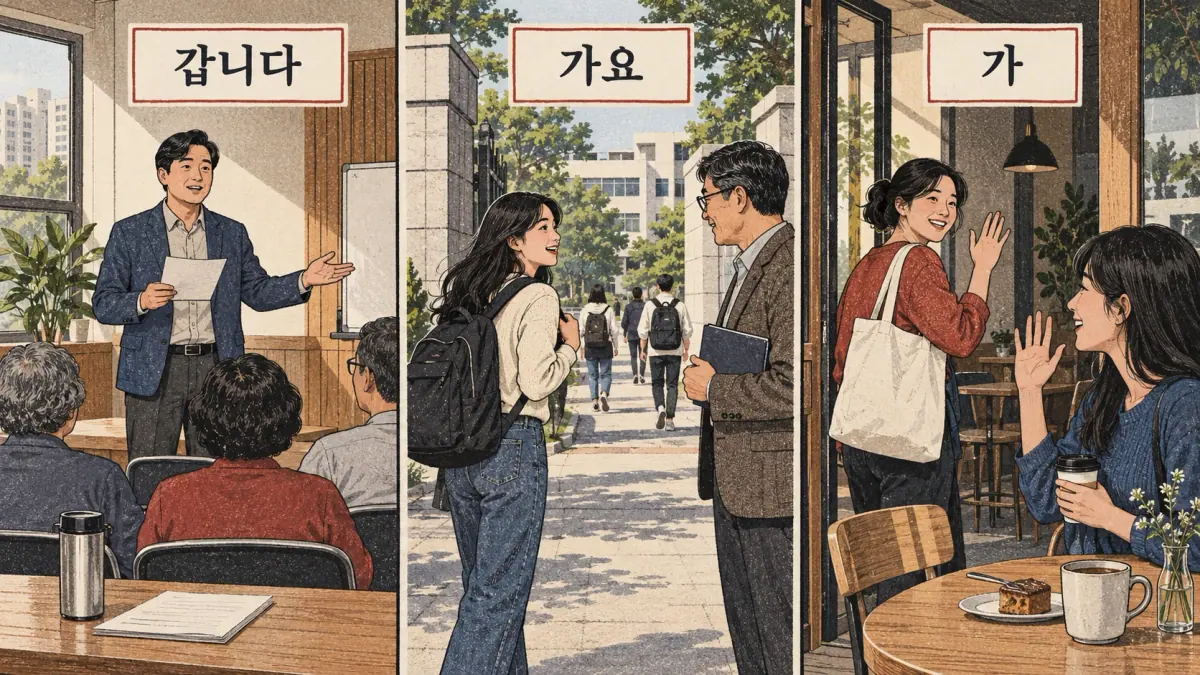
Between speech levels, only the final ending changes; the stem and the tense marker stay the same. Compare three levels of 가다 in the present:
| Level | Korean name | Form | Typical use |
|---|---|---|---|
| Polite | 해요체 (haeyoche) | 가요 | strangers, shop staff, teachers, everyday speech |
| Formal | 합쇼체 (hapsyoche) | 갑니다 | news, announcements, speeches, service settings |
| Casual | 해체 (haeche) | 가 | close friends, family, people younger than you |
All three can translate as "I go" or "I am going", but they send different social messages. If you are unsure, use the polite style. It is never rude and it is rarely too stiff. Traditional grammar lists six speech levels, but beginners work with these three. A full comparison is in Korean speech levels, and the meaning of tense is in Korean tenses.
That is the regular system. Now for the exceptions, which are fewer than learners fear.
Which Verbs Follow a Different Pattern?
A small, closed set of verbs follows a different pattern, called irregular conjugation (불규칙 활용, bulgyuchik hwaryong). In these verbs, one of the three steps behaves differently, usually because the final sound of the stem changes. The grid shows which step differs for five verbs.
| Verb | Class | Polite present | Which step differs? |
|---|---|---|---|
| 먹다 (eat) | regular | 먹어요 | none |
| 가다 (go) | regular | 가요 | step 3 only (normal vowel drop) |
| 하다 (do) | special | 해요 | step 2 (여 instead of 아) |
| 돕다 (help) | ㅂ-irregular | 도와요 | the stem sound ㅂ becomes 오 (도 + 오 + 아요 → 도와요) |
| 모르다 (not know) | 르-irregular | 몰라요 | the stem 르 becomes ㄹ라 |
The point of the grid is the preview, not the full rule. In an irregular verb you can still use the three steps, but the stem changes after step 1, before the ending attaches. The classes are ㅂ, ㄷ, ㅅ, 르, ㅎ, ㅡ and ㄹ, and they are taught in Korean irregular verbs. Irregular verbs can look intimidating in tables, but they are a short list, and the most common ones, such as 듣다, 덥다 and 모르다, appear early.
You can check any form with the Korean verb conjugator. If difficulty worries you, Is Korean conjugation hard? answers it honestly.
Do Adjectives Conjugate in Korean?

Yes, adjectives conjugate in Korean with the same tense and politeness endings as verbs. Korean adjectives are sometimes called descriptive verbs, because they take tense and politeness endings just like action verbs.
- 좋다 (be good) → 좋아요 (it is good), 좋았어요 (it was good), 좋습니다 (formal)
- 크다 (be big) → 커요, 컸어요, 큽니다
- 예쁘다 (be pretty) → 예뻐요, 예뻤어요, 예쁩니다
The main difference for beginners appears when the word modifies a noun: a verb takes 는 (먹는 사람, "the person who eats"), while an adjective takes ㄴ/은 (큰 집, "a big house"). That is a separate lesson. For conjugation, use the same three steps.
Why Do Learners Know the Rules but Pick the Wrong Ending?

Learners pick the wrong ending because conjugation (활용) and ending choice (어미 선택, eomi seontaek) are two different skills. Conjugation is the mechanical skill of attaching an ending correctly. Ending choice is the meaning skill of knowing which ending the situation needs. A learner can attach 아서/어서 perfectly and still use it where Korean speakers would say -(으)니까.
Three misconceptions cause most trouble:
- "Conjugation means memorising tables." Tables are the output, not the method. The three steps generate the forms, so you need the steps and a few examples, not a table per verb.
- "A form I can build is a form I should use." Building 먹었어요 is easy. Deciding between 먹었어요, 먹었었어요 and 먹었다 depends on meaning and style.
- "Irregular verbs mean random verbs." Irregular verbs fall into seven classes, and each class has one rule. They are patterns, not accidents.
Practice both skills in order. First automate the mechanics with the recipes. Then study endings by meaning in the grammar section, starting from Korean tenses. With the mechanics and the meaning separated, a study order becomes easy to plan.
In What Order Should You Learn the Forms?
Learn the forms in this order: polite present, past, future, formal and casual, then the irregular classes. Each stage reuses the previous one, so the order saves time. The time figures below are editorial estimates for planning, not measurements. Individual pace varies widely.
| Stage | Form | Lesson | Planning estimate |
|---|---|---|---|
| 1 | Polite present | the present tense recipe | 2 to 3 sessions of 30 minutes |
| 2 | Past | past tense conjugation | 1 to 2 sessions |
| 3 | Future | future tense conjugation | 1 to 2 sessions |
| 4 | Formal and casual | formal conjugation and casual conjugation | 1 session each |
| 5 | Irregular classes | Korean irregular verbs | about 1 session per class |
Start with the polite present for a practical reason: it is the form you will use and hear most from your first day, and it teaches vowel harmony and contraction, which every other form needs. The whole section is mapped on Korean verb conjugation.
Practice
Try each task before you check the answers.
- Find the stem of 마시다 and of 공부하다.
- Choose 아요 or 어요 for the stem 앉 and then write the polite present.
- Write the polite past of 가다.
- Which level is 갑니다: polite, formal or casual?
Answers to the Practice
- 마시 and 공부하. Remove 다.
- The last vowel of 앉 is ㅏ, so 아요: 앉아요 [안자요].
- 갔어요. The stem 가 ends in ㅏ, so 가 + 았 fuses into 갔, and 어요 follows.
- Formal (합쇼체). The ending ㅂ니다 marks the formal style.
If you missed an answer, return to the step it names. The next lesson gives the full recipe.
What to Learn Next
With Korean conjugation explained in three steps, the best next move is to learn why every dictionary verb ends in 다 on the Korean verb base form, and then to practise the polite present with the present tense recipe. Use the Korean verb conjugator to check your forms, and read polite present for the contraction rules.
This lesson does not teach irregular classes, ending choice by meaning, or the full speech-level system. The study-time figures are editorial estimates. The forms follow standard written Korean as described by the National Institute of Korean Language (국립국어원), and the Hangul spellings are the authoritative form.
Frequently Asked Questions
Does Korean have conjugation? Yes. Korean verbs and adjectives take endings that show tense, politeness and mood, for example 가요, 갔어요 and 갑니다 from 가다. Unlike Spanish or French, Korean conjugation does not change the verb for person, number or gender. The same form 가요 means I go, you go, he goes or they go.
Is Korean conjugation hard? It is easier than Spanish in one way and harder in another. There is no agreement with person or number, so one form serves every subject. The difficulty lies in choosing among speech levels and in learning a small set of irregular classes. The main patterns are taught in the first few conjugation lessons.
How many verb forms are there in Korean? There is no single count, because endings can be stacked. A beginner needs about nine core forms per verb: three speech levels (polite, formal, casual) in three tenses (present, past, future). Traditional grammar lists six speech levels, and further endings add moods and connections, so the total grows with level.
Do adjectives conjugate in Korean? Yes. Korean adjectives, also called descriptive verbs, take the same endings as action verbs: 좋다 becomes 좋아요, 좋았어요 and 좋습니다. The main place they differ is the modifier form before a noun, where a verb uses 는 and an adjective uses ㄴ or 은; adjectives also have no command form.
What is the first form I should learn? Learn the polite present (-아요/-어요) first. It works with strangers, shop staff and teachers, and it is the form heard most often in daily speech. After it, learn the past tense, then the future and the formal style. The recipe is in the present tense lesson.