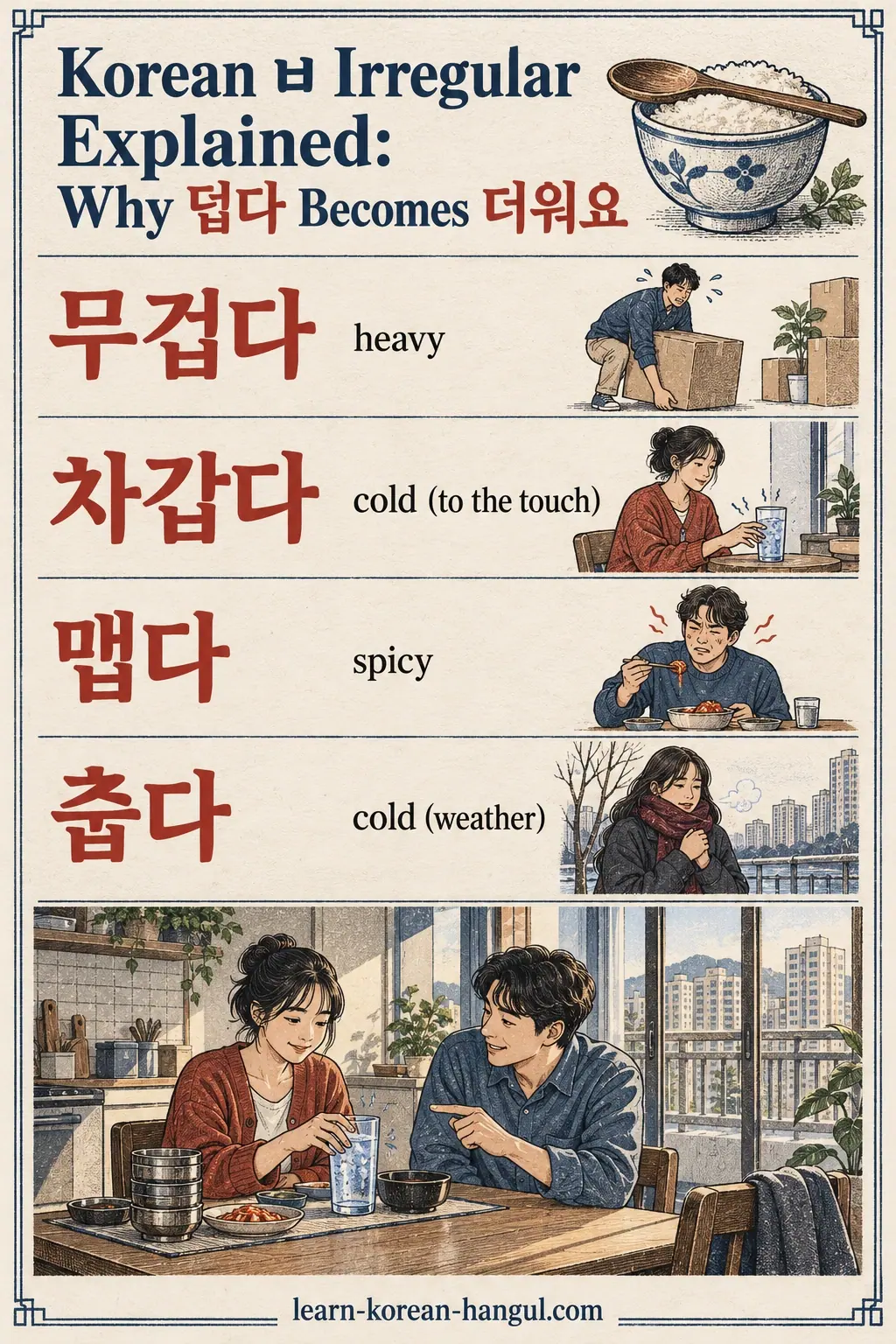
What you'll learn
- Conjugate 20 ㅂ-irregular words in the polite present, the past and the -(으)면 form.
- Explain why 돕다 gives 도와요 but 어렵다 gives 어려워요.
- Rule out five regular look-alikes: 입다, 잡다, 좁다, 접다 and 씹다.
- Use ㅂ words before nouns and in "because" sentences: 더운 날, 추워서.
Prerequisites: you can build the polite present of a regular verb, as shown in how to recognize irregular verbs. Time: about 30 minutes.
The first section defines the class before the rule is built up step by step.
What Is the Korean ㅂ Irregular?

The Korean ㅂ irregular (ㅂ 불규칙, bieup bulgyuchik) is a group of verbs and adjectives whose stem ends in ㅂ and whose ㅂ changes to 우 before a vowel. A stem is the part of the word left when you remove 다: the stem of 덥다 is 덥. Regular stems never change; irregular stems change in a fixed, predictable way.
English has the same idea on a smaller scale. "Walk" becomes "walked", but "bring" becomes "brought": the stem itself changes. In Korean the change is far more regular than in English, because every ㅂ-irregular word changes in exactly the same way.
The class is large. Of the 474 verbs and adjectives in this site's verb dictionary, 36 are ㅂ-irregular, more than any other irregular class. Most of them are adjectives that learners need in the first weeks: 덥다 (hot), 춥다 (cold), 쉽다 (easy), 어렵다 (difficult), 맵다 (spicy) and 귀엽다 (cute). The full word list lives on the ㅂ irregular words hub.
The next section turns that definition into a rule you can apply.
The Rule: ㅂ Changes to 우 before a Vowel
The rule has two parts. First, the final ㅂ of the stem is replaced by the vowel 우. Second, that 우 joins the ending, and 우 + 어 contracts to 워. Because the stem now ends in 우, the ending is always the 어 version, even after ㅏ or ㅗ (two exceptions follow below).
Worked Example: 덥다 → 더워요
Follow the five steps for the polite present of 덥다 ("to be hot").
- Remove 다. 덥다 → 덥.
- Check the ending. The polite present ending -아요/-어요 starts with a vowel, so the rule applies.
- Replace ㅂ with 우. 덥 → 더우.
- Add 어요. 더우 + 어요 → 더우어요.
- Contract 우 + 어 into 워. 더우어요 → 더워요 (deowoyo).
The contraction in step 5 is the same one regular verbs use: 배우다 → 배워요. It is taught in full in the lesson on the ㅝ contraction. You'll know it worked when the result ends in 워요 and no ㅂ is left anywhere in the word.
덥다
| Form | Korean | Romanization | Rule |
|---|---|---|---|
| Polite present | 더워요 | deowoyo | ㅂ → 우 before a vowel; 우 + 어 → 워 |
| Polite past | 더웠어요 | deowosseoyo | ㅂ → 우 before 었 |
| If (-(으)면) | 더우면 | deoumyeon | ㅂ → 우; the linking 으 is absorbed |
| Before a noun | 더운 | deoun | ㅂ → 우 before -(으)ㄴ |
| And (-고) | 덥고 | deopgo | consonant ending: no change |
| Formal present | 덥습니다 | deopseumnida | consonant ending: no change |
- ㅂ irregular: final ㅂ becomes 우 before an ending that starts with a vowel
The rule depends entirely on the first sound of the ending, so the next section sorts the common endings into two groups.
Which Endings Trigger the Change?
Any ending that starts with a vowel triggers the change, including the 으 of -(으)면, -(으)니까 and -(으)ㄴ. Endings that start with a consonant leave the ㅂ in place. With -(으) endings, the 우 replaces both the ㅂ and the linking 으, so 덥 + 으면 gives 더우면, not 더우으면.
| Ending | First sound | 덥다 (be hot) | 어렵다 (be difficult) | Change? |
|---|---|---|---|---|
| -아요/-어요 (polite present) | vowel | 더워요 | 어려워요 | yes |
| -았/었- (past) | vowel | 더웠어요 | 어려웠어요 | yes |
| -(으)면 (if) | vowel 으 | 더우면 | 어려우면 | yes |
| -(으)니까 (because) | vowel 으 | 더우니까 | 어려우니까 | yes |
| -(으)ㄴ (before a noun) | vowel 으 | 더운 | 어려운 | yes |
| -(으)ㄹ 거예요 (future) | vowel 으 | 더울 거예요 | 어려울 거예요 | yes |
| -고 (and) | consonant | 덥고 | 어렵고 | no |
| -습니다 (formal) | consonant | 덥습니다 | 어렵습니다 | no |
| -지만 (but) | consonant | 덥지만 | 어렵지만 | no |
A quick self-test: say the ending on its own. If you hear a vowel first (어, 았, 으), change ㅂ to 우. If you hear a consonant first (ㄱ, ㅅ, ㅈ), leave the stem alone. With the trigger rule in place, the next section applies it to the words you will actually meet.
Korean ㅂ Irregular Explained in 20 Common Words

The table gives 20 everyday ㅂ-irregular words in three forms, sorted by how the stem ends. Read down a group and the pattern repeats: the stem loses ㅂ, gains 우, and 우 + 어 becomes 워.
| Group | Dictionary form | Meaning | Polite present | Polite past | If -(으)면 |
|---|---|---|---|---|---|
| -겁다 | 무겁다 | heavy | 무거워요 | 무거웠어요 | 무거우면 |
| -겁다 | 뜨겁다 | hot (to the touch) | 뜨거워요 | 뜨거웠어요 | 뜨거우면 |
| -겁다 | 즐겁다 | enjoyable | 즐거워요 | 즐거웠어요 | 즐거우면 |
| -갑다 | 차갑다 | cold (to the touch) | 차가워요 | 차가웠어요 | 차가우면 |
| -갑다 | 반갑다 | glad to meet | 반가워요 | 반가웠어요 | 반가우면 |
| -깝다 | 가깝다 | near | 가까워요 | 가까웠어요 | 가까우면 |
| -럽다 | 시끄럽다 | noisy | 시끄러워요 | 시끄러웠어요 | 시끄러우면 |
| -럽다 | 부럽다 | envious | 부러워요 | 부러웠어요 | 부러우면 |
| -롭다 | 새롭다 | new | 새로워요 | 새로웠어요 | 새로우면 |
| -롭다 | 외롭다 | lonely | 외로워요 | 외로웠어요 | 외로우면 |
| -답다 | 아름답다 | beautiful | 아름다워요 | 아름다웠어요 | 아름다우면 |
| -렵다 | 어렵다 | difficult | 어려워요 | 어려웠어요 | 어려우면 |
| -엽다 | 귀엽다 | cute | 귀여워요 | 귀여웠어요 | 귀여우면 |
| -볍다 | 가볍다 | light | 가벼워요 | 가벼웠어요 | 가벼우면 |
| -맙다 | 고맙다 | thankful | 고마워요 | 고마웠어요 | 고마우면 |
| -섭다 | 무섭다 | scary | 무서워요 | 무서웠어요 | 무서우면 |
| one syllable | 덥다 | hot (weather) | 더워요 | 더웠어요 | 더우면 |
| one syllable | 춥다 | cold (weather) | 추워요 | 추웠어요 | 추우면 |
| one syllable | 쉽다 | easy | 쉬워요 | 쉬웠어요 | 쉬우면 |
| one syllable | 맵다 | spicy | 매워요 | 매웠어요 | 매우면 |
Three suffixes deserve a special note: -롭다, -답다 and -스럽다. They build new adjectives from nouns, such as 자유롭다 ("free"), 학생답다 ("like a student") and 자랑스럽다 ("proud"). Every word made with them is ㅂ-irregular, so a new word you have never seen still follows the rule: 자랑스러워요, 학생다워요.
A handful of action verbs belong to the class too: 돕다 (help), 줍다 (pick up), 눕다 (lie down) and 굽다 (grill). They give 도와요, 주워요, 누워요 and 구워요. The first of these, 돕다, breaks the 워 pattern, which the next section explains.
Why Do 돕다 and 곱다 Take 와?

돕다 ("to help") and 곱다 ("to be fine, pretty") take 와 because the Hangul Orthography (한글 맞춤법, 1988, Article 18) makes them the only exceptions. For one-syllable stems 돕 and 곱, the ending -아 is written as 와: 도와요, 고와요. Every other ㅂ-irregular word, including 고맙다 and 가깝다, takes 워.
| Word | Polite present | Past | Note |
|---|---|---|---|
| 돕다 (help) | 도와요 | 도왔어요 | exception: 와 |
| 곱다 (be fine, pretty) | 고와요 | 고왔어요 | exception: 와 |
| 고맙다 (be thankful) | 고마워요 | 고마웠어요 | 워, even after ㅏ |
| 가깝다 (be near) | 가까워요 | 가까웠어요 | 워, even after ㅏ |
The history explains why learners still see 고마와 in old books and songs. Before the 1988 orthography, ㅂ words whose stem vowel was ㅏ or ㅗ were written with 와: 고마와, 가까와. The 1988 rules followed how people actually spoke and changed them all to 워, keeping 와 only for 돕다 and 곱다. If a text writes 고마와요, it is older or non-standard.
The 와 pair is the only exception inside the class, so the next section turns to the words outside it.
Which ㅂ Words Are Regular?

Regular ㅂ words keep their ㅂ before every ending: 입다 ("to wear") gives 입어요, never 이워요. The most common are action verbs, plus the adjective 좁다 ("to be narrow"). Their dictionary forms look exactly like irregular ones, so they must be learned as a short list.
| Regular word | Meaning | Polite present | Past | If -(으)면 |
|---|---|---|---|---|
| 입다 | wear | 입어요 [이버요] | 입었어요 | 입으면 |
| 잡다 | catch, hold | 잡아요 [자바요] | 잡았어요 | 잡으면 |
| 좁다 | be narrow | 좁아요 [조바요] | 좁았어요 | 좁으면 |
| 접다 | fold | 접어요 | 접었어요 | 접으면 |
| 씹다 | chew | 씹어요 | 씹었어요 | 씹으면 |
| 뽑다 | pull out, pick | 뽑아요 | 뽑았어요 | 뽑으면 |
| 업다 | carry on the back | 업어요 | 업었어요 | 업으면 |
A rule of thumb works for most beginner words: adjectives ending in -ㅂ다 are almost all irregular (좁다 and 수줍다 "to be shy" are the main exceptions), while action verbs ending in -ㅂ다 are more often regular. Watch one homograph: 굽다 "to grill" is irregular (고기를 구워요), but 굽다 "to be bent" is regular (허리가 굽어요). The full list of traps is in regular verbs that look irregular. Once you can sort the words, the next step is using them in real sentences.
ㅂ Words in Common Sentence Patterns

ㅂ-irregular words appear in every pattern a beginner uses, and the same trigger test applies each time. The examples below use weather, food and study words, which are where these adjectives show up most.
| Pattern | Form | Example | Meaning |
|---|---|---|---|
| Before a noun -(으)ㄴ | 더운 | 더운 날 | a hot day |
| Before a noun -(으)ㄴ | 어려운 | 어려운 질문 | a difficult question |
| Because -아서/어서 | 추워서 | 추워서 집에 있었어요. | It was cold, so I stayed home. |
| Past -았/었- | 매웠어요 | 김치가 매웠어요. | The kimchi was spicy. |
| Future guess -(으)ㄹ 거예요 | 추울 거예요 | 내일은 추울 거예요. | It will probably be cold tomorrow. |
| Because -(으)니까 | 무거우니까 | 무거우니까 같이 들어요. | It's heavy, so let's carry it together. |
| Polite request -(으)세요 | 도우세요 | 할머니를 도우세요. | Please help Grandmother. |
Weather talk is the fastest way to practise: 오늘 더워요? ("Is it hot today?"), 아니요, 좀 추워요 ("No, it's a bit cold"). More words for this topic are in Korean weather vocabulary. Seeing the forms is half the skill, and the next section covers hearing them.
How Does the ㅂ Irregular Sound?
In speech, the ㅂ is audible only before a consonant ending, and even there it sounds like an unreleased [p]. Before a vowel ending it is gone completely, replaced by a [w] glide: 더워요 is said [더워요] with no trace of ㅂ. Listen for a [w] sound in place of a missing ㅂ.
| Consonant ending (ㅂ kept) | Spoken | Vowel ending (ㅂ → 우) | Spoken |
|---|---|---|---|
| 덥고 | [덥꼬] | 더워요 | [더워요] |
| 춥지만 | [춥찌만] | 추워서 | [추워서] |
| 쉽습니다 | [쉽씀니다] | 쉬운 | [쉬운] |
Notice also that ㅂ before ㄱ, ㅅ or ㅈ makes the next consonant tense: 덥고 is [덥꼬], 쉽습니다 is [쉽씀니다]. This is ordinary sound change and has nothing to do with the irregular rule. The habits that cause most errors are collected in the next section.
Common Misconceptions
Four beliefs cause most ㅂ-irregular errors.
- Learners often assume every -ㅂ다 word is irregular. Actually 입다, 잡다, 좁다 and other look-alikes are regular. Wrong: 이워요. Right: 입어요.
- Learners often write 와 after ㅏ or ㅗ. Actually only 돕다 and 곱다 take 와. Wrong: 고마와요, 가까와요. Right: 고마워요, 가까워요.
- Learners often keep ㅂ before 으. Actually the linking 으 counts as a vowel. Wrong: 덥으면, 어렵은 질문. Right: 더우면, 어려운 질문.
- Learners often change ㅂ in every form. Actually consonant endings keep it. Wrong: 더우고, 어려우습니다. Right: 덥고, 어렵습니다.
An honest limit of this lesson: it gives the beginner-level words and the main rule of thumb, not every rare ㅂ word in the dictionary. When you meet a new action verb ending in -ㅂ다, check its conjugation in 표준국어대사전 or the krdict learners' dictionary before you rely on the pattern.
Practice: 10 Items
Give the form asked for. Answers follow.
- 춥다, polite present
- 맵다, polite past
- 돕다, polite present
- 입다, polite present
- 쉽다, -(으)면
- 어렵다, before 문제 ("problem")
- 가깝다, polite present
- 좁다, polite past
- 덥다, + -고
- 귀엽다, + -아서/어서
Practice · 8
What is the polite present of 춥다 (to be cold)?
Show answer
추워요
Before a vowel, ㅂ becomes 우, and 우 + 어 contracts to 워.
What is the polite present of 돕다 (to help)?
Show answer
도와요
돕다 and 곱다 are the only exceptions that take 와 under the 1988 Hangul Orthography.
What is the polite present of 고맙다 (to be thankful)?
Show answer
고마워요
Every ㅂ-irregular word except 돕다 and 곱다 takes 워, even after ㅏ; 고마와 is an older, pre-1988 spelling.
What is the polite present of 입다 (to wear)?
Show answer
입어요
입다 is a regular look-alike: its ㅂ stays before every ending.
What is the -(으)면 form of 쉽다 (to be easy)?
Show answer
쉬우면
The linking 으 counts as a vowel; 우 replaces both the ㅂ and the 으.
How do you say "hot and ..." with 덥다 + -고?
Show answer
덥고
-고 starts with a consonant, so the stem stays unchanged.
How do you say "a difficult problem" with 어렵다 before 문제?
Show answer
어려운 문제
-(으)ㄴ starts with a vowel sound, so ㅂ becomes 우: 어려운.
What is the polite past of 좁다 (to be narrow)?
Show answer
좁았어요
좁다 is one of the few regular ㅂ adjectives, so its ㅂ stays.
Answer key
| # | Answer | Why |
|---|---|---|
| 1 | 추워요 | ㅂ → 우, 우 + 어 → 워 |
| 2 | 매웠어요 | ㅂ → 우 before 었 |
| 3 | 도와요 | exception: 돕다 takes 와 |
| 4 | 입어요 | regular look-alike |
| 5 | 쉬우면 | 우 replaces ㅂ and the linking 으 |
| 6 | 어려운 문제 | ㅂ → 우 before -(으)ㄴ |
| 7 | 가까워요 | 워, even after ㅏ |
| 8 | 좁았어요 | regular adjective |
| 9 | 덥고 | consonant ending, no change |
| 10 | 귀여워서 | ㅂ → 우 before 어서 |
If you got 8 or more right, you can apply the rule to new words. Mistakes on items 4 and 8 mean the look-alike list needs another look.
What Should You Learn after the ㅂ Irregular?
With the Korean ㅂ irregular explained, compare it with the other classes in the irregular verbs chart, which shows all seven learner classes side by side. If you are not sure which class a new word belongs to, go back to how to recognize irregular verbs and run its two quick tests.
What this page does not cover. It does not list every rare ㅂ word, and it does not cover the other irregular classes (ㄷ, ㅅ, 르, ㅎ, ㅡ, ㄹ). About this page. Last updated 2026-10-09. The Korean text and conjugated forms were drafted with AI assistance and cross-checked with the site's rule-based conjugation engine; the Korean reviewer checks every lesson before publication. Romanization follows the Revised Romanization of Korean and is only a learning aid.
Frequently Asked Questions
Why does 덥다 become 더워요 and not 덥어요? Because 덥다 is a ㅂ-irregular adjective. Its stem 덥 changes to 더우 before any ending that starts with a vowel, and 우 + 어요 contracts to 워요. The form 덥어요 follows the regular pattern, which only regular stems such as 입다 (입어요) use. 표준국어대사전 lists 덥다 as ㅂ-irregular.
What is the past tense of 쉽다? The polite past of 쉽다 ("to be easy") is 쉬웠어요 (swiwosseoyo). The stem 쉽 becomes 쉬우, which joins 었 to give 쉬웠, and 어요 completes the form. The formal past is 쉬웠습니다 and the casual past is 쉬웠어. 시험이 쉬웠어요 means "The exam was easy."
Is 입다 a ㅂ irregular verb? No. 입다 ("to wear") is regular, so the ㅂ stays: 입어요, 입었어요, 입으면. Learners write 이워요 because 입다 looks like 덥다. The safest rule is that most adjectives ending in -ㅂ다 are irregular, while action verbs such as 입다, 잡다, 접다 and 씹다 must be checked one by one.
How do I say hot weather and hot water in Korean? Use 덥다 for hot weather and 뜨겁다 for hot objects and liquids. Both are ㅂ-irregular: 날씨가 더워요 ("The weather is hot") and 물이 뜨거워요 ("The water is hot"). Before a noun they become 더운 날 ("a hot day") and 뜨거운 물 ("hot water"). The cold pair works the same way: 추워요 and 차가워요.
Does the ㅂ change happen in formal speech? Only in some formal forms. The formal present ending -습니다 starts with a consonant, so the ㅂ stays: 덥습니다, 어렵습니다. The formal past contains 었, which starts with a vowel, so the ㅂ changes: 더웠습니다, 어려웠습니다. Every form follows the same test: look at the first sound of the ending.