What you'll learn
- Conjugate 그렇다, 이렇다, 어떻다, 빨갛다, 파랗다, 노랗다, 하얗다 and 까맣다 in the polite present, the past and the form before a noun.
- Trace 그래서, 그러면 and 어때요 back to their dictionary forms.
- Keep 좋다, 많다 and 싫다 regular.
- Describe objects by colour: 빨간 사과, 파란 하늘.
Prerequisites: you know what an irregular class is from how to recognize irregular verbs and can make 아요/어요 forms. Time: about 30 minutes.
The first section defines the class and shows what makes it unusual.
What Is the Korean ㅎ Irregular?

The Korean ㅎ irregular (ㅎ 불규칙, hieut bulgyuchik) is a group of adjectives whose stem ends in ㅎ and loses that ㅎ before a vowel. Its signature is that the stem's own vowel changes as well: the ㅓ of 그렇 becomes ㅐ in 그래요. In the ㄷ, ㅂ and ㅅ classes only the final consonant changes, and in the 르 class an extra ㄹ appears, but no class except ㅎ turns the stem vowel into ㅐ.
The class contains adjectives only. The ㅎ-final verbs a beginner meets, such as 놓다 ("to put"), 넣다 ("to put in") and 낳다 ("to give birth"), are all regular. The ten ㅎ-irregular words this site teaches first are the demonstratives 그렇다, 이렇다, 저렇다 and 어떻다, and the colour and shape words 빨갛다, 노랗다, 파랗다, 하얗다, 까맣다 and 동그랗다. Size and shade words such as 커다랗다 (be very big) and 조그맣다 (be small) follow the same rule.
The class is small, but its forms are everywhere. 그래요 ("that's right"), 그래서 ("so") and 어때요? ("how is it?") are heard in almost every everyday conversation, and all three are ㅎ-irregular forms. The word list with dictionary links is on the ㅎ irregular words hub. The next section breaks the rule into its two parts.
The Rule: Two Changes, One Class
The ㅎ irregular has one change before 아/어 endings and a different one before 으 endings. Learn them as two short rules.
- Before 아/어: drop ㅎ, then merge the stem vowel and the ending into ㅐ (or ㅒ after ㅑ). 그렇 + 어요 → 그래요.
- Before 으: drop ㅎ and drop the 으 of the ending. 빨갛 + 은 → 빨간; 그렇 + 으면 → 그러면.
Worked Example: 그렇다 → 그래요
- Remove 다. 그렇다 → 그렇.
- Check the ending. -어요 starts with 어, so the 아/어 rule applies.
- Drop ㅎ. 그렇 → 그러.
- Merge the vowel and the ending into ㅐ. 러 + 어 → 래.
- Add 요. 그래요 (geuraeyo).
Worked Example: 빨갛다 → 빨간
- Remove 다. 빨갛다 → 빨갛.
- Choose the ending. Before a noun, adjectives take -(으)ㄴ; after a consonant this is -은.
- Drop ㅎ and 으. 빨갛 + 은 → 빨가 + ㄴ.
- Attach ㄴ as the final consonant. 빨간 (ppalgan), as in 빨간 사과, "a red apple."
You'll know it worked when no ㅎ is left in the form and, before 아/어, the last syllable contains ㅐ or ㅒ. The usual slip at step 4 of the first example is writing 그러요 or 그럴어요; the merge into ㅐ is what makes the class unique.
그렇다
| Form | Korean | Romanization | Rule |
|---|---|---|---|
| Polite present | 그래요 | geuraeyo | ㅎ drops; ㅓ + 어 → ㅐ |
| Polite past | 그랬어요 | geuraesseoyo | ㅎ drops before 었; vowel → ㅐ |
| Because (-아서/어서) | 그래서 | geuraeseo | ㅎ drops; vowel → ㅐ |
| If (-(으)면) | 그러면 | geureomyeon | ㅎ and 으 drop |
| Before a noun | 그런 | geureon | ㅎ and 으 drop |
| But (-지만) | 그렇지만 | geureochiman | consonant ending: ㅎ kept |
- ㅎ irregular: ㅎ drops before a vowel; before 아/어 the vowel becomes ㅐ
Both rules depend on the first sound of the ending, so the next section lists the common endings by group.
Which Endings Trigger the Change?
Endings that start with 아/어 or 으 trigger the change; endings that start with a consonant keep the ㅎ. In speech, a kept ㅎ combines with the next consonant to make it aspirated: 빨갛고 is said [빨가코].
| Ending | Group | 그렇다 | 빨갛다 |
|---|---|---|---|
| -아요/-어요 | 아/어 | 그래요 | 빨개요 |
| -았/었- (past) | 아/어 | 그랬어요 | 빨갰어요 |
| -아서/어서 (so) | 아/어 | 그래서 | 빨개서 |
| -(으)면 (if) | 으 | 그러면 | 빨가면 |
| -(으)ㄴ (before a noun) | 으 | 그런 | 빨간 |
| -(으)니까 (because) | 으 | 그러니까 | 빨가니까 |
| -고 (and) | consonant | 그렇고 [그러코] | 빨갛고 [빨가코] |
| -지만 (but) | consonant | 그렇지만 [그러치만] | 빨갛지만 [빨가치만] |
| -습니다 (formal) | consonant | 그렇습니다 [그러씀니다] | 빨갛습니다 [빨가씀니다] |
The consonant rows matter for formal and written Korean, where 그렇습니다 and 그렇지만 are common. With the trigger rule settled, the next section lists the words themselves.
The ㅎ-Irregular Word List

The table gives the 그렇다 family and the colour and shape words in three forms. The past is the present form with ㅆ added to the ㅐ syllable, so 빨개요 becomes 빨갰어요.
| Word | Meaning | Polite present | Polite past | Before a noun |
|---|---|---|---|---|
| 그렇다 | be so, be like that | 그래요 | 그랬어요 | 그런 |
| 이렇다 | be like this | 이래요 | 이랬어요 | 이런 |
| 저렇다 | be like that (over there) | 저래요 | 저랬어요 | 저런 |
| 어떻다 | be how | 어때요 | 어땠어요 | 어떤 |
| 빨갛다 | be red | 빨개요 | 빨갰어요 | 빨간 |
| 노랗다 | be yellow | 노래요 | 노랬어요 | 노란 |
| 파랗다 | be blue | 파래요 | 파랬어요 | 파란 |
| 하얗다 | be white | 하얘요 | 하얬어요 | 하얀 |
| 까맣다 | be black | 까매요 | 까맸어요 | 까만 |
| 동그랗다 | be round | 동그래요 | 동그랬어요 | 동그란 |
| 커다랗다 | be very big | 커다래요 | 커다랬어요 | 커다란 |
Only 하얗다 takes ㅒ, because its stem vowel is ㅑ: 하얘요. The other ㅏ and ㅓ stems take ㅐ. In fast speech 하얘요 and 하애요 can sound close, so this is mainly a spelling point. The first four words are the source of many everyday connectives, which the next section unpacks.
Where Do 그래서, 그럼 and 어때요 Come From?

그래서, 그럼 and 어때요 are conjugated forms of the ㅎ-irregular adjectives 그렇다 and 어떻다, used so often that learners meet them as separate words. Seeing the dictionary form behind them shows that one rule explains a dozen high-frequency expressions.
| Word | Built from | Rule applied | Meaning |
|---|---|---|---|
| 그래요 | 그렇 + 어요 | 아/어: ㅎ drops, → ㅐ | that's right; really? |
| 그래서 | 그렇 + 어서 | 아/어 | so, therefore |
| 그래도 | 그렇 + 어도 | 아/어 | even so, still |
| 그러면 / 그럼 | 그렇 + 으면 | 으: ㅎ and 으 drop | then, in that case |
| 그러니까 | 그렇 + 으니까 | 으 | so, that's why |
| 그런데 | 그렇 + 은데 | 으 | but, by the way |
| 어때요? | 어떻 + 어요 | 아/어 | how is it? |
| 어떤 | 어떻 + 은 | 으 | what kind of |
그럼 is the spoken short form of 그러면. 그래서 늦었어요 means "So I was late", 그럼 내일 만나요 means "Then let's meet tomorrow", and 이 옷 어때요? means "How about these clothes?" Korean dictionaries list some of these words, such as 그래서 and 그런데, as separate entries, but their form follows the ㅎ rule.
Is It 어떡해 or 어떻게?
Both spellings are correct, but they are different words. 어떻게 ("how") is 어떻 + 게; -게 starts with a consonant, so the ㅎ stays and the word is said [어떠케]: 어떻게 가요?, "How do I get there?" 어떡해 is a contraction of the phrase 어떻게 해, "what do I do?", and it ends a sentence on its own: 지갑을 잃어버렸어요. 어떡해요?, "I lost my wallet. What should I do?" Writing 어떻해 or 어떡게 mixes the two.
The next section turns to the ㅎ words that do not follow it.
Which ㅎ Words Are Regular?

Regular ㅎ words keep the ㅎ in writing before every ending: 좋다 ("to be good") gives 좋아요, not 조애요. Three groups stay regular: the adjective 좋다, adjectives whose stem ends in a double final consonant with ㅎ (ㄶ, ㅀ), and every ㅎ-final verb.
| Group | Word | Polite present | Spoken | Before a noun |
|---|---|---|---|---|
| single ㅎ adjective | 좋다 (be good) | 좋아요 | [조아요] | 좋은 [조은] |
| ㄶ adjective | 많다 (be many) | 많아요 | [마나요] | 많은 [마는] |
| ㄶ adjective | 괜찮다 (be okay) | 괜찮아요 | [괜차나요] | 괜찮은 |
| ㅀ adjective | 싫다 (be disliked) | 싫어요 | [시러요] | 싫은 |
| verb | 놓다 (put) | 놓아요 | [노아요] | 놓는 |
| verb | 넣다 (put in) | 넣어요 | [너어요] | 넣는 |
The ㅎ in these words is silent before a vowel, which is why 좋아요 sounds like [조아요]. It is still written, and dropping it in spelling (조아요) is a common error in learners' texts. 놓아요 also has a short form, 놔요, that comes from the ㅘ contraction rather than the ㅎ rule. More traps of this kind are collected in regular verbs that look irregular. The next section returns to the irregular words in their most common use.
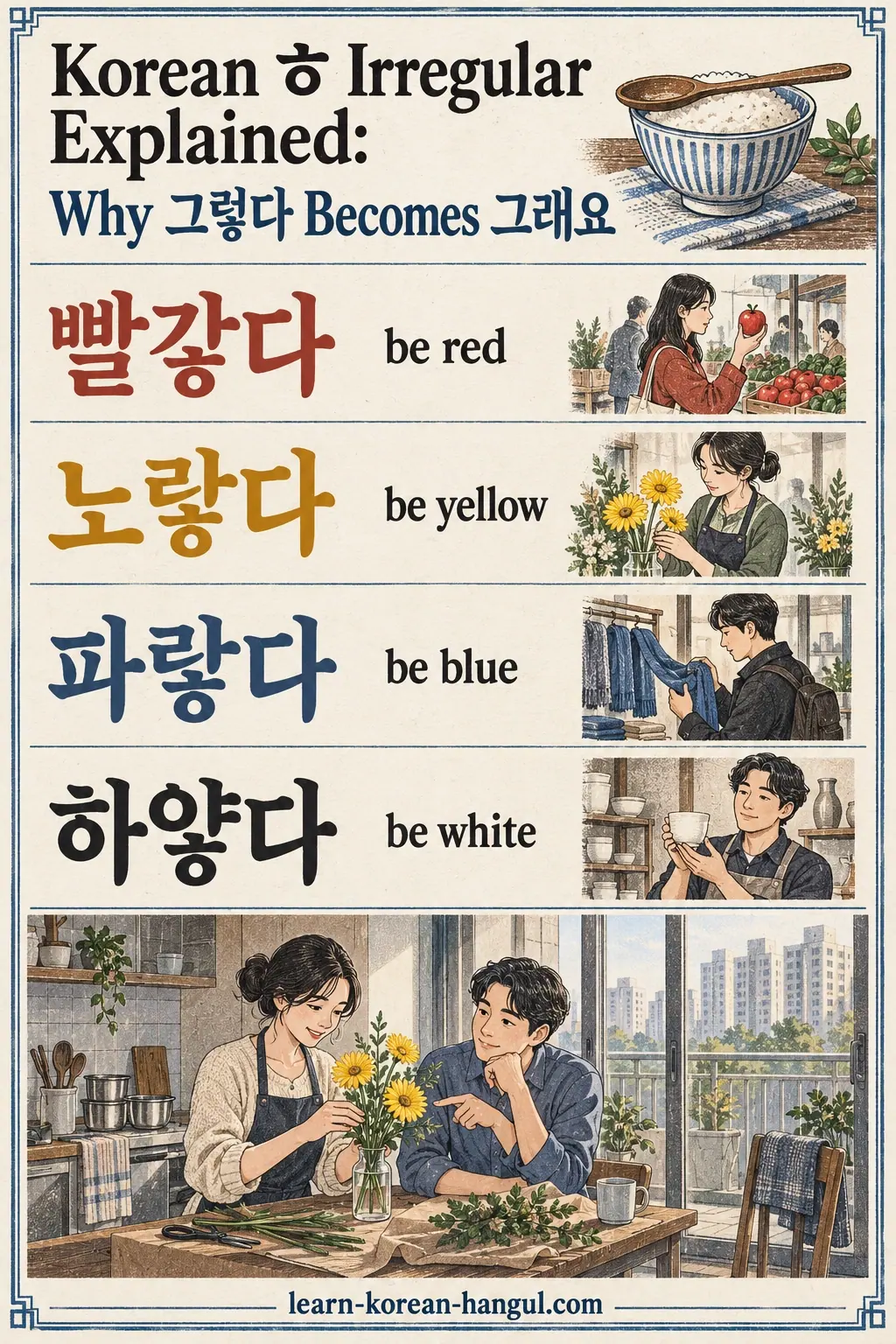
Korean ㅎ Irregular Explained through Colours

Colour words are where learners use the ㅎ irregular most, usually before a noun. The modifier form drops both ㅎ and 으, so every basic colour ends in ㄴ when it describes something.
| Colour adjective | Before a noun | Example | Meaning |
|---|---|---|---|
| 빨갛다 | 빨간 | 빨간 사과 | a red apple |
| 노랗다 | 노란 | 노란 꽃 | a yellow flower |
| 파랗다 | 파란 | 파란 하늘 | a blue sky |
| 하얗다 | 하얀 | 하얀 눈 | white snow |
| 까맣다 | 까만 | 까만 머리 | black hair |
For the sentence-final form, use the polite present: 하늘이 파래요, "The sky is blue." The colour nouns 빨강, 노랑 and 파랑 and the full colour vocabulary are in colors in Korean, and the adjective forms with shades are in Korean colour adjectives.
One recent change affects the ending -네요 ("oh, I see"). The older rule required the ㅎ to drop: 노라네요, 그러네요. Since 2015 the National Institute of Korean Language has also accepted the forms that keep it, 노랗네요 and 그렇네요, so both are now standard. The misconceptions below cover the errors that remain.
Common Misconceptions
Four beliefs cause most ㅎ-irregular errors.
- Learners often treat 좋다 as irregular. Actually it is regular. Wrong: 조애요, 존 사람. Right: 좋아요, 좋은 사람.
- Learners often keep 으 before a noun. Actually ㅎ and 으 both drop. Wrong: 빨갛은 사과, 빨가은 사과. Right: 빨간 사과.
- Learners often drop ㅎ before consonant endings. Actually -고, -지만 and -습니다 keep it. Wrong: 그러지만, 파라습니다. Right: 그렇지만, 파랗습니다.
- Learners often write 하애요. Actually ㅑ gives ㅒ. Right: 하얘요.
An honest limit: this page covers the basic colours and the 그렇다 family. Korean also has many shade words, such as darker or lighter colour adjectives, whose vowel merges follow extra rules of vowel harmony; those are treated on the colour adjectives page and should be checked in 표준국어대사전 before use.
Practice: 10 Items
Give the form asked for. Answers follow.
- 파랗다, polite present
- 어떻다, polite past
- 좋다, polite present
- 노랗다, before 우산 ("umbrella")
- 그렇다, + -지만
- 하얗다, polite present
- 이렇다, before 날 ("day")
- 많다, polite present
- 까맣다, polite past
- 그렇다, + -아서/어서
Practice · 8
What is the polite present of 파랗다 (to be blue)?
Show answer
파래요
Before 아/어 the ㅎ drops and the vowel merges into ㅐ.
How do you say "a red apple"?
Show answer
빨간 사과
Before 으 endings, both the ㅎ and the 으 drop: 빨갛 + 은 → 빨간.
What is the polite present of 좋다 (to be good)?
Show answer
좋아요
좋다 is regular: the ㅎ stays in writing, even though 좋아요 is pronounced [조아요].
What is the polite present of 하얗다 (to be white)?
Show answer
하얘요
The stem vowel is ㅑ, so it merges into ㅒ, not ㅐ.
How do you say "but" with 그렇다 + -지만?
Show answer
그렇지만
-지만 starts with a consonant, so the ㅎ is kept.
What is the polite past of 어떻다 (to be how), as in "How was the trip?"
Show answer
어땠어요
The ㅎ drops before 었 and the vowel becomes ㅐ, giving 어땠어요.
Which dictionary form does the connective 그래서 ("so") come from?
Show answer
그렇다 + -어서
그래서 is 그렇 + 어서: the ㅎ drops and the vowel merges into ㅐ, the same rule that gives 그래요.
What is the polite present of 많다 (to be many)?
Show answer
많아요
Adjectives with a double final consonant containing ㅎ (ㄶ, ㅀ) are regular, so the ㅎ stays.
Answer key
| # | Answer | Why |
|---|---|---|
| 1 | 파래요 | ㅎ drops; → ㅐ |
| 2 | 어땠어요 | ㅎ drops before 었; → ㅐ |
| 3 | 좋아요 | regular |
| 4 | 노란 우산 | ㅎ and 으 drop |
| 5 | 그렇지만 | consonant ending keeps ㅎ |
| 6 | 하얘요 | ㅑ stem → ㅒ |
| 7 | 이런 날 | ㅎ and 으 drop |
| 8 | 많아요 | ㄶ stem, regular |
| 9 | 까맸어요 | ㅎ drops; → ㅐ, past |
| 10 | 그래서 | ㅎ drops; → ㅐ |
If you got 8 or more right, the class is under control. Errors on items 3 and 8 mean the regular look-alikes need another look.
What Should You Learn after the ㅎ Irregular?
With the Korean ㅎ irregular explained, see how its two-part change compares with the six other classes in the irregular verbs chart. For any new ㅎ word, the decision tree in how to recognize irregular verbs tells you whether to expect 그래요-type forms or regular 좋아요-type forms.
What this page does not cover. It does not cover the other irregular classes, shade words such as darker colour adjectives, or the full pronunciation rules for ㅎ. About this page. Last updated 2026-10-09. The Korean text and conjugated forms were drafted with AI assistance and cross-checked with the site's rule-based conjugation engine; the Korean reviewer checks every lesson before publication. Romanization follows the Revised Romanization of Korean and is only a learning aid.
Frequently Asked Questions
Is 좋다 a ㅎ irregular adjective? No. 좋다 ("to be good") is regular even though its stem ends in ㅎ, so it gives 좋아요, 좋았어요 and 좋은. The ㅎ is kept in writing but silent before a vowel, which is why 좋아요 sounds like [조아요]. 좋다 is the best-known exception among adjectives with a single ㅎ at the end of the stem.
What is the past tense of 어떻다? The polite past of 어떻다 ("to be how") is 어땠어요 (eottaesseoyo), as in 여행 어땠어요?, "How was the trip?" The ㅎ drops and 어 merges into ㅐ, giving 어때, and 었 adds the past. The present question is 어때요? and the formal past is 어땠습니까?
How do I say "a red apple" in Korean? Say 빨간 사과 (ppalgan sagwa). 빨갛다 ("to be red") is ㅎ-irregular, so before a noun the ㅎ drops together with the 으 of the modifier ending: 빨갛 + 은 becomes 빨간. The same pattern gives 노란 꽃 ("a yellow flower"), 파란 하늘 ("a blue sky") and 하얀 눈 ("white snow").
Is it 그렇네요 or 그러네요? Both are standard today. The older rule allowed only 그러네요, with the ㅎ dropped before -네. In 2015 the National Institute of Korean Language also accepted forms that keep the ㅎ, such as 그렇네요 and 노랗네요. You will hear both, and either is correct in writing.
Why is 하얗다 하얘요 and not 하애요? Because the stem vowel of 하얗다 is ㅑ, not ㅏ. When the ㅎ drops, ㅑ and 아 merge into ㅒ, the "y" version of ㅐ, so the result is 하얘요 (hayaeyo). 빨갛다 has ㅏ, which merges into ㅐ: 빨개요. In fast speech, 하얘요 and 하애요 can sound close, so the spelling must be learned.