What you'll learn
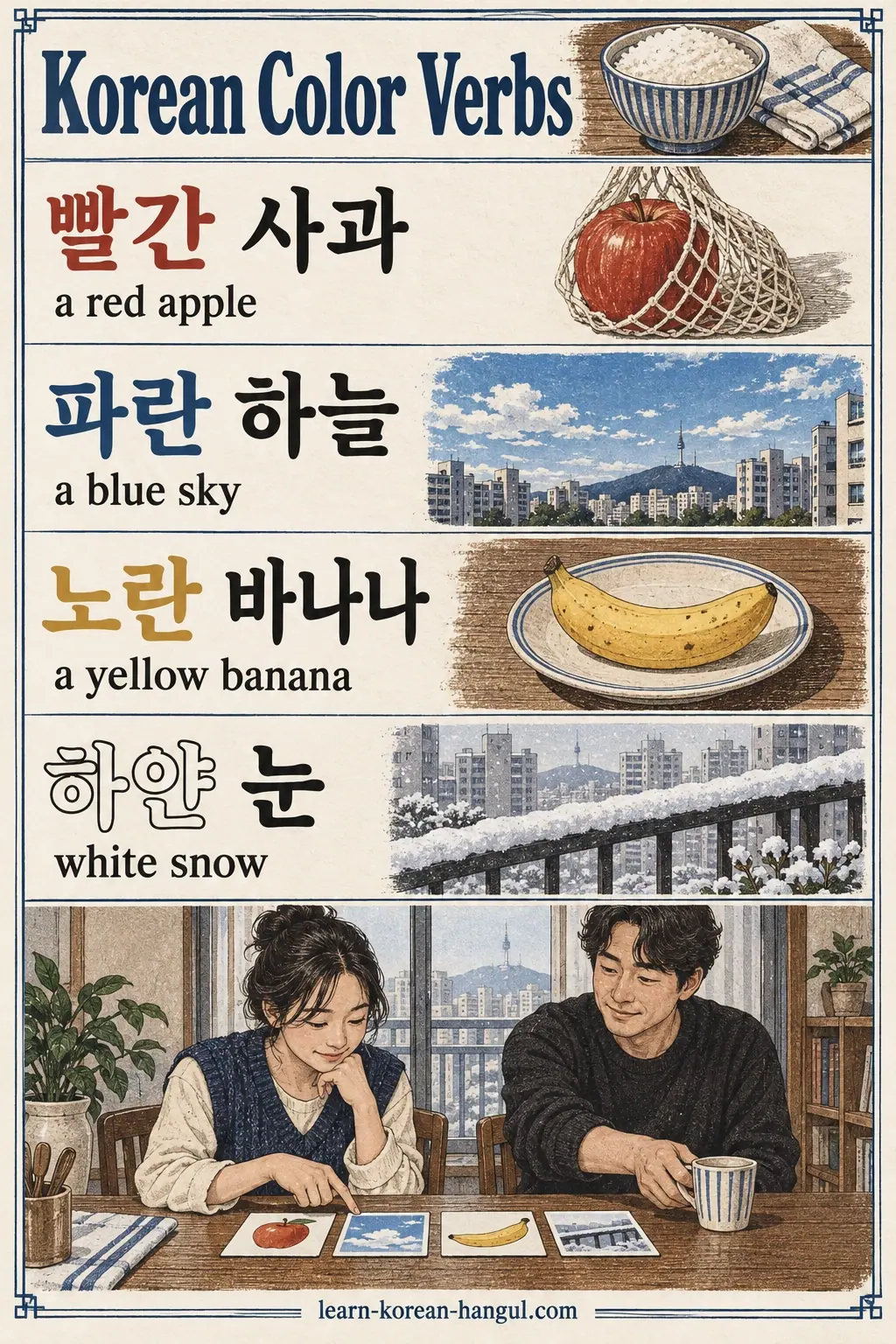
- Use red, blue, yellow, white and black as predicates (빨개요), modifiers (빨간 사과) and colour nouns (빨간색).
- Name six colours that are nouns only: 초록색, 보라색, 분홍색, 주황색, 갈색, 회색.
- Apply the ㅎ irregular rule to five colour adjectives.
- Ask and answer 무슨 색이에요?
Prerequisites: verbs vs adjectives. Time: about 30 minutes.
Key facts
- Modifier forms: 빨간, 파란, 노란, 하얀, 까만.
- Noun colours add 색: 초록색, 보라색, 분홍색.
How Do You Say Colours in Korean?
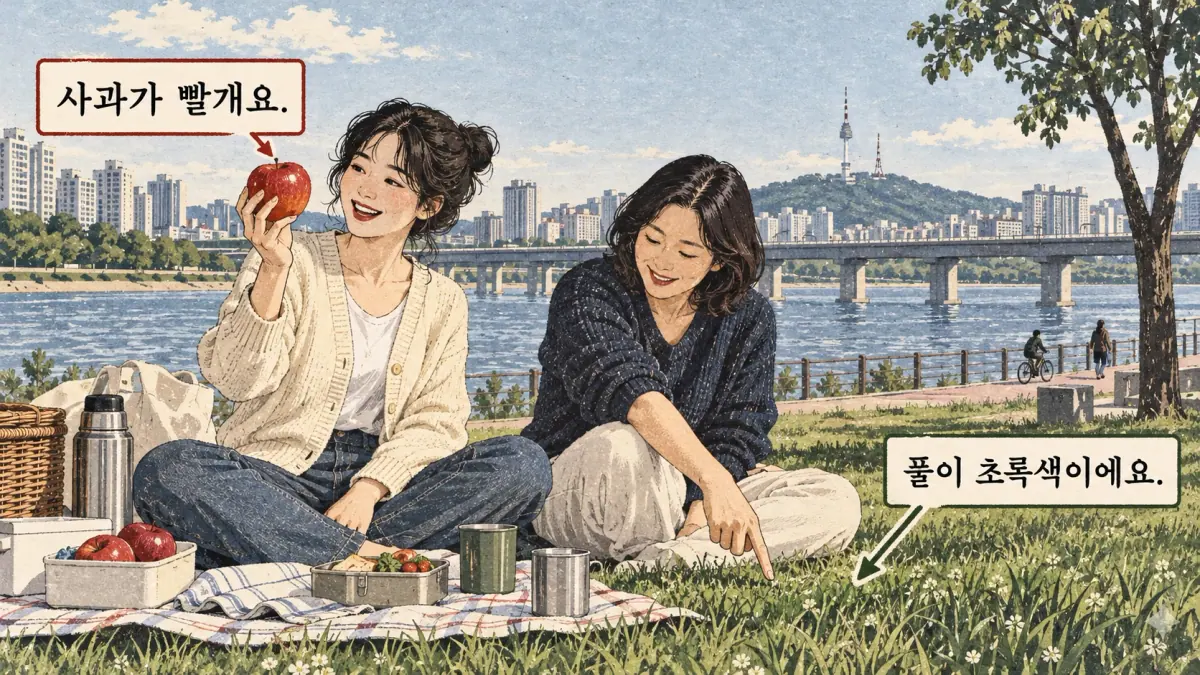
You say colours in Korean with one of two word types: a colour adjective such as 빨갛다, or a colour noun such as 초록색 with 이다. Adjectives describe a thing directly (사과가 빨개요), and nouns name the colour (사과는 빨간색이에요). Five basic colours are adjectives, and most others are nouns.
| Type | Example | Predicate | Before a noun |
|---|---|---|---|
| Adjective | 빨갛다 (red) | 사과가 빨개요. | 빨간 사과 |
| Noun | 초록색 (green) | 풀이 초록색이에요. | 초록색 풀 |
The split is not obvious from English, where "red" and "green" behave alike. It matters because adjectives take verb endings and nouns take 이다. The first group is the five basic adjectives.
Which Colours Are Adjectives?
Five basic colours are adjectives: 빨갛다, 파랗다, 노랗다, 하얗다 and 까맣다. All end in 랗 or 맣, which is the sign of the ㅎ irregular class. The table gives their forms.
| Dictionary form | Meaning | Polite present | Polite past | Modifier | Noun forms |
|---|---|---|---|---|---|
| 빨갛다 | red | 빨개요 | 빨갰어요 | 빨간 | 빨강 / 빨간색 |
| 파랗다 | blue | 파래요 | 파랬어요 | 파란 | 파랑 / 파란색 |
| 노랗다 | yellow | 노래요 | 노랬어요 | 노란 | 노랑 / 노란색 |
| 하얗다 | white | 하얘요 | 하얬어요 | 하얀 | 하양 / 하얀색 |
| 까맣다 | black | 까매요 | 까맸어요 | 까만 | 까망 / 까만색 |
Four more colour adjectives are common in reading and fixed phrases. They are not ㅎ words, and 푸르다 is a special case.
| Dictionary form | Meaning | Polite present | Modifier | Class |
|---|---|---|---|---|
| 검다 | black (darker, more formal) | 검어요 | 검은 | regular |
| 희다 | white (pure, fair) | 희어요 | 흰 | regular |
| 붉다 | red (deep, literary) | 붉어요 | 붉은 | regular |
| 푸르다 | blue-green (sky, leaves) | 푸르러요 | 푸른 | 러 irregular |
검다, 희다 and 붉다 are regular. 푸르다 is a 러 irregular word whose polite present adds 러, giving 푸르러요. The first three often replace 까맣다, 하얗다 and 빨갛다 in written or formal descriptions, as in 검은 구름 ("dark clouds"). Now the colours that are not adjectives.
Which Colours Are Nouns Only?
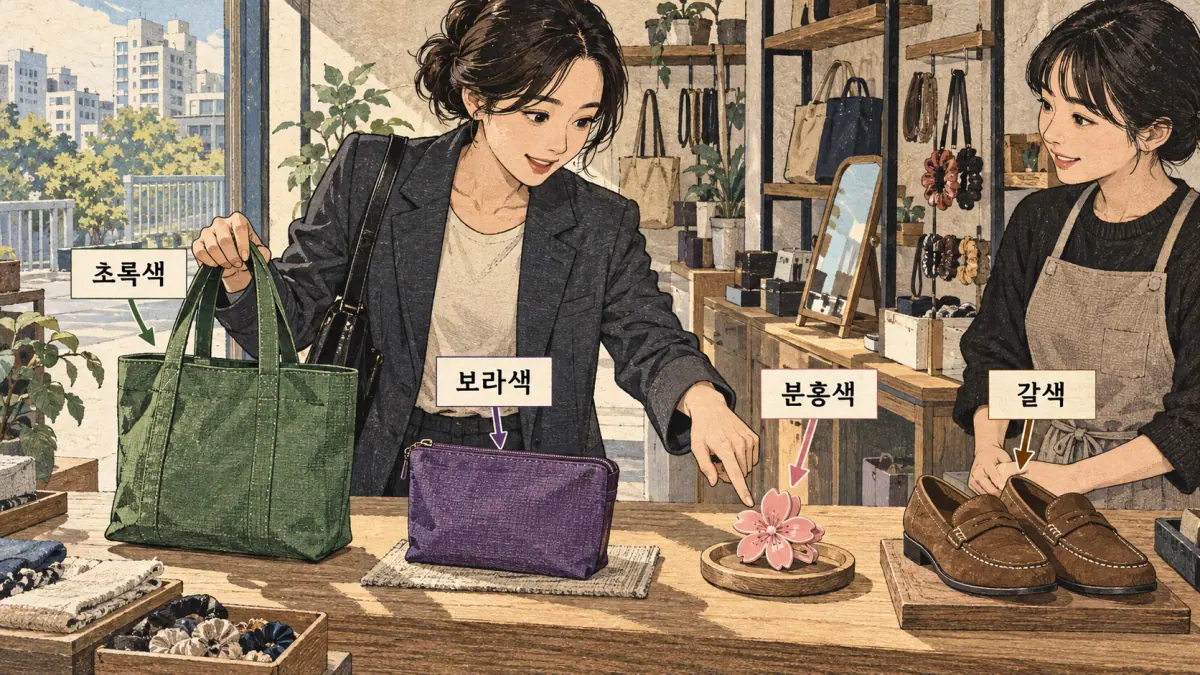
Six common colours are nouns, so they need 색 ("colour") or a noun form and use 이다 as the predicate. The sentence 풀이 초록색이에요 means "The grass is green": 초록색 is a noun, and 이에요 is the polite present of 이다.
| Colour noun | Meaning | Example |
|---|---|---|
| 초록색 | green | 풀이 초록색이에요. (The grass is green.) |
| 보라색 | purple | 가방이 보라색이에요. (The bag is purple.) |
| 분홍색 | pink | 꽃이 분홍색이에요. (The flower is pink.) |
| 주황색 | orange | 귤이 주황색이에요. (The tangerine is orange.) |
| 갈색 | brown | 신발이 갈색이에요. (The shoes are brown.) |
| 회색 | grey | 구름이 회색이에요. (The cloud is grey.) |
The copula changes with the last sound of the noun: 이에요 follows a consonant (초록색이에요, 분홍이에요) and 예요 follows a vowel (보라예요, when the short noun 보라 is used). With the full forms ending in 색 the choice is always 이에요, which is one more reason to prefer them at first. You cannot say 초록해요 or 보라해요, because there is no verb. Before a noun the colour noun stays unchanged: 초록색 옷 ("green clothes"). Some speakers drop 색 in short forms, such as 초록 and 보라, but 색 makes the word clear. Pale colours often borrow nouns: 하늘색 ("sky blue") and 연두색 ("light green") work the same way. The next section shows all four forms of the adjective colours.
What Are the Four Forms of Each Colour Adjective?
Each colour adjective has four forms: dictionary form, polite present, modifier and noun. The dictionary form lists the word, the polite present ends a sentence, the modifier sits before a noun, and the noun names the colour. The example uses 빨갛다.
| Form | Korean | Use | Example |
|---|---|---|---|
| Dictionary | 빨갛다 | word lists | 빨갛다 means "to be red" |
| Polite present | 빨개요 | ends a sentence | 사과가 빨개요. |
| Modifier | 빨간 | before a noun | 빨간 사과 |
| Noun | 빨강 / 빨간색 | names the colour | 빨간색이에요. |
Why Does ㅎ Drop?
ㅎ drops because the ㅎ irregular rule removes ㅎ before a vowel ending and changes the vowel. Follow the steps for 파랗다.
- Start with the stem. 파랗다 has the stem 파랗.
- Add 아요. 파랗 + 아요.
- Drop ㅎ and merge. 파라 + 아요 gives 파래요, where ㅏ + ㅏ becomes ㅐ.
- For the modifier, drop ㅎ and add ㄴ. 파라 + ㄴ gives 파란.
You know it worked when the form has no ㅎ and the vowel is ㅐ (or ㅒ for 하얗다: 하얘요). Before a consonant ㅎ stays: 파랗고 ("blue and"), 파랗지 않아요 ("not blue"). The complete rule is in the ㅎ irregular lesson, and the same rule applies to 이렇다 and 그렇다. The modifier ending is explained in the adjective -(으)ㄴ form.
Why Is a Red Apple 빨간 사과 and Not 빨강 사과?
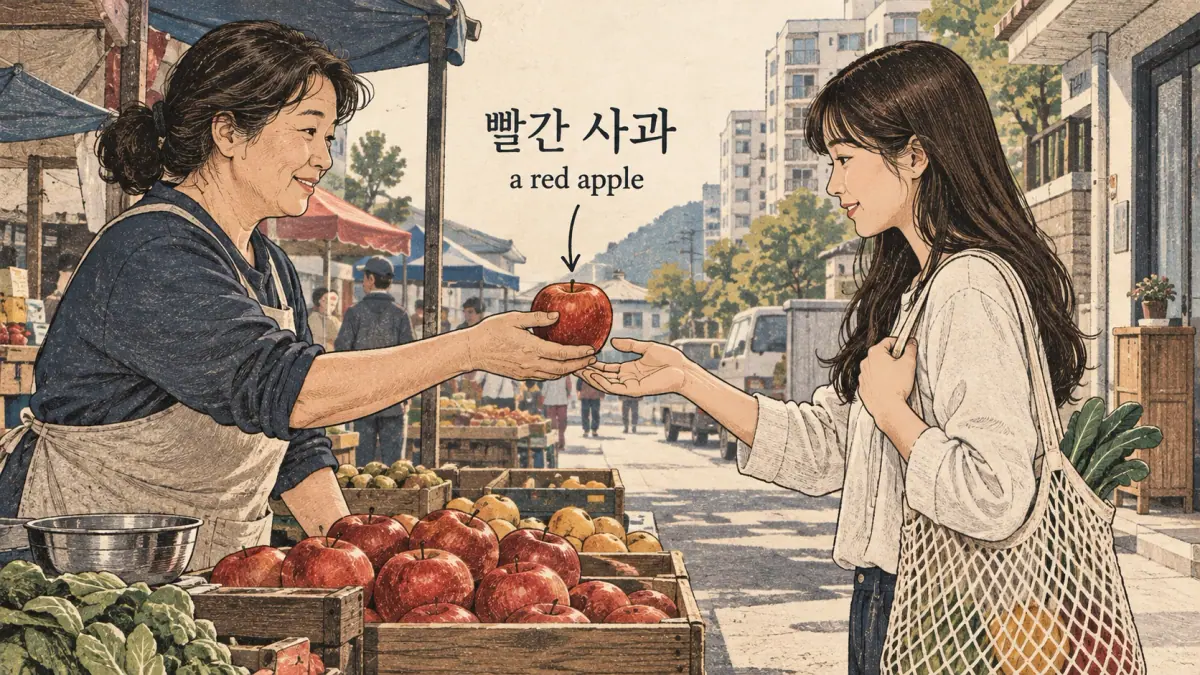
A red apple is 빨간 사과 because the modifier 빨간 describes the noun, while 빨강 is itself a noun. A noun cannot modify another noun directly in this way. The table shows five modifier phrases.
| Phrase | Meaning |
|---|---|
| 빨간 사과 | a red apple |
| 파란 하늘 | a blue sky |
| 노란 바나나 | a yellow banana |
| 하얀 눈 | white snow |
| 까만 머리 | black hair |
The same logic separates 파란 (modifier) from 파랑 (noun). 파란색 and 파랑 both name the colour blue, and 파란색 can also come before 이에요: 이 가방은 파란색이에요 ("This bag is blue"). Use the modifier before a noun and the noun at the end of a sentence with 이다. The next section covers cases where the English colour does not map neatly onto Korean.
Which Colour Nuances Confuse Learners?
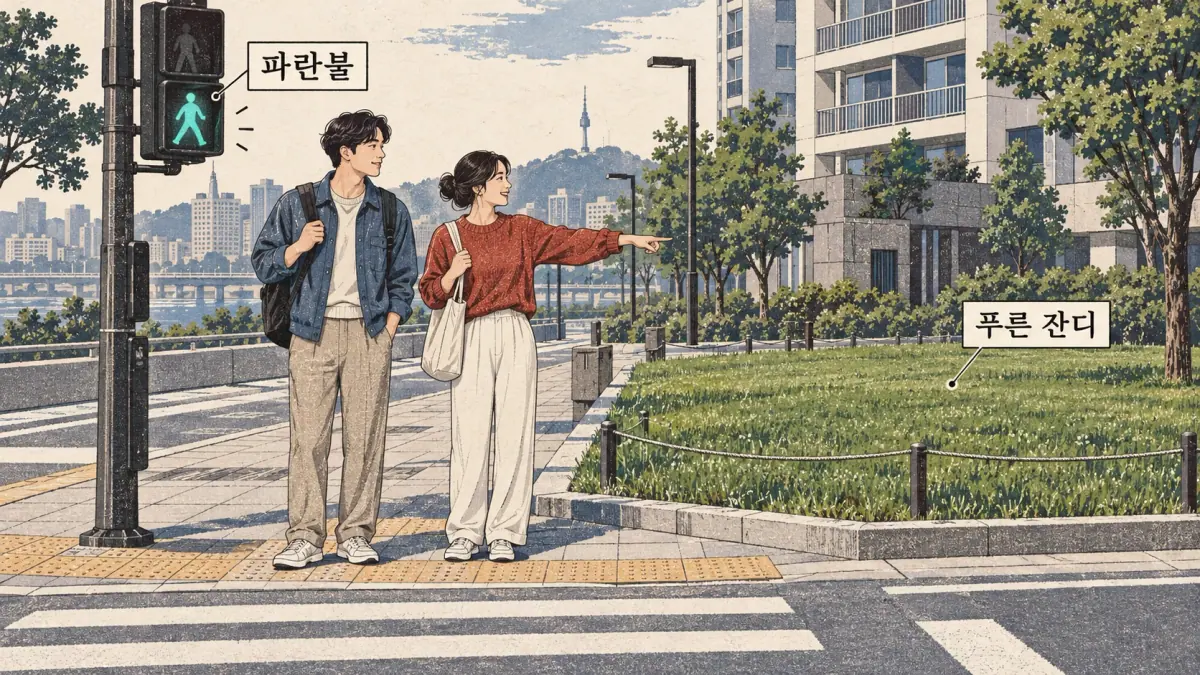
Three nuances confuse learners: 파랗다 also covers green in some fixed phrases, 푸르다 covers the blue-green of leaves and sky, and shades such as 연두색 and 하늘색 exist as separate nouns. Treat these as vocabulary to learn, not rules to derive.
- 파란불. A green traffic light is called 파란불 ("blue light"), and 신호등이 파란불이에요 means "The light is green". Korean traditionally grouped blue and green, and the old usage survives in this phrase.
- 푸르다. 푸른 하늘 ("blue sky") and 푸른 잔디 ("green lawn") use 푸르다 for the blue-green family. The polite present 푸르러요 is irregular.
- 하늘색 and 연두색. These are nouns, so 하늘색 옷 means "sky-blue clothes".
A beginner needs only the five basic adjectives and six nouns above. As a rule of thumb, start with the colour you can see in front of you: describe it with the adjective, and name it with the noun only when someone asks 무슨 색이에요?
How Do You Describe Light, Dark and Changing Colours?
Light and dark shades come from a modifier placed before the colour noun, and changing colours use -아/어지다. The shade words 밝은 ("bright"), 어두운 ("dark"), 연한 ("pale") and 진한 ("deep") are the modifier forms of the adjectives 밝다, 어둡다, 연하다 and 진하다, so they sit before 색 words just as 빨간 sits before 사과.
| Phrase | Meaning | Pattern |
|---|---|---|
| 밝은 파란색 | light blue | 밝은 + colour noun |
| 어두운 빨간색 | dark red | 어두운 + colour noun |
| 연한 분홍색 | pale pink | 연한 + colour noun |
| 진한 초록색 | deep green | 진한 + colour noun |
| 얼굴이 빨개졌어요. | The face turned red. | stem + 아/어지다 (become) |
| 머리가 하얘졌어요. | The hair turned white. | stem + 아/어지다 (become) |
The ending -아/어지다 turns an adjective into a verb meaning "to become": 빨갛다 becomes 빨개지다 ("to turn red"). The past 빨개졌어요 describes a change that has happened, such as a face turning red from embarrassment or sun. In the present, 빨개져요 describes a change that is happening or repeated. A static state uses the plain adjective, 얼굴이 빨개요 ("The face is red"). Both patterns use the ㅎ-drop stem 빨개, so learning that stem once covers all of them. The next section lists the frames you will say most.
Sentence Frames: How Do You Talk about Colours?
Four frames cover most colour talk. Each uses the forms above.
| Frame | Example | Meaning |
|---|---|---|
| N이/가 + colour adjective | 하늘이 파래요. | The sky is blue. |
| colour modifier + N | 파란 하늘 | a blue sky |
| N은/는 + colour noun + 이에요 | 풀은 초록색이에요. | The grass is green. |
| 무슨 색이에요? | 이 사과는 무슨 색이에요? | What colour is this apple? |
The answer to 무슨 색이에요? uses the noun: 빨간색이에요 ("It is red"). You can also answer with the adjective, 빨개요, when you want to describe the thing. For the colour vocabulary as a word list, see colors in Korean.
Mini Dialogue: Shopping for a Bag
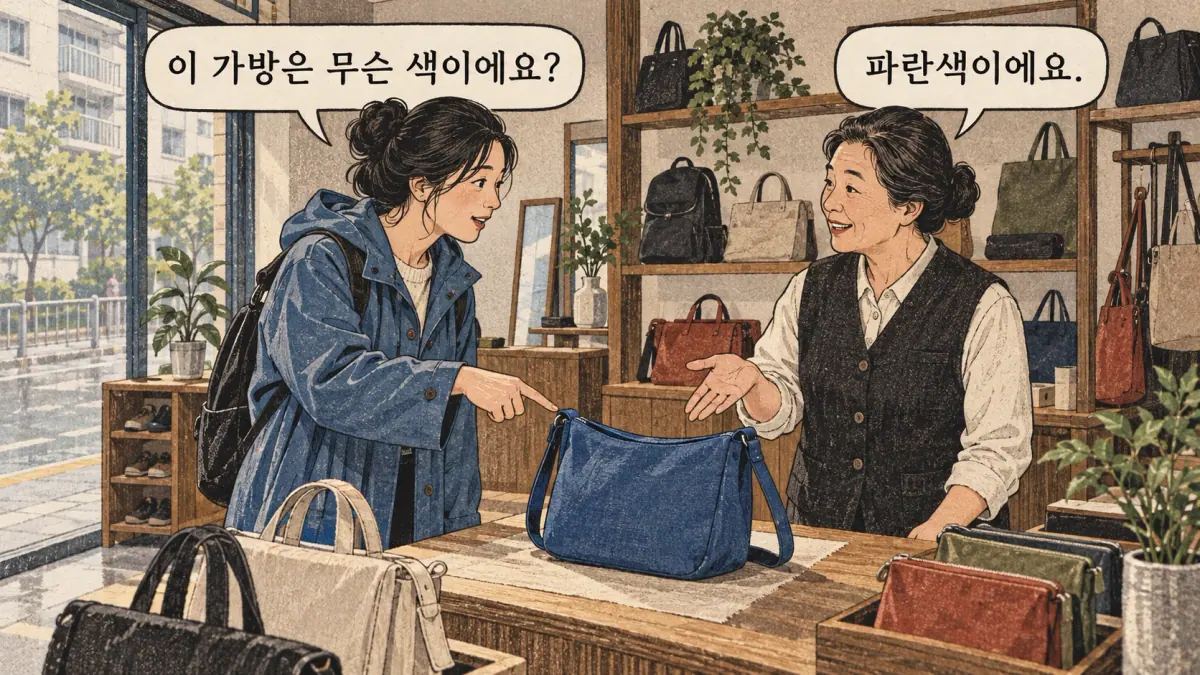
This four-line dialogue uses a colour noun, a colour modifier and a colour adjective in a real exchange. A customer asks the colour of a bag and then asks about another colour.
| Speaker | Korean | English |
|---|---|---|
| 손님 | 이 가방은 무슨 색이에요? | What colour is this bag? |
| 직원 | 파란색이에요. | It is blue. |
| 손님 | 빨간 가방도 있어요? | Do you have a red bag too? |
| 직원 | 네, 있어요. 빨간 가방은 조금 비싸요. | Yes. The red bag is a little expensive. |
Notice three forms in four lines. 파란색이에요 is the noun answer to 무슨 색이에요?. 빨간 가방 uses the modifier before a noun. 비싸요 is a plain adjective with no colour at all. Learners often memorise 빨강, 파랑 and 노랑 from colour lists, and then cannot attach them to a noun. The fix is to learn each colour in the pair 빨간 / 빨간색 first and treat the noun forms as secondary.
Practice: Can You Use the Colours?
Translate each item into Korean, then check the answer column. Cover the answers first.
| # | English | Answer |
|---|---|---|
| 1 | The apple is red. | 사과가 빨개요. |
| 2 | The sky is blue. | 하늘이 파래요. |
| 3 | The banana is yellow. | 바나나가 노래요. |
| 4 | The snow is white. | 눈이 하얘요. |
| 5 | The hair is black. | 머리가 까매요. |
| 6 | a red bag | 빨간 가방 |
| 7 | a white shirt | 하얀 셔츠 |
| 8 | The grass is green. | 풀이 초록색이에요. |
| 9 | The bag is purple. | 가방이 보라색이에요. |
| 10 | What colour is it? | 무슨 색이에요? |
Practice · 8
How do you say "The apple is red"?
Show answer
사과가 빨개요.
빨갛다 is ㅎ irregular: the ㅎ drops and ㅏ + ㅏ becomes ㅐ, giving 빨개요. There is no verb 빨강하다, and the modifier 빨간 cannot end a sentence.
Which phrase means "a red apple"?
Show answer
빨간 사과
Before a noun you use the modifier 빨간. 빨강 is a noun, and two nouns in a row do not work here.
What is the polite present of 하얗다 (white)?
Show answer
하얘요
The ㅎ must drop, and for 하얗다 the vowel becomes ㅒ: 하얘요. 하얀 is the modifier.
How do you say "The grass is green"?
Show answer
풀이 초록색이에요.
초록색 is a colour noun, so it takes 이다: 초록색이에요. There is no verb 초록하다.
Which of these colours is a noun only, not an adjective?
Show answer
보라색
The five basic colour adjectives are 빨갛다, 파랗다, 노랗다, 하얗다 and 까맣다; 보라색 is one of the noun-only colours.
What is the modifier form of 파랗다, as in ___ 하늘 (a blue sky)?
Show answer
파란
For the modifier, drop ㅎ and add ㄴ: 파라 + ㄴ gives 파란. 파랑 is the noun.
What does 파란불 refer to at a traffic light?
Show answer
A green light
Korean traditionally grouped blue and green, and the old usage survives in 파란불, the green traffic light.
Which sentence describes a face that has turned red?
Show answer
얼굴이 빨개졌어요.
-아/어지다 means "to become", so the past 빨개졌어요 describes a change that has happened. 얼굴이 빨개요 only describes a static state.
Score eight or more and you can use the colour adjectives in daily speech. Frequent errors are:
- 빨강해요. There is no verb 빨강하다; write 빨개요.
- 파란해요. 파란 is the modifier and cannot end a sentence; write 파래요.
- 하얗아요. The ㅎ must drop; write 하얘요.
- 초록해요. 초록색 is a noun, so write 초록색이에요.
- 빨강 사과. Two nouns in a row; write 빨간 사과.
What this page does not cover. It leaves out colour idioms, shade words beyond the four above (such as 짙은, "deep, thick"), and the verb 물들다 ("to be dyed").
What Should You Learn after Korean Color Verbs?
After the Korean color verbs in this lesson, continue with the ㅎ irregular lesson, where colour adjectives and the 그렇다 family are covered in full. Then try the adjective -(으)ㄴ form for all adjective types.
About this page. Last updated 2026-10-09. The Korean text on this page was machine-generated and reviewed and signed off by Min-ji Park on 15 October 2026. Forms were cross-checked with the site's rule-based conjugation engine. Romanization follows the Revised Romanization of Korean and is shown only as a learning aid.
Frequently Asked Questions
How do I say red in Korean? Red has three forms. The adjective is 빨갛다, with the polite present 빨개요 ("it is red") and the modifier 빨간 ("red", before a noun). The noun is 빨강 or 빨간색 ("the colour red"). Say 빨간 사과 for a red apple, 사과가 빨개요 for "The apple is red", and 빨간색이에요 for "It is red-coloured".
What is the difference between 빨강 and 빨간색? Both are nouns meaning "the colour red", and they are interchangeable in most sentences: 좋아하는 색은 빨강이에요 or 빨간색이에요. 빨간색 is built from the modifier 빨간 plus 색 ("colour"), and 빨강 is the shorter noun form. Neither is used before another noun; the modifier 빨간 does that job.
How do I say green in Korean? Green is usually the noun 초록색 or 초록, and the lighter yellow-green is 연두색. Because it is a noun, it needs 이다 as a predicate: 풀이 초록색이에요 ("The grass is green"). Before a noun, say 초록색 옷 ("green clothes"). The adjective 푸르다 also covers the green-blue of leaves and the sky.
Why is it 하얘요 and not 하얗아요? The ㅎ drops and the vowel changes before 어요, which is the ㅎ irregular rule. 하얗 + 아요 becomes 하얘요, and 파랗 + 아요 becomes 파래요. The ㅎ stays in the dictionary form and before consonants, as in 하얗고 ("white and") and 하얗습니다. Before ㄴ it drops with no vowel change: 하얀.
Can I use 빨강 directly before a noun? No. 빨강 is a noun, so 빨강 사과 sounds like two nouns in a row. Use the modifier 빨간 before a noun, as in 빨간 사과, or use 빨간색 as a noun in a sentence such as 사과는 빨간색이에요. The same rule applies to 파란, 노란, 하얀 and 까만.