Colors in Korean at a Glance
Color words are among the first adjectives and nouns any learner needs: to describe clothes, food, a car or a flag. Most Korean color nouns are built from a color word and 색 (color), as in 빨간색 (red-color) and 파란색 (blue-color). Once you know the pattern, you can make a new color word from any base.
The list has four groups. The basic colors come first, with the two general words 색 and 색깔. Then come the words for shades such as light and dark, then metals and neutral words such as gold, silver and transparent, and last the five traditional colors of Korean culture, 오방색.
The list holds 40 words. By origin, the list has 3 native, 22 Sino-Korean and 15 mixed words. "Mixed" means a word that combines parts of different origins: in 빨간색 a native color root joins the Sino-Korean 색 (色), and in 베이지색 an English loanword does. Colors such as 주황색 and 초록색 are Sino-Korean throughout.
| Group | Words | Examples |
|---|---|---|
| Basic colors | 14 | 색, 색깔, 빨간색, 주황색 |
| Shades and light/dark | 10 | 연두색, 하늘색, 청록색, 살구색 |
| Metals and neutrals | 8 | 금색, 은색, 구리색, 무색 |
| Colors in culture | 8 | 오방색, 청색, 적색, 황색 |
This list sits inside Nature and the World. It lists the color nouns only. The adjective forms, such as 빨갛다, are on the color adjectives page, and the next topic in this section is Geography and Countries.
Which Color Words Should You Learn First?
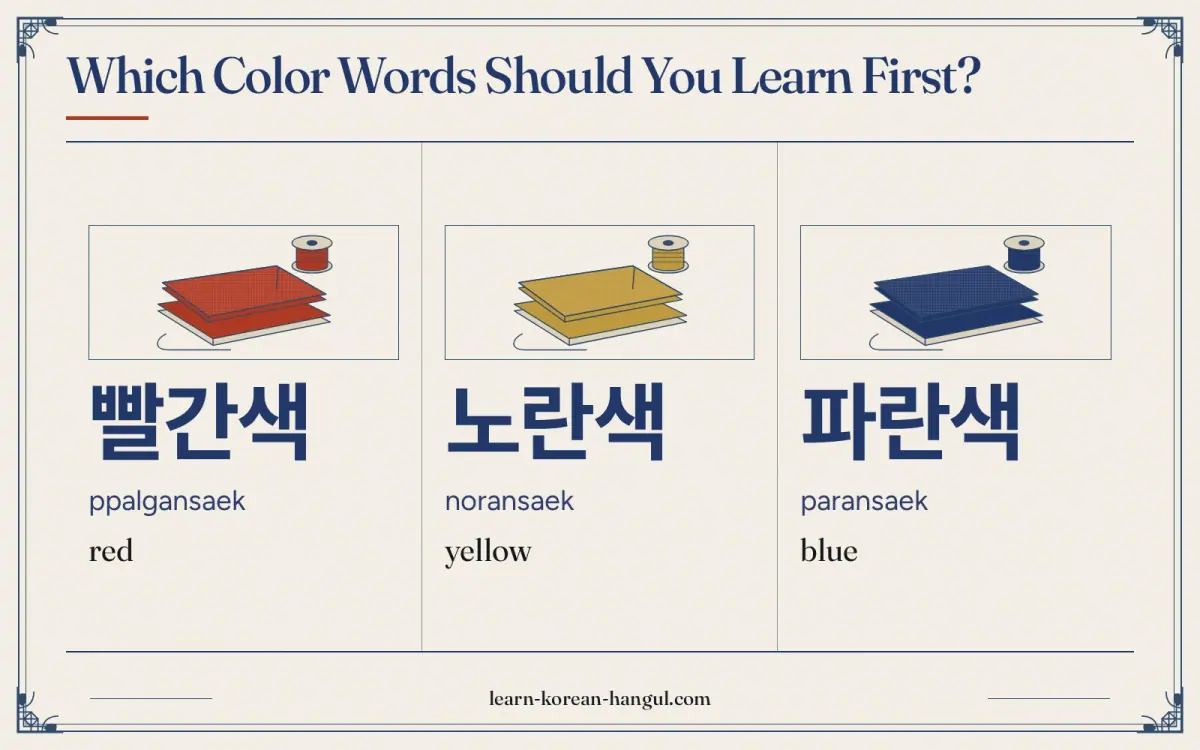
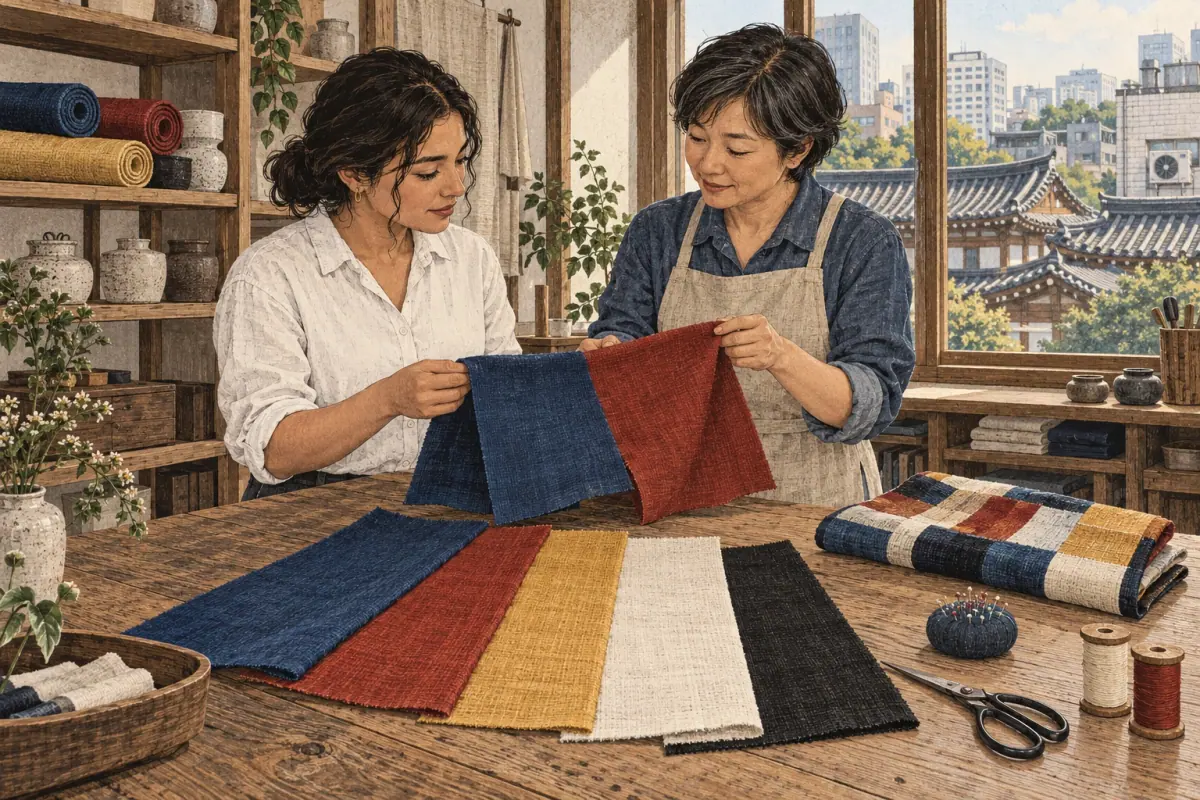
Start with five colors you use every day: 빨간색, 파란색, 검은색, 하얀색 and 갈색. Use the scene to see eight colors at once, then press play and the slow button on each of the five and say the word aloud.
Word · 8
- 1
빨간색
ppalgansaek
red
- 2
노란색
noransaek
yellow
- 3
파란색
paransaek
blue
- 4
초록색
choroksaek
green
- 5
보라색
borasaek
purple
- 6
분홍색
bunhongsaek
pink
- 7
검은색
geomeunsaek
black
- 8
하얀색
hayansaek
white
빨간색 (ppalgansaek) means red. The root 빨간 means red. The tense ㅃ at the start is said without a puff of air. Example: 빨간색 사과를 먹어요. (I eat a red apple.)
파란색 (paransaek) means blue. The root 파란 means blue. In daily speech 파란 can also cover the green of a traffic light. Example: 하늘이 파란색이에요. (The sky is blue.)
검은색 (geomeunsaek) means black. The root 검은 comes from the adjective 검다. 까만색 is also used. Example: 검은색 고양이가 지나가요. (A black cat passes by.)
하얀색 (hayansaek) means white. The root 하얀 comes from the adjective 하얗다. The ㅎ drops in the modifier form. Example: 하얀색 셔츠를 입어요. (I wear a white shirt.)
갈색 (galsaek) means brown. Example: 갈색 곰이 있어요. (There is a brown bear.)
Basic Colors
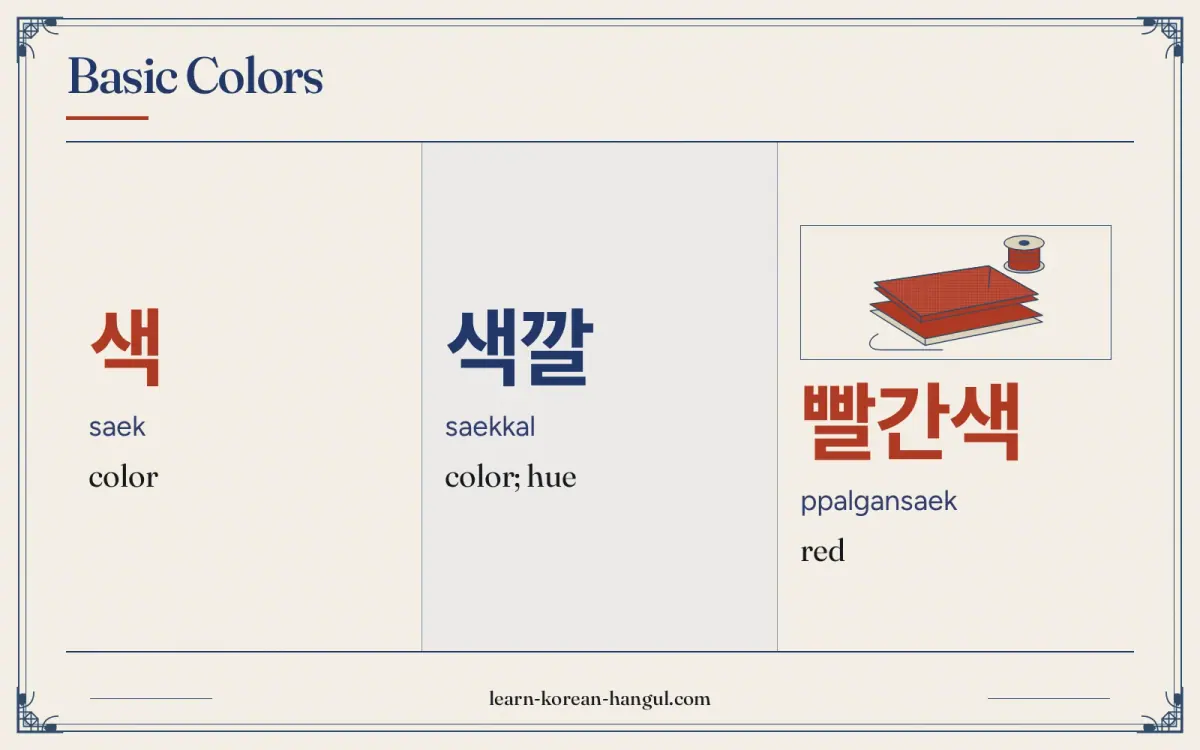
The first group has fourteen words: the two general words for color, and twelve basic colors. Each color has a base word plus 색, so the pattern is easy to see.
| No. | Hangul | Revised Romanization | Meaning | Origin | Example sentence | Audio assetId |
|---|---|---|---|---|---|---|
| 1 | 색 | saek | color | Sino-Korean | 무슨 색을 좋아해요? (museun saegeul joahaeyo; What color do you like?) | au-pg-vocabulary-nature-colors-1; example: au-pg-vocabulary-nature-colors-101 |
| 2 | 색깔 | saekkal | color; hue | mixed | 이 옷은 색깔이 예뻐요. (i oseun saekkari yeppeoyo; The color of these clothes is pretty.) | au-pg-vocabulary-nature-colors-2; example: au-pg-vocabulary-nature-colors-102 |
| 3 | 빨간색 | ppalgansaek | red | mixed | 빨간색 사과를 먹어요. (ppalgansaek sagwareul meogeoyo; I eat a red apple.) | au-pg-vocabulary-nature-colors-3; example: au-pg-vocabulary-nature-colors-103 |
| 4 | 주황색 | juhwangsaek | orange | Sino-Korean | 주황색 귤이 맛있어요. (juhwangsaek gyuri masisseoyo; The orange tangerine is tasty.) | au-pg-vocabulary-nature-colors-4; example: au-pg-vocabulary-nature-colors-104 |
| 5 | 노란색 | noransaek | yellow | mixed | 노란색 택시가 와요. (noransaek taeksiga wayo; A yellow taxi comes.) | au-pg-vocabulary-nature-colors-5; example: au-pg-vocabulary-nature-colors-105 |
| 6 | 초록색 | choroksaek | green | Sino-Korean | 초록색 나무가 많아요. (choroksaek namuga manayo; There are many green trees.) | au-pg-vocabulary-nature-colors-6; example: au-pg-vocabulary-nature-colors-106 |
| 7 | 파란색 | paransaek | blue | mixed | 하늘이 파란색이에요. (haneuri paransaegieyo; The sky is blue.) | au-pg-vocabulary-nature-colors-7; example: au-pg-vocabulary-nature-colors-107 |
| 8 | 남색 | namsaek | navy blue; indigo | Sino-Korean | 남색 가방을 샀어요. (namsaek gabangeul sasseoyo; I bought a navy bag.) | au-pg-vocabulary-nature-colors-8; example: au-pg-vocabulary-nature-colors-108 |
| 9 | 보라색 | borasaek | purple | mixed | 보라색 꽃이 예뻐요. (borasaek kkochi yeppeoyo; The purple flower is pretty.) | au-pg-vocabulary-nature-colors-9; example: au-pg-vocabulary-nature-colors-109 |
| 10 | 분홍색 | bunhongsaek | pink | Sino-Korean | 분홍색 치마를 입어요. (bunhongsaek chimareul ibeoyo; I wear a pink skirt.) | au-pg-vocabulary-nature-colors-10; example: au-pg-vocabulary-nature-colors-110 |
| 11 | 갈색 | galsaek | brown | Sino-Korean | 갈색 곰이 있어요. (galsaek gomi isseoyo; There is a brown bear.) | au-pg-vocabulary-nature-colors-11; example: au-pg-vocabulary-nature-colors-111 |
| 12 | 검은색 | geomeunsaek | black | mixed | 검은색 고양이가 지나가요. (geomeunsaek goyangiga jinagayo; A black cat passes by.) | au-pg-vocabulary-nature-colors-12; example: au-pg-vocabulary-nature-colors-112 |
| 13 | 하얀색 | hayansaek | white | mixed | 하얀색 셔츠를 입어요. (hayansaek syeocheureul ibeoyo; I wear a white shirt.) | au-pg-vocabulary-nature-colors-13; example: au-pg-vocabulary-nature-colors-113 |
| 14 | 회색 | hoesaek | gray | Sino-Korean | 회색 구름이 많아요. (hoesaek gureumi manayo; There are many gray clouds.) | au-pg-vocabulary-nature-colors-14; example: au-pg-vocabulary-nature-colors-114 |
- 색 and 색깔 both mean color. 색 is the short word that ends most color names, and 색깔 is the word you use to ask about the color of something: 색깔이 뭐예요? (What color is it?).
- Most basic colors end in 색. Before a noun, the adjective form without 색 is very common: 빨간 사과 (a red apple) is more usual than 빨간색 사과.
- 검은색 and 까만색 are both black. Both are standard and common, and the adjective 까맣다 often suggests a deep, glossy black.
Example Sentences
Color sentences use color + noun, or noun + 이/가 + color + 이에요. In the first pattern the color goes before the noun: 빨간색 사과 (a red apple). In the second pattern the color ends the sentence: 하늘이 파란색이에요 (the sky is blue). Every color noun ends in 색, which ends in a consonant, so the copula is always 이에요, never 예요: 하늘이 파란색이에요 and 물은 무색이에요. To ask a color, say 무슨 색이에요? (What color is it?) or 색깔이 뭐예요?
How Do You Say Shades and Light/Dark in Korean?
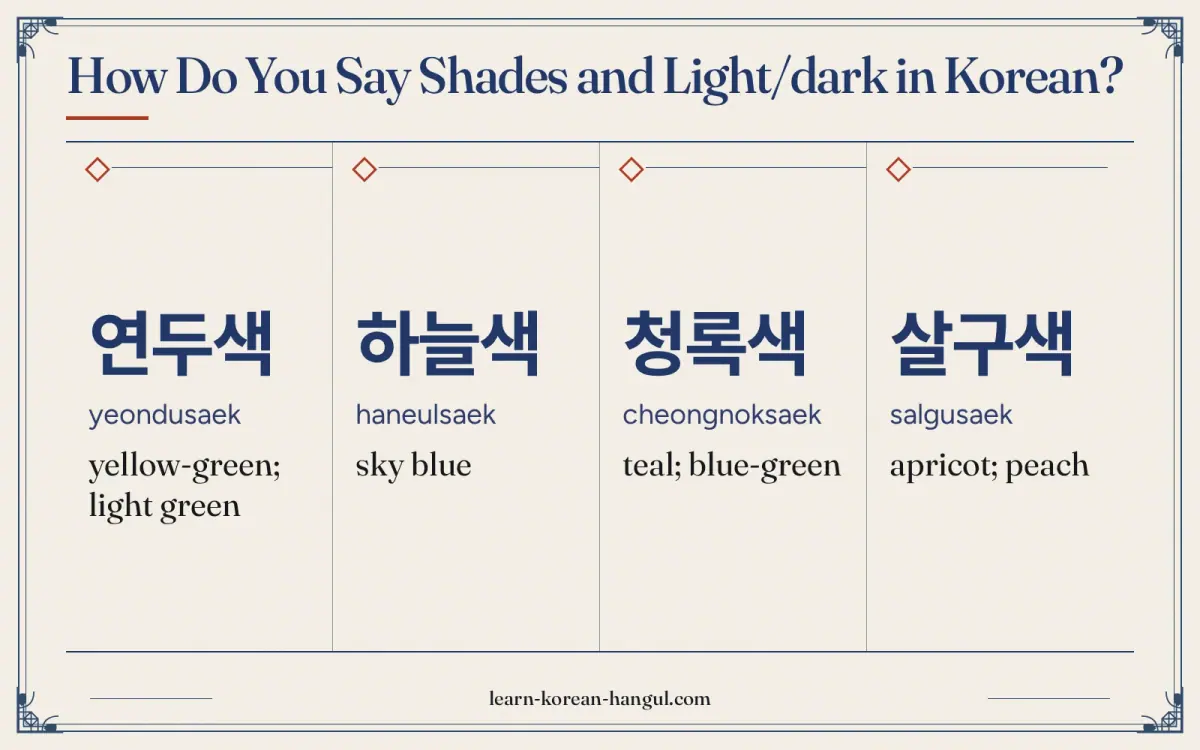
Shades add detail to the basic colors. The group has ten words. Six are color names, three of them named after things (sky, apricot, chestnut), and four are shade words that go before another color.
| No. | Hangul | Revised Romanization | Meaning | Origin | Example sentence | Audio assetId |
|---|---|---|---|---|---|---|
| 15 | 연두색 | yeondusaek | yellow-green; light green | Sino-Korean | 연두색 잎이 나왔어요. (yeondusaek ipi nawasseoyo; Light green leaves came out.) | au-pg-vocabulary-nature-colors-15; example: au-pg-vocabulary-nature-colors-115 |
| 16 | 하늘색 | haneulsaek | sky blue | mixed | 하늘색 티셔츠를 입어요. (haneulsaek tisyeocheureul ibeoyo; I wear a sky-blue T-shirt.) | au-pg-vocabulary-nature-colors-16; example: au-pg-vocabulary-nature-colors-116 |
| 17 | 청록색 | cheongnoksaek | teal; blue-green | Sino-Korean | 청록색 바다가 예뻐요. (cheongnoksaek badaga yeppeoyo; The teal sea is pretty.) | au-pg-vocabulary-nature-colors-17; example: au-pg-vocabulary-nature-colors-117 |
| 18 | 살구색 | salgusaek | apricot; peach | mixed | 살구색 립스틱을 사요. (salgusaek ripseutigeul sayo; I buy apricot-colored lipstick.) | au-pg-vocabulary-nature-colors-18; example: au-pg-vocabulary-nature-colors-118 |
| 19 | 베이지색 | beijisaek | beige | mixed | 베이지색 코트가 따뜻해요. (beijisaek koteuga ttatteutaeyo; The beige coat is warm.) | au-pg-vocabulary-nature-colors-19; example: au-pg-vocabulary-nature-colors-119 |
| 20 | 밤색 | bamsaek | chestnut brown | mixed | 밤색 머리카락이에요. (bamsaek meorikaragieyo; It is chestnut-brown hair.) | au-pg-vocabulary-nature-colors-20; example: au-pg-vocabulary-nature-colors-120 |
| 21 | 연한 | yeonhan | light; pale | mixed | 연한 파란색이 좋아요. (yeonhan paransaegi joayo; I like light blue.) | au-pg-vocabulary-nature-colors-21; example: au-pg-vocabulary-nature-colors-121 |
| 22 | 진한 | jinhan | dark; deep; strong | mixed | 진한 커피를 마셔요. (jinhan keopireul masyeoyo; I drink strong coffee.) | au-pg-vocabulary-nature-colors-22; example: au-pg-vocabulary-nature-colors-122 |
| 23 | 밝은 | balgeun | bright; light | native | 밝은 색을 좋아해요. (balgeun saegeul joahaeyo; I like bright colors.) | au-pg-vocabulary-nature-colors-23; example: au-pg-vocabulary-nature-colors-123 |
| 24 | 어두운 | eoduun | dark | native | 어두운 색 옷이 많아요. (eoduun saek osi manayo; I have many dark-colored clothes.) | au-pg-vocabulary-nature-colors-24; example: au-pg-vocabulary-nature-colors-124 |
- 하늘색, 살구색 and 밤색 are named after things. 하늘 is sky, 살구 is apricot and 밤 is chestnut. The pattern is object + 색.
- 연한 and 진한 are modifier forms of the adjectives 연하다 and 진하다. They go before a noun, like 연한 파란색 (light blue).
- 밝은 comes from 밝다 (to be bright), and 어두운 comes from 어둡다 (to be dark). The ㅂ of 어둡다 changes to 우 before a vowel.
Metals and Neutrals
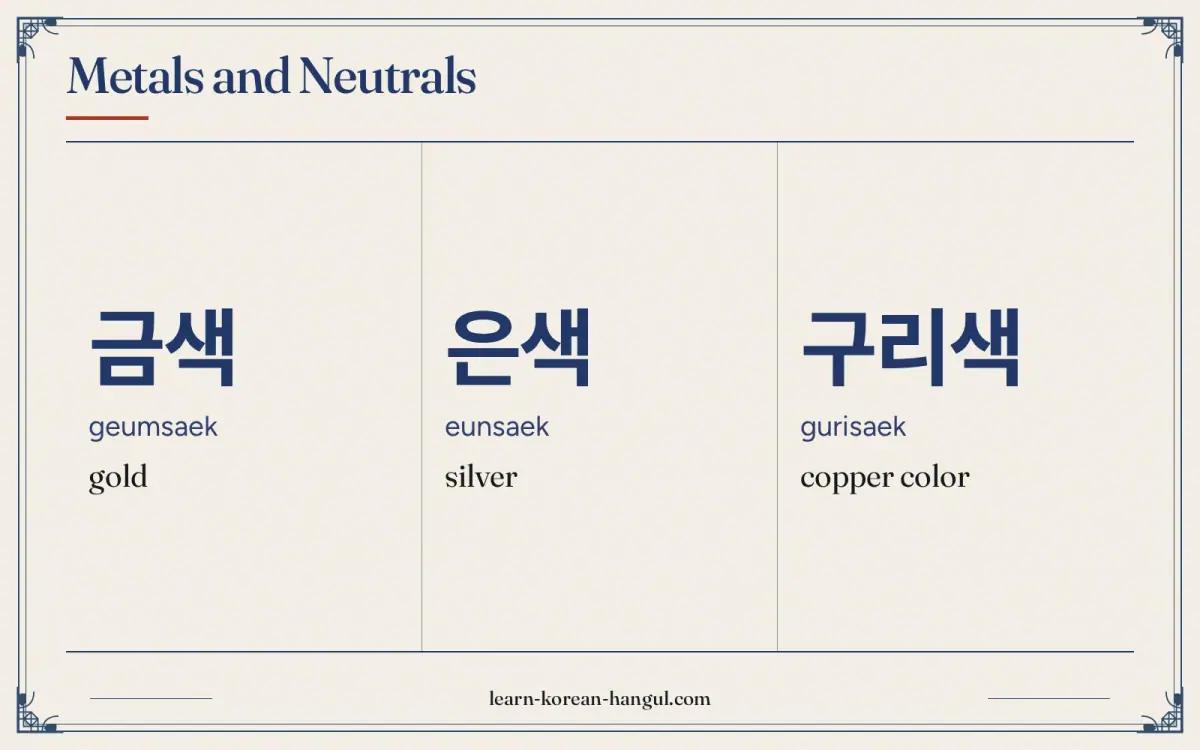
The third group has eight words for metal colors and for words that describe color in general. These words are useful for shopping, art and school. 알록달록 is a sound-symbolic word that paints a picture of many colors together.
| No. | Hangul | Revised Romanization | Meaning | Origin | Example sentence | Audio assetId |
|---|---|---|---|---|---|---|
| 25 | 금색 | geumsaek | gold | Sino-Korean | 금색 반지를 샀어요. (geumsaek banjireul sasseoyo; I bought a gold ring.) | au-pg-vocabulary-nature-colors-25; example: au-pg-vocabulary-nature-colors-125 |
| 26 | 은색 | eunsaek | silver | Sino-Korean | 은색 자동차가 있어요. (eunsaek jadongchaga isseoyo; There is a silver car.) | au-pg-vocabulary-nature-colors-26; example: au-pg-vocabulary-nature-colors-126 |
| 27 | 구리색 | gurisaek | copper color | mixed | 구리색 동전이에요. (gurisaek dongjeonieyo; It is a copper-colored coin.) | au-pg-vocabulary-nature-colors-27; example: au-pg-vocabulary-nature-colors-127 |
| 28 | 무색 | musaek | colorless | Sino-Korean | 물은 무색이에요. (mureun musaegieyo; Water is colorless.) | au-pg-vocabulary-nature-colors-28; example: au-pg-vocabulary-nature-colors-128 |
| 29 | 투명 | tumyeong | transparency; clear | Sino-Korean | 유리는 투명해요. (yurineun tumyeonghaeyo; Glass is transparent.) | au-pg-vocabulary-nature-colors-29; example: au-pg-vocabulary-nature-colors-129 |
| 30 | 흑백 | heukbaek | black and white | Sino-Korean | 흑백 사진을 찍어요. (heukbaek sajineul jjigeoyo; I take black-and-white photos.) | au-pg-vocabulary-nature-colors-30; example: au-pg-vocabulary-nature-colors-130 |
| 31 | 단색 | dansaek | single color | Sino-Korean | 단색 옷을 좋아해요. (dansaek oseul joahaeyo; I like plain single-color clothes.) | au-pg-vocabulary-nature-colors-31; example: au-pg-vocabulary-nature-colors-131 |
| 32 | 알록달록 | allokdallok | colorful; in many colors | native | 알록달록한 우산이에요. (allokdallokhan usanieyo; It is a colorful umbrella.) | au-pg-vocabulary-nature-colors-32; example: au-pg-vocabulary-nature-colors-132 |
- 금색 and 은색 are the colors of gold and silver. The word for gold itself is 금, and for silver it is 은.
- 투명 is a noun, and you add 하다 to make a description: 투명해요 means "it is transparent".
- 알록달록 belongs to the group of mimetic words, which are explained on the Onomatopoeia and Mimetic Words page.
How Do You Say Colors in Culture (obangsaek) in Korean?
The last group has eight words from traditional Korean culture. The five Sino-Korean color words are formal names. They are less common in daily speech than 파란색 or 빨간색, but they appear in museums, at palaces, in traditional ceremonies and in technical terms such as 백색 가전 (white goods).
| No. | Hangul | Revised Romanization | Meaning | Origin | Example sentence | Audio assetId |
|---|---|---|---|---|---|---|
| 33 | 오방색 | obangsaek | five directional colors | Sino-Korean | 오방색은 한국 전통 색이에요. (obangsaegeun hanguk jeontong saegieyo; Obangsaek are traditional Korean colors.) | au-pg-vocabulary-nature-colors-33; example: au-pg-vocabulary-nature-colors-133 |
| 34 | 청색 | cheongsaek | blue; blue-green | Sino-Korean | 청색은 동쪽을 뜻해요. (cheongsaegeun dongjjogeul tteuthaeyo; Blue means east.) | au-pg-vocabulary-nature-colors-34; example: au-pg-vocabulary-nature-colors-134 |
| 35 | 적색 | jeoksaek | red | Sino-Korean | 적색은 남쪽을 뜻해요. (jeoksaegeun namjjogeul tteuthaeyo; Red means south.) | au-pg-vocabulary-nature-colors-35; example: au-pg-vocabulary-nature-colors-135 |
| 36 | 황색 | hwangsaek | yellow | Sino-Korean | 황색은 중앙을 뜻해요. (hwangsaegeun jungangeul tteuthaeyo; Yellow means the center.) | au-pg-vocabulary-nature-colors-36; example: au-pg-vocabulary-nature-colors-136 |
| 37 | 백색 | baeksaek | white | Sino-Korean | 백색은 서쪽을 뜻해요. (baeksaegeun seojjogeul tteuthaeyo; White means west.) | au-pg-vocabulary-nature-colors-37; example: au-pg-vocabulary-nature-colors-137 |
| 38 | 흑색 | heuksaek | black | Sino-Korean | 흑색은 북쪽을 뜻해요. (heuksaegeun bukjjogeul tteuthaeyo; Black means north.) | au-pg-vocabulary-nature-colors-38; example: au-pg-vocabulary-nature-colors-138 |
| 39 | 색동 | saekdong | rainbow stripes | mixed | 아이가 색동 한복을 입어요. (aiga saekdong hanbogeul ibeoyo; The child wears a striped hanbok.) | au-pg-vocabulary-nature-colors-39; example: au-pg-vocabulary-nature-colors-139 |
| 40 | 단청 | dancheong | dancheong; painted decoration | Sino-Korean | 궁궐에 단청이 있어요. (gunggwore dancheongi isseoyo; The palace has dancheong painting.) | au-pg-vocabulary-nature-colors-40; example: au-pg-vocabulary-nature-colors-140 |
- The five color words are short and have one Sino-Korean syllable plus 색: 청색, 적색, 황색, 백색, 흑색.
- 오방색 means "five directional colors". The table below shows how each color matches a direction.
- 단청 is the colorful pattern painted on palaces and temples. It uses the five traditional colors.
Noun Forms and Adjective Forms
Most basic colors have two forms: a noun that ends in 색 (color), and an adjective that describes something. The noun is used as a name: 빨간색 is "red". The adjective is used before a noun or at the end of a sentence: 빨간 사과 (a red apple) and 사과가 빨개요 (the apple is red).
| Noun | Before a noun | Polite sentence form | Dictionary form |
|---|---|---|---|
| 빨간색 (ppalgansaek) | 빨간 (ppalgan) | 빨개요 (ppalgaeyo) | 빨갛다 |
| 노란색 (noransaek) | 노란 (noran) | 노래요 (noraeyo) | 노랗다 |
| 파란색 (paransaek) | 파란 (paran) | 파래요 (paraeyo) | 파랗다 |
| 하얀색 (hayansaek) | 하얀 (hayan) | 하얘요 (hayaeyo) | 하얗다 |
| 까만색 (kkamansaek) | 까만 (kkaman) | 까매요 (kkamaeyo) | 까맣다 |
| 검은색 (geomeunsaek) | 검은 (geomeun) | 검어요 (geomeoyo) | 검다 |
Four of these adjectives (빨갛다, 노랗다, 파랗다, 하얗다) end in ㅎ and are called ㅎ-irregular. Their ㅎ drops before an ending that starts with a vowel, and the stem vowel changes before 아/어: 빨갛다 becomes 빨개요, not 빨갛어요. The adjective 까맣다 follows the same rule. The adjective 검다 is regular: its sentence form is 검어요. The page on color adjectives explains all these forms in detail, and this list gives only the nouns.
Shade Words: Light, Dark and Bright
Shade words go before a color to make it lighter, darker or brighter. They are adjectives in the form that comes before a noun, so they are placed first: 연한 파란색 (light blue), 진한 파란색 (dark or deep blue), 밝은 파란색 (bright blue), 어두운 파란색 (dark blue).
| Shade word | Dictionary form | Meaning | Example |
|---|---|---|---|
| 연한 | 연하다 | light; pale | 연한 분홍색 (light pink) |
| 진한 | 진하다 | dark; deep; strong | 진한 보라색 (deep purple) |
| 밝은 | 밝다 | bright; light | 밝은 노란색 (bright yellow) |
| 어두운 | 어둡다 | dark | 어두운 갈색 (dark brown) |
연한 and 진한 describe how much pigment a color has. 밝은 and 어두운 describe how bright it is. Both pairs work with any color noun from the first group.
The Five Traditional Colors: 오방색
오방색 (obangsaek) means "five directional colors". It is a traditional system of five colors, and each color stands for a direction and an element. The five are blue-green (청), red (적), yellow (황), white (백) and black (흑). The system belongs to traditional East Asian thought, and it shows up in Korean art and clothing.
| Color word | Color | Direction | Element | Season |
|---|---|---|---|---|
| 청색 (青) | blue-green | east | wood | spring |
| 적색 (赤) | red | south | fire | summer |
| 황색 (黃) | yellow | center | earth | late summer, or the turn between seasons |
| 백색 (白) | white | west | metal | autumn |
| 흑색 (黑) | black | north | water | winter |
You can see the five colors in the stripes of 색동 (saekdong) sleeves on a child's festival hanbok, and in the painted patterns on palace and temple beams called 단청 (dancheong). Each color word above ends in 색 (color) and starts with one Sino-Korean syllable, so they are easy to link to Chinese-based words you may already know. The common spoken names for the same colors are 파란색, 빨간색, 노란색, 하얀색 and 검은색.
The words 오방색, 색동 and 단청 appear in museums, palaces and traditional events, so they are worth knowing if you visit Korea. For more culture words, see the traditional culture list for clothing, crafts and heritage terms.
Color Words in Everyday Phrases
Korean groups blue and green differently from English in some speech. The word 파란색 means blue, and 초록색 means green, but in everyday speech the traffic light is described with 파란불 (paranbul), literally "blue light", for the green light that means go. The red light is 빨간불 (ppalganbul). The same habit appears in 푸른 하늘 (a blue sky) and 푸른 숲 (a green forest), where 푸른 can describe either blue or green.
| Phrase | Revised Romanization | Meaning | Note |
|---|---|---|---|
| 파란불 | paranbul | green light (go) | literally blue light |
| 빨간불 | ppalganbul | red light (stop) | the stop signal |
| 푸른 하늘 | pureun haneul | blue sky | 푸른 covers blue and green |
| 하얀 거짓말 | hayan geojinmal | white lie | a small, harmless lie |
| 검은 머리 | geomeun meori | black hair | the usual way to say it |
In practice, use 초록색 when you want to say green on purpose, as in 초록색 나무 (a green tree). Use 파란불 when you talk about the traffic light. The border between 파란 and 초록 varies a little between speakers, so 초록색 is the safe choice when you mean green.
How Do You Pronounce These Words?
Color words have many final-consonant changes. The table lists five words whose sound differs from the spelling, following the Standard Pronunciation rules (표준 발음법) of the 국립국어원.
| Word | Romanization | Said | Rule |
|---|---|---|---|
| 갈색 | galsaek | [갈쌕] | after ㄹ in a Sino-Korean word, ㅅ becomes tense [ㅆ] |
| 초록색 | choroksaek | [초록쌕] | after the final ㄱ of 록, ㅅ becomes tense [ㅆ] |
| 청록색 | cheongnoksaek | [청녹쌕] | ㄹ after ㅇ is said [ㄴ], and ㅅ after the final ㄱ is tense |
| 흑백 | heukbaek | [흑빽] | after the final ㄱ of 흑, ㅂ becomes tense [ㅃ] |
| 검은색 | geomeunsaek | [거믄색] | the final ㅁ of 검 links to the vowel of 은 |
Revised Romanization is the official romanization system of South Korea, announced on 7 July 2000. It follows most sound changes, such as linking and nasalization, and it spells the written double letters (ㄲ as kk), but it does not show tensing caused by a neighbouring sound: 색동 is said [색똥] but written saekdong. It is a learning aid, so always read the Hangul as well.
Audio and Slow Playback
Each headword and each example sentence has its own audio clip, and the five words in the learn-first section also have a slow clip at 0.8 times the speed. Nothing plays until you press a button. Listen once, repeat aloud, and only then check the romanization.
What Mistakes Do Learners Make with Color Words?
- Writing the adjective instead of the noun. Say 빨간색 for the color name and 빨개요 for the sentence "it is red".
- Saying 빨갛어요 for "it is red". The ㅎ-irregular rule makes it 빨개요.
- Using 파란색 and 초록색 as the same word. In general the sky is 파란색 and leaves are 초록색, but a traffic light for "go" is called 파란불.
- Using 노란 alone as a color name. 노란 must stand before a noun (노란 택시); as a name, say 노란색.
- Reading the romanization instead of the sounds. Words such as 색동 contain a tense sound, [색똥], but Revised Romanization shows only saekdong.
Practice: Flashcards and Worksheet
Drill these 40 words with the vocabulary flashcard decks: each card shows the Hangul on one side and the meaning on the other, so you can test recall instead of recognition. Print a labelling sheet from the vocabulary worksheets and write the Korean word for each numbered object in the scene above. A simple plan is to learn eight words a day, one group at a time.
Korean Colors Worksheet
Try this five-question check, then say the words aloud once more.
Practice · 5
What does 색 mean?
Show answer
color
색 (saek) means color.
What does 보라색 mean?
Show answer
purple
보라색 (borasaek) means purple.
What does 청록색 mean?
Show answer
teal; blue-green
청록색 (cheongnoksaek) means teal; blue-green.
What does 금색 mean?
Show answer
gold
금색 (geumsaek) means gold.
What does 오방색 mean?
Show answer
five directional colors
오방색 (obangsaek) means five directional colors.
Self-Test: 10 Sentences
Fill each blank with a word from this page. Say the whole sentence aloud when you have it. The answers follow the test.
- 이 옷은 ___이 예뻐요. (The color of these clothes is pretty.)
- ___ 택시가 와요. (A yellow taxi comes.)
- ___ 꽃이 예뻐요. (The purple flower is pretty.)
- ___ 셔츠를 입어요. (I wear a white shirt.)
- ___ 바다가 예뻐요. (The teal sea is pretty.)
- ___ 파란색이 좋아요. (I like light blue.)
- ___ 반지를 샀어요. (I bought a gold ring.)
- 유리는 ___해요. (Glass is transparent.)
- ___은 한국 전통 색이에요. (Obangsaek are traditional Korean colors.)
- ___은 서쪽을 뜻해요. (White means west.)
Answers: 1. 색깔; 2. 노란색; 3. 보라색; 4. 하얀색; 5. 청록색; 6. 연한; 7. 금색; 8. 투명; 9. 오방색; 10. 백색.
A score of 8 or more suggests the words are settling in. If you scored lower, reread the groups where you missed words.
Where to Go Next
After colors, many learners move on to Geography and Countries. This list sits inside Nature and the World.
Frequently Asked Questions
How Do You Say Black in Korean?
Say 검은색 (geomeunsaek) for black as a noun. You will also hear 까만색 (kkamansaek). Before a noun the adjective forms are 검은 and 까만: 검은 머리 (black hair) and 까만 밤 (a black night). In a sentence, say 검어요 or 까매요.
How Do You Pronounce 파란색 (paransaek)?
Say pa-ran-saek. The first two syllables are plain, and the last one ends in ㄱ, which you hold short without releasing it. The three beats are even. Press the audio button on this page to hear it, then say it slowly twice.
How Many Color Words Should I Learn First?
Learn the five starter words, 빨간색, 파란색, 검은색, 하얀색 and 갈색, then add yellow, green, purple and pink. Eight new words a day with a short review of the older ones is a steady pace, and the whole list takes about five days.
Where Can I Practise Color Words with Flashcards?
Use the vocabulary flashcard decks. Start with the basic colors, then add the shades and the neutral words. Review the older cards before you add new ones, so the earlier words do not fade.
Is the Romanization on This Page Official?
Yes, as a learning aid. It follows the Revised Romanization of Korean, the system South Korea has officially used since 7 July 2000, and the page also gives the Hangul for every word. It follows most sound changes but does not show tensing: 색동 is written saekdong but is said [색똥]. Treat the Hangul as the real spelling.
Is There a Printable Worksheet for Color Words?
The vocabulary worksheets page lists the printable sheets. The sheet for this topic is a labelling task built on the same illustrated scene as this page, so you write the Korean word next to each numbered object.