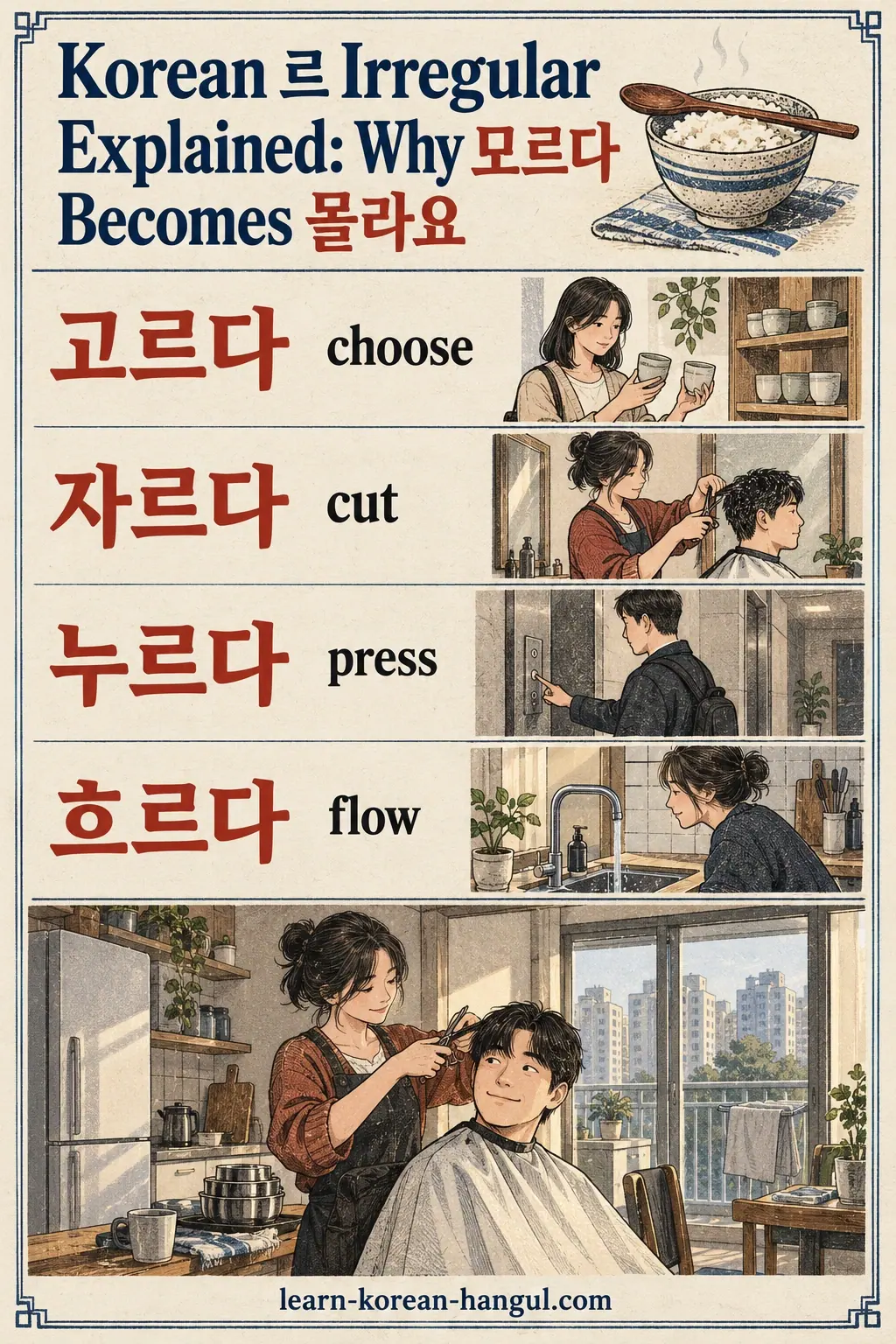
What you will be able to do after this lesson
- Conjugate 15 르 words in the polite present, the polite past and the casual form.
- Choose 라 or 러 from the vowel before 르.
- Keep 르 unchanged before endings such as -(으)면, -ㅂ니다 and -고.
- Recognise 따르다, 치르다 and 들르다 as words that are not 르 irregular.
Before you start: this page assumes you have read how to recognize irregular verbs first, and that you know the 아요/어요 choice from vowel harmony in conjugation. Time: about 30 minutes. Level: A1.
What Is the Korean 르 Irregular?

The Korean 르 irregular (르 불규칙, reu bulgyuchik) is a class of verbs and adjectives whose stem ends in the syllable 르 and changes shape before an ending that starts with 아 or 어. The stem is the dictionary form minus 다: 모르다 (not to know) has the stem 모르. In the polite present, 모르 does not simply add 아요. It becomes 몰라요.
The class matters more than its size suggests, because its members are basic words. 몰라요 ("I don't know") is one of the first phrases a learner needs, and 달라요 ("It's different") and 빨라요 ("It's fast") come up in the first everyday conversations. Other members include 고르다 (to choose), 자르다 (to cut) and 부르다 (to call, to sing).
Two facts define the class:
- The change: before 아/어, 르 becomes ㄹ + 라 or ㄹ + 러.
- The limit: before every other ending, 르 stays exactly as it is.
Revised Romanization writes 몰라요 as mollayo. The romanization only helps with reading; the Hangul spelling is what you need to learn. The change itself is a two-step process, shown next.
The Rule: 르 Becomes ㄹㄹ before 아/어
Before an ending that starts with 아 or 어, the ㅡ of 르 drops, and an extra ㄹ is added as the final consonant of the syllable before it. The ㄹ of 르 then joins the ending as 라 or 러. The result is a doubled ㄹ across the syllable border: 몰 + 라.
Here is the rule in one line: 모르 + 아요 → 몰 + 라요 = 몰라요; 부르 + 어요 → 불 + 러요 = 불러요.
| Step | 모르다 (not know) | 부르다 (call, sing) |
|---|---|---|
| 1. Stem | 모르 | 부르 |
| 2. Ending chosen by the vowel before 르 | 모 has ㅗ → 아요 | 부 has ㅜ → 어요 |
| 3. Drop the ㅡ of 르 | 모 + ㄹ + 아요 | 부 + ㄹ + 어요 |
| 4. Add an extra ㄹ under the syllable before | 몰 + ㄹ + 아요 | 불 + ㄹ + 어요 |
| 5. Write the blocks | 몰라요 | 불러요 |
The doubled ㄹ is what you hear. In 몰라요, the tongue holds the ㄹ across both syllables, so the sound is a clear "l", like English "l" held a little longer. A single ㄹ between vowels would sound like a light flap, as in 모라요, which is not a Korean word.
Worked Example: 고르다 and 누르다 Step by Step
Take 고르다 (to choose) first.
- Remove 다. The stem is 고르.
- Look at the vowel before 르. 고 has ㅗ, so the ending is 아요.
- Drop ㅡ and add ㄹ under 고: 골 + 라요.
- Result: 골라요. Past: 골랐어요.
Now take 누르다 (to press).
- Remove 다. The stem is 누르.
- 누 has ㅜ, so the ending is 어요.
- Drop ㅡ and add ㄹ under 누: 눌 + 러요.
- Result: 눌러요. Past: 눌렀어요.
모르다
| Form | Korean | Romanization | Rule |
|---|---|---|---|
| Polite present | 몰라요 | mollayo | 모르 + 아요: ㅡ drops, ㄹ doubles |
| Polite past | 몰랐어요 | mollasseoyo | 몰라 + ㅆ어요 |
| Casual present | 몰라 | molla | 몰라요 without 요 |
| Formal present | 모릅니다 | moreumnida | 모르 + ㅂ니다, no change |
| If (-(으)면) | 모르면 | moreumyeon | 모르 + 면, no change |
The rule is mechanical once the ending is known. The only real choice is between 라 and 러, which the next section settles.
How Do You Choose 라 or 러?

Choose 라 when the vowel before 르 is ㅏ or ㅗ, and 러 for every other vowel. The vowel of 르 itself, ㅡ, disappears, so the syllable before it becomes the last vowel of the stem, and ordinary vowel harmony decides the ending. The same logic drives the ㅡ drop in 바쁘다 → 바빠요, explained on the ㅡ irregular page.
| Vowel before 르 | Ending | Words | Polite present |
|---|---|---|---|
| ㅏ | 라 | 다르다, 빠르다, 마르다, 자르다, 바르다 | 달라요, 빨라요, 말라요, 잘라요, 발라요 |
| ㅗ | 라 | 모르다, 고르다, 오르다 | 몰라요, 골라요, 올라요 |
| ㅜ | 러 | 부르다, 누르다, 배부르다 | 불러요, 눌러요, 배불러요 |
| ㅣ | 러 | 기르다, 이르다 (be early) | 길러요, 일러요 |
| ㅡ | 러 | 흐르다, 게으르다 | 흘러요, 게을러요 |
Long words follow the same check. 목마르다 (to be thirsty) has 마 before 르, so it gives 목말라요. 서두르다 (to hurry) has 두 before 르, so it gives 서둘러요. Only the syllable directly before 르 counts, never the first syllable of the word.
A rule of thumb: ㅗ is the trap. Learners remember "ㅏ takes 라" and then write 몰러요 for 모르다. ㅗ belongs with ㅏ, so 모르다, 고르다 and 오르다 all take 라. With 라 and 러 settled, the past and casual forms follow directly.
What Are the past Forms of 르 Words?

The past forms of 르 words keep the doubled ㄹ and add ㅆ to 라 or 러: 몰랐어요, 불렀어요. The past marker 았/었 starts with 아 or 어, so it triggers the same change as the polite present. If you know 몰라요, you get the past by turning 라 into 랐.
| Word | Polite present | Polite past | Casual present | Casual past |
|---|---|---|---|---|
| 모르다 | 몰라요 | 몰랐어요 | 몰라 | 몰랐어 |
| 다르다 | 달라요 | 달랐어요 | 달라 | 달랐어 |
| 빠르다 | 빨라요 | 빨랐어요 | 빨라 | 빨랐어 |
| 부르다 | 불러요 | 불렀어요 | 불러 | 불렀어 |
| 누르다 | 눌러요 | 눌렀어요 | 눌러 | 눌렀어 |
The casual forms 몰라 and 달라 are often the first forms learners hear in dramas and songs, because the casual style (반말) simply removes 요. The same change appears before other 아/어 endings: 몰라서 (because I don't know), 빨라도 (even if it is fast) and 골라 주세요 (please choose).
- 저는 그 사람을 몰라요. = I don't know that person.
- 한국 음식은 일본 음식하고 달라요. = Korean food is different from Japanese food.
- 노래를 불러 주세요. = Please sing a song.
- 어제 머리를 잘랐어요. = I got my hair cut yesterday.
The past tense is where the rule applies most often. The opposite question, which endings leave 르 alone, prevents the most frequent error.
Why Do You Say 모르면 and Not 몰라면?

You say 모르면 because -(으)면 does not start with 아 or 어, so 르 stays unchanged. 몰라 is the 아/어 form of the stem, and only 아/어 endings attach to it. Every other ending attaches to the plain stem 모르, which ends in a vowel, so the vowel shape of the ending is used.
This is the main difference from the ㅂ, ㄷ and ㅅ irregulars, which also change before 으 endings (도우면, 들으면, 나으면). 르 stems change only before 아/어.
| Ending | 모르다 | 다르다 | 부르다 | Wrong form |
|---|---|---|---|---|
| -(으)면 (if) | 모르면 | 다르면 | 부르면 | 몰르면, 몰라면 |
| -ㅂ니다 (formal) | 모릅니다 | 다릅니다 | 부릅니다 | 몰릅니다 |
| -고 (and) | 모르고 | 다르고 | 부르고 | 몰라고 |
| -는 / -(으)ㄴ (modifier) | 모르는 | 다른 | 부르는 | 몰르는 |
| -세요 (honorific) | 모르세요 | 다르세요 | 부르세요 | 몰라세요 |
| -겠어요 (guess, soft) | 모르겠어요 | 다르겠어요 | 부르겠어요 | 몰르겠어요 |
An expert insight: 모르겠어요 and 몰라요 both mean "I don't know", but 모르겠어요 is the softer reply in service and classroom situations, because -겠- makes the answer less blunt. Both forms are correct, and only 몰라요 shows the 르 change. Some words end in 르 and still never show the doubled ㄹ, as the next section explains.
Which 르 Words Are Not 르 Irregular?

따르다, 치르다 and 들르다 end in 르 but are not 르 irregular: they only drop ㅡ before 아/어 and never add an extra ㄹ. They belong to the ㅡ drop pattern, the same pattern as 쓰다 → 써요. A fourth word, 이르다 meaning "to reach", follows a separate rare class.
| Word | Meaning | Polite present | Polite past | Class | Wrong form |
|---|---|---|---|---|---|
| 따르다 | follow; pour | 따라요 | 따랐어요 | ㅡ drop | 딸라요 |
| 치르다 | pay; take (an exam) | 치러요 | 치렀어요 | ㅡ drop | 칠러요 |
| 들르다 | drop by | 들러요 | 들렀어요 | ㅡ drop | 들렸어요 |
| 이르다 | reach, arrive at | 이르러요 | 이르렀어요 | 러 irregular | 일러요 |
들르다 is a special trap. 들러요 already shows two ㄹ letters, so it looks like the doubling rule, but one ㄹ belongs to 들 and the other to 르; only the ㅡ has gone. Even Korean speakers sometimes write 들렸어요 for "I dropped by", which is the past of a different verb, 들리다 (to be heard). The standard form is 들렀어요.
이르다 is three different words in the dictionary. Meaning "to be early" or "to tell (on someone)", it is 르 irregular: 일러요. Meaning "to reach", it adds 러 instead: 이르러요. The cousins 따르다 and 치르다 are covered with the other ㅡ words in ㅡ irregular, and the rare 러 class (이르다 "reach", 푸르다 "be blue") is in 러 and 우 irregulars. With the exceptions set aside, the core 15 words can be learned as one list.
Common 르 Words with Audio
The 15 words below are the 르 irregulars a beginner meets most. The table gives the 라/러 group, the polite present, the polite past and the formal present, which keeps 르.
| # | Word | Meaning | Group | Polite present | Polite past | Formal |
|---|---|---|---|---|---|---|
| 1 | 모르다 | not know | 라 | 몰라요 | 몰랐어요 | 모릅니다 |
| 2 | 다르다 | be different | 라 | 달라요 | 달랐어요 | 다릅니다 |
| 3 | 빠르다 | be fast | 라 | 빨라요 | 빨랐어요 | 빠릅니다 |
| 4 | 마르다 | dry; be thin | 라 | 말라요 | 말랐어요 | 마릅니다 |
| 5 | 자르다 | cut | 라 | 잘라요 | 잘랐어요 | 자릅니다 |
| 6 | 고르다 | choose | 라 | 골라요 | 골랐어요 | 고릅니다 |
| 7 | 오르다 | go up, rise | 라 | 올라요 | 올랐어요 | 오릅니다 |
| 8 | 바르다 | apply, spread | 라 | 발라요 | 발랐어요 | 바릅니다 |
| 9 | 부르다 | call; sing | 러 | 불러요 | 불렀어요 | 부릅니다 |
| 10 | 누르다 | press | 러 | 눌러요 | 눌렀어요 | 누릅니다 |
| 11 | 이르다 | be early | 러 | 일러요 | 일렀어요 | 이릅니다 |
| 12 | 게으르다 | be lazy | 러 | 게을러요 | 게을렀어요 | 게으릅니다 |
| 13 | 배부르다 | be full (after eating) | 러 | 배불러요 | 배불렀어요 | 배부릅니다 |
| 14 | 기르다 | raise, grow | 러 | 길러요 | 길렀어요 | 기릅니다 |
| 15 | 흐르다 | flow | 러 | 흘러요 | 흘렀어요 | 흐릅니다 |
Short sentences with these words:
- 아직 일러요. = It's still early.
- 배불러요. = I'm full.
- 물가가 많이 올랐어요. = Prices have gone up a lot.
- 이 버튼을 눌러 주세요. = Please press this button.
Do not confuse 기르다 (길러요, raise) with 길다 (길어요, be long), or 마르다 (말라요) with 말다 (말아요, roll). The extra ㄹ is the clue that the dictionary form ends in 르. The table of errors below gathers these traps.
Common Mistakes with 르 Words
Most 르 errors either skip the extra ㄹ, choose the wrong vowel or spread the change to endings that do not trigger it.
| Wrong form | Correct form | What went wrong |
|---|---|---|
| 모라요 | 몰라요 | missed the extra ㄹ |
| 모르아요 | 몰라요 | added 아요 without the 르 change |
| 몰러요 | 몰라요 | ㅗ before 르 takes 라, not 러 |
| 불라요 | 불러요 | ㅜ before 르 takes 러 |
| 몰르면, 몰라면 | 모르면 | changed 르 before -(으)면 |
| 몰릅니다 | 모릅니다 | changed 르 before -ㅂ니다 |
| 딸라요 | 따라요 | treated 따르다 as 르 irregular |
Practice
Write the polite present unless another form is asked for. Answers follow the quiz.
Practice · 8
What is the polite present of 모르다 (not to know)?
Show answer
몰라요
Before 아/어 the ㅡ of 르 drops and ㄹ doubles; ㅗ before 르 takes 라.
What is the polite present of 부르다 (to call, to sing)?
Show answer
불러요
The vowel before 르 is ㅜ, so the ending is 러, and the doubled ㄹ gives 불 + 러요.
What is the polite past of 고르다 (to choose)?
Show answer
골랐어요
ㅗ takes 라, the ㄹ doubles, and the past adds ㅆ: 골랐어요.
What is the -(으)면 form of 모르다?
Show answer
모르면
-(으)면 does not start with 아 or 어, so 르 stays unchanged.
What is the polite present of 따르다 (to follow)?
Show answer
따라요
따르다 is not 르 irregular; it only drops ㅡ before 아/어, with no extra ㄹ.
What is the polite present of 게으르다 (to be lazy)?
Show answer
게을러요
The vowel before 르 is ㅡ, which is not ㅏ or ㅗ, so the ending is 러.
What is the formal present of 모르다?
Show answer
모릅니다
-ㅂ니다 is not an 아/어 ending, so the plain stem 모르 is used.
How do you write "I dropped by" with 들르다 in the polite past?
Show answer
들렀어요
들르다 only drops ㅡ, giving 들렀어요; 들렸어요 is the past of a different verb, 들리다 (to be heard).
- 다르다
- 고르다, polite past
- 부르다
- 게으르다
- 빠르다, casual present
- 모르다 + -(으)면
- 따르다
- 누르다 + 주세요
- 오르다, polite past
- Fix the error: 몰러요
Answers to the Practice
- 달라요. ㅏ before 르 gives 라.
- 골랐어요. ㅗ gives 라, then the past adds ㅆ.
- 불러요. ㅜ gives 러.
- 게을러요. ㅡ before 르 gives 러.
- 빨라. The casual form drops 요.
- 모르면. -(으)면 does not trigger the change.
- 따라요. 따르다 only drops ㅡ.
- 눌러 주세요. 주세요 follows the 아/어 form.
- 올랐어요. ㅗ gives 라.
- 몰라요. ㅗ belongs with ㅏ.
If you missed item 6 or 7, reread the sections on non-trigger endings and exceptions; those two ideas cause most 르 errors.
What to Learn Next
The Korean 르 irregular comes down to one rule and one choice: before 아/어, drop ㅡ and double ㄹ, then pick 라 after ㅏ or ㅗ and 러 after anything else. See the full word list on 르 irregular. Next, compare all seven classes in the irregular verbs chart, which gives the trigger, an example verb and its polite present, past, formal and -(으)면 forms.
This lesson covers the 르 class in the main beginner endings. It does not cover the ㅡ drop in full or the rare 러 class, which have their own pages linked above.
Frequently Asked Questions
Why is 모르다 몰라요? 모르다 is a 르 irregular verb. Before an ending that starts with 아 or 어, the ㅡ of 르 drops and an extra ㄹ is added under 모, giving 몰 + 라. The vowel before 르 is ㅗ, so the ending is 아요, not 어요. The result is 몰라요, and the past is 몰랐어요.
Is 따르다 a 르 irregular? No. 따르다 (to follow, to pour) only drops the ㅡ of 르 before 아/어, with no extra ㄹ, so its polite present is 따라요 and its past is 따랐어요. It belongs to the ㅡ drop pattern with 쓰다 and 크다. 딸라요 is a learner error, never a Korean form.
What is the past tense of 부르다? The polite past of 부르다 (to call, to sing) is 불렀어요. The past marker starts with 어, so the 르 change applies: 부르 becomes 불러, and ㅆ is added to make 불렀어요. The formal past is 불렀습니다, and the casual past is 불렀어. The present 부릅니다 keeps 르.
Is 이르다 a 르 irregular? It depends on the meaning. 이르다 meaning "to be early" or "to tell (on someone)" is a 르 irregular, so it gives 일러요. 이르다 meaning "to reach" adds 러 instead and gives 이르러요. A dictionary such as the NIKL Standard Korean Language Dictionary lists them as separate headwords.
Are 르 adjectives conjugated the same way as 르 verbs? Yes. Adjectives such as 다르다, 빠르다 and 게으르다 follow the same rule: 달라요, 빨라요, 게을러요. The only difference is the present modifier, where adjectives take -(으)ㄴ and verbs take -는. The modifier keeps 르, so the forms are 다른 and 빠른 for adjectives and 모르는 for a verb.