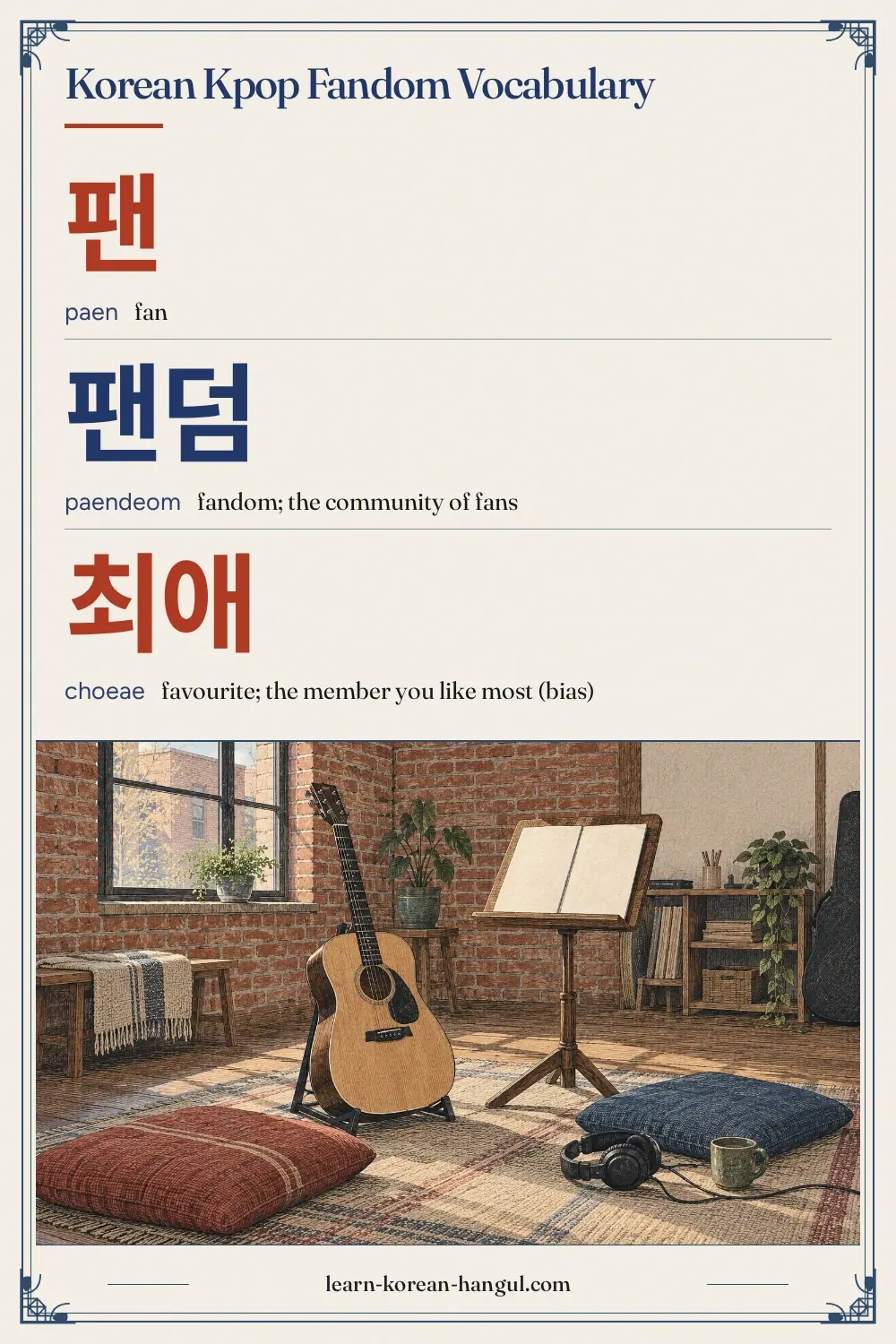
Korean Kpop Fandom Vocabulary at a Glance
Korean Kpop fandom vocabulary is what you need to follow a fan community in Korean. A 팬 belongs to a 팬덤, buys 굿즈, brings an 응원봉 to a 콘서트 and learns the 응원법, the chant that goes with each song. Many words are short slang made from Korean or English parts, so they change fast. This page holds 35 words in five groups, and it marks the slang so you know when a word is casual.
| Group | Words | Use |
|---|---|---|
| Favourites and bias | 7 | Saying who you like and how long |
| Fan clubs and events | 6 | Joining a fan club and going to events |
| Lightsticks and merch | 8 | Naming what fans buy and bring |
| Fan chants | 7 | Joining in at a concert |
| Online fandom | 7 | Reading and posting fan messages |
The list belongs to K-pop, so the parent page is K-Pop Words. The sister list for the music business is K-Pop Industry Vocabulary, and the sentences fans say to each other are in K-pop fan phrases. The next section says where to start.
Which K-Pop Fandom Words Should You Learn First?
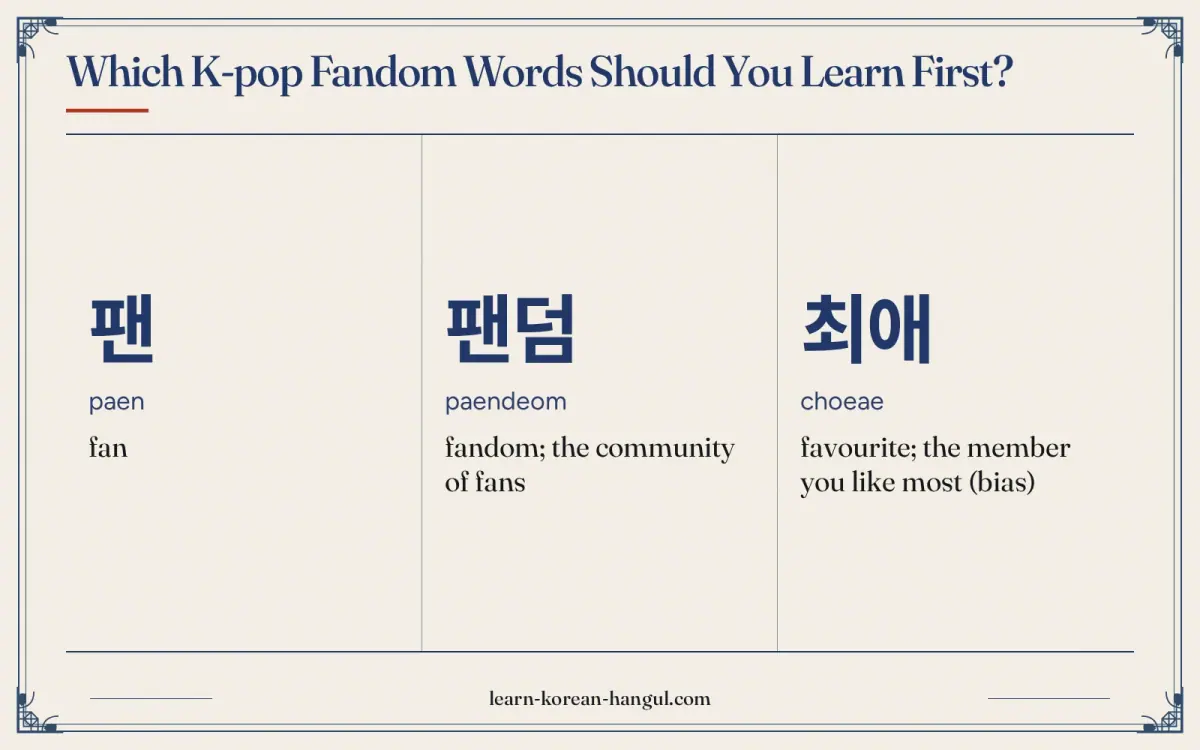
Learn 팬, 팬덤, 최애 and 응원봉 first. They are the words you hear in the first minute of a fan video. Then learn 굿즈 and 응원법, because they are the two things a new fan buys and learns.
- Day one. 팬, 팬덤, 최애, 차애, 입덕 and 덕질.
- Day two. The groups and events: 팬클럽, 팬카페, 팬미팅, 팬 사인회 and 회원.
- Day three. The things: 응원봉, 굿즈, 포토카드, 앨범, 포스터 and 티켓.
- Day four. The chants and the online words.
At 8 to 10 words a day, the list takes four days plus review. This scene puts eight of the words on one picture.
Word · 8
- 1
팬
paen
fan
- 2
팬덤
paendeom
fandom; the community of fans
- 3
최애
choeae
favourite; the member you like most (bias)
- 4
팬클럽
paenkeulleop
fan club
- 5
응원봉
eungwonbong
lightstick; cheering stick
- 6
굿즈
gutjeu
goods; fan merchandise
- 7
포토카드
potokadeu
photocard
- 8
응원법
eungwonbeop
fan chant; the cheering routine for a song
By origin, the list has 11 Sino-Korean words, 16 loanwords and 8 mixed words. Loanwords dominate because fan culture borrows English words, and the mixed words combine parts of different origins, such as 댓글 (Sino-Korean 대 + native 글). The origin column in each table marks them.
Favourites and Bias
A fan is a 팬, and all the fans of one group together are the 팬덤. The member you like best is your 최애, and the second favourite is your 차애. Becoming a fan is called 입덕, and the activities of a fan are called 덕질. A devoted fan of anything is a 덕후.
| No. | Hangul | Revised Romanization | Origin | Meaning | Example sentence | Audio assetId |
|---|---|---|---|---|---|---|
| 1 | 팬 | paen | loanword | fan | 저는 그 가수의 팬이에요. (I am a fan of that singer.) | au-pg-vocabulary-culture-kpop-fandom-1; example: au-pg-vocabulary-culture-kpop-fandom-36 |
| 2 | 팬덤 | paendeom | loanword | fandom; the community of fans | 이 그룹은 팬덤이 커요. (This group has a big fandom.) | au-pg-vocabulary-culture-kpop-fandom-2; example: au-pg-vocabulary-culture-kpop-fandom-37 |
| 3 | 최애 | choeae | Sino-Korean | favourite; the member you like most (bias) | 제 최애는 리더예요. (My favourite is the leader.) | au-pg-vocabulary-culture-kpop-fandom-3; example: au-pg-vocabulary-culture-kpop-fandom-38 |
| 4 | 차애 | chaae | Sino-Korean | second favourite | 제 차애는 막내예요. (My second favourite is the youngest member.) | au-pg-vocabulary-culture-kpop-fandom-4; example: au-pg-vocabulary-culture-kpop-fandom-39 |
| 5 | 입덕 | ipdeok | mixed | becoming a fan; falling into fandom | 이 노래로 입덕했어요. (I became a fan through this song.) | au-pg-vocabulary-culture-kpop-fandom-5; example: au-pg-vocabulary-culture-kpop-fandom-40 |
| 6 | 덕질 | deokjil | mixed | fan activities; being a devoted fan | 주말에는 덕질을 해요. (I do fan activities on weekends.) | au-pg-vocabulary-culture-kpop-fandom-6; example: au-pg-vocabulary-culture-kpop-fandom-41 |
| 7 | 덕후 | deokhu | mixed | devoted fan; enthusiast | 저는 케이팝 덕후예요. (I am a K-pop enthusiast.) | au-pg-vocabulary-culture-kpop-fandom-7; example: au-pg-vocabulary-culture-kpop-fandom-42 |
The word 최애 is written with the Sino-Korean characters for most (最) and love (愛), and 차애 is second (次) and love. Fans use 최애 in the sense of the English bias, though 최애 is a little broader and can be used for a favourite food or show too. The words 입덕, 덕질 and 덕후 are casual slang from fan communities.
| Word | Built from | Plain meaning |
|---|---|---|
| 입덕 | 입 (enter) + 덕 (fan) | becoming a fan |
| 덕질 | 덕 (fan) + 질 (doing) | acting as a fan |
| 덕후 | 덕 + 후 | a devoted fan |
| 최애 | 최 (most) + 애 (love) | favourite |
| 차애 | 차 (next) + 애 (love) | second favourite |
The suffix 질 turns a noun into an activity, as in 덕질 and 낚시질 (fishing). It can sound negative in other words, but in 덕질 it is playful.
Example Sentences
Each example is a short polite sentence. Most follow the pattern noun + 을/를 + verb, as in 앨범을 세 장 샀어요 (I bought three albums), or subject + 이/가 + adjective, as in 함성이 정말 커요. Several end in 요 after 해, such as 덕질을 해요. Say each one aloud and swap the noun.
Fan words are casual, so every example is in the polite 해요 style, which is the right level for a fan forum. The fan clubs come next.
How Do You Say Fan Clubs and Events in Korean?
Fans organise through a 팬클럽 (fan club), and a 공식 팬클럽 is the official one run by the company. Online it is often a 팬카페, a fan community site. Fans meet the group at a 팬미팅 (fan meeting), where the talk is closer than at a concert, or a 팬 사인회 (fan sign event). To join, you register as a 회원 (member).
| No. | Hangul | Revised Romanization | Origin | Meaning | Example sentence | Audio assetId |
|---|---|---|---|---|---|---|
| 8 | 팬클럽 | paenkeulleop | loanword | fan club | 저는 팬클럽에 가입했어요. (I joined a fan club.) | au-pg-vocabulary-culture-kpop-fandom-8; example: au-pg-vocabulary-culture-kpop-fandom-43 |
| 9 | 공식 팬클럽 | gongsik paenkeulleop | mixed | official fan club | 공식 팬클럽에는 이름이 있어요. (An official fan club has a name.) | au-pg-vocabulary-culture-kpop-fandom-9; example: au-pg-vocabulary-culture-kpop-fandom-44 |
| 10 | 팬카페 | paenkape | loanword | fan cafe; an online fan community | 팬카페에서 소식을 확인해요. (I check the news on the fan cafe.) | au-pg-vocabulary-culture-kpop-fandom-10; example: au-pg-vocabulary-culture-kpop-fandom-45 |
| 11 | 팬미팅 | paenmiting | loanword | fan meeting; an event where fans meet the group | 팬미팅에서 가수를 만났어요. (I met the singer at the fan meeting.) | au-pg-vocabulary-culture-kpop-fandom-11; example: au-pg-vocabulary-culture-kpop-fandom-46 |
| 12 | 팬 사인회 | paen sainhoe | mixed | fan sign event | 팬 사인회에 당첨됐어요. (I won a place at the fan sign event.) | au-pg-vocabulary-culture-kpop-fandom-12; example: au-pg-vocabulary-culture-kpop-fandom-47 |
| 13 | 회원 | hoewon | Sino-Korean | member of a club | 회원 번호를 입력해요. (I enter my membership number.) | au-pg-vocabulary-culture-kpop-fandom-13; example: au-pg-vocabulary-culture-kpop-fandom-48 |
Note that 팬클럽 means a fan club in general, and a group's official club usually has its own name. The words 팬카페 and 팬클럽 are often used for the same community. The word 당첨 in the example means to be chosen in a draw, and it is the word used when tickets or sign-event places are given by lottery.
Lightsticks and Merch
At a concert, fans carry an 응원봉, a lightstick that is usually specific to one group. Between concerts they collect 굿즈 (merchandise), such as a 포토카드 (photocard), an 앨범, a 포스터 or a 사인 (autograph). A concert needs a 티켓, and fans often send a 선물 (gift) to the group.
| No. | Hangul | Revised Romanization | Origin | Meaning | Example sentence | Audio assetId |
|---|---|---|---|---|---|---|
| 14 | 응원봉 | eungwonbong | Sino-Korean | lightstick; cheering stick | 콘서트에 응원봉을 가져갔어요. (I took a lightstick to the concert.) | au-pg-vocabulary-culture-kpop-fandom-14; example: au-pg-vocabulary-culture-kpop-fandom-49 |
| 15 | 굿즈 | gutjeu | loanword | goods; fan merchandise | 콘서트장에서 굿즈를 샀어요. (I bought merch at the concert hall.) | au-pg-vocabulary-culture-kpop-fandom-15; example: au-pg-vocabulary-culture-kpop-fandom-50 |
| 16 | 포토카드 | potokadeu | loanword | photocard | 앨범에 포토카드가 들어 있어요. (There is a photocard in the album.) | au-pg-vocabulary-culture-kpop-fandom-16; example: au-pg-vocabulary-culture-kpop-fandom-51 |
| 17 | 앨범 | aelbeom | loanword | album | 앨범을 세 장 샀어요. (I bought three albums.) | au-pg-vocabulary-culture-kpop-fandom-17; example: au-pg-vocabulary-culture-kpop-fandom-52 |
| 18 | 포스터 | poseuteo | loanword | poster | 방에 포스터를 붙여요. (I put a poster up in my room.) | au-pg-vocabulary-culture-kpop-fandom-18; example: au-pg-vocabulary-culture-kpop-fandom-53 |
| 19 | 티켓 | tiket | loanword | ticket | 콘서트 티켓을 예매했어요. (I booked a concert ticket.) | au-pg-vocabulary-culture-kpop-fandom-19; example: au-pg-vocabulary-culture-kpop-fandom-54 |
| 20 | 사인 | sain | loanword | autograph; signature | 가수가 앨범에 사인을 해 줬어요. (The singer signed my album.) | au-pg-vocabulary-culture-kpop-fandom-20; example: au-pg-vocabulary-culture-kpop-fandom-55 |
| 21 | 선물 | seonmul | Sino-Korean | gift | 팬이 가수에게 선물을 보냈어요. (A fan sent a gift to the singer.) | au-pg-vocabulary-culture-kpop-fandom-21; example: au-pg-vocabulary-culture-kpop-fandom-56 |
The word 응원봉 is made from 응원 (cheering) and 봉 (stick), so it means cheering stick. In English the word lightstick is used, and Korean fans say 응원봉 in speech. The counter for albums is 장, as in 한 장, 두 장, and the counter for people is 명. The word 굿즈 is written in Hangul from English goods and keeps the plural s.
How Do You Say Fan Chants in Korean?
At a concert, fans do not only listen. They learn the 응원법, the chant and clap pattern for each song, and shout it at the right moment. When the whole audience sings together, it is a 떼창. When the show ends, the fans call for an 앙코르, and many hold up a 슬로건, a banner with a message for the group.
| No. | Hangul | Revised Romanization | Origin | Meaning | Example sentence | Audio assetId |
|---|---|---|---|---|---|---|
| 22 | 응원법 | eungwonbeop | Sino-Korean | fan chant; the cheering routine for a song | 응원법을 미리 외워요. (I memorise the chant in advance.) | au-pg-vocabulary-culture-kpop-fandom-22; example: au-pg-vocabulary-culture-kpop-fandom-57 |
| 23 | 떼창 | ttechang | mixed | group singing by the audience | 관객이 떼창을 해요. (The audience sings together.) | au-pg-vocabulary-culture-kpop-fandom-23; example: au-pg-vocabulary-culture-kpop-fandom-58 |
| 24 | 앙코르 | angkoreu | loanword | encore | 관객이 앙코르를 외쳐요. (The audience calls for an encore.) | au-pg-vocabulary-culture-kpop-fandom-24; example: au-pg-vocabulary-culture-kpop-fandom-59 |
| 25 | 슬로건 | seullogeon | loanword | slogan; a fan banner | 팬들이 슬로건을 들어요. (The fans hold up banners.) | au-pg-vocabulary-culture-kpop-fandom-25; example: au-pg-vocabulary-culture-kpop-fandom-60 |
| 26 | 구호 | guho | Sino-Korean | cheer; shout; slogan | 모두 구호를 같이 외쳐요. (Everyone shouts the cheer together.) | au-pg-vocabulary-culture-kpop-fandom-26; example: au-pg-vocabulary-culture-kpop-fandom-61 |
| 27 | 함성 | hamseong | Sino-Korean | loud cheer; roar of the crowd | 함성이 정말 커요. (The cheering is really loud.) | au-pg-vocabulary-culture-kpop-fandom-27; example: au-pg-vocabulary-culture-kpop-fandom-62 |
| 28 | 응원 | eungwon | Sino-Korean | cheering; support | 팬들이 큰 소리로 응원해요. (The fans cheer loudly.) | au-pg-vocabulary-culture-kpop-fandom-28; example: au-pg-vocabulary-culture-kpop-fandom-63 |
Dictionaries list 앙코르 as the standard spelling, and 앵콜 is a common informal spelling that you will see on posters. The word 응원 is also the everyday word for supporting a team or a friend, and it is the root of 응원봉 and 응원법.
Online Fandom
Much of fandom happens online. Fans post to SNS (social media), add a 해시태그, and write a 댓글 (comment). They watch a 직캠, a video filmed by a fan, take part in a 투표 (vote) and join a 스밍, a group streaming session, or a 총공, an all-out coordinated effort to push a song.
| No. | Hangul | Revised Romanization | Origin | Meaning | Example sentence | Audio assetId |
|---|---|---|---|---|---|---|
| 29 | SNS | eseuenseu | loanword | social media | SNS에 사진을 올려요. (I post photos on social media.) | au-pg-vocabulary-culture-kpop-fandom-29; example: au-pg-vocabulary-culture-kpop-fandom-64 |
| 30 | 해시태그 | haesitaegeu | loanword | hashtag | 해시태그를 붙여서 올려요. (I add a hashtag and post it.) | au-pg-vocabulary-culture-kpop-fandom-30; example: au-pg-vocabulary-culture-kpop-fandom-65 |
| 31 | 댓글 | daetgeul | mixed | comment | 댓글을 읽어요. (I read the comments.) | au-pg-vocabulary-culture-kpop-fandom-31; example: au-pg-vocabulary-culture-kpop-fandom-66 |
| 32 | 스밍 | seuming | loanword | streaming (short for 스트리밍) | 스밍을 같이 해요. (We stream together.) | au-pg-vocabulary-culture-kpop-fandom-32; example: au-pg-vocabulary-culture-kpop-fandom-67 |
| 33 | 총공 | chonggong | Sino-Korean | total push; a coordinated fan campaign | 오늘 저녁에 총공이 있어요. (There is a coordinated campaign this evening.) | au-pg-vocabulary-culture-kpop-fandom-33; example: au-pg-vocabulary-culture-kpop-fandom-68 |
| 34 | 직캠 | jikkaem | mixed | fancam; a video filmed by a fan | 이 직캠을 봤어요? (Did you watch this fancam?) | au-pg-vocabulary-culture-kpop-fandom-34; example: au-pg-vocabulary-culture-kpop-fandom-69 |
| 35 | 투표 | tupyo | Sino-Korean | vote; voting | 매일 투표를 해요. (I vote every day.) | au-pg-vocabulary-culture-kpop-fandom-35; example: au-pg-vocabulary-culture-kpop-fandom-70 |
스밍 and 총공 are slang, and their meaning is tied to fan campaigns. If you are not sure, use the full words 스트리밍 and 총공격 in writing or with people you do not know. Slang changes quickly, so the words that fans use next year may be different.
How Do You Pronounce These Words?
Several of these words change sound where a final consonant meets the next consonant. The table lists the changes that learners most often miss.
| Spelling | Pronunciation | What happens |
|---|---|---|
| 입덕 | [입떡] | The ㄷ after a final ㅂ becomes tense |
| 덕질 | [덕찔] | The ㅈ after a final ㄱ becomes tense |
| 덕후 | [더쿠] | Final ㄱ and ㅎ join into an aspirated ㅋ, and the sound moves to the next syllable |
| 굿즈 | [굳쯔] | The final ㅅ is said as ㄷ, and the ㅈ after it becomes tense |
| 댓글 | [댇끌] | The final ㅅ is said as ㄷ, and the ㄱ after it becomes tense |
| 사인회 | [사인회/사인훼] | The vowel ㅚ can be said as a diphthong, [we] |
| 최애 | [최애/췌애] | The vowel ㅚ can be said as a diphthong, [we] |
The rules come from the Standard Pronunciation rules (표준 발음법) of the 국립국어원.
Audio and Slow Playback
Each word has a normal clip, and 5 key words also have a slow clip at 0.8 times the speed: 최애, 덕질, 응원봉, 응원법 and 총공. Nothing plays until you press a button.
Listen to 덕후 first. You should hear [더쿠], two beats, with a puff of air on the ㅋ and no separate h.
What Mistakes Do Learners Make with K-Pop Fandom Words?
- Reading 덕후 as deok-hu with a separate h. The spoken form is [더쿠].
- Using 입덕 for the whole time as a fan. 입덕 is the moment you become a fan, and the ongoing activity is 덕질.
- Writing 앵콜 in formal writing. The standard spelling is 앙코르.
- Using fan slang with people you do not know. 스밍 and 총공 sound natural among fans only.
- Mixing up 팬클럽 and 팬덤. A 팬클럽 is an organised club, and a 팬덤 is the whole community of fans.
The first and third mistakes change the sound or the spelling, and the others change the meaning or the register. The next section turns the list into practice.
Practice: Flashcards and Worksheet
Drill these words with the Kpop Korean words flashcards or browse all the vocabulary flashcard decks. A printable worksheet for these words (word list, matching, writing practice, fill-in-the-blank exercises and answer key) is available in A4 and US Letter from the download card on this page. Progress in the decks is saved only in your browser.
Korean K-Pop Fandom Vocabulary Worksheet
Try this five-question check, then say the 35 words aloud once more.
Practice · 5
What does 팬덤 mean?
Show answer
fandom; the community of fans
팬덤 (paendeom) means fandom; the community of fans.
What does 최애 mean?
Show answer
favourite; the member you like most (bias)
최애 (choeae) means favourite; the member you like most (bias).
What does 응원봉 mean?
Show answer
lightstick; cheering stick
응원봉 (eungwonbong) means lightstick; cheering stick.
What does 응원법 mean?
Show answer
fan chant; the cheering routine for a song
응원법 (eungwonbeop) means fan chant; the cheering routine for a song.
What does 직캠 mean?
Show answer
fancam; a video filmed by a fan
직캠 (jikkaem) means fancam; a video filmed by a fan.
For one word at a time, see lightstick in Korean, fan club in Korean and bias in Korean.
Where to Go Next
This list sits inside K-Pop Words. After Korean Kpop fandom vocabulary, many learners move on to K-Pop Industry Vocabulary for the music business, or to the K-pop fan phrases for sentences to say.
Frequently Asked Questions
How Do You Say Fan in Korean?
A fan is 팬 (paen), a loanword from English written in Hangul. To say you are a fan of someone, use 저는 그 가수의 팬이에요 (jeoneun geu gasuui paenieyo). All the fans of a group together are the 팬덤 (paendeom). Press the audio button to hear the word.
How Do You Pronounce 팬덤 (paendeom)?
팬덤 is said paen-deom, in two beats. The first syllable 팬 starts with an aspirated ㅍ, with a clear puff of air, and ends in n. The second syllable 덤 has the vowel ㅓ, made with unrounded lips, and ends in m. Use the slow clip to match the rhythm, and keep the syllables even.
How Many K-Pop Fandom Words Should I Learn First?
Learn six first: 팬, 팬덤, 최애, 응원봉, 굿즈 and 응원법. That takes one day. Then add the fan-club words, the chant words and the online words. The whole list of 35 takes four days at 8 to 10 words a day, with review on the fifth day.
Where Can I Practise K-Pop Fandom Words with Flashcards?
Use the Kpop Korean words flashcards, a 30-card deck with audio that includes many of these fan words. Progress stays in your browser. The K-pop fan phrases page has sentences that use many of these words, so review it together with this page.
Is the Romanization on This Page Official?
It follows the Revised Romanization of Korean, which South Korea officially adopted on 7 July 2000 and whose rules the National Institute of Korean Language (국립국어원) publishes. It is a learning aid that does not mark every sound change, so learn the Hangul and use the audio to hear the real sound.
Is There a Printable Worksheet for K-Pop Fandom Words?
A printable worksheet for these words (word list, matching, writing practice, fill-in-the-blank exercises and answer key) is available in A4 and US Letter from the download card on this page. For practice, copy the tables above by hand: write the Hangul, cover the English column, and check your answers against the page.