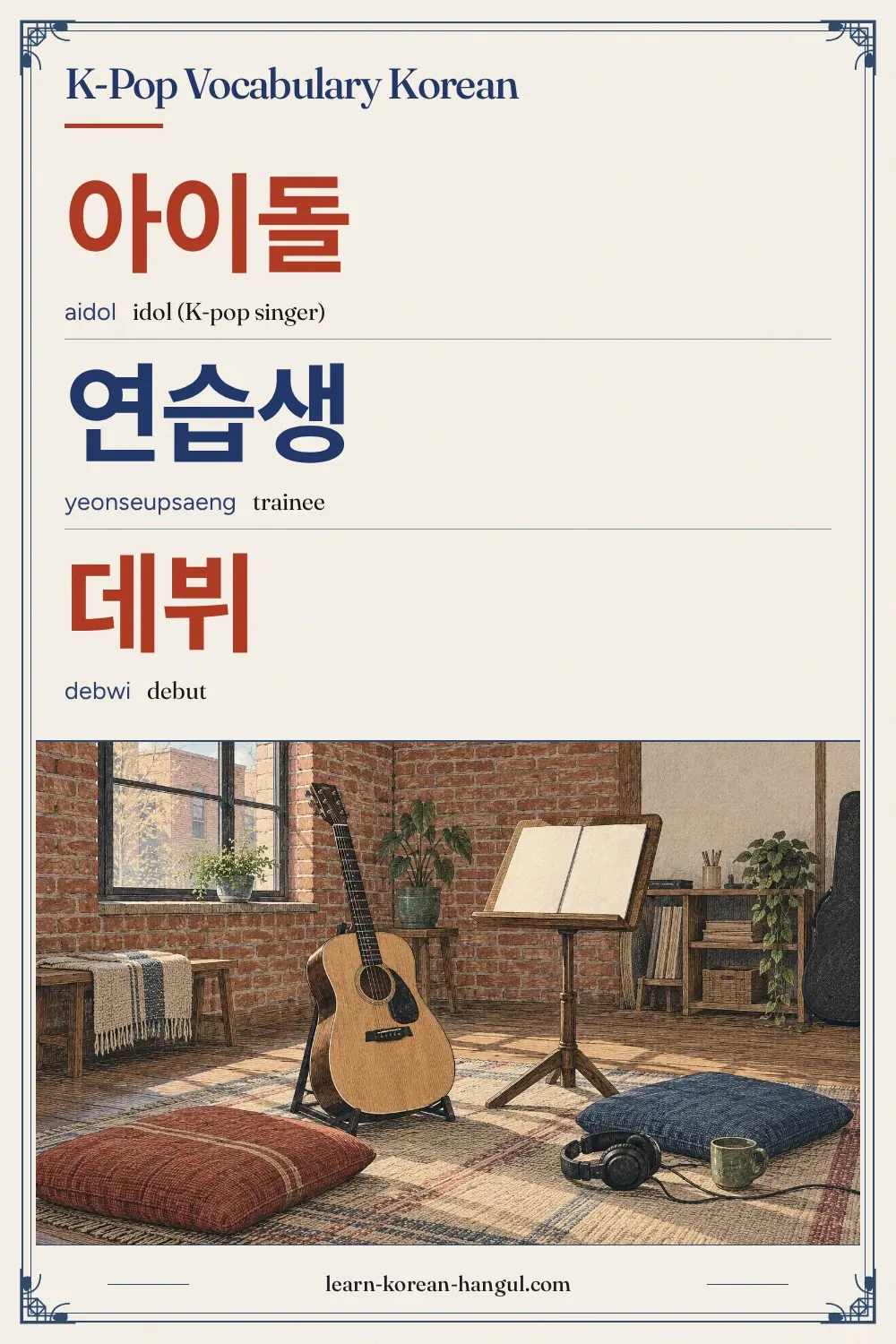
K-Pop Vocabulary Korean at a Glance
K-pop vocabulary Korean is the set of words you hear in interviews, music shows and fan videos. A group begins with an 오디션 and a period as an 연습생, then it makes a 데뷔, releases a 앨범 and returns later with a 컴백. Inside the group each member has a role, such as 리더 or 래퍼. Many of the words are English loanwords that Korean has respelled, so you can guess part of the meaning. This page holds 35 words in five groups.
| Group | Words | Use |
|---|---|---|
| Becoming an idol | 7 | Following the path from audition to debut |
| Group roles | 7 | Naming each member's role |
| Releases and promotion | 9 | Reading release news |
| Variety and appearances | 6 | Talking about shows and performances |
| Business terms | 6 | Reading contract and company news |
The list belongs to K-pop, so the parent page is K-Pop Words. The sister list for fans is fandom vocabulary, and the sentences you say to a fan are in K-pop fan phrases. The next section says where to start.
Which K-Pop Industry Words Should You Learn First?
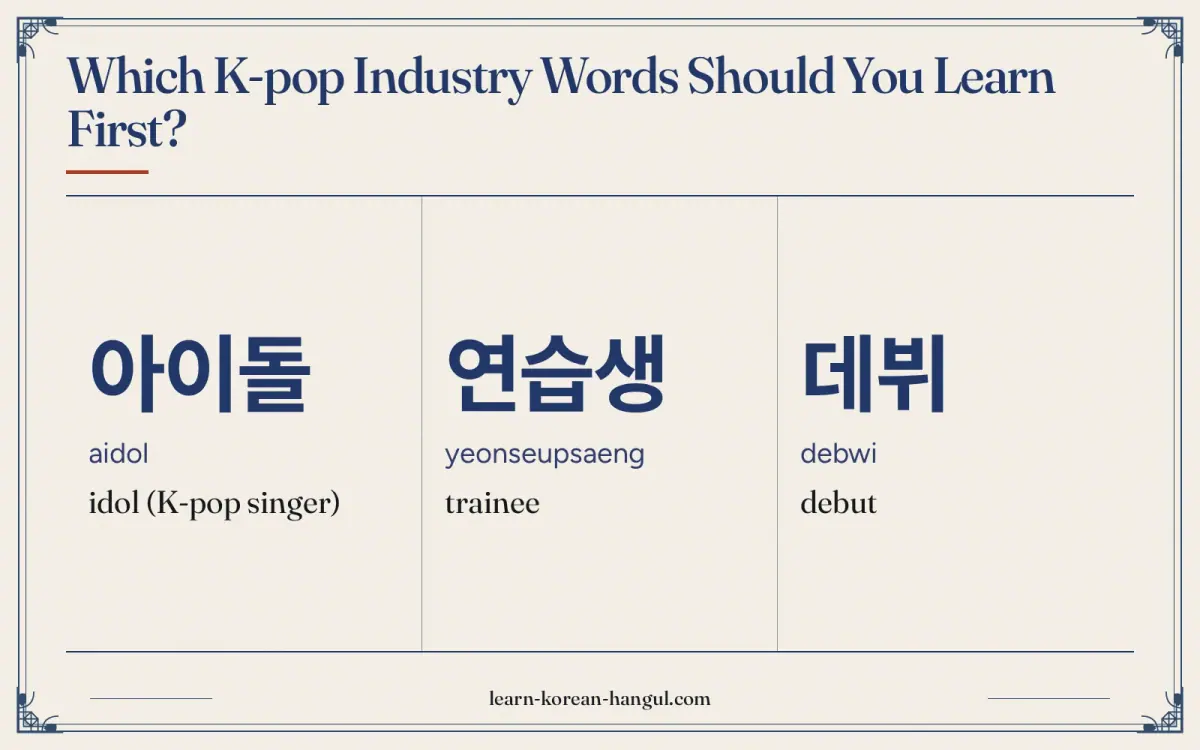
Learn 아이돌, 데뷔, 컴백, 앨범 and 멤버 first. They are the words that appear in almost every article and video title. Then learn the group roles, because interviews use them constantly.
- Day one. 아이돌, 연습생, 오디션, 데뷔, 그룹 and 멤버.
- Day two. The roles: 리더, 메인보컬, 래퍼, 막내, 센터 and 비주얼.
- Day three. The release words: 앨범, 타이틀곡, 수록곡, 싱글, 컴백 and 음원.
- Day four. The appearance words and the business words.
At 8 to 10 words a day, the list takes four days plus review. This scene puts eight of the words on one picture.
Word · 8
- 1
아이돌
aidol
idol (K-pop singer)
- 2
연습생
yeonseupsaeng
trainee
- 3
데뷔
debwi
debut
- 4
리더
rideo
leader
- 5
래퍼
raepeo
rapper
- 6
앨범
aelbeom
album
- 7
무대
mudae
stage
- 8
전속계약
jeonsokgyeyak
exclusive contract
By origin, the list has 16 Sino-Korean words, 1 native word, 16 loanwords and 2 mixed words. Loanwords dominate because the industry borrows English terms, while the Sino-Korean words are the business and contract terms. The one native word is 막내. The origin column in each table marks them.
Becoming an Idol
An 아이돌 is a singer-performer who trains in a company before appearing in public. The path starts with an 오디션 (audition). Those who pass become an 연습생 (trainee) and spend time in 연습 (practice). The first release is the 데뷔. A new group is a 신인 group in its first year.
| No. | Hangul | Revised Romanization | Origin | Meaning | Example sentence | Audio assetId |
|---|---|---|---|---|---|---|
| 1 | 아이돌 | aidol | loanword | idol (K-pop singer) | 저는 아이돌을 좋아해요. (I like idols.) | au-pg-vocabulary-culture-kpop-industry-1; example: au-pg-vocabulary-culture-kpop-industry-36 |
| 2 | 연습생 | yeonseupsaeng | Sino-Korean | trainee | 그는 연습생이에요. (He is a trainee.) | au-pg-vocabulary-culture-kpop-industry-2; example: au-pg-vocabulary-culture-kpop-industry-37 |
| 3 | 오디션 | odisyeon | loanword | audition | 오디션에 합격했어요. (I passed the audition.) | au-pg-vocabulary-culture-kpop-industry-3; example: au-pg-vocabulary-culture-kpop-industry-38 |
| 4 | 연습 | yeonseup | Sino-Korean | practice; training | 매일 노래를 연습해요. (I practise singing every day.) | au-pg-vocabulary-culture-kpop-industry-4; example: au-pg-vocabulary-culture-kpop-industry-39 |
| 5 | 데뷔 | debwi | loanword | debut | 그 가수는 작년에 데뷔했어요. (That singer debuted last year.) | au-pg-vocabulary-culture-kpop-industry-5; example: au-pg-vocabulary-culture-kpop-industry-40 |
| 6 | 신인 | sinin | Sino-Korean | rookie; newcomer | 올해 신인 그룹이 많아요. (There are many rookie groups this year.) | au-pg-vocabulary-culture-kpop-industry-6; example: au-pg-vocabulary-culture-kpop-industry-41 |
| 7 | 그룹 | geurup | loanword | group | 그 그룹은 멤버가 다섯 명이에요. (That group has five members.) | au-pg-vocabulary-culture-kpop-industry-7; example: au-pg-vocabulary-culture-kpop-industry-42 |
Notice that 연습생 is [연습쌩], with a tense ㅅ. The words in this group follow the steps of a career, so read the table below from top to bottom. The time a trainee spends in training differs a lot from group to group, so the table gives no numbers.
| Step | Word | Meaning |
|---|---|---|
| 1 | 오디션 | The audition |
| 2 | 연습생 | The trainee period |
| 3 | 데뷔 | The first release |
| 4 | 활동 | The promotion period after a release |
| 5 | 컴백 | A return with a new release |
| 6 | 재계약 / 해체 | A renewed contract, or the end of the group |
Example Sentences
Each example is a short polite sentence. Most follow the pattern subject + 이/가 + verb, as in 새 앨범이 나왔어요 (a new album came out), or noun + 을/를 + verb, as in 뮤직비디오를 봤어요. Several use the past, such as 합격했어요 (passed) and 데뷔했어요 (debuted), because the news describes events that have happened. Say each one aloud and swap the noun.
The first group follows the path of a trainee, so its sentences read in order. The roles come next.
How Do You Say Group Roles in Korean?
Each member of a group is a 멤버, and each usually has a role. The 리더 leads the group. The 메인보컬 is the strongest singer, and the 래퍼 raps. The 센터 stands in the middle of the formation, and the 비주얼 is the member who is known as the face of the group. The youngest member is the 막내.
| No. | Hangul | Revised Romanization | Origin | Meaning | Example sentence | Audio assetId |
|---|---|---|---|---|---|---|
| 8 | 멤버 | membeo | loanword | member | 멤버들이 무대에 올라가요. (The members go up on stage.) | au-pg-vocabulary-culture-kpop-industry-8; example: au-pg-vocabulary-culture-kpop-industry-43 |
| 9 | 리더 | rideo | loanword | leader | 리더는 팀을 이끌어요. (The leader guides the team.) | au-pg-vocabulary-culture-kpop-industry-9; example: au-pg-vocabulary-culture-kpop-industry-44 |
| 10 | 메인보컬 | meinbokeol | loanword | main vocalist | 메인보컬이 노래를 잘해요. (The main vocalist sings well.) | au-pg-vocabulary-culture-kpop-industry-10; example: au-pg-vocabulary-culture-kpop-industry-45 |
| 11 | 래퍼 | raepeo | loanword | rapper | 래퍼가 랩을 해요. (The rapper raps.) | au-pg-vocabulary-culture-kpop-industry-11; example: au-pg-vocabulary-culture-kpop-industry-46 |
| 12 | 막내 | mangnae | native | the youngest member (often spelled maknae in K-pop) | 막내는 열여섯 살이에요. (The youngest member is sixteen years old.) | au-pg-vocabulary-culture-kpop-industry-12; example: au-pg-vocabulary-culture-kpop-industry-47 |
| 13 | 센터 | senteo | loanword | center; the member in the middle position | 센터가 무대 가운데에 서요. (The center stands in the middle of the stage.) | au-pg-vocabulary-culture-kpop-industry-13; example: au-pg-vocabulary-culture-kpop-industry-48 |
| 14 | 비주얼 | bijueol | loanword | visual; the member known for looks | 비주얼 멤버가 인기가 많아요. (The visual member is very popular.) | au-pg-vocabulary-culture-kpop-industry-14; example: au-pg-vocabulary-culture-kpop-industry-49 |
The romanization of 막내 is mangnae, because the ㄱ before ㄴ is said as ng. The K-pop spelling maknae is a common fan spelling, and you will see it on social media. Roles are labels that a company or fans give, and the same member can have more than one.
Releases and Promotion
A release is an 앨범, and there are several sizes. A 정규 앨범 is a full-length album, a 미니 앨범 is a shorter one, and a 싱글 has only a few songs. Inside an album, the 타이틀곡 is the main song, and the others are 수록곡. The 음원 is the digital release of a song. The period of promotion after a release is the 활동, and a return with a new release is a 컴백.
| No. | Hangul | Revised Romanization | Origin | Meaning | Example sentence | Audio assetId |
|---|---|---|---|---|---|---|
| 15 | 앨범 | aelbeom | loanword | album | 새 앨범이 나왔어요. (A new album came out.) | au-pg-vocabulary-culture-kpop-industry-15; example: au-pg-vocabulary-culture-kpop-industry-50 |
| 16 | 정규 앨범 | jeonggyu aelbeom | mixed | full-length album | 정규 앨범에는 노래가 많이 들어 있어요. (A full-length album contains many songs.) | au-pg-vocabulary-culture-kpop-industry-16; example: au-pg-vocabulary-culture-kpop-industry-51 |
| 17 | 미니 앨범 | mini aelbeom | loanword | mini album | 미니 앨범은 정규 앨범보다 짧아요. (A mini album is shorter than a full-length album.) | au-pg-vocabulary-culture-kpop-industry-17; example: au-pg-vocabulary-culture-kpop-industry-52 |
| 18 | 싱글 | singgeul | loanword | single | 싱글은 노래가 한두 곡 들어 있어요. (A single has one or two songs.) | au-pg-vocabulary-culture-kpop-industry-18; example: au-pg-vocabulary-culture-kpop-industry-53 |
| 19 | 타이틀곡 | taiteulgok | mixed | title track; the main song of an album | 이번 타이틀곡이 좋아요. (This title track is good.) | au-pg-vocabulary-culture-kpop-industry-19; example: au-pg-vocabulary-culture-kpop-industry-54 |
| 20 | 수록곡 | surokgok | Sino-Korean | album track; a non-title song on an album | 수록곡도 모두 좋아요. (The album tracks are all good too.) | au-pg-vocabulary-culture-kpop-industry-20; example: au-pg-vocabulary-culture-kpop-industry-55 |
| 21 | 컴백 | keombaek | loanword | comeback; a new release after a break | 그 그룹이 다음 달에 컴백해요. (That group is coming back next month.) | au-pg-vocabulary-culture-kpop-industry-21; example: au-pg-vocabulary-culture-kpop-industry-56 |
| 22 | 활동 | hwaldong | Sino-Korean | activities; the promotion period | 오늘부터 활동을 시작해요. (We start promotions today.) | au-pg-vocabulary-culture-kpop-industry-22; example: au-pg-vocabulary-culture-kpop-industry-57 |
| 23 | 음원 | eumwon | Sino-Korean | digital music release; sound source | 음원이 오늘 공개돼요. (The music release is made public today.) | au-pg-vocabulary-culture-kpop-industry-23; example: au-pg-vocabulary-culture-kpop-industry-58 |
The word 컴백 is a loanword from English comeback, and Korean uses it for any return of a group with a new release. It does not mean the group had failed before. Pay attention to the tense sound in 수록곡, which is said [수록꼭]. In 타이틀곡 you will hear both a plain and a tense ㄱ, [타이틀곡] and [타이틀꼭], so follow the audio.
How Do You Say Variety and Appearances in Korean?
Groups also appear on television. An 예능 is a variety show, and an 음악 방송 is a weekly music show. The stage is the 무대, and a full performance for fans is a 콘서트. Fans watch the 뮤직비디오 and learn the 안무 (choreography).
| No. | Hangul | Revised Romanization | Origin | Meaning | Example sentence | Audio assetId |
|---|---|---|---|---|---|---|
| 24 | 예능 | yeneung | Sino-Korean | variety show; entertainment programme | 예능 프로그램에 나와요. (He appears on a variety show.) | au-pg-vocabulary-culture-kpop-industry-24; example: au-pg-vocabulary-culture-kpop-industry-59 |
| 25 | 음악 방송 | eumak bangsong | Sino-Korean | music show on television | 음악 방송에서 일 위를 했어요. (We took first place on the music show.) | au-pg-vocabulary-culture-kpop-industry-25; example: au-pg-vocabulary-culture-kpop-industry-60 |
| 26 | 무대 | mudae | Sino-Korean | stage | 무대가 정말 멋있어요. (The stage is really cool.) | au-pg-vocabulary-culture-kpop-industry-26; example: au-pg-vocabulary-culture-kpop-industry-61 |
| 27 | 콘서트 | konseoteu | loanword | concert | 콘서트에 가고 싶어요. (I want to go to a concert.) | au-pg-vocabulary-culture-kpop-industry-27; example: au-pg-vocabulary-culture-kpop-industry-62 |
| 28 | 뮤직비디오 | myujikbidio | loanword | music video | 뮤직비디오를 봤어요. (I watched the music video.) | au-pg-vocabulary-culture-kpop-industry-28; example: au-pg-vocabulary-culture-kpop-industry-63 |
| 29 | 안무 | anmu | Sino-Korean | choreography | 이 노래는 안무가 어려워요. (The choreography of this song is difficult.) | au-pg-vocabulary-culture-kpop-industry-29; example: au-pg-vocabulary-culture-kpop-industry-64 |
An 예능 show is not a music show. If you search for a group's TV appearances, 예능 gives variety shows and 음악 방송 gives weekly music programmes. The phrase 일 위 means first place, and it uses the Sino-Korean number 일.
Business Terms
Behind every group is a company. It is called a 소속사 (the company an artist belongs to) or a 기획사 (an entertainment company that plans and produces). The artist signs a 계약 (contract), and an exclusive one is a 전속계약. When it ends, the sides may sign a 재계약 (renewed contract), or the group may announce a 해체 (disbandment).
| No. | Hangul | Revised Romanization | Origin | Meaning | Example sentence | Audio assetId |
|---|---|---|---|---|---|---|
| 30 | 소속사 | sosoksa | Sino-Korean | agency; the company an artist belongs to | 소속사가 발표했어요. (The agency announced it.) | au-pg-vocabulary-culture-kpop-industry-30; example: au-pg-vocabulary-culture-kpop-industry-65 |
| 31 | 기획사 | gihoeksa | Sino-Korean | entertainment company; production company | 큰 기획사에서 연습생을 뽑아요. (A large company picks trainees.) | au-pg-vocabulary-culture-kpop-industry-31; example: au-pg-vocabulary-culture-kpop-industry-66 |
| 32 | 계약 | gyeyak | Sino-Korean | contract | 계약을 했어요. (We signed a contract.) | au-pg-vocabulary-culture-kpop-industry-32; example: au-pg-vocabulary-culture-kpop-industry-67 |
| 33 | 전속계약 | jeonsokgyeyak | Sino-Korean | exclusive contract | 소속사와 전속계약을 했어요. (I signed an exclusive contract with the agency.) | au-pg-vocabulary-culture-kpop-industry-33; example: au-pg-vocabulary-culture-kpop-industry-68 |
| 34 | 재계약 | jaegyeyak | Sino-Korean | contract renewal | 올해 재계약을 해요. (We renew the contract this year.) | au-pg-vocabulary-culture-kpop-industry-34; example: au-pg-vocabulary-culture-kpop-industry-69 |
| 35 | 해체 | haeche | Sino-Korean | disbandment; breaking up | 그 그룹이 해체했어요. (That group disbanded.) | au-pg-vocabulary-culture-kpop-industry-35; example: au-pg-vocabulary-culture-kpop-industry-70 |
These words are the ones in business news, and they are neutral in tone. 소속사 is the company the artist belongs to, and 기획사 is the company that plans and produces, and the news often uses the two almost interchangeably. Terms of a contract are private, so articles state only that one was signed or renewed.
How Do You Pronounce These Words?
Many K-pop words are loanwords, and most of them are said as spelled. The Sino-Korean words change more often in speech. The table lists the changes that learners most often miss.
| Spelling | Pronunciation | What happens |
|---|---|---|
| 연습생 | [연습쌩] | The ㅅ after a final ㅂ becomes tense |
| 활동 | [활똥] | The ㄷ after a final ㄹ becomes tense |
| 소속사 | [소속싸] | The ㅅ after a final ㄱ becomes tense |
| 수록곡 | [수록꼭] | The ㄱ after a final ㄱ becomes tense |
| 타이틀곡 | [타이틀곡] or [타이틀꼭] | The final ㄹ of 틀 is a light l, and the ㄱ that follows may be plain or tense |
| 막내 | [망내] | The final ㄱ becomes ng before the nasal ㄴ |
| 음악 방송 | [으막 방송] | The final ㅁ of 음 moves onto the vowel of 악, so you hear eu-mak; the next word is said separately |
The rules come from the Standard Pronunciation rules (표준 발음법) of the 국립국어원.
Audio and Slow Playback
Each word has a normal clip, and 5 key words also have a slow clip at 0.8 times the speed: 연습생, 데뷔, 막내, 타이틀곡 and 전속계약. Nothing plays until you press a button.
Listen to 연습생 first. You should hear a tense s at the start of the last syllable, [연습쌩], with the ㅂ of 습 closed and unreleased.
What Mistakes Do Learners Make with K-Pop Industry Words?
- Reading 연습생 as yeon-seup-saeng with a plain s. The spoken form is [연습쌩].
- Using 컴백 for a debut. 데뷔 is the first release, and 컴백 is a later return.
- Writing 막내 as makne. The romanization is mangnae, and the K-pop spelling is maknae.
- Mixing up 소속사 and 기획사. 소속사 is the company an artist belongs to, and 기획사 plans and produces.
- Saying 아이돌 for any singer. An 아이돌 is a performer who trained in a company system, and a 가수 is a singer in general.
The first four mistakes change the meaning or sound, and the last changes how precise you are. The next section turns the list into practice.
Practice: Flashcards and Worksheet
Drill these words with the Kpop Korean words flashcards or browse all the vocabulary flashcard decks. A printable worksheet for these words (word list, matching, writing practice, fill-in-the-blank exercises and answer key) is available in A4 and US Letter from the download card on this page. Progress in the decks is saved only in your browser.
K-Pop Industry Vocabulary Worksheet
Try this five-question check, then say the 35 words aloud once more.
Practice · 5
What does 아이돌 mean?
Show answer
idol (K-pop singer)
아이돌 (aidol) means idol (K-pop singer).
What does 연습생 mean?
Show answer
trainee
연습생 (yeonseupsaeng) means trainee.
What does 래퍼 mean?
Show answer
rapper
래퍼 (raepeo) means rapper.
What does 타이틀곡 mean?
Show answer
title track; the main song of an album
타이틀곡 (taiteulgok) means title track; the main song of an album.
What does 소속사 mean?
Show answer
agency; the company an artist belongs to
소속사 (sosoksa) means agency; the company an artist belongs to.
For one word at a time, see trainee in Korean, debut in Korean and k pop in Korean.
Where to Go Next
This list sits inside K-Pop Words. After K-pop vocabulary Korean, many learners move on to the fandom list, which covers fan clubs, lightsticks and chants.
Frequently Asked Questions
How Do You Say Idol in Korean?
An idol is 아이돌 (aidol), a loanword from English written in Hangul. It means a K-pop performer who trains in a company before debuting. A singer in general is 가수. To say you like idols, use 저는 아이돌을 좋아해요 (jeoneun aidoreul joahaeyo). Press the audio button to hear the word.
How Do You Pronounce 연습생 (yeonseupsaeng)?
연습생 is said [연습쌩], yeon-seup-ssaeng, in three beats. The vowel ㅕ in the first syllable is a glide plus eo. The ㅂ at the end of 습 is closed and not released. The last syllable begins with a tense ㅅ, said without a puff of air. Use the slow clip to match the rhythm.
How Many K-Pop Industry Words Should I Learn First?
Learn five first: 아이돌, 데뷔, 컴백, 앨범 and 멤버. That takes one day. Then add the roles, the release words and the business words. The whole list of 35 takes four days at 8 to 10 words a day, with review on the fifth day.
Where Can I Practise K-Pop Industry Words with Flashcards?
Use the Kpop Korean words flashcards, a 30-card deck with audio that includes industry words such as 연습생, 데뷔, 소속사 and 타이틀곡. Progress stays in your browser. The fandom list has the fan side of the same topic, so review the two lists together to cover both the industry and the people who follow it.
Is the Romanization on This Page Official?
It follows the Revised Romanization of Korean, which South Korea officially adopted on 7 July 2000 and whose rules the National Institute of Korean Language (국립국어원) publishes. It is a learning aid that does not mark every sound change, so learn the Hangul and use the audio to hear the real sound.
Is There a Printable Worksheet for K-Pop Industry Words?
A printable worksheet for these words (word list, matching, writing practice, fill-in-the-blank exercises and answer key) is available in A4 and US Letter from the download card on this page. For practice, copy the tables above by hand: write the Hangul, cover the English column, and check your answers against the page.