Korean Accessories and Jewelry Vocabulary at a Glance
Korean accessories and jewelry vocabulary is the set of nouns for what you add to an outfit: jewelry, bags, hats, glasses, watches and hair items. Korean uses a different verb for how you wear each item, so this page teaches the noun together with its verb. It is a child of the Clothing page.
| Group | Words | Use |
|---|---|---|
| Jewelry | 7 | Naming rings, necklaces and the metals |
| Bags and wallets | 6 | Describing what you carry |
| Hats and scarves | 6 | Winter and sun wear |
| Glasses and watches | 6 | Vision and time |
| Hair accessories and extras | 5 | Hair items, belts and ties |
This page uses generic nouns and no brand names. Brand words change quickly, and shop signs are a better place to learn them. The next section ranks the groups by use.
Which Accessories and Jewelry Words Should You Learn First?
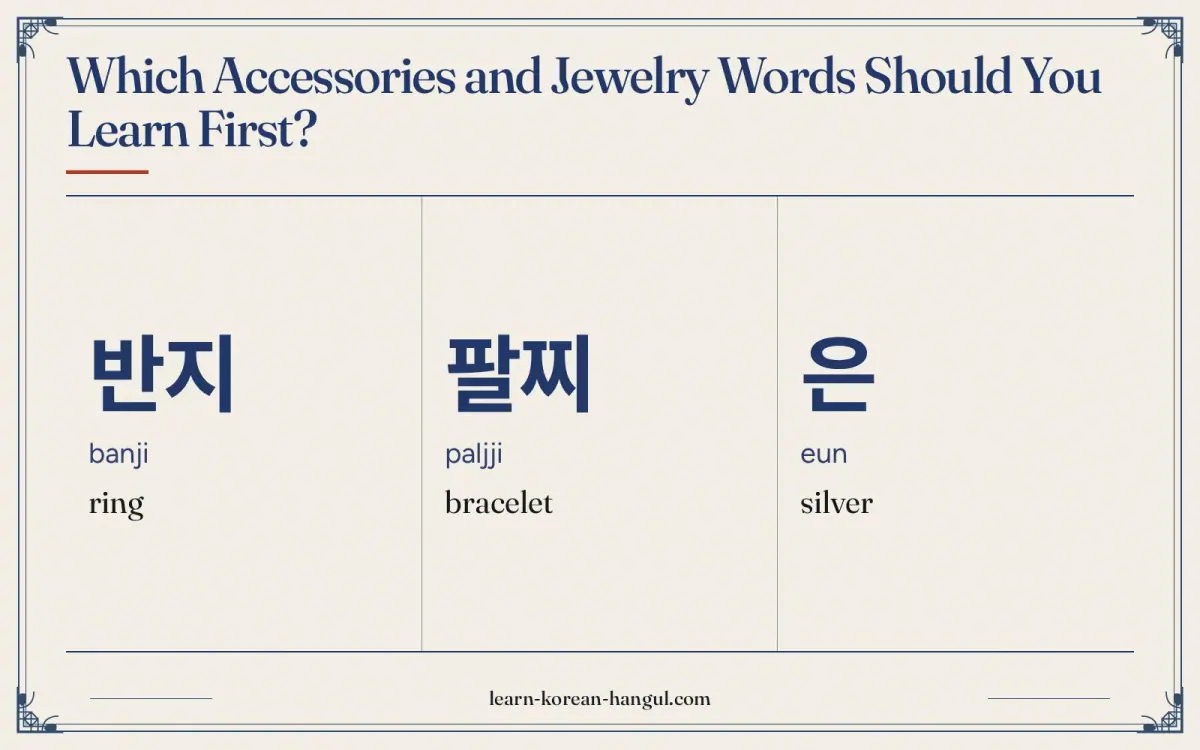
Learn 가방, 지갑, 안경 and 시계 first, because you use them every day and they are on every packing list. Add 반지 and 목걸이 next for conversations about gifts and shopping. The hair items and extras can wait.
- Day one. 가방, 지갑, 모자, 안경 and 시계.
- Day two. 반지, 목걸이, 귀걸이 and 팔찌.
- Day three. 목도리, 스카프, 장갑 and the bags.
- Day four. The glasses, watches and hair words.
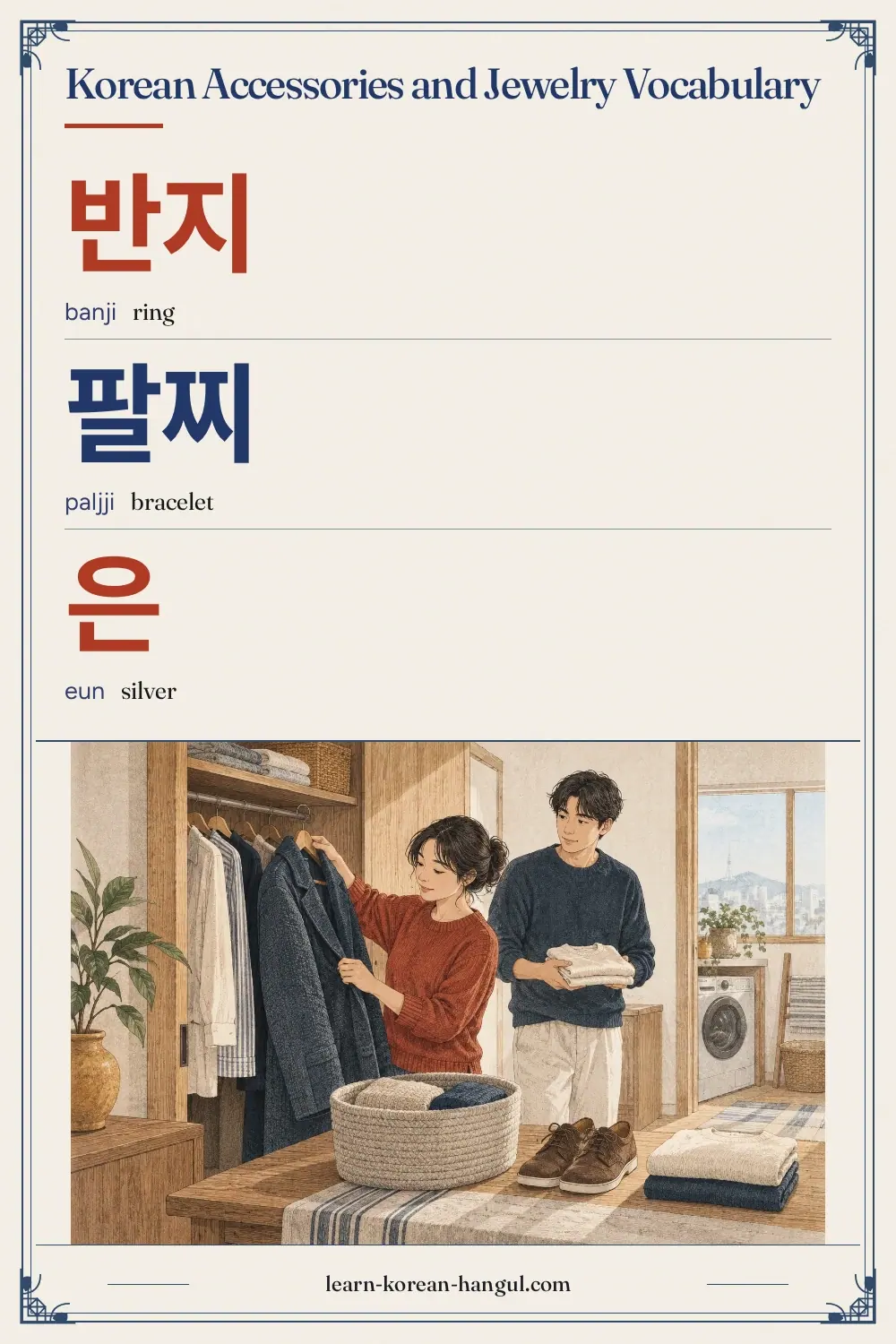
At 8 to 10 words a day, the list takes three to four days plus review. This scene puts eight of the words on one picture.
Word · 8
- 1
반지
banji
ring
- 2
팔찌
paljji
bracelet
- 3
은
eun
silver
- 4
배낭
baenang
backpack; rucksack
- 5
파우치
pauchi
pouch
- 6
목도리
mokdori
scarf (thick, for winter)
- 7
비니
bini
beanie
- 8
콘택트렌즈
kontaekteurenjeu
contact lenses
A third of the list is loanwords, such as 핸드백, 스카프 and 선글라스, and you can guess them from English. The origin column in each table marks them. The first group is jewelry.
Jewelry
Most jewelry words are native Korean. 목걸이 and 귀걸이 join 목 (neck) or 귀 (ear) to 걸이 (something that hangs), and 팔찌 is worn on the 팔 (arm). 반지 is the ring, and the metals are 금 (gold) and 은 (silver). Gems are 보석. Note that 은 also appears as a grammar particle, but as a noun it means silver.
| No. | Hangul | Revised Romanization | Origin | Meaning | Example sentence | Audio assetId |
|---|---|---|---|---|---|---|
| 1 | 반지 | banji | Sino-Korean | ring | 손가락에 반지를 껴요. (I wear a ring on my finger.) | au-pg-vocabulary-daily-life-clothing-accessories-1; example: au-pg-vocabulary-daily-life-clothing-accessories-31 |
| 2 | 목걸이 | mokgeori | native | necklace | 목걸이를 해요. (I wear a necklace.) | au-pg-vocabulary-daily-life-clothing-accessories-2; example: au-pg-vocabulary-daily-life-clothing-accessories-32 |
| 3 | 귀걸이 | gwigeori | native | earrings | 귀걸이가 예뻐요. (The earrings are pretty.) | au-pg-vocabulary-daily-life-clothing-accessories-3; example: au-pg-vocabulary-daily-life-clothing-accessories-33 |
| 4 | 팔찌 | paljji | native | bracelet | 팔찌가 작아요. (The bracelet is small.) | au-pg-vocabulary-daily-life-clothing-accessories-4; example: au-pg-vocabulary-daily-life-clothing-accessories-34 |
| 5 | 보석 | boseok | Sino-Korean | gem; jewel | 보석이 반짝여요. (The jewel sparkles.) | au-pg-vocabulary-daily-life-clothing-accessories-5; example: au-pg-vocabulary-daily-life-clothing-accessories-35 |
| 6 | 금 | geum | Sino-Korean | gold | 금 반지를 샀어요. (I bought a gold ring.) | au-pg-vocabulary-daily-life-clothing-accessories-6; example: au-pg-vocabulary-daily-life-clothing-accessories-36 |
| 7 | 은 | eun | Sino-Korean | silver | 은 목걸이가 예뻐요. (The silver necklace is pretty.) | au-pg-vocabulary-daily-life-clothing-accessories-7; example: au-pg-vocabulary-daily-life-clothing-accessories-37 |
In Korea a ring has a social meaning that learners often ask about. 커플링 (couple rings) are a common gift between dating partners, and a 100-day anniversary, called 백일, is a popular occasion for gifts. The dating vocabulary page covers the words for these moments. Customs differ between couples, so treat this as a general note.
Example Sentences
Each example is a short polite sentence. Most follow the pattern item + 을/를 + verb, where the verb depends on the item, as the next table shows. Say each sentence aloud and swap the item. Replace 반지 in 반지를 껴요 with 장갑 and you get 장갑을 껴요, which is also correct, because both use 끼다.
Using the right verb matters more than any single noun, so the next table lists the common pairs.
Which Verb Goes with Which Accessory?
Korean uses a different verb for each way of putting something on: 끼다 for things that fit tightly, 쓰다 for things on the head or face, 차다 for things strapped to the wrist or waist, 메다 for things on your back or shoulder, and 매다 for things that you tie. English uses wear for all of them. Verbs are covered in full in the common verbs lesson, so this table only gives the polite present forms.
| Verb | Polite present | Used with | Example |
|---|---|---|---|
| 끼다 | 껴요 | rings, gloves, contact lenses | 반지를 껴요 (I wear a ring) |
| 쓰다 | 써요 | hats, glasses, sunglasses | 안경을 써요 (I wear glasses) |
| 차다 | 차요 | wristwatches, bracelets | 손목시계를 차요 (I wear a wristwatch) |
| 매다 | 매요 | belts, neckties | 벨트를 매요 (I wear a belt) |
| 메다 | 메요 | backpacks, shoulder bags | 배낭을 메요 (I carry a backpack) |
| 하다 | 해요 | necklaces, earrings, scarves, headbands | 목걸이를 해요 (I wear a necklace) |
The verb 하다 is the general choice for jewelry and scarves, so if you are unsure, 해요 is almost always understood. The next group is the things you carry.
How Do You Say Bags and Wallets in Korean?
The general word for bag is 가방, and a 핸드백 is a handbag. A 배낭 is a backpack, and you carry it with 메다. A 지갑 is a wallet, a 동전 지갑 is a coin purse, and a 파우치 is a small zip pouch for makeup or cables.
| No. | Hangul | Revised Romanization | Origin | Meaning | Example sentence | Audio assetId |
|---|---|---|---|---|---|---|
| 8 | 가방 | gabang | old loanword | bag | 가방이 무거워요. (The bag is heavy.) | au-pg-vocabulary-daily-life-clothing-accessories-8; example: au-pg-vocabulary-daily-life-clothing-accessories-38 |
| 9 | 핸드백 | haendeubaek | loanword | handbag | 핸드백을 사고 싶어요. (I want to buy a handbag.) | au-pg-vocabulary-daily-life-clothing-accessories-9; example: au-pg-vocabulary-daily-life-clothing-accessories-39 |
| 10 | 배낭 | baenang | Sino-Korean | backpack; rucksack | 배낭을 메요. (I carry a backpack.) | au-pg-vocabulary-daily-life-clothing-accessories-10; example: au-pg-vocabulary-daily-life-clothing-accessories-40 |
| 11 | 지갑 | jigap | Sino-Korean | wallet | 지갑을 잃어버렸어요. (I lost my wallet.) | au-pg-vocabulary-daily-life-clothing-accessories-11; example: au-pg-vocabulary-daily-life-clothing-accessories-41 |
| 12 | 동전 지갑 | dongjeon jigap | Sino-Korean | coin purse | 동전 지갑이 작아요. (The coin purse is small.) | au-pg-vocabulary-daily-life-clothing-accessories-12; example: au-pg-vocabulary-daily-life-clothing-accessories-42 |
| 13 | 파우치 | pauchi | loanword | pouch | 파우치에 화장품이 있어요. (There is makeup in the pouch.) | au-pg-vocabulary-daily-life-clothing-accessories-13; example: au-pg-vocabulary-daily-life-clothing-accessories-43 |
The word 가방 also covers school bags and suitcases when you add a word before it, as in 여행 가방 (travel bag). The word 지갑 is one of the first nouns learners need for shopping, as in 지갑을 잃어버렸어요 (I lost my wallet). The phrases for that moment are on the emergency phrases page.
Hats and Scarves
A 모자 is a hat or cap, and a 야구 모자 is a baseball cap. Korean separates two kinds of scarf. A 목도리 is a thick winter scarf worn around the neck, and a 스카프 is a thin fashion scarf. 장갑 are gloves, and a 비니 is a knitted beanie.
| No. | Hangul | Revised Romanization | Origin | Meaning | Example sentence | Audio assetId |
|---|---|---|---|---|---|---|
| 14 | 모자 | moja | Sino-Korean | hat; cap | 모자를 써요. (I wear a hat.) | au-pg-vocabulary-daily-life-clothing-accessories-14; example: au-pg-vocabulary-daily-life-clothing-accessories-44 |
| 15 | 야구 모자 | yagu moja | Sino-Korean | baseball cap | 야구 모자가 편해요. (The baseball cap is comfortable.) | au-pg-vocabulary-daily-life-clothing-accessories-15; example: au-pg-vocabulary-daily-life-clothing-accessories-45 |
| 16 | 목도리 | mokdori | native | scarf (thick, for winter) | 겨울에 목도리를 해요. (I wear a scarf in winter.) | au-pg-vocabulary-daily-life-clothing-accessories-16; example: au-pg-vocabulary-daily-life-clothing-accessories-46 |
| 17 | 스카프 | seukapeu | loanword | scarf (thin, for fashion) | 스카프가 예뻐요. (The scarf is pretty.) | au-pg-vocabulary-daily-life-clothing-accessories-17; example: au-pg-vocabulary-daily-life-clothing-accessories-47 |
| 18 | 장갑 | janggap | Sino-Korean | gloves | 장갑을 껴요. (I wear gloves.) | au-pg-vocabulary-daily-life-clothing-accessories-18; example: au-pg-vocabulary-daily-life-clothing-accessories-48 |
| 19 | 비니 | bini | loanword | beanie | 비니가 따뜻해요. (The beanie is warm.) | au-pg-vocabulary-daily-life-clothing-accessories-19; example: au-pg-vocabulary-daily-life-clothing-accessories-49 |
The difference between 목도리 and 스카프 matters when you shop: ask for a 목도리 in winter, and for a 스카프 for style. The verb for a scarf is 하다 or 두르다, and 둘러요 means wrap around.
How Do You Say Glasses and Watches in Korean?
Glasses are 안경 and sunglasses are 선글라스. Contact lenses are 콘택트렌즈, often shortened to 렌즈. A clock or watch is 시계, and a wristwatch is 손목시계. A smartwatch is 스마트워치.
| No. | Hangul | Revised Romanization | Origin | Meaning | Example sentence | Audio assetId |
|---|---|---|---|---|---|---|
| 20 | 안경 | angyeong | Sino-Korean | glasses | 안경을 써요. (I wear glasses.) | au-pg-vocabulary-daily-life-clothing-accessories-20; example: au-pg-vocabulary-daily-life-clothing-accessories-50 |
| 21 | 선글라스 | seongeullaseu | loanword | sunglasses | 선글라스를 샀어요. (I bought sunglasses.) | au-pg-vocabulary-daily-life-clothing-accessories-21; example: au-pg-vocabulary-daily-life-clothing-accessories-51 |
| 22 | 콘택트렌즈 | kontaekteurenjeu | loanword | contact lenses | 콘택트렌즈를 사용해요. (I use contact lenses.) | au-pg-vocabulary-daily-life-clothing-accessories-22; example: au-pg-vocabulary-daily-life-clothing-accessories-52 |
| 23 | 시계 | sigye | Sino-Korean | clock; watch | 시계를 봐요. (I look at the clock.) | au-pg-vocabulary-daily-life-clothing-accessories-23; example: au-pg-vocabulary-daily-life-clothing-accessories-53 |
| 24 | 손목시계 | sonmoksigye | mixed | wristwatch | 손목시계를 차요. (I wear a wristwatch.) | au-pg-vocabulary-daily-life-clothing-accessories-24; example: au-pg-vocabulary-daily-life-clothing-accessories-54 |
| 25 | 스마트워치 | seumateuwochi | loanword | smartwatch | 스마트워치가 편리해요. (The smartwatch is convenient.) | au-pg-vocabulary-daily-life-clothing-accessories-25; example: au-pg-vocabulary-daily-life-clothing-accessories-55 |
The word 시계 means both clock and watch, so you add 손목 (wrist) when you need to be clear. The same pattern works for other items, such as 안경 + 집 for a glasses case. These words are also useful when you describe a person, as in 안경을 쓴 사람 (a person wearing glasses).
Hair Accessories
Hair items are built from 머리 (head or hair) and a second word: 머리핀 is a hairpin, 머리끈 is a hair tie and 머리띠 is a headband. 머리끈 and 머리띠 are fully native Korean, while 머리핀 adds the loanword 핀 (pin). This group also holds two items from outside the hair group: 벨트 and 넥타이.
| No. | Hangul | Revised Romanization | Origin | Meaning | Example sentence | Audio assetId |
|---|---|---|---|---|---|---|
| 26 | 머리핀 | meoripin | mixed | hairpin | 머리핀을 꽂아요. (I put in a hairpin.) | au-pg-vocabulary-daily-life-clothing-accessories-26; example: au-pg-vocabulary-daily-life-clothing-accessories-56 |
| 27 | 머리끈 | meorikkeun | native | hair tie | 머리끈으로 머리를 묶어요. (I tie my hair with a hair tie.) | au-pg-vocabulary-daily-life-clothing-accessories-27; example: au-pg-vocabulary-daily-life-clothing-accessories-57 |
| 28 | 머리띠 | meoritti | native | headband | 머리띠를 해요. (I wear a headband.) | au-pg-vocabulary-daily-life-clothing-accessories-28; example: au-pg-vocabulary-daily-life-clothing-accessories-58 |
| 29 | 벨트 | belteu | loanword | belt | 벨트를 매요. (I wear a belt.) | au-pg-vocabulary-daily-life-clothing-accessories-29; example: au-pg-vocabulary-daily-life-clothing-accessories-59 |
| 30 | 넥타이 | nektai | loanword | necktie | 넥타이가 파란색이에요. (The tie is blue.) | au-pg-vocabulary-daily-life-clothing-accessories-30; example: au-pg-vocabulary-daily-life-clothing-accessories-60 |
You will also hear fashion words that are not objects. 패션 is fashion, 스타일 is style, and 코디 is short for coordination, meaning the styling of an outfit. A friend might say 오늘 코디 예뻐요 (your outfit today is pretty). These three are loanwords and are not part of the 30 words above.
How Do You Pronounce These Words?
Most accessory words are pronounced as they are spelled, but six need a note. The tense sounds in 목걸이 and 목도리 come from a rule that makes a consonant tense after a final ㄱ.
| Spelling | Pronunciation | What happens |
|---|---|---|
| 목걸이 | [목꺼리] | ㄱ after a final ㄱ becomes tense, and the ㄹ of 걸 moves to the vowel 이 |
| 귀걸이 | [귀거리] | No final consonant comes before the ㄱ, so it stays plain |
| 목도리 | [목또리] | ㄷ after a final ㄱ becomes tense |
| 팔찌 | [팔찌] | ㅉ is tense: tighten the throat and release no puff of air |
| 시계 | [시계/시게] | The vowel ㅖ may be said as [ㅔ] after a consonant |
| 지갑 | [지갑] | Final ㅂ is unreleased: the lips close and no air comes out |
The rules come from the Standard Pronunciation rules (표준 발음법) of the 국립국어원. The audio is generated with text-to-speech and checked by a Korean teacher before publication.
Audio and Slow Playback
Each word has a normal clip, and 5 key words also have a slow clip at 0.8 times the speed: 반지, 목걸이, 목도리, 안경 and 손목시계. Nothing plays until you press a button.
Listen to 목걸이 first. You should hear a tense k in the middle, as if the word were spelled 목꺼리.
What Mistakes Do Learners Make with Accessories and Jewelry Words?
- Using one verb for everything. Say 모자를 써요 (a hat), 반지를 껴요 (a ring) and 시계를 차요 (a watch). Using 입어요 for these items sounds wrong, because 입다 is for clothes.
- Reading 목걸이 as mok-geol-i. The spoken form is [목꺼리].
- Mixing up 목도리 and 스카프. Both are scarves, but one is thick and for winter and the other is thin and for style.
- Confusing 은 (silver) with the particle 은. As a noun, it needs a following word such as 은 반지.
- Dropping the object particle. Say 반지를 껴요, and do not say 반지 껴요 in writing.
The first mistake is the most common one, because English uses a single verb. The next section turns the list into practice.
Practice: Flashcards and Worksheet
Drill these words with the vocabulary flashcard decks. A printable worksheet for these words (word list, matching, writing practice, fill-in-the-blank exercises and answer key) is available in A4 and US Letter from the download card on this page. Progress in the decks is saved only in your browser.
Korean Accessories and Jewelry Worksheet
Try this five-question check, then say the 30 words aloud once more.
Practice · 5
What does 반지 mean?
Show answer
ring
반지 (banji) means ring.
What does 가방 mean?
Show answer
bag
가방 (gabang) means bag.
What does 야구 모자 mean?
Show answer
baseball cap
야구 모자 (yagu moja) means baseball cap.
What does 비니 mean?
Show answer
beanie
비니 (bini) means beanie.
What does 머리핀 mean?
Show answer
hairpin
머리핀 (meoripin) means hairpin.
Where to Go Next
This list sits inside Clothing. After the Korean accessories and jewelry vocabulary, go back to that page for tops, bottoms and shoes, or read the shopping phrases to ask for a size or a colour. The Daily Life hub lists the other everyday topics.
Frequently Asked Questions
How Do You Say Ring in Korean?
Ring is 반지 (banji). To say you wear one, use 반지를 껴요 (banjireul kkyeoyo), with the verb 끼다 for tight-fitting items. A couple ring is 커플링, and a wedding ring is 결혼반지. Say banji with a plain ㅂ at the start and a soft j sound in the second syllable.
How Do You Pronounce 목걸이 (mokgeori)?
목걸이 is spelled mok-geol-i and said [목꺼리], mok-kkeo-ri. The final ㄱ of 목 makes the next ㄱ tense, and the ㄹ moves to the next syllable. Hold the tension in your throat for the second syllable, and press the audio button to compare.
How Many Accessories and Jewelry Words Should I Learn First?
Learn about 10 first: 가방, 지갑, 모자, 안경, 시계, 반지, 목걸이, 귀걸이, 목도리 and 장갑. That is one day at 8 to 10 words a day. Add the bags, glasses and hair items afterwards, and review all 30 with the flashcards.
Where Can I Practise Accessories and Jewelry Words with Flashcards?
Use the vocabulary flashcard decks, which list every deck with audio. A deck for these words is planned. Progress stays in your browser. The Clothing page has the main clothing list, which pairs well with this one, so review the two lists together.
Is the Romanization on This Page Official?
It follows the Revised Romanization of Korean, which South Korea officially adopted on 7 July 2000 and whose rules the National Institute of Korean Language (국립국어원) publishes. It is a learning aid that does not mark every sound change, so learn the Hangul and use the audio to hear the real sound.
Is There a Printable Worksheet for Accessories and Jewelry Words?
A printable worksheet for these words (word list, matching, writing practice, fill-in-the-blank exercises and answer key) is available in A4 and US Letter from the download card on this page. For practice, copy the tables above by hand: write the Hangul, cover the English column, and check your answers against the page.