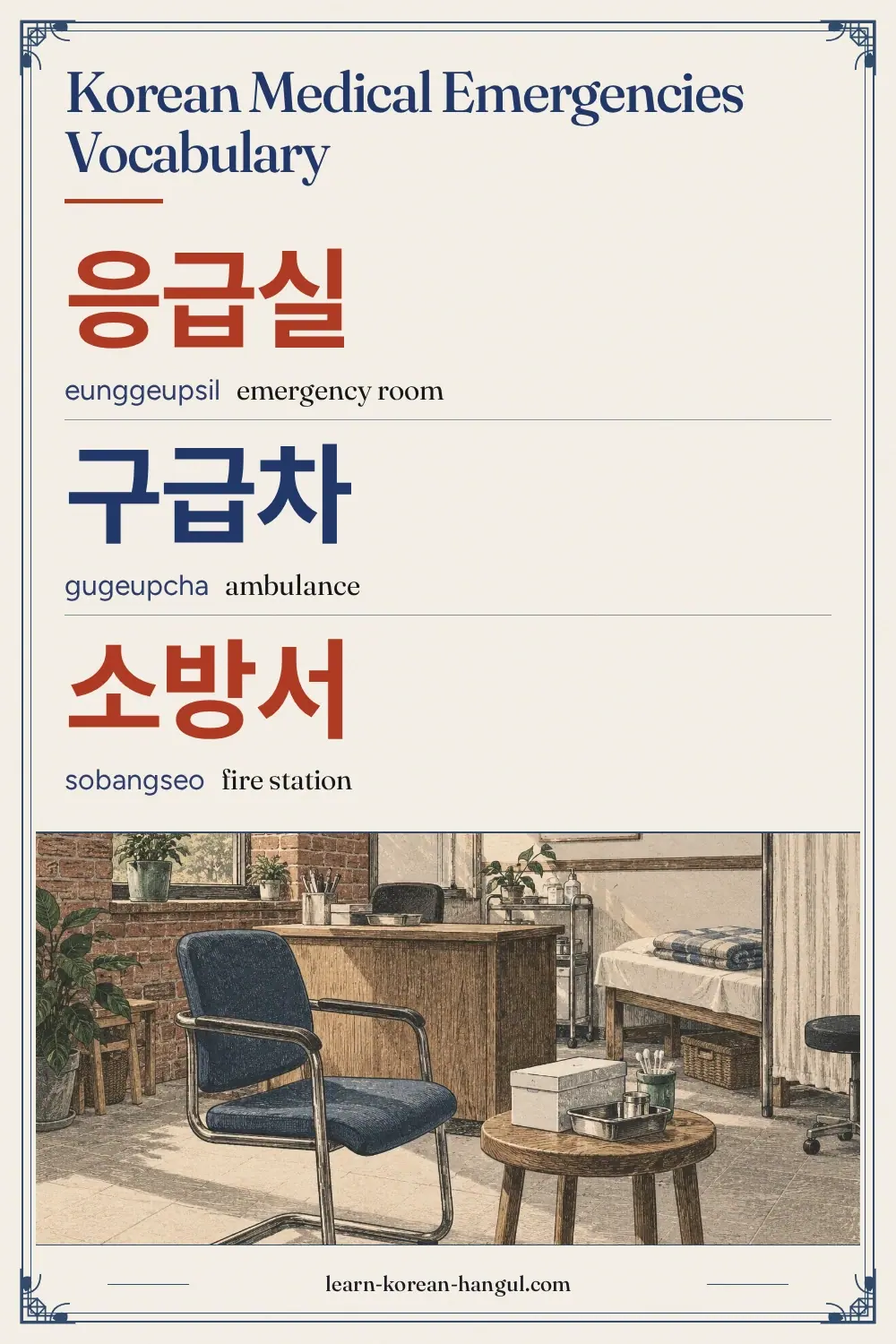
Korean Medical Emergencies Vocabulary at a Glance
This list holds 25 words in five groups, ordered the way an emergency unfolds: who you call, what happened, how you ask for help, what happens at the hospital door and what information you give. It sits inside Health and Medicine, and the words are chosen for use, not for frequency. Most are nouns, so they work when you say them alone, which is often all you can manage under stress.
| Group | Words | Use |
|---|---|---|
| Emergency services | 5 | Naming the place or vehicle you need |
| Accidents | 5 | Saying what happened |
| Calling for help | 5 | Getting attention and reporting |
| Hospital arrival | 5 | Reading signs and talking to staff |
| Medical information | 5 | Giving the details staff ask for |
Two of the groups are worth learning even if you never expect an emergency. The calling-for-help group gives you the words that make a stranger act, and the medical-information group is the data a hospital asks for at every visit, not only in a crisis. The question most learners ask first is where to begin.
Which Medical Emergency Words Should You Learn First?
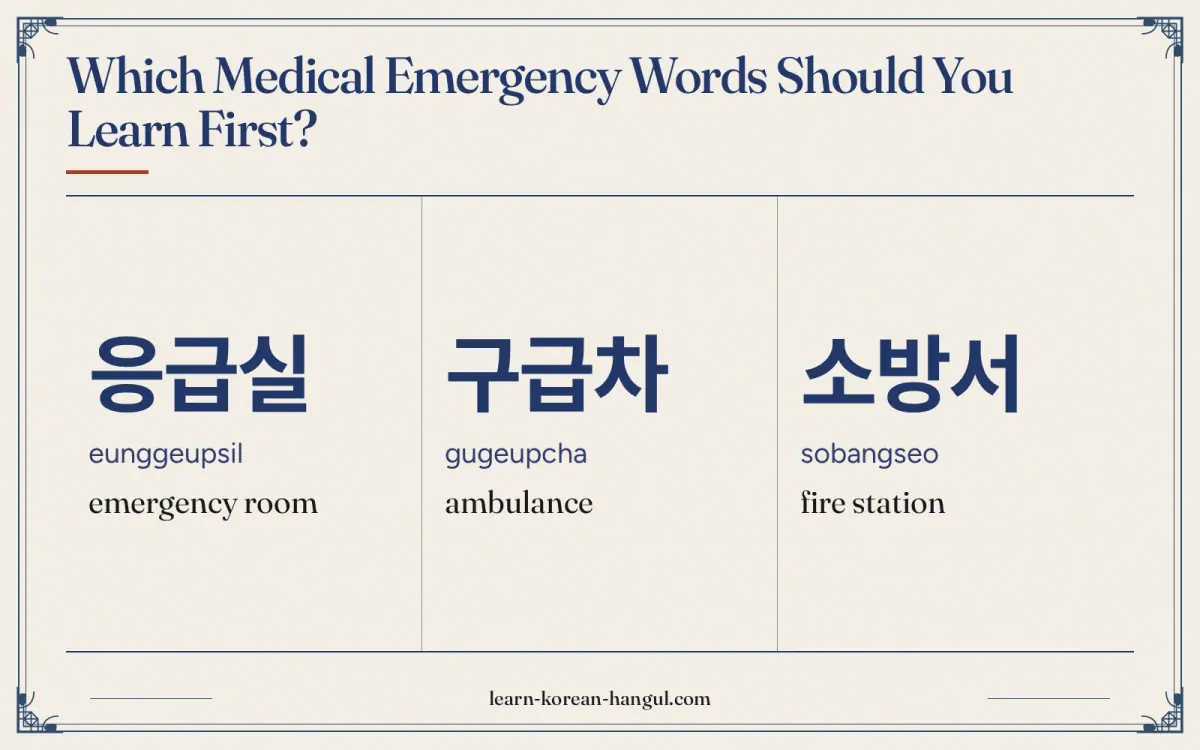
Learn 도와주세요 (help me), 응급실 (emergency room), 구급차 (ambulance), 사고 (accident) and 주소 (address) first. These five cover calling for help, naming the place you need, and saying where you are. A good test is the sentence you would say with one breath: 구급차를 불러 주세요, which means please call an ambulance.
- Words to say. 도와주세요, 살려 주세요, 구급차, 주소, 알레르기. Drill these aloud with the audio until you can say them without looking.
- Words to recognise. 응급실, 접수, 보호자, 수술. You will see these on signs and forms, so drill them by reading with the romanization covered.
- Words to hear. 빨리 and 의식 are spoken at you by staff or bystanders. Drill these by listening and pointing to the meaning.
The scene below shows a hospital entrance with numbered objects that match words in this list. The numbers in the scene follow the word list, so the same illustration works as a labelling exercise later.
Word · 8
- 1
응급실
eunggeupsil
emergency room
- 2
구급차
gugeupcha
ambulance
- 3
소방서
sobangseo
fire station
- 4
경찰서
gyeongchalseo
police station
- 5
접수
jeopsu
registration; check-in desk
- 6
의사
uisa
doctor
- 7
간호사
ganhosa
nurse
- 8
보호자
bohoja
guardian; person responsible for the patient
Emergency Services
These five words name the services behind an emergency call. In Korea the number for fire and ambulance is 119, said 일일구 (irilgu, with the 일 sound linking to the next syllable), and the number for police is 112, said 일일이 (irili). 응급 means urgent in a medical sense, and 실 means room, so 응급실 is literally the urgent room.
| No. | Hangul | Revised Romanization | Meaning and note | Example sentence | Audio assetId |
|---|---|---|---|---|---|
| 1 | 응급실 | eunggeupsil | emergency room. Sino-Korean: urgent + room. | 응급실이 어디예요? (Where is the emergency room?) | au-pg-vocabulary-daily-life-health-emergency-1; example: au-pg-vocabulary-daily-life-health-emergency-26 |
| 2 | 구급차 | gugeupcha | ambulance. 차 means vehicle; 불러 주세요 means please call. | 구급차를 불러 주세요. (Please call an ambulance.) | au-pg-vocabulary-daily-life-health-emergency-2; example: au-pg-vocabulary-daily-life-health-emergency-27 |
| 3 | 소방서 | sobangseo | fire station. Fire engines and rescue teams are based here. | 소방서는 저기에 있어요. (The fire station is over there.) | au-pg-vocabulary-daily-life-health-emergency-3; example: au-pg-vocabulary-daily-life-health-emergency-28 |
| 4 | 경찰서 | gyeongchalseo | police station. 경찰 is police; 서 marks an office or station. | 경찰서가 가까워요? (Is the police station close?) | au-pg-vocabulary-daily-life-health-emergency-4; example: au-pg-vocabulary-daily-life-health-emergency-29 |
| 5 | 병원 | byeongwon | hospital. The general word; 응급실 is one part of it. | 병원에 가요. (I am going to the hospital.) | au-pg-vocabulary-daily-life-health-emergency-5; example: au-pg-vocabulary-daily-life-health-emergency-30 |
Example Sentences
Three sentence frames cover most of the examples. The first is noun + 이/가 어디예요? (where is the noun?), as in 응급실이 어디예요?. The second is noun + 을/를 불러 주세요 (please call the noun), as in 구급차를 불러 주세요. The third is noun + 이/가 있어요 or 없어요 (there is or is not a noun), as in 알레르기가 있어요. Say each sentence aloud after the audio. The particle 이 follows a noun ending in a consonant (응급실이) and 가 follows a noun ending in a vowel (사고가).
Once you can name the service, you need words for what happened.
How Do You Say Accidents in Korean?
The main word for an accident is 사고 (sago), and Korean builds more exact words by putting a kind in front of it: 교통사고 is a traffic accident. The other words in this group describe a result, such as an injury, a fire or loss of consciousness. Each is short enough to say to a passer-by or a call handler.
| No. | Hangul | Revised Romanization | Meaning and note | Example sentence | Audio assetId |
|---|---|---|---|---|---|
| 6 | 사고 | sago | accident. The verb 나다 pairs with 사고, 불 and 화재. | 사고가 났어요. (An accident happened.) | au-pg-vocabulary-daily-life-health-emergency-6; example: au-pg-vocabulary-daily-life-health-emergency-31 |
| 7 | 교통사고 | gyotongsago | traffic accident. 교통 means traffic; the word is one block. | 교통사고가 났어요. (A traffic accident happened.) | au-pg-vocabulary-daily-life-health-emergency-7; example: au-pg-vocabulary-daily-life-health-emergency-32 |
| 8 | 부상 | busang | injury. 심하다 means severe; use it for any injury. | 부상이 심해요. (The injury is serious.) | au-pg-vocabulary-daily-life-health-emergency-8; example: au-pg-vocabulary-daily-life-health-emergency-33 |
| 9 | 화재 | hwajae | fire (disaster). Formal word for a fire as an event. | 건물에 화재가 났어요. (There is a fire in the building.) | au-pg-vocabulary-daily-life-health-emergency-9; example: au-pg-vocabulary-daily-life-health-emergency-34 |
| 10 | 의식 | uisik | consciousness. The first syllable keeps the full [의] sound because it starts the word. | 의식이 없어요. (The person is unconscious.) | au-pg-vocabulary-daily-life-health-emergency-10; example: au-pg-vocabulary-daily-life-health-emergency-35 |
Note that 불 (fire) is the everyday word and 화재 is the formal word for a fire as an event. In a real emergency you would shout 불이야 (buriya, fire), but 화재가 났어요 is the sentence you would say on the phone. Notice that 의식이 없어요 uses the pattern noun + 이/가 없어요, meaning there is no noun.
Naming the event is half the job, and the other half is asking for help.
Calling for Help
These five words are the most important ones on the page. 도와주세요 and 살려 주세요 are both polite requests for help, but they are not equal: 도와주세요 means please help me and fits any situation, while 살려 주세요 means please save me and is for danger to life. 신고 is the word for reporting something to the authorities.
| No. | Hangul | Revised Romanization | Meaning and note | Example sentence | Audio assetId |
|---|---|---|---|---|---|
| 11 | 도와주세요 | dowajuseyo | please help (me). A polite phrase, already complete. | 도와주세요! (Please help me!) | au-pg-vocabulary-daily-life-health-emergency-11; example: au-pg-vocabulary-daily-life-health-emergency-36 |
| 12 | 살려 주세요 | sallyeo juseyo | please save me. Use only when life is in danger. | 살려 주세요! (Please save me!) | au-pg-vocabulary-daily-life-health-emergency-12; example: au-pg-vocabulary-daily-life-health-emergency-37 |
| 13 | 신고 | singo | report (to the authorities). Also used for tax and address reports. | 경찰에 신고했어요. (I reported it to the police.) | au-pg-vocabulary-daily-life-health-emergency-13; example: au-pg-vocabulary-daily-life-health-emergency-38 |
| 14 | 전화 | jeonhwa | phone call. 전화하다 is to phone; 해 주세요 asks a favour. | 전화해 주세요. (Please make a call.) | au-pg-vocabulary-daily-life-health-emergency-14; example: au-pg-vocabulary-daily-life-health-emergency-39 |
| 15 | 빨리 | ppalli | quickly. Place before the verb: 빨리 가요, go quickly. | 빨리 오세요. (Please come quickly.) | au-pg-vocabulary-daily-life-health-emergency-15; example: au-pg-vocabulary-daily-life-health-emergency-40 |
When help arrives, the next step is the hospital door.
How Do You Say Hospital Arrival in Korean?
At a Korean hospital you first register at a desk, called 접수 (jeopsu), and then see a doctor or nurse. The five words here are the ones you will read on signs and hear from staff. 보호자 is a useful word that has no single English match: it means the adult who is responsible for a patient, usually a family member who signs forms.
| No. | Hangul | Revised Romanization | Meaning and note | Example sentence | Audio assetId |
|---|---|---|---|---|---|
| 16 | 접수 | jeopsu | registration; check-in desk. Final ㅂ plus ㅅ sounds like [접쑤]. | 접수는 어디예요? (Where is registration?) | au-pg-vocabulary-daily-life-health-emergency-16; example: au-pg-vocabulary-daily-life-health-emergency-41 |
| 17 | 의사 | uisa | doctor. Add 선생님 to be polite when speaking to one. | 의사 선생님을 불러 주세요. (Please call the doctor.) | au-pg-vocabulary-daily-life-health-emergency-17; example: au-pg-vocabulary-daily-life-health-emergency-42 |
| 18 | 간호사 | ganhosa | nurse. 사 is the suffix for a professional person. | 간호사가 와요. (The nurse is coming.) | au-pg-vocabulary-daily-life-health-emergency-18; example: au-pg-vocabulary-daily-life-health-emergency-43 |
| 19 | 수술 | susul | surgery. 걸리다 means to take time. | 수술은 두 시간 걸려요. (The surgery takes two hours.) | au-pg-vocabulary-daily-life-health-emergency-19; example: au-pg-vocabulary-daily-life-health-emergency-44 |
| 20 | 보호자 | bohoja | guardian; person responsible for the patient. 계세요 is the honorific of 있어요. | 보호자는 어디 계세요? (Where is the guardian?) | au-pg-vocabulary-daily-life-health-emergency-20; example: au-pg-vocabulary-daily-life-health-emergency-45 |
The last group is the information you give, which hospitals ask for at every visit.
Medical Information
A hospital will ask for your name, address, symptoms, allergies and blood type. These five words are the labels on those questions. Practise them as answers: 이름은 ...이에요/예요 (my name is ...), 주소는 ...이에요/예요 (my address is ...). Write them on a card and keep it in your phone case or wallet.
| No. | Hangul | Revised Romanization | Meaning and note | Example sentence | Audio assetId |
|---|---|---|---|---|---|
| 21 | 이름 | ireum | name. 뭐예요 means what is it. | 이름이 뭐예요? (What is your name?) | au-pg-vocabulary-daily-life-health-emergency-21; example: au-pg-vocabulary-daily-life-health-emergency-46 |
| 22 | 주소 | juso | address. 말하다 is to say. | 주소를 말해 주세요. (Please say your address.) | au-pg-vocabulary-daily-life-health-emergency-22; example: au-pg-vocabulary-daily-life-health-emergency-47 |
| 23 | 증상 | jeungsang | symptom. More symptom words are on Korean Symptoms Vocabulary. | 증상이 심해요. (The symptoms are severe.) | au-pg-vocabulary-daily-life-health-emergency-23; example: au-pg-vocabulary-daily-life-health-emergency-48 |
| 24 | 알레르기 | allereugi | allergy. A loanword from German Allergie. | 페니실린 알레르기가 있어요. (I have a penicillin allergy.) | au-pg-vocabulary-daily-life-health-emergency-24; example: au-pg-vocabulary-daily-life-health-emergency-49 |
| 25 | 혈액형 | hyeoraekhyeong | blood type. 형 marks a type; say the letter plus 형. | 혈액형은 A형이에요. (My blood type is A.) | au-pg-vocabulary-daily-life-health-emergency-25; example: au-pg-vocabulary-daily-life-health-emergency-50 |
Blood type is asked about more often in Korea than in many countries, and the answer is spoken as a letter plus 형, so A형 is said [에이형]. Allergy information deserves special care, so learn the name of any drug or food you react to before you travel.
With the words in place, the remaining question is how to say them clearly.
How Do You Pronounce These Words?
Most words here are pronounced as they are spelled, but four patterns change the sound. Standard pronunciation follows the National Institute of Korean Language (국립국어원) rules, and the romanization follows the Revised Romanization of Korean, which does not mark every sound change.
| Spelling | Sounds like | What changes |
|---|---|---|
| 응급실 | [응급씰] | After a final ㅂ, the ㅅ is said as a tense ㅆ. |
| 접수 | [접쑤] | Same rule: ㅂ + ㅅ gives a tense [쑤]. |
| 혈액형 | [혀래켱] | ㄹ links to the next vowel, and ㄱ + ㅎ merges into [ㅋ]. |
| 의식 | [의식] | Spoken 의 at the start of a word; in 의식이 the ㄱ links to give [의시기]. |
| 일일구 | [이릴구] | The final ㄹ of the first 일 links to the vowel of the second, giving [이릴구]. |
The tense ㅆ sound in 응급실 and 접수 is the one learners most often miss. Tense consonants are said with a tight throat and no puff of air. Hear the difference in the audio before you try it yourself. The double-letter sounds are explained on the pronunciation pages of this site.
Audio and Slow Playback
Each word and each example has its own audio clip, and the five clips below play the hardest words slowly. Play a clip, say the word aloud, then play it again and compare.
What Mistakes Do Learners Make with Medical Emergency Words?
Five mistakes come up again and again. Most come from translating an English word directly.
- Using 비상 for a medical emergency. 비상 is the word on emergency exit signs (비상구), not for patients. Use 응급 for medical matters, as in 응급실.
- Mixing up the two cries for help. 도와주세요 is please help and fits any problem. 살려 주세요 is please save me and is for life-threatening danger, so save it for those moments.
- Adding an ending to a ready-made phrase. 도와주세요 and 살려 주세요 are already polite. Do not add 요 or 니다 after them.
- Forgetting the particle on the thing you need. Say 구급차를 불러 주세요, not 구급차 불러 주세요, when you have time. In a rush, a bare noun and 주세요 is still understood.
- Learning words without the numbers. A call handler may ask where you are or how many people are hurt. Learn the Sino-Korean numbers for addresses and the counter 명 for people, and see the emergency phrases for full sentences.
None of these mistakes will stop a helper from understanding you. Clear words and a calm voice matter more than perfect grammar, so practise the sounds above. The next section turns the list into practice.
Practice: Flashcards and Worksheet
Use the deck first, then the quiz, then the worksheet. The flashcard deck below has all 25 words with audio; start with recognition mode and switch to listening mode when you can read each card. Progress stays in your browser. The vocabulary flashcard decks page lists every deck, and the quiz asks five meaning questions.
Practice · 55
- 01응급실
Show answer
headword 1: emergency room
- 02구급차
Show answer
headword 2: ambulance
- 03소방서
Show answer
headword 3: fire station
- 04경찰서
Show answer
headword 4: police station
- 05병원
Show answer
headword 5: hospital
- 06사고
Show answer
headword 6: accident
- 07교통사고
Show answer
headword 7: traffic accident
- 08부상
Show answer
headword 8: injury
- 09화재
Show answer
headword 9: fire (disaster)
- 10의식
Show answer
headword 10: consciousness
- 11도와주세요
Show answer
headword 11: please help (me)
- 12살려 주세요
Show answer
headword 12: please save me
- 13신고
Show answer
headword 13: report (to the authorities)
- 14전화
Show answer
headword 14: phone call
- 15빨리
Show answer
headword 15: quickly
- 16접수
Show answer
headword 16: registration; check-in desk
- 17의사
Show answer
headword 17: doctor
- 18간호사
Show answer
headword 18: nurse
- 19수술
Show answer
headword 19: surgery
- 20보호자
Show answer
headword 20: guardian; person responsible for the patient
- 21이름
Show answer
headword 21: name
- 22주소
Show answer
headword 22: address
- 23증상
Show answer
headword 23: symptom
- 24알레르기
Show answer
headword 24: allergy
- 25혈액형
Show answer
headword 25: blood type
- 26응급실이 어디예요?
Show answer
example sentence for headword 1
- 27구급차를 불러 주세요.
Show answer
example sentence for headword 2
- 28소방서는 저기에 있어요.
Show answer
example sentence for headword 3
- 29경찰서가 가까워요?
Show answer
example sentence for headword 4
- 30병원에 가요.
Show answer
example sentence for headword 5
- 31사고가 났어요.
Show answer
example sentence for headword 6
- 32교통사고가 났어요.
Show answer
example sentence for headword 7
- 33부상이 심해요.
Show answer
example sentence for headword 8
- 34건물에 화재가 났어요.
Show answer
example sentence for headword 9
- 35의식이 없어요.
Show answer
example sentence for headword 10
- 36도와주세요!
Show answer
example sentence for headword 11
- 37살려 주세요!
Show answer
example sentence for headword 12
- 38경찰에 신고했어요.
Show answer
example sentence for headword 13
- 39전화해 주세요.
Show answer
example sentence for headword 14
- 40빨리 오세요.
Show answer
example sentence for headword 15
- 41접수는 어디예요?
Show answer
example sentence for headword 16
- 42의사 선생님을 불러 주세요.
Show answer
example sentence for headword 17
- 43간호사가 와요.
Show answer
example sentence for headword 18
- 44수술은 두 시간 걸려요.
Show answer
example sentence for headword 19
- 45보호자는 어디 계세요?
Show answer
example sentence for headword 20
- 46이름이 뭐예요?
Show answer
example sentence for headword 21
- 47주소를 말해 주세요.
Show answer
example sentence for headword 22
- 48증상이 심해요.
Show answer
example sentence for headword 23
- 49페니실린 알레르기가 있어요.
Show answer
example sentence for headword 24
- 50혈액형은 A형이에요.
Show answer
example sentence for headword 25
- 51응급실
Show answer
slow playback of headword 1: emergency room
- 52구급차
Show answer
slow playback of headword 2: ambulance
- 53접수
Show answer
slow playback of headword 16: registration; check-in desk
- 54혈액형
Show answer
slow playback of headword 25: blood type
- 55알레르기
Show answer
slow playback of headword 24: allergy
Practice · 5
What does 응급실 (eunggeupsil) mean?
Show answer
emergency room
응급실 means emergency room. Example: 응급실이 어디예요? (Where is the emergency room?)
What does 구급차 (gugeupcha) mean?
Show answer
ambulance
구급차 means ambulance. Example: 구급차를 불러 주세요. (Please call an ambulance.)
What does 사고 (sago) mean?
Show answer
accident
사고 means accident. Example: 사고가 났어요. (An accident happened.)
What does 부상 (busang) mean?
Show answer
injury
부상 means injury. Example: 부상이 심해요. (The injury is serious.)
What does 알레르기 (allereugi) mean?
Show answer
allergy
알레르기 means allergy. Example: 페니실린 알레르기가 있어요. (I have a penicillin allergy.)
Korean Medical Emergencies Vocabulary Worksheet (PDF)
A printable worksheet for these words (word list, matching, writing practice, fill-in-the-blank exercises and answer key) is available in A4 and US Letter from the download card on this page. For practice, copy the 25 words by hand: writing each word once with its meaning is a quick way to fix the spelling.
Where to Go Next
Next, read the emergency phrases, which put these words into full sentences, or continue with Korean Mental Health Vocabulary. For the single word, the page on emergency room in Korean gives the one-word answer. To move up a level, go back to Health and Medicine.
Frequently Asked Questions
How Do You Say Emergency Room in Korean?
Emergency room is 응급실 (eunggeupsil). It is said [응급씰], with a tense ㅆ after the final ㅂ. To ask where it is, say 응급실이 어디예요? (Where is the emergency room?). The full word is 응급 (urgent) plus 실 (room).
How Do You Pronounce 구급차 (gugeupcha)?
Say gu-geup-cha in three even beats. The first syllable is a short gu, the second ends in a closed p sound, and the last is cha with a puff of air. The word means ambulance. Press the audio button on this page to hear it and the slow version.
How Many Medical Emergency Words Should I Learn First?
Learn five first: 도와주세요, 응급실, 구급차, 사고 and 주소. At five new words a day the whole list of 25 takes five days plus review. Learn the calling-for-help group before the others, since those words get action fastest.
Where Can I Practise Medical Emergency Words with Flashcards?
Use the vocabulary flashcard decks. The deck for this page holds the 25 words with Hangul, romanization and audio, and has recognition and listening modes. Your progress stays in your browser. Return to review the words that you missed.
Is the Romanization on This Page Official?
It follows the Revised Romanization of Korean, which South Korea adopted on 7 July 2000 and whose rules the National Institute of Korean Language (국립국어원) publishes. It is a learning aid and does not mark every sound change, so rely on the Hangul and the audio.
Is There a Printable Worksheet for Medical Emergency Words?
A printable worksheet for these words (word list, matching, writing practice, fill-in-the-blank exercises and answer key) is available in A4 and US Letter from the download card on this page. For practice, copy the tables above by hand or use the flashcard deck, which has the same 25 words.