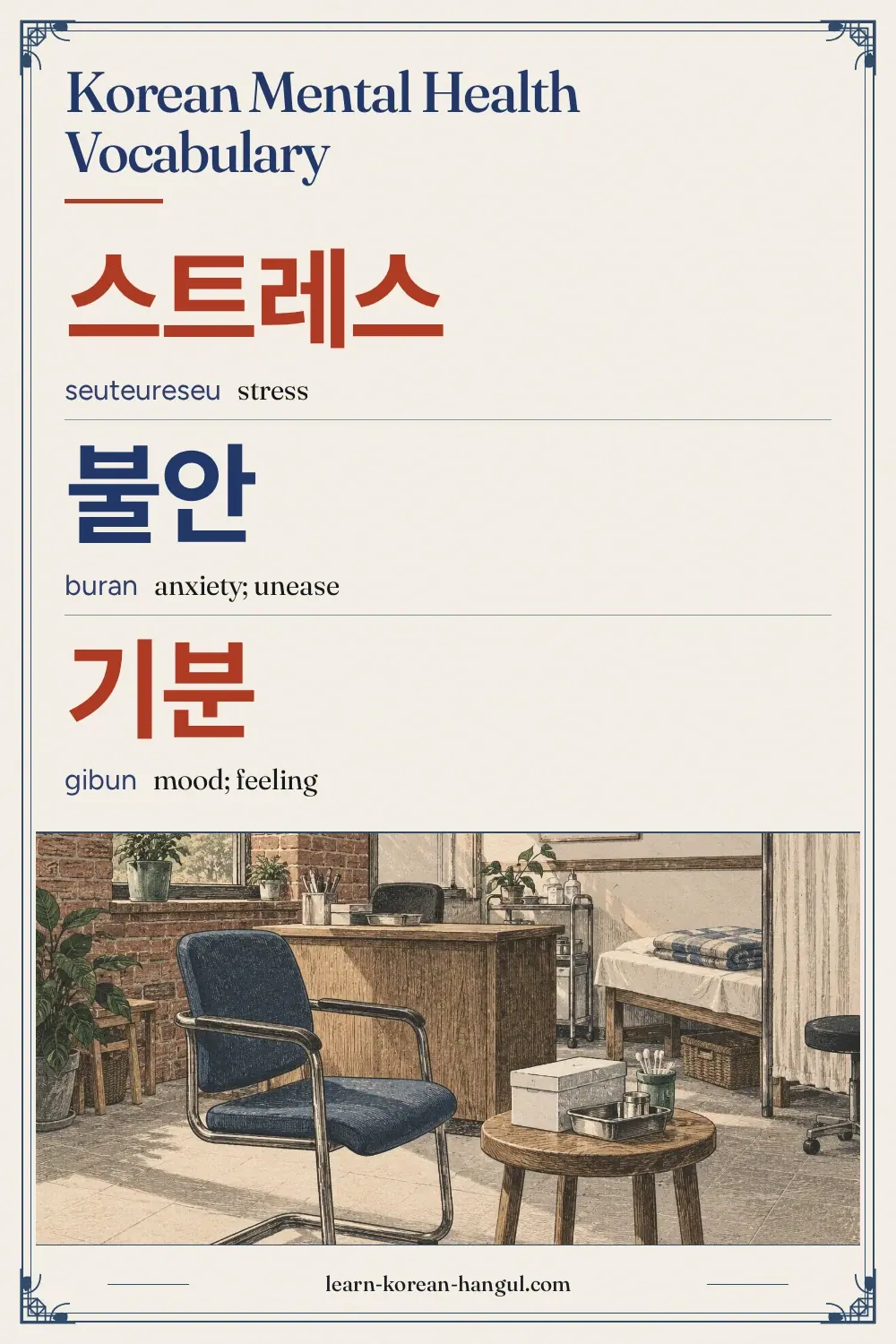
Korean Mental Health Vocabulary at a Glance
The list moves from feelings to help. You name the pressure you feel, describe your mood, talk about sleep, find the words for seeing a counsellor and finish with ways to look after yourself. That is why the groups run from stress and anxiety, to mood, to sleep, to counselling and support, and last to coping and wellbeing. The page belongs to Health and Medicine. For words that describe feelings in general, see emotions and feelings phrases.
| Group | Words | Use |
|---|---|---|
| Stress and anxiety | 6 | Naming pressure, worry and tension |
| Mood | 6 | Naming how you feel |
| Sleep | 6 | Describing how you sleep and how tired you are |
| Counselling and support | 6 | Finding help and talking to someone |
| Coping and wellbeing | 6 | Talking about caring for yourself |
Most words are nouns, and they combine with a small set of verbs, such as 받다 (receive), 느끼다 (feel) and 취하다 (take). Two words, 우울증 and 불면증, are clinical terms for conditions, and the page flags where a gentler everyday word exists. The next section ranks the words by how soon you will need them.
Which Mental Health Words Should You Learn First?
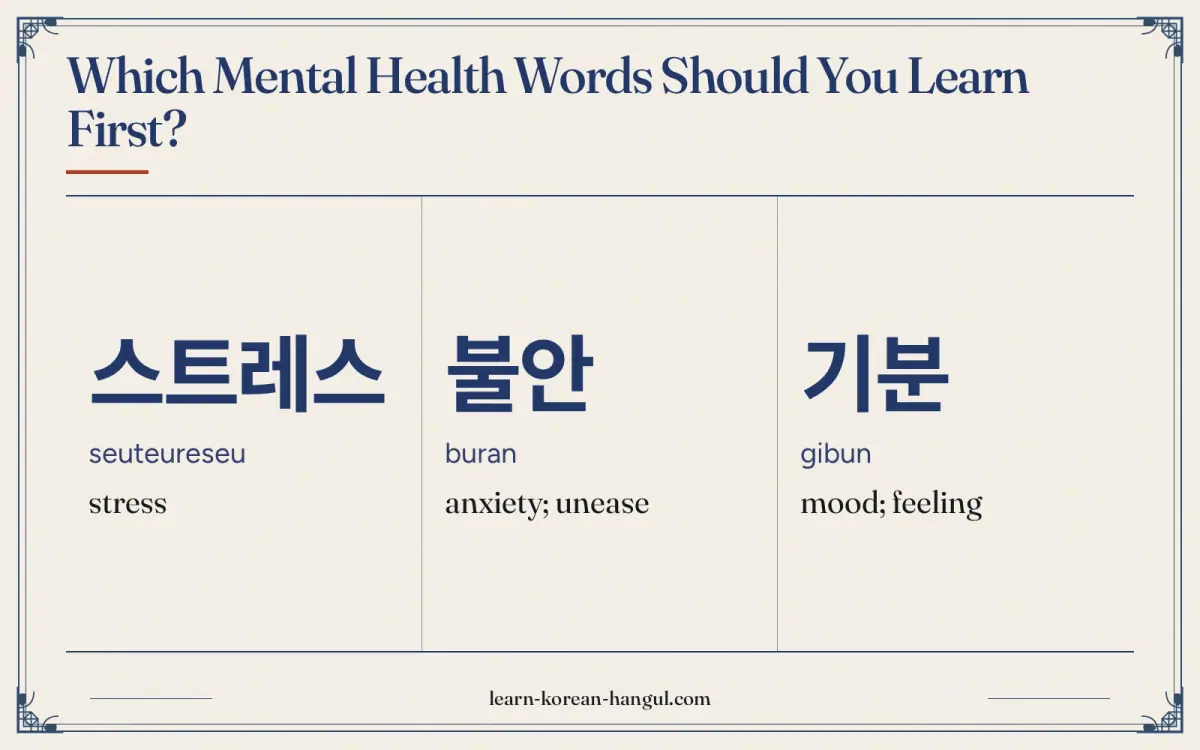
Learn 스트레스 (stress), 기분 (mood), 걱정 (worry), 마음 (heart and mind) and 상담 (counselling) first. With those five you can say how you feel, say what is on your mind and ask for someone to talk to. The clinical terms can wait until you need to read them.
- Words to say. 스트레스, 기분, 걱정, 마음, 휴식. These are what you say to friends and colleagues.
- Words to recognise. 우울증, 불면증, 정신과, 치료. You read these on forms, in articles and on clinic signs.
- Words to understand when spoken. 상담, 도움 and 위로. A friend or a counsellor may use them to you.
At five new words a day, the whole list of 30 takes six days plus review. Start with the first and second groups, because they cover most daily conversation.
This page teaches vocabulary only. It is not medical advice, and it cannot replace a doctor or counsellor. If you or someone near you is in immediate danger, call 119 for an ambulance or 112 for the police, and use the sentences on the Emergencies page. For suicide-prevention counselling, call 109 (자살예방 상담전화), the single national number that the Ministry of Health and Welfare (보건복지부, mohw.go.kr) has run since 1 January 2024. The mental health crisis line 1577-0199 (정신건강 위기상담전화) also answers 24 hours a day. Foreign residents can call 1345, the Ministry of Justice's Immigration Contact Center, for help with life in Korea in about 20 languages; it is an information line, not a crisis line. Numbers and services can change, so check mohw.go.kr and your local health centre (보건소) for the current details.
The scene below puts eight of the 30 words on one picture of a calm room.
Word · 8
- 1
스트레스
seuteureseu
stress
- 2
불안
buran
anxiety; unease
- 3
기분
gibun
mood; feeling
- 4
수면
sumyeon
sleep (formal)
- 5
낮잠
natjam
nap
- 6
상담
sangdam
counselling; consultation
- 7
휴식
hyusik
rest; a break
- 8
산책
sanchaek
walk; stroll
How Do Koreans Talk about Stress and Feelings?
Korean treats stress as something you receive and something you release. The usual phrase is 스트레스를 받아요 (seuteureseureul badayo), literally I receive stress, which means I am stressed. To describe the reverse, Korean says 스트레스를 풀어요 (I untie my stress), which means I relieve it, with a walk, a meal or a hobby. The verb 풀다 means to untie or loosen, so the picture is of a knot coming undone.
Feelings are often located in the 마음 (maeum), the heart and mind, rather than named as a diagnosis. People say 마음이 힘들어요 (my heart is tired; I am struggling) or 마음이 편해요 (I feel at ease). This is a gentle, everyday way to talk about a hard time without using a clinical word. A related word, 기분, is the mood of the moment: 기분이 좋아요 is I feel good, and 기분이 안 좋아요 is I do not feel well.
Clinical words are also common in text, news and at a clinic. 우울 means a low mood and is used in daily speech, while 우울증 is depression as a condition. 불면 means sleeplessness, and 불면증 is insomnia. When a friend says 우울해요, they are describing how they feel, not claiming a diagnosis. Keep that difference when you reply.
Stress and Anxiety
The first group holds the words for pressure. 스트레스 is the loanword that nearly everyone uses. 불안, 걱정 and 긴장 describe slightly different states: unease, worry and tension. 부담 is the weight of an expectation, and 짜증 is irritation.
| No. | Hangul | Revised Romanization | Meaning and note | Example sentence | Audio assetId |
|---|---|---|---|---|---|
| 1 | 스트레스 | seuteureseu | stress. Loanword. The usual verb is 받다 (receive), and 풀다 (untie) is used for relief. | 스트레스를 받아요. (I am stressed.) | au-pg-vocabulary-daily-life-health-mental-health-1; example: au-pg-vocabulary-daily-life-health-mental-health-31 |
| 2 | 불안 | buran | anxiety; unease. Said [부란]. Add 하다 to describe the feeling: 불안하다. | 요즘 불안해요. (I feel uneasy these days.) | au-pg-vocabulary-daily-life-health-mental-health-2; example: au-pg-vocabulary-daily-life-health-mental-health-32 |
| 3 | 걱정 | geokjeong | worry. Said [걱쩡]. Also used in the comforting phrase 걱정하지 마세요 (do not worry). | 걱정이 많아요. (I have a lot of worries.) | au-pg-vocabulary-daily-life-health-mental-health-3; example: au-pg-vocabulary-daily-life-health-mental-health-33 |
| 4 | 긴장 | ginjang | tension; nervousness. Add 되다 to say you feel nervous: 긴장되다. | 너무 긴장돼요. (I am very nervous.) | au-pg-vocabulary-daily-life-health-mental-health-4; example: au-pg-vocabulary-daily-life-health-mental-health-34 |
| 5 | 부담 | budam | burden; pressure. The weight of an expectation or a cost. 부담스럽다 means to feel heavy or awkward. | 부담이 커요. (The pressure is big.) | au-pg-vocabulary-daily-life-health-mental-health-5; example: au-pg-vocabulary-daily-life-health-mental-health-35 |
| 6 | 짜증 | jjajeung | irritation; annoyance. Used with 나다 and spaced: 짜증 나다 means to be annoyed. | 짜증 나요. (I am annoyed.) | au-pg-vocabulary-daily-life-health-mental-health-6; example: au-pg-vocabulary-daily-life-health-mental-health-36 |
Each of these words can be placed before 이/가 and a short verb, which gives you quick sentences such as 부담이 커요 and 걱정이 많아요. The adjective 많다 (to be many) and 크다 (to be big) are the two most useful partners.
Notice that 짜증 and 나다 are written as two words, 짜증 나요. Some people write them together online, but the standard dictionary spells the phrase with a space.
Stress is one side of the picture. The next group names the mood that can follow.
Mood and Feelings
Mood words are the ones friends use. 기분 is the general word, and 우울, 외로움, 슬픔 and 행복 name specific feelings. 우울증 is also in this group, because learners meet it next to 우울 and need to see the difference.
| No. | Hangul | Revised Romanization | Meaning and note | Example sentence | Audio assetId |
|---|---|---|---|---|---|
| 7 | 기분 | gibun | mood; feeling. The mood of the moment. 기분이 좋아요 is I feel good. | 기분이 좋아요. (I feel good.) | au-pg-vocabulary-daily-life-health-mental-health-7; example: au-pg-vocabulary-daily-life-health-mental-health-37 |
| 8 | 우울 | uul | gloom; low mood. Add 하다 for the feeling: 우울하다. Used in daily speech. | 요즘 우울해요. (I have been feeling low lately.) | au-pg-vocabulary-daily-life-health-mental-health-8; example: au-pg-vocabulary-daily-life-health-mental-health-38 |
| 9 | 우울증 | uuljeung | depression (condition). Said [우울쯩]. A clinical term for a condition, not the same as feeling low for a day. | 우울증은 치료할 수 있어요. (Depression can be treated.) | au-pg-vocabulary-daily-life-health-mental-health-9; example: au-pg-vocabulary-daily-life-health-mental-health-39 |
| 10 | 외로움 | oeroum | loneliness. A noun made from the adjective 외롭다 (lonely). | 외로움을 느껴요. (I feel lonely.) | au-pg-vocabulary-daily-life-health-mental-health-10; example: au-pg-vocabulary-daily-life-health-mental-health-40 |
| 11 | 슬픔 | seulpeum | sadness. A noun made from the adjective 슬프다 (sad). | 슬픔을 나눠요. (We share the sadness.) | au-pg-vocabulary-daily-life-health-mental-health-11; example: au-pg-vocabulary-daily-life-health-mental-health-41 |
| 12 | 행복 | haengbok | happiness. Add 하다 for the adjective: 행복하다. A noun keeps its h in romanization. | 행복해요. (I am happy.) | au-pg-vocabulary-daily-life-health-mental-health-12; example: au-pg-vocabulary-daily-life-health-mental-health-42 |
There is an important difference between 우울해요 and 우울증이에요. The first says I feel low, and a friend can answer with comfort. The second says I have a condition, and a friend would usually respond with care and a suggestion to see a professional. Use the gentler word unless a doctor has given a diagnosis.
Many feeling nouns are made from adjectives: 외롭다 becomes 외로움, 슬프다 becomes 슬픔. The suffix -(으)ㅁ turns a describing word into a noun. The same suffix gives 기쁨 (joy), which appears in the emotions vocabulary.
Mood and sleep are closely linked, so the next group covers sleep.
Sleep and Tiredness
Sleep is one of the first things people mention when they are stressed. 수면 is the formal word for sleep, and 불면증 is insomnia. 피로 is tiredness, 악몽 is a nightmare, 낮잠 is a nap, and 숙면 is deep, good sleep.
| No. | Hangul | Revised Romanization | Meaning and note | Example sentence | Audio assetId |
|---|---|---|---|---|---|
| 13 | 수면 | sumyeon | sleep (formal). The formal word. In daily speech people say 잠: 잠이 안 와요 means I cannot fall asleep. | 수면이 부족해요. (I am short of sleep.) | au-pg-vocabulary-daily-life-health-mental-health-13; example: au-pg-vocabulary-daily-life-health-mental-health-43 |
| 14 | 불면증 | bulmyeonjeung | insomnia. Said [불면쯩]. A clinical term. The suffix 증 names a condition. | 불면증이 있어요. (I have insomnia.) | au-pg-vocabulary-daily-life-health-mental-health-14; example: au-pg-vocabulary-daily-life-health-mental-health-44 |
| 15 | 피로 | piro | fatigue; tiredness. A noun for exhaustion. 피곤하다 is the everyday adjective. | 피로가 쌓여요. (Fatigue builds up.) | au-pg-vocabulary-daily-life-health-mental-health-15; example: au-pg-vocabulary-daily-life-health-mental-health-45 |
| 16 | 악몽 | angmong | nightmare. Said [앙몽]. 악 means bad and 몽 means dream. The verb is 꾸다: 꿈을 꾸다. | 악몽을 꿔요. (I have nightmares.) | au-pg-vocabulary-daily-life-health-mental-health-16; example: au-pg-vocabulary-daily-life-health-mental-health-46 |
| 17 | 낮잠 | natjam | nap. Said [낟짬]. 낮 means daytime and 잠 means sleep. | 낮잠을 자요. (I take a nap.) | au-pg-vocabulary-daily-life-health-mental-health-17; example: au-pg-vocabulary-daily-life-health-mental-health-47 |
| 18 | 숙면 | sungmyeon | deep sleep; sound sleep. Said [숭면]. Often used in the phrase 숙면을 취하다, to sleep well. | 숙면을 취해요. (I sleep soundly.) | au-pg-vocabulary-daily-life-health-mental-health-18; example: au-pg-vocabulary-daily-life-health-mental-health-48 |
Two verb partners are worth learning. 꾸다 (to dream) pairs with 꿈 and 악몽, and 취하다 (to take) pairs with 숙면 and 휴식. Both follow regular patterns. The verb 쌓이다 (to pile up) pairs with 피로 and 스트레스, which gives 스트레스가 쌓여요 (stress builds up).
Notice also how Korean separates the formal 수면 from the everyday 잠. In a conversation you say 잠을 못 자요 (I cannot sleep), and on a form you read 수면 시간 (sleep time). Match the word to the setting.
When tiredness and worry do not ease, the next step is to find help.
Counselling and Support
This group names the help that is available. 상담 is counselling or a consultation, and 상담사 is the counsellor. 정신과 is a psychiatry department, 치료 is treatment, 휴식 is rest, and 도움 is help.
| No. | Hangul | Revised Romanization | Meaning and note | Example sentence | Audio assetId |
|---|---|---|---|---|---|
| 19 | 상담 | sangdam | counselling; consultation. Used for talking with a counsellor and for any consultation, including a shop or school. | 상담을 받고 싶어요. (I want to receive counselling.) | au-pg-vocabulary-daily-life-health-mental-health-19; example: au-pg-vocabulary-daily-life-health-mental-health-49 |
| 20 | 상담사 | sangdamsa | counsellor. 상담 plus 사, a suffix for a skilled professional. | 상담사와 이야기해요. (I talk with the counsellor.) | au-pg-vocabulary-daily-life-health-mental-health-20; example: au-pg-vocabulary-daily-life-health-mental-health-50 |
| 21 | 정신과 | jeongsingwa | psychiatry department. Said [정신꽈]. The clinic or department for mental health care. | 정신과에 가요. (I go to the psychiatry clinic.) | au-pg-vocabulary-daily-life-health-mental-health-21; example: au-pg-vocabulary-daily-life-health-mental-health-51 |
| 22 | 치료 | chiryo | treatment. General word for treatment. Add 받다 to say you receive it. | 치료는 시간이 걸려요. (Treatment takes time.) | au-pg-vocabulary-daily-life-health-mental-health-22; example: au-pg-vocabulary-daily-life-health-mental-health-52 |
| 23 | 휴식 | hyusik | rest; a break. Said [휴식]. With a particle it links: 휴식이 is [휴시기]. | 휴식이 필요해요. (I need rest.) | au-pg-vocabulary-daily-life-health-mental-health-23; example: au-pg-vocabulary-daily-life-health-mental-health-53 |
| 24 | 도움 | doum | help; assistance. A noun. 도움이 되다 means to be helpful. | 도움을 요청해요. (I ask for help.) | au-pg-vocabulary-daily-life-health-mental-health-24; example: au-pg-vocabulary-daily-life-health-mental-health-54 |
For some people it is easier to say 상담 than 정신과, because 상담 sounds like an ordinary conversation. Counselling is also available through schools, workplaces and local health centres. The words on this page help you read their signs and leaflets, and the Ministry of Health and Welfare (mohw.go.kr) publishes the current services.
The verb pair 받다 (receive) and 요청하다 (ask for) frames help-seeking: 상담을 받다, 도움을 요청하다. These two verbs are polite and neutral, so they work in any setting.
The last group is about the small habits that help in between.
Coping and Wellbeing
The final group is about the habits people mention when they talk about looking after themselves. 마음 and 정신 name the heart and the mind. 감정 is the word for emotions. 명상 and 산책 are two calming activities, and 위로 is the comfort you give or receive.
| No. | Hangul | Revised Romanization | Meaning and note | Example sentence | Audio assetId |
|---|---|---|---|---|---|
| 25 | 마음 | maeum | heart; mind. The place where feelings sit. 마음이 편해요 means I feel at ease. | 마음이 편해요. (My heart feels at ease.) | au-pg-vocabulary-daily-life-health-mental-health-25; example: au-pg-vocabulary-daily-life-health-mental-health-55 |
| 26 | 정신 | jeongsin | mind; spirit; consciousness. 정신이 없어요 means I am so busy I cannot think straight. | 정신이 없어요. (I am frazzled.) | au-pg-vocabulary-daily-life-health-mental-health-26; example: au-pg-vocabulary-daily-life-health-mental-health-56 |
| 27 | 감정 | gamjeong | emotion. Used for emotions in general. 감정을 말하다 means to put feelings into words. | 감정을 말해요. (I say how I feel.) | au-pg-vocabulary-daily-life-health-mental-health-27; example: au-pg-vocabulary-daily-life-health-mental-health-57 |
| 28 | 명상 | myeongsang | meditation. Said as written. The verb is 하다: 명상을 하다. | 명상을 해요. (I meditate.) | au-pg-vocabulary-daily-life-health-mental-health-28; example: au-pg-vocabulary-daily-life-health-mental-health-58 |
| 29 | 산책 | sanchaek | walk; stroll. Add 하다 to say you go for a walk: 산책하다. | 공원에서 산책해요. (I take a walk in the park.) | au-pg-vocabulary-daily-life-health-mental-health-29; example: au-pg-vocabulary-daily-life-health-mental-health-59 |
| 30 | 위로 | wiro | comfort; consolation. Used as 위로가 되다 (to be a comfort). A different word from 위로 meaning upward. | 위로가 됐어요. (It was a comfort.) | au-pg-vocabulary-daily-life-health-mental-health-30; example: au-pg-vocabulary-daily-life-health-mental-health-60 |
The words 마음 and 정신 are close, but they are not the same. 마음 is where feelings live: 마음이 아파요 means my heart aches in a feeling sense. 정신 is the mind in the sense of attention and consciousness: 정신을 차리다 means to pull yourself together. When in doubt, use 마음 for feelings and 정신 for focus.
Short phrases of comfort use words from this page. 괜찮아요? (Are you okay?) is the first thing to ask. 힘들면 말해 주세요 (If it is hard, please tell me) offers help, and 푹 쉬세요 (get some good rest) suggests a break. These are polite and warm, and they use forms you have already met.
Which Mental Health Words Are Gentle and Which Are Clinical?
Korean offers two layers of vocabulary for most states. The everyday layer describes how you feel. The clinical layer names a condition and is used by doctors and in writing. Choose the layer to match your situation.
| Everyday wording | Clinical wording | Note |
|---|---|---|
| 우울해요 (I feel low) | 우울증 (depression) | Use the everyday word unless a doctor has diagnosed a condition |
| 잠이 안 와요 (I cannot sleep) | 불면증 (insomnia) | The everyday phrase is enough to ask for help |
| 마음이 힘들어요 (I am struggling) | 정신과 치료 (psychiatric treatment) | 마음 is gentler than 정신 |
| 이야기하고 싶어요 (I want to talk) | 상담을 받고 싶어요 (I want counselling) | 상담 is a normal, neutral word |
Some people find it hard to talk about mental health in any language. Korean gives you the gentle options, and you can build up to the clinical words when you need them. If you are helping a friend, listening and the phrase 괜찮아요? usually matter more than any vocabulary.
How Do You Pronounce These Words?
Mental health words contain several sound changes, because many end in a consonant that changes before the next sound. Standard pronunciation follows the National Institute of Korean Language (국립국어원) rules. The romanization follows the Revised Romanization of Korean, which writes tense letters such as kk and tt but does not show tensing caused by a neighbouring sound.
| Spelling | Sounds like | What changes |
|---|---|---|
| 불안 | [부란] | The final ㄹ links to the vowel of 안, so the two syllables flow as bu-ran. |
| 걱정 | [걱쩡] | A final ㄱ makes the next ㅈ tense. |
| 우울증 | [우울쯩] | In a Sino-Korean word, ㄹ makes a following ㅈ tense. |
| 불면증 | [불면쯩] | The 증 (condition) is said tense, as in 우울증. |
| 악몽 | [앙몽] | A final ㄱ before ㅁ is said as ㅇ. |
| 낮잠 | [낟짬] | Final ㅈ is said as ㄷ, and it makes the next ㅈ tense. |
| 숙면 | [숭면] | A final ㄱ before ㅁ is said as ㅇ. |
| 정신과 | [정신꽈] | The ㄱ of 과 is said tense, as in other department names. |
The nasal change in 악몽 and 숙면 is easy to miss because the Hangul shows ㄱ, but the sound is ㅇ. The page on nasalization explains the change. Say the vowels ㅡ and ㅓ in 스트레스, 슬픔 and 정신과 with unrounded lips.
Audio and Slow Playback
Every word and every example sentence has its own clip. The five clips below replay the trickiest words slowly. Play one, repeat it aloud, then play it again and compare.
What Mistakes Do Learners Make with Mental Health Words?
These five mistakes cause most of the misunderstandings.
- Using 우울증 for a low mood. 우울증 names a condition. For a bad day, say 우울해요 or 기분이 안 좋아요.
- Saying 스트레스가 있어요. It is understood, but the natural verb is 받다: 스트레스를 받아요. To relieve it, use 풀다.
- Writing 짜증나요 as one word. The standard spelling is 짜증 나요, with a space.
- Mixing 마음 and 정신. 마음 holds feelings, and 정신 means mind and attention. 정신이 없어요 means I am overwhelmed, not that I have no mind.
- Using 수면 in casual speech. 수면 is formal. Friends say 잠: 잠을 못 자요.
Matching the word to the setting is the quickest way to sound natural.
Practice: Flashcards and Worksheet
Study in three steps. First, run the flashcard deck in recognition mode until you recognise each of the 30 words. Second, switch to listening mode. Third, take the quiz. The deck covers all 30 words with audio, and your progress stays in your browser. The vocabulary flashcard decks page lists the other decks.
Practice · 65
- 01스트레스
Show answer
headword 1: stress
- 02불안
Show answer
headword 2: anxiety; unease
- 03걱정
Show answer
headword 3: worry
- 04긴장
Show answer
headword 4: tension; nervousness
- 05부담
Show answer
headword 5: burden; pressure
- 06짜증
Show answer
headword 6: irritation; annoyance
- 07기분
Show answer
headword 7: mood; feeling
- 08우울
Show answer
headword 8: gloom; low mood
- 09우울증
Show answer
headword 9: depression (condition)
- 10외로움
Show answer
headword 10: loneliness
- 11슬픔
Show answer
headword 11: sadness
- 12행복
Show answer
headword 12: happiness
- 13수면
Show answer
headword 13: sleep (formal)
- 14불면증
Show answer
headword 14: insomnia
- 15피로
Show answer
headword 15: fatigue; tiredness
- 16악몽
Show answer
headword 16: nightmare
- 17낮잠
Show answer
headword 17: nap
- 18숙면
Show answer
headword 18: deep sleep; sound sleep
- 19상담
Show answer
headword 19: counselling; consultation
- 20상담사
Show answer
headword 20: counsellor
- 21정신과
Show answer
headword 21: psychiatry department
- 22치료
Show answer
headword 22: treatment
- 23휴식
Show answer
headword 23: rest; a break
- 24도움
Show answer
headword 24: help; assistance
- 25마음
Show answer
headword 25: heart; mind
- 26정신
Show answer
headword 26: mind; spirit; consciousness
- 27감정
Show answer
headword 27: emotion
- 28명상
Show answer
headword 28: meditation
- 29산책
Show answer
headword 29: walk; stroll
- 30위로
Show answer
headword 30: comfort; consolation
- 31스트레스를 받아요.
Show answer
example sentence for headword 1
- 32요즘 불안해요.
Show answer
example sentence for headword 2
- 33걱정이 많아요.
Show answer
example sentence for headword 3
- 34너무 긴장돼요.
Show answer
example sentence for headword 4
- 35부담이 커요.
Show answer
example sentence for headword 5
- 36짜증 나요.
Show answer
example sentence for headword 6
- 37기분이 좋아요.
Show answer
example sentence for headword 7
- 38요즘 우울해요.
Show answer
example sentence for headword 8
- 39우울증은 치료할 수 있어요.
Show answer
example sentence for headword 9
- 40외로움을 느껴요.
Show answer
example sentence for headword 10
- 41슬픔을 나눠요.
Show answer
example sentence for headword 11
- 42행복해요.
Show answer
example sentence for headword 12
- 43수면이 부족해요.
Show answer
example sentence for headword 13
- 44불면증이 있어요.
Show answer
example sentence for headword 14
- 45피로가 쌓여요.
Show answer
example sentence for headword 15
- 46악몽을 꿔요.
Show answer
example sentence for headword 16
- 47낮잠을 자요.
Show answer
example sentence for headword 17
- 48숙면을 취해요.
Show answer
example sentence for headword 18
- 49상담을 받고 싶어요.
Show answer
example sentence for headword 19
- 50상담사와 이야기해요.
Show answer
example sentence for headword 20
- 51정신과에 가요.
Show answer
example sentence for headword 21
- 52치료는 시간이 걸려요.
Show answer
example sentence for headword 22
- 53휴식이 필요해요.
Show answer
example sentence for headword 23
- 54도움을 요청해요.
Show answer
example sentence for headword 24
- 55마음이 편해요.
Show answer
example sentence for headword 25
- 56정신이 없어요.
Show answer
example sentence for headword 26
- 57감정을 말해요.
Show answer
example sentence for headword 27
- 58명상을 해요.
Show answer
example sentence for headword 28
- 59공원에서 산책해요.
Show answer
example sentence for headword 29
- 60위로가 됐어요.
Show answer
example sentence for headword 30
- 61우울증
Show answer
slow playback of headword 9: depression (condition)
- 62악몽
Show answer
slow playback of headword 16: nightmare
- 63숙면
Show answer
slow playback of headword 18: deep sleep; sound sleep
- 64정신과
Show answer
slow playback of headword 21: psychiatry department
- 65걱정
Show answer
slow playback of headword 3: worry
Practice · 5
What does 스트레스 (seuteureseu) mean?
Show answer
stress
스트레스 means stress. Example: 스트레스를 받아요. (I am stressed.)
What does 불안 (buran) mean?
Show answer
anxiety; unease
불안 means anxiety; unease. Example: 요즘 불안해요. (I feel uneasy these days.)
What does 불면증 (bulmyeonjeung) mean?
Show answer
insomnia
불면증 means insomnia. Example: 불면증이 있어요. (I have insomnia.)
What does 상담 (sangdam) mean?
Show answer
counselling; consultation
상담 means counselling; consultation. Example: 상담을 받고 싶어요. (I want to receive counselling.)
What does 명상 (myeongsang) mean?
Show answer
meditation
명상 means meditation. Example: 명상을 해요. (I meditate.)
Korean Mental Health Vocabulary Worksheet (PDF)
A printable worksheet for these words (word list, matching, writing practice, fill-in-the-blank exercises and answer key) is available in A4 and US Letter from the download card on this page. For practice, copy the 30 words by hand and write the meaning beside each one. Then write two sentences of your own, such as 요즘 스트레스를 많이 받아요 (I get a lot of stress these days).
Where to Go Next
After this page, continue with Korean Medical Emergencies Vocabulary, or review the clinic words on Korean Dentist Vocabulary. For urgent situations, open the Emergencies phrases. To move up a level, return to Health and Medicine.
Frequently Asked Questions
How Do You Say Stress in Korean?
Stress is 스트레스 (seuteureseu), a loanword from English. The usual phrase is 스트레스를 받아요, which means I am stressed. To relieve it, say 스트레스를 풀어요. The word is the same in daily speech and in writing.
How Do You Say Anxiety in Korean?
Anxiety is 불안 (buran), pronounced [부란]. Add 하다 to describe the feeling, as in 불안해요 (I feel uneasy). The word 걱정 (worry) is more everyday and is the one friends use. For the single word, see the page on anxiety in Korean.
What Is the Difference between 우울 and 우울증?
우울 describes a low mood that anyone can have, and you can say 우울해요 about a hard week. 우울증 (uuljeung), pronounced [우울쯩], is depression as a condition, and the word is normally used by doctors or after a diagnosis. Use the gentler word unless you have been diagnosed.
How Do You Pronounce 불면증 and 악몽?
Say [불면쯩], bul-myeon-jjeung, for 불면증, with a tense 증 as in 우울증 [우울쯩], and ang-mong for 악몽, which is pronounced [앙몽] because a final ㄱ before ㅁ is said as ㅇ. Press the audio buttons on this page for the normal and slow versions of the trickiest words.
Is the Romanization on This Page Official?
It follows the Revised Romanization of Korean, which South Korea adopted on 7 July 2000 and whose rules the National Institute of Korean Language (국립국어원) publishes. It is a learning aid and does not show every sound change, so rely on the Hangul and the audio.
Is This Page Medical Advice?
No. It teaches Korean words only and cannot replace a doctor or counsellor. If you or someone near you is in immediate danger, call 119 for an ambulance or 112 for the police. For suicide-prevention counselling, call 109, the national line the Ministry of Health and Welfare (mohw.go.kr) has run since January 2024.