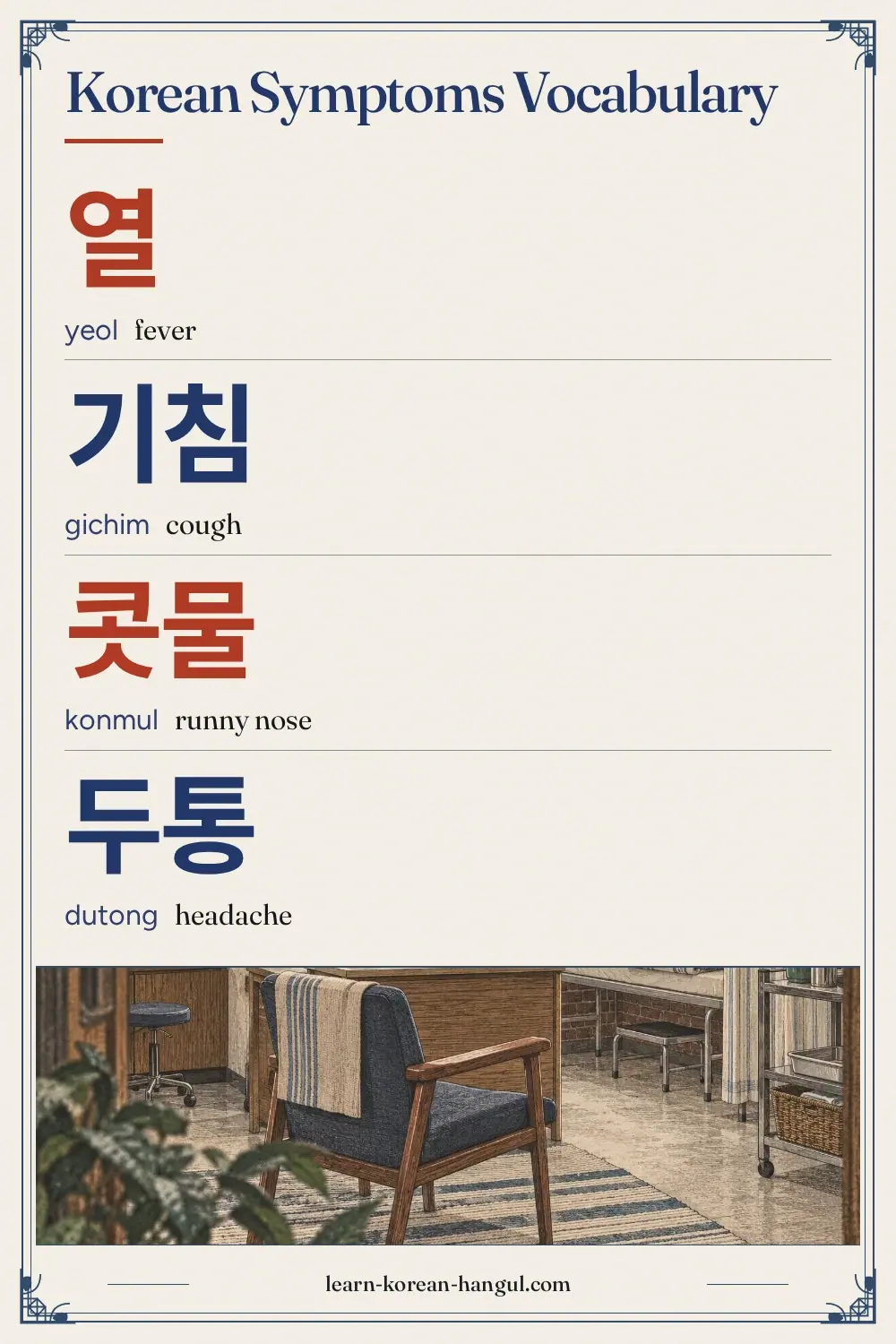
Korean Symptoms Vocabulary at a Glance
This list has 40 words in five groups of eight. The groups follow what a doctor asks about: fever and cold signs, pain, the stomach, the skin and long-term illnesses. It belongs to Health and Medicine. Each word comes with a short polite sentence, so you can say what is wrong and not only name the symptom.
| Group | Words | Use |
|---|---|---|
| Fever and cold | 8 | Describing a cold, flu or fever |
| Pain | 8 | Saying where and how it hurts |
| Digestive problems | 8 | Talking about the stomach and bowels |
| Skin and allergies | 8 | Describing rashes, burns and allergies |
| Chronic illnesses | 8 | Naming long-term conditions |
Korean does not use one verb for every symptom. Pain takes 아파요, while fever and cough take 나요, and catching a cold takes 걸렸어요. The next section ranks the words and explains that split.
Which Symptom Words Should You Learn First?
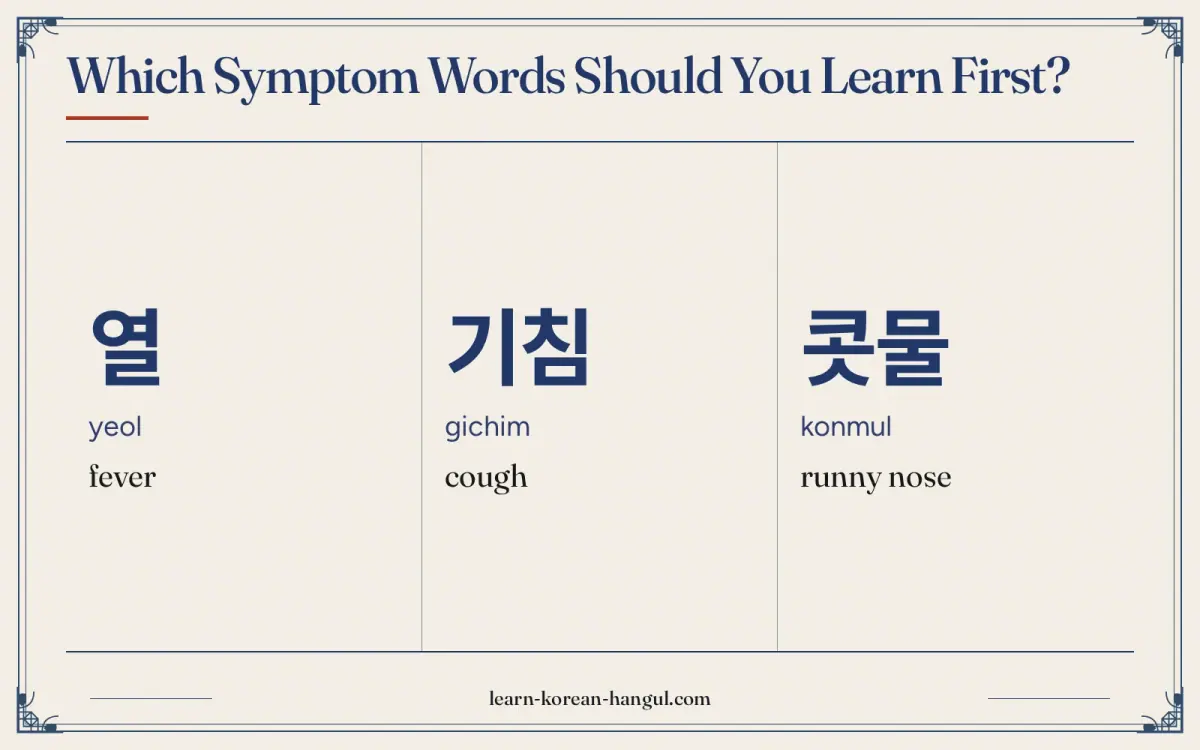
Learn 아파요 (it hurts), 열 (fever), 기침 (cough), 두통 (headache) and 복통 (stomachache) first. They cover the most common reasons to see a doctor, and four of them fit a frame you can reuse. Add the body-part word and you can say almost anything: 머리가 아파요 means my head hurts.
- Words to say. 아파요, 열, 기침, 콧물, 두통, 복통, 알레르기. These describe how you feel.
- Words to recognise. 독감, 코로나, 당뇨병, 고혈압, 천식. These appear in notices, forms and the doctor's questions.
- Words to hear. 심해요 (it is severe) and 며칠 (how many days) come from the doctor, so learn to recognise the questions even when you cannot yet answer in full.
Compare the three respiratory illness words used in notices: 감기 (a cold), 독감 (the flu) and 코로나 (COVID-19). 감기 is mild and common, 독감 is influenza (the flu), and 코로나 is the everyday shortened name for COVID-19. Notices and test slips use these three, so learn to tell them apart. The scene below shows a clinic with numbered objects that match the list.
Word · 8
- 1
열
yeol
fever
- 2
기침
gichim
cough
- 3
콧물
konmul
runny nose
- 4
두통
dutong
headache
- 5
복통
boktong
stomachache
- 6
설사
seolsa
diarrhea
- 7
두드러기
dudeureogi
hives
- 8
당뇨병
dangnyobyeong
diabetes
Fever and Cold
Fever and cold symptoms use the verb 나다, which means to come out or to appear. You do not say I have a cough with 있다 in most speech; you say 기침이 나요, a cough comes out. Colds and flu use 걸리다, to be caught: 감기에 걸렸어요 means I caught a cold. The particle 에 marks the illness you caught.
| No. | Hangul | Revised Romanization | Meaning and note | Example sentence | Audio assetId |
|---|---|---|---|---|---|
| 1 | 열 | yeol | fever. Literally, heat comes out. Also means heat. | 열이 나요. (I have a fever.) | au-pg-vocabulary-daily-life-health-symptoms-illness-1; example: au-pg-vocabulary-daily-life-health-symptoms-illness-41 |
| 2 | 기침 | gichim | cough. Same verb 나다 as for fever. | 기침이 나요. (I have a cough.) | au-pg-vocabulary-daily-life-health-symptoms-illness-2; example: au-pg-vocabulary-daily-life-health-symptoms-illness-42 |
| 3 | 콧물 | konmul | runny nose. Said [콘물]; nose (코) plus water (물). | 콧물이 나요. (My nose is running.) | au-pg-vocabulary-daily-life-health-symptoms-illness-3; example: au-pg-vocabulary-daily-life-health-symptoms-illness-43 |
| 4 | 재채기 | jaechaegi | sneeze. Also uses 나요. | 재채기가 나요. (I keep sneezing.) | au-pg-vocabulary-daily-life-health-symptoms-illness-4; example: au-pg-vocabulary-daily-life-health-symptoms-illness-44 |
| 5 | 목 | mok | throat; neck. The same word means neck; context decides. | 목이 아파요. (My throat hurts.) | au-pg-vocabulary-daily-life-health-symptoms-illness-5; example: au-pg-vocabulary-daily-life-health-symptoms-illness-45 |
| 6 | 감기 | gamgi | cold (illness). 걸리다 means to be caught. | 감기에 걸렸어요. (I caught a cold.) | au-pg-vocabulary-daily-life-health-symptoms-illness-6; example: au-pg-vocabulary-daily-life-health-symptoms-illness-46 |
| 7 | 독감 | dokgam | flu (influenza). Said [독깜]; 독 (毒) means poison, here severe. | 독감에 걸렸어요. (I caught the flu.) | au-pg-vocabulary-daily-life-health-symptoms-illness-7; example: au-pg-vocabulary-daily-life-health-symptoms-illness-47 |
| 8 | 코로나 | korona | COVID-19 (everyday name). 검사 means test; 받다 means to receive. | 코로나 검사를 받았어요. (I took a COVID test.) | au-pg-vocabulary-daily-life-health-symptoms-illness-8; example: au-pg-vocabulary-daily-life-health-symptoms-illness-48 |
Example Sentences
Two frames do most of the work in this list. For pain, use body part + 이/가 아파요, as in 목이 아파요. For fever, cough and runny nose, use noun + 이/가 나요, as in 열이 나요. For long-term conditions, use noun + 이/가 있어요. Remember that 이 follows a consonant and 가 follows a vowel, so 열이 and 기침이, but 재채기가. Say each example aloud after the audio and then swap in a different noun.
How Do You Say Pain in Korean?
Pain is 아프다 (apeuda), a descriptive verb meaning to hurt. To say where it hurts, name the body part and add 이/가 아파요, as in 머리가 아파요 (my head hurts) or 배가 아파요 (my stomach hurts). Compounds with 통 (痛, pain) name the ache: 두통 is head pain, 복통 is belly pain and 치통 is tooth pain. 통증 is the formal word for pain in general.
| No. | Hangul | Revised Romanization | Meaning and note | Example sentence | Audio assetId |
|---|---|---|---|---|---|
| 9 | 아파요 | apayo | it hurts. The base verb is 아프다. Add a body part first. | 머리가 아파요. (My head hurts.) | au-pg-vocabulary-daily-life-health-symptoms-illness-9; example: au-pg-vocabulary-daily-life-health-symptoms-illness-49 |
| 10 | 두통 | dutong | headache. 두 is head; 통 is pain. | 두통이 심해요. (My headache is severe.) | au-pg-vocabulary-daily-life-health-symptoms-illness-10; example: au-pg-vocabulary-daily-life-health-symptoms-illness-50 |
| 11 | 복통 | boktong | stomachache. 복 is belly. | 복통이 있어요. (I have a stomachache.) | au-pg-vocabulary-daily-life-health-symptoms-illness-11; example: au-pg-vocabulary-daily-life-health-symptoms-illness-51 |
| 12 | 치통 | chitong | toothache. 치 is tooth (Sino-Korean). | 치통이 있어요. (I have a toothache.) | au-pg-vocabulary-daily-life-health-symptoms-illness-12; example: au-pg-vocabulary-daily-life-health-symptoms-illness-52 |
| 13 | 통증 | tongjeung | pain (formal). The word a doctor uses. | 통증이 심해요. (The pain is severe.) | au-pg-vocabulary-daily-life-health-symptoms-illness-13; example: au-pg-vocabulary-daily-life-health-symptoms-illness-53 |
| 14 | 근육통 | geunyuktong | muscle pain. 근육 means muscle. | 근육통이 있어요. (I have muscle pain.) | au-pg-vocabulary-daily-life-health-symptoms-illness-14; example: au-pg-vocabulary-daily-life-health-symptoms-illness-54 |
| 15 | 몸살 | momsal | body aches from illness. 몸 is body; the word covers the aches and tiredness of a cold or overwork. | 몸살이 났어요. (I have body aches.) | au-pg-vocabulary-daily-life-health-symptoms-illness-15; example: au-pg-vocabulary-daily-life-health-symptoms-illness-55 |
| 16 | 허리 | heori | waist; lower back. A common complaint; in 허리가 아파요 it means the lower back. | 허리가 아파요. (My lower back hurts.) | au-pg-vocabulary-daily-life-health-symptoms-illness-16; example: au-pg-vocabulary-daily-life-health-symptoms-illness-56 |
The word 배 means stomach in 배가 아파요, but it can also mean a pear or a boat. Context tells you which one. Koreans also say 속이 안 좋아요 (my insides feel bad) for a stomach upset, a softer expression than 아파요.
Digestive Problems
Digestive words are short nouns used with 이/가 나요 or 이/가 있어요. 설사 is diarrhea, 변비 is constipation, 구토 is vomiting in formal speech, and 메스꺼움 is nausea. 체하다 is a verb for the uncomfortable full feeling after eating too fast, and it has no neat English match. Use it to tell a pharmacist why you want a 소화제.
| No. | Hangul | Revised Romanization | Meaning and note | Example sentence | Audio assetId |
|---|---|---|---|---|---|
| 17 | 설사 | seolsa | diarrhea. The verb is 하다, to do. | 설사를 해요. (I have diarrhea.) | au-pg-vocabulary-daily-life-health-symptoms-illness-17; example: au-pg-vocabulary-daily-life-health-symptoms-illness-57 |
| 18 | 변비 | byeonbi | constipation. Said as written. | 변비가 있어요. (I am constipated.) | au-pg-vocabulary-daily-life-health-symptoms-illness-18; example: au-pg-vocabulary-daily-life-health-symptoms-illness-58 |
| 19 | 구토 | guto | vomiting. Formal; the everyday verb is 토하다. | 구토를 했어요. (I vomited.) | au-pg-vocabulary-daily-life-health-symptoms-illness-19; example: au-pg-vocabulary-daily-life-health-symptoms-illness-59 |
| 20 | 메스꺼움 | meseukkeoum | nausea. The adjective is 메스껍다. | 메스꺼움이 있어요. (I feel nauseous.) | au-pg-vocabulary-daily-life-health-symptoms-illness-20; example: au-pg-vocabulary-daily-life-health-symptoms-illness-60 |
| 21 | 소화불량 | sohwabullyang | indigestion. 소화 is digestion; 불량 means poor. | 소화불량이에요. (I have indigestion.) | au-pg-vocabulary-daily-life-health-symptoms-illness-21; example: au-pg-vocabulary-daily-life-health-symptoms-illness-61 |
| 22 | 배탈 | baetal | stomach upset. Often from food that did not agree. | 배탈이 났어요. (I have an upset stomach.) | au-pg-vocabulary-daily-life-health-symptoms-illness-22; example: au-pg-vocabulary-daily-life-health-symptoms-illness-62 |
| 23 | 체하다 | chehada | to have indigestion from eating fast. Past tense is used for a present state. | 체했어요. (I have indigestion (from eating too fast).) | au-pg-vocabulary-daily-life-health-symptoms-illness-23; example: au-pg-vocabulary-daily-life-health-symptoms-illness-63 |
| 24 | 속쓰림 | soksseurim | heartburn. 속 means inside; 쓰림 is a burning sting. | 속쓰림이 있어요. (I have heartburn.) | au-pg-vocabulary-daily-life-health-symptoms-illness-24; example: au-pg-vocabulary-daily-life-health-symptoms-illness-64 |
How Do You Say Skin and Allergies in Korean?
Skin words describe what you see or feel on the surface. 알레르기 is allergy, a loanword, and 두드러기 is hives, an itchy raised rash that often follows an allergic reaction. 상처 is a wound and 화상 is a burn. Use 생겼어요 (it appeared) or 났어요 (it came out) with most skin problems.
| No. | Hangul | Revised Romanization | Meaning and note | Example sentence | Audio assetId |
|---|---|---|---|---|---|
| 25 | 알레르기 | allereugi | allergy. 땅콩 is peanut; name the trigger first. | 땅콩 알레르기가 있어요. (I have a peanut allergy.) | au-pg-vocabulary-daily-life-health-symptoms-illness-25; example: au-pg-vocabulary-daily-life-health-symptoms-illness-65 |
| 26 | 발진 | baljin | rash. Said [발찐]. | 발진이 생겼어요. (A rash appeared.) | au-pg-vocabulary-daily-life-health-symptoms-illness-26; example: au-pg-vocabulary-daily-life-health-symptoms-illness-66 |
| 27 | 가려움 | garyeoum | itching. The verb form is 가려워요. | 가려움이 심해요. (The itching is severe.) | au-pg-vocabulary-daily-life-health-symptoms-illness-27; example: au-pg-vocabulary-daily-life-health-symptoms-illness-67 |
| 28 | 두드러기 | dudeureogi | hives. Used for allergy-type rashes. | 두드러기가 났어요. (I broke out in hives.) | au-pg-vocabulary-daily-life-health-symptoms-illness-28; example: au-pg-vocabulary-daily-life-health-symptoms-illness-68 |
| 29 | 화상 | hwasang | burn. 입다 means to wear, but 화상을 입다 means to suffer a burn. | 화상을 입었어요. (I got a burn.) | au-pg-vocabulary-daily-life-health-symptoms-illness-29; example: au-pg-vocabulary-daily-life-health-symptoms-illness-69 |
| 30 | 상처 | sangcheo | wound; cut. Use for cuts and scrapes. | 상처가 났어요. (I have a wound.) | au-pg-vocabulary-daily-life-health-symptoms-illness-30; example: au-pg-vocabulary-daily-life-health-symptoms-illness-70 |
| 31 | 멍 | meong | bruise. 들다 means to appear in this phrase. | 멍이 들었어요. (I have a bruise.) | au-pg-vocabulary-daily-life-health-symptoms-illness-31; example: au-pg-vocabulary-daily-life-health-symptoms-illness-71 |
| 32 | 아토피 | atopi | atopic dermatitis; eczema. Short for 아토피 피부염. | 아토피가 있어요. (I have eczema.) | au-pg-vocabulary-daily-life-health-symptoms-illness-32; example: au-pg-vocabulary-daily-life-health-symptoms-illness-72 |
Allergy information matters at a pharmacy or restaurant. Learn the Korean name for any food or drug you react to, then say it with 알레르기가 있어요. The Korean Pharmacy Vocabulary page has more words for allergies and side effects.
Chronic Illnesses
Chronic illnesses are conditions that continue for months or years, and the Korean words are mostly Sino-Korean compounds that end in 병 (illness), 증 (condition) or 염 (inflammation). A doctor will often ask whether you have any of these, so learn to recognise them. Use 이/가 있어요 to say you have one.
| No. | Hangul | Revised Romanization | Meaning and note | Example sentence | Audio assetId |
|---|---|---|---|---|---|
| 33 | 당뇨병 | dangnyobyeong | diabetes. 병 means illness. | 당뇨병이 있어요. (I have diabetes.) | au-pg-vocabulary-daily-life-health-symptoms-illness-33; example: au-pg-vocabulary-daily-life-health-symptoms-illness-73 |
| 34 | 고혈압 | gohyeorap | high blood pressure. Said [고혀랍]; 고 means high. | 고혈압이 있어요. (I have high blood pressure.) | au-pg-vocabulary-daily-life-health-symptoms-illness-34; example: au-pg-vocabulary-daily-life-health-symptoms-illness-74 |
| 35 | 천식 | cheonsik | asthma. Tell the pharmacist before buying cold medicine. | 천식이 있어요. (I have asthma.) | au-pg-vocabulary-daily-life-health-symptoms-illness-35; example: au-pg-vocabulary-daily-life-health-symptoms-illness-75 |
| 36 | 비염 | biyeom | rhinitis; nasal allergy. 염 means inflammation. | 비염이 있어요. (I have rhinitis.) | au-pg-vocabulary-daily-life-health-symptoms-illness-36; example: au-pg-vocabulary-daily-life-health-symptoms-illness-76 |
| 37 | 불면증 | bulmyeonjeung | insomnia. 불면 is no sleep; 증 is condition. | 불면증이 있어요. (I have insomnia.) | au-pg-vocabulary-daily-life-health-symptoms-illness-37; example: au-pg-vocabulary-daily-life-health-symptoms-illness-77 |
| 38 | 편두통 | pyeondutong | migraine. 편 is one side; the pain is often on one side. | 편두통이 있어요. (I have migraines.) | au-pg-vocabulary-daily-life-health-symptoms-illness-38; example: au-pg-vocabulary-daily-life-health-symptoms-illness-78 |
| 39 | 관절염 | gwanjeollyeom | arthritis. 관절 means joint. | 관절염이 있어요. (I have arthritis.) | au-pg-vocabulary-daily-life-health-symptoms-illness-39; example: au-pg-vocabulary-daily-life-health-symptoms-illness-79 |
| 40 | 빈혈 | binhyeol | anemia. 빈 means empty; 혈 means blood. | 빈혈이 있어요. (I have anemia.) | au-pg-vocabulary-daily-life-health-symptoms-illness-40; example: au-pg-vocabulary-daily-life-health-symptoms-illness-80 |
Naming a symptom is only half of what a doctor needs, because they also ask how bad it is and how long.
How Do You Say How Bad It Is and for How Long?
A doctor asks two follow-up questions: how severe is it, and since when? Severity words go before the verb, and duration phrases end in 부터 (from). Combine them with any symptom to give a full report. For example, 어제부터 열이 많이 나요 means I have had a high fever since yesterday.
| Korean | Romanization | Meaning |
|---|---|---|
| 조금 | jogeum | a little |
| 많이 | mani | a lot |
| 너무 | neomu | too much; very |
| 어제부터 | eojebuteo | since yesterday |
| 이틀 전부터 | iteul jeonbuteo | since two days ago |
| 오늘 아침부터 | oneul achimbuteo | since this morning |
Note that 이틀 means two days, a native Korean word, and that 전 means before. For severe or sudden symptoms, skip the grammar and use the emergency phrases. Describing a longer history is a useful step toward the pharmacy and dentist visits.
How Do You Pronounce These Words?
Symptom words have several sound changes, mostly at syllable boundaries. Standard pronunciation follows the National Institute of Korean Language (국립국어원) rules, and the romanization follows the Revised Romanization of Korean, which does not mark every sound change.
| Spelling | Sounds like | What changes |
|---|---|---|
| 콧물 | [콘물] | The final ㅅ becomes ㄷ, then the ㄷ turns into ㄴ before ㅁ. |
| 독감 | [독깜] | After a final ㄱ, the next ㄱ is said as a tense [ㄲ]. |
| 발진 | [발찐] | In Sino-Korean words, ㅈ after a final ㄹ is said tense. |
| 고혈압 | [고혀랍] | ㄹ links to the vowel of the next syllable. |
| 열이 | [여리] | The final ㄹ links to the vowel of 이. |
Linking is the habit of moving a final consonant to the next syllable when that syllable starts with a vowel sound. It is why 열이 sounds like yeo-ri. Listen for it in every example sentence that has a noun with a particle.
Audio and Slow Playback
Each word and sentence has its own clip. The five clips below replay the hardest words slowly. Play one, repeat it aloud, then play it again and compare.
What Mistakes Do Learners Make with Symptom Words?
These five mistakes come from applying one English verb to every symptom.
- Using 아파요 for a cough or fever. Pain takes 아파요, but fever, cough and runny nose take 나요. Say 열이 나요, not 열이 아파요.
- Mixing up 감기 and 독감. 감기 is the common cold, and 독감 is the flu, which is stronger and usually brings a high fever. Do not use them as synonyms.
- Dropping the particle. Say 머리가 아파요, not 머리 아파요, when you can. Everyday speech drops particles, but the full form is clearer in a clinic.
- Reading 목 only as neck. 목 means both neck and throat. 목이 아파요 usually means a sore throat, and 목이 뻐근해요 means a stiff neck.
- Learning illness names without the frame. Names alone are not sentences. Learn 이/가 있어요 for conditions and 이/가 나요 for fever and cough, and your 40 words become 40 sentences.
If you are unsure, point to the part that hurts and say 여기가 아파요 (it hurts here). That works for any body part. For single words from this list, see fever in Korean and cough in Korean.
Practice: Flashcards and Worksheet
Use the deck first, the quiz second and the worksheet third. The flashcard deck below holds all 40 words with audio; start with recognition mode and add listening mode when you can read each card. Your progress stays in your browser. The vocabulary flashcard decks page lists the other decks.
Practice · 85
- 01열
Show answer
headword 1: fever
- 02기침
Show answer
headword 2: cough
- 03콧물
Show answer
headword 3: runny nose
- 04재채기
Show answer
headword 4: sneeze
- 05목
Show answer
headword 5: throat; neck
- 06감기
Show answer
headword 6: cold (illness)
- 07독감
Show answer
headword 7: flu (influenza)
- 08코로나
Show answer
headword 8: COVID-19 (everyday name)
- 09아파요
Show answer
headword 9: it hurts
- 10두통
Show answer
headword 10: headache
- 11복통
Show answer
headword 11: stomachache
- 12치통
Show answer
headword 12: toothache
- 13통증
Show answer
headword 13: pain (formal)
- 14근육통
Show answer
headword 14: muscle pain
- 15몸살
Show answer
headword 15: body aches from illness
- 16허리
Show answer
headword 16: waist; lower back
- 17설사
Show answer
headword 17: diarrhea
- 18변비
Show answer
headword 18: constipation
- 19구토
Show answer
headword 19: vomiting
- 20메스꺼움
Show answer
headword 20: nausea
- 21소화불량
Show answer
headword 21: indigestion
- 22배탈
Show answer
headword 22: stomach upset
- 23체하다
Show answer
headword 23: to have indigestion from eating fast
- 24속쓰림
Show answer
headword 24: heartburn
- 25알레르기
Show answer
headword 25: allergy
- 26발진
Show answer
headword 26: rash
- 27가려움
Show answer
headword 27: itching
- 28두드러기
Show answer
headword 28: hives
- 29화상
Show answer
headword 29: burn
- 30상처
Show answer
headword 30: wound; cut
- 31멍
Show answer
headword 31: bruise
- 32아토피
Show answer
headword 32: atopic dermatitis; eczema
- 33당뇨병
Show answer
headword 33: diabetes
- 34고혈압
Show answer
headword 34: high blood pressure
- 35천식
Show answer
headword 35: asthma
- 36비염
Show answer
headword 36: rhinitis; nasal allergy
- 37불면증
Show answer
headword 37: insomnia
- 38편두통
Show answer
headword 38: migraine
- 39관절염
Show answer
headword 39: arthritis
- 40빈혈
Show answer
headword 40: anemia
- 41열이 나요.
Show answer
example sentence for headword 1
- 42기침이 나요.
Show answer
example sentence for headword 2
- 43콧물이 나요.
Show answer
example sentence for headword 3
- 44재채기가 나요.
Show answer
example sentence for headword 4
- 45목이 아파요.
Show answer
example sentence for headword 5
- 46감기에 걸렸어요.
Show answer
example sentence for headword 6
- 47독감에 걸렸어요.
Show answer
example sentence for headword 7
- 48코로나 검사를 받았어요.
Show answer
example sentence for headword 8
- 49머리가 아파요.
Show answer
example sentence for headword 9
- 50두통이 심해요.
Show answer
example sentence for headword 10
- 51복통이 있어요.
Show answer
example sentence for headword 11
- 52치통이 있어요.
Show answer
example sentence for headword 12
- 53통증이 심해요.
Show answer
example sentence for headword 13
- 54근육통이 있어요.
Show answer
example sentence for headword 14
- 55몸살이 났어요.
Show answer
example sentence for headword 15
- 56허리가 아파요.
Show answer
example sentence for headword 16
- 57설사를 해요.
Show answer
example sentence for headword 17
- 58변비가 있어요.
Show answer
example sentence for headword 18
- 59구토를 했어요.
Show answer
example sentence for headword 19
- 60메스꺼움이 있어요.
Show answer
example sentence for headword 20
- 61소화불량이에요.
Show answer
example sentence for headword 21
- 62배탈이 났어요.
Show answer
example sentence for headword 22
- 63체했어요.
Show answer
example sentence for headword 23
- 64속쓰림이 있어요.
Show answer
example sentence for headword 24
- 65땅콩 알레르기가 있어요.
Show answer
example sentence for headword 25
- 66발진이 생겼어요.
Show answer
example sentence for headword 26
- 67가려움이 심해요.
Show answer
example sentence for headword 27
- 68두드러기가 났어요.
Show answer
example sentence for headword 28
- 69화상을 입었어요.
Show answer
example sentence for headword 29
- 70상처가 났어요.
Show answer
example sentence for headword 30
- 71멍이 들었어요.
Show answer
example sentence for headword 31
- 72아토피가 있어요.
Show answer
example sentence for headword 32
- 73당뇨병이 있어요.
Show answer
example sentence for headword 33
- 74고혈압이 있어요.
Show answer
example sentence for headword 34
- 75천식이 있어요.
Show answer
example sentence for headword 35
- 76비염이 있어요.
Show answer
example sentence for headword 36
- 77불면증이 있어요.
Show answer
example sentence for headword 37
- 78편두통이 있어요.
Show answer
example sentence for headword 38
- 79관절염이 있어요.
Show answer
example sentence for headword 39
- 80빈혈이 있어요.
Show answer
example sentence for headword 40
- 81콧물
Show answer
slow playback of headword 3: runny nose
- 82독감
Show answer
slow playback of headword 7: flu (influenza)
- 83발진
Show answer
slow playback of headword 26: rash
- 84고혈압
Show answer
slow playback of headword 34: high blood pressure
- 85기침
Show answer
slow playback of headword 2: cough
Practice · 5
What does 열 (yeol) mean?
Show answer
fever
열 means fever. Example: 열이 나요. (I have a fever.)
What does 기침 (gichim) mean?
Show answer
cough
기침 means cough. Example: 기침이 나요. (I have a cough.)
What does 두통 (dutong) mean?
Show answer
headache
두통 means headache. Example: 두통이 심해요. (My headache is severe.)
What does 설사 (seolsa) mean?
Show answer
diarrhea
설사 means diarrhea. Example: 설사를 해요. (I have diarrhea.)
What does 천식 (cheonsik) mean?
Show answer
asthma
천식 means asthma. Example: 천식이 있어요. (I have asthma.)
Korean Symptoms Vocabulary Worksheet (PDF)
A printable worksheet for these words (word list, matching, writing practice, fill-in-the-blank exercises and answer key) is available in A4 and US Letter from the download card on this page. For practice, copy the 40 words by hand in groups of eight. Write one sentence per group with a different body part, such as 배가 아파요.
Where to Go Next
After this page, continue with Korean Pharmacy Vocabulary, where you buy and take the medicine, or Korean Dentist Vocabulary. If symptoms are severe, use the emergency phrases. To move up a level, go back to Health and Medicine.
Frequently Asked Questions
How Do You Say Fever in Korean?
Fever is 열 (yeol). To say you have a fever, use the verb 나다: 열이 나요 (I have a fever), because the heat comes out. The word 열 also means heat. The ㄹ at the end links to the vowel of the particle, so 열이 is said [여리].
How Do You Pronounce 기침 (gichim)?
Say gi-chim in two even beats. The first syllable is like gee, and the second is chim with a puff of air on the ch. There is no sound change in this word. It means cough, and you say 기침이 나요 (I have a cough). Press the audio button to hear it.
How Many Symptom Words Should I Learn First?
Five first: 아파요, 열, 기침, 두통 and 복통. At five new words a day the whole list of 40 takes eight days plus review. Learn the two frames, 이/가 아파요 and 이/가 나요, before you learn all 40.
Where Can I Practise Symptom Words with Flashcards?
Use the vocabulary flashcard decks. The deck for this page holds all 40 words with Hangul, romanization and audio, with recognition and listening modes. Your progress stays in your browser. Review the cards you missed the next day.
Is the Romanization on This Page Official?
It follows the Revised Romanization of Korean, which South Korea adopted on 7 July 2000 and whose rules the National Institute of Korean Language (국립국어원) publishes. It is a learning aid and does not mark every sound change, so rely on the Hangul and the audio.
Is There a Printable Worksheet for Symptom Words?
A printable worksheet for these words (word list, matching, writing practice, fill-in-the-blank exercises and answer key) is available in A4 and US Letter from the download card on this page. For practice, copy the tables on this page by hand or use the flashcard deck, which has the same 40 words.