Korean Dentist Vocabulary at a Glance
A dental visit has a clear order, and the list follows it. You book, you arrive, you name the tooth, the dentist names the treatment, and you ask about cost. That is why the groups run from the clinic and its people, to the teeth, to treatments, to pain and problems, and last to appointments and cost. This page belongs to Health and Medicine. Pair it with body parts for the rest of the face, and with Korean Pharmacy Vocabulary for the medicine you may be given afterwards.
| Group | Words | Use |
|---|---|---|
| The clinic and its people | 5 | Naming the place, the staff and the patient |
| The teeth | 5 | Naming teeth and gums |
| Treatments | 5 | Naming common dental procedures |
| Pain and problems | 5 | Describing what is wrong |
| Appointments and cost | 5 | Booking, checking in and paying |
Almost every word is a noun, and most are Sino-Korean, built from syllables such as 치 (tooth) and 과 (department). Two are verbs of sensation, 시리다 and 흔들리다, which you need because a tooth problem is described by how it feels. The next section ranks the words by how soon you will need them.
Which Dentist Words Should You Learn First?
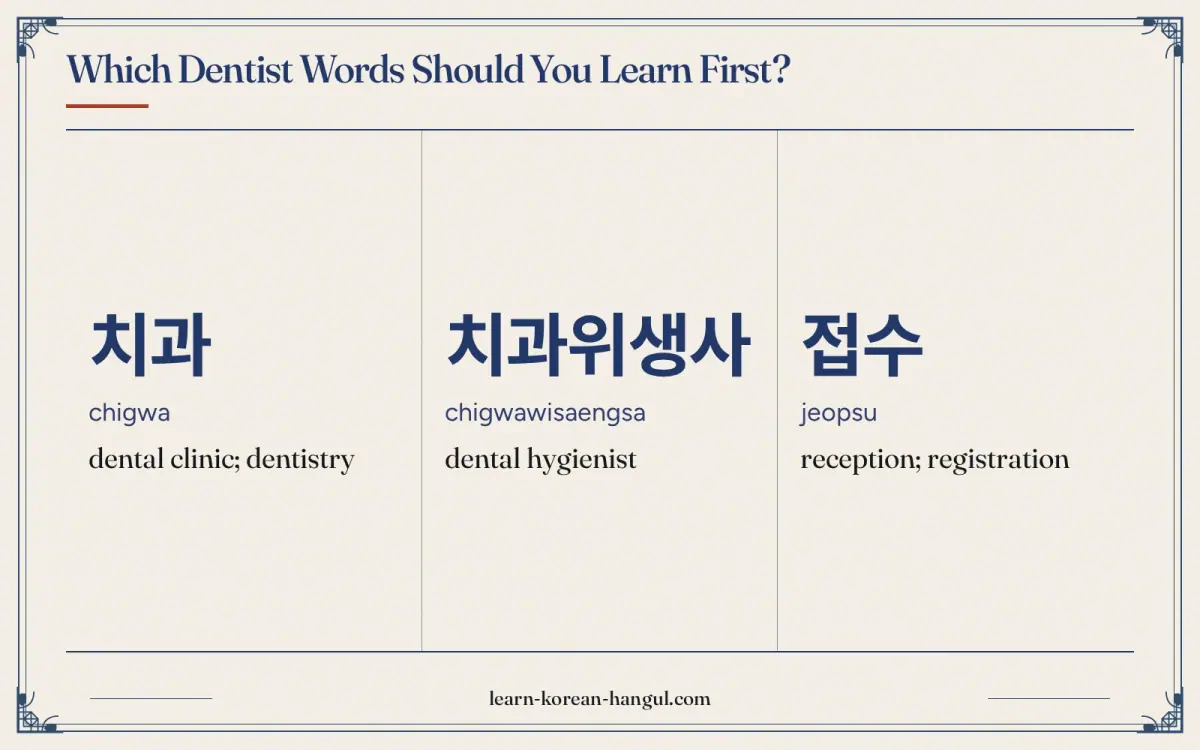
Learn 치과 (dental clinic), 예약 (appointment), 충치 (cavity), 치통 (toothache) and 사랑니 (wisdom tooth) first. With those five you can book a visit, say why you are coming and name the most common problem. Add 스케일링 (scaling) if you want a check-up and cleaning.
- Words to say. 치과, 예약, 충치, 치통, 사랑니, 스케일링. You use these to book and to explain.
- Words to recognise. 접수, 진료, 마취, 비용, 보험. You read these on forms and hear them at the desk.
- Words to understand when spoken. 입을 벌려 주세요 and the other instructions in the section about what the dentist says.
At five new words a day, the whole list of 25 takes five days plus review. Learn the first and fifth groups on the first day, because they cover booking and paying.
This page teaches vocabulary and is not dental or medical advice. If you have swelling, bleeding that will not stop or severe pain after hours, go to an emergency room and use the words on the Korean Medical Emergencies Vocabulary page. Korea's emergency number for an ambulance is 119.
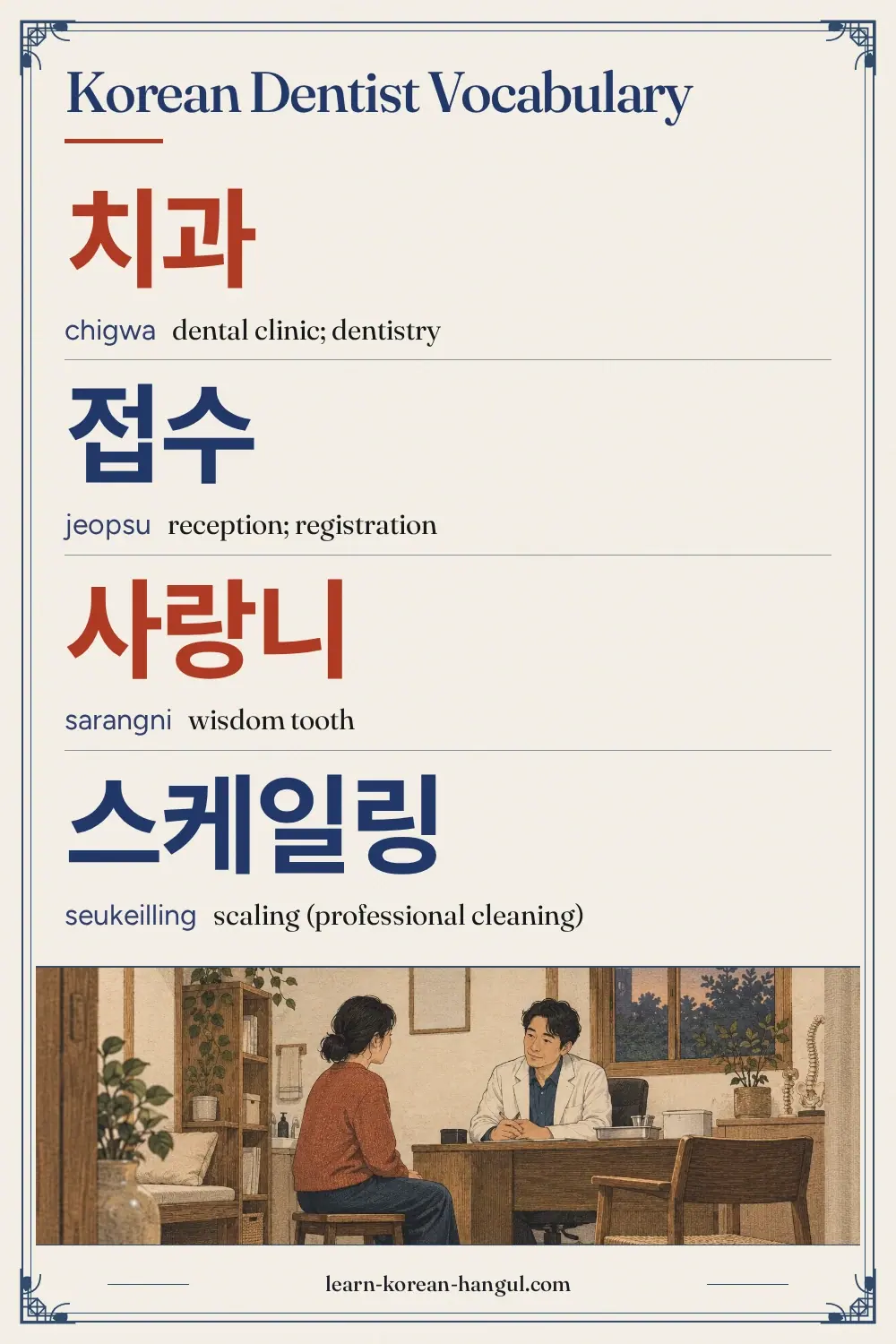
The scene below puts eight of the 25 words on one picture of a dental clinic.
Word · 8
- 1
치과
chigwa
dental clinic; dentistry
- 2
치과위생사
chigwawisaengsa
dental hygienist
- 3
접수
jeopsu
reception; registration
- 4
사랑니
sarangni
wisdom tooth
- 5
스케일링
seukeilling
scaling (professional cleaning)
- 6
임플란트
impeullanteu
dental implant
- 7
충치
chungchi
cavity; tooth decay
- 8
예약
yeyak
appointment; reservation
What Is the Difference between 치과 and 치과의사?
Korean separates the place from the person, and the difference matters when you book. 치과 (chigwa) is the dental clinic or the dental department of a hospital. 치과의사 (chigwauisa) is the dentist, the person. The word 과 means department or branch, and it appears in every medical specialty: 내과 is internal medicine, 안과 is eye medicine and 피부과 is dermatology.
So you go to a 치과, and you meet a 치과의사. A sentence like 치과에 가요 (I go to the dental clinic) is the one you use in everyday speech. When you speak to the dentist in the room, call them 선생님 (seonsaengnim), a respectful title that means teacher and is also used for doctors. Avoid using 의사 alone as a form of address, since it names the job rather than greeting the person.
The clinic also has a 치과위생사 (chigwawisaengsa), a dental hygienist, who often cleans teeth and explains home care, and a front desk where you do the 접수 (registration). Knowing the four roles helps you follow who is speaking.
The Clinic and Its People
The first group names the clinic and the people in it. 치과 is the place. 치과의사, 치과위생사 and 환자 are the three roles you hear described, and 접수 is the front desk step that comes before you sit in the chair.
| No. | Hangul | Revised Romanization | Meaning and note | Example sentence | Audio assetId |
|---|---|---|---|---|---|
| 1 | 치과 | chigwa | dental clinic; dentistry. Said [치꽈]. 치 means tooth and 과 means department. | 치과에 가요. (I go to the dental clinic.) | au-pg-vocabulary-daily-life-health-dentist-1; example: au-pg-vocabulary-daily-life-health-dentist-26 |
| 2 | 치과의사 | chigwauisa | dentist (the person). Add 선생님 when speaking to one. 의 in the middle may be said [의] or [이]. | 치과의사를 만나요. (I meet the dentist.) | au-pg-vocabulary-daily-life-health-dentist-2; example: au-pg-vocabulary-daily-life-health-dentist-27 |
| 3 | 치과위생사 | chigwawisaengsa | dental hygienist. Licensed title for the person who cleans teeth and gives care advice. | 치과위생사가 설명해 줘요. (The hygienist explains it to me.) | au-pg-vocabulary-daily-life-health-dentist-3; example: au-pg-vocabulary-daily-life-health-dentist-28 |
| 4 | 환자 | hwanja | patient. Sino-Korean word used in every hospital and clinic. | 환자가 기다려요. (The patient is waiting.) | au-pg-vocabulary-daily-life-health-dentist-4; example: au-pg-vocabulary-daily-life-health-dentist-29 |
| 5 | 접수 | jeopsu | reception; registration. Said [접쑤]. The step where you give your name and have your insurance checked. | 접수는 저기예요. (Reception is over there.) | au-pg-vocabulary-daily-life-health-dentist-5; example: au-pg-vocabulary-daily-life-health-dentist-30 |
You can use these five words to describe a visit before you learn anything else: 치과에 가요. 접수해요. 치과의사를 만나요. (I go to the clinic. I register. I meet the dentist.) The verb 만나다 (to meet) is a regular verb.
Now that you know who is in the room, you can name what they look at.
The Teeth
Korean has two words for tooth. 치아 is the formal and written word, used by dentists and on forms. 이 is the everyday word, as in 이가 아파요 (my tooth hurts). The names of individual teeth are mostly compounds with 니, a form of 이 that appears at the end of the word.
| No. | Hangul | Revised Romanization | Meaning and note | Example sentence | Audio assetId |
|---|---|---|---|---|---|
| 6 | 치아 | chia | tooth; teeth (formal). The formal word. The everyday word is 이, which is spelled the same as the number two and the word this. | 치아가 아파요. (My tooth hurts.) | au-pg-vocabulary-daily-life-health-dentist-6; example: au-pg-vocabulary-daily-life-health-dentist-31 |
| 7 | 앞니 | amni | front tooth. Said [암니]. The ㅍ is said as ㅁ before ㄴ. 앞 means front. | 앞니가 부러졌어요. (My front tooth broke.) | au-pg-vocabulary-daily-life-health-dentist-7; example: au-pg-vocabulary-daily-life-health-dentist-32 |
| 8 | 어금니 | eogeumni | molar. The back teeth used for chewing. | 어금니로 씹어요. (I chew with my molars.) | au-pg-vocabulary-daily-life-health-dentist-8; example: au-pg-vocabulary-daily-life-health-dentist-33 |
| 9 | 사랑니 | sarangni | wisdom tooth. Literally love tooth. The name is usually explained as the tooth that appears around the age of first love. | 사랑니를 뽑아요. (I have my wisdom tooth pulled out.) | au-pg-vocabulary-daily-life-health-dentist-9; example: au-pg-vocabulary-daily-life-health-dentist-34 |
| 10 | 잇몸 | inmom | gums. Said [인몸]. 이 (tooth) plus 몸 (body); the extra ㅅ marks a compound. | 잇몸에서 피가 나요. (My gums bleed.) | au-pg-vocabulary-daily-life-health-dentist-10; example: au-pg-vocabulary-daily-life-health-dentist-35 |
The verb 뽑다 means to pull out, and it is used for teeth and weeds alike. The sentence 사랑니를 뽑아요 is said by someone who has a wisdom tooth removed, and it is natural to use a plain present tense for a planned event. The sentence 피가 나요 uses 나다 (to come out), the same verb as in 열이 나요 (I have a fever), and it describes bleeding.
Note the sound of 앞니 and 잇몸. The ㅍ of 앞 and the ㅅ of 잇 are said as nasal sounds because the next syllable starts with ㄴ or ㅁ. The page on nasalization explains this change.
When something is wrong with a tooth, the next group tells the dentist what to do.
Treatments
The treatment words mix two loanwords and three Sino-Korean words. 스케일링 and 임플란트 come from English, while 치료, 마취 and 교정 are built from Chinese-based syllables. A dentist usually names the procedure first and then explains the steps, so recognising the noun is enough to follow the plan.
| No. | Hangul | Revised Romanization | Meaning and note | Example sentence | Audio assetId |
|---|---|---|---|---|---|
| 11 | 치료 | chiryo | treatment. Used for any medical treatment. 충치 치료 means cavity treatment. | 치료를 받아요. (I receive treatment.) | au-pg-vocabulary-daily-life-health-dentist-11; example: au-pg-vocabulary-daily-life-health-dentist-36 |
| 12 | 스케일링 | seukeilling | scaling (professional cleaning). Loanword for removing tartar. Often booked as a regular check-up. | 스케일링을 받고 싶어요. (I want to have my teeth scaled.) | au-pg-vocabulary-daily-life-health-dentist-12; example: au-pg-vocabulary-daily-life-health-dentist-37 |
| 13 | 임플란트 | impeullanteu | dental implant. Loanword. Used for a false tooth fixed into the jaw. | 임플란트를 해요. (I get a dental implant.) | au-pg-vocabulary-daily-life-health-dentist-13; example: au-pg-vocabulary-daily-life-health-dentist-38 |
| 14 | 마취 | machwi | anaesthesia. Sino-Korean word. Used before a procedure that would otherwise hurt. | 마취가 풀렸어요. (The anaesthetic has worn off.) | au-pg-vocabulary-daily-life-health-dentist-14; example: au-pg-vocabulary-daily-life-health-dentist-39 |
| 15 | 교정 | gyojeong | orthodontic treatment; braces. In a dental setting 치아 교정 means braces. 교정 alone also means correction, and a word spelled the same way means proofreading. | 교정을 하고 있어요. (I am wearing braces.) | au-pg-vocabulary-daily-life-health-dentist-15; example: au-pg-vocabulary-daily-life-health-dentist-40 |
Two sentence frames carry most of these words. The first is noun + 을/를 받다, to receive, as in 치료를 받아요 and 스케일링을 받고 싶어요. The second is noun + 을/를 하다, to do, as in 임플란트를 해요. The frame -고 싶어요 means I want to, and it is formed from the verb stem, so 받다 gives 받고 싶어요.
Because 교정 has two meanings, add 치아 when you want to be clear: 치아 교정. A dentist will understand 교정 alone, but a form or a message may need the extra word.
Treatment is only the end of the story. Most visits begin with a problem.
Pain and Problems
This group is the one you will use to explain why you came. 충치 is a cavity, 치통 is toothache, and 치석 is the hard deposit that builds up on teeth. 시리다 and 흔들리다 are two verbs that describe how a tooth feels, and they are the most natural way to describe sensitive or loose teeth.
| No. | Hangul | Revised Romanization | Meaning and note | Example sentence | Audio assetId |
|---|---|---|---|---|---|
| 16 | 충치 | chungchi | cavity; tooth decay. 충 is insect and 치 is tooth. The word means a tooth eaten by a bug, the old explanation. | 충치가 있어요. (I have a cavity.) | au-pg-vocabulary-daily-life-health-dentist-16; example: au-pg-vocabulary-daily-life-health-dentist-41 |
| 17 | 치통 | chitong | toothache. 치 (tooth) plus 통 (pain). 두통 (headache) and 복통 (stomachache) follow the same pattern. | 치통이 심해요. (The toothache is severe.) | au-pg-vocabulary-daily-life-health-dentist-17; example: au-pg-vocabulary-daily-life-health-dentist-42 |
| 18 | 치석 | chiseok | tartar; dental calculus. Hardened plaque that scaling removes. | 치석이 많아요. (There is a lot of tartar.) | au-pg-vocabulary-daily-life-health-dentist-18; example: au-pg-vocabulary-daily-life-health-dentist-43 |
| 19 | 시리다 | sirida | to feel a sharp cold ache; to be sensitive. Used for teeth and also for cold hands. The polite present is 시려요. | 이가 시려요. (My teeth are sensitive.) | au-pg-vocabulary-daily-life-health-dentist-19; example: au-pg-vocabulary-daily-life-health-dentist-44 |
| 20 | 흔들리다 | heundeullida | to wobble; to be loose. Used for teeth, chairs and branches alike. | 이가 흔들려요. (My tooth is loose.) | au-pg-vocabulary-daily-life-health-dentist-20; example: au-pg-vocabulary-daily-life-health-dentist-45 |
The pattern for describing a problem is subject + 이/가 + verb. The subject is the tooth, and the particle 이/가 marks it: 이가 시려요, 이가 흔들려요. For a general ache, 아프다 (to hurt) is the verb, as in 치아가 아파요. Add 너무 (very, too) for emphasis: 너무 아파요.
The word 충치 sounds scary, but it is common vocabulary and it is the main word on any dentist's list. The word 이 for tooth is the same spelling as the number two, so read the verb that follows to be sure.
The last group is about arranging the visit and paying for it.
Appointments and Cost
The final group covers the paperwork. 예약 is the appointment you book, and 진료 is the consultation or treatment that follows. 검진 is a check-up. 비용 and 보험 are the money words: the cost, and whether insurance pays.
| No. | Hangul | Revised Romanization | Meaning and note | Example sentence | Audio assetId |
|---|---|---|---|---|---|
| 21 | 예약 | yeyak | appointment; reservation. Add 하다 to make a verb: 예약하다. Also used for restaurants and hotels. | 예약하고 싶어요. (I want to make an appointment.) | au-pg-vocabulary-daily-life-health-dentist-21; example: au-pg-vocabulary-daily-life-health-dentist-46 |
| 22 | 진료 | jillyo | medical consultation; treatment. Said [질료]. The ㄴ before ㄹ is said as ㄹ. | 진료는 몇 시예요? (What time is the consultation?) | au-pg-vocabulary-daily-life-health-dentist-22; example: au-pg-vocabulary-daily-life-health-dentist-47 |
| 23 | 검진 | geomjin | check-up; examination. A planned medical check. 치아 검진 is a dental check-up. | 치아 검진을 받아요. (I have a dental check-up.) | au-pg-vocabulary-daily-life-health-dentist-23; example: au-pg-vocabulary-daily-life-health-dentist-48 |
| 24 | 비용 | biyong | cost; expense. A neutral word. The question 비용이 얼마예요? asks the cost. | 비용이 얼마예요? (How much does it cost?) | au-pg-vocabulary-daily-life-health-dentist-24; example: au-pg-vocabulary-daily-life-health-dentist-49 |
| 25 | 보험 | boheom | insurance. Short for 건강보험 (health insurance) in a clinic. | 보험이 돼요? (Is it covered by insurance?) | au-pg-vocabulary-daily-life-health-dentist-25; example: au-pg-vocabulary-daily-life-health-dentist-50 |
The question 보험이 돼요? literally asks whether insurance becomes possible. It is the natural way to ask whether something is covered. Korea has a national health insurance scheme, run by the National Health Insurance Service (국민건강보험공단), and what it covers for dental work depends on the treatment and on rules that change. Scaling, implants and braces are the items learners most often ask about. Check the current rules at nhis.or.kr or ask the clinic directly.
The verb 돼요 is the polite present of 되다 (to become, to be possible). It is also the verb in 안 돼요 (that is not allowed), and you will meet it again in many grammar patterns.
What Does the Dentist Say to You?
Dentists use short, polite instructions, and you can recognise them even before you can produce them. Most end in 주세요, the same ending you use to ask for things. The difference is that the dentist is asking you.
| What you hear | Meaning |
|---|---|
| 입을 벌려 주세요. | Please open your mouth. |
| 아프면 손을 들어 주세요. | Please raise your hand if it hurts. |
| 물로 헹궈 주세요. | Please rinse with water. |
| 다음 주에 또 오세요. | Please come again next week. |
Each line is made from a verb you know plus 주세요 or 세요. 벌리다 becomes 벌려, 들다 becomes 들어, and 헹구다 becomes 헹궈. The pattern verb + -아/어 주세요 asks someone to do something for your sake. The ending -(으)세요 gives a polite instruction directly, as in 오세요.
You can answer with short sentences from this page: 아파요 (it hurts), 괜찮아요 (it is fine) or 이가 시려요 (my teeth are sensitive). Practise the three answers aloud with the audio, since they are the replies you will actually give.
How Do You Pronounce These Words?
Dentist words contain several sound changes, because many end in a consonant that changes before the next sound. Standard pronunciation follows the National Institute of Korean Language (국립국어원) rules. The romanization follows the Revised Romanization of Korean, which writes tense letters such as kk and tt but does not show tensing caused by a neighbouring sound.
| Spelling | Sounds like | What changes |
|---|---|---|
| 치과 | [치꽈] | The ㄱ of 과 is said tense in this word, as in other department names. |
| 접수 | [접쑤] | A final ㅂ makes the next ㅅ tense. |
| 앞니 | [암니] | Final ㅍ is said as ㅂ, and ㅂ before ㄴ becomes ㅁ. |
| 잇몸 | [인몸] | Final ㅅ is said as ㄷ, and ㄷ before ㅁ becomes ㄴ. |
| 진료 | [질료] | ㄴ before ㄹ is said as ㄹ, so two ㄹ sounds follow each other. |
| 스케일링 | [스케일링] | Two ㄹ sounds: the final ㄹ of 일 and the ㄹ of 링 join into one long l. |
| 임플란트 | [임플란트] | Four syllables: im-peul-lan-teu. The ㄹ of 플 and the ㄹ of 란 join into a long l. |
Place the tense sounds in 치과 and 접수 with a tight throat and no puff of breath. The page on tensification explains why a stop sound makes the next consonant tense. Say the vowels ㅓ and ㅡ in 어금니, 스케일링 and 임플란트 with unrounded lips.
Audio and Slow Playback
Every word and every example sentence has its own clip. The five clips below replay the trickiest words slowly. Play one, repeat it aloud, then play it again and compare.
What Mistakes Do Learners Make with Dentist Words?
These five mistakes cause most of the confusion at a dental clinic.
- Saying 치과 for the dentist. 치과 is the clinic. The person is 치과의사. Say 치과에 가요 for I go to the clinic.
- Using 이 in an unclear sentence. 이 means tooth, two and this. Add the verb: 이가 아파요 is clearly a tooth. In writing and on forms, use 치아.
- Mixing 충치 and 치통. 충치 is the cavity, and 치통 is the ache. You can have either one without the other.
- Reading 교정 as only braces. The word also means correction. Say 치아 교정 when the meaning matters.
- Assuming every treatment is covered. Ask 보험이 돼요? before you agree to a procedure. The answer depends on the treatment.
Learning the first group and the question 보험이 돼요? removes most of the risk.
Practice: Flashcards and Worksheet
Study in three steps. First, run the flashcard deck in recognition mode until you recognise each of the 25 words. Second, switch to listening mode. Third, take the quiz. The deck covers all 25 words with audio, and your progress stays in your browser. The vocabulary flashcard decks page lists the other decks.
Practice · 55
- 01치과
Show answer
headword 1: dental clinic; dentistry
- 02치과의사
Show answer
headword 2: dentist (the person)
- 03치과위생사
Show answer
headword 3: dental hygienist
- 04환자
Show answer
headword 4: patient
- 05접수
Show answer
headword 5: reception; registration
- 06치아
Show answer
headword 6: tooth; teeth (formal)
- 07앞니
Show answer
headword 7: front tooth
- 08어금니
Show answer
headword 8: molar
- 09사랑니
Show answer
headword 9: wisdom tooth
- 10잇몸
Show answer
headword 10: gums
- 11치료
Show answer
headword 11: treatment
- 12스케일링
Show answer
headword 12: scaling (professional cleaning)
- 13임플란트
Show answer
headword 13: dental implant
- 14마취
Show answer
headword 14: anaesthesia
- 15교정
Show answer
headword 15: orthodontic treatment; braces
- 16충치
Show answer
headword 16: cavity; tooth decay
- 17치통
Show answer
headword 17: toothache
- 18치석
Show answer
headword 18: tartar; dental calculus
- 19시리다
Show answer
headword 19: to feel a sharp cold ache; to be sensitive
- 20흔들리다
Show answer
headword 20: to wobble; to be loose
- 21예약
Show answer
headword 21: appointment; reservation
- 22진료
Show answer
headword 22: medical consultation; treatment
- 23검진
Show answer
headword 23: check-up; examination
- 24비용
Show answer
headword 24: cost; expense
- 25보험
Show answer
headword 25: insurance
- 26치과에 가요.
Show answer
example sentence for headword 1
- 27치과의사를 만나요.
Show answer
example sentence for headword 2
- 28치과위생사가 설명해 줘요.
Show answer
example sentence for headword 3
- 29환자가 기다려요.
Show answer
example sentence for headword 4
- 30접수는 저기예요.
Show answer
example sentence for headword 5
- 31치아가 아파요.
Show answer
example sentence for headword 6
- 32앞니가 부러졌어요.
Show answer
example sentence for headword 7
- 33어금니로 씹어요.
Show answer
example sentence for headword 8
- 34사랑니를 뽑아요.
Show answer
example sentence for headword 9
- 35잇몸에서 피가 나요.
Show answer
example sentence for headword 10
- 36치료를 받아요.
Show answer
example sentence for headword 11
- 37스케일링을 받고 싶어요.
Show answer
example sentence for headword 12
- 38임플란트를 해요.
Show answer
example sentence for headword 13
- 39마취가 풀렸어요.
Show answer
example sentence for headword 14
- 40교정을 하고 있어요.
Show answer
example sentence for headword 15
- 41충치가 있어요.
Show answer
example sentence for headword 16
- 42치통이 심해요.
Show answer
example sentence for headword 17
- 43치석이 많아요.
Show answer
example sentence for headword 18
- 44이가 시려요.
Show answer
example sentence for headword 19
- 45이가 흔들려요.
Show answer
example sentence for headword 20
- 46예약하고 싶어요.
Show answer
example sentence for headword 21
- 47진료는 몇 시예요?
Show answer
example sentence for headword 22
- 48치아 검진을 받아요.
Show answer
example sentence for headword 23
- 49비용이 얼마예요?
Show answer
example sentence for headword 24
- 50보험이 돼요?
Show answer
example sentence for headword 25
- 51치과
Show answer
slow playback of headword 1: dental clinic; dentistry
- 52접수
Show answer
slow playback of headword 5: reception; registration
- 53앞니
Show answer
slow playback of headword 7: front tooth
- 54임플란트
Show answer
slow playback of headword 13: dental implant
- 55진료
Show answer
slow playback of headword 22: medical consultation; treatment
Practice · 5
What does 치과 (chigwa) mean?
Show answer
dental clinic; dentistry
치과 means dental clinic; dentistry. Example: 치과에 가요. (I go to the dental clinic.)
What does 사랑니 (sarangni) mean?
Show answer
wisdom tooth
사랑니 means wisdom tooth. Example: 사랑니를 뽑아요. (I have my wisdom tooth pulled out.)
What does 스케일링 (seukeilling) mean?
Show answer
scaling (professional cleaning)
스케일링 means scaling (professional cleaning). Example: 스케일링을 받고 싶어요. (I want to have my teeth scaled.)
What does 충치 (chungchi) mean?
Show answer
cavity; tooth decay
충치 means cavity; tooth decay. Example: 충치가 있어요. (I have a cavity.)
What does 비용 (biyong) mean?
Show answer
cost; expense
비용 means cost; expense. Example: 비용이 얼마예요? (How much does it cost?)
Korean Dentist Vocabulary Worksheet (PDF)
A printable worksheet for these words (word list, matching, writing practice, fill-in-the-blank exercises and answer key) is available in A4 and US Letter from the download card on this page. For practice, copy the 25 words by hand and write the meaning beside each one. Then write two sentences of your own, such as 치과 예약을 하고 싶어요 (I want to book a dental appointment).
Where to Go Next
After this page, continue with Korean Mental Health Vocabulary, or review the medicine words on Korean Pharmacy Vocabulary. For the single word, see dentist in Korean, and for a tooth, see tooth in Korean. To move up a level, return to Health and Medicine.
Frequently Asked Questions
How Do You Say Dental Clinic in Korean?
A dental clinic is 치과 (chigwa), pronounced [치꽈]. Say 치과에 가요 for I go to the dental clinic. The dentist, the person, is 치과의사 (chigwauisa). When you speak to a dentist, call them 선생님 (seonsaengnim).
How Do You Say Cavity in Korean?
A cavity is 충치 (chungchi). Say 충치가 있어요 for I have a cavity. The word combines 충 (insect) and 치 (tooth), and it is the standard word for tooth decay. A toothache is 치통 (chitong), which is a different thing.
How Do You Say Wisdom Tooth in Korean?
A wisdom tooth is 사랑니 (sarangni), literally a love tooth. The name is usually explained as the tooth that appears around the age of first love. Say 사랑니를 뽑아요 for I have a wisdom tooth pulled out.
How Do You Pronounce 치과 (chigwa)?
Say chi-gwa, but make the second sound tense, as in [치꽈]. The ㄱ of 과 is said tight and unaspirated, with no puff of breath, the same as in other department names such as 내과. Press the audio button on this page for the normal and slow versions.
Is the Romanization on This Page Official?
It follows the Revised Romanization of Korean, which South Korea adopted on 7 July 2000 and whose rules the National Institute of Korean Language (국립국어원) publishes. It is a learning aid and does not show every sound change, so rely on the Hangul and the audio.
Is There a Printable Worksheet for Dentist Words?
A printable worksheet for these words (word list, matching, writing practice, fill-in-the-blank exercises and answer key) is available in A4 and US Letter from the download card on this page. For practice, copy the tables on this page by hand or use the flashcard deck, which carries the same 25 words.