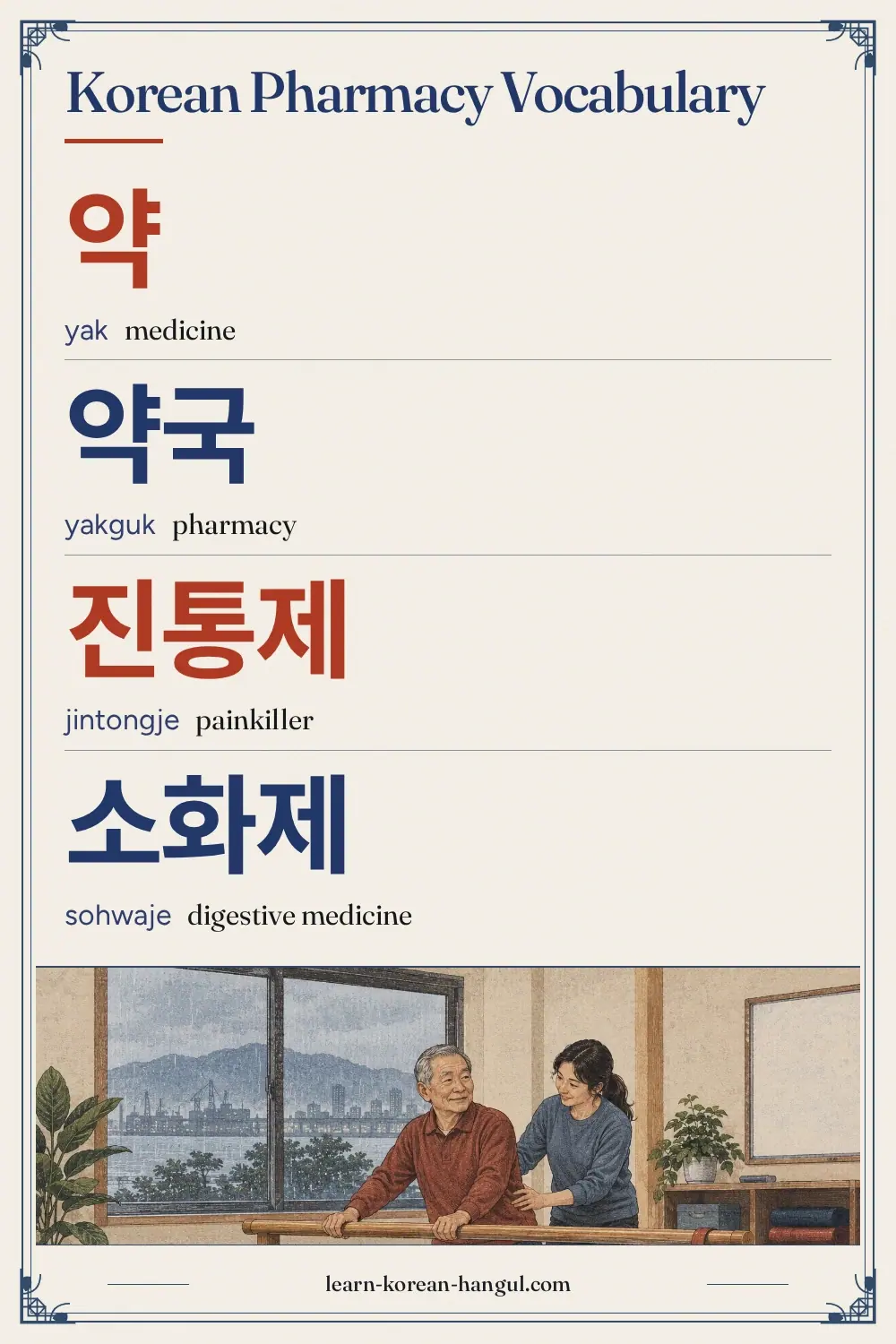
Korean Pharmacy Vocabulary at a Glance
This list has 30 words in five groups of six. It follows the order of a pharmacy visit: you name the kind of medicine you need, a pharmacist tells you how to take it, you ask about reactions, you add first aid items and you may buy a vitamin. It belongs to Health and Medicine, and it pairs with the symptom words, because the pharmacist first asks what is wrong.
| Group | Words | Use |
|---|---|---|
| Types of medicine | 6 | Asking for a medicine by name |
| Dosage and instructions | 6 | Reading when and how much to take |
| Side effects | 6 | Asking about and reporting reactions |
| First aid items | 6 | Buying supplies for minor injuries |
| Vitamins and supplements | 6 | Buying vitamins and nutritional products |
The words are mostly nouns, plus a few label words such as 식전 and 식후, which tell you when to take a dose. Learners often want to know which of the 30 matter most, so the next section ranks them.
Which Pharmacy Words Should You Learn First?
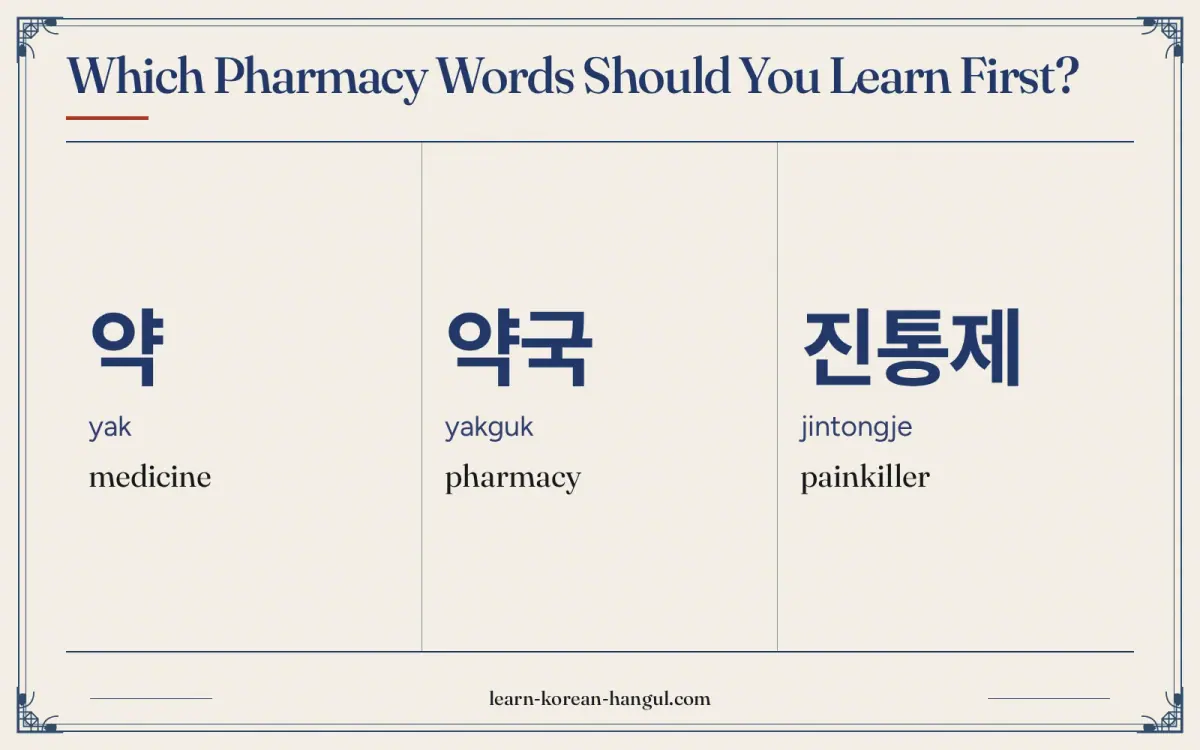
Learn 약 (medicine), 약국 (pharmacy), 처방전 (prescription), 식후 (after meals) and 부작용 (side effect) first. With those five you can say where you are going, whether you have a prescription and whether you can take a drug at once. Then add the medicine types, such as 진통제 (painkiller), that you are most likely to ask for by name.
- Words to say. 약, 진통제, 소화제, 감기약, 반창고. These are what you ask for across the counter.
- Words to recognise. 처방전, 식전, 식후, 복용, 부작용, 주의 사항. These are printed on labels and leaflets, so learn them by reading.
- Words to understand when spoken. 하루, 알 and 드세요. The pharmacist says these when explaining how to take a drug.
Korea has a few more habits worth knowing. Some medicines need a doctor's 처방전, while others you can buy freely; the law uses the terms 전문의약품 (prescription-only medicine) and 일반의약품 (over-the-counter medicine). A short list of basic medicines, such as some painkillers and digestive medicines, can also be sold at convenience stores. Confirm any specific rule with the pharmacist.
Word · 8
- 1
약
yak
medicine
- 2
약국
yakguk
pharmacy
- 3
진통제
jintongje
painkiller
- 4
소화제
sohwaje
digestive medicine
- 5
연고
yeongo
ointment
- 6
처방전
cheobangjeon
prescription
- 7
반창고
banchanggo
adhesive bandage
- 8
체온계
che-ongye
thermometer
Types of Medicine
The plain word for medicine is 약 (yak), and Korean makes types by adding a suffix. 제 (je) marks a medicine made to treat something, so 진통제 is a pain-stopping medicine and 소화제 is a digestion medicine. Compounds with 약 name the illness first: 감기약 is cold medicine. Say the name and then 주세요 (please give me) to ask for it.
| No. | Hangul | Revised Romanization | Meaning and note | Example sentence | Audio assetId |
|---|---|---|---|---|---|
| 1 | 약 | yak | medicine. Medicine is eaten (먹다), not drunk, in Korean. | 약을 먹어요. (I take medicine.) | au-pg-vocabulary-daily-life-health-pharmacy-1; example: au-pg-vocabulary-daily-life-health-pharmacy-31 |
| 2 | 약국 | yakguk | pharmacy. Said [약꾹]; 국 here means office, not soup. | 약국은 어디예요? (Where is the pharmacy?) | au-pg-vocabulary-daily-life-health-pharmacy-2; example: au-pg-vocabulary-daily-life-health-pharmacy-32 |
| 3 | 진통제 | jintongje | painkiller. 진통 means relief of pain; 제 means medicine. | 진통제 있어요? (Do you have a painkiller?) | au-pg-vocabulary-daily-life-health-pharmacy-3; example: au-pg-vocabulary-daily-life-health-pharmacy-33 |
| 4 | 소화제 | sohwaje | digestive medicine. 소화 is digestion; ask for it after a heavy meal. | 소화제 주세요. (A digestive medicine, please.) | au-pg-vocabulary-daily-life-health-pharmacy-4; example: au-pg-vocabulary-daily-life-health-pharmacy-34 |
| 5 | 감기약 | gamgiyak | cold medicine. 감기 is a cold; the same pattern works for 두통약. | 감기약 주세요. (Cold medicine, please.) | au-pg-vocabulary-daily-life-health-pharmacy-5; example: au-pg-vocabulary-daily-life-health-pharmacy-35 |
| 6 | 연고 | yeongo | ointment. The verb 바르다 means to spread on skin. | 연고를 발라요. (I apply ointment.) | au-pg-vocabulary-daily-life-health-pharmacy-6; example: au-pg-vocabulary-daily-life-health-pharmacy-36 |
Notice that the sentences end in 요 and use the object particle 을 after a consonant and 를 after a vowel. Ending a request with 주세요 is the safest polite form at any counter.
Example Sentences
Three frames cover most of the examples. The first is noun + 주세요 (please give me noun), as in 소화제 주세요. The second is noun + 있어요? (do you have noun?), as in 진통제 있어요?. The third is noun + 이/가 있어요 (I have noun), as in 알레르기가 있어요. Say each aloud after the audio. A pharmacist will usually answer with a dosage line, so keep reading to the label section.
Once you have the medicine, the next question is how to take it.
How Do You Say Dosage and Instructions in Korean?
A dosage instruction in Korean has three parts: when, how many and how often. 식전 and 식후 say when, a native number plus 알 says how many pills, and 하루 plus a number plus 번 says how often. 처방전 is the prescription the pharmacist reads first, and 복용 is the formal word for taking a medicine, the one printed on labels.
| No. | Hangul | Revised Romanization | Meaning and note | Example sentence | Audio assetId |
|---|---|---|---|---|---|
| 7 | 처방전 | cheobangjeon | prescription. A doctor writes it; the pharmacist fills it. | 처방전이 있어요. (I have a prescription.) | au-pg-vocabulary-daily-life-health-pharmacy-7; example: au-pg-vocabulary-daily-life-health-pharmacy-37 |
| 8 | 식전 | sikjeon | before meals. Said [식쩐]; 드세요 is the polite form of 먹다. | 식전에 드세요. (Please take it before meals.) | au-pg-vocabulary-daily-life-health-pharmacy-8; example: au-pg-vocabulary-daily-life-health-pharmacy-38 |
| 9 | 식후 | sikhu | after meals. Said [시쿠]; the most common label word. | 식후 삼십 분에 드세요. (Take it 30 minutes after meals.) | au-pg-vocabulary-daily-life-health-pharmacy-9; example: au-pg-vocabulary-daily-life-health-pharmacy-39 |
| 10 | 알 | al | pill (counter). Counts pills with native numbers: 한 알, 두 알. | 하루에 두 알 드세요. (Take two pills a day.) | au-pg-vocabulary-daily-life-health-pharmacy-10; example: au-pg-vocabulary-daily-life-health-pharmacy-40 |
| 11 | 복용 | bogyong | taking (a medicine); dose. Formal; used on labels and by pharmacists. | 복용 방법을 알려 주세요. (Please tell me how to take it.) | au-pg-vocabulary-daily-life-health-pharmacy-11; example: au-pg-vocabulary-daily-life-health-pharmacy-41 |
| 12 | 하루 | haru | one day; a day. Add 에 and a number plus 번 for times per day. | 하루에 세 번 드세요. (Take it three times a day.) | au-pg-vocabulary-daily-life-health-pharmacy-12; example: au-pg-vocabulary-daily-life-health-pharmacy-42 |
Native numbers drop their last syllable before a counter: 하나 becomes 한, 둘 becomes 두, 셋 becomes 세. That is why the sentence says 두 알 and 세 번, not 둘 알 and 셋 번. The same counter pattern is explained on the counters for things page, where 알 appears with other small round objects.
Dosage tells you how to take a drug, and the next group tells you what it might do to you.
Side Effects
Side effects are 부작용 (bujagyong), and a pharmacist will ask whether you have 알레르기 (an allergy) before selling you anything. The words here let you answer and ask. They also help you read the 주의 사항 (precautions) section, a block of text on every box. The usual question is 부작용이 있어요?, which asks whether there are side effects.
| No. | Hangul | Revised Romanization | Meaning and note | Example sentence | Audio assetId |
|---|---|---|---|---|---|
| 13 | 부작용 | bujagyong | side effect. Said [부자굥]; 작용 means action or effect. | 부작용이 있어요? (Are there side effects?) | au-pg-vocabulary-daily-life-health-pharmacy-13; example: au-pg-vocabulary-daily-life-health-pharmacy-43 |
| 14 | 알레르기 | allereugi | allergy. Say the name of the drug you react to. | 알레르기가 있어요. (I have an allergy.) | au-pg-vocabulary-daily-life-health-pharmacy-14; example: au-pg-vocabulary-daily-life-health-pharmacy-44 |
| 15 | 졸음 | joreum | drowsiness. Many cold medicines cause this. | 졸음이 와요. (Drowsiness comes (I feel sleepy).) | au-pg-vocabulary-daily-life-health-pharmacy-15; example: au-pg-vocabulary-daily-life-health-pharmacy-45 |
| 16 | 어지럼증 | eojireomjeung | dizziness. In speech people usually say 어지러워요 (I feel dizzy). | 어지럼증이 있어요. (I have dizziness.) | au-pg-vocabulary-daily-life-health-pharmacy-16; example: au-pg-vocabulary-daily-life-health-pharmacy-46 |
| 17 | 발진 | baljin | rash. Said [발찐]; 생기다 means to appear. | 발진이 생겼어요. (A rash appeared.) | au-pg-vocabulary-daily-life-health-pharmacy-17; example: au-pg-vocabulary-daily-life-health-pharmacy-47 |
| 18 | 주의 사항 | juui sahang | precautions; warnings. Often printed in small type on the box. | 주의 사항을 읽어요. (I read the precautions.) | au-pg-vocabulary-daily-life-health-pharmacy-18; example: au-pg-vocabulary-daily-life-health-pharmacy-48 |
If a reaction is severe, do not rely on this list. Go to an emergency room and use the emergency phrases, which give full sentences. The vocabulary here is for ordinary questions at a counter.
Many pharmacy trips are not about illness at all, but about small injuries at home.
How Do You Say First Aid Items in Korean?
First aid items are sold at pharmacies and convenience stores, and the names are short. Several are loanwords or half-loanwords, such as 마스크 (mask), while others are Sino-Korean compounds, such as 소독약. A thermometer is 체온계, built from 체온 (body temperature) and 계 (instrument), the same 계 that appears in other measuring tools.
| No. | Hangul | Revised Romanization | Meaning and note | Example sentence | Audio assetId |
|---|---|---|---|---|---|
| 19 | 반창고 | banchanggo | adhesive bandage. The everyday word for a plaster or Band-Aid. | 반창고 있어요? (Do you have adhesive bandages?) | au-pg-vocabulary-daily-life-health-pharmacy-19; example: au-pg-vocabulary-daily-life-health-pharmacy-49 |
| 20 | 붕대 | bungdae | bandage (roll). 감다 means to wrap around. | 붕대를 감아요. (I wrap a bandage.) | au-pg-vocabulary-daily-life-health-pharmacy-20; example: au-pg-vocabulary-daily-life-health-pharmacy-50 |
| 21 | 소독약 | sodogyak | antiseptic. 소독 is disinfection. | 소독약을 발라요. (I apply antiseptic.) | au-pg-vocabulary-daily-life-health-pharmacy-21; example: au-pg-vocabulary-daily-life-health-pharmacy-51 |
| 22 | 체온계 | che-ongye | thermometer. 체온 is body temperature; 계 marks an instrument. | 체온계를 써요. (I use a thermometer.) | au-pg-vocabulary-daily-life-health-pharmacy-22; example: au-pg-vocabulary-daily-life-health-pharmacy-52 |
| 23 | 파스 | paseu | medicated patch. Used for sore muscles and joints. | 파스를 붙여요. (I stick on a medicated patch.) | au-pg-vocabulary-daily-life-health-pharmacy-23; example: au-pg-vocabulary-daily-life-health-pharmacy-53 |
| 24 | 마스크 | maseukeu | mask. Wear on the face uses 쓰다. | 마스크를 써요. (I wear a mask.) | au-pg-vocabulary-daily-life-health-pharmacy-24; example: au-pg-vocabulary-daily-life-health-pharmacy-54 |
Two verbs repay attention. 바르다 (to spread) goes with ointments and antiseptics, while 붙이다 (to stick on) goes with patches. The verb for a mask is 쓰다, the same word as for a hat or glasses.
The last group covers the shelves most visitors browse without a prescription.
Vitamins and Supplements
Korean pharmacies and drugstores sell a wide range of supplements, so these six words help you read shelf labels. The general term is 영양제, a nutrition product, and the specific names mix loanwords (비타민, 칼슘) with Sino-Korean words (유산균, 철분). 홍삼 is red ginseng, ginseng that has been steamed and dried, a traditional health product that many people take for energy.
| No. | Hangul | Revised Romanization | Meaning and note | Example sentence | Audio assetId |
|---|---|---|---|---|---|
| 25 | 비타민 | bitamin | vitamin. A loanword; vitamin C is 비타민 씨. | 비타민을 먹어요. (I take vitamins.) | au-pg-vocabulary-daily-life-health-pharmacy-25; example: au-pg-vocabulary-daily-life-health-pharmacy-55 |
| 26 | 영양제 | yeongyangje | nutritional supplement. 영양 means nutrition; 제 means medicine. | 영양제를 먹어요. (I take a supplement.) | au-pg-vocabulary-daily-life-health-pharmacy-26; example: au-pg-vocabulary-daily-life-health-pharmacy-56 |
| 27 | 유산균 | yusangyun | probiotics. Literally lactic-acid bacteria. | 유산균을 먹어요. (I take probiotics.) | au-pg-vocabulary-daily-life-health-pharmacy-27; example: au-pg-vocabulary-daily-life-health-pharmacy-57 |
| 28 | 홍삼 | hongsam | red ginseng. Sold as a drink, a paste or a capsule. | 홍삼을 마셔요. (I drink red ginseng.) | au-pg-vocabulary-daily-life-health-pharmacy-28; example: au-pg-vocabulary-daily-life-health-pharmacy-58 |
| 29 | 철분 | cheolbun | iron (mineral). 부족하다 means to be short of. | 철분이 부족해요. (Iron is lacking.) | au-pg-vocabulary-daily-life-health-pharmacy-29; example: au-pg-vocabulary-daily-life-health-pharmacy-59 |
| 30 | 칼슘 | kalsyum | calcium. Written 칼슘; the sound is kal-syum. | 칼슘을 먹어요. (I take calcium.) | au-pg-vocabulary-daily-life-health-pharmacy-30; example: au-pg-vocabulary-daily-life-health-pharmacy-60 |
Before the sound notes, here is how the words work together on a real label.
How Do You Read a Korean Medicine Label?
A label packs the dosage into a few short lines. The sample below shows the three that matter. Read them from left to right: how often, when, how many. Numerals on labels are often digits, so you need to know their spoken forms.
| On the label | How a pharmacist says it | Meaning |
|---|---|---|
| 하루 3회 | 하루에 세 번 (haru-e se beon) | three times a day |
| 식후 30분 | 식후 삼십 분 (sikhu samsip bun) | 30 minutes after meals |
| 1회 2알 | 한 번에 두 알 (han beone du al) | two pills each time |
| 식전 | 식전 (sikjeon) | before meals |
The label counter 회 (hoe) means times, and in speech it is usually replaced by 번. Read aloud as written, 하루 3회 is 하루 삼 회. The numbers with 회 and 분 use Sino-Korean numbers (삼, 삼십) on labels, while 알 and 번 use native numbers (두, 세). Mixing the two systems is normal. Check the counters for things page before you go.
How Do You Pronounce These Words?
Pharmacy words contain several sound changes, because many end in a consonant. Standard pronunciation follows the National Institute of Korean Language (국립국어원) rules, and the romanization follows the Revised Romanization of Korean, which does not mark every sound change.
| Spelling | Sounds like | What changes |
|---|---|---|
| 약국 | [약꾹] | The final ㄱ makes the next ㄱ tense, so 국 is said [꾹]. |
| 식후 | [시쿠] | ㄱ followed by ㅎ merges into [ㅋ]; the ㄱ moves into the next syllable. |
| 식전 | [식쩐] | After a final ㄱ, the ㅈ is said as a tense [ㅉ]. |
| 복용 | [보굥] | The final ㄱ links to the vowel sound of the next syllable. |
| 부작용 | [부자굥] | Same linking: the ㄱ of 작 moves to 용. |
The tense sounds in 약국 and 식전 are the ones learners most often get wrong. Say the second sound with a tight throat and no puff of breath. The pronunciation pages of this site explain tense sounds in more detail.
Audio and Slow Playback
Every word and every example sentence has its own clip. The five clips below replay the trickiest words slowly. Play one, repeat it aloud, then play it again and compare.
What Mistakes Do Learners Make with Pharmacy Words?
These five mistakes cause most misunderstandings at a counter.
- Saying 약 when you mean the shop. 약 is medicine and 약국 is the pharmacy. Use 약국에 가요 for I am going to the pharmacy.
- Drinking medicine. Korean says 약을 먹다, to eat medicine, even for liquids and pills. 마시다 is for drinks and is not used for ordinary medicine. Drink-type products, such as a bottle of 홍삼, take 마시다.
- Mixing up 식전 and 식후. 전 means before and 후 means after. Check the second character, not the first.
- Using 개 for pills. Count pills with 알, as in 두 알. Use 개 for general objects, not for tablets.
- Expecting every medicine behind the counter. Some basic medicines are also sold in convenience stores, and strong medicines need a 처방전. Ask 처방전이 필요해요? to check.
Learning the counters and the two label words 식전 and 식후 removes most of the risk.
Practice: Flashcards and Worksheet
Study in three steps. First, run the flashcard deck in recognition mode until you recognise each of the 30 words. Second, switch to listening mode. Third, take the quiz. The deck covers all 30 words with audio, and your progress stays in your browser. The vocabulary flashcard decks page lists the other decks.
Practice · 65
- 01약
Show answer
headword 1: medicine
- 02약국
Show answer
headword 2: pharmacy
- 03진통제
Show answer
headword 3: painkiller
- 04소화제
Show answer
headword 4: digestive medicine
- 05감기약
Show answer
headword 5: cold medicine
- 06연고
Show answer
headword 6: ointment
- 07처방전
Show answer
headword 7: prescription
- 08식전
Show answer
headword 8: before meals
- 09식후
Show answer
headword 9: after meals
- 10알
Show answer
headword 10: pill (counter)
- 11복용
Show answer
headword 11: taking (a medicine); dose
- 12하루
Show answer
headword 12: one day; a day
- 13부작용
Show answer
headword 13: side effect
- 14알레르기
Show answer
headword 14: allergy
- 15졸음
Show answer
headword 15: drowsiness
- 16어지럼증
Show answer
headword 16: dizziness
- 17발진
Show answer
headword 17: rash
- 18주의 사항
Show answer
headword 18: precautions; warnings
- 19반창고
Show answer
headword 19: adhesive bandage
- 20붕대
Show answer
headword 20: bandage (roll)
- 21소독약
Show answer
headword 21: antiseptic
- 22체온계
Show answer
headword 22: thermometer
- 23파스
Show answer
headword 23: medicated patch
- 24마스크
Show answer
headword 24: mask
- 25비타민
Show answer
headword 25: vitamin
- 26영양제
Show answer
headword 26: nutritional supplement
- 27유산균
Show answer
headword 27: probiotics
- 28홍삼
Show answer
headword 28: red ginseng
- 29철분
Show answer
headword 29: iron (mineral)
- 30칼슘
Show answer
headword 30: calcium
- 31약을 먹어요.
Show answer
example sentence for headword 1
- 32약국은 어디예요?
Show answer
example sentence for headword 2
- 33진통제 있어요?
Show answer
example sentence for headword 3
- 34소화제 주세요.
Show answer
example sentence for headword 4
- 35감기약 주세요.
Show answer
example sentence for headword 5
- 36연고를 발라요.
Show answer
example sentence for headword 6
- 37처방전이 있어요.
Show answer
example sentence for headword 7
- 38식전에 드세요.
Show answer
example sentence for headword 8
- 39식후 삼십 분에 드세요.
Show answer
example sentence for headword 9
- 40하루에 두 알 드세요.
Show answer
example sentence for headword 10
- 41복용 방법을 알려 주세요.
Show answer
example sentence for headword 11
- 42하루에 세 번 드세요.
Show answer
example sentence for headword 12
- 43부작용이 있어요?
Show answer
example sentence for headword 13
- 44알레르기가 있어요.
Show answer
example sentence for headword 14
- 45졸음이 와요.
Show answer
example sentence for headword 15
- 46어지럼증이 있어요.
Show answer
example sentence for headword 16
- 47발진이 생겼어요.
Show answer
example sentence for headword 17
- 48주의 사항을 읽어요.
Show answer
example sentence for headword 18
- 49반창고 있어요?
Show answer
example sentence for headword 19
- 50붕대를 감아요.
Show answer
example sentence for headword 20
- 51소독약을 발라요.
Show answer
example sentence for headword 21
- 52체온계를 써요.
Show answer
example sentence for headword 22
- 53파스를 붙여요.
Show answer
example sentence for headword 23
- 54마스크를 써요.
Show answer
example sentence for headword 24
- 55비타민을 먹어요.
Show answer
example sentence for headword 25
- 56영양제를 먹어요.
Show answer
example sentence for headword 26
- 57유산균을 먹어요.
Show answer
example sentence for headword 27
- 58홍삼을 마셔요.
Show answer
example sentence for headword 28
- 59철분이 부족해요.
Show answer
example sentence for headword 29
- 60칼슘을 먹어요.
Show answer
example sentence for headword 30
- 61약국
Show answer
slow playback of headword 2: pharmacy
- 62식후
Show answer
slow playback of headword 9: after meals
- 63식전
Show answer
slow playback of headword 8: before meals
- 64복용
Show answer
slow playback of headword 11: taking (a medicine); dose
- 65부작용
Show answer
slow playback of headword 13: side effect
Practice · 5
What does 진통제 (jintongje) mean?
Show answer
painkiller
진통제 means painkiller. Example: 진통제 있어요? (Do you have a painkiller?)
What does 처방전 (cheobangjeon) mean?
Show answer
prescription
처방전 means prescription. Example: 처방전이 있어요. (I have a prescription.)
What does 식후 (sikhu) mean?
Show answer
after meals
식후 means after meals. Example: 식후 삼십 분에 드세요. (Take it 30 minutes after meals.)
What does 부작용 (bujagyong) mean?
Show answer
side effect
부작용 means side effect. Example: 부작용이 있어요? (Are there side effects?)
What does 반창고 (banchanggo) mean?
Show answer
adhesive bandage
반창고 means adhesive bandage. Example: 반창고 있어요? (Do you have adhesive bandages?)
Korean Pharmacy Vocabulary Worksheet (PDF)
A printable worksheet for these words (word list, matching, writing practice, fill-in-the-blank exercises and answer key) is available in A4 and US Letter from the download card on this page. For practice, copy the 30 words by hand and write the meaning beside each. Writing the label line 식후 30분 yourself fixes both the word and the number pattern.
Where to Go Next
After this page, continue with Korean Symptoms Vocabulary, which teaches the words a pharmacist asks about first, or Korean Dentist Vocabulary. For the single word, see pharmacy in Korean. To move up a level, return to Health and Medicine.
Frequently Asked Questions
How Do You Say Medicine in Korean?
Medicine is 약 (yak). Add 을 to make an object, as in 약을 먹어요 (I take medicine). Korean uses the verb 먹다, which means to eat, for ordinary medicine. A pharmacy is 약국 (yakguk), pronounced [약꾹], and a prescription is 처방전 (cheobangjeon).
How Do You Pronounce 약국 (yakguk)?
Say yak-guk, but make the second sound tense, as in [약꾹]. After a final ㄱ, the next ㄱ is said tight and unaspirated, with no puff of breath. Both syllables end in a closed k sound. Press the audio button on this page for the normal and slow versions.
How Many Pharmacy Words Should I Learn First?
Five first: 약, 약국, 처방전, 식후 and 부작용. At five new words a day the whole list of 30 takes six days plus review. Add the medicine types you actually expect to ask for, such as 진통제 or 소화제.
Where Can I Practise Pharmacy Words with Flashcards?
Use the vocabulary flashcard decks. The deck for this page holds all 30 words with Hangul, romanization and audio, with recognition and listening modes. Your progress stays in your browser. Return daily and review the cards you missed.
Is the Romanization on This Page Official?
It follows the Revised Romanization of Korean, which South Korea adopted on 7 July 2000 and whose rules the National Institute of Korean Language (국립국어원) publishes. It is a learning aid and does not mark every sound change, so rely on the Hangul and the audio.
Is There a Printable Worksheet for Pharmacy Words?
A printable worksheet for these words (word list, matching, writing practice, fill-in-the-blank exercises and answer key) is available in A4 and US Letter from the download card on this page. For practice, copy the tables on this page by hand or use the flashcard deck, which carries the same 30 words.