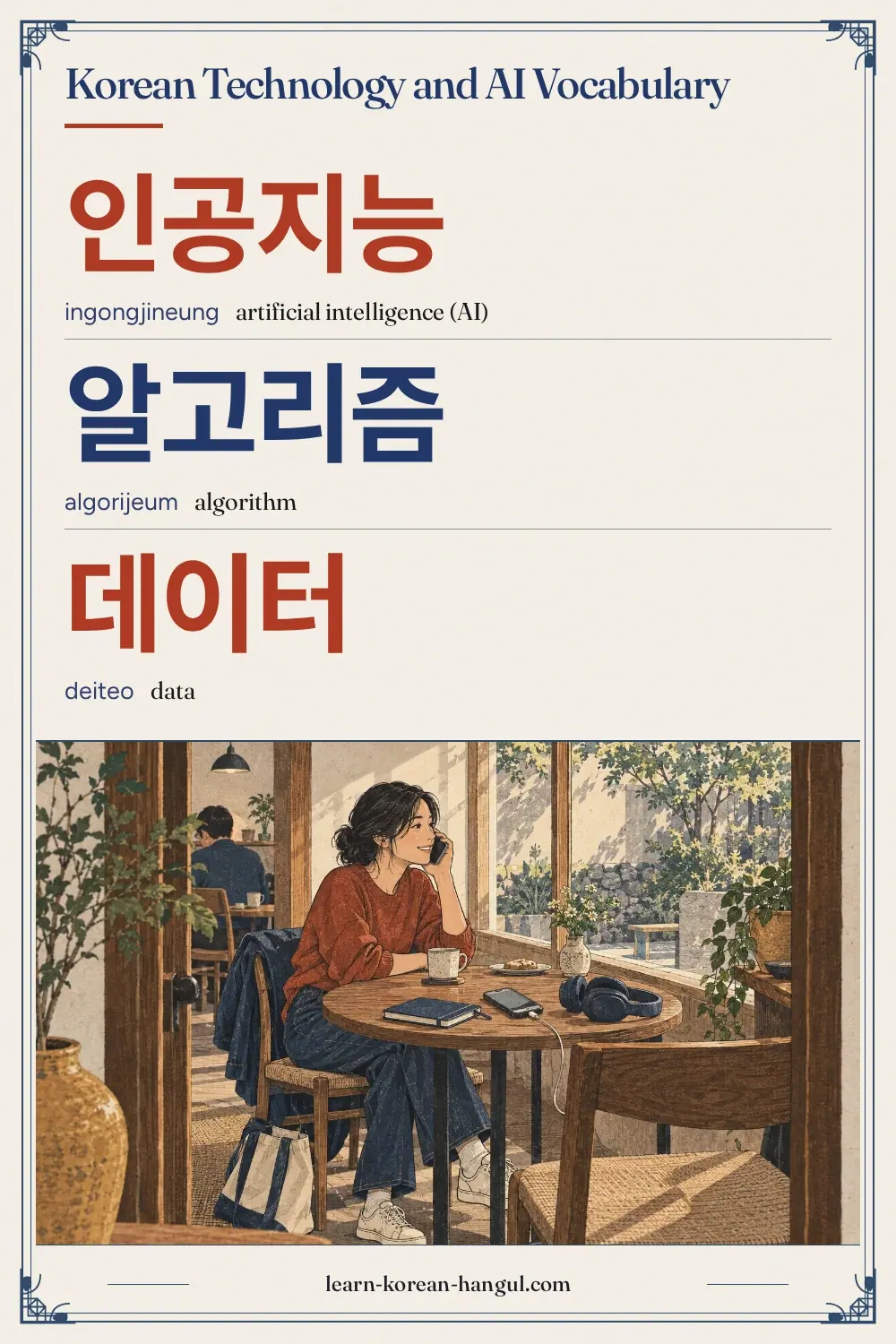
Korean Technology and AI Vocabulary at a Glance
This list has 35 words in five groups of seven. It starts with the core AI terms, then the data and software they run on, then the robots and devices that use them, then the people and companies that build them, and ends with the words for rules, rights and risks. It belongs to Technology and Internet and follows Korean Computer and Internet Vocabulary.
| Group | Words | Use |
|---|---|---|
| AI and algorithms | 7 | The core words about artificial intelligence |
| Data and software | 7 | What AI runs on |
| Robots and devices | 7 | Machines that act on their own |
| Developers and start-ups | 7 | People, companies and money |
| Ethics, safety and society | 7 | Rules, rights and risks |
Most are nouns, and many take 하다 or 되다 to become verbs, such as 자동화되다 (be automated), 투자하다 (invest) and 연구하다 (research). The words come from two sources. Sino-Korean words, such as 지능, 기술 and 정보, are built from short parts. Loanwords, such as 로봇, 센서 and 클라우드, are written the way Korean hears the English word. News reports use both kinds.
Which Technology and AI Words Should You Learn First?
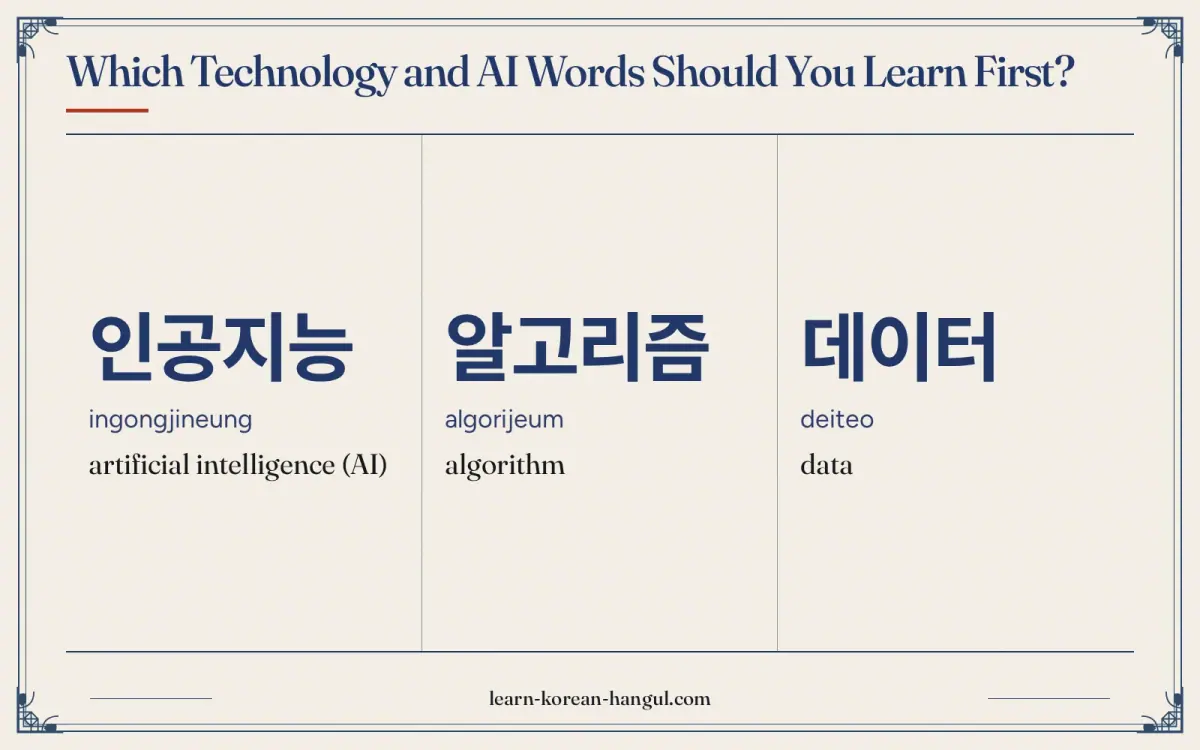
Learn 인공지능 (artificial intelligence), 데이터 (data), 기술 (technology), 로봇 (robot) and 정보 (information) first. These five appear in almost every news report and class on technology, and the rest of the list builds on them. After them, add 알고리즘, 개발자 and 개인정보.
- Words to say. 인공지능, 데이터, 기술, 로봇, 정보, 개발자. You use them when you talk about work, study or the news.
- Words to recognise. 알고리즘, 소프트웨어, 클라우드, 센서, 스타트업, 투자. They appear in headlines and on company pages.
- Words to understand when spoken. 윤리, 규제, 저작권, 딥페이크, 편향. A debate, a lecture or a news anchor uses these.
The vocabulary on this page changes quickly, because new tools appear all the time. The core words stay the same, while the brand names and new terms change, so learn the core words first. For the single-word answer, see technology in korean.
Word · 12
- 1
인공지능
ingongjineung
artificial intelligence (AI)
- 2
알고리즘
algorijeum
algorithm
- 3
데이터
deiteo
data
- 4
클라우드
keullaudeu
cloud (computing)
- 5
로봇
robot
robot
- 6
센서
senseo
sensor
- 7
드론
deuron
drone
- 8
자율주행
jayuljuhaeng
self-driving; autonomous driving
- 9
가상현실
gasanghyeonsil
virtual reality
- 10
개발자
gaebalja
developer; software developer
- 11
스타트업
seutateueop
start-up
- 12
저작권
jeojakgwon
copyright
How Do You Say Artificial Intelligence in Korean?
These seven words are the core of any conversation about AI. The first three name the field, and the last four name how it works: the rules, the learning, the chatbot and the output. Several are built from the same Sino-Korean parts, so you can reuse what you learn.
| No. | Hangul | Revised Romanization | Meaning and note | Example sentence | Audio assetId |
|---|---|---|---|---|---|
| 1 | 인공지능 | ingongjineung | artificial intelligence (AI). 인공 (artificial) + 지능 (intelligence). The usual word in news and in formal writing. | 인공지능이 번역을 도와줘요. (Artificial intelligence helps with translation.) | au-pg-vocabulary-daily-life-technology-ai-1; example: au-pg-vocabulary-daily-life-technology-ai-36 |
| 2 | 에이아이 | eiai | AI (the letters A and I). The spoken form of the letters AI. It is often written in Latin letters, AI, and read aloud as 에이아이. | 요즘 에이아이 기술이 빨리 발전해요. (These days AI technology develops quickly.) | au-pg-vocabulary-daily-life-technology-ai-2; example: au-pg-vocabulary-daily-life-technology-ai-37 |
| 3 | 지능 | jineung | intelligence. The ability to think and learn. It is the second half of 인공지능. Also seen in 지능 지수 (IQ). | 동물도 지능이 있어요. (Animals also have intelligence.) | au-pg-vocabulary-daily-life-technology-ai-3; example: au-pg-vocabulary-daily-life-technology-ai-38 |
| 4 | 알고리즘 | algorijeum | algorithm. A loanword from English. The ㅡ in the last syllable is unrounded. | 이 알고리즘은 사진을 분류해요. (This algorithm sorts photos.) | au-pg-vocabulary-daily-life-technology-ai-4; example: au-pg-vocabulary-daily-life-technology-ai-39 |
| 5 | 학습 | hakseup | learning; training (of a model). Said [학씁]. 학 (learn) + 습 (practise). In school it means study, and in AI it means training. | 컴퓨터가 데이터를 학습해요. (The computer learns from data.) | au-pg-vocabulary-daily-life-technology-ai-5; example: au-pg-vocabulary-daily-life-technology-ai-40 |
| 6 | 챗봇 | chaetbot | chatbot. Said [챋뽇]. 챗 (chat) + 봇 (bot). A program that answers in text. | 챗봇에 질문했어요. (I asked the chatbot a question.) | au-pg-vocabulary-daily-life-technology-ai-6; example: au-pg-vocabulary-daily-life-technology-ai-41 |
| 7 | 생성 | saengseong | generation; creating. A formal noun. 생성형 (generative) goes in front of a noun: 생성형 인공지능 is generative AI. | 이미지 생성은 몇 초 걸려요. (Image generation takes a few seconds.) | au-pg-vocabulary-daily-life-technology-ai-7; example: au-pg-vocabulary-daily-life-technology-ai-42 |
Example Sentences
The sentences use three frames. The first is subject + 이/가 + object + 을/를 + verb, as in 컴퓨터가 데이터를 학습해요 (the computer learns from data). The second is subject + 은/는 + object + 을/를 + verb, as in 이 알고리즘은 사진을 분류해요, where 은 marks the topic. The third is target + 에 + verb, as in 챗봇에 질문했어요, where 에 marks the one you ask. After a vowel the subject particle is 가, and after a consonant it is 이: 컴퓨터가, 인공지능이. Say each sentence aloud after its clip.
The verb 도와주다 (help) is a compound verb. Its polite form is 도와줘요, as in 인공지능이 번역을 도와줘요. The long form is 도와주어요, but the short form 도와줘요 is what people say.
Data and Software
These seven words name the things that AI and other systems run on: the data, the software, the storage and the technology itself. They are loanwords or short Sino-Korean words, and they appear on every company page and in every news report on technology.
| No. | Hangul | Revised Romanization | Meaning and note | Example sentence | Audio assetId |
|---|---|---|---|---|---|
| 8 | 데이터 | deiteo | data. A loanword. Raw facts and numbers. 정보 is processed information. | 데이터를 저장해요. (I store the data.) | au-pg-vocabulary-daily-life-technology-ai-8; example: au-pg-vocabulary-daily-life-technology-ai-43 |
| 9 | 정보 | jeongbo | information. Facts that have meaning for a reader. It is a Sino-Korean word, and it is in 개인정보 too. | 이 사이트에는 정보가 많아요. (There is a lot of information on this site.) | au-pg-vocabulary-daily-life-technology-ai-9; example: au-pg-vocabulary-daily-life-technology-ai-44 |
| 10 | 기술 | gisul | technology; skill. The word for technology and for a technical skill. 신기술 is new technology. | 새로운 기술을 배워요. (I learn a new technology.) | au-pg-vocabulary-daily-life-technology-ai-10; example: au-pg-vocabulary-daily-life-technology-ai-45 |
| 11 | 시스템 | siseutem | system. A loanword. Used for computer systems and also for any organised system. | 시스템이 갑자기 멈췄어요. (The system suddenly stopped.) | au-pg-vocabulary-daily-life-technology-ai-11; example: au-pg-vocabulary-daily-life-technology-ai-46 |
| 12 | 소프트웨어 | sopeuteuweeo | software. A long loanword with five syllables. The pair is 하드웨어, hardware. | 소프트웨어를 업데이트해요. (I update the software.) | au-pg-vocabulary-daily-life-technology-ai-12; example: au-pg-vocabulary-daily-life-technology-ai-47 |
| 13 | 클라우드 | keullaudeu | cloud (computing). A loanword. Photos or files stored on the cloud are 클라우드에 저장된 파일. | 사진을 클라우드에 올려요. (I upload photos to the cloud.) | au-pg-vocabulary-daily-life-technology-ai-13; example: au-pg-vocabulary-daily-life-technology-ai-48 |
| 14 | 개인정보 | gaeinjeongbo | personal information. 개인 (individual) + 정보 (information). It is usually written as one word, and the spaced 개인 정보 is also correct. | 개인정보를 보호해야 해요. (You must protect personal information.) | au-pg-vocabulary-daily-life-technology-ai-14; example: au-pg-vocabulary-daily-life-technology-ai-49 |
The difference between 데이터 and 정보 is worth knowing. 데이터 is the raw material, such as a list of numbers, and 정보 is what you learn from it. A shop's sales figures are 데이터, and the fact that more people buy on Friday is 정보. In everyday talk the line between them is loose, but technical writing keeps them apart, and a report may use both in the same sentence.
The word 기술 has two meanings. It can mean technology, as in 정보 기술 (information technology), or a skill, as in 요리 기술 (cooking skill). The sentence tells you which. The related word 기술자 means an engineer or a technician.
How Do You Say Robot and Drone in Korean?
Robots and devices are the machines that do jobs without a person's help. These seven words cover the machine, the idea of automation, the sensor that gives it information, and the new devices: drones, self-driving cars and virtual reality. Most are loanwords.
| No. | Hangul | Revised Romanization | Meaning and note | Example sentence | Audio assetId |
|---|---|---|---|---|---|
| 15 | 로봇 | robot | robot. Said [로볻]. A loanword. A cleaning robot is 청소 로봇 and a robot vacuum is 로봇 청소기. | 로봇이 청소를 해요. (The robot does the cleaning.) | au-pg-vocabulary-daily-life-technology-ai-15; example: au-pg-vocabulary-daily-life-technology-ai-50 |
| 16 | 자동화 | jadonghwa | automation. 자동 (automatic) + 화 (turning into). 화 is a suffix, like -ization. | 공장은 자동화되고 있어요. (The factory is being automated.) | au-pg-vocabulary-daily-life-technology-ai-16; example: au-pg-vocabulary-daily-life-technology-ai-51 |
| 17 | 센서 | senseo | sensor. A loanword. Parts of a phone, a car or a smart home that detect motion, light or heat. | 센서가 움직임을 감지해요. (The sensor detects movement.) | au-pg-vocabulary-daily-life-technology-ai-17; example: au-pg-vocabulary-daily-life-technology-ai-52 |
| 18 | 드론 | deuron | drone. A loanword. Used for camera drones and for delivery drones. | 드론으로 사진을 찍어요. (I take photos with a drone.) | au-pg-vocabulary-daily-life-technology-ai-18; example: au-pg-vocabulary-daily-life-technology-ai-53 |
| 19 | 자율주행 | jayuljuhaeng | self-driving; autonomous driving. 자율 (acting on its own) + 주행 (driving). 자율주행 자동차 is a self-driving car. | 자율주행 자동차가 도로를 달려요. (A self-driving car runs on the road.) | au-pg-vocabulary-daily-life-technology-ai-19; example: au-pg-vocabulary-daily-life-technology-ai-54 |
| 20 | 스마트 | seumateu | smart. A loanword, used as a prefix: 스마트 시계 (smartwatch), 스마트 홈 (smart home). | 스마트 시계를 사고 싶어요. (I want to buy a smartwatch.) | au-pg-vocabulary-daily-life-technology-ai-20; example: au-pg-vocabulary-daily-life-technology-ai-55 |
| 21 | 가상현실 | gasanghyeonsil | virtual reality. 가상 (virtual) + 현실 (reality). Often shortened to the letters VR. | 가상현실 게임을 해 봤어요. (I have tried a virtual reality game.) | au-pg-vocabulary-daily-life-technology-ai-21; example: au-pg-vocabulary-daily-life-technology-ai-56 |
Several words here make longer terms by joining with a noun. 로봇 + 청소기 gives a robot vacuum, 스마트 + 시계 gives a smartwatch, and 자율주행 + 자동차 gives a self-driving car. Korean noun phrases are put together in this way, so one new word can open many phrases.
The sentence 가상현실 게임을 해 봤어요 uses the pattern -아/어 보다, which means try doing something or have done it. 해 봤어요 is the past of 해 보다 and means I have tried it. This is a useful pattern when you talk about new technology.
Developers and Start-Ups
These seven words name the people who build technology and the companies and money behind them. They are the words you hear in a job interview, in a business news report and at a technology event. The group mixes Sino-Korean words with loanwords.
| No. | Hangul | Revised Romanization | Meaning and note | Example sentence | Audio assetId |
|---|---|---|---|---|---|
| 22 | 개발자 | gaebalja | developer; software developer. 개발 (development) + 자 (person). The ending 자 is the usual way to name a person by role. | 제 동생은 개발자예요. (My younger sibling is a developer.) | au-pg-vocabulary-daily-life-technology-ai-22; example: au-pg-vocabulary-daily-life-technology-ai-57 |
| 23 | 엔지니어 | enjinieo | engineer. A loanword. The Sino-Korean word 기술자 is used for a technician. In job titles, 엔지니어 is common. | 그는 소프트웨어 엔지니어예요. (He is a software engineer.) | au-pg-vocabulary-daily-life-technology-ai-23; example: au-pg-vocabulary-daily-life-technology-ai-58 |
| 24 | 연구 | yeongu | research; study. With 하다 it is 연구하다. Researchers are 연구원, and a research lab is 연구소. | 대학에서 인공지능을 연구해요. (I research artificial intelligence at the university.) | au-pg-vocabulary-daily-life-technology-ai-24; example: au-pg-vocabulary-daily-life-technology-ai-59 |
| 25 | 스타트업 | seutateueop | start-up. A loanword for a young technology company. Written as one word. | 친구가 스타트업에서 일해요. (My friend works at a start-up.) | au-pg-vocabulary-daily-life-technology-ai-25; example: au-pg-vocabulary-daily-life-technology-ai-60 |
| 26 | 투자 | tuja | investment. With 하다 it is 투자하다. The company you invest in takes 에: 이 회사에 투자해요. | 이 회사에 투자했어요. (I invested in this company.) | au-pg-vocabulary-daily-life-technology-ai-26; example: au-pg-vocabulary-daily-life-technology-ai-61 |
| 27 | 혁신 | hyeoksin | innovation. Said [혁씬]. 혁 (renew) + 신 (new). A common word in business talk and company slogans. | 혁신이 필요해요. (Innovation is needed.) | au-pg-vocabulary-daily-life-technology-ai-27; example: au-pg-vocabulary-daily-life-technology-ai-62 |
| 28 | 창업 | changeop | starting a business; founding. 창 (create) + 업 (business). With 하다 it is 창업하다, meaning to start a company. | 내년에 창업할 거예요. (I will start a business next year.) | au-pg-vocabulary-daily-life-technology-ai-28; example: au-pg-vocabulary-daily-life-technology-ai-63 |
The ending 자 names a person who does something: 개발자 (developer), 연구자 (researcher), 투자자 (investor), 창업자 (founder). Once you know the pattern, you can read many job titles. A related ending, 원, names a member, as in 연구원 (researcher at an institute) and 직원 (staff member).
The sentence 내년에 창업할 거예요 uses the future ending -ㄹ 거예요. The verb 창업하다 is a 하다 verb, so its future form is 창업할 거예요. The sound is [창어팔꺼예요], with the tense ㄲ attached. For the ending, see the future ending.
Ethics, Safety and Society
Technology also raises questions about rules, rights and risks. These seven words are the ones used in news reports and debates about AI: ethics, regulation, copyright, deepfakes, bias, jobs and new technology. They are formal words, so you will see them more often than you hear them.
| No. | Hangul | Revised Romanization | Meaning and note | Example sentence | Audio assetId |
|---|---|---|---|---|---|
| 29 | 윤리 | yulli | ethics; morals. Said [율리]. 윤 (principle) + 리 (reason). The ㄴ becomes ㄹ before ㄹ. AI 윤리 is the usual phrase. | 인공지능 윤리가 중요해요. (AI ethics is important.) | au-pg-vocabulary-daily-life-technology-ai-29; example: au-pg-vocabulary-daily-life-technology-ai-64 |
| 30 | 규제 | gyuje | regulation; restriction. A formal noun for rules that limit something. With 하다 it is 규제하다. | 정부가 새로운 규제를 만들었어요. (The government made new regulations.) | au-pg-vocabulary-daily-life-technology-ai-30; example: au-pg-vocabulary-daily-life-technology-ai-65 |
| 31 | 저작권 | jeojakgwon | copyright. Said [저작꿘]. 저작 (authorship) + 권 (right). The ㄱ of 권 is tense. | 저작권을 지켜야 해요. (You must respect copyright.) | au-pg-vocabulary-daily-life-technology-ai-31; example: au-pg-vocabulary-daily-life-technology-ai-66 |
| 32 | 딥페이크 | dippeikeu | deepfake. 딥 (deep) + 페이크 (fake). A loanword for a fake video or voice made with AI. | 딥페이크 영상을 조심하세요. (Be careful of deepfake videos.) | au-pg-vocabulary-daily-life-technology-ai-32; example: au-pg-vocabulary-daily-life-technology-ai-67 |
| 33 | 편향 | pyeonhyang | bias; skew. A formal noun. 편 (one side) + 향 (direction). Used for bias in data or in a model. | 데이터에 편향이 있을 수 있어요. (There may be bias in the data.) | au-pg-vocabulary-daily-life-technology-ai-33; example: au-pg-vocabulary-daily-life-technology-ai-68 |
| 34 | 일자리 | iljari | job; place of work. Said [일짜리]. A native word for a job or a position. 일 (work) + 자리 (place). | 일자리를 찾고 있어요. (I am looking for a job.) | au-pg-vocabulary-daily-life-technology-ai-34; example: au-pg-vocabulary-daily-life-technology-ai-69 |
| 35 | 신기술 | singisul | new technology. 신 (new) + 기술 (technology). Appears in news about industry and research. | 신기술을 소개하는 행사예요. (It is an event that introduces new technology.) | au-pg-vocabulary-daily-life-technology-ai-35; example: au-pg-vocabulary-daily-life-technology-ai-70 |
Several of these words are common in newspaper phrases, and their meaning is stable even when the news changes. 규제 is regulation. 저작권 is copyright. 편향 is bias. When you read a headline, look for these nouns first, then read the verb. A headline about 인공지능 규제 is about regulating AI, and a headline about 저작권 is about who owns a work.
Because these topics are changing quickly, this page gives only the vocabulary and not the rules. For current rules and laws, read the official sources, not a vocabulary list.
How Do You Say AI in Korean?
There are two common ways to say AI in Korean, and both are correct. 인공지능 is the Korean word, built from 인공 (artificial) and 지능 (intelligence). 에이아이 is the English letters A and I read the Korean way. News headlines often print the letters AI in Latin script, and a news anchor reads them as 에이아이.
| Form | How you write it | When you hear it | Example |
|---|---|---|---|
| 인공지능 | Hangul | News, schools, formal writing | 인공지능이 발전해요. |
| 에이아이 | Hangul, from the letters | Daily speech and company names | 에이아이 서비스를 써요. |
| AI | Latin letters | Headlines, product names | AI 기술 |
| 생성형 인공지능 | Hangul | News about chatbots and image tools | 생성형 인공지능이 늘고 있어요. |
The word 아이 means a child, so 아이 alone does not mean AI. A Korean speaker will say 에이아이 with all four syllables. The letter pairs of IT (아이티) and VR (브이알) are read the same way, as spoken letters. For the single-word page, see technology in korean.
How Are Korean Technology Words Built from Sino-Korean Parts?
Many technology terms are built from short Sino-Korean parts. Once you know the parts, you can guess the meaning of a new term and remember the old ones. The parts are the same Hanja-based syllables used across the language.
| Word | Parts | Meaning of the parts | Meaning of the word |
|---|---|---|---|
| 인공지능 | 인공 + 지능 | artificial + intelligence | artificial intelligence |
| 자동화 | 자동 + 화 | automatic + -ization | automation |
| 가상현실 | 가상 + 현실 | virtual + reality | virtual reality |
| 개인정보 | 개인 + 정보 | individual + information | personal information |
| 자율주행 | 자율 + 주행 | autonomous + driving | self-driving |
| 저작권 | 저작 + 권 | authorship + right | copyright |
| 신기술 | 신 + 기술 | new + technology | new technology |
Three small endings appear again and again: 자 (a person), 화 (becoming), and 권 (a right). So 개발자 is a developer, 자동화 is automation, and 저작권 is copyright. A new word with one of these endings is easy to understand. For the system behind this, see the Hanja word families.
How Do You Pronounce These Words?
Technology words mix loanwords and Sino-Korean words. Loanwords add a vowel ㅡ (eu) between English consonants. Sino-Korean words have a few sound changes at the joins between syllables. Standard pronunciation follows the National Institute of Korean Language (국립국어원) rules, and the romanization follows the Revised Romanization of Korean, which records some sound changes and ignores others.
| Spelling | Sounds like | What changes |
|---|---|---|
| 윤리 | [율리] | The final ㄴ becomes ㄹ before ㄹ. The Romanization writes the sound: yulli. |
| 학습 | [학씁] | The ㅅ becomes tense after the final ㄱ, and the final ㅂ is not released. The Romanization does not show the tensing: hakseup. |
| 저작권 | [저작꿘] | The ㄱ of 권 becomes tense after the final ㄱ of 작. The Romanization writes jeojakgwon. |
| 일자리 | [일짜리] | The ㅈ becomes tense after the final ㄹ. The Romanization writes iljari. |
| 챗봇 | [챋뽇] | The final ㅅ is said as [ㄷ], and the ㅂ after it is tense. The Romanization writes chaetbot. |
| 혁신 | [혁씬] | The ㅅ becomes tense after the final ㄱ. The Romanization writes hyeoksin. |
| 알고리즘 | [알고리즘] | No change. The Romanization writes algorijeum, and the ㅡ is unrounded. |
The sound ㅓ in 센서 (senseo), 엔지니어 (enjinieo) and 소프트웨어 (sopeuteuweeo) is not a rounded "o". It is an unrounded vowel, close to the "u" in "cup", made with the lips open and relaxed. The Romanization writes it eo, which is misleading to English readers, so rely on the clip. Also watch the vowel ㅡ in 소프트웨어: the syllables 프 and 트 each carry a short ㅡ, so the word has five syllables.
Audio and Slow Playback
Every headword and every example sentence has its own audio. The five clips below replay the trickiest words slowly. Play one, repeat it aloud, then play it again and compare.
What Mistakes Do Learners Make with Technology Words?
These five mistakes come up often with technology and AI words.
- Saying 아이 for AI. 아이 means a child. AI is 에이아이 or 인공지능.
- Using 데이터 and 정보 as the same word. 데이터 is raw data and 정보 is information with meaning. The fixed term for personal data is 개인정보, not 개인 데이터.
- Using 에서 for the company you invest in. 이 회사에서 투자했어요 sounds as if the company itself made the investment, because 에서 can mark an organisation as the subject. The target of investment takes 에: 이 회사에 투자했어요.
- Using 로봇 for every machine. 로봇 is a robot that acts on its own. A general machine is 기계.
- Dropping the vowel in loanwords. 알고리즘 has four syllables, al-go-ri-jeum. Without the vowels, a Korean listener may not recognise the word.
A habit that avoids most of these: learn each word with the verb it usually takes, such as 데이터를 저장하다, 회사에 투자하다 and 기술을 개발하다. The verb tells you the particle, and the particle tells you the word's job.
Practice: Flashcards and Worksheet
Study in three steps. First, run the flashcard deck in recognition mode until you know each of the 35 words. Second, switch to listening mode and answer from the audio alone. Third, take the quiz. The deck covers all 35 words with audio, and your progress stays in your browser. The vocabulary flashcard decks page lists the other decks.
Practice · 75
- 01인공지능
Show answer
headword 1: artificial intelligence (AI)
- 02에이아이
Show answer
headword 2: AI (the letters A and I)
- 03지능
Show answer
headword 3: intelligence
- 04알고리즘
Show answer
headword 4: algorithm
- 05학습
Show answer
headword 5: learning; training (of a model)
- 06챗봇
Show answer
headword 6: chatbot
- 07생성
Show answer
headword 7: generation; creating
- 08데이터
Show answer
headword 8: data
- 09정보
Show answer
headword 9: information
- 10기술
Show answer
headword 10: technology; skill
- 11시스템
Show answer
headword 11: system
- 12소프트웨어
Show answer
headword 12: software
- 13클라우드
Show answer
headword 13: cloud (computing)
- 14개인정보
Show answer
headword 14: personal information
- 15로봇
Show answer
headword 15: robot
- 16자동화
Show answer
headword 16: automation
- 17센서
Show answer
headword 17: sensor
- 18드론
Show answer
headword 18: drone
- 19자율주행
Show answer
headword 19: self-driving; autonomous driving
- 20스마트
Show answer
headword 20: smart
- 21가상현실
Show answer
headword 21: virtual reality
- 22개발자
Show answer
headword 22: developer; software developer
- 23엔지니어
Show answer
headword 23: engineer
- 24연구
Show answer
headword 24: research; study
- 25스타트업
Show answer
headword 25: start-up
- 26투자
Show answer
headword 26: investment
- 27혁신
Show answer
headword 27: innovation
- 28창업
Show answer
headword 28: starting a business; founding
- 29윤리
Show answer
headword 29: ethics; morals
- 30규제
Show answer
headword 30: regulation; restriction
- 31저작권
Show answer
headword 31: copyright
- 32딥페이크
Show answer
headword 32: deepfake
- 33편향
Show answer
headword 33: bias; skew
- 34일자리
Show answer
headword 34: job; place of work
- 35신기술
Show answer
headword 35: new technology
- 36인공지능이 번역을 도와줘요.
Show answer
example sentence for 인공지능: Artificial intelligence helps with translation.
- 37요즘 에이아이 기술이 빨리 발전해요.
Show answer
example sentence for 에이아이: These days AI technology develops quickly.
- 38동물도 지능이 있어요.
Show answer
example sentence for 지능: Animals also have intelligence.
- 39이 알고리즘은 사진을 분류해요.
Show answer
example sentence for 알고리즘: This algorithm sorts photos.
- 40컴퓨터가 데이터를 학습해요.
Show answer
example sentence for 학습: The computer learns from data.
- 41챗봇에 질문했어요.
Show answer
example sentence for 챗봇: I asked the chatbot a question.
- 42이미지 생성은 몇 초 걸려요.
Show answer
example sentence for 생성: Image generation takes a few seconds.
- 43데이터를 저장해요.
Show answer
example sentence for 데이터: I store the data.
- 44이 사이트에는 정보가 많아요.
Show answer
example sentence for 정보: There is a lot of information on this site.
- 45새로운 기술을 배워요.
Show answer
example sentence for 기술: I learn a new technology.
- 46시스템이 갑자기 멈췄어요.
Show answer
example sentence for 시스템: The system suddenly stopped.
- 47소프트웨어를 업데이트해요.
Show answer
example sentence for 소프트웨어: I update the software.
- 48사진을 클라우드에 올려요.
Show answer
example sentence for 클라우드: I upload photos to the cloud.
- 49개인정보를 보호해야 해요.
Show answer
example sentence for 개인정보: You must protect personal information.
- 50로봇이 청소를 해요.
Show answer
example sentence for 로봇: The robot does the cleaning.
- 51공장은 자동화되고 있어요.
Show answer
example sentence for 자동화: The factory is being automated.
- 52센서가 움직임을 감지해요.
Show answer
example sentence for 센서: The sensor detects movement.
- 53드론으로 사진을 찍어요.
Show answer
example sentence for 드론: I take photos with a drone.
- 54자율주행 자동차가 도로를 달려요.
Show answer
example sentence for 자율주행: A self-driving car runs on the road.
- 55스마트 시계를 사고 싶어요.
Show answer
example sentence for 스마트: I want to buy a smartwatch.
- 56가상현실 게임을 해 봤어요.
Show answer
example sentence for 가상현실: I have tried a virtual reality game.
- 57제 동생은 개발자예요.
Show answer
example sentence for 개발자: My younger sibling is a developer.
- 58그는 소프트웨어 엔지니어예요.
Show answer
example sentence for 엔지니어: He is a software engineer.
- 59대학에서 인공지능을 연구해요.
Show answer
example sentence for 연구: I research artificial intelligence at the university.
- 60친구가 스타트업에서 일해요.
Show answer
example sentence for 스타트업: My friend works at a start-up.
- 61이 회사에 투자했어요.
Show answer
example sentence for 투자: I invested in this company.
- 62혁신이 필요해요.
Show answer
example sentence for 혁신: Innovation is needed.
- 63내년에 창업할 거예요.
Show answer
example sentence for 창업: I will start a business next year.
- 64인공지능 윤리가 중요해요.
Show answer
example sentence for 윤리: AI ethics is important.
- 65정부가 새로운 규제를 만들었어요.
Show answer
example sentence for 규제: The government made new regulations.
- 66저작권을 지켜야 해요.
Show answer
example sentence for 저작권: You must respect copyright.
- 67딥페이크 영상을 조심하세요.
Show answer
example sentence for 딥페이크: Be careful of deepfake videos.
- 68데이터에 편향이 있을 수 있어요.
Show answer
example sentence for 편향: There may be bias in the data.
- 69일자리를 찾고 있어요.
Show answer
example sentence for 일자리: I am looking for a job.
- 70신기술을 소개하는 행사예요.
Show answer
example sentence for 신기술: It is an event that introduces new technology.
- 71인공지능
Show answer
slow playback of the headword 인공지능
- 72알고리즘
Show answer
slow playback of the headword 알고리즘
- 73소프트웨어
Show answer
slow playback of the headword 소프트웨어
- 74윤리
Show answer
slow playback of the headword 윤리
- 75저작권
Show answer
slow playback of the headword 저작권
Practice · 8
What does 지능 (jineung) mean?
Show answer
intelligence
지능 means intelligence. Example: 동물도 지능이 있어요. (Animals also have intelligence.)
What does 학습 (hakseup) mean?
Show answer
learning; training (of a model)
학습 means learning; training (of a model). Example: 컴퓨터가 데이터를 학습해요. (The computer learns from data.)
What does 기술 (gisul) mean?
Show answer
technology; skill
기술 means technology; skill. Example: 새로운 기술을 배워요. (I learn a new technology.)
What does 센서 (senseo) mean?
Show answer
sensor
센서 means sensor. Example: 센서가 움직임을 감지해요. (The sensor detects movement.)
What does 자율주행 (jayuljuhaeng) mean?
Show answer
self-driving; autonomous driving
자율주행 means self-driving; autonomous driving. Example: 자율주행 자동차가 도로를 달려요. (A self-driving car runs on the road.)
What does 연구 (yeongu) mean?
Show answer
research; study
연구 means research; study. Example: 대학에서 인공지능을 연구해요. (I research artificial intelligence at the university.)
What does 저작권 (jeojakgwon) mean?
Show answer
copyright
저작권 means copyright. Example: 저작권을 지켜야 해요. (You must respect copyright.)
What does 일자리 (iljari) mean?
Show answer
job; place of work
일자리 means job; place of work. Example: 일자리를 찾고 있어요. (I am looking for a job.)
Korean Technology and AI Vocabulary Worksheet (PDF)
A printable worksheet for these words (word list, matching, writing practice, fill-in-the-blank exercises and answer key) is available in A4 and US Letter from the download card on this page. For practice, read one Korean technology headline a day and underline the words from this page. Saying the headline aloud while you point at each known word fixes the word and the pattern.
Where to Go Next
After this page, go back to Korean Computer and Internet Vocabulary for everyday computer words, or Korean Smartphone Vocabulary for phone words. The Sino-Korean parts in these words are explained in the Hanja word families. To return to the full set, go to Technology and Internet.
Frequently Asked Questions
How Do You Say Artificial Intelligence in Korean?
Artificial intelligence is 인공지능 (ingongjineung). It is built from 인공 (artificial) and 지능 (intelligence). In speech, many people say 에이아이, the letters A and I read aloud. Headlines often print AI in Latin letters. Do not say 아이, which means a child.
How Do You Pronounce 알고리즘 (algorijeum)?
Say al-go-ri-jeum, with four syllables: al, go, ri, jeum. The first ㄹ closes the first syllable, and the ㄹ in 리 is a light tap. The last vowel ㅡ is unrounded: spread your lips and say "uh" with your tongue back, then close with ㅁ. Press the audio button for the normal and slow versions.
How Many Technology and AI Words Should I Learn First?
Five first: 인공지능, 데이터, 기술, 로봇 and 정보. At five new words a day, the whole list of 35 takes seven days plus review. Add 알고리즘, 개발자 and 개인정보 on day two, since they appear in most news about technology.
Where Can I Practise Technology and AI Words with Flashcards?
Use the vocabulary flashcard decks. The deck for this page holds all 35 words with Hangul, romanization and audio, and it offers recognition and listening modes. Your progress stays in your browser, so return daily and review the cards you missed.
Is the Romanization on This Page Official?
It follows the Revised Romanization of Korean, which South Korea adopted on 7 July 2000 and whose rules the National Institute of Korean Language (국립국어원) publishes. It is a learning aid and does not show every sound change, so rely on the Hangul and the audio.
Is There a Printable Worksheet for Technology and AI Words?
A printable worksheet for these words (word list, matching, writing practice, fill-in-the-blank exercises and answer key) is available in A4 and US Letter from the download card on this page. For practice, copy the tables on this page by hand or use the flashcard deck, which carries the same 35 words.