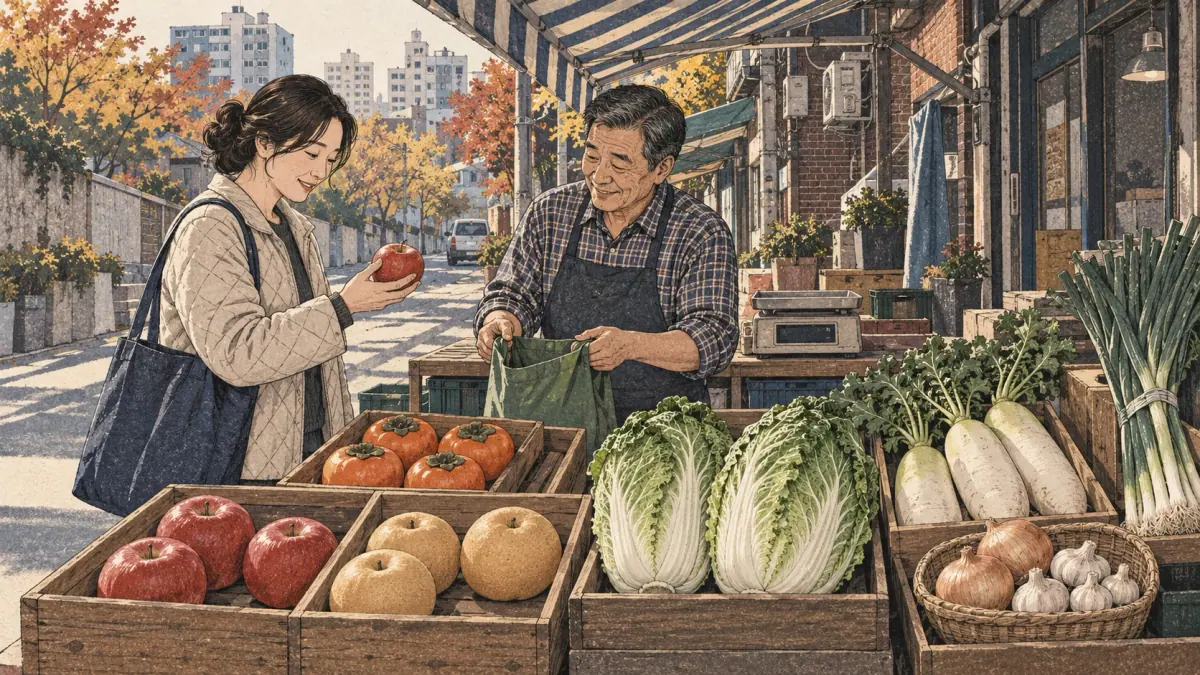
Fruits in Korean at a Glance
Fruits in Korean are named directly, and most names are one to three syllables, such as 배 (pear) and 복숭아 (peach). This section holds two full lists, one for fruit and one for vegetables. Between them they teach 80 words, and this page previews ten of them, then shows which fruit arrives in which season.
Which List Should You Open First?
Open the fruit list if you want words for a dessert plate, a market stall or a cafe menu. Open the vegetable list if you cook, read recipes or order side dishes. If you do both, start with fruit: its words are shorter and more of them are loanwords.
| List | Words | Best for | Level |
|---|---|---|---|
| Korean Fruit Names | 40 | Shopping, desserts, cafe drinks | A1 |
| Korean Vegetables Vocabulary | 40 | Cooking, recipes, side dishes | A1 |
Levels are editorial estimates, not official levels. Both lists use the same layout, so what you learn on one carries to the other.
Fruits
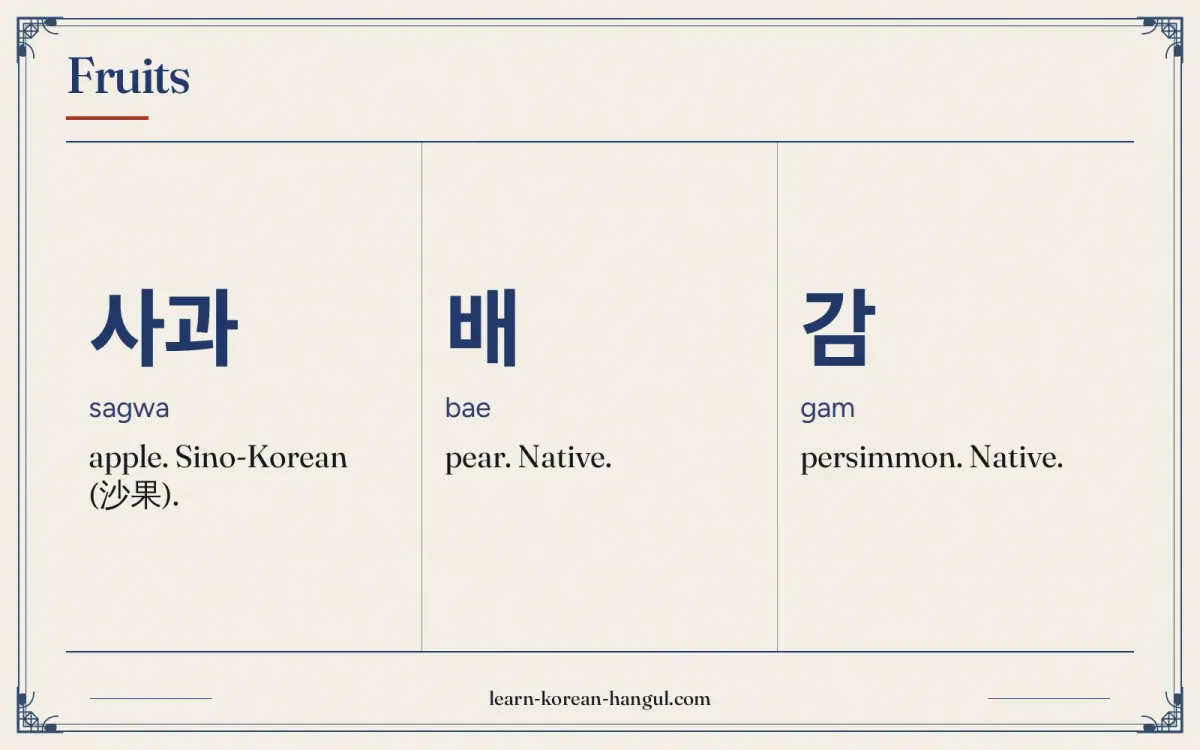
The fruit list has 40 words in five groups: everyday fruits, Korean seasonal fruits, tropical and imported fruits, berries and melons, and dried fruit with juice. It includes fruits that rarely appear in English-language lists, such as 참외 (Korean melon), 홍시 (soft persimmon) and 한라봉 (a Jeju mandarin). It also warns about two double meanings: 사과 means apple and apology, and 배 means pear, belly and ship. Open Korean Fruit Names.
The table below is a ten-word starter set from both lists. Play each clip, then say the word aloud.
| No. | Hangul | Revised Romanization | Meaning and origin | Example sentence | Audio assetId |
|---|---|---|---|---|---|
| 1 | 사과 | sagwa | apple. Sino-Korean (沙果). | 사과를 깎아요. (I peel an apple.) | au-pg-vocabulary-food-fruits-vegetables-1; example: au-pg-vocabulary-food-fruits-vegetables-11 |
| 2 | 배 | bae | pear. Native. | 배가 달아요. (The pear is sweet.) | au-pg-vocabulary-food-fruits-vegetables-2; example: au-pg-vocabulary-food-fruits-vegetables-12 |
| 3 | 감 | gam | persimmon. Native. | 가을에 감이 열려요. (In autumn, persimmons hang on the trees.) | au-pg-vocabulary-food-fruits-vegetables-3; example: au-pg-vocabulary-food-fruits-vegetables-13 |
| 4 | 귤 | gyul | tangerine. Sino-Korean (橘). | 겨울에는 귤을 많이 먹어요. (In winter I eat many tangerines.) | au-pg-vocabulary-food-fruits-vegetables-4; example: au-pg-vocabulary-food-fruits-vegetables-14 |
| 5 | 바나나 | banana | banana. Loanword. | 바나나를 먹어요. (I eat a banana.) | au-pg-vocabulary-food-fruits-vegetables-5; example: au-pg-vocabulary-food-fruits-vegetables-15 |
| 6 | 레몬 | remon | lemon. Loanword. | 레몬을 잘라요. (I cut the lemon.) | au-pg-vocabulary-food-fruits-vegetables-6; example: au-pg-vocabulary-food-fruits-vegetables-16 |
| 7 | 배추 | baechu | napa cabbage. Native. | 배추로 김치를 담가요. (I make kimchi with napa cabbage.) | au-pg-vocabulary-food-fruits-vegetables-7; example: au-pg-vocabulary-food-fruits-vegetables-17 |
| 8 | 무 | mu | Korean radish. Native. | 무로 깍두기를 만들어요. (I make cubed radish kimchi with radish.) | au-pg-vocabulary-food-fruits-vegetables-8; example: au-pg-vocabulary-food-fruits-vegetables-18 |
| 9 | 양파 | yangpa | onion. Compound of 양 (洋, Western) and 파 (green onion). | 양파를 썰면 눈물이 나요. (When I slice an onion, I cry.) | au-pg-vocabulary-food-fruits-vegetables-9; example: au-pg-vocabulary-food-fruits-vegetables-19 |
| 10 | 마늘 | maneul | garlic. Native. | 마늘을 다져요. (I mince the garlic.) | au-pg-vocabulary-food-fruits-vegetables-10; example: au-pg-vocabulary-food-fruits-vegetables-20 |
Notice the split in origin. The native words (배, 감, 무, 마늘) and the Sino-Korean words (사과, 귤) are short and have no English echo, so they need repetition. The loanwords (바나나, 레몬) sound like English and are quick to guess, so learn them first for easy wins.
What Is in the Vegetables List?
The vegetable list has 40 words in five groups: leafy greens, roots, alliums and peppers, gourds and fruit-vegetables, and mushrooms with sprouts. It explains that 파 is green onion while 대파 is the large type, and that the Korean radish 무 is thicker than the long daikon sold abroad. It also covers vegetables used almost only in Korean cooking, such as 깻잎 (perilla leaf) and 도라지 (bellflower root). Open Korean Vegetables Vocabulary.
Seasonal Produce
Korean shops follow the seasons, and so do the words people say. A fruit name often comes with its season, as in 가을에 감 (persimmons in autumn). The strip below is a rough guide, because greenhouses and imports mean many fruits sell all year.
| Season | Typical produce |
|---|---|
| Winter to spring (겨울–봄) | 딸기 (greenhouse-grown) |
| Summer (여름) | 참외 (early summer), 수박, 복숭아 |
| Late summer to autumn (가을) | 포도, 감, 배, 사과 |
| Winter (겨울) | 귤 |
Fruit is also a gift. A box of 배 or 사과 is a typical present at the autumn holiday Chuseok (추석), and a 과일 바구니 (fruit basket) is a gift for visiting a sick friend. Fruit given as a gift is called 선물용 과일. It is bought in boxes and chosen for looks as much as for taste.
What Is in the Buying Produce List?
Buying produce needs a short set of market phrases, and they use the same pattern: item, number, counter, 주세요. The counters differ by shape. A single piece is 개, a bunch of grapes is 송이, a bag is 봉지 and a box is 상자. Numbers before counters are native Korean numbers, such as 한 (one), 두 (two) and 세 (three). Press each button and repeat.
| Phrase | Meaning |
|---|---|
| 사과 세 개 주세요. | Three apples, please. |
| 귤 한 봉지 주세요. | One bag of tangerines, please. |
| 배 한 상자 주세요. | One box of pears, please. |
| 포도 한 송이 주세요. | One bunch of grapes, please. |
Each phrase has the same four slots, so you can build new ones by swapping the fruit and the counter. The food counters page lists more units for food and drink.
What Do All the Lists Have in Common?
Every list in this section uses the same layout: a Hangul word, a Revised Romanization spelling, a short English meaning, an audio clip and an example sentence. The romanization is a learning aid that follows the rules published by the National Institute of Korean Language (국립국어원). The lists cover nouns only; verbs such as 먹다 (to eat) and 깎다 (to peel) appear in the example sentences and in the verb lessons.
Three habits make the lists easier. First, say each word aloud right after the audio. Second, learn words in their groups, because a group gives each word company. Third, link a word to a sentence, as in 사과를 깎아요, so you remember how it works in speech.
Practice: Flashcards and Worksheet
Run the flashcard deck for this section to review the ten starter words, then open the deck on each list page for all 40. Your progress stays in your browser. The vocabulary flashcard decks page lists the other decks.
Practice · 24
- 01사과
Show answer
headword 1: apple
- 02배
Show answer
headword 2: pear
- 03감
Show answer
headword 3: persimmon
- 04귤
Show answer
headword 4: tangerine
- 05바나나
Show answer
headword 5: banana
- 06레몬
Show answer
headword 6: lemon
- 07배추
Show answer
headword 7: napa cabbage
- 08무
Show answer
headword 8: Korean radish
- 09양파
Show answer
headword 9: onion
- 10마늘
Show answer
headword 10: garlic
- 11사과를 깎아요.
Show answer
example for 사과
- 12배가 달아요.
Show answer
example for 배
- 13가을에 감이 열려요.
Show answer
example for 감
- 14겨울에는 귤을 많이 먹어요.
Show answer
example for 귤
- 15바나나를 먹어요.
Show answer
example for 바나나
- 16레몬을 잘라요.
Show answer
example for 레몬
- 17배추로 김치를 담가요.
Show answer
example for 배추
- 18무로 깍두기를 만들어요.
Show answer
example for 무
- 19양파를 썰면 눈물이 나요.
Show answer
example for 양파
- 20마늘을 다져요.
Show answer
example for 마늘
- 21사과 세 개 주세요.
Show answer
market phrase: Three apples, please.
- 22귤 한 봉지 주세요.
Show answer
market phrase: One bag of tangerines, please.
- 23배 한 상자 주세요.
Show answer
market phrase: One box of pears, please.
- 24포도 한 송이 주세요.
Show answer
market phrase: One bunch of grapes, please.
Korean Fruits and Vegetables Worksheet (PDF)
A printable worksheet for these words (word list, matching, writing practice, fill-in-the-blank exercises and answer key) is available in A4 and US Letter from the download card on this page.
Where to Go Next
Fruits in Korean and vegetable names work best when you meet them in both lists, so study the two pages in order. After this page, open Korean Fruit Names and then Korean Vegetables Vocabulary. For the wider topic, return to Food and Drink. Fruit flavours also appear in Korean Coffee Shop Vocabulary.
Frequently Asked Questions
How Do You Say Fruits in Korean?
Fruits is 과일 (gwail), and a single fruit is named directly, such as 사과 (apple) or 딸기 (strawberry). A fruit shop is a 과일 가게. The Korean Fruit Names page lists 40 fruit words with audio and examples.
How Do You Say Vegetables in Korean?
Vegetables is 채소 (chaeso). The word 야채 (yachae) is also common in speech. The Korean Vegetables Vocabulary page lists 40 vegetable words, from 배추 (napa cabbage) to 느타리버섯 (oyster mushroom). Formal writing and the National Institute of Korean Language prefer 채소, while menus and markets use both words.
Which Fruits Are in Season in Korea?
In general, 딸기 comes in winter and spring, 참외 and 수박 in summer, 감 and 배 in autumn and 귤 in winter. Greenhouses and imports blur these dates, so the seasons are a guide and not a rule.
How Do I Buy Fruit and Vegetables in Korean?
Say the item, the number with its counter, and 주세요. For example, 귤 한 봉지 주세요 means one bag of tangerines, please. Use 개 for single items, 송이 for a bunch, 봉지 for a bag and 상자 for a box.
Are Fruit and Vegetable Names Native Korean Words?
Some are native Korean, such as 배, 감 and 무. Some are Sino-Korean, such as 사과 (沙果) and 귤 (橘). Newer imports are loanwords, such as 바나나, 레몬 and 키위, which sound like their English source and are easy to guess.
Is the Romanization on This Page Official?
It follows the Revised Romanization of Korean, which South Korea adopted on 7 July 2000 and whose rules the National Institute of Korean Language (국립국어원) publishes. It is a learning aid, so rely on the Hangul and the audio.