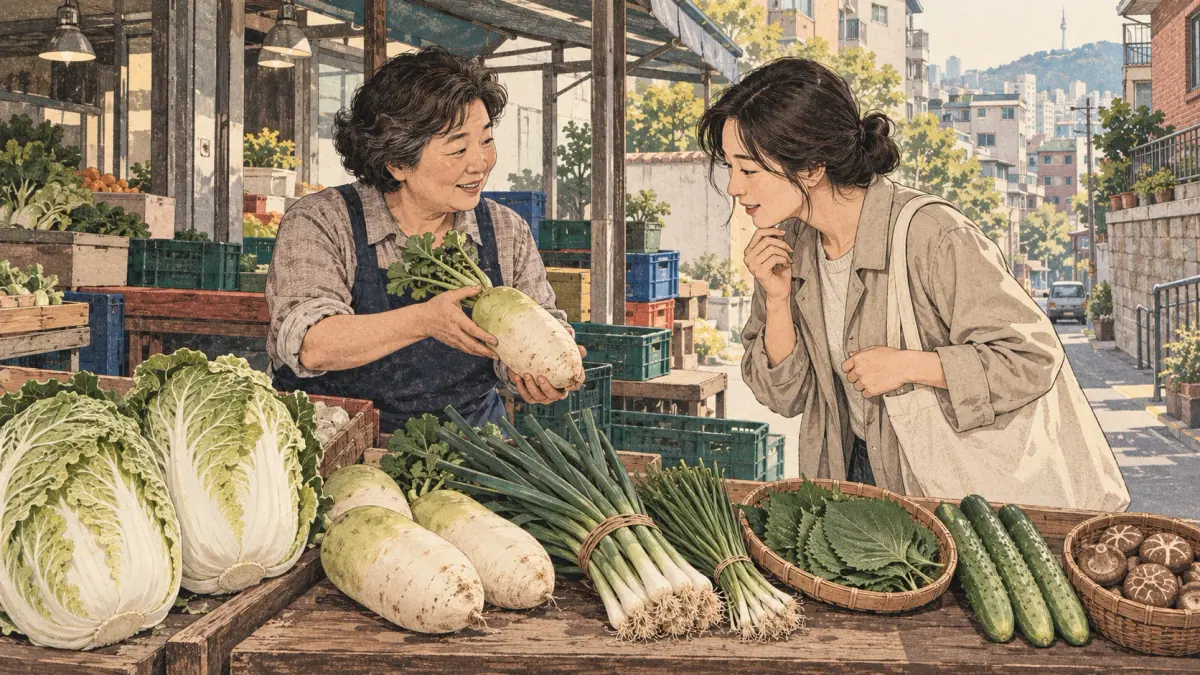
Korean Vegetables Vocabulary at a Glance
This list has 40 words in five groups. It belongs to Fruits and Vegetables. The groups follow how vegetables are laid out in a Korean market: leaves, roots, onions and peppers, vine vegetables, and mushrooms with sprouts. Many of the words are native Korean, and a few such as 토마토, 파프리카 and 브로콜리 are loanwords.
| Group | Words | Use |
|---|---|---|
| Leafy greens | 8 | Greens for wraps, soups and side dishes |
| Roots | 8 | Radish, carrot and starchy roots |
| Alliums and peppers | 8 | Onions, garlic, chives and chili |
| Gourds and fruit-vegetables | 9 | Cucumber, squash, tomato and similar |
| Mushrooms and sprouts | 7 | Mushrooms and bean sprouts |
Because Korean cooking uses so many vegetables as side dishes, vegetable words are among the most useful food words you can learn. Almost every table has at least a few.
Which Vegetable Names Should You Learn First?
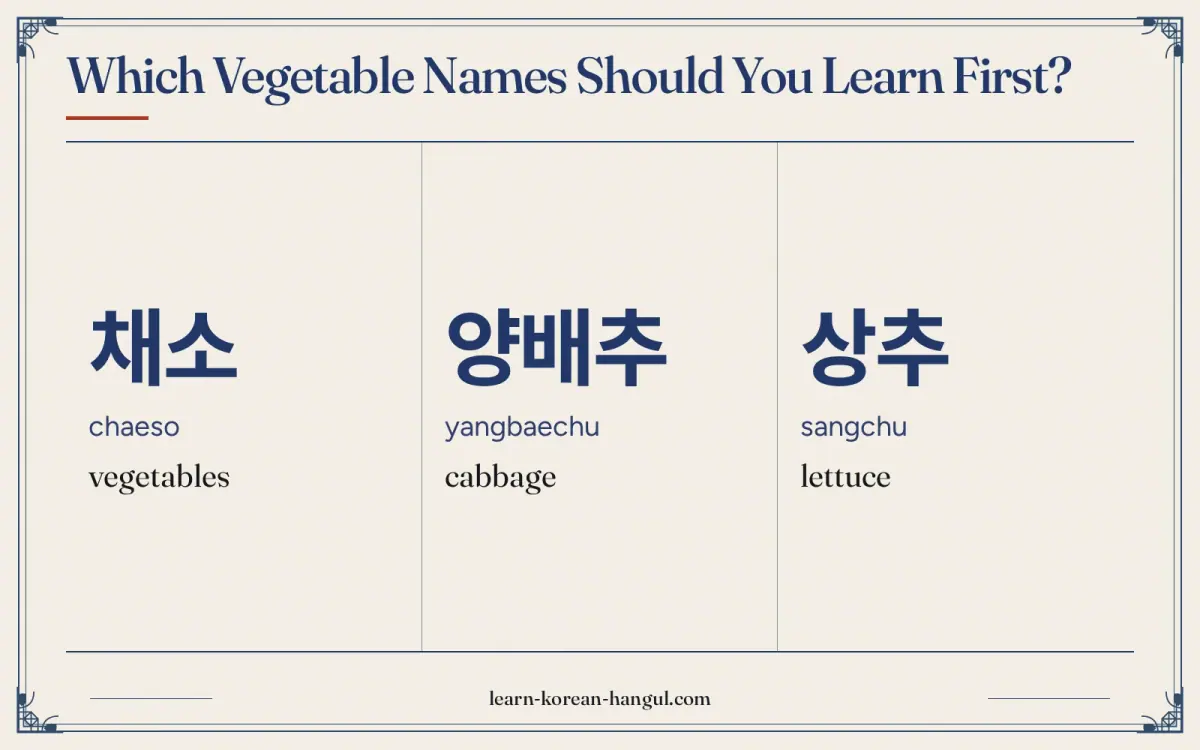
Learn 배추, 무, 양파, 마늘, 파 and 고추 first. They are the base of kimchi, soups and stews, so you will meet them on most recipe lists and menus. A sentence such as 마늘을 다져요 (I mince garlic) uses one of them with a useful kitchen verb.
- Words to say. 양파, 마늘, 파, 감자, 당근. Use these when you shop and cook.
- Words to recognise. 깻잎, 나물, 도라지, 미나리. These show up on menus and at the table.
- Pairs to separate. 파 and 대파; 무 (radish) and 물 (water) differ by one final consonant.
Vegetable words also help at a restaurant, where banchan is made of them. The scene below shows a vegetable market with numbered objects that match the list.
Word · 20
- 1
채소
chaeso
vegetables
- 2
양배추
yangbaechu
cabbage
- 3
상추
sangchu
lettuce
- 4
미나리
minari
water dropwort
- 5
무
mu
Korean radish
- 6
감자
gamja
potato
- 7
도라지
doraji
bellflower root
- 8
우엉
ueong
burdock root
- 9
파
pa
green onion; scallion
- 10
쪽파
jjokpa
small green onion
- 11
양파
yangpa
onion
- 12
고추
gochu
chili pepper
- 13
오이
oi
cucumber
- 14
애호박
aehobak
Korean zucchini
- 15
토마토
tomato
tomato
- 16
파프리카
papeurika
bell pepper (paprika)
- 17
브로콜리
beurokolli
broccoli
- 18
표고버섯
pyogobeoseot
shiitake mushroom
- 19
느타리버섯
neutaribeoseot
oyster mushroom
- 20
숙주
sukju
mung bean sprouts
Leafy Greens
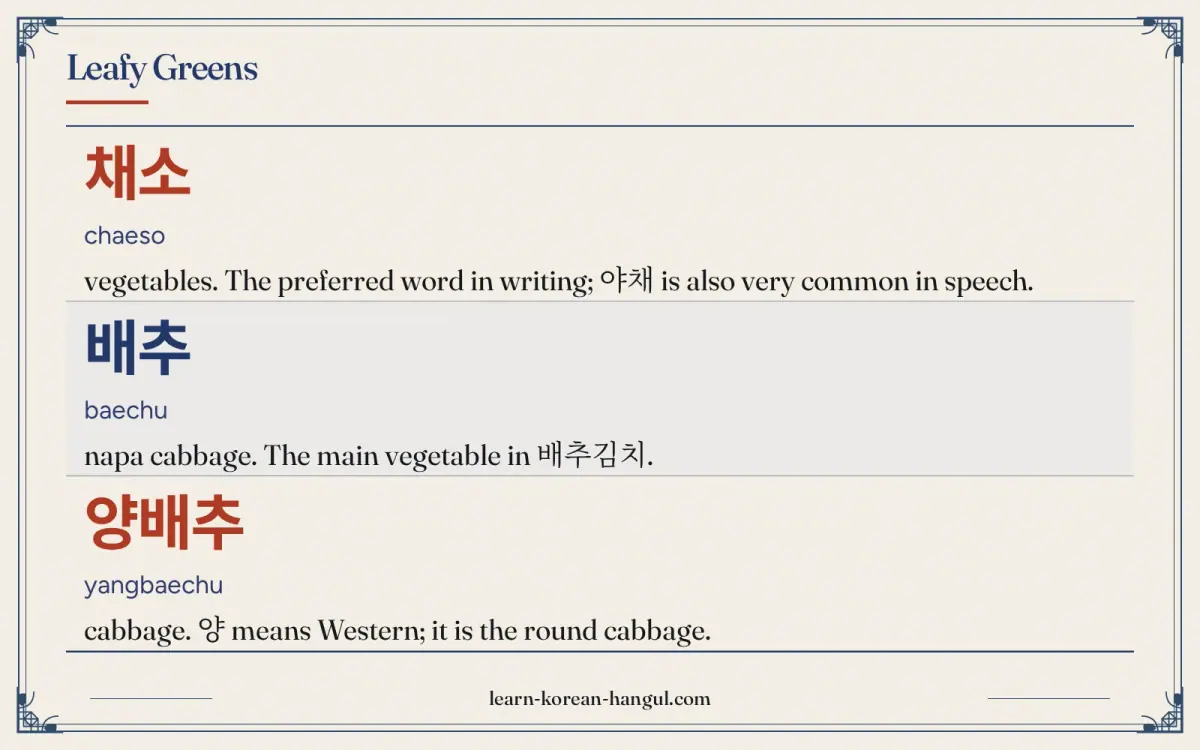
Leafy greens are the backbone of Korean food. 배추 (napa cabbage) is the main kimchi vegetable, 상추 (lettuce) wraps grilled meat, and 나물 covers the many seasoned greens served as side dishes. The general word for vegetables is 채소, and you also hear 야채 in daily speech.
| No. | Hangul | Revised Romanization | Meaning and note | Example sentence | Audio assetId |
|---|---|---|---|---|---|
| 1 | 채소 | chaeso | vegetables. The preferred word in writing; 야채 is also very common in speech. | 채소를 많이 먹어요. (I eat a lot of vegetables.) | au-pg-vocabulary-food-fruits-vegetables-vegetables-1; example: au-pg-vocabulary-food-fruits-vegetables-vegetables-41 |
| 2 | 배추 | baechu | napa cabbage. The main vegetable in 배추김치. | 배추로 김치를 담가요. (I make kimchi with napa cabbage.) | au-pg-vocabulary-food-fruits-vegetables-vegetables-2; example: au-pg-vocabulary-food-fruits-vegetables-vegetables-42 |
| 3 | 양배추 | yangbaechu | cabbage. 양 means Western; it is the round cabbage. | 양배추를 썰어요. (I slice the cabbage.) | au-pg-vocabulary-food-fruits-vegetables-vegetables-3; example: au-pg-vocabulary-food-fruits-vegetables-vegetables-43 |
| 4 | 시금치 | sigeumchi | spinach. Usually blanched and seasoned as a side dish. | 시금치를 데쳐요. (I blanch the spinach.) | au-pg-vocabulary-food-fruits-vegetables-vegetables-4; example: au-pg-vocabulary-food-fruits-vegetables-vegetables-44 |
| 5 | 상추 | sangchu | lettuce. Eaten as a wrap with meat and paste. | 상추에 고기를 싸요. (I wrap meat in lettuce.) | au-pg-vocabulary-food-fruits-vegetables-vegetables-5; example: au-pg-vocabulary-food-fruits-vegetables-vegetables-45 |
| 6 | 깻잎 | kkaennip | perilla leaf. Said [깬닙]. Rare in Western cooking, everyday in Korean wraps and pickles. | 깻잎은 향이 강해요. (Perilla leaves have a strong scent.) | au-pg-vocabulary-food-fruits-vegetables-vegetables-6; example: au-pg-vocabulary-food-fruits-vegetables-vegetables-46 |
| 7 | 미나리 | minari | water dropwort. A crisp, fragrant green used in soups and stews. | 미나리는 향긋해요. (Water dropwort smells fresh.) | au-pg-vocabulary-food-fruits-vegetables-vegetables-7; example: au-pg-vocabulary-food-fruits-vegetables-vegetables-47 |
| 8 | 나물 | namul | seasoned greens; wild greens. Covers 시금치나물, 콩나물 and 고사리 (bracken) dishes. | 나물을 무쳐요. (I season the greens.) | au-pg-vocabulary-food-fruits-vegetables-vegetables-8; example: au-pg-vocabulary-food-fruits-vegetables-vegetables-48 |
나물 is both an ingredient and a dish. It names wild or cultivated greens that are blanched and tossed with sesame oil, salt or soy sauce. You will see it on the banchan table in nearly every meal.
Example Sentences
Three frames carry most of the examples. The first is vegetable + 을/를 + cooking verb, as in 당근을 볶아요 (I stir-fry the carrot). The second is vegetable + 이/가 + describing word, as in 고추가 매워요 (the chili is spicy). The third is vegetable + 로/으로 + dish, as in 배추로 김치를 담가요 (I make kimchi with napa cabbage). Say each aloud after the audio and swap in another vegetable. Use 를 after a vowel (감자를) and 을 after a consonant (당근을), and 로 after a vowel (배추로) but 으로 after a consonant.
Which Root Vegetables Should You Know?
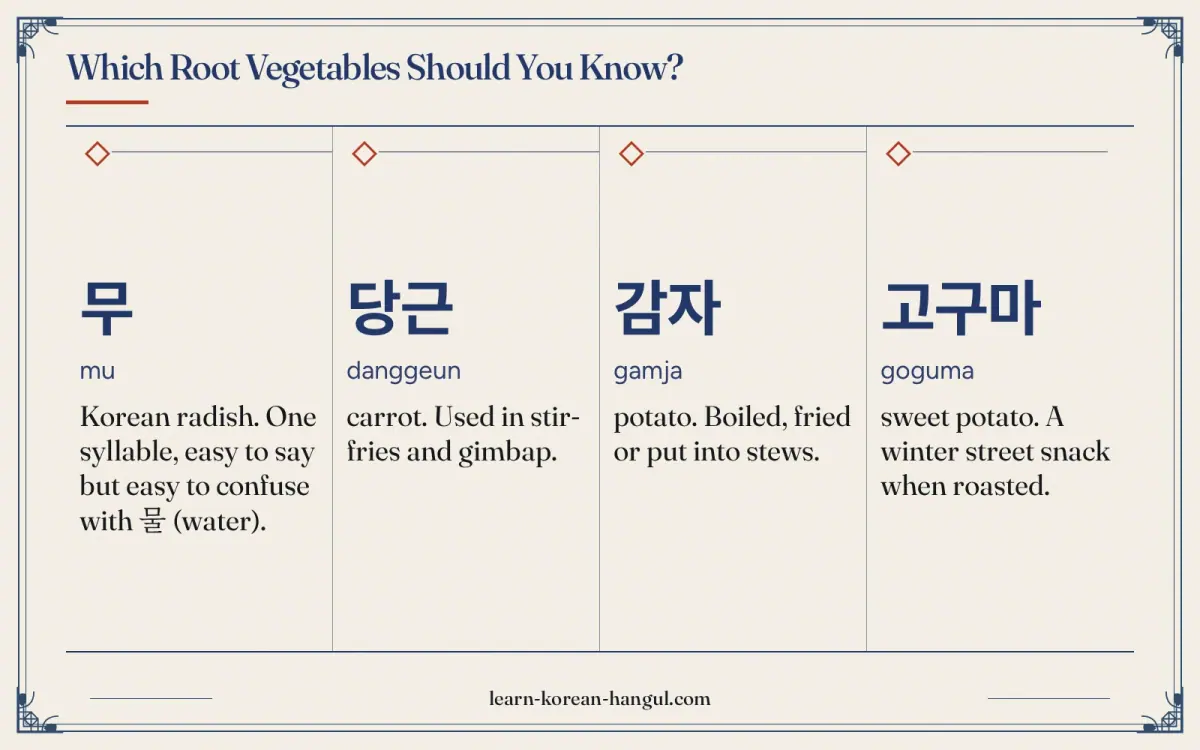
Root vegetables store well, so they traditionally carried Korean households through winter. The Korean radish 무 is thicker and denser than the long white daikon sold in many English-speaking markets, and it is the base of 깍두기 (cubed radish kimchi) and many soups. 감자 and 고구마 are the two starchy roots, and 도라지 is a bellflower root also used in folk remedies for sore throats.
| No. | Hangul | Revised Romanization | Meaning and note | Example sentence | Audio assetId |
|---|---|---|---|---|---|
| 9 | 무 | mu | Korean radish. One syllable, easy to say but easy to confuse with 물 (water). | 무로 깍두기를 만들어요. (I make cubed radish kimchi with radish.) | au-pg-vocabulary-food-fruits-vegetables-vegetables-9; example: au-pg-vocabulary-food-fruits-vegetables-vegetables-49 |
| 10 | 당근 | danggeun | carrot. Used in stir-fries and gimbap. | 당근을 볶아요. (I stir-fry the carrot.) | au-pg-vocabulary-food-fruits-vegetables-vegetables-10; example: au-pg-vocabulary-food-fruits-vegetables-vegetables-50 |
| 11 | 감자 | gamja | potato. Boiled, fried or put into stews. | 감자를 삶아요. (I boil the potatoes.) | au-pg-vocabulary-food-fruits-vegetables-vegetables-11; example: au-pg-vocabulary-food-fruits-vegetables-vegetables-51 |
| 12 | 고구마 | goguma | sweet potato. A winter street snack when roasted. | 고구마를 구워요. (I roast the sweet potatoes.) | au-pg-vocabulary-food-fruits-vegetables-vegetables-12; example: au-pg-vocabulary-food-fruits-vegetables-vegetables-52 |
| 13 | 도라지 | doraji | bellflower root. Eaten as a seasoned side dish. | 도라지는 조금 써요. (Bellflower root is a little bitter.) | au-pg-vocabulary-food-fruits-vegetables-vegetables-13; example: au-pg-vocabulary-food-fruits-vegetables-vegetables-53 |
| 14 | 연근 | yeongeun | lotus root. Sliced and simmered in soy sauce. | 연근을 조려요. (I simmer the lotus root.) | au-pg-vocabulary-food-fruits-vegetables-vegetables-14; example: au-pg-vocabulary-food-fruits-vegetables-vegetables-54 |
| 15 | 우엉 | ueong | burdock root. A long thin root, common in gimbap. | 우엉은 김밥에 들어가요. (Burdock goes into gimbap.) | au-pg-vocabulary-food-fruits-vegetables-vegetables-15; example: au-pg-vocabulary-food-fruits-vegetables-vegetables-55 |
| 16 | 생강 | saenggang | ginger. Used in tea and as a seasoning. | 생강차를 마셔요. (I drink ginger tea.) | au-pg-vocabulary-food-fruits-vegetables-vegetables-16; example: au-pg-vocabulary-food-fruits-vegetables-vegetables-56 |
Most of these words end in a vowel or a nasal, so they take 를 or 을 in a regular way: 무를, 당근을, 감자를, 고구마를. The one trap is sound: 무 (radish) and 물 (water) differ only by a final ㄹ, so say the vowel short and stop.
Alliums and Peppers
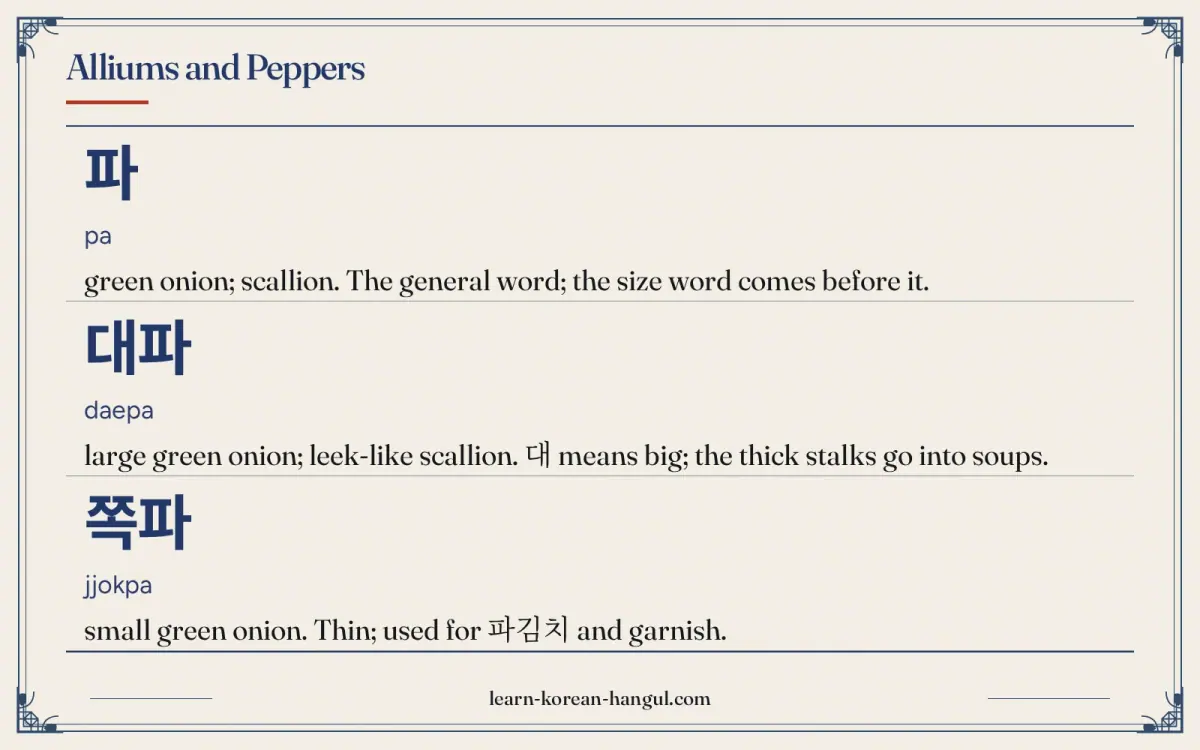
Alliums and peppers supply the flavour base of Korean cooking. 파 is the general word for green onion or scallion, and shoppers distinguish the thick 대파 (large green onion) from the thin 쪽파 (small green onion). Garlic and chili peppers sit at the top of nearly every recipe.
| No. | Hangul | Revised Romanization | Meaning and note | Example sentence | Audio assetId |
|---|---|---|---|---|---|
| 17 | 파 | pa | green onion; scallion. The general word; the size word comes before it. | 파를 송송 썰어요. (I slice the green onion thinly.) | au-pg-vocabulary-food-fruits-vegetables-vegetables-17; example: au-pg-vocabulary-food-fruits-vegetables-vegetables-57 |
| 18 | 대파 | daepa | large green onion; leek-like scallion. 대 means big; the thick stalks go into soups. | 대파가 굵어요. (The large green onions are thick.) | au-pg-vocabulary-food-fruits-vegetables-vegetables-18; example: au-pg-vocabulary-food-fruits-vegetables-vegetables-58 |
| 19 | 쪽파 | jjokpa | small green onion. Thin; used for 파김치 and garnish. | 쪽파로 파김치를 담가요. (I make green onion kimchi with small green onions.) | au-pg-vocabulary-food-fruits-vegetables-vegetables-19; example: au-pg-vocabulary-food-fruits-vegetables-vegetables-59 |
| 20 | 부추 | buchu | garlic chives. Flat leaves used in pancakes and dumplings. | 부추전을 부쳐요. (I make chive pancakes.) | au-pg-vocabulary-food-fruits-vegetables-vegetables-20; example: au-pg-vocabulary-food-fruits-vegetables-vegetables-60 |
| 21 | 양파 | yangpa | onion. 양 means Western; the round onion. | 양파를 썰면 눈물이 나요. (When I slice an onion, I cry.) | au-pg-vocabulary-food-fruits-vegetables-vegetables-21; example: au-pg-vocabulary-food-fruits-vegetables-vegetables-61 |
| 22 | 마늘 | maneul | garlic. The ㅡ in 늘 is an unrounded vowel, not 'nool'; used in most dishes. | 마늘을 다져요. (I mince the garlic.) | au-pg-vocabulary-food-fruits-vegetables-vegetables-22; example: au-pg-vocabulary-food-fruits-vegetables-vegetables-62 |
| 23 | 고추 | gochu | chili pepper. Fresh green or red; dried and ground, it becomes 고춧가루 (chili flakes). | 고추가 매워요. (The chili pepper is spicy.) | au-pg-vocabulary-food-fruits-vegetables-vegetables-23; example: au-pg-vocabulary-food-fruits-vegetables-vegetables-63 |
| 24 | 청양고추 | cheongyanggochu | Cheongyang chili. A very hot green chili. | 청양고추는 아주 매워요. (Cheongyang chilies are very hot.) | au-pg-vocabulary-food-fruits-vegetables-vegetables-24; example: au-pg-vocabulary-food-fruits-vegetables-vegetables-64 |
The pair 파 and 대파 matters on a shopping list. A recipe that says 대파 wants the thick stalk, and a recipe that says 쪽파 wants the thin one. Buying plain 파 usually gets you whichever the shop has. For single-word notes, see green onion in Korean and garlic in Korean.
How Do You Say Gourds and Fruit-Vegetables in Korean?
Gourds and fruit-vegetables are the vegetables that grow on vines and bushes. 호박 is the general word for pumpkin and squash, and 애호박 is the green zucchini-like type used in stews. Several words in this group, such as 토마토 and 파프리카, are loanwords.
| No. | Hangul | Revised Romanization | Meaning and note | Example sentence | Audio assetId |
|---|---|---|---|---|---|
| 25 | 오이 | oi | cucumber. Two syllables; the 이 is pronounced clearly. | 오이가 아삭해요. (The cucumber is crunchy.) | au-pg-vocabulary-food-fruits-vegetables-vegetables-25; example: au-pg-vocabulary-food-fruits-vegetables-vegetables-65 |
| 26 | 호박 | hobak | pumpkin; squash. The orange pumpkin and the green types. | 호박죽을 먹어요. (I eat pumpkin porridge.) | au-pg-vocabulary-food-fruits-vegetables-vegetables-26; example: au-pg-vocabulary-food-fruits-vegetables-vegetables-66 |
| 27 | 애호박 | aehobak | Korean zucchini. The green squash used in stews and pancakes. | 애호박을 볶아요. (I stir-fry the zucchini.) | au-pg-vocabulary-food-fruits-vegetables-vegetables-27; example: au-pg-vocabulary-food-fruits-vegetables-vegetables-67 |
| 28 | 가지 | gaji | eggplant. Also means branch and kind; the context decides. | 가지나물을 좋아해요. (I like seasoned eggplant.) | au-pg-vocabulary-food-fruits-vegetables-vegetables-28; example: au-pg-vocabulary-food-fruits-vegetables-vegetables-68 |
| 29 | 토마토 | tomato | tomato. A loanword; 방울토마토 is the cherry tomato. | 토마토가 빨개요. (The tomatoes are red.) | au-pg-vocabulary-food-fruits-vegetables-vegetables-29; example: au-pg-vocabulary-food-fruits-vegetables-vegetables-69 |
| 30 | 피망 | pimang | green pepper. The mild bell pepper. | 피망 안에 씨가 있어요. (There are seeds inside a green pepper.) | au-pg-vocabulary-food-fruits-vegetables-vegetables-30; example: au-pg-vocabulary-food-fruits-vegetables-vegetables-70 |
| 31 | 파프리카 | papeurika | bell pepper (paprika). The coloured sweet pepper. | 파프리카는 색이 다양해요. (Bell peppers come in many colours.) | au-pg-vocabulary-food-fruits-vegetables-vegetables-31; example: au-pg-vocabulary-food-fruits-vegetables-vegetables-71 |
| 32 | 옥수수 | oksusu | corn. Said [옥쑤수]. | 옥수수를 쪄요. (I steam the corn.) | au-pg-vocabulary-food-fruits-vegetables-vegetables-32; example: au-pg-vocabulary-food-fruits-vegetables-vegetables-72 |
| 33 | 브로콜리 | beurokolli | broccoli. A loanword; the ㄹㄹ is said as a long l. | 브로콜리는 몸에 좋아요. (Broccoli is good for your health.) | au-pg-vocabulary-food-fruits-vegetables-vegetables-33; example: au-pg-vocabulary-food-fruits-vegetables-vegetables-73 |
Tomato is a good example of a boundary word. Botanically a fruit, 토마토 sits in the vegetable section in a Korean market, so it belongs in this list.
Mushrooms and Sprouts
Mushrooms and sprouts are cheap, quick to cook and used in almost every soup or side dish. 버섯 is the general word for mushroom, and each type adds its own name before it. 콩나물 and 숙주 are sprouts. 콩나물 are soybean sprouts, while 숙주 are mung bean sprouts.
| No. | Hangul | Revised Romanization | Meaning and note | Example sentence | Audio assetId |
|---|---|---|---|---|---|
| 34 | 버섯 | beoseot | mushroom. Said [버섣]; the type name is added before it. | 버섯을 씻어요. (I wash the mushrooms.) | au-pg-vocabulary-food-fruits-vegetables-vegetables-34; example: au-pg-vocabulary-food-fruits-vegetables-vegetables-74 |
| 35 | 표고버섯 | pyogobeoseot | shiitake mushroom. Often sold dried. Said [표고버섣]. | 표고버섯을 말려요. (I dry shiitake mushrooms.) | au-pg-vocabulary-food-fruits-vegetables-vegetables-35; example: au-pg-vocabulary-food-fruits-vegetables-vegetables-75 |
| 36 | 팽이버섯 | paengibeoseot | enoki mushroom. Thin, white and in a bunch. Said [팽이버섣]. | 팽이버섯은 가늘어요. (Enoki mushrooms are thin.) | au-pg-vocabulary-food-fruits-vegetables-vegetables-36; example: au-pg-vocabulary-food-fruits-vegetables-vegetables-76 |
| 37 | 느타리버섯 | neutaribeoseot | oyster mushroom. Pale grey and soft; a common stir-fry mushroom. Said [느타리버섣]. | 느타리버섯을 볶아요. (I stir-fry oyster mushrooms.) | au-pg-vocabulary-food-fruits-vegetables-vegetables-37; example: au-pg-vocabulary-food-fruits-vegetables-vegetables-77 |
| 38 | 콩나물 | kongnamul | soybean sprouts. 콩 (bean) + 나물 (greens). | 콩나물국을 끓여요. (I make soybean sprout soup.) | au-pg-vocabulary-food-fruits-vegetables-vegetables-38; example: au-pg-vocabulary-food-fruits-vegetables-vegetables-78 |
| 39 | 숙주 | sukju | mung bean sprouts. Said [숙쭈]. Milder than 콩나물, with a small head instead of a large yellow bean. | 숙주는 쌀국수에 들어가요. (Mung bean sprouts go into rice noodles.) | au-pg-vocabulary-food-fruits-vegetables-vegetables-39; example: au-pg-vocabulary-food-fruits-vegetables-vegetables-79 |
| 40 | 새싹 | saessak | sprout; seedling. Used for young shoots, as in 새싹 채소. | 새싹 채소를 샐러드에 넣어요. (I put sprouts in the salad.) | au-pg-vocabulary-food-fruits-vegetables-vegetables-40; example: au-pg-vocabulary-food-fruits-vegetables-vegetables-80 |
Notice that 콩나물 contains 나물. Many Korean vegetable names stack a smaller word onto a bigger one: 표고 + 버섯, 콩 + 나물. When you meet a long unknown vegetable word, look for a part you already know.
How Do You Pronounce These Words?
Vegetable words include tense sounds, a hidden ㄴ and a stop-consonant ending. Standard pronunciation follows the National Institute of Korean Language (국립국어원) rules, and the romanization follows the Revised Romanization of Korean, which writes the sound you hear in some cases and the spelling in others.
| Spelling | Sounds like | What changes |
|---|---|---|
| 깻잎 | [깬닙] | The final ㅅ is said [ㄷ], and ㄴ is added before 잎, so ㄷ becomes [ㄴ]. |
| 버섯 | [버섣] | At the end of a word the final ㅅ is said [ㄷ]. |
| 옥수수 | [옥쑤수] | The ㅅ after a final ㄱ becomes a tense [ㅆ]. |
| 숙주 | [숙쭈] | The ㅈ after a final ㄱ becomes a tense [ㅉ]. |
| 브로콜리 | [브로콜리] | No spelling change; ㄹㄹ is a long l sound. |
When a particle with a vowel follows 버섯, the original sound returns: 버섯이 is said [버서시]. Compare 버섣 alone with 버서시 and you can hear the ㅅ come back. The same happens with 깻잎이 [깬니피].
Audio and Slow Playback
Each word and sentence has its own clip. The five clips below replay the hardest words slowly. Play one, repeat it aloud, then play it again and compare.
What Mistakes Do Learners Make with Vegetable Names?
Five mistakes appear often.
- Treating 파 and 대파 as the same. 파 is the general word. When a recipe says 대파, use the thick stalks, and for 쪽파 use the thin ones.
- Calling 무 daikon in a recipe. The Korean radish 무 is shorter, thicker and denser than the long daikon. Grocers sell it as 무.
- Using 야채 in formal writing. The National Institute of Korean Language recommends 채소 for writing. 야채 is common in speech and on menus, and both are understood.
- Mixing up 고추 and 고춧가루. 고추 is the fresh pepper. 고춧가루 is the dried pepper flakes sold in a bag.
- Spelling 깻잎 as 깨잎. The word is 깻잎, from 깨 (here the perilla seed, 들깨) plus 잎 (leaf), with a linking ㅅ (사이시옷) in between.
Separating these pairs removes most shopping errors. For more help with one word, see vegetables in Korean.
Practice: Flashcards and Worksheet
Study in three steps. First, run the flashcard deck in recognition mode until you recognise all 40 words. Second, switch to listening mode. Third, take the quiz. The deck holds all 40 words with audio, and your progress stays in your browser. The vocabulary flashcard decks page lists the other decks.
Practice · 85
- 01채소
Show answer
headword 1: vegetables
- 02배추
Show answer
headword 2: napa cabbage
- 03양배추
Show answer
headword 3: cabbage
- 04시금치
Show answer
headword 4: spinach
- 05상추
Show answer
headword 5: lettuce
- 06깻잎
Show answer
headword 6: perilla leaf
- 07미나리
Show answer
headword 7: water dropwort
- 08나물
Show answer
headword 8: seasoned greens; wild greens
- 09무
Show answer
headword 9: Korean radish
- 10당근
Show answer
headword 10: carrot
- 11감자
Show answer
headword 11: potato
- 12고구마
Show answer
headword 12: sweet potato
- 13도라지
Show answer
headword 13: bellflower root
- 14연근
Show answer
headword 14: lotus root
- 15우엉
Show answer
headword 15: burdock root
- 16생강
Show answer
headword 16: ginger
- 17파
Show answer
headword 17: green onion; scallion
- 18대파
Show answer
headword 18: large green onion; leek-like scallion
- 19쪽파
Show answer
headword 19: small green onion
- 20부추
Show answer
headword 20: garlic chives
- 21양파
Show answer
headword 21: onion
- 22마늘
Show answer
headword 22: garlic
- 23고추
Show answer
headword 23: chili pepper
- 24청양고추
Show answer
headword 24: Cheongyang chili
- 25오이
Show answer
headword 25: cucumber
- 26호박
Show answer
headword 26: pumpkin; squash
- 27애호박
Show answer
headword 27: Korean zucchini
- 28가지
Show answer
headword 28: eggplant
- 29토마토
Show answer
headword 29: tomato
- 30피망
Show answer
headword 30: green pepper
- 31파프리카
Show answer
headword 31: bell pepper (paprika)
- 32옥수수
Show answer
headword 32: corn
- 33브로콜리
Show answer
headword 33: broccoli
- 34버섯
Show answer
headword 34: mushroom
- 35표고버섯
Show answer
headword 35: shiitake mushroom
- 36팽이버섯
Show answer
headword 36: enoki mushroom
- 37느타리버섯
Show answer
headword 37: oyster mushroom
- 38콩나물
Show answer
headword 38: soybean sprouts
- 39숙주
Show answer
headword 39: mung bean sprouts
- 40새싹
Show answer
headword 40: sprout; seedling
- 41채소를 많이 먹어요.
Show answer
example for 채소
- 42배추로 김치를 담가요.
Show answer
example for 배추
- 43양배추를 썰어요.
Show answer
example for 양배추
- 44시금치를 데쳐요.
Show answer
example for 시금치
- 45상추에 고기를 싸요.
Show answer
example for 상추
- 46깻잎은 향이 강해요.
Show answer
example for 깻잎
- 47미나리는 향긋해요.
Show answer
example for 미나리
- 48나물을 무쳐요.
Show answer
example for 나물
- 49무로 깍두기를 만들어요.
Show answer
example for 무
- 50당근을 볶아요.
Show answer
example for 당근
- 51감자를 삶아요.
Show answer
example for 감자
- 52고구마를 구워요.
Show answer
example for 고구마
- 53도라지는 조금 써요.
Show answer
example for 도라지
- 54연근을 조려요.
Show answer
example for 연근
- 55우엉은 김밥에 들어가요.
Show answer
example for 우엉
- 56생강차를 마셔요.
Show answer
example for 생강
- 57파를 송송 썰어요.
Show answer
example for 파
- 58대파가 굵어요.
Show answer
example for 대파
- 59쪽파로 파김치를 담가요.
Show answer
example for 쪽파
- 60부추전을 부쳐요.
Show answer
example for 부추
- 61양파를 썰면 눈물이 나요.
Show answer
example for 양파
- 62마늘을 다져요.
Show answer
example for 마늘
- 63고추가 매워요.
Show answer
example for 고추
- 64청양고추는 아주 매워요.
Show answer
example for 청양고추
- 65오이가 아삭해요.
Show answer
example for 오이
- 66호박죽을 먹어요.
Show answer
example for 호박
- 67애호박을 볶아요.
Show answer
example for 애호박
- 68가지나물을 좋아해요.
Show answer
example for 가지
- 69토마토가 빨개요.
Show answer
example for 토마토
- 70피망 안에 씨가 있어요.
Show answer
example for 피망
- 71파프리카는 색이 다양해요.
Show answer
example for 파프리카
- 72옥수수를 쪄요.
Show answer
example for 옥수수
- 73브로콜리는 몸에 좋아요.
Show answer
example for 브로콜리
- 74버섯을 씻어요.
Show answer
example for 버섯
- 75표고버섯을 말려요.
Show answer
example for 표고버섯
- 76팽이버섯은 가늘어요.
Show answer
example for 팽이버섯
- 77느타리버섯을 볶아요.
Show answer
example for 느타리버섯
- 78콩나물국을 끓여요.
Show answer
example for 콩나물
- 79숙주는 쌀국수에 들어가요.
Show answer
example for 숙주
- 80새싹 채소를 샐러드에 넣어요.
Show answer
example for 새싹
- 81깻잎
Show answer
slow playback: 깻잎
- 82옥수수
Show answer
slow playback: 옥수수
- 83숙주
Show answer
slow playback: 숙주
- 84느타리버섯
Show answer
slow playback: 느타리버섯
- 85브로콜리
Show answer
slow playback: 브로콜리
Practice · 6
What does 채소 (chaeso) mean?
Show answer
vegetables
채소 means vegetables. Example: 채소를 많이 먹어요. (I eat a lot of vegetables.)
What does 미나리 (minari) mean?
Show answer
water dropwort
미나리 means water dropwort. Example: 미나리는 향긋해요. (Water dropwort smells fresh.)
What does 도라지 (doraji) mean?
Show answer
bellflower root
도라지 means bellflower root. Example: 도라지는 조금 써요. (Bellflower root is a little bitter.)
What does 쪽파 (jjokpa) mean?
Show answer
small green onion
쪽파 means small green onion. Example: 쪽파로 파김치를 담가요. (I make green onion kimchi with small green onions.)
What does 오이 (oi) mean?
Show answer
cucumber
오이 means cucumber. Example: 오이가 아삭해요. (The cucumber is crunchy.)
What does 파프리카 (papeurika) mean?
Show answer
bell pepper (paprika)
파프리카 means bell pepper (paprika). Example: 파프리카는 색이 다양해요. (Bell peppers come in many colours.)
Korean Vegetables Vocabulary Worksheet (PDF)
A printable worksheet for these words (word list, matching, writing practice, fill-in-the-blank exercises and answer key) is available in A4 and US Letter from the download card on this page. For practice, list the vegetables in a favourite Korean dish and write one cooking sentence for each.
Where to Go Next
Once this Korean vegetables vocabulary feels familiar, add the fruit list to complete the produce section. After this page, continue with Korean Fruit Names. For the overview, return to Fruits and Vegetables. Vegetables also fill the banchan list.
Frequently Asked Questions
How Do You Say Vegetables in Korean?
Vegetables is 채소 (chaeso). The word 야채 (yachae) is also common in speech. A vegetable shop is a 채소 가게 or 야채 가게, and supermarket produce aisles are signed with either word. In formal writing, 채소 is the safer choice.
What Is the Difference between 파 and 대파?
파 is the general word for green onion. 대파 means the large, thick kind, and 쪽파 means the small, thin kind. Recipes name the one they want, so buy the matching size. The single-word page on green onion in Korean has more detail.
Is Korean Radish the Same as Daikon?
They are related but not the same. 무 is the Korean radish, which is shorter and thicker and has a firmer texture than the long white daikon. It is the base of 깍두기, 생채 and many soups.
Which Vegetables Are Used Mostly in Korean Cooking?
The best known are 깻잎 (perilla leaf), 나물 greens, 도라지 (bellflower root), 미나리 (water dropwort) and 쪽파. They are rare in English-speaking supermarkets but appear often in Korean side dishes. Korean grocers abroad usually stock 깻잎 and 미나리 fresh.
How Do You Pronounce 깻잎?
Say kkaen-nip. The spelling 깻잎 is said [깬닙], because the final ㅅ becomes ㄷ and then ㄴ before the added ㄴ sound. The first sound is a tense kk. Press the audio button and repeat. Add a vowel particle and the ㅍ returns, so 깻잎이 is said [깬니피].
Is the Romanization on This Page Official?
It follows the Revised Romanization of Korean, which South Korea adopted on 7 July 2000 and whose rules the National Institute of Korean Language (국립국어원) publishes. It is a learning aid, so rely on the Hangul and the audio.