
Korean Counters for Food: the Essentials
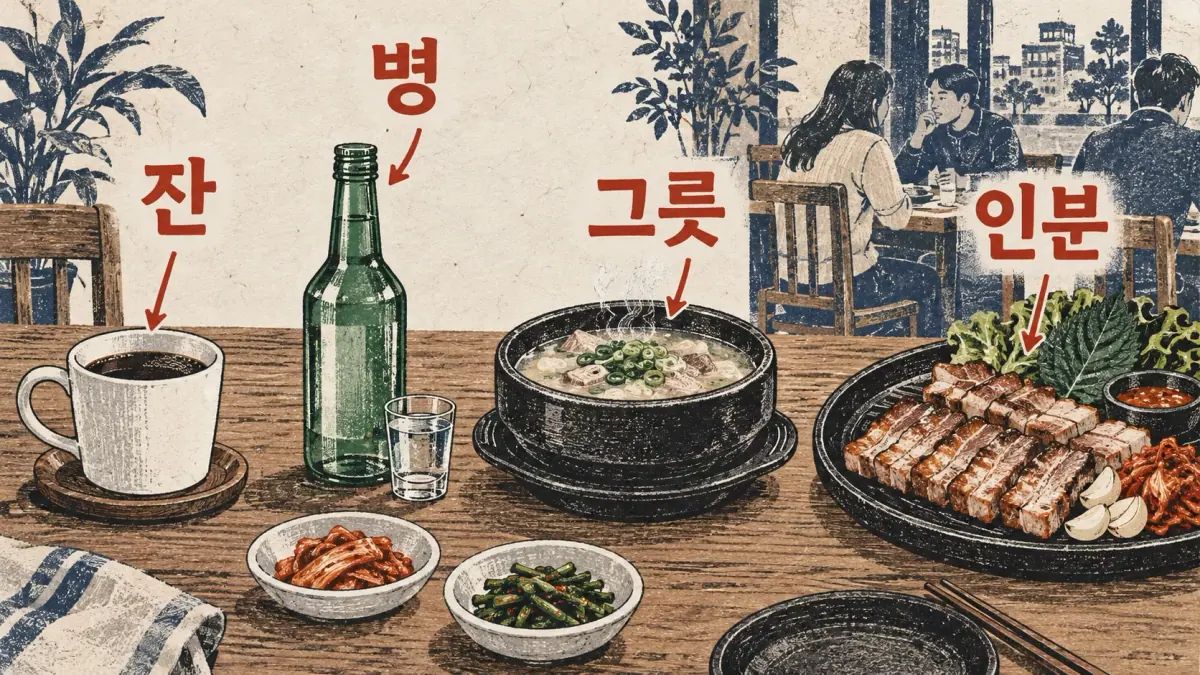
Korean counters for food work like English phrases such as "a cup of tea" or "a bowl of rice". The counter tells the server the unit you want, not only the amount. The pattern is: item, number, counter, then 주세요 (please give me).
| Counter | Container | Example | Meaning |
|---|---|---|---|
| 잔 | cup or glass | 커피 두 잔 | two cups of coffee |
| 병 | bottle | 소주 한 병 | one bottle of soju |
| 그릇 | bowl | 국 한 그릇 | one bowl of soup |
| 인분 | serving | 삼겹살 이 인분 | two servings of pork belly |
The key idea is container logic. The same drink can take different counters, depending on what holds it: 맥주 두 잔 (two glasses of beer) and 맥주 두 병 (two bottles of beer). When you order, pick the container first, and the counter follows.
Numbers also follow a rule. 잔, 병 and 그릇 take native numbers (한, 두, 세, 네), but 인분 takes Sino-Korean numbers (일, 이, 삼). The next section lists the lessons that teach each counter.
What Pages Are in This Group?
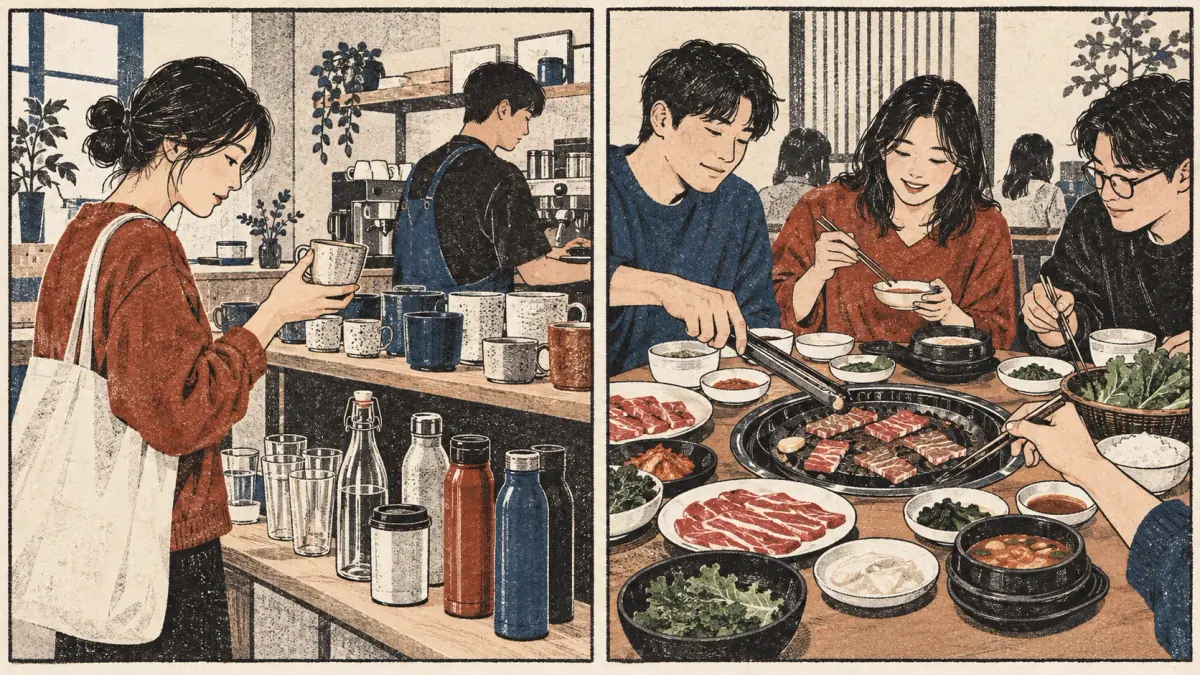
Four lessons cover the food and drink counters, two for drinks and two for food. Read the drink pair first, because 잔 and 병 appear in almost every order.
Drinks
The 잔 counter lesson teaches how to count cups and glasses of drink. It covers coffee, tea, water, beer and soju, shows how to ask 몇 잔이에요?, and explains the difference between the cup object 컵 and the counter 잔.
The 병 counter lesson teaches how to count bottles. It covers beer, soju, water and wine, and compares ordering by the bottle with ordering by the glass in the same restaurant.
Food
The 그릇 counter lesson teaches how to count bowls of rice, soup and noodles. It shows which dishes arrive in a bowl and how to ask for a second helping, and it explains where other containers such as plates take over.
The 인분 counter lesson teaches how to count servings when you order shared dishes. It is the exception in this group because it takes Sino-Korean numbers, and the lesson shows how to read menu prices that say 1인분 or 2인분.
After the pages themselves, the quickest way to use this group is to practise the ordering lines.
How Do You Order with Counters?

To order with counters, say the item, the number, the counter and 주세요: 소주 한 병 주세요. To add more, put 더 (more) before 주세요, and name the same counter again.
| Situation | Sentence | Meaning |
|---|---|---|
| Coffee shop | 아메리카노 두 잔 주세요. | Two Americanos, please. |
| Bar | 맥주 두 병 주세요. | Two bottles of beer, please. |
| Restaurant | 국 한 그릇 주세요. | One bowl of soup, please. |
| Grill | 삼겹살 이 인분 주세요. | Two servings of pork belly, please. |
| More rice | 밥 한 공기 더 주세요. | One more bowl of rice, please. |
Every line uses the same order, which is why one pattern gets you through a whole meal. For full ordering scripts with replies from the server, see Korean restaurant phrases.
Which Number System Does Each Food Counter Take?
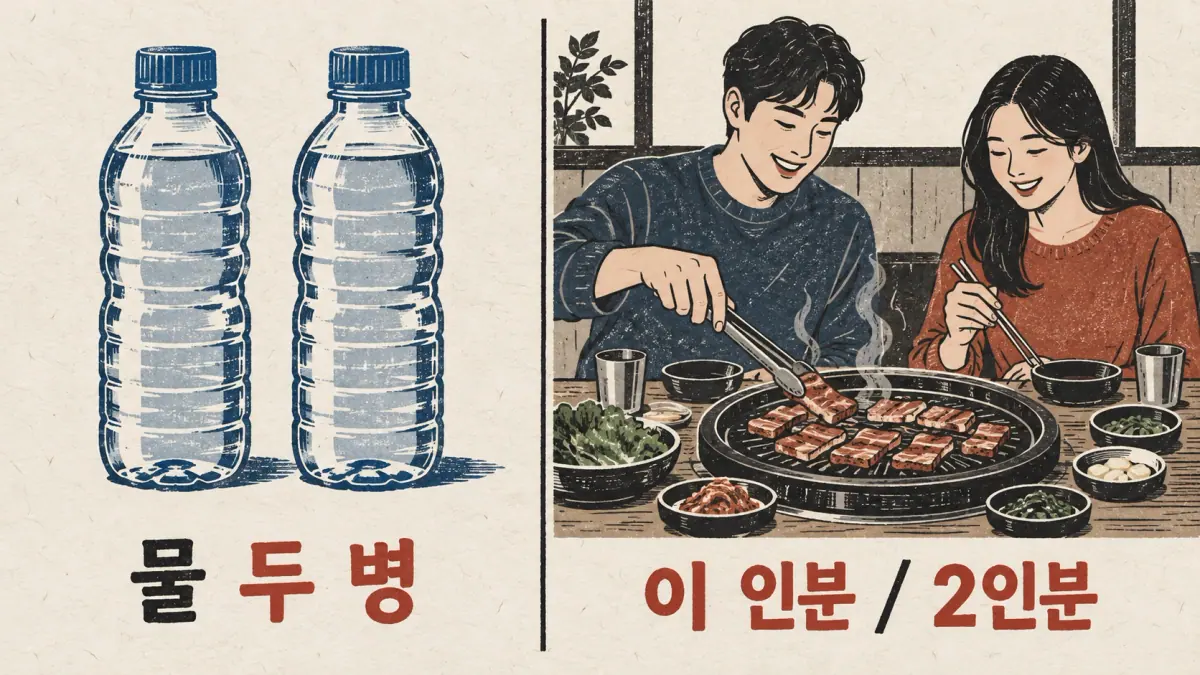
잔, 병 and 그릇 take native Korean numbers, and 인분 takes Sino-Korean numbers. This is the single exception to remember, because most everyday counters follow the native rule.
| Counter | Number system | Short forms | Example |
|---|---|---|---|
| 잔 | native | 한, 두, 세, 네 | 물 세 잔 |
| 병 | native | 한, 두, 세, 네 | 물 두 병 |
| 그릇 | native | 한, 두, 세, 네 | 밥 두 그릇 |
| 인분 | Sino-Korean | none | 이 인분 / 2인분 |
On menus, 인분 is usually written with digits attached: 2인분 is read 이 인분. Many grill restaurants sell meat by the serving and may ask for a minimum of two servings, so expect to say 이 인분 more often than 일 인분.
Cup, Glass or 잔: How Do You Choose?
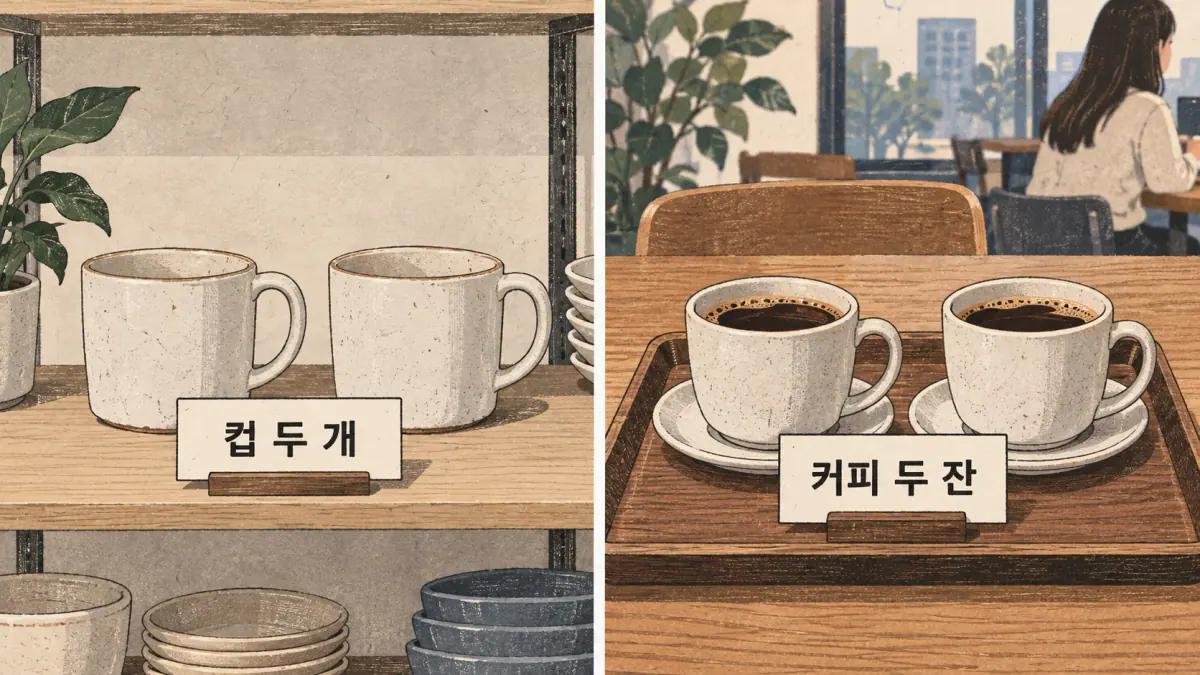
Use 잔 as the counter whenever you count drinks in cups or glasses, and use 컵 only when you mean the cup as an object. The words look alike, so the distinction needs an example.
| Word | Role | Example | Meaning |
|---|---|---|---|
| 컵 | noun, the object | 컵 두 개 | two cups, as items |
| 잔 | counter, the unit | 커피 두 잔 | two cups of coffee |
Think of 컵 as "cup" and 잔 as "cupful". You buy 컵 두 개 in a store, but you order 커피 두 잔 in a café.
Reading a Menu with Counters

A menu line often pairs a dish with a counter and a price, and the counter tells you how the dish is sold. Read it left to right: dish, unit, price.
| Menu text | Reading | What it tells you |
|---|---|---|
| 삼겹살 (1인분) | 삼겹살 일 인분 | price per serving of pork belly |
| 소주 1병 | 소주 한 병 | price per bottle of soju |
| 생맥주 1잔 | 생맥주 한 잔 | price per glass of draft beer |
| 국밥 1그릇 | 국밥 한 그릇 | price per bowl of soup with rice |
Notice how the digit 1 changes its reading by counter. With 병, 잔 and 그릇 the digit is read as the native 한, and with 인분 it is read as the Sino-Korean 일. Reading the digit correctly is the quickest sign that you know which number system each counter uses.
Mistakes to Avoid with Food Counters
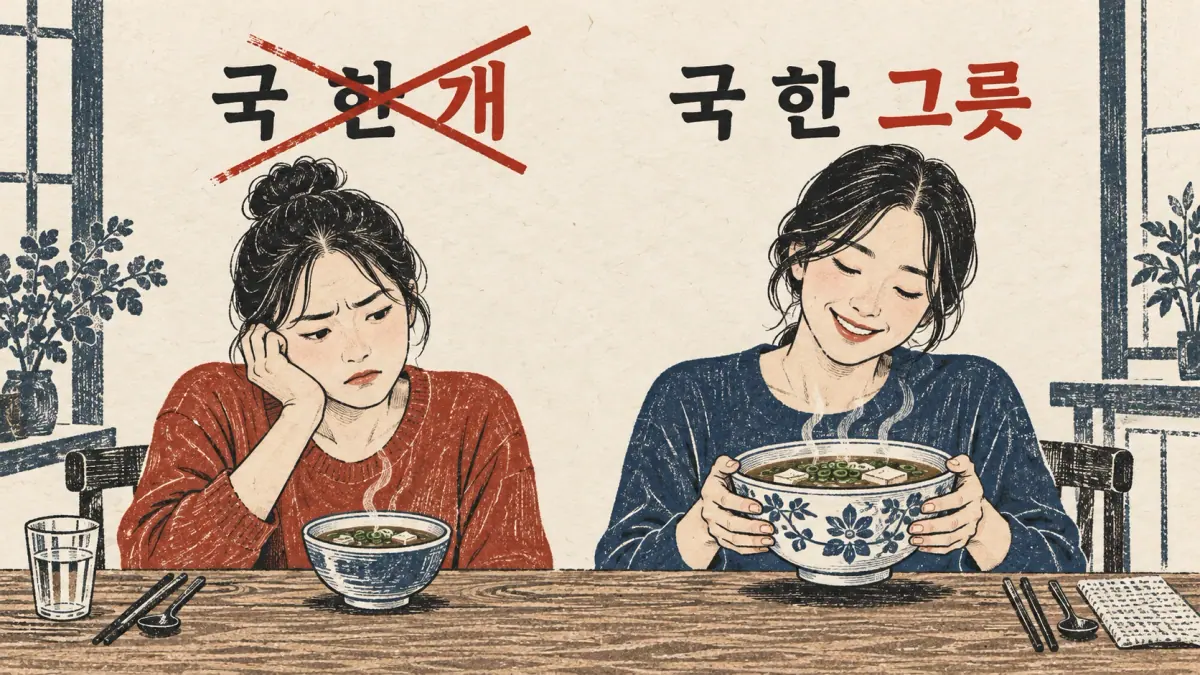
Three errors account for most mistakes in this group.
- Using the wrong container. Wrong: 맥주 두 개 for bottles. Right: 맥주 두 병.
- Using native numbers with 인분. Wrong: 두 인분. Right: 이 인분.
- Counting dishes with 개. Wrong: 국 한 개. Right: 국 한 그릇.
Each mistake has the same cause: the counter should name the container or the serving, not just the item.
What This Group Does Not Cover
This group covers the four main container and serving counters. Other food counters exist, such as 접시 for plates, 줄 for rolls of gimbap, 판 for whole pizzas and 공기 for rice bowls, but they sit beyond these four lessons. Whole animals served as food, like a fried chicken, take 마리, which is taught in the 마리 counter lesson. For the general rules, return to how Korean counters work.
Where to Start
If you are new to ordering in Korean, learn 잔 and 병 first, because they cover drinks, and add 인분 before you eat at a grill restaurant. For more counters, return to Korean Counters, or compare this group with Counting Things. Practise by describing your next meal with Korean counters for food and say the order aloud.
Frequently Asked Questions
How do I order two beers in Korean?
Say the drink, the number and the container, then 주세요. For bottles, say 맥주 두 병 주세요. For draft beer in glasses, say 생맥주 두 잔 주세요. The counter shows the container you want, so choose 병 or 잔 first. Add 여기요 (excuse me) to call the staff politely.
What is 인분?
인분 means a serving or portion, and restaurants use it for dishes that are cooked for sharing, such as grilled meat. It is the one food counter that takes Sino-Korean numbers: 일 인분 (one serving), 이 인분 (two), 삼 인분 (three). On menus it is written with digits, as in 2인분, and many places set a two-serving minimum.
Do I use 컵 or 잔?
컵 is the object, a cup, and 잔 is the counter. So you buy 컵 두 개 (two cups as items) but order 커피 두 잔 (two cups of coffee). Use 잔 whenever the cup holds a drink you are ordering or pouring, and use 개 only when you count empty cups as objects.
Can I count dishes with 개?
Only individual pieces. You can count pieces such as dumplings with 개, as in 만두 열 개, but whole dishes use serving or container counters: 국 한 그릇, 삼겹살 이 인분. A plate of food may also be 한 접시. Using 개 for a bowl of soup sounds like counting the bowl as an object.