
Korean Fruit Names at a Glance
This list has 40 words in five groups. It belongs to Fruits and Vegetables. The first group holds the fruits everyone eats. The second holds fruits tied to a Korean season. The remaining three cover imported fruit, berries and melons, and fruit that is dried or turned into juice. Long-established fruits have native names (배, 감) or Sino-Korean names built from Chinese characters (사과 沙果, 귤 橘), while newer arrivals such as 바나나, 키위 and 망고 are loanwords.
| Group | Words | Use |
|---|---|---|
| Everyday fruits | 9 | The fruits on most tables |
| Korean seasonal fruits | 9 | Fruits tied to a season in Korea |
| Tropical and imported fruits | 7 | Fruit from warm countries |
| Berries, grapes and melons | 7 | Small fruits and big melons |
| Dried fruit, juice and parts | 8 | Fruit products and fruit parts |
The origin split helps you learn. A native or Sino-Korean fruit name is usually one or two syllables, as in 배 and 사과. A loanword is usually longer and sounds like its English source, as in 파인애플 (pineapple), so it is easy to guess when you see it written.
Which Fruit Names Should You Learn First?
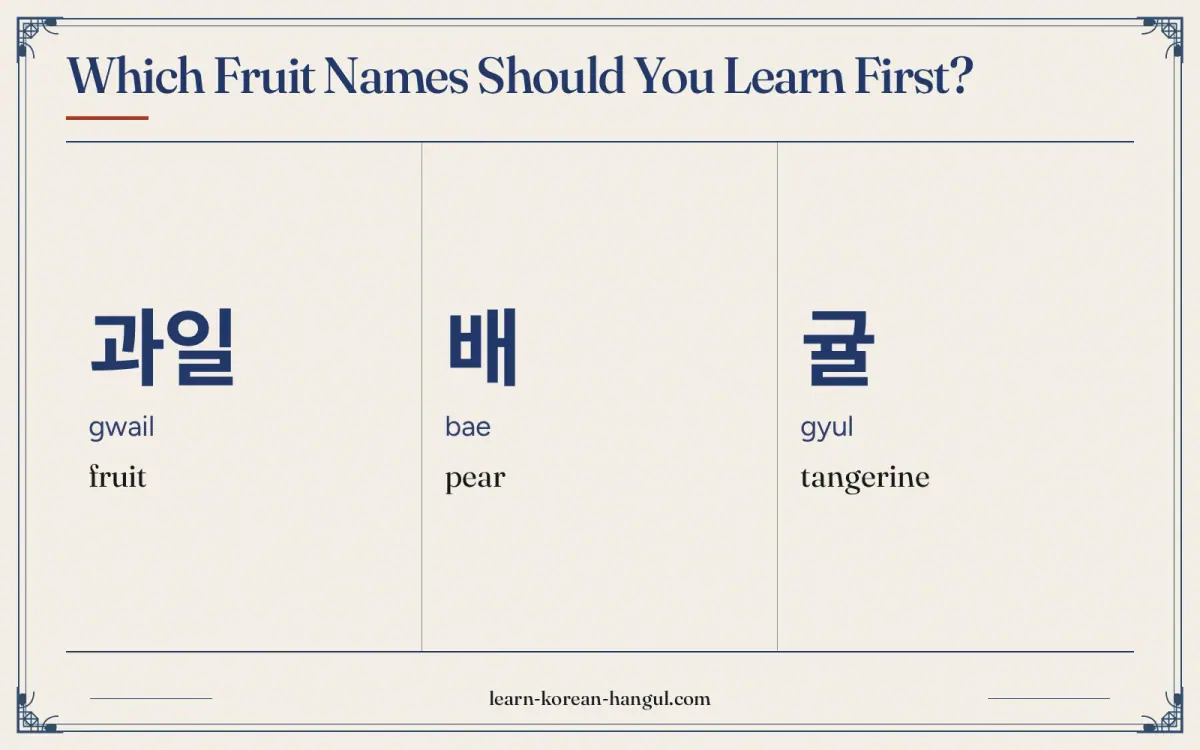
Learn 사과, 바나나, 포도, 딸기 and 귤 first. They are everyday fruits in Korean supermarkets, on cafe menus and in beginner textbooks. A short sentence such as 사과를 먹어요 (I eat an apple) uses the first of them with the most common verb.
- Words to say. 사과, 바나나, 포도, 딸기, 수박. Use these when you shop or order.
- Words to recognise. 참외, 홍시, 한라봉, 유자. You see these in markets, on gift boxes and in tea names such as 유자차.
- Words that need care. 배 (pear, belly, ship) and 사과 (apple, apology).
A Korean fruit stall sells by season, so learning the seasons and the names together makes both stick. The scene below shows a fruit stall with numbered objects that match the list.
Word · 20
- 1
과일
gwail
fruit
- 2
배
bae
pear
- 3
귤
gyul
tangerine
- 4
포도
podo
grape
- 5
수박
subak
watermelon
- 6
홍시
hongsi
soft ripe persimmon
- 7
복숭아
boksunga
peach
- 8
대추
daechu
jujube
- 9
한라봉
hallabong
hallabong (Jeju mandarin)
- 10
파인애플
painaepeul
pineapple
- 11
키위
kiwi
kiwi
- 12
자몽
jamong
grapefruit
- 13
코코넛
kokoneot
coconut
- 14
산딸기
santtalgi
wild raspberry
- 15
체리
cheri
cherry
- 16
청포도
cheongpodo
green grape
- 17
건포도
geonpodo
raisin
- 18
말린 과일
mallin gwail
dried fruit
- 19
과즙
gwajeup
fruit juice (the liquid in fruit)
- 20
씨
ssi
seed
Everyday Fruits
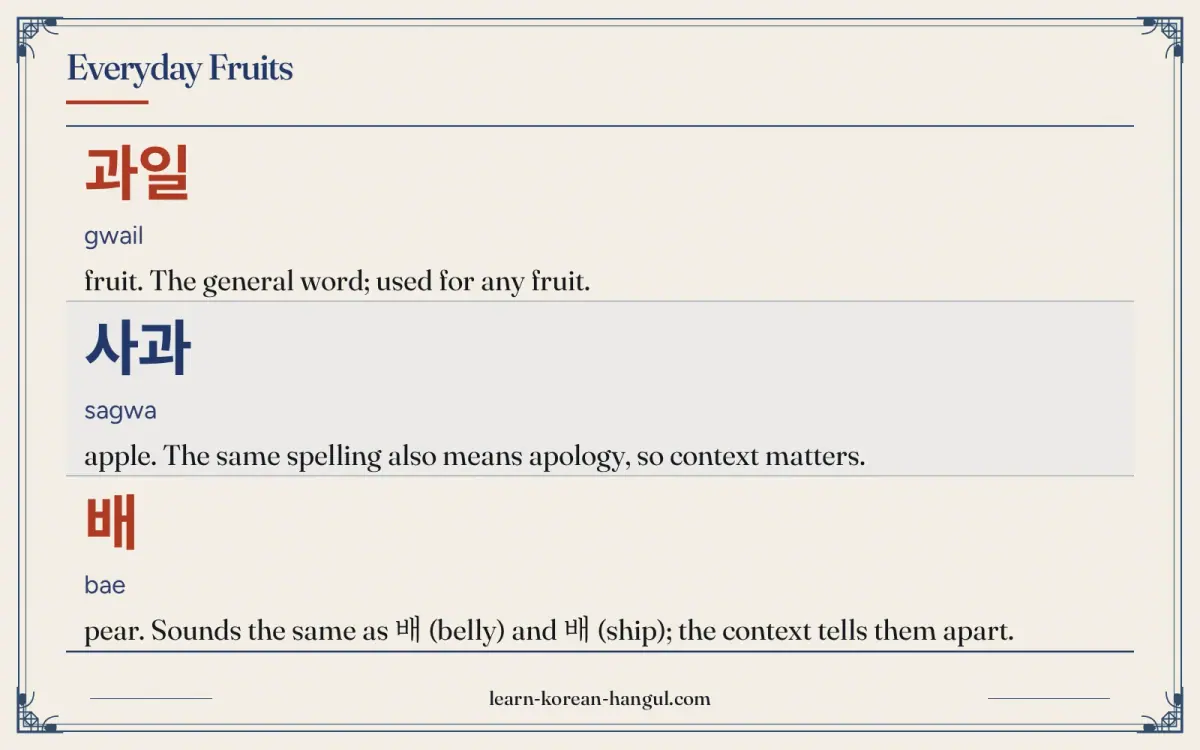
Everyday fruits are the words you will meet first, at breakfast, in a lunchbox or on a dessert plate. 과일 (gwail) is the general word for fruit, and each fruit takes its name directly. Fruit is usually eaten fresh and peeled or sliced, and a plate of cut fruit after a meal is common in Korean homes.
| No. | Hangul | Revised Romanization | Meaning and note | Example sentence | Audio assetId |
|---|---|---|---|---|---|
| 1 | 과일 | gwail | fruit. The general word; used for any fruit. | 과일을 좋아해요. (I like fruit.) | au-pg-vocabulary-food-fruits-vegetables-fruits-1; example: au-pg-vocabulary-food-fruits-vegetables-fruits-41 |
| 2 | 사과 | sagwa | apple. The same spelling also means apology, so context matters. | 사과를 깎아요. (I peel an apple.) | au-pg-vocabulary-food-fruits-vegetables-fruits-2; example: au-pg-vocabulary-food-fruits-vegetables-fruits-42 |
| 3 | 배 | bae | pear. Sounds the same as 배 (belly) and 배 (ship); the context tells them apart. | 배가 달아요. (The pear is sweet.) | au-pg-vocabulary-food-fruits-vegetables-fruits-3; example: au-pg-vocabulary-food-fruits-vegetables-fruits-43 |
| 4 | 바나나 | banana | banana. A loanword; imported fruit. | 바나나를 먹어요. (I eat a banana.) | au-pg-vocabulary-food-fruits-vegetables-fruits-4; example: au-pg-vocabulary-food-fruits-vegetables-fruits-44 |
| 5 | 귤 | gyul | tangerine. Small and easy to peel; a winter fruit. | 겨울에는 귤을 많이 먹어요. (In winter I eat many tangerines.) | au-pg-vocabulary-food-fruits-vegetables-fruits-5; example: au-pg-vocabulary-food-fruits-vegetables-fruits-45 |
| 6 | 오렌지 | orenji | orange. A loanword; usually the larger imported orange. | 오렌지 주스 주세요. (Orange juice, please.) | au-pg-vocabulary-food-fruits-vegetables-fruits-6; example: au-pg-vocabulary-food-fruits-vegetables-fruits-46 |
| 7 | 포도 | podo | grape. Counted by the bunch with 송이. | 포도 한 송이 주세요. (A bunch of grapes, please.) | au-pg-vocabulary-food-fruits-vegetables-fruits-7; example: au-pg-vocabulary-food-fruits-vegetables-fruits-47 |
| 8 | 딸기 | ttalgi | strawberry. The tense ㄸ is said without a puff of air. | 딸기가 맛있어요. (The strawberries are tasty.) | au-pg-vocabulary-food-fruits-vegetables-fruits-8; example: au-pg-vocabulary-food-fruits-vegetables-fruits-48 |
| 9 | 수박 | subak | watermelon. A summer fruit that is bought whole or by the slice. | 수박이 시원해요. (The watermelon is refreshing.) | au-pg-vocabulary-food-fruits-vegetables-fruits-9; example: au-pg-vocabulary-food-fruits-vegetables-fruits-49 |
Two homophones deserve a note. 사과 means both apple and apology, and 배 means pear, belly and ship. Korean speakers rarely get confused because the sentence around the word decides the meaning: 사과를 먹어요 is about eating, while 사과해요 is about apologising.
Example Sentences
Three frames carry most of the examples. The first is fruit + 을/를 + verb, as in 바나나를 먹어요 (I eat a banana). The second is fruit + 이/가 + describing word, as in 딸기가 맛있어요 (the strawberries are tasty). The third is fruit + number + counter + 주세요, as in 포도 한 송이 주세요 (a bunch of grapes, please). Say each aloud after the audio and swap in another fruit. Remember that 를 follows a vowel (바나나를) and 을 follows a consonant (귤을).
Which Fruits Belong to a Korean Season?
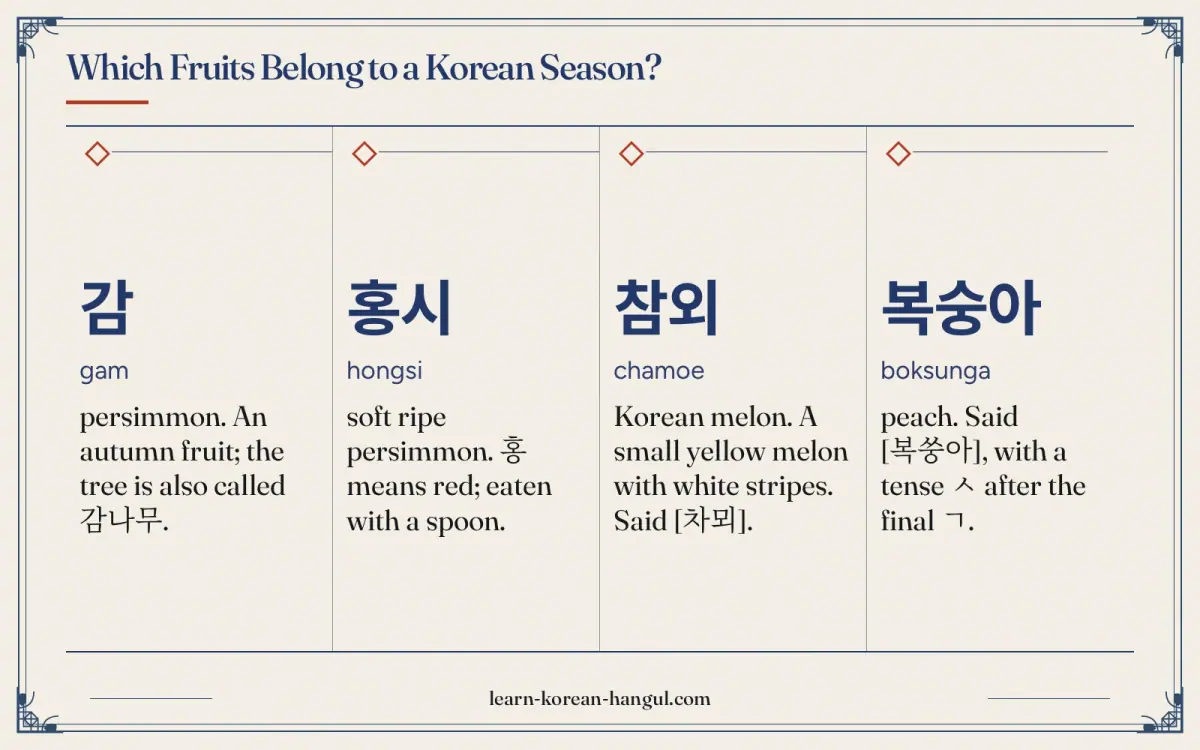
Korean seasonal fruits are the ones shops display when they are at their best. In general, 딸기 comes in winter and spring, 참외 and 복숭아 in summer, 감 in autumn and 귤 in winter, though greenhouses stretch these dates. The words below include fruits you will hardly find in English-language lists.
| No. | Hangul | Revised Romanization | Meaning and note | Example sentence | Audio assetId |
|---|---|---|---|---|---|
| 10 | 감 | gam | persimmon. An autumn fruit; the tree is also called 감나무. | 가을에 감이 열려요. (In autumn, persimmons hang on the trees.) | au-pg-vocabulary-food-fruits-vegetables-fruits-10; example: au-pg-vocabulary-food-fruits-vegetables-fruits-50 |
| 11 | 홍시 | hongsi | soft ripe persimmon. 홍 means red; eaten with a spoon. | 홍시는 아주 말랑해요. (Hongsi persimmons are very soft.) | au-pg-vocabulary-food-fruits-vegetables-fruits-11; example: au-pg-vocabulary-food-fruits-vegetables-fruits-51 |
| 12 | 참외 | chamoe | Korean melon. A small yellow melon with white stripes. Said [차뫼]. | 여름에 참외를 먹어요. (In summer I eat Korean melon.) | au-pg-vocabulary-food-fruits-vegetables-fruits-12; example: au-pg-vocabulary-food-fruits-vegetables-fruits-52 |
| 13 | 복숭아 | boksunga | peach. Said [복쑹아], with a tense ㅅ after the final ㄱ. | 복숭아가 부드러워요. (The peach is soft.) | au-pg-vocabulary-food-fruits-vegetables-fruits-13; example: au-pg-vocabulary-food-fruits-vegetables-fruits-53 |
| 14 | 자두 | jadu | plum. Slightly sour and juicy. | 자두는 새콤해요. (Plums are tart.) | au-pg-vocabulary-food-fruits-vegetables-fruits-14; example: au-pg-vocabulary-food-fruits-vegetables-fruits-54 |
| 15 | 대추 | daechu | jujube. Often dried and used in tea and soups. | 대추차를 마셔요. (I drink jujube tea.) | au-pg-vocabulary-food-fruits-vegetables-fruits-15; example: au-pg-vocabulary-food-fruits-vegetables-fruits-55 |
| 16 | 유자 | yuja | yuja (citron). A fragrant citrus used for tea and preserves. | 유자는 향이 좋아요. (Yuja has a lovely scent.) | au-pg-vocabulary-food-fruits-vegetables-fruits-16; example: au-pg-vocabulary-food-fruits-vegetables-fruits-56 |
| 17 | 한라봉 | hallabong | hallabong (Jeju mandarin). A large sweet citrus, named for Mount Halla on Jeju. Said [할라봉]. | 한라봉은 제주도에서 유명해요. (Hallabong is famous on Jeju Island.) | au-pg-vocabulary-food-fruits-vegetables-fruits-17; example: au-pg-vocabulary-food-fruits-vegetables-fruits-57 |
| 18 | 매실 | maesil | green plum; Japanese apricot. Mostly used for tea and syrup, not eaten raw. | 매실차를 만들어요. (I make green plum tea.) | au-pg-vocabulary-food-fruits-vegetables-fruits-18; example: au-pg-vocabulary-food-fruits-vegetables-fruits-58 |
Seasonal fruit is also a gift. A box of 배 is a common present at Chuseok, and a box of 한라봉 is popular around the Lunar New Year (설날), its winter season. The next section moves to fruit that arrives from abroad.
| Fruit | Usual season in Korea |
|---|---|
| 딸기 | Winter to spring |
| 참외 | Early summer |
| 수박, 복숭아 | Summer |
| 포도 | Late summer to early autumn |
| 감, 배, 사과 | Autumn |
| 귤 | Winter |
The table is a rough guide, not a rule. Greenhouses and imports mean you can buy many fruits all year round.
Tropical and Imported Fruits
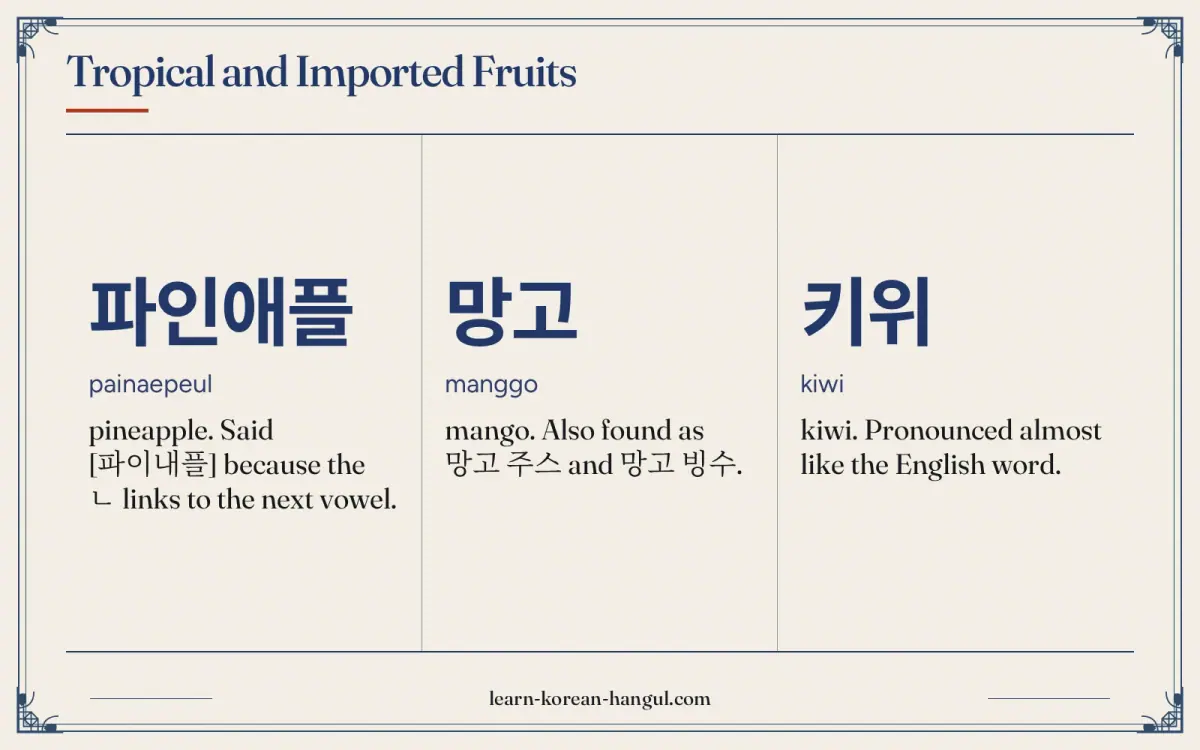
Tropical fruits arrive from abroad, so their names are loanwords written in Hangul. Most are quick to learn because they sound like their English names; 자몽 is the exception. You will meet them in the supermarket, in juice bars and on cafe menus.
| No. | Hangul | Revised Romanization | Meaning and note | Example sentence | Audio assetId |
|---|---|---|---|---|---|
| 19 | 파인애플 | painaepeul | pineapple. Said [파이내플] because the ㄴ links to the next vowel. | 파인애플이 달콤해요. (The pineapple is sweet.) | au-pg-vocabulary-food-fruits-vegetables-fruits-19; example: au-pg-vocabulary-food-fruits-vegetables-fruits-59 |
| 20 | 망고 | manggo | mango. Also found as 망고 주스 and 망고 빙수. | 망고를 좋아해요. (I like mango.) | au-pg-vocabulary-food-fruits-vegetables-fruits-20; example: au-pg-vocabulary-food-fruits-vegetables-fruits-60 |
| 21 | 키위 | kiwi | kiwi. Pronounced almost like the English word. | 키위는 시큼해요. (Kiwi fruit is sour.) | au-pg-vocabulary-food-fruits-vegetables-fruits-21; example: au-pg-vocabulary-food-fruits-vegetables-fruits-61 |
| 22 | 레몬 | remon | lemon. Often used in 레몬차 and in lemonade, which menus write 레몬에이드 (the standard spelling is 레모네이드). | 레몬을 잘라요. (I cut the lemon.) | au-pg-vocabulary-food-fruits-vegetables-fruits-22; example: au-pg-vocabulary-food-fruits-vegetables-fruits-62 |
| 23 | 자몽 | jamong | grapefruit. The name came through Japanese from Portuguese zamboa (a pomelo); popular in ade drinks. | 자몽은 쓴맛이 나요. (Grapefruit has a bitter taste.) | au-pg-vocabulary-food-fruits-vegetables-fruits-23; example: au-pg-vocabulary-food-fruits-vegetables-fruits-63 |
| 24 | 아보카도 | abokado | avocado. Four syllables, with no stress. | 아보카도를 반으로 잘라요. (I cut the avocado in half.) | au-pg-vocabulary-food-fruits-vegetables-fruits-24; example: au-pg-vocabulary-food-fruits-vegetables-fruits-64 |
| 25 | 코코넛 | kokoneot | coconut. Written with the final 넛 for the English nut. Said [코코넏]. | 코코넛 주스를 마셔요. (I drink coconut juice.) | au-pg-vocabulary-food-fruits-vegetables-fruits-25; example: au-pg-vocabulary-food-fruits-vegetables-fruits-65 |
Loanword fruits often appear as fruit + 주스 or fruit + 에이드, as in 망고 주스 and 자몽에이드. The Korean Coffee Shop Vocabulary page uses these flavour words on cafe menus.
How Do You Say Berries and Melons in Korean?
Small fruits and melons follow the same 'fruit + type' habit. Korean often marks a colour or a wild origin with a prefix. 산 means mountain, so 산딸기 is a wild raspberry (literally a mountain strawberry). 청 means blue or green, so 청포도 is a green grape.
| No. | Hangul | Revised Romanization | Meaning and note | Example sentence | Audio assetId |
|---|---|---|---|---|---|
| 26 | 블루베리 | beulluberi | blueberry. A loanword; Korean adds the vowel ㅡ after b in 블 and splits the l into ㄹㄹ (beul-lu). | 블루베리를 먹어요. (I eat blueberries.) | au-pg-vocabulary-food-fruits-vegetables-fruits-26; example: au-pg-vocabulary-food-fruits-vegetables-fruits-66 |
| 27 | 산딸기 | santtalgi | wild raspberry. 산 (mountain) + 딸기 (strawberry). | 산딸기는 작아요. (Wild raspberries are small.) | au-pg-vocabulary-food-fruits-vegetables-fruits-27; example: au-pg-vocabulary-food-fruits-vegetables-fruits-67 |
| 28 | 앵두 | aengdu | Korean cherry (Nanking cherry). A small red fruit with a short early-summer season. | 앵두는 빨개요. (Korean cherries are red.) | au-pg-vocabulary-food-fruits-vegetables-fruits-28; example: au-pg-vocabulary-food-fruits-vegetables-fruits-68 |
| 29 | 체리 | cheri | cherry. The imported cherry is the larger one. | 체리가 비싸요. (Cherries are expensive.) | au-pg-vocabulary-food-fruits-vegetables-fruits-29; example: au-pg-vocabulary-food-fruits-vegetables-fruits-69 |
| 30 | 멜론 | mellon | melon. Distinct from 참외, the Korean melon. | 멜론은 향이 좋아요. (Melons smell good.) | au-pg-vocabulary-food-fruits-vegetables-fruits-30; example: au-pg-vocabulary-food-fruits-vegetables-fruits-70 |
| 31 | 청포도 | cheongpodo | green grape. 청 means blue or green. | 청포도는 새콤달콤해요. (Green grapes are sweet and sour.) | au-pg-vocabulary-food-fruits-vegetables-fruits-31; example: au-pg-vocabulary-food-fruits-vegetables-fruits-71 |
| 32 | 석류 | seongnyu | pomegranate. Said [성뉴]: the ㄹ becomes ㄴ after ㄱ, and the ㄱ then becomes ㅇ before that ㄴ. | 석류 안에 씨가 많아요. (There are many seeds inside a pomegranate.) | au-pg-vocabulary-food-fruits-vegetables-fruits-32; example: au-pg-vocabulary-food-fruits-vegetables-fruits-72 |
Compare 멜론 and 참외 when you shop. A 참외 is small and yellow, while a 멜론 is larger with green or netted skin. Both are sold in summer.
Dried Fruit and Juice
The last group covers fruit after it has been processed, plus the words for its parts. Drying is an old way to keep fruit through winter, and 곶감 (dried persimmon) is the best-known Korean example. 과일 주스 and 과즙 cover drinks and juice.
| No. | Hangul | Revised Romanization | Meaning and note | Example sentence | Audio assetId |
|---|---|---|---|---|---|
| 33 | 건포도 | geonpodo | raisin. 건 means dried; 포도 means grape. | 빵에 건포도가 들어 있어요. (There are raisins in the bread.) | au-pg-vocabulary-food-fruits-vegetables-fruits-33; example: au-pg-vocabulary-food-fruits-vegetables-fruits-73 |
| 34 | 곶감 | gotgam | dried persimmon. Said [곧깜]. A traditional winter snack. | 곶감은 감을 말려서 만들어요. (Dried persimmon is made by drying persimmons.) | au-pg-vocabulary-food-fruits-vegetables-fruits-34; example: au-pg-vocabulary-food-fruits-vegetables-fruits-74 |
| 35 | 말린 과일 | mallin gwail | dried fruit. 말린 is a describing word from 말리다 (to dry). | 말린 과일을 간식으로 먹어요. (I eat dried fruit as a snack.) | au-pg-vocabulary-food-fruits-vegetables-fruits-35; example: au-pg-vocabulary-food-fruits-vegetables-fruits-75 |
| 36 | 과일 주스 | gwail juseu | fruit juice. Add the fruit before 주스 for a flavour: 사과 주스. | 과일 주스 한 잔 주세요. (A glass of fruit juice, please.) | au-pg-vocabulary-food-fruits-vegetables-fruits-36; example: au-pg-vocabulary-food-fruits-vegetables-fruits-76 |
| 37 | 과즙 | gwajeup | fruit juice (the liquid in fruit). Describes juiciness: 과즙이 많다. | 이 과일은 과즙이 많아요. (This fruit is juicy.) | au-pg-vocabulary-food-fruits-vegetables-fruits-37; example: au-pg-vocabulary-food-fruits-vegetables-fruits-77 |
| 38 | 껍질 | kkeopjil | peel; skin. Said [껍찔]. | 껍질을 벗겨요. (I peel off the skin.) | au-pg-vocabulary-food-fruits-vegetables-fruits-38; example: au-pg-vocabulary-food-fruits-vegetables-fruits-78 |
| 39 | 씨 | ssi | seed. A different word, 씨 (氏), is the polite title after a name, as in 민수 씨. | 수박씨를 뱉어요. (I spit out the watermelon seeds.) | au-pg-vocabulary-food-fruits-vegetables-fruits-39; example: au-pg-vocabulary-food-fruits-vegetables-fruits-79 |
| 40 | 과일 바구니 | gwail baguni | fruit basket. A common gift for visiting a sick friend or a new home. | 과일 바구니를 선물해요. (I give a fruit basket as a gift.) | au-pg-vocabulary-food-fruits-vegetables-fruits-40; example: au-pg-vocabulary-food-fruits-vegetables-fruits-80 |
Use 껍질 and 씨 with the verbs 벗기다 (to peel off) and 뱉다 (to spit out). They give you the two most useful actions at the fruit plate.
Fruit is sold in standard units. A single piece is counted with 개, a bunch with 송이, a box with 상자 and a bag with 봉지. So 사과 세 개 is three apples and 귤 한 봉지 is a bag of tangerines. The food counters page lists more units.
How Do You Pronounce These Words?
Fruit names include tense sounds, linking and a nasal change. Standard pronunciation follows the National Institute of Korean Language (국립국어원) rules, and the romanization follows the Revised Romanization of Korean, which writes the sound you hear in some cases and the spelling in others.
| Spelling | Sounds like | What changes |
|---|---|---|
| 복숭아 | [복쑹아] | The ㅅ after a final ㄱ becomes a tense [ㅆ]. |
| 곶감 | [곧깜] | The final ㅈ is said [ㄷ], and the next ㄱ becomes a tense [ㄲ]. |
| 껍질 | [껍찔] | The ㅈ after a final ㅂ becomes a tense [ㅉ]. |
| 석류 | [성뉴] | The ㄹ becomes [ㄴ] after ㄱ, and the ㄱ then becomes [ㅇ] before it. |
| 파인애플 | [파이내플] | The final ㄴ links to the next vowel. |
The pattern behind three of these is the same: a final ㄱ, ㅂ or ㄷ-sound makes the next plain consonant tense. You will find it in many nouns, so a rule you learn from 복숭아 also helps with 껍질. The word 석류 is different, because it follows the nasal rules (Standard Pronunciation Articles 18 and 19).
Audio and Slow Playback
Each word and sentence has its own clip. The five clips below replay the hardest words slowly. Play one, repeat it aloud, then play it again and compare.
What Mistakes Do Learners Make with Fruit Names?
Five mistakes appear often.
- Saying 사과 alone to mean "sorry". 사과 is a noun, apple or apology, so on its own it sounds like a fruit name. To apologise, say 미안해요 or 죄송해요; the formal 사과드립니다 (I offer my apology) needs the verb.
- Confusing 배 (pear) with 배 (belly). In a shop the meaning is clear. If you point at your stomach and say 배가 아파요, it means your belly hurts.
- Calling a 참외 a 멜론. A 참외 is the small yellow Korean melon. A 멜론 is the larger melon with netted skin.
- Using 개 for everything. 개 works for single fruits, but a bunch of grapes is 송이 and a bag of tangerines is 봉지.
- Writing 오랜지 for 오렌지. The loanword is spelled 오렌지, with ㅔ in the second syllable.
Fixing these five covers most shopping trouble. For a single word with fuller notes, see apple in Korean.
Practice: Flashcards and Worksheet
Study in three steps. First, run the flashcard deck in recognition mode until you recognise all 40 words. Second, switch to listening mode. Third, take the quiz. The deck holds all 40 words with audio, and your progress stays in your browser. The vocabulary flashcard decks page lists the other decks.
Practice · 85
- 01과일
Show answer
headword 1: fruit
- 02사과
Show answer
headword 2: apple
- 03배
Show answer
headword 3: pear
- 04바나나
Show answer
headword 4: banana
- 05귤
Show answer
headword 5: tangerine
- 06오렌지
Show answer
headword 6: orange
- 07포도
Show answer
headword 7: grape
- 08딸기
Show answer
headword 8: strawberry
- 09수박
Show answer
headword 9: watermelon
- 10감
Show answer
headword 10: persimmon
- 11홍시
Show answer
headword 11: soft ripe persimmon
- 12참외
Show answer
headword 12: Korean melon
- 13복숭아
Show answer
headword 13: peach
- 14자두
Show answer
headword 14: plum
- 15대추
Show answer
headword 15: jujube
- 16유자
Show answer
headword 16: yuja (citron)
- 17한라봉
Show answer
headword 17: hallabong (Jeju mandarin)
- 18매실
Show answer
headword 18: green plum; Japanese apricot
- 19파인애플
Show answer
headword 19: pineapple
- 20망고
Show answer
headword 20: mango
- 21키위
Show answer
headword 21: kiwi
- 22레몬
Show answer
headword 22: lemon
- 23자몽
Show answer
headword 23: grapefruit
- 24아보카도
Show answer
headword 24: avocado
- 25코코넛
Show answer
headword 25: coconut
- 26블루베리
Show answer
headword 26: blueberry
- 27산딸기
Show answer
headword 27: wild raspberry
- 28앵두
Show answer
headword 28: Korean cherry
- 29체리
Show answer
headword 29: cherry
- 30멜론
Show answer
headword 30: melon
- 31청포도
Show answer
headword 31: green grape
- 32석류
Show answer
headword 32: pomegranate
- 33건포도
Show answer
headword 33: raisin
- 34곶감
Show answer
headword 34: dried persimmon
- 35말린 과일
Show answer
headword 35: dried fruit
- 36과일 주스
Show answer
headword 36: fruit juice
- 37과즙
Show answer
headword 37: fruit juice (the liquid in fruit)
- 38껍질
Show answer
headword 38: peel; skin
- 39씨
Show answer
headword 39: seed
- 40과일 바구니
Show answer
headword 40: fruit basket
- 41과일을 좋아해요.
Show answer
example for 과일
- 42사과를 깎아요.
Show answer
example for 사과
- 43배가 달아요.
Show answer
example for 배
- 44바나나를 먹어요.
Show answer
example for 바나나
- 45겨울에는 귤을 많이 먹어요.
Show answer
example for 귤
- 46오렌지 주스 주세요.
Show answer
example for 오렌지
- 47포도 한 송이 주세요.
Show answer
example for 포도
- 48딸기가 맛있어요.
Show answer
example for 딸기
- 49수박이 시원해요.
Show answer
example for 수박
- 50가을에 감이 열려요.
Show answer
example for 감
- 51홍시는 아주 말랑해요.
Show answer
example for 홍시
- 52여름에 참외를 먹어요.
Show answer
example for 참외
- 53복숭아가 부드러워요.
Show answer
example for 복숭아
- 54자두는 새콤해요.
Show answer
example for 자두
- 55대추차를 마셔요.
Show answer
example for 대추
- 56유자는 향이 좋아요.
Show answer
example for 유자
- 57한라봉은 제주도에서 유명해요.
Show answer
example for 한라봉
- 58매실차를 만들어요.
Show answer
example for 매실
- 59파인애플이 달콤해요.
Show answer
example for 파인애플
- 60망고를 좋아해요.
Show answer
example for 망고
- 61키위는 시큼해요.
Show answer
example for 키위
- 62레몬을 잘라요.
Show answer
example for 레몬
- 63자몽은 쓴맛이 나요.
Show answer
example for 자몽
- 64아보카도를 반으로 잘라요.
Show answer
example for 아보카도
- 65코코넛 주스를 마셔요.
Show answer
example for 코코넛
- 66블루베리를 먹어요.
Show answer
example for 블루베리
- 67산딸기는 작아요.
Show answer
example for 산딸기
- 68앵두는 빨개요.
Show answer
example for 앵두
- 69체리가 비싸요.
Show answer
example for 체리
- 70멜론은 향이 좋아요.
Show answer
example for 멜론
- 71청포도는 새콤달콤해요.
Show answer
example for 청포도
- 72석류 안에 씨가 많아요.
Show answer
example for 석류
- 73빵에 건포도가 들어 있어요.
Show answer
example for 건포도
- 74곶감은 감을 말려서 만들어요.
Show answer
example for 곶감
- 75말린 과일을 간식으로 먹어요.
Show answer
example for 말린 과일
- 76과일 주스 한 잔 주세요.
Show answer
example for 과일 주스
- 77이 과일은 과즙이 많아요.
Show answer
example for 과즙
- 78껍질을 벗겨요.
Show answer
example for 껍질
- 79수박씨를 뱉어요.
Show answer
example for 씨
- 80과일 바구니를 선물해요.
Show answer
example for 과일 바구니
- 81복숭아
Show answer
slow playback: 복숭아
- 82곶감
Show answer
slow playback: 곶감
- 83껍질
Show answer
slow playback: 껍질
- 84석류
Show answer
slow playback: 석류
- 85파인애플
Show answer
slow playback: 파인애플
Practice · 6
What does 과일 (gwail) mean?
Show answer
fruit
과일 means fruit. Example: 과일을 좋아해요. (I like fruit.)
What does 포도 (podo) mean?
Show answer
grape
포도 means grape. Example: 포도 한 송이 주세요. (A bunch of grapes, please.)
What does 복숭아 (boksunga) mean?
Show answer
peach
복숭아 means peach. Example: 복숭아가 부드러워요. (The peach is soft.)
What does 파인애플 (painaepeul) mean?
Show answer
pineapple
파인애플 means pineapple. Example: 파인애플이 달콤해요. (The pineapple is sweet.)
What does 코코넛 (kokoneot) mean?
Show answer
coconut
코코넛 means coconut. Example: 코코넛 주스를 마셔요. (I drink coconut juice.)
What does 청포도 (cheongpodo) mean?
Show answer
green grape
청포도 means green grape. Example: 청포도는 새콤달콤해요. (Green grapes are sweet and sour.)
Korean Fruit Names Worksheet (PDF)
A printable worksheet for these words (word list, matching, writing practice, fill-in-the-blank exercises and answer key) is available in A4 and US Letter from the download card on this page. For practice, list the five fruits in your kitchen in Korean and write one sentence for each.
Where to Go Next
Once these Korean fruit names feel familiar, move on to the produce you cook with. After this page, continue with Korean Vegetables Vocabulary. For the overview, return to Fruits and Vegetables. Fruit also appears in Korean Coffee Shop Vocabulary.
Frequently Asked Questions
How Do You Say Fruit in Korean?
Fruit is 과일 (gwail). It is a general word, like fruit in English, and each fruit also has its own name, such as 사과 (apple) and 딸기 (strawberry). A fruit shop is a 과일 가게, and fruit juice is 과일 주스.
How Do You Say Apple in Korean?
Apple is 사과 (sagwa). Say sa-gwa in two beats, with the second syllable like 'gwa' in guava. The same spelling also means apology, so the sentence decides the meaning. The single-word page on apple in Korean has more detail.
Which Korean Fruits Are Not Common in English?
The best known are 참외 (Korean melon), 감 (persimmon), 대추 (jujube), 유자 (yuja citron) and 한라봉 (a Jeju mandarin). Each has a season, a typical use and an entry in this list, so you can recognise them at a market.
How Do You Count Fruit in Korean?
Use 개 for single pieces, 송이 for a bunch of grapes, 봉지 for a bag and 상자 for a box. Put the fruit first and the number second: 사과 세 개 means three apples. Native Korean numbers are used with these counters.
Why Do 배 and 사과 Have Two Meanings?
They are homonyms, words that share a spelling and sound but have different origins. 배 covers pear, belly and ship. 사과 covers apple and apology. The sentence around the word shows which one is meant, and Korean speakers rarely mix them up.
Is the Romanization on This Page Official?
It follows the Revised Romanization of Korean, which South Korea adopted on 7 July 2000 and whose rules the National Institute of Korean Language (국립국어원) publishes. It is a learning aid, so rely on the Hangul and the audio.