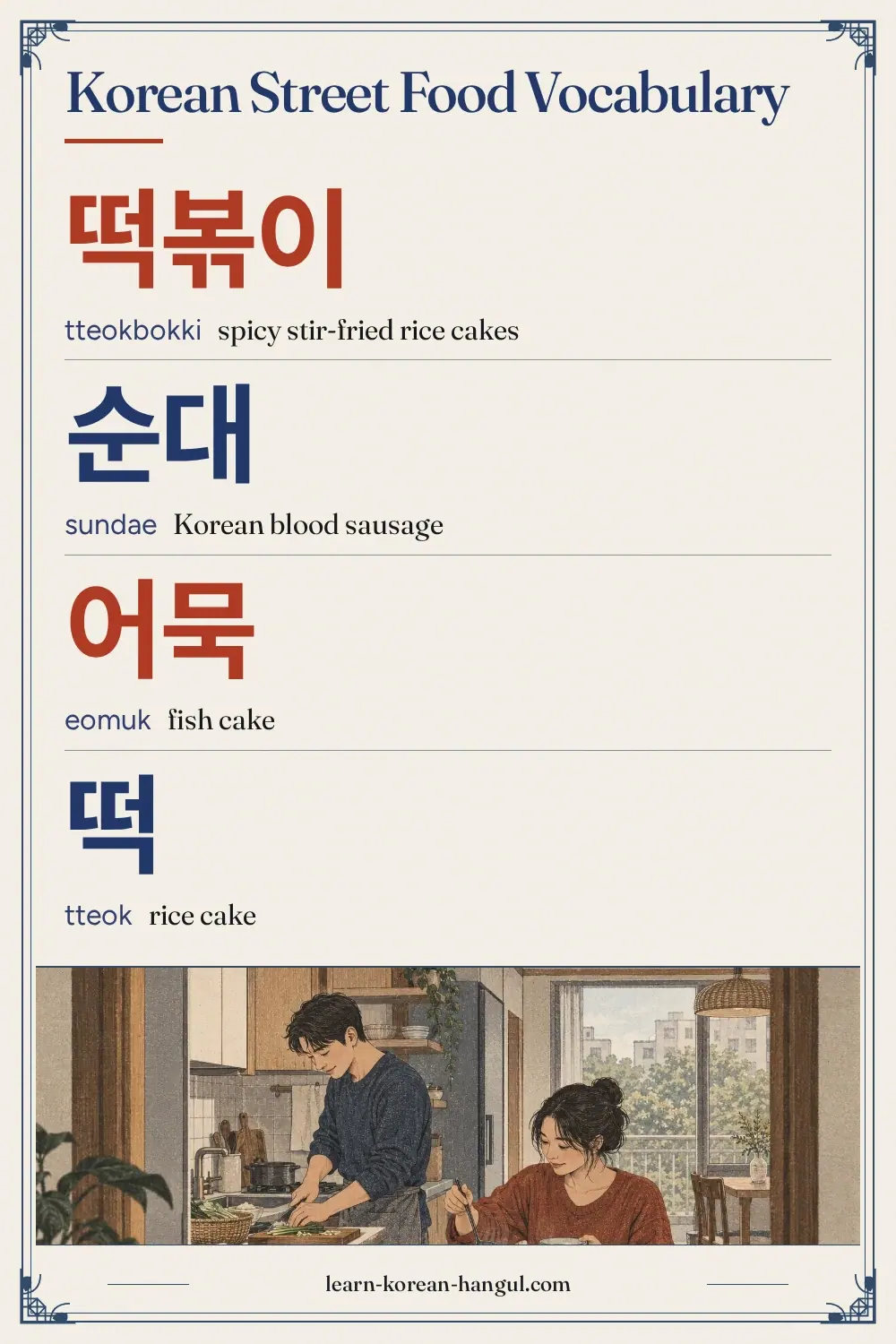
Korean Street Food Vocabulary at a Glance
Street food in Korea is sold from three kinds of place. A 포장마차 is a tented stall, often with a few stools, that stays open late. A 노점 is a plain stall on the pavement. A 분식집 is a small snack shop with a fixed address, and its menu is built on flour (분식 means food made from flour or grain). The names of the dishes are short and mostly native Korean, so they are friendly to a beginner who can already read Hangul.
The list has 25 words in five groups. You can order with only two patterns: the dish name plus a number and 주세요 (please give me), and the dish name plus 있어요? (do you have it?). Both appear in the examples below. This list sits inside Korean Dishes, where the stews, soups, side dishes and desserts have their own pages.
| Group | Words | Examples |
|---|---|---|
| Rice cake and fish cake | 5 | 떡볶이, 순대, 어묵, 떡 |
| Fried snacks | 5 | 튀김, 김말이, 만두, 닭강정 |
| Sweet street snacks | 5 | 호떡, 붕어빵, 계란빵, 뻥튀기 |
| Skewers | 4 | 꼬치, 닭꼬치, 어묵꼬치, 떡꼬치 |
| Winter and summer favourites | 6 | 군고구마, 군밤, 아이스크림, 포장마차 |
By word origin, the list has 13 native, 7 mixed, 3 Sino-Korean and 2 loanword entries. Native words are the easiest to hear, because each syllable is a common Korean sound. The mixed words, such as 호떡 and 붕어빵, join a Chinese-derived syllable or a loan syllable to a native one.
Which Street Food Names Should You Learn First?
Start with the five names a stall board shows most often: 떡볶이, 순대, 튀김, 어묵 and 호떡. Press play, then the slow button, and say each name aloud.
떡볶이 (tteokbokki) means spicy stir-fried rice cakes. It is rice cakes stir-fried in a red chilli-paste sauce, and the name is built from 떡 (rice cake) and 볶이 (a stir-fried thing). After the final ㄱ of 떡 the ㅂ becomes tense, and the ㄲ of 볶 carries over to 이, so it is said [떡뽀끼]. Example: 떡볶이 하나 주세요. (One portion of tteokbokki, please.)
순대 (sundae) means Korean blood sausage. It is a sausage of noodles, vegetables and usually pig's blood in a casing, sliced and served with salt or a dipping sauce. English readers often hear "sundae" the ice cream, but the Korean word is said [순대], with a plain ㄷ. Example: 순대는 소금에 찍어 먹어요. (I eat sundae dipped in salt.)
튀김 (twigim) means fried food in batter. It is the word for anything deep-fried in batter. At a stall it usually means a plate of fried vegetables, squid or sweet potato that you dip in the tteokbokki sauce. Example: 떡볶이에 튀김을 찍어 먹어요. (I dip fried snacks into the tteokbokki sauce.)
어묵 (eomuk) means fish cake. It is fish cake, sold as flat pieces or on skewers in a hot broth. The standard word is 어묵, and the broth is free to drink at many stalls. Example: 어묵 국물이 따뜻해요. (The fish cake broth is warm.)
호떡 (hotteok) means sweet filled pancake. It is a fried pancake with a sweet filling of brown sugar, cinnamon and nuts. It is a winter favourite, and the hot syrup inside can burn your mouth. Example: 호떡 안에 설탕이 들어 있어요. (There is sugar inside the hotteok.)
Rice Cake and Fish Cake
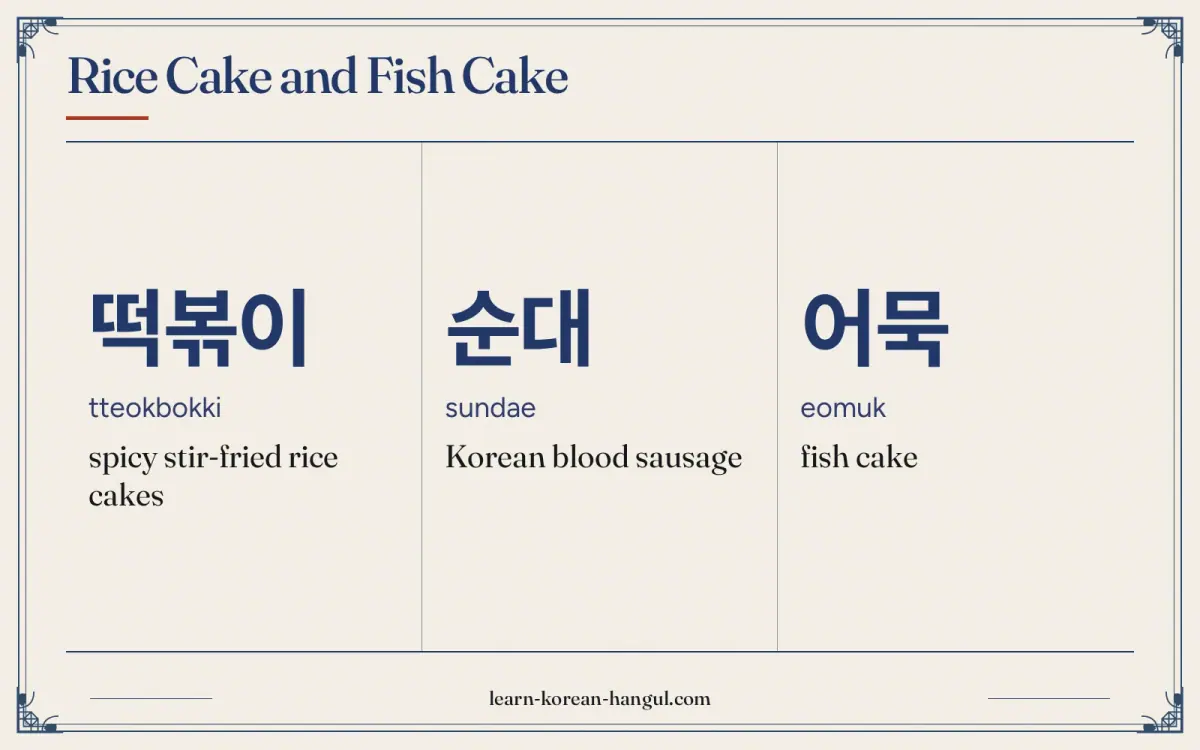
The classic trio of the stall is rice cakes in red sauce, sausage and fish cake in broth. These five words are the base of the menu.
| No. | Hangul | Revised Romanization | Meaning | Origin | Example sentence | Audio assetId |
|---|---|---|---|---|---|---|
| 1 | 떡볶이 | tteokbokki | spicy stir-fried rice cakes | native | 떡볶이 하나 주세요. (tteokbokki hana juseyo; One portion of tteokbokki, please.) | au-pg-vocabulary-food-korean-dishes-street-food-1; example: au-pg-vocabulary-food-korean-dishes-street-food-101 |
| 2 | 순대 | sundae | Korean blood sausage | native | 순대는 소금에 찍어 먹어요. (sundaeneun sogeume jjigeo meogeoyo; I eat sundae dipped in salt.) | au-pg-vocabulary-food-korean-dishes-street-food-2; example: au-pg-vocabulary-food-korean-dishes-street-food-102 |
| 3 | 어묵 | eomuk | fish cake | mixed | 어묵 국물이 따뜻해요. (eomuk gungmuri ttatteutaeyo; The fish cake broth is warm.) | au-pg-vocabulary-food-korean-dishes-street-food-3; example: au-pg-vocabulary-food-korean-dishes-street-food-103 |
| 4 | 떡 | tteok | rice cake | native | 떡은 쌀로 만들어요. (tteogeun ssallo mandeureoyo; Rice cakes are made from rice.) | au-pg-vocabulary-food-korean-dishes-street-food-4; example: au-pg-vocabulary-food-korean-dishes-street-food-104 |
| 5 | 국물 | gungmul | broth; soup liquid | native | 국물을 더 주세요. (gungmureul deo juseyo; Please give me more broth.) | au-pg-vocabulary-food-korean-dishes-street-food-5; example: au-pg-vocabulary-food-korean-dishes-street-food-105 |
- 떡볶이: The cakes are cylinders of rice flour called 가래떡. Add 치즈 (cheese) or 라면 (instant noodles) to the order if the stall offers them. Many stalls sell it by the portion, so 하나 means one dish here, not one piece.
- 순대: Salt is the usual partner in Seoul, but a spicy dipping sauce and a pairing with liver slices are common too. The ㄷ between vowels is a plain sound, close to English d.
- 어묵: The word joins 어 (fish, from Chinese) and 묵 (a jelly-like food, native). Many signs still write the Japanese-origin word 오뎅, but the standard word is 어묵.
- 떡: This single syllable names a whole family of chewy rice-flour foods, from the tteokbokki cylinders to the sweet cakes of the next page. The ending ㄱ is held and not released, so the word stops sharply.
- 국물: Stalls refill broth for free, so asking 국물 더 주세요 is normal. The spelling is 국물 but it is said [궁물], because ㄱ before ㅁ turns into ㅇ (ng).
Example Sentences
The ordering pattern has two parts: the dish name plus a number, then 주세요. For example, 어묵 두 개 주세요 means two pieces of fish cake, please, and 떡볶이 이 인분 주세요 means two portions of tteokbokki. Pieces use the native number with 개, and portions use 인분 (portion) with the Sino-Korean number. If you want to ask whether a stall has something, use 있어요?, as in 붕어빵 있어요? (Do you have bungeoppang?). You can hear the whole pattern on the audio for 붕어빵 세 개 주세요. For the rest of a restaurant visit, see the ordering phrases page.
How Do You Say Fried Snacks in Korean?
Fried food is served with tteokbokki or bought alone by the piece. Five words cover what you will see in the glass case.
| No. | Hangul | Revised Romanization | Meaning | Origin | Example sentence | Audio assetId |
|---|---|---|---|---|---|---|
| 6 | 튀김 | twigim | fried food in batter | native | 떡볶이에 튀김을 찍어 먹어요. (tteokbokkie twigimeul jjigeo meogeoyo; I dip fried snacks into the tteokbokki sauce.) | au-pg-vocabulary-food-korean-dishes-street-food-6; example: au-pg-vocabulary-food-korean-dishes-street-food-106 |
| 7 | 김말이 | gimmari | seaweed-wrapped noodle roll | native | 김말이는 바삭해요. (gimmarineun basakaeyo; The gimmari is crispy.) | au-pg-vocabulary-food-korean-dishes-street-food-7; example: au-pg-vocabulary-food-korean-dishes-street-food-107 |
| 8 | 만두 | mandu | dumpling | Sino-Korean | 만두 다섯 개 주세요. (mandu daseot gae juseyo; Five dumplings, please.) | au-pg-vocabulary-food-korean-dishes-street-food-8; example: au-pg-vocabulary-food-korean-dishes-street-food-108 |
| 9 | 닭강정 | dakgangjeong | sweet crunchy fried chicken | native | 닭강정은 달고 바삭해요. (dakgangjeongeun dalgo basakaeyo; Dakgangjeong is sweet and crunchy.) | au-pg-vocabulary-food-korean-dishes-street-food-9; example: au-pg-vocabulary-food-korean-dishes-street-food-109 |
| 10 | 핫도그 | hatdogeu | corn dog | loanword | 핫도그에 소스를 뿌려요. (hatdogeue soseureul ppuryeoyo; I squirt sauce on a corn dog.) | au-pg-vocabulary-food-korean-dishes-street-food-10; example: au-pg-vocabulary-food-korean-dishes-street-food-110 |
- 튀김: The verb behind it is 튀기다 (to deep-fry), and the noun ending -ㅁ turns the action into a food. The topic here is the dish, not the verb, so you only need the noun.
- 김말이: The roll is glass noodles wrapped in dried seaweed (김) and fried. The name comes from 김 plus 말이 (a rolled thing), and it is said [김마리], because the ㄹ moves onto the empty vowel slot.
- 만두: Dumplings can be steamed (찐만두) or fried (군만두). Counting uses the native number with 개: 다섯 개 is five pieces.
- 닭강정: Bite-sized chicken pieces are fried, then coated in a sticky sweet and spicy glaze. The 닭 here is said [닥] because the ㄹ in the cluster is silent before a consonant, and the ㄱ after it becomes tense: [닥깡정].
- 핫도그: The Korean corn dog is a sausage or cheese stick in thick batter, often rolled in potato cubes or crumbs and dusted with sugar. The word is an English loan. The final ㅅ of 핫 is said like t, and the last syllable 그 adds a vowel that English does not have.
Sweet Street Snacks
Sweets are sold from separate carts and are often seasonal. These five show how native words and loan words sit together.
| No. | Hangul | Revised Romanization | Meaning | Origin | Example sentence | Audio assetId |
|---|---|---|---|---|---|---|
| 11 | 호떡 | hotteok | sweet filled pancake | mixed | 호떡 안에 설탕이 들어 있어요. (hotteok ane seoltangi deureo isseoyo; There is sugar inside the hotteok.) | au-pg-vocabulary-food-korean-dishes-street-food-11; example: au-pg-vocabulary-food-korean-dishes-street-food-111 |
| 12 | 붕어빵 | bungeoppang | fish-shaped pastry | mixed | 붕어빵 세 개 주세요. (bungeoppang se gae juseyo; Three bungeoppang, please.) | au-pg-vocabulary-food-korean-dishes-street-food-12; example: au-pg-vocabulary-food-korean-dishes-street-food-112 |
| 13 | 계란빵 | gyeranppang | egg bread | mixed | 계란빵은 따뜻할 때 맛있어요. (gyeranppangeun ttatteutal ttae masisseoyo; Egg bread is tasty when it is warm.) | au-pg-vocabulary-food-korean-dishes-street-food-13; example: au-pg-vocabulary-food-korean-dishes-street-food-113 |
| 14 | 뻥튀기 | ppeongtwigi | puffed grain snack | native | 뻥튀기 기계에서 큰 소리가 나요. (ppeongtwigi gigyeeseo keun soriga nayo; The puffing machine makes a loud noise.) | au-pg-vocabulary-food-korean-dishes-street-food-14; example: au-pg-vocabulary-food-korean-dishes-street-food-114 |
| 15 | 솜사탕 | somsatang | cotton candy | mixed | 솜사탕은 입에서 녹아요. (somsatangeun ibeseo nogayo; Cotton candy melts in your mouth.) | au-pg-vocabulary-food-korean-dishes-street-food-15; example: au-pg-vocabulary-food-korean-dishes-street-food-115 |
- 호떡: The first syllable 호 is usually explained as a Chinese-derived word for people from the north and west, and 떡 is the native word for a dough cake. Learners can treat the word as one unit.
- 붕어빵: The mould is shaped like a carp (붕어) and the batter is filled with sweet red bean paste. There is no fish inside. The ㅇ at the end of 붕 stays with the first syllable: [붕어빵].
- 계란빵: It is a small sweet loaf baked with a whole egg inside. Some speakers say 달걀빵, since 달걀 is the native word for egg, but 계란빵 is the usual stall name.
- 뻥튀기: A machine heats rice or corn in a closed drum and releases it with a bang. The name starts with 뻥, an imitation of that bang.
- 솜사탕: The word is 솜 (cotton wool) plus 사탕 (candy). The verb 녹다 (to melt) is a good partner for it.
How Do You Say Skewers in Korean?
Skewers are bought one by one. The base word 꼬치 combines with the filling to make the menu name, which makes this the easiest group to extend.
| No. | Hangul | Revised Romanization | Meaning | Origin | Example sentence | Audio assetId |
|---|---|---|---|---|---|---|
| 16 | 꼬치 | kkochi | skewer | native | 꼬치 하나 같이 먹을래요? (kkochi hana gachi meogeullaeyo; Shall we share one skewer?) | au-pg-vocabulary-food-korean-dishes-street-food-16; example: au-pg-vocabulary-food-korean-dishes-street-food-116 |
| 17 | 닭꼬치 | dakkkochi | chicken skewer | native | 닭꼬치에 매운 소스를 발라 주세요. (dakkkochie maeun soseureul balla juseyo; Please put spicy sauce on the chicken skewer.) | au-pg-vocabulary-food-korean-dishes-street-food-17; example: au-pg-vocabulary-food-korean-dishes-street-food-117 |
| 18 | 어묵꼬치 | eomukkkochi | fish cake skewer | mixed | 어묵꼬치는 국물과 같이 나와요. (eomukkkochineun gungmulgwa gachi nawayo; Fish cake skewers come with broth.) | au-pg-vocabulary-food-korean-dishes-street-food-18; example: au-pg-vocabulary-food-korean-dishes-street-food-118 |
| 19 | 떡꼬치 | tteokkkochi | rice cake skewer | native | 떡꼬치는 쫄깃해요. (tteokkkochineun jjolgitaeyo; Rice cake skewers are chewy.) | au-pg-vocabulary-food-korean-dishes-street-food-19; example: au-pg-vocabulary-food-korean-dishes-street-food-119 |
- 꼬치: The ending 을래요 is a friendly way to suggest something. The first sound is a tense ㄲ, which is made with a tight throat and no puff of air.
- 닭꼬치: The word is 닭 (chicken) plus 꼬치. The 닭 is said [닥], with the ㄹ silent, so the whole word is said [닥꼬치].
- 어묵꼬치: The pattern is filling plus 꼬치, as in 어묵 plus 꼬치. The same pattern gives 떡꼬치 and 양꼬치 (lamb skewers).
- 떡꼬치: Grilled rice cakes are brushed with a sweet and spicy sauce. 쫄깃하다 is the word for a pleasant chewy bite.
Winter and Summer Favourites
Some stall food follows the weather, and the same cart may sell roasted sweet potatoes in January and ice cream in July. The last group also gives you the words for the places where food is sold.
| No. | Hangul | Revised Romanization | Meaning | Origin | Example sentence | Audio assetId |
|---|---|---|---|---|---|---|
| 20 | 군고구마 | gungoguma | roasted sweet potato | native | 겨울에는 군고구마를 먹어요. (gyeoureneun gungogumareul meogeoyo; In winter I eat roasted sweet potatoes.) | au-pg-vocabulary-food-korean-dishes-street-food-20; example: au-pg-vocabulary-food-korean-dishes-street-food-120 |
| 21 | 군밤 | gunbam | roasted chestnuts | native | 군밤 한 봉지 주세요. (gunbam han bongji juseyo; One bag of roasted chestnuts, please.) | au-pg-vocabulary-food-korean-dishes-street-food-21; example: au-pg-vocabulary-food-korean-dishes-street-food-121 |
| 22 | 아이스크림 | aiseukeurim | ice cream | loanword | 여름에는 아이스크림을 먹어요. (yeoreumeneun aiseukeurimeul meogeoyo; In summer I eat ice cream.) | au-pg-vocabulary-food-korean-dishes-street-food-22; example: au-pg-vocabulary-food-korean-dishes-street-food-122 |
| 23 | 포장마차 | pojangmacha | tent stall | Sino-Korean | 포장마차에서 어묵을 먹었어요. (pojangmachaeseo eomugeul meogeosseoyo; I ate fish cake at a tent stall.) | au-pg-vocabulary-food-korean-dishes-street-food-23; example: au-pg-vocabulary-food-korean-dishes-street-food-123 |
| 24 | 노점 | nojeom | street stall | Sino-Korean | 노점에서 호떡을 샀어요. (nojeomeseo hotteogeul sasseoyo; I bought hotteok at a street stall.) | au-pg-vocabulary-food-korean-dishes-street-food-24; example: au-pg-vocabulary-food-korean-dishes-street-food-124 |
| 25 | 분식집 | bunsikjip | snack shop | mixed | 분식집에서 김밥도 팔아요. (bunsikjibeseo gimbapdo parayo; A snack shop also sells gimbap.) | au-pg-vocabulary-food-korean-dishes-street-food-25; example: au-pg-vocabulary-food-korean-dishes-street-food-125 |
- 군고구마: The prefix 군 means roasted or baked, and 고구마 is the sweet potato. It is the classic winter street snack, sold by the bag or by weight.
- 군밤: The word is 군 (roasted) plus 밤 (chestnut). A 봉지 is a paper or plastic bag, which is how chestnuts are sold.
- 아이스크림: The word is an English loan with five syllables, each with its own vowel. Korean adds 으 where English has a consonant cluster.
- 포장마차: The name joins 포장 (a cloth cover) and 마차 (a cart). The stalls serve food, drinks and soup into the night, so the word also suggests a late evening out.
- 노점: The word is made of 노 (open air) and 점 (shop). It is the neutral term for any pavement seller, including those who sell fruit or clothes.
- 분식집: Its menu has tteokbokki, gimbap, ramyeon and fried snacks. The final ㄱ of 식 makes the ㅈ in 집 tense, so it is said [분식찝].
How Do You Pronounce These Words?
Street food names are short, but five of them change sound when spoken. The table follows the Standard Pronunciation rules (표준 발음법) of the 국립국어원.
| Word | Romanization | Said | Rule |
|---|---|---|---|
| 떡볶이 | tteokbokki | [떡뽀끼] | the ㅂ after the final ㄱ of 떡 becomes tense [ㅃ], and the ㄲ of 볶 moves onto the empty ㅇ of 이 |
| 국물 | gungmul | [궁물] | ㄱ before ㅁ becomes ㅇ (ng) |
| 닭꼬치 | dakkkochi | [닥꼬치] | of the pair ㄹㄱ at the end of 닭, only ㄱ is said before a consonant |
| 분식집 | bunsikjip | [분식찝] | ㅈ after the final ㄱ becomes tense |
| 김말이 | gimmari | [김마리] | the ㄹ of 말 moves onto the empty ㅇ of 이 |
Revised Romanization is the official romanization system of South Korea, announced on 7 July 2000. It follows most sound changes, as in 국물 gungmul, but it does not show tensing caused by a neighbouring sound, so 떡볶이 is written tteokbokki even though it is said [떡뽀끼]. It is only a learning aid. Always read the Hangul as well.
Audio and Slow Playback
Each headword and each example sentence has its own audio clip, and the 5 words in the first-words section also have a slow clip at 0.8 times the speed. Nothing plays until you press a button. Listen once to 떡볶이, repeat it aloud twice, and only then check the romanization.
What Mistakes Do Learners Make with Street Food Names?
- Reading 순대 as the English word sundae. The Korean word is blood sausage, said [순대], and it is a savoury food.
- Writing 오뎅 on a list of Korean words. It is still seen on stall signs, but the standard word is 어묵.
- Treating 호떡 as a rice cake. It is a fried pancake, and 떡 here only means a dough cake.
- Saying 떡볶이 한 개 when you want a plate. 한 개 suggests one piece; for one serving say 떡볶이 하나 주세요 or 떡볶이 일 인분 주세요.
- Expecting fish inside 붕어빵. The fish is only the shape of the mould.
- Saying 닭꼬치 as [달꼬치]. The ㄹ is silent in this word.
Practice: Flashcards and Worksheet
Drill all 25 words with the vocabulary flashcard decks: each card shows the Hangul on one side and the meaning on the other, so you can test yourself in both directions. Consult the vocabulary worksheets page for printable sheets; for practice, write the Korean name for each numbered object in the scene above by hand. A simple plan is to do the first two groups on day one (ten words) and the rest on day two, then return to the whole set after a week. Order out loud in front of the scene, pointing at each stall item: 붕어빵 세 개 주세요, 어묵 하나 주세요.
Self-Test: 10 Sentences
Fill each blank with a word from this page. Say the whole sentence aloud when you have it. The answers follow the test.
- ___ 하나 주세요. (One portion of tteokbokki, please.)
- ___ 국물이 따뜻해요. (The fish cake broth is warm.)
- 떡볶이에 ___을 찍어 먹어요. (I dip fried snacks into the tteokbokki sauce.)
- ___ 다섯 개 주세요. (Five dumplings, please.)
- ___ 안에 설탕이 들어 있어요. (There is sugar inside the hotteok.)
- ___은 따뜻할 때 맛있어요. (Egg bread is tasty when it is warm.)
- ___ 하나 같이 먹을래요? (Shall we share one skewer?)
- ___는 국물과 같이 나와요. (Fish cake skewers come with broth.)
- ___ 한 봉지 주세요. (One bag of roasted chestnuts, please.)
- ___에서 어묵을 먹었어요. (I ate fish cake at a tent stall.)
Answers: 1. 떡볶이; 2. 어묵; 3. 튀김; 4. 만두; 5. 호떡; 6. 계란빵; 7. 꼬치; 8. 어묵꼬치; 9. 군밤; 10. 포장마차.
A score of 8 or more suggests the words are settling in. If you scored lower, reread the groups where you missed words.
Where to Go Next
This Korean street food vocabulary list sits inside Korean Dishes. After this, many learners move on to Korean Side Dishes (Banchan) Vocabulary or to Korean Desserts and Rice Cakes Vocabulary, which goes deeper into 떡 and sweets. For the single-word answer about the dish that heads this page, see tteokbokki in korean.
FAQ
How Do You Say Spicy Rice Cakes in Korean?
Say 떡볶이 (tteokbokki). It is pronounced [떡뽀끼], and the usual order is 떡볶이 하나 주세요 (One portion of tteokbokki, please). The name joins 떡 (rice cake) and 볶이 (a stir-fried thing), and most stalls serve it in a red chilli-paste sauce with fish cake. For the single-word answer, see tteokbokki in korean.
How Do You Pronounce 순대 (sundae)?
Say soon-deh, with the second vowel like the "e" in English "bed", not like the ice cream. The ㄷ of 대 is a plain consonant, so after the ㄴ it sounds like a soft English d, and the final ㄴ of 순 is just an n. The word means Korean blood sausage.
How Many Street Food Names Should I Learn First?
Learn the five words in the first-words section: 떡볶이, 순대, 튀김, 어묵 and 호떡. They appear on nearly every stall board. Add 붕어빵, 꼬치 and 닭꼬치 next, then the seasonal group, and the 25-word list is done in three short sessions.
Where Can I Practise Street Food Names with Flashcards?
Use the vocabulary flashcard decks. Start with the ten words from the first two groups, then add the sweets and skewers. Review older cards before adding new ones, so the first words do not fade, and say each word aloud as you flip the card.
Is the Romanization on This Page Official?
Yes, as a learning aid. It follows the Revised Romanization of Korean, the system South Korea has officially used since 7 July 2000, and the page also gives the Hangul for every word. It follows most sound changes but does not show tensing caused by a neighbouring sound: 떡볶이 is written tteokbokki but said [떡뽀끼]. Treat the Hangul as the real spelling.
Is There a Printable Worksheet for Street Food Names?
The vocabulary worksheets page lists the printable sheets. For paper practice, use the illustrated scene on this page as a labelling task and write the Korean name next to each numbered object. You can also copy the scene words by hand.