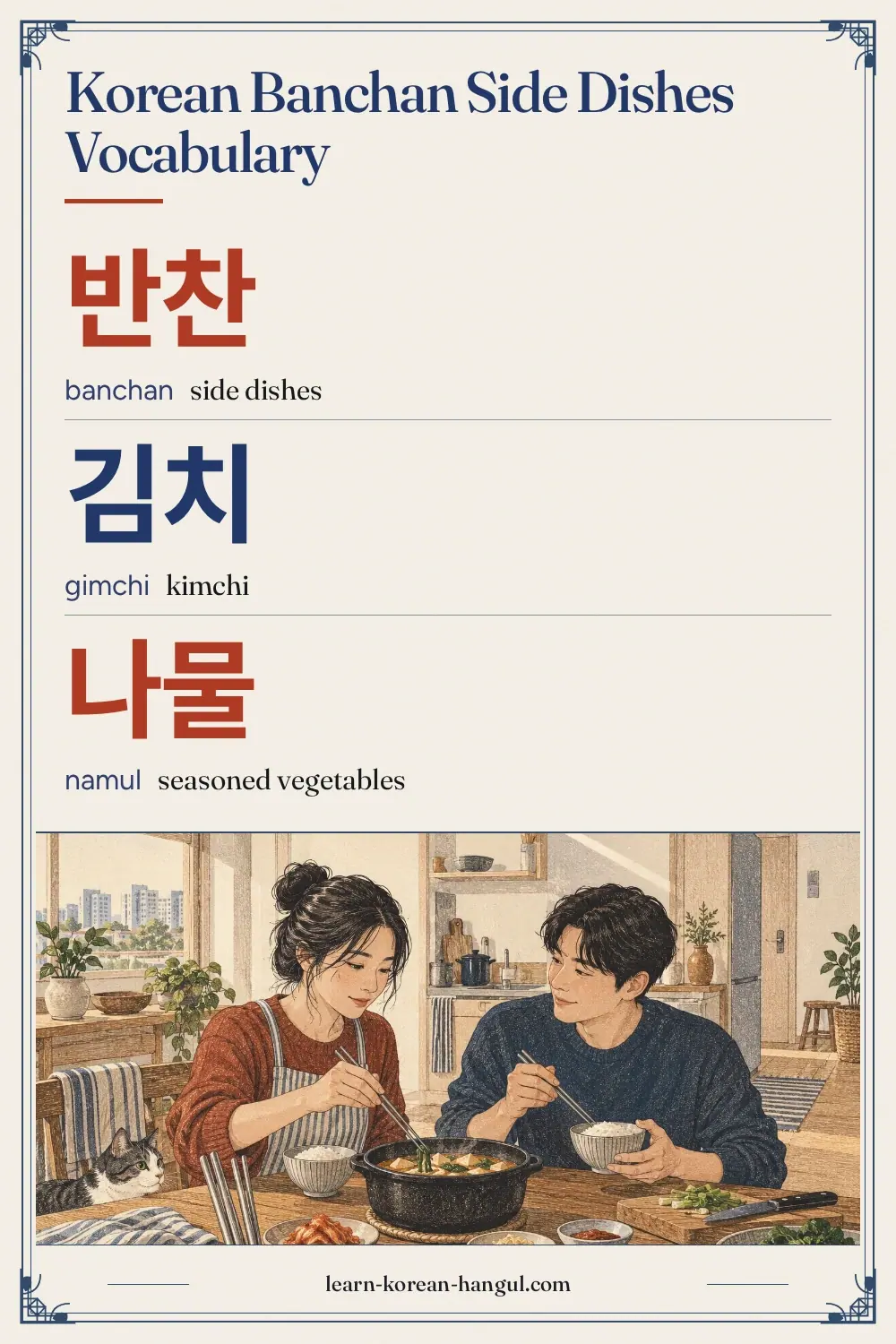
Korean Banchan Side Dishes Vocabulary at a Glance
This list has 30 words in five groups of six. It follows the way a banchan table is built: pickles and kimchi first, then seasoned vegetables, then dishes that are stir-fried or braised, then egg and pancake dishes, and finally the dried and salted items that keep for weeks. It sits inside Korean Dishes, next to the pages for main dishes.
| Group | Words | Use |
|---|---|---|
| Kimchi and pickles | 6 | Naming the cold, tangy dishes on the table |
| Seasoned vegetables (나물) | 6 | Naming greens and roots seasoned by hand |
| Braised and stir-fried | 6 | Naming cooked, salty-sweet dishes for rice |
| Fried and egg dishes | 6 | Naming egg dishes and pan-fried pancakes |
| Dried and salted | 6 | Naming preserved items that keep without cooking |
Most of the words are compound nouns. A compound noun joins two words into one, so 멸치볶음 is 멸치 (anchovy) plus 볶음 (stir-frying). Once you know the six method endings in the key facts, you can guess the cooking style of a dish you have never seen. That habit is the main idea of this page.
Which Banchan Side Dishes Should You Learn First?
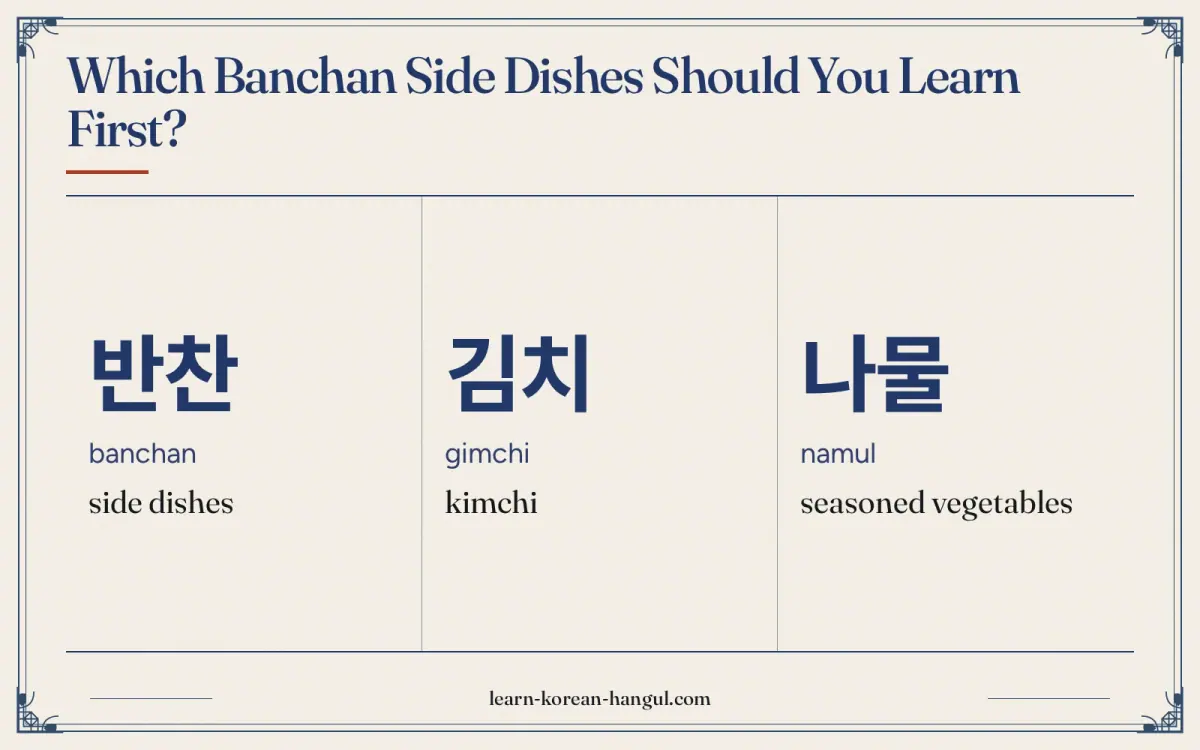
Learn 반찬 (side dishes), 김치 (kimchi), 계란말이 (rolled omelette), 멸치볶음 (stir-fried anchovies) and 시금치나물 (seasoned spinach) first. They appear on almost every home-style table and in most restaurants, so you will meet them in the first week of eating in Korea.
- Words to say. 반찬, 김치, 계란말이. These are the names you use when you point and ask or when you order more.
- Words to recognise. 멸치볶음, 콩나물무침, 감자조림, 장조림. They appear on set menus and in lunch boxes.
- Words to read on labels. 젓갈, 장아찌, 김자반. These are common in the cold section of a supermarket.
Banchan are shared. Everyone at the table eats from the same small plates, and at many restaurants the staff will refill a plate if you ask. The polite request is 더 주세요 (please give me more). Check the menu or ask first, because some places charge for extra plates of certain items.
Word · 8
- 1
반찬
banchan
side dishes
- 2
김치
gimchi
kimchi
- 3
나물
namul
seasoned vegetables
- 4
멸치볶음
myeolchibokkeum
stir-fried anchovies
- 5
계란말이
gyeranmari
rolled omelette
- 6
계란찜
gyeranjjim
steamed egg
- 7
젓갈
jeotgal
salted fermented seafood
- 8
밑반찬
mitbanchan
staple side dishes
Kimchi and Pickles
Banchan is the umbrella word, and kimchi is its best-known member. The six words here name the pickled side of the table. Korean makes pickles with salt, soy sauce, vinegar or chilli, so each word hints at the method. 장아찌 are vegetables kept in soy sauce or vinegar, while 단무지 is the yellow radish served with noodles and rolled rice.
| No. | Hangul | Revised Romanization | Meaning and note | Example sentence | Audio assetId |
|---|---|---|---|---|---|
| 1 | 반찬 | banchan | side dishes. Includes every small shared dish; it is a collective noun. | 반찬이 많아요. (There are many side dishes.) | au-pg-vocabulary-food-korean-dishes-banchan-1; example: au-pg-vocabulary-food-korean-dishes-banchan-31 |
| 2 | 김치 | gimchi | kimchi. Fermented vegetables, usually napa cabbage. English menus often write kimchi. | 김치가 매워요. (The kimchi is spicy.) | au-pg-vocabulary-food-korean-dishes-banchan-2; example: au-pg-vocabulary-food-korean-dishes-banchan-32 |
| 3 | 깍두기 | kkakdugi | cubed radish kimchi. Said [깍뚜기]. Radish cut into cubes; goes well with soup. | 깍두기가 맛있어요. (The cubed radish kimchi is tasty.) | au-pg-vocabulary-food-korean-dishes-banchan-3; example: au-pg-vocabulary-food-korean-dishes-banchan-33 |
| 4 | 장아찌 | jangajji | soy-pickled vegetables. Vegetables kept in soy sauce or vinegar; salty and keeps for months. | 장아찌를 먹어요. (I eat soy-pickled vegetables.) | au-pg-vocabulary-food-korean-dishes-banchan-4; example: au-pg-vocabulary-food-korean-dishes-banchan-34 |
| 5 | 단무지 | danmuji | yellow pickled radish. Sweet and sour; comes with 김밥 and Chinese-Korean noodles. | 단무지는 노란색이에요. (Pickled radish is yellow.) | au-pg-vocabulary-food-korean-dishes-banchan-5; example: au-pg-vocabulary-food-korean-dishes-banchan-35 |
| 6 | 오이소박이 | oisobagi | stuffed cucumber kimchi. Cucumber cut and filled with seasoned chilli; a summer dish. | 오이소박이를 좋아해요. (I like stuffed cucumber kimchi.) | au-pg-vocabulary-food-korean-dishes-banchan-6; example: au-pg-vocabulary-food-korean-dishes-banchan-36 |
Example Sentences
Three sentence frames cover almost every example here. The first is noun + 이/가 or 은/는 + adjective, as in 멸치볶음은 짜요 (the stir-fried anchovies are salty). The second is noun + 을/를 + verb, as in 김치전을 부쳐요 (I pan-fry a kimchi pancake). The third is noun + 주세요 (please give me noun), the polite way to ask for something at a table. Use the audio, then say each sentence aloud once.
Note the particle 이/가 in the examples. It marks the subject, as in 김치가 매워요 (the kimchi is spicy). You choose 이 after a consonant and 가 after a vowel. The pickles need no cooking at serving time, so they are ready as soon as you sit down.
How Do You Say Seasoned Vegetables (나물) in Korean?
나물 (namul) means seasoned vegetables or wild greens, and the dish name usually says which plant it is made from. The method word 무침 means mixing by hand with seasoning, from the verb 무치다 (to toss with seasoning). A 나물 is blanched, squeezed and mixed with sesame oil, garlic and salt. It is a gentle, usually non-spicy counterweight to kimchi.
| No. | Hangul | Revised Romanization | Meaning and note | Example sentence | Audio assetId |
|---|---|---|---|---|---|
| 7 | 나물 | namul | seasoned vegetables. Blanched greens or roots seasoned with sesame oil; also means wild greens. | 나물을 무쳐요. (I toss the vegetables with seasoning.) | au-pg-vocabulary-food-korean-dishes-banchan-7; example: au-pg-vocabulary-food-korean-dishes-banchan-37 |
| 8 | 시금치나물 | sigeumchinamul | seasoned spinach. One of the most common 나물; mild and nutty. | 시금치나물을 먹어요. (I eat seasoned spinach.) | au-pg-vocabulary-food-korean-dishes-banchan-8; example: au-pg-vocabulary-food-korean-dishes-banchan-38 |
| 9 | 콩나물무침 | kongnamulmuchim | seasoned bean sprouts. Soybean sprouts with sesame oil and salt. | 콩나물무침이 맛있어요. (The seasoned bean sprouts are tasty.) | au-pg-vocabulary-food-korean-dishes-banchan-9; example: au-pg-vocabulary-food-korean-dishes-banchan-39 |
| 10 | 도라지무침 | dorajimuchim | seasoned bellflower root. Bellflower root with a spicy dressing; chewy. | 도라지무침 있어요? (Do you have seasoned bellflower root?) | au-pg-vocabulary-food-korean-dishes-banchan-10; example: au-pg-vocabulary-food-korean-dishes-banchan-40 |
| 11 | 고사리나물 | gosarinamul | seasoned bracken. Bracken fern shoots; served at ceremonial meals and in 비빔밥. | 고사리나물을 좋아해요. (I like seasoned bracken.) | au-pg-vocabulary-food-korean-dishes-banchan-11; example: au-pg-vocabulary-food-korean-dishes-banchan-41 |
| 12 | 무생채 | musaengchae | shredded radish salad. Raw radish cut into thin strips with chilli and vinegar. | 무생채를 만들어요. (I make shredded radish salad.) | au-pg-vocabulary-food-korean-dishes-banchan-12; example: au-pg-vocabulary-food-korean-dishes-banchan-42 |
Plain 나물 dishes are mild, so they pair well with strongly flavoured stews. A quick way to guess a name: plant name + 나물 for a blanched green, plant name + 무침 for a salad with a spicy or tangy dressing, and plant name + 생채 for a raw shredded salad.
Braised and Stir-Fried Banchan
These dishes are cooked with soy sauce, sugar and oil, so they taste salty and a little sweet. The two method words are 볶음 (stir-fried) and 조림 (braised, meaning simmered in a seasoned liquid until it is almost gone). 볶음 is said with a tense sound, and 조림 stays soft. Most of these dishes are made in a large batch and keep well in the fridge.
| No. | Hangul | Revised Romanization | Meaning and note | Example sentence | Audio assetId |
|---|---|---|---|---|---|
| 13 | 멸치볶음 | myeolchibokkeum | stir-fried anchovies. Said [멸치보끔]. Small dried anchovies in a sweet soy glaze; a staple lunchbox dish. | 멸치볶음은 짜요. (The stir-fried anchovies are salty.) | au-pg-vocabulary-food-korean-dishes-banchan-13; example: au-pg-vocabulary-food-korean-dishes-banchan-43 |
| 14 | 감자조림 | gamjajorim | braised potatoes. Potato chunks simmered in soy sauce and sugar. | 감자조림을 먹어요. (I eat braised potatoes.) | au-pg-vocabulary-food-korean-dishes-banchan-14; example: au-pg-vocabulary-food-korean-dishes-banchan-44 |
| 15 | 콩자반 | kongjaban | sweet braised beans. Small black beans simmered until glossy. | 콩자반은 달아요. (The braised beans are sweet.) | au-pg-vocabulary-food-korean-dishes-banchan-15; example: au-pg-vocabulary-food-korean-dishes-banchan-45 |
| 16 | 어묵볶음 | eomukbokkeum | stir-fried fish cake. Said [어묵보끔]. Sliced fish cake with onion and soy sauce. | 어묵볶음 주세요. (Stir-fried fish cake, please.) | au-pg-vocabulary-food-korean-dishes-banchan-16; example: au-pg-vocabulary-food-korean-dishes-banchan-46 |
| 17 | 진미채볶음 | jinmichaebokkeum | seasoned dried squid. Said [진미채보끔]. Shredded dried squid with a red-pepper sauce; chewy. | 진미채볶음이 맛있어요. (The seasoned dried squid is tasty.) | au-pg-vocabulary-food-korean-dishes-banchan-17; example: au-pg-vocabulary-food-korean-dishes-banchan-47 |
| 18 | 장조림 | jangjorim | soy-braised beef. Beef (or eggs) braised in soy sauce; eaten shredded over rice. | 장조림을 밥이랑 먹어요. (I eat soy-braised beef with rice.) | au-pg-vocabulary-food-korean-dishes-banchan-18; example: au-pg-vocabulary-food-korean-dishes-banchan-48 |
You will hear 볶음 as [보끔] because the ㄲ is a doubled letter that you say tight. The Revised Romanization writes it bokkeum. Spend a minute on this: once 볶음 sounds right, 멸치볶음, 어묵볶음 and 진미채볶음 all sound right.
How Do Banchan Names Show the Cooking Method?
Korean side dish names are built from an ingredient plus a method ending, and the ending is the part to memorise. The table below collects the six endings used on this page. Each one is a noun, so you can attach it to a new ingredient and get a correct dish name.
| Ending | Meaning | Example on this page | Cooking idea |
|---|---|---|---|
| 무침 (muchim) | tossed with seasoning | 콩나물무침 | blanch, then mix by hand |
| 볶음 (bokkeum) | stir-fried | 멸치볶음 | fry with oil and sauce |
| 조림 (jorim) | braised | 감자조림 | simmer in soy sauce |
| 전 (jeon) | pan-fried pancake | 호박전 | coat in batter and fry |
| 찜 (jjim) | steamed | 계란찜 | cook with steam |
| 장아찌 (jangajji) | soy-pickled | 장아찌 | keep in soy sauce or vinegar |
A small cautionary note. The pattern is a strong guide, not a law. 말이 in 계란말이 is not on the list because it names the rolling shape, and 생채 names a raw salad. When you meet a new name, check the ending first and the ingredient second. For the numbers you need to order, see the food counters page, where 가지 (kinds) is explained next to 인분 (portions).
How Do You Say Fried and Egg Dishes in Korean?
Egg and pan-fried dishes are the favourites of children and the quickest to cook. 계란 (gyeran) is egg, and the suffix tells you the method: 말이 means rolled, 찜 means steamed. The pancake suffix 전 (jeon) means a flat dish coated in egg batter and fried in a shallow pan. The word 부침 (buchim) is a related term that covers pan-fried foods.
| No. | Hangul | Revised Romanization | Meaning and note | Example sentence | Audio assetId |
|---|---|---|---|---|---|
| 19 | 계란말이 | gyeranmari | rolled omelette. Eggs rolled in layers with chopped vegetables; sliced into rounds. | 계란말이를 좋아해요. (I like rolled omelette.) | au-pg-vocabulary-food-korean-dishes-banchan-19; example: au-pg-vocabulary-food-korean-dishes-banchan-49 |
| 20 | 계란찜 | gyeranjjim | steamed egg. Eggs steamed in a small pot until soft and puffy. | 계란찜이 부드러워요. (The steamed egg is soft.) | au-pg-vocabulary-food-korean-dishes-banchan-20; example: au-pg-vocabulary-food-korean-dishes-banchan-50 |
| 21 | 두부부침 | dububuchim | pan-fried tofu. Tofu slices fried until golden, then dipped in soy sauce. | 두부부침을 만들어요. (I make pan-fried tofu.) | au-pg-vocabulary-food-korean-dishes-banchan-21; example: au-pg-vocabulary-food-korean-dishes-banchan-51 |
| 22 | 김치전 | gimchijeon | kimchi pancake. Chopped kimchi in a flour batter; crisp at the edges. | 김치전을 부쳐요. (I pan-fry a kimchi pancake.) | au-pg-vocabulary-food-korean-dishes-banchan-22; example: au-pg-vocabulary-food-korean-dishes-banchan-52 |
| 23 | 호박전 | hobakjeon | zucchini pancake. Said [호박쩐]. Zucchini slices dipped in egg and fried. | 호박전을 먹어요. (I eat zucchini pancake.) | au-pg-vocabulary-food-korean-dishes-banchan-23; example: au-pg-vocabulary-food-korean-dishes-banchan-53 |
| 24 | 감자전 | gamjajeon | potato pancake. Grated potato fried flat; crisp outside and chewy inside. | 감자전이 바삭해요. (The potato pancake is crispy.) | au-pg-vocabulary-food-korean-dishes-banchan-24; example: au-pg-vocabulary-food-korean-dishes-banchan-54 |
Remember that 전 starts with a tense sound after a final stop such as ㄱ, so 호박전 is [호박쩐], while 감자전 keeps a plain ㅈ. Pancake dishes are often shared as a main dish at rainy-day meals and on holidays, but small portions of 전 still count as banchan.
Dried and Salted Banchan
The last group is the preserved side of Korean meals. Dried fish, salted seafood and seasoned seaweed last for weeks, so families keep them stocked. 밑반찬 (mitbanchan) is the useful umbrella word: dishes made ahead and kept in the fridge. 젓갈 is salted, fermented seafood, which gives kimchi its depth.
| No. | Hangul | Revised Romanization | Meaning and note | Example sentence | Audio assetId |
|---|---|---|---|---|---|
| 25 | 젓갈 | jeotgal | salted fermented seafood. Said [젇깔]. Shrimp, squid or fish salted for months; used in kimchi and as a side. | 젓갈은 짜요. (Salted seafood is salty.) | au-pg-vocabulary-food-korean-dishes-banchan-25; example: au-pg-vocabulary-food-korean-dishes-banchan-55 |
| 26 | 명란젓 | myeongnanjeot | salted pollock roe. Said [명난젇]. Pollock eggs salted and seasoned with chilli; eaten with rice. | 명란젓 주세요. (Salted pollock roe, please.) | au-pg-vocabulary-food-korean-dishes-banchan-26; example: au-pg-vocabulary-food-korean-dishes-banchan-56 |
| 27 | 김 | gim | seaweed (laver). Dried sheets of laver, roasted and salted; the same word as in 김밥. | 김에 밥을 싸요. (I wrap rice in laver.) | au-pg-vocabulary-food-korean-dishes-banchan-27; example: au-pg-vocabulary-food-korean-dishes-banchan-57 |
| 28 | 김자반 | gimjaban | seasoned seaweed flakes. Crumbled laver, sugar and sesame seeds; sprinkled on rice. | 김자반을 뿌려요. (I sprinkle seasoned seaweed flakes.) | au-pg-vocabulary-food-korean-dishes-banchan-28; example: au-pg-vocabulary-food-korean-dishes-banchan-58 |
| 29 | 오징어채 | ojingeochae | shredded dried squid. Dried squid torn into strips; the plain form of the seasoned 진미채. | 오징어채를 먹어요. (I eat shredded dried squid.) | au-pg-vocabulary-food-korean-dishes-banchan-29; example: au-pg-vocabulary-food-korean-dishes-banchan-59 |
| 30 | 밑반찬 | mitbanchan | staple side dishes. Said [믿빤찬]. Dishes made ahead; a household keeps several in the fridge. | 밑반찬을 만들어요. (I make staple side dishes.) | au-pg-vocabulary-food-korean-dishes-banchan-30; example: au-pg-vocabulary-food-korean-dishes-banchan-60 |
Salted items are strong, so they are eaten in tiny amounts with a spoonful of rice. The word 짜다 (to be salty) appears often in conversation about them. Some of these words are also on grocery shelves, so you will see them printed rather than spoken.
How Do You Ask for More Banchan?
Ask for refills with a short request and the dish name: 김치 더 주세요 (more kimchi, please). At many restaurants the staff will refill popular plates without a charge, but this is a custom, not a rule, so look at the menu or ask. Use 반찬 더 주세요 for more side dishes in general. To decline a refill, say 반찬은 괜찮아요 (I am fine for side dishes).
A table usually shows how many 가지 (kinds) it has. A simple home meal might have three kinds, while a 한정식 (Korean set meal) can bring a dozen or more. You count them with native numbers: 반찬 세 가지 (three kinds of side dishes), 반찬 다섯 가지 (five kinds).
How Do You Pronounce These Words?
Banchan names contain several tense sounds and linking sounds. Standard pronunciation follows the National Institute of Korean Language (국립국어원) rules, and the romanization on this page follows the Revised Romanization of Korean, which does not mark every sound change.
| Spelling | Sounds like | What changes |
|---|---|---|
| 깍두기 | [깍뚜기] | After the final ㄱ, the ㄷ is said as a tense [ㄸ]. |
| 멸치볶음 | [멸치보끔] | The final ㄲ of 볶 moves to the next syllable and links with the vowel of 음. |
| 밑반찬 | [믿빤찬] | Final ㅌ is said as [ㄷ], and the ㅂ after it becomes a tense [ㅃ]. |
| 호박전 | [호박쩐] | After a final ㄱ-type sound, the ㅈ of 전 is said as a tense [ㅉ]. |
| 젓갈 | [젇깔] | Final ㅅ is said as [ㄷ], and the ㄱ after it is tense [ㄲ]. |
| 명란젓 | [명난젇] | The ㄹ after ㅇ is said [ㄴ], and final ㅅ is [ㄷ]. |
The tense sounds in 깍두기 and 호박전 are the ones learners most often miss. Say the tense sound with a tight throat and no puff of air. If you hear a puff, you are saying an aspirated [ㅌ] or [ㅊ] and the word will sound slightly wrong.
Audio and Slow Playback
Every word and every example sentence has its own clip. The five clips below replay the trickiest words slowly. Play one, repeat it aloud, then play it again and compare.
What Mistakes Do Learners Make with Banchan Side Dishes?
These five mistakes come up most often when learners order or talk about side dishes.
- Treating 반찬 as one dish. 반찬 is a group word, so you do not say "one banchan" the way you say one plate. Count the plates by kind: 반찬 두 가지 (two kinds of side dishes).
- Dropping the tense sound in 볶음. Say [보끔], not [보금]. A soft sound changes the word and some listeners will not catch it.
- Mixing 나물 and 무침. 나물 names the vegetable dish, usually blanched and mild. 무침 names the method of tossing with seasoning, often with chilli or vinegar. Both translate as "seasoned vegetables", but the taste often differs.
- Calling every pancake 전 without the ingredient. 전 alone is a type. Say 호박전 or 감자전 to name the dish.
- Expecting every side dish to be free. Refills are common at many places, but not all. Ask first when you are unsure.
Once you can say the six method endings from memory, most of these slips disappear. For the longer words, try the slow audio before you start the flashcards.
Practice: Flashcards and Worksheet
Study in three steps. First, run the flashcard deck in recognition mode until you know each of the 30 words. Second, switch to listening mode and say the word before you look. Third, take the quiz. Your progress stays in your browser, and the vocabulary flashcard decks page lists the other decks.
Practice · 65
- 01반찬
Show answer
headword 1: side dishes
- 02김치
Show answer
headword 2: kimchi
- 03깍두기
Show answer
headword 3: cubed radish kimchi
- 04장아찌
Show answer
headword 4: soy-pickled vegetables
- 05단무지
Show answer
headword 5: yellow pickled radish
- 06오이소박이
Show answer
headword 6: stuffed cucumber kimchi
- 07나물
Show answer
headword 7: seasoned vegetables
- 08시금치나물
Show answer
headword 8: seasoned spinach
- 09콩나물무침
Show answer
headword 9: seasoned bean sprouts
- 10도라지무침
Show answer
headword 10: seasoned bellflower root
- 11고사리나물
Show answer
headword 11: seasoned bracken
- 12무생채
Show answer
headword 12: shredded radish salad
- 13멸치볶음
Show answer
headword 13: stir-fried anchovies
- 14감자조림
Show answer
headword 14: braised potatoes
- 15콩자반
Show answer
headword 15: sweet braised beans
- 16어묵볶음
Show answer
headword 16: stir-fried fish cake
- 17진미채볶음
Show answer
headword 17: seasoned dried squid
- 18장조림
Show answer
headword 18: soy-braised beef
- 19계란말이
Show answer
headword 19: rolled omelette
- 20계란찜
Show answer
headword 20: steamed egg
- 21두부부침
Show answer
headword 21: pan-fried tofu
- 22김치전
Show answer
headword 22: kimchi pancake
- 23호박전
Show answer
headword 23: zucchini pancake
- 24감자전
Show answer
headword 24: potato pancake
- 25젓갈
Show answer
headword 25: salted fermented seafood
- 26명란젓
Show answer
headword 26: salted pollock roe
- 27김
Show answer
headword 27: seaweed (laver)
- 28김자반
Show answer
headword 28: seasoned seaweed flakes
- 29오징어채
Show answer
headword 29: shredded dried squid
- 30밑반찬
Show answer
headword 30: staple side dishes
- 31반찬이 많아요.
Show answer
example sentence for 반찬
- 32김치가 매워요.
Show answer
example sentence for 김치
- 33깍두기가 맛있어요.
Show answer
example sentence for 깍두기
- 34장아찌를 먹어요.
Show answer
example sentence for 장아찌
- 35단무지는 노란색이에요.
Show answer
example sentence for 단무지
- 36오이소박이를 좋아해요.
Show answer
example sentence for 오이소박이
- 37나물을 무쳐요.
Show answer
example sentence for 나물
- 38시금치나물을 먹어요.
Show answer
example sentence for 시금치나물
- 39콩나물무침이 맛있어요.
Show answer
example sentence for 콩나물무침
- 40도라지무침 있어요?
Show answer
example sentence for 도라지무침
- 41고사리나물을 좋아해요.
Show answer
example sentence for 고사리나물
- 42무생채를 만들어요.
Show answer
example sentence for 무생채
- 43멸치볶음은 짜요.
Show answer
example sentence for 멸치볶음
- 44감자조림을 먹어요.
Show answer
example sentence for 감자조림
- 45콩자반은 달아요.
Show answer
example sentence for 콩자반
- 46어묵볶음 주세요.
Show answer
example sentence for 어묵볶음
- 47진미채볶음이 맛있어요.
Show answer
example sentence for 진미채볶음
- 48장조림을 밥이랑 먹어요.
Show answer
example sentence for 장조림
- 49계란말이를 좋아해요.
Show answer
example sentence for 계란말이
- 50계란찜이 부드러워요.
Show answer
example sentence for 계란찜
- 51두부부침을 만들어요.
Show answer
example sentence for 두부부침
- 52김치전을 부쳐요.
Show answer
example sentence for 김치전
- 53호박전을 먹어요.
Show answer
example sentence for 호박전
- 54감자전이 바삭해요.
Show answer
example sentence for 감자전
- 55젓갈은 짜요.
Show answer
example sentence for 젓갈
- 56명란젓 주세요.
Show answer
example sentence for 명란젓
- 57김에 밥을 싸요.
Show answer
example sentence for 김
- 58김자반을 뿌려요.
Show answer
example sentence for 김자반
- 59오징어채를 먹어요.
Show answer
example sentence for 오징어채
- 60밑반찬을 만들어요.
Show answer
example sentence for 밑반찬
- 61깍두기
Show answer
slow playback: 깍두기
- 62멸치볶음
Show answer
slow playback: 멸치볶음
- 63어묵볶음
Show answer
slow playback: 어묵볶음
- 64호박전
Show answer
slow playback: 호박전
- 65젓갈
Show answer
slow playback: 젓갈
Practice · 5
What does 반찬 (banchan) mean?
Show answer
side dishes
반찬 means side dishes. Example: 반찬이 많아요. (There are many side dishes.)
What does 나물 (namul) mean?
Show answer
seasoned vegetables
나물 means seasoned vegetables. Example: 나물을 무쳐요. (I toss the vegetables with seasoning.)
What does 감자조림 (gamjajorim) mean?
Show answer
braised potatoes
감자조림 means braised potatoes. Example: 감자조림을 먹어요. (I eat braised potatoes.)
What does 계란찜 (gyeranjjim) mean?
Show answer
steamed egg
계란찜 means steamed egg. Example: 계란찜이 부드러워요. (The steamed egg is soft.)
What does 젓갈 (jeotgal) mean?
Show answer
salted fermented seafood
젓갈 means salted fermented seafood. Example: 젓갈은 짜요. (Salted seafood is salty.)
Korean Banchan Side Dishes Vocabulary Worksheet (PDF)
A printable worksheet for these words (word list, matching, writing practice, fill-in-the-blank exercises and answer key) is available in A4 and US Letter from the download card on this page. For practice, copy the 30 words by hand, write the method ending beside each, and underline the 볶음, 조림, 무침 or 전 part.
Where to Go Next
Korean banchan side dishes vocabulary pairs naturally with the main dishes they accompany. After this page, continue with Korean Soups (Guk and Tang) Vocabulary, the next dishes on the table, or Korean Street Food Vocabulary for snacks you buy at a stall. To move up a level, return to Korean Dishes.
Frequently Asked Questions
How Do You Say Side Dishes in Korean?
Side dishes are 반찬 (banchan). It is a collective noun, so use 가지 (kinds) to count, as in 반찬 세 가지. Add 더 주세요 to ask for more. English menus sometimes write banchan as panchan, but the Revised Romanization form is banchan.
What Are the Most Common Banchan?
Kimchi (김치) comes first. Next are 멸치볶음 (stir-fried anchovies), 시금치나물 (seasoned spinach), 콩나물무침 (seasoned bean sprouts) and 계란말이 (rolled omelette). Which dishes appear depends on the region, the season and the restaurant. Home tables often add a 밑반찬 such as 장조림 or 멸치볶음 kept in the fridge.
How Do You Pronounce 멸치볶음 (myeolchibokkeum)?
Say myeol-chi-bo-kkeum, but link the last two syllables so the sound is [멸치보끔]. The final ㄲ moves to the vowel of 음 and is said tight, with no puff of breath. Press the slow audio button on this page to compare.
Where Can I Practise Banchan Words with Flashcards?
Use the vocabulary flashcard decks. The deck for this page holds all 30 words with Hangul, romanization and audio, in recognition and listening modes. Your progress stays in your browser, and you can return daily to review the cards you missed.
Is the Romanization on This Page Official?
It follows the Revised Romanization of Korean, which South Korea adopted on 7 July 2000 and whose rules the National Institute of Korean Language (국립국어원) publishes. It is a learning aid and does not mark every sound change, so rely on the Hangul and the audio.
Is There a Printable Worksheet for Banchan Words?
A printable worksheet for these words (word list, matching, writing practice, fill-in-the-blank exercises and answer key) is available in A4 and US Letter from the download card on this page. For practice, copy the tables on this page by hand or use the flashcard deck, which carries the same 30 words.