Korean Dishes Names at a Glance
This list has 40 words in six groups. It belongs to Food and Drink. The groups follow the structure of a Korean meal: rice at the centre, a stew or soup, grilled dishes, noodles, snacks and finally kimchi, side dishes and sweets. Each word comes with a Hangul spelling, audio and an example sentence. Nine deeper pages go through each topic in detail.
| Group | Words | Use |
|---|---|---|
| Rice and one-bowl dishes | 7 | Rice meals and rice-based bowls |
| Stews and soups | 7 | Thick stews and thin soups |
| Grilled meat and BBQ | 6 | Grill restaurant words |
| Noodles and dumplings | 6 | Noodle soups, cold noodles and dumplings |
| Street food and snacks | 7 | Stall snacks and winter treats |
| Kimchi, side dishes and desserts | 7 | Banchan, pancakes and sweets |
Korean dish names are predictable. Most end in a type word, so once you know what 밥, 국, 찌개, 전, 탕 and 구이 mean, you can read a new dish name before you taste it.
Which Korean Dish Names Should You Learn First?
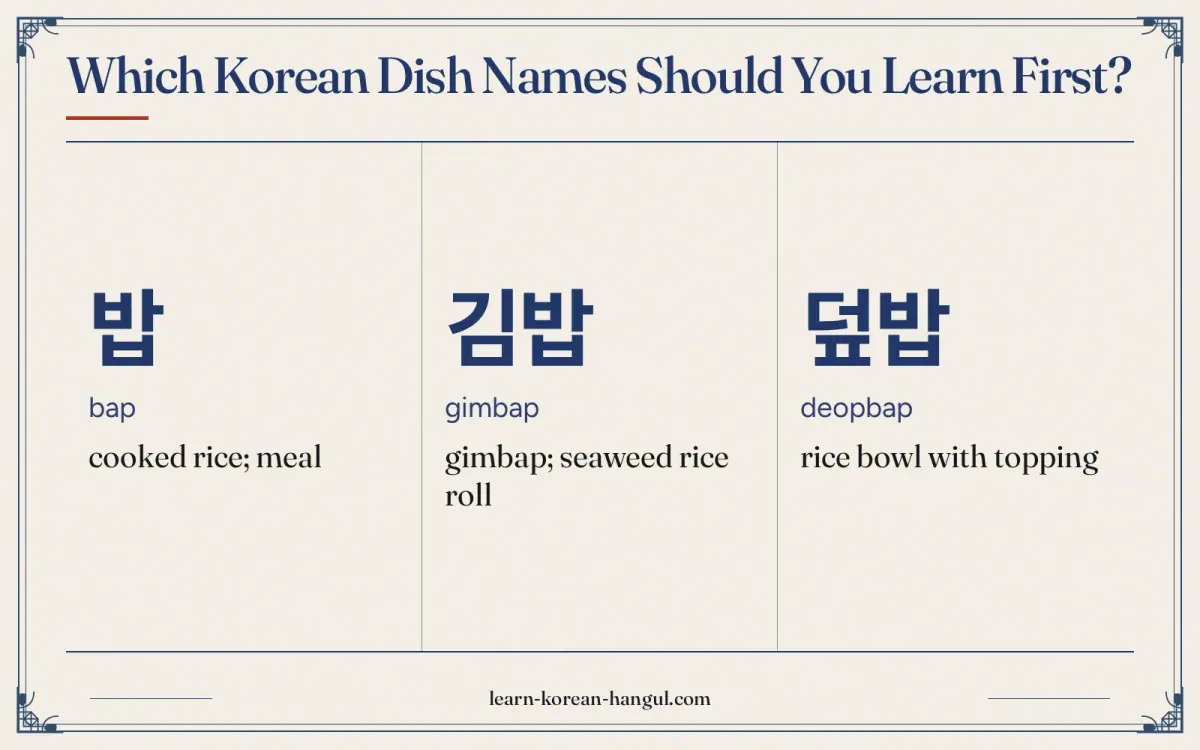
Learn 밥, 김치, 비빔밥, 불고기 and 찌개 first. They cover the table's centre, its most famous side dish, two dishes known worldwide and the general word for stew. A short sentence such as 비빔밥 하나 주세요 (one bibimbap, please) uses one of them with an order phrase.
- Words to say. 비빔밥, 김밥, 불고기, 김치찌개, 삼겹살. Use these to order.
- Words to recognise. 칼국수, 잡채, 순대, 호떡, 빙수. You read them on boards and menus.
- Type words to learn. 밥, 국, 찌개, 전, 탕, 구이. They unlock the rest.
The table below shows the six type words, what they mean and where they appear.
| Type word | Meaning | Examples |
|---|---|---|
| 밥 | rice dish | 비빔밥, 김밥, 볶음밥 |
| 국 | soup | 미역국, 콩나물국 |
| 찌개 | stew | 김치찌개, 된장찌개 |
| 전 | pancake | 파전, 김치전 |
| 탕 | hot, hearty soup | 삼계탕, 갈비탕 |
| 구이 | grilled | 생선구이, 소금구이 |
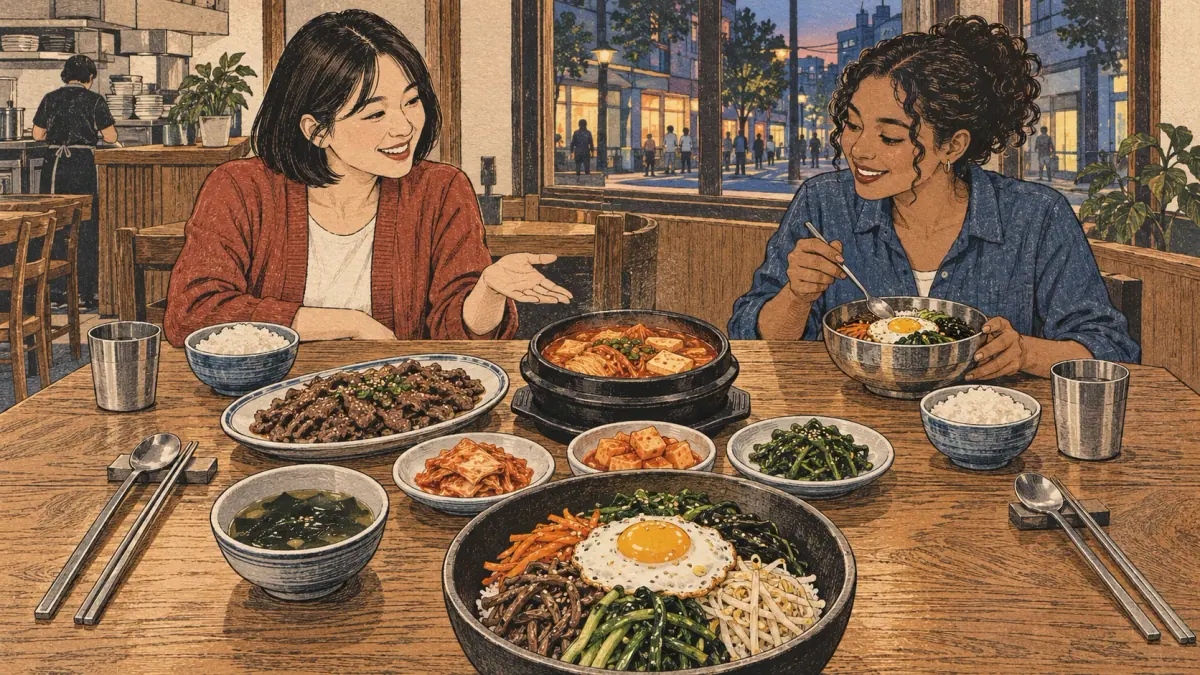
The scene below shows a Korean table with numbered dishes that match the list.
Word · 20
- 1
밥
bap
cooked rice; meal
- 2
김밥
gimbap
gimbap; seaweed rice roll
- 3
덮밥
deopbap
rice bowl with topping
- 4
주먹밥
jumeokbap
rice ball
- 5
김치찌개
gimchijjigae
kimchi stew
- 6
순두부찌개
sundubujjigae
soft tofu stew
- 7
미역국
miyeokguk
seaweed soup
- 8
불고기
bulgogi
bulgogi; marinated beef
- 9
삼겹살
samgyeopsal
pork belly
- 10
고깃집
gogijip
meat restaurant
- 11
국수
guksu
noodles
- 12
라면
ramyeon
instant noodles
- 13
짜장면
jjajangmyeon
black bean noodles
- 14
떡볶이
tteokbokki
tteokbokki; spicy rice cakes
- 15
튀김
twigim
fried food
- 16
호떡
hotteok
hotteok; sweet filled pancake
- 17
붕어빵
bungeoppang
fish-shaped pastry
- 18
깍두기
kkakdugi
cubed radish kimchi
- 19
잡채
japchae
japchae; glass noodle stir-fry
- 20
떡
tteok
rice cake
Rice and One-Bowl Dishes
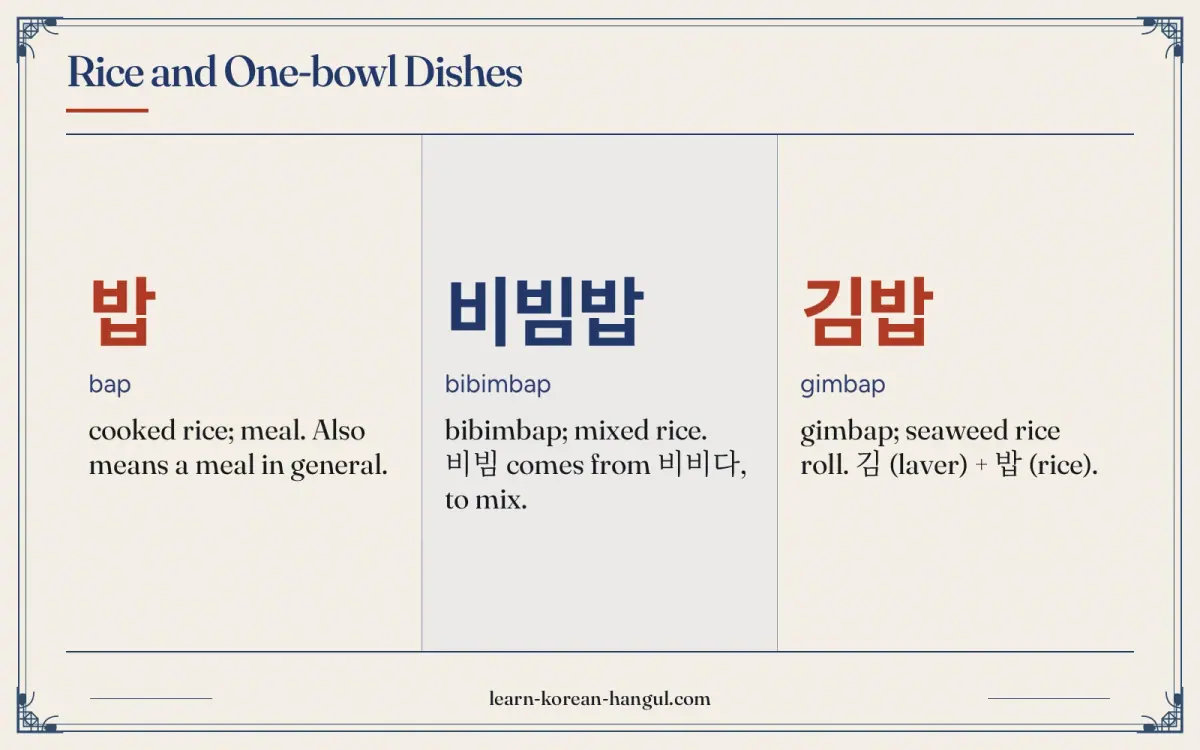
Rice and one-bowl dishes are the heart of a Korean meal. The word 밥 means cooked rice and also a meal, so 밥 먹었어요? asks whether you have eaten. Many dish names end in 밥, which marks a rice dish. The deeper list is on the Korean Rice Dishes Vocabulary page.
| No. | Hangul | Revised Romanization | Meaning and note | Example sentence | Audio assetId |
|---|---|---|---|---|---|
| 1 | 밥 | bap | cooked rice; meal. Also means a meal in general. | 밥을 먹어요. (I eat rice (a meal).) | au-pg-vocabulary-food-korean-dishes-1; example: au-pg-vocabulary-food-korean-dishes-41 |
| 2 | 비빔밥 | bibimbap | bibimbap; mixed rice. 비빔 comes from 비비다, to mix. | 비빔밥에 채소가 많아요. (Bibimbap has a lot of vegetables.) | au-pg-vocabulary-food-korean-dishes-2; example: au-pg-vocabulary-food-korean-dishes-42 |
| 3 | 김밥 | gimbap | gimbap; seaweed rice roll. 김 (laver) + 밥 (rice). | 김밥을 싸요. (I roll gimbap.) | au-pg-vocabulary-food-korean-dishes-3; example: au-pg-vocabulary-food-korean-dishes-43 |
| 4 | 볶음밥 | bokkeumbap | fried rice. 볶음 means stir-fried. Said [보끔밥]. | 볶음밥을 시켜요. (I order fried rice.) | au-pg-vocabulary-food-korean-dishes-4; example: au-pg-vocabulary-food-korean-dishes-44 |
| 5 | 덮밥 | deopbap | rice bowl with topping. 덮 comes from 덮다, to cover. Said [덥빱]. | 덮밥은 한 그릇 요리예요. (A rice bowl is a one-bowl dish.) | au-pg-vocabulary-food-korean-dishes-5; example: au-pg-vocabulary-food-korean-dishes-45 |
| 6 | 죽 | juk | porridge. Eaten when sick or as a light meal. | 아플 때 죽을 먹어요. (When I am sick I eat porridge.) | au-pg-vocabulary-food-korean-dishes-6; example: au-pg-vocabulary-food-korean-dishes-46 |
| 7 | 주먹밥 | jumeokbap | rice ball. 주먹 means fist. Said [주먹빱]. | 주먹밥을 만들어요. (I make rice balls.) | au-pg-vocabulary-food-korean-dishes-7; example: au-pg-vocabulary-food-korean-dishes-47 |
The ending 밥 has two jobs. It marks a rice dish (김밥, 볶음밥) and it is a stand-alone word for a meal. When the second job is meant, you hear it in 밥 먹었어요? and in 아침밥 (breakfast), where the word grows into the meal name.
Example Sentences
Three frames carry most of the examples. The first is dish + 을/를 + 먹어요, as in 밥을 먹어요 (I eat rice). The second is dish + 이/가 + describing word, as in 김치찌개는 매워요 (kimchi stew is spicy). The third is dish + 하나 + 주세요, as in 순두부찌개 하나 주세요 (one soft tofu stew, please). Say each aloud after the audio and swap in another dish. Use 을 after a consonant (밥을) and 를 after a vowel (김치를).
How Do You Say Stews and Soups in Korean?
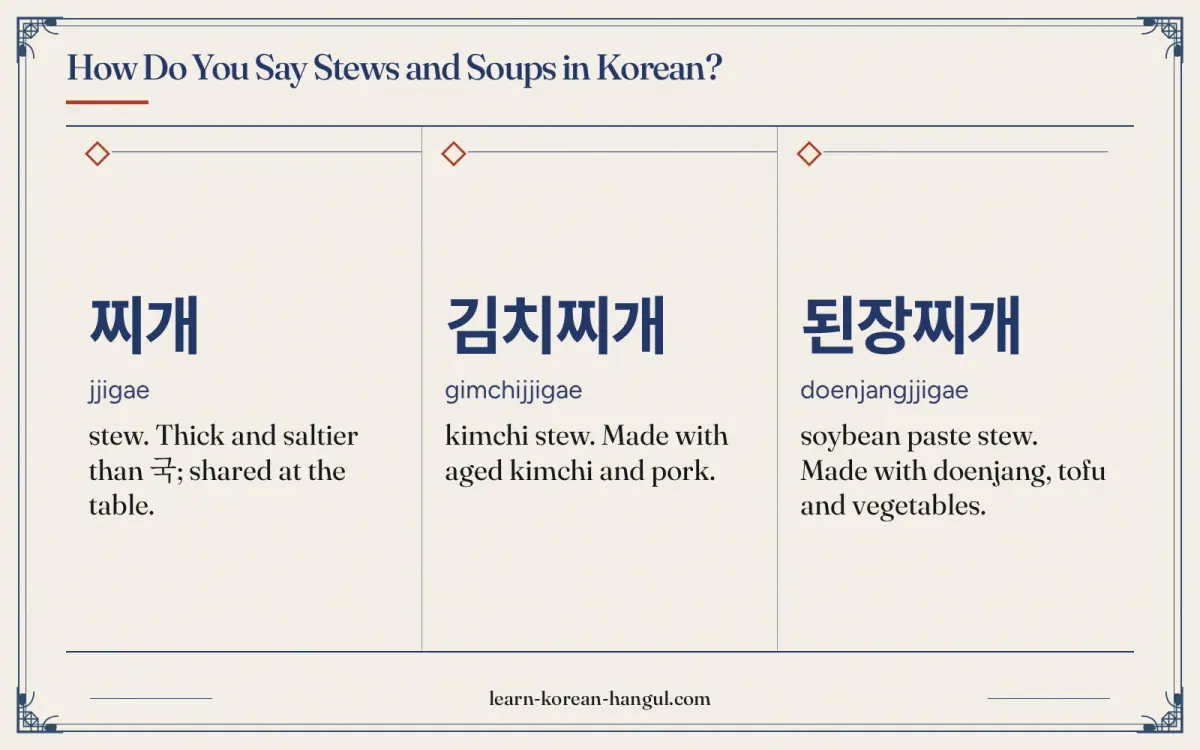
A Korean table often has both a 찌개 (stew) and a 국 (soup), and they are different dishes. A 찌개 is thick, strongly seasoned and shared from the middle of the table. A 국 is thinner and served in an individual bowl. The ending 탕 marks a hot, hearty soup. See the Korean Stews (Jjigae) Vocabulary and Korean Soups (Guk and Tang) Vocabulary pages for longer lists.
| No. | Hangul | Revised Romanization | Meaning and note | Example sentence | Audio assetId |
|---|---|---|---|---|---|
| 8 | 찌개 | jjigae | stew. Thick and saltier than 국; shared at the table. | 찌개가 보글보글 끓어요. (The stew bubbles away.) | au-pg-vocabulary-food-korean-dishes-8; example: au-pg-vocabulary-food-korean-dishes-48 |
| 9 | 김치찌개 | gimchijjigae | kimchi stew. Made with aged kimchi and pork. | 김치찌개는 매워요. (Kimchi stew is spicy.) | au-pg-vocabulary-food-korean-dishes-9; example: au-pg-vocabulary-food-korean-dishes-49 |
| 10 | 된장찌개 | doenjangjjigae | soybean paste stew. Made with doenjang, tofu and vegetables. | 된장찌개를 좋아해요. (I like soybean paste stew.) | au-pg-vocabulary-food-korean-dishes-10; example: au-pg-vocabulary-food-korean-dishes-50 |
| 11 | 순두부찌개 | sundubujjigae | soft tofu stew. Silken tofu in a spicy broth. | 순두부찌개 하나 주세요. (One soft tofu stew, please.) | au-pg-vocabulary-food-korean-dishes-11; example: au-pg-vocabulary-food-korean-dishes-51 |
| 12 | 국 | guk | soup. Clear and eaten from a bowl with rice. | 국이 뜨거워요. (The soup is hot.) | au-pg-vocabulary-food-korean-dishes-12; example: au-pg-vocabulary-food-korean-dishes-52 |
| 13 | 미역국 | miyeokguk | seaweed soup. Eaten on birthdays. Said [미역꾹]. | 생일에 미역국을 먹어요. (On my birthday I eat seaweed soup.) | au-pg-vocabulary-food-korean-dishes-13; example: au-pg-vocabulary-food-korean-dishes-53 |
| 14 | 삼계탕 | samgyetang | ginseng chicken soup. A whole young chicken stuffed with rice. | 여름에 삼계탕을 먹어요. (In summer I eat ginseng chicken soup.) | au-pg-vocabulary-food-korean-dishes-14; example: au-pg-vocabulary-food-korean-dishes-54 |
Stew versus soup is the first distinction to learn. If a Korean menu offers 된장찌개 and 된장국, they are two different dishes made with the same paste, one thick and one thin. Single-word notes are on the kimchi stew in Korean and soybean paste stew in Korean pages.
Grilled Meat and BBQ
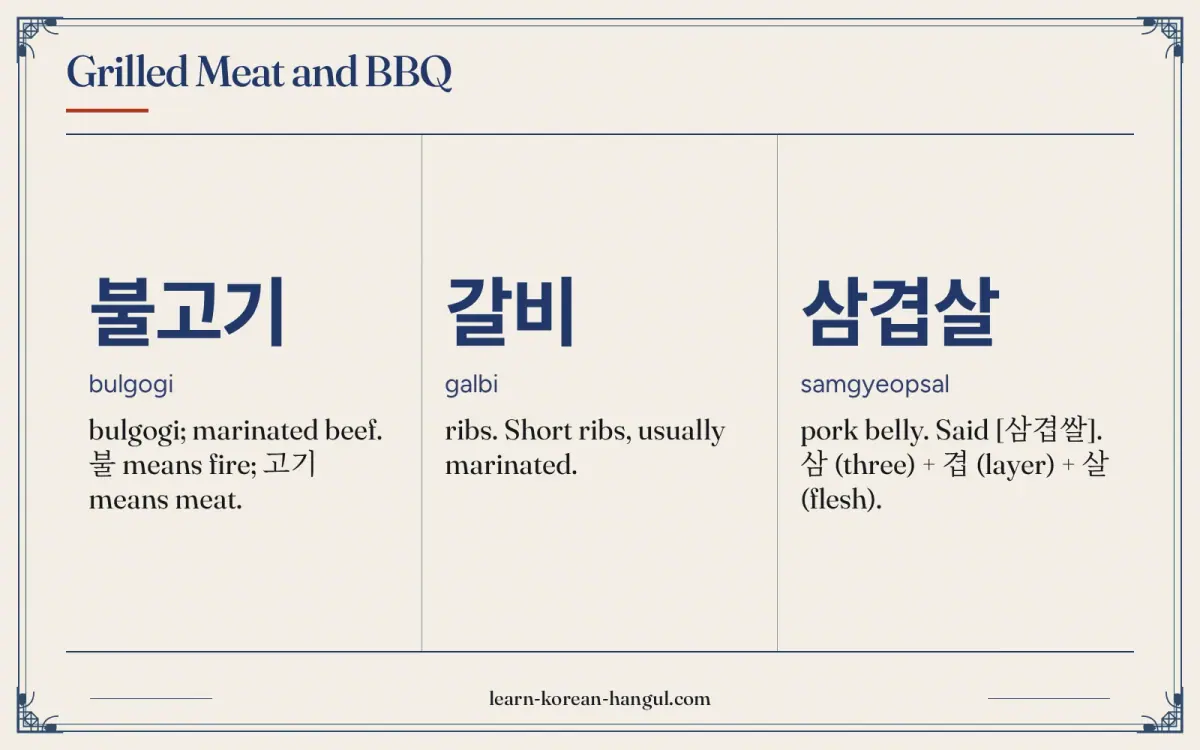
Grilled meat is the best-known Korean meal abroad. At a 고깃집 (meat restaurant) you grill the meat yourself, wrap it in a leaf with garnishes and eat it in one bite. The names come from the cut (삼겹살, 갈비) or from the cooking (불고기, literally 'fire meat'). The Korean BBQ Vocabulary page covers the table in depth.
| No. | Hangul | Revised Romanization | Meaning and note | Example sentence | Audio assetId |
|---|---|---|---|---|---|
| 15 | 불고기 | bulgogi | bulgogi; marinated beef. 불 means fire; 고기 means meat. | 불고기는 달콤해요. (Bulgogi is sweet.) | au-pg-vocabulary-food-korean-dishes-15; example: au-pg-vocabulary-food-korean-dishes-55 |
| 16 | 갈비 | galbi | ribs. Short ribs, usually marinated. | 갈비를 구워요. (I grill the ribs.) | au-pg-vocabulary-food-korean-dishes-16; example: au-pg-vocabulary-food-korean-dishes-56 |
| 17 | 삼겹살 | samgyeopsal | pork belly. Said [삼겹쌀]. 삼 (three) + 겹 (layer) + 살 (flesh). | 삼겹살을 쌈에 싸 먹어요. (I wrap pork belly in a leaf and eat it.) | au-pg-vocabulary-food-korean-dishes-17; example: au-pg-vocabulary-food-korean-dishes-57 |
| 18 | 쌈 | ssam | wrap; leaf wrap. Lettuce or perilla leaves used as a wrapper. | 쌈에 마늘을 넣어요. (I put garlic in the wrap.) | au-pg-vocabulary-food-korean-dishes-18; example: au-pg-vocabulary-food-korean-dishes-58 |
| 19 | 고깃집 | gogijip | meat restaurant. Said [고기찝]; the ㅅ in the spelling (사이시옷) makes the ㅈ tense. | 고깃집에서 저녁을 먹어요. (I eat dinner at a meat restaurant.) | au-pg-vocabulary-food-korean-dishes-19; example: au-pg-vocabulary-food-korean-dishes-59 |
| 20 | 구이 | gui | grilled dish. Added to a name: 생선구이. | 생선구이를 먹어요. (I eat grilled fish.) | au-pg-vocabulary-food-korean-dishes-20; example: au-pg-vocabulary-food-korean-dishes-60 |
Portions at a grill restaurant are counted in 인분 (servings), so the order sentence is cut + number + 인분 + 주세요. See the food counters page.
How Do You Say Noodles and Dumplings in Korean?
Noodle names combine a base word with a style. 국수 is the general word for noodles, and 면 is the noun ending in dish names such as 냉면 (cold noodles). 라면 is instant noodles, and 만두 are dumplings. The Korean Noodles Vocabulary page has the full list.
| No. | Hangul | Revised Romanization | Meaning and note | Example sentence | Audio assetId |
|---|---|---|---|---|---|
| 21 | 국수 | guksu | noodles. Said [국쑤]. The general word. | 국수를 삶아요. (I boil the noodles.) | au-pg-vocabulary-food-korean-dishes-21; example: au-pg-vocabulary-food-korean-dishes-61 |
| 22 | 냉면 | naengmyeon | cold noodles. 냉 means cold; 면 means noodles. | 냉면은 차가워요. (Naengmyeon is served cold.) | au-pg-vocabulary-food-korean-dishes-22; example: au-pg-vocabulary-food-korean-dishes-62 |
| 23 | 라면 | ramyeon | instant noodles. A loanword from Japanese ramen. | 라면을 끓여요. (I boil instant noodles.) | au-pg-vocabulary-food-korean-dishes-23; example: au-pg-vocabulary-food-korean-dishes-63 |
| 24 | 칼국수 | kalguksu | knife-cut noodles. 칼 means knife. Said [칼국쑤]. | 칼국수는 국물이 시원해요. (Knife-cut noodle soup has a refreshing broth.) | au-pg-vocabulary-food-korean-dishes-24; example: au-pg-vocabulary-food-korean-dishes-64 |
| 25 | 짜장면 | jjajangmyeon | black bean noodles. A Korean-Chinese dish. | 짜장면을 배달시켜요. (I order black bean noodles for delivery.) | au-pg-vocabulary-food-korean-dishes-25; example: au-pg-vocabulary-food-korean-dishes-65 |
| 26 | 만두 | mandu | dumplings. Steamed, fried or in soup. | 만두를 빚어요. (I shape dumplings.) | au-pg-vocabulary-food-korean-dishes-26; example: au-pg-vocabulary-food-korean-dishes-66 |
The pair 국수 and 면 is a native-versus-Sino-Korean pair for noodles. 국수 stands alone as a word. 면 appears as the ending in compounds such as 냉면 and 짜장면.
Street Food and Snacks
Street food is cheap, quick and eaten standing. Stalls sell 떡볶이 (spicy rice cakes), fried items and fish cake skewers, and winter brings 호떡 and 붕어빵. The Korean Street Food Vocabulary page covers stall words as well.
| No. | Hangul | Revised Romanization | Meaning and note | Example sentence | Audio assetId |
|---|---|---|---|---|---|
| 27 | 떡볶이 | tteokbokki | tteokbokki; spicy rice cakes. Said [떡뽀끼]. From 떡 (rice cake) and 볶이 (stir-frying). | 떡볶이를 먹으러 가요. (I go to eat tteokbokki.) | au-pg-vocabulary-food-korean-dishes-27; example: au-pg-vocabulary-food-korean-dishes-67 |
| 28 | 순대 | sundae | blood sausage; sundae. Eaten with salt or a dip. | 순대를 소금에 찍어요. (I dip the sundae in salt.) | au-pg-vocabulary-food-korean-dishes-28; example: au-pg-vocabulary-food-korean-dishes-68 |
| 29 | 튀김 | twigim | fried food. Fried vegetables and squid. | 튀김을 떡볶이 국물에 찍어요. (I dip the fried food in the tteokbokki sauce.) | au-pg-vocabulary-food-korean-dishes-29; example: au-pg-vocabulary-food-korean-dishes-69 |
| 30 | 어묵 | eomuk | fish cake. Served on skewers in a hot broth. | 어묵 국물이 따뜻해요. (The fish cake broth is warm.) | au-pg-vocabulary-food-korean-dishes-30; example: au-pg-vocabulary-food-korean-dishes-70 |
| 31 | 호떡 | hotteok | hotteok; sweet filled pancake. Filled with brown sugar. | 호떡은 안에 설탕이 들어 있어요. (Hotteok has sugar inside.) | au-pg-vocabulary-food-korean-dishes-31; example: au-pg-vocabulary-food-korean-dishes-71 |
| 32 | 닭꼬치 | dakkkochi | chicken skewer. 닭 (chicken) + 꼬치 (skewer). Said [닥꼬치]. | 닭꼬치를 사요. (I buy a chicken skewer.) | au-pg-vocabulary-food-korean-dishes-32; example: au-pg-vocabulary-food-korean-dishes-72 |
| 33 | 붕어빵 | bungeoppang | fish-shaped pastry. A winter snack with red bean filling. | 겨울에 붕어빵을 사 먹어요. (In winter I buy and eat fish-shaped pastry.) | au-pg-vocabulary-food-korean-dishes-33; example: au-pg-vocabulary-food-korean-dishes-73 |
Note that 순대 here is the food, not the English word sundae. It is made from pig intestine filled with noodles and blood. Foreign visitors sometimes confuse the sound.
How Do You Say Kimchi, Side Dishes and Desserts in Korean?
Kimchi, side dishes and sweets complete the meal. 김치 is a fermented vegetable dish, and 반찬 is the name for all the small side dishes put on the table. Pancakes are called 전, and a chilled dessert in summer is 빙수. For the full lists, see Korean Kimchi Types Vocabulary, Korean Side Dishes (Banchan) Vocabulary and Korean Desserts and Rice Cakes Vocabulary.
| No. | Hangul | Revised Romanization | Meaning and note | Example sentence | Audio assetId |
|---|---|---|---|---|---|
| 34 | 김치 | gimchi | kimchi. Fermented vegetables, most often napa cabbage. | 김치는 발효 음식이에요. (Kimchi is a fermented food.) | au-pg-vocabulary-food-korean-dishes-34; example: au-pg-vocabulary-food-korean-dishes-74 |
| 35 | 깍두기 | kkakdugi | cubed radish kimchi. Said [깍뚜기]. Made from 무 (radish) cut into cubes. | 깍두기는 무로 만들어요. (Kkakdugi is made with radish.) | au-pg-vocabulary-food-korean-dishes-35; example: au-pg-vocabulary-food-korean-dishes-75 |
| 36 | 반찬 | banchan | side dishes. Free refills in many restaurants. | 반찬이 많아요. (There are many side dishes.) | au-pg-vocabulary-food-korean-dishes-36; example: au-pg-vocabulary-food-korean-dishes-76 |
| 37 | 잡채 | japchae | japchae; glass noodle stir-fry. Made from sweet potato starch noodles. | 잡채는 당면으로 만들어요. (Japchae is made with glass noodles.) | au-pg-vocabulary-food-korean-dishes-37; example: au-pg-vocabulary-food-korean-dishes-77 |
| 38 | 전 | jeon | jeon; Korean pancake. Eaten on rainy days and at holidays. | 비 오는 날에는 전을 먹어요. (On rainy days I eat jeon.) | au-pg-vocabulary-food-korean-dishes-38; example: au-pg-vocabulary-food-korean-dishes-78 |
| 39 | 떡 | tteok | rice cake. Made from rice flour. | 명절에 떡을 먹어요. (On holidays I eat rice cake.) | au-pg-vocabulary-food-korean-dishes-39; example: au-pg-vocabulary-food-korean-dishes-79 |
| 40 | 빙수 | bingsu | bingsu; shaved ice dessert. A summer dessert with red beans or fruit. | 여름에 빙수를 먹어요. (In summer I eat shaved ice dessert.) | au-pg-vocabulary-food-korean-dishes-40; example: au-pg-vocabulary-food-korean-dishes-80 |
The word 전 is also a suffix. 파전 is a green onion pancake, and 김치전 is a kimchi pancake. This is a pattern you can use on a menu: ingredient + 전.
How Do You Pronounce These Words?
Dish names contain many tense sounds and linking. Standard pronunciation follows the National Institute of Korean Language (국립국어원) rules, and the romanization follows the Revised Romanization of Korean, which writes the sound you hear in some cases and the spelling in others.
| Spelling | Sounds like | What changes |
|---|---|---|
| 볶음밥 | [보끔밥] | The final ㄲ links to the next syllable; the ㅂ after ㅁ stays plain. |
| 덮밥 | [덥빱] | The final ㅍ is said [ㅂ], and the next ㅂ becomes tense [ㅃ]. |
| 떡볶이 | [떡뽀끼] | The ㄲ links to 이, and the ㅂ after final ㄱ becomes tense [ㅃ]. |
| 국수 | [국쑤] | The ㅅ after a final ㄱ becomes a tense [ㅆ]. |
| 깍두기 | [깍뚜기] | The ㄷ after a final ㄱ becomes tense [ㄸ]. |
Revised Romanization does not write the tense sound, so it spells 볶음밥 as bokkeumbap and 떡볶이 as tteokbokki. Menus use other spellings, such as bibimbab, bibimbop and bibimbap. The standard form is bibimbap, and all of them stand for 비빔밥.
Audio and Slow Playback
Each word and sentence has its own clip. The five clips below replay the hardest words slowly. Play one, repeat it aloud, then play it again and compare.
What Mistakes Do Learners Make with Korean Dish Names?
Five mistakes appear often.
- Treating 찌개 and 국 as the same dish. A 찌개 is thick and strongly seasoned. A 국 is thinner and milder. They are served differently.
- Reading 밥 only as rice. 밥 also means a meal. 밥 먹었어요? is a common greeting that means have you eaten?
- Copying the romanization on a menu as the standard. Menus print bibimbab, bibimbop and more. The Revised Romanization is bibimbap.
- Ordering a dish without checking the ingredients. A dish name does not list the allergens. If you have an allergy, tell staff: 새우 알레르기가 있어요 means I have a shrimp allergy. Common allergens are 땅콩, 새우 and 계란.
- Confusing 순대 (blood sausage) with the English sundae. They look the same in the Latin alphabet, but they are very different foods.
Knowing the type words removes most of the guesswork. For the ordering phrases that go with these names, see restaurant phrases.
Practice: Flashcards and Worksheet
Study in three steps. First, run the flashcard deck in recognition mode until you recognise all 40 words. Second, switch to listening mode. Third, take the quiz. The deck holds all 40 words with audio, and your progress stays in your browser. The vocabulary flashcard decks page lists the other decks.
Practice · 85
- 01밥
Show answer
headword 1: cooked rice; meal
- 02비빔밥
Show answer
headword 2: bibimbap; mixed rice
- 03김밥
Show answer
headword 3: gimbap; seaweed rice roll
- 04볶음밥
Show answer
headword 4: fried rice
- 05덮밥
Show answer
headword 5: rice bowl with topping
- 06죽
Show answer
headword 6: porridge
- 07주먹밥
Show answer
headword 7: rice ball
- 08찌개
Show answer
headword 8: stew
- 09김치찌개
Show answer
headword 9: kimchi stew
- 10된장찌개
Show answer
headword 10: soybean paste stew
- 11순두부찌개
Show answer
headword 11: soft tofu stew
- 12국
Show answer
headword 12: soup
- 13미역국
Show answer
headword 13: seaweed soup
- 14삼계탕
Show answer
headword 14: ginseng chicken soup
- 15불고기
Show answer
headword 15: bulgogi; marinated beef
- 16갈비
Show answer
headword 16: ribs
- 17삼겹살
Show answer
headword 17: pork belly
- 18쌈
Show answer
headword 18: wrap; leaf wrap
- 19고깃집
Show answer
headword 19: meat restaurant
- 20구이
Show answer
headword 20: grilled dish
- 21국수
Show answer
headword 21: noodles
- 22냉면
Show answer
headword 22: cold noodles
- 23라면
Show answer
headword 23: instant noodles
- 24칼국수
Show answer
headword 24: knife-cut noodles
- 25짜장면
Show answer
headword 25: black bean noodles
- 26만두
Show answer
headword 26: dumplings
- 27떡볶이
Show answer
headword 27: tteokbokki; spicy rice cakes
- 28순대
Show answer
headword 28: blood sausage; sundae
- 29튀김
Show answer
headword 29: fried food
- 30어묵
Show answer
headword 30: fish cake
- 31호떡
Show answer
headword 31: hotteok; sweet filled pancake
- 32닭꼬치
Show answer
headword 32: chicken skewer
- 33붕어빵
Show answer
headword 33: fish-shaped pastry
- 34김치
Show answer
headword 34: kimchi
- 35깍두기
Show answer
headword 35: cubed radish kimchi
- 36반찬
Show answer
headword 36: side dishes
- 37잡채
Show answer
headword 37: japchae; glass noodle stir-fry
- 38전
Show answer
headword 38: jeon; Korean pancake
- 39떡
Show answer
headword 39: rice cake
- 40빙수
Show answer
headword 40: bingsu; shaved ice dessert
- 41밥을 먹어요.
Show answer
example for 밥
- 42비빔밥에 채소가 많아요.
Show answer
example for 비빔밥
- 43김밥을 싸요.
Show answer
example for 김밥
- 44볶음밥을 시켜요.
Show answer
example for 볶음밥
- 45덮밥은 한 그릇 요리예요.
Show answer
example for 덮밥
- 46아플 때 죽을 먹어요.
Show answer
example for 죽
- 47주먹밥을 만들어요.
Show answer
example for 주먹밥
- 48찌개가 보글보글 끓어요.
Show answer
example for 찌개
- 49김치찌개는 매워요.
Show answer
example for 김치찌개
- 50된장찌개를 좋아해요.
Show answer
example for 된장찌개
- 51순두부찌개 하나 주세요.
Show answer
example for 순두부찌개
- 52국이 뜨거워요.
Show answer
example for 국
- 53생일에 미역국을 먹어요.
Show answer
example for 미역국
- 54여름에 삼계탕을 먹어요.
Show answer
example for 삼계탕
- 55불고기는 달콤해요.
Show answer
example for 불고기
- 56갈비를 구워요.
Show answer
example for 갈비
- 57삼겹살을 쌈에 싸 먹어요.
Show answer
example for 삼겹살
- 58쌈에 마늘을 넣어요.
Show answer
example for 쌈
- 59고깃집에서 저녁을 먹어요.
Show answer
example for 고깃집
- 60생선구이를 먹어요.
Show answer
example for 구이
- 61국수를 삶아요.
Show answer
example for 국수
- 62냉면은 차가워요.
Show answer
example for 냉면
- 63라면을 끓여요.
Show answer
example for 라면
- 64칼국수는 국물이 시원해요.
Show answer
example for 칼국수
- 65짜장면을 배달시켜요.
Show answer
example for 짜장면
- 66만두를 빚어요.
Show answer
example for 만두
- 67떡볶이를 먹으러 가요.
Show answer
example for 떡볶이
- 68순대를 소금에 찍어요.
Show answer
example for 순대
- 69튀김을 떡볶이 국물에 찍어요.
Show answer
example for 튀김
- 70어묵 국물이 따뜻해요.
Show answer
example for 어묵
- 71호떡은 안에 설탕이 들어 있어요.
Show answer
example for 호떡
- 72닭꼬치를 사요.
Show answer
example for 닭꼬치
- 73겨울에 붕어빵을 사 먹어요.
Show answer
example for 붕어빵
- 74김치는 발효 음식이에요.
Show answer
example for 김치
- 75깍두기는 무로 만들어요.
Show answer
example for 깍두기
- 76반찬이 많아요.
Show answer
example for 반찬
- 77잡채는 당면으로 만들어요.
Show answer
example for 잡채
- 78비 오는 날에는 전을 먹어요.
Show answer
example for 전
- 79명절에 떡을 먹어요.
Show answer
example for 떡
- 80여름에 빙수를 먹어요.
Show answer
example for 빙수
- 81볶음밥
Show answer
slow playback: 볶음밥
- 82덮밥
Show answer
slow playback: 덮밥
- 83떡볶이
Show answer
slow playback: 떡볶이
- 84깍두기
Show answer
slow playback: 깍두기
- 85닭꼬치
Show answer
slow playback: 닭꼬치
Practice · 6
What does 밥 (bap) mean?
Show answer
cooked rice; meal
밥 means cooked rice; meal. Example: 밥을 먹어요. (I eat rice (a meal).)
What does 주먹밥 (jumeokbap) mean?
Show answer
rice ball
주먹밥 means rice ball. Example: 주먹밥을 만들어요. (I make rice balls.)
What does 미역국 (miyeokguk) mean?
Show answer
seaweed soup
미역국 means seaweed soup. Example: 생일에 미역국을 먹어요. (On my birthday I eat seaweed soup.)
What does 고깃집 (gogijip) mean?
Show answer
meat restaurant
고깃집 means meat restaurant. Example: 고깃집에서 저녁을 먹어요. (I eat dinner at a meat restaurant.)
What does 짜장면 (jjajangmyeon) mean?
Show answer
black bean noodles
짜장면 means black bean noodles. Example: 짜장면을 배달시켜요. (I order black bean noodles for delivery.)
What does 호떡 (hotteok) mean?
Show answer
hotteok; sweet filled pancake
호떡 means hotteok; sweet filled pancake. Example: 호떡은 안에 설탕이 들어 있어요. (Hotteok has sugar inside.)
Korean Dishes Names Worksheet (PDF)
A printable worksheet for these words (word list, matching, writing practice, fill-in-the-blank exercises and answer key) is available in A4 and US Letter from the download card on this page. For practice, write the type word for each of five dishes you know.
Pages in This Section
Nine deeper lists expand the groups on this page. Each has its own audio, deck and quiz.
- Korean Rice Dishes Vocabulary: 25 words for bibimbap, gimbap, fried rice and rice words.
- Korean Stews (Jjigae) Vocabulary: 25 words for kimchi stew, soybean stew and other stews by name.
- Korean Soups (Guk and Tang) Vocabulary: 25 words for seaweed soup, ginseng chicken soup and everyday guk.
- Korean BBQ Vocabulary: 35 words for pork belly, ribs, wraps and sauces at a grill.
- Korean Noodles Vocabulary: 25 words for naengmyeon, jjajangmyeon, kalguksu and ramyeon.
- Korean Street Food Vocabulary: 25 words for tteokbokki, fish cake, hotteok and stall words.
- Korean Kimchi Types Vocabulary: 25 words for cabbage, radish, water and aged kimchi.
- Korean Side Dishes (Banchan) Vocabulary: 30 words for kimchi, seasoned greens, braised and fried side dishes.
- Korean Desserts and Rice Cakes Vocabulary: 30 words for tteok, traditional sweets, bingsu and cafe desserts.
Where to Go Next
Korean dishes names are easiest to keep when you use them at a real meal, so pick one deeper list and order from it. After this page, open the list that matches your next meal, such as Korean BBQ Vocabulary or Korean Street Food Vocabulary. To see what goes into these dishes, continue with Ingredients. To move up a level, return to Food and Drink.
Frequently Asked Questions
How Do You Say Korean Food in Korean?
Korean food is 한식 (hansik) or 한국 음식 (hanguk eumsik). A dish is 요리 (yori) when you mean cooking, and 음식 (eumsik) when you mean food in general. This page lists the names of common dishes instead.
How Do You Say Bibimbap in Korean?
Bibimbap is 비빔밥, said bi-bim-bap. It comes from 비비다 (to mix) and 밥 (rice). The standard Revised Romanization is bibimbap, although menus also print bibimbab and bibimbop. Press the audio button to hear it. The final ㅂ of 밥 is barely released, so it sounds close to bap, not bab.
What Is the Difference between 찌개 and 국?
A 찌개 is a thick, strongly seasoned stew, shared from the middle of the table. A 국 is a thinner soup, served in a bowl for each person. Both are eaten with rice, but they are different dishes.
What Do the Endings 밥, 국, 전 and 구이 Mean?
밥 marks a rice dish, 국 a soup, 전 a pancake and 구이 a grilled dish. 찌개 marks a stew and 탕 a hot, hearty soup. Knowing the ending helps you read a new dish name. For example, 콩나물국 is bean sprout soup, and 갈비탕 is short rib soup.
Which Dish Names Should I Learn First?
Start with 밥, 김치, 비빔밥, 불고기 and 찌개. They cover rice, the best-known side dish, a famous mixed dish, grilled beef and a stew. Learn the six type words next, then open the deeper list that matches your next meal.
Is the Romanization on This Page Official?
It follows the Revised Romanization of Korean, which South Korea adopted on 7 July 2000 and whose rules the National Institute of Korean Language (국립국어원) publishes. It is a learning aid. Menus use other spellings, so rely on the Hangul and the audio.