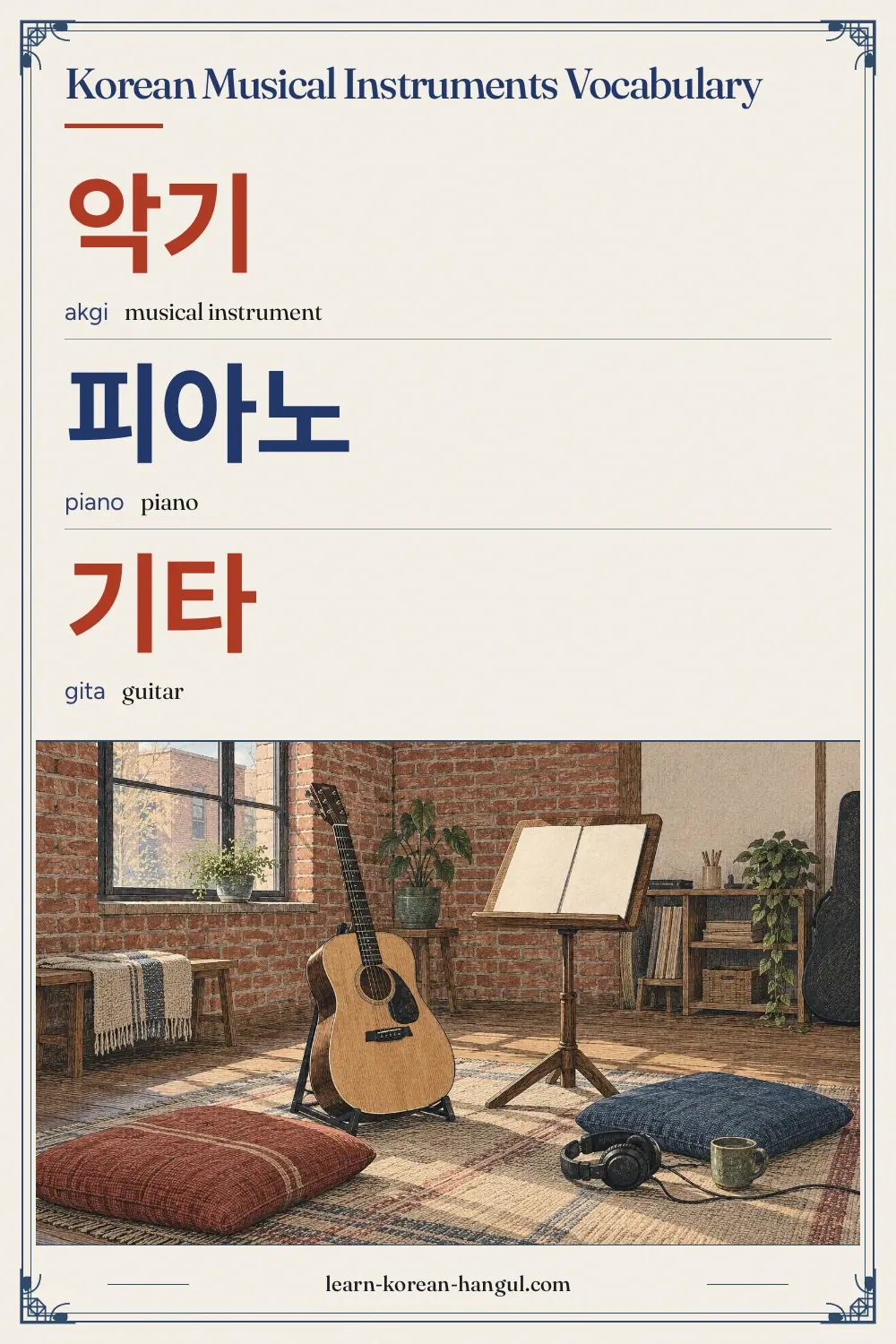
Korean Musical Instruments Vocabulary at a Glance
Most Western instruments keep their English name in Korean, spelled in Hangul. 피아노 is piano and 기타 is guitar, so a learner who can read Hangul already knows them. The Korean traditional instruments are different: their names are Korean or Chinese-derived words, and each one has its own shape, material and way of being played. This page teaches both kinds, because a Korean music class, a concert hall or a K-pop interview uses both.
There is one more difference. English says play for nearly every instrument, but Korean picks a verb by the way the sound is made: you hit a piano or drum (치다), blow a flute (불다), bow a violin (켜다) and pluck a gayageum (타다). A small table below shows the four verbs. The list has 35 words in five groups, and it sits inside Music. For the traditional side of the culture, see traditional culture.
| Group | Words | Examples |
|---|---|---|
| Western strings and keys | 8 | 악기, 피아노, 기타, 바이올린 |
| Winds and brass | 7 | 플루트, 클라리넷, 색소폰, 트럼펫 |
| Percussion | 5 | 드럼, 탬버린, 실로폰, 심벌즈 |
| Korean traditional instruments | 9 | 가야금, 거문고, 해금, 대금 |
| Music rooms and groups | 6 | 연주, 오케스트라, 밴드, 합창단 |
By word origin, the list has 21 loanword, 9 Sino-Korean and 5 native entries. The Western instruments are loanwords, the traditional instruments are a mix of native and Sino-Korean words, and the music-room words are Sino-Korean.
Which Musical Instrument Names Should You Learn First?
Start with five words: 악기, 피아노, 기타, 가야금 and 장구. The first three are the everyday ones, and the last two give you a first look at the traditional side. Press play, then the slow button, and say each word aloud.
악기 (akgi) means musical instrument. It is the word for any musical instrument. It joins 악 (music) and 기 (tool), and it appears in 악기 가게 (instrument shop) and 전통 악기 (traditional instrument). The first ㄱ makes the next ㄱ tense, so it is said [악끼]. Example: 어떤 악기를 연주해요? (What instrument do you play?)
피아노 (piano) means piano. It is the Korean spelling of piano, and it is one of the most learned instruments for children in Korea. Its verb is 치다 (to strike), so you say 피아노를 쳐요. Example: 저는 피아노를 쳐요. (I play the piano.)
기타 (gita) means guitar. It means guitar, but it has a twin: the same spelling 기타 also means other or etc., from a Chinese-derived word. The sentence tells you which one is meant, and 기타를 치다 is the guitar. Example: 기타를 배우고 싶어요. (I want to learn the guitar.)
가야금 (gayageum) means gayageum (plucked zither). It is a long zither with twelve silk strings in its traditional form, played by plucking on the strings while the player sits on the floor. Its name is a Sino-Korean word, and its verb is 타다 (to pluck) or 연주하다 (to perform). Example: 전통 가야금은 열두 줄이에요. (The traditional gayageum has twelve strings.)
장구 (janggu) means janggu (hourglass drum). It is an hourglass-shaped drum with two heads. The left side is struck with the hand or palm and the right side with a thin stick, and so one drum produces two tones. It is the main rhythm instrument of Korean folk music. Example: 장구는 양쪽을 쳐요. (You hit both sides of the janggu.)
Western Strings and Keys
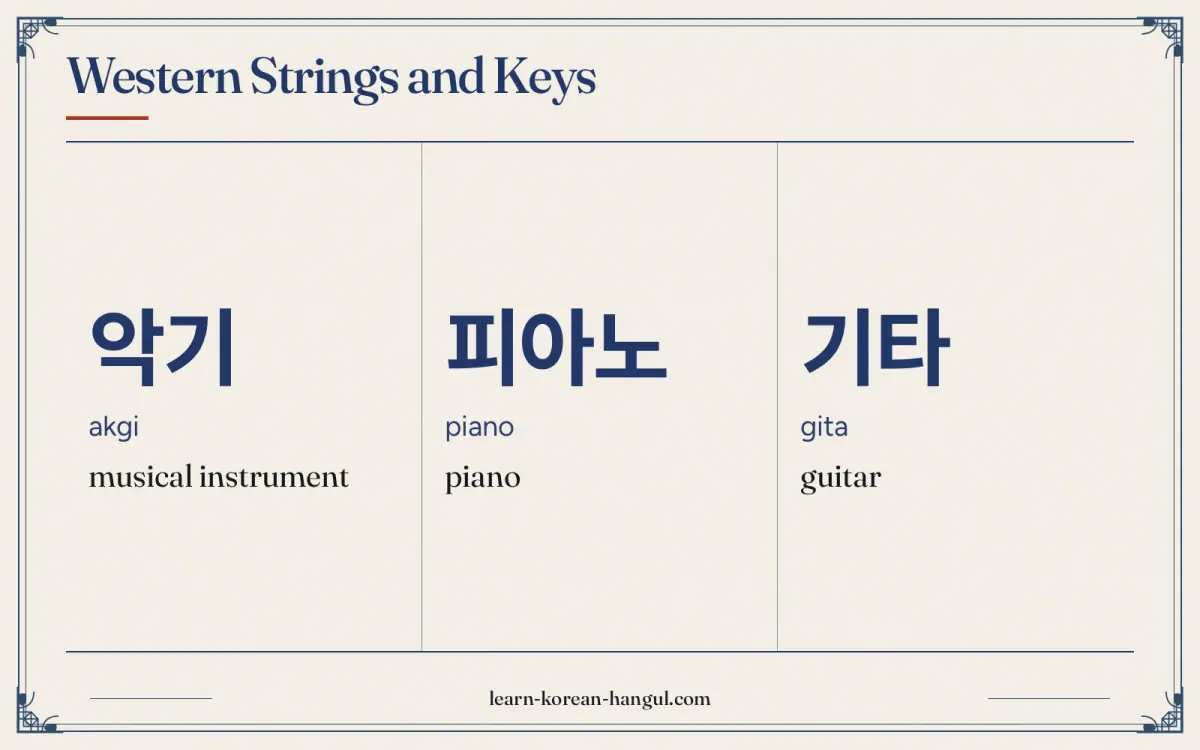
These eight words are the instruments that you meet first in a school music room or a pop band. Seven of them are English loanwords, and the exception is 악기, the general word for the whole group.
| No. | Hangul | Revised Romanization | Meaning | Origin | Example sentence | Audio assetId |
|---|---|---|---|---|---|---|
| 1 | 악기 | akgi | musical instrument | Sino-Korean | 어떤 악기를 연주해요? (eotteon akgireul yeonjuhaeyo; What instrument do you play?) | au-pg-vocabulary-hobbies-music-instruments-1; example: au-pg-vocabulary-hobbies-music-instruments-101 |
| 2 | 피아노 | piano | piano | loanword | 저는 피아노를 쳐요. (jeoneun pianoreul cheoyo; I play the piano.) | au-pg-vocabulary-hobbies-music-instruments-2; example: au-pg-vocabulary-hobbies-music-instruments-102 |
| 3 | 기타 | gita | guitar | loanword | 기타를 배우고 싶어요. (gitareul baeugo sipeoyo; I want to learn the guitar.) | au-pg-vocabulary-hobbies-music-instruments-3; example: au-pg-vocabulary-hobbies-music-instruments-103 |
| 4 | 바이올린 | baiollin | violin | loanword | 바이올린을 켜요. (baiollineul kyeoyo; I play the violin.) | au-pg-vocabulary-hobbies-music-instruments-4; example: au-pg-vocabulary-hobbies-music-instruments-104 |
| 5 | 첼로 | chello | cello | loanword | 첼로 소리가 깊어요. (chello soriga gipeoyo; The cello sound is deep.) | au-pg-vocabulary-hobbies-music-instruments-5; example: au-pg-vocabulary-hobbies-music-instruments-105 |
| 6 | 하프 | hapeu | harp | loanword | 하프는 줄이 많아요. (hapeuneun juri manayo; A harp has many strings.) | au-pg-vocabulary-hobbies-music-instruments-6; example: au-pg-vocabulary-hobbies-music-instruments-106 |
| 7 | 키보드 | kibodeu | keyboard (instrument) | loanword | 키보드로 작곡해요. (kibodeuro jakgokaeyo; I compose with a keyboard.) | au-pg-vocabulary-hobbies-music-instruments-7; example: au-pg-vocabulary-hobbies-music-instruments-107 |
| 8 | 우쿨렐레 | ukullelle | ukulele | loanword | 우쿨렐레는 작고 가벼워요. (ukullelleneun jakgo gabyeowoyo; The ukulele is small and light.) | au-pg-vocabulary-hobbies-music-instruments-8; example: au-pg-vocabulary-hobbies-music-instruments-108 |
- 악기: Use it as the general question. 연주하다 is a safe verb when you are unsure which of 치다, 불다 or 켜다 fits.
- 피아노: The verb 치다 means to hit, which is how a pianist's fingers act on the keys. 피아노를 배우다 means to learn the piano.
- 기타: The guitar uses 치다 too, because the right hand strikes the strings. Keep 기타 (guitar) apart from 기타 (other) by the object ending 를 and the verb.
- 바이올린: The verb 켜다 means to bow a stringed instrument. The same spelling also means to switch on a light or a device, so the object tells you which meaning is intended.
- 첼로: The cello also takes 켜다. The ㄹㄹ in the middle is a long l sound, as in English "all along".
- 하프: The harp is plucked, so the verb is 타다. The loan word keeps the English meaning exactly.
- 키보드: The same word is the computer keyboard. Context makes the meaning clear, and a music shop sign with 건반 악기 means keyboard instruments.
- 우쿨렐레: It has four syllables and a long ㄹㄹ in the middle. Learners love it as a first instrument because it is cheap and small.
Example Sentences
Choosing the verb is the main grammar point of this topic. The four verbs below are all regular in the polite present, and the forms were checked with the site conjugator.
| Verb | Polite present | Meaning | Used with |
|---|---|---|---|
| 치다 | 쳐요 | to strike or hit | 피아노, 기타, 드럼, 심벌즈, 장구, 북, 꽹과리, 징 |
| 불다 | 불어요 | to blow | 플루트, 클라리넷, 색소폰, 트럼펫, 하모니카, 대금, 피리 |
| 켜다 | 켜요 | to bow | 바이올린, 첼로, 해금 |
| 타다 | 타요 | to pluck or play (zithers, harp) | 가야금, 하프, 거문고 |
If you are not sure, use 연주하다 (to play, perform), whose polite present is 연주해요. For example, 가야금을 연주해요 is always correct. The object particle 을 or 를 follows the instrument in every one of these sentences: 피아노를 쳐요, 플루트를 불어요, 바이올린을 켜요.
How Do You Say Winds and Brass in Korean?
Wind instruments are played with the verb 불다, which means to blow. This gives a very simple rule for the whole group: name plus 를 plus 불어요.
| No. | Hangul | Revised Romanization | Meaning | Origin | Example sentence | Audio assetId |
|---|---|---|---|---|---|---|
| 9 | 플루트 | peulluteu | flute | loanword | 플루트를 불어요. (peulluteureul bureoyo; I play the flute.) | au-pg-vocabulary-hobbies-music-instruments-9; example: au-pg-vocabulary-hobbies-music-instruments-109 |
| 10 | 클라리넷 | keullarinet | clarinet | loanword | 클라리넷 소리가 부드러워요. (keullarinet soriga budeureowoyo; The clarinet sounds soft.) | au-pg-vocabulary-hobbies-music-instruments-10; example: au-pg-vocabulary-hobbies-music-instruments-110 |
| 11 | 색소폰 | saeksopon | saxophone | loanword | 색소폰을 배우고 있어요. (saeksoponeul baeugo isseoyo; I am learning the saxophone.) | au-pg-vocabulary-hobbies-music-instruments-11; example: au-pg-vocabulary-hobbies-music-instruments-111 |
| 12 | 트럼펫 | teureompet | trumpet | loanword | 트럼펫 소리가 커요. (teureompet soriga keoyo; The trumpet sound is loud.) | au-pg-vocabulary-hobbies-music-instruments-12; example: au-pg-vocabulary-hobbies-music-instruments-112 |
| 13 | 트롬본 | teurombon | trombone | loanword | 트롬본은 슬라이드를 움직여요. (teuromboneun seullaideureul umjigyeoyo; A trombone moves a slide.) | au-pg-vocabulary-hobbies-music-instruments-13; example: au-pg-vocabulary-hobbies-music-instruments-113 |
| 14 | 하모니카 | hamonika | harmonica | loanword | 하모니카는 주머니에 들어가요. (hamonikaneun jumeonie deureogayo; A harmonica fits in a pocket.) | au-pg-vocabulary-hobbies-music-instruments-14; example: au-pg-vocabulary-hobbies-music-instruments-114 |
| 15 | 리코더 | rikodeo | recorder | loanword | 학교에서 리코더를 배웠어요. (hakgyoeseo rikodeoreul baewosseoyo; I learned the recorder at school.) | au-pg-vocabulary-hobbies-music-instruments-15; example: au-pg-vocabulary-hobbies-music-instruments-115 |
- 플루트: The loan word starts with ㅍ, an aspirated sound with a puff of air, unlike the plain ㅂ.
- 클라리넷: The adjective 부드럽다 describes a soft or smooth sound; it is the opposite of 거칠다 (rough).
- 색소폰: The pattern -고 있다 means in the middle of doing. It suits a long-term hobby.
- 트럼펫: The last syllable 펫 ends in ㅅ, which is said like t, so the word ends with a clean t sound, as in English.
- 트롬본: The word 슬라이드 is the English loan for slide. The verb 움직이다 means to move something.
- 하모니카: The verb 불다 also covers harmonicas, since you blow in and out.
- 리코더: The recorder is the wind instrument of every school music class, as in many countries.
Percussion
Percussion instruments are struck or shaken, so most of them take 치다. The first five words below are all Western percussion, and the traditional drums have their own group.
| No. | Hangul | Revised Romanization | Meaning | Origin | Example sentence | Audio assetId |
|---|---|---|---|---|---|---|
| 16 | 드럼 | deureom | drums; drum set | loanword | 드럼을 치면 신나요. (deureomeul chimyeon sinnayo; It is exciting when I play the drums.) | au-pg-vocabulary-hobbies-music-instruments-16; example: au-pg-vocabulary-hobbies-music-instruments-116 |
| 17 | 탬버린 | taembeorin | tambourine | loanword | 탬버린을 흔들어요. (taembeorineul heundeureoyo; I shake the tambourine.) | au-pg-vocabulary-hobbies-music-instruments-17; example: au-pg-vocabulary-hobbies-music-instruments-117 |
| 18 | 실로폰 | sillopon | xylophone | loanword | 실로폰은 채로 쳐요. (silloponeun chaero cheoyo; You hit a xylophone with mallets.) | au-pg-vocabulary-hobbies-music-instruments-18; example: au-pg-vocabulary-hobbies-music-instruments-118 |
| 19 | 심벌즈 | simbeoljeu | cymbals | loanword | 심벌즈를 크게 쳐요. (simbeoljeureul keuge cheoyo; I strike the cymbals loudly.) | au-pg-vocabulary-hobbies-music-instruments-19; example: au-pg-vocabulary-hobbies-music-instruments-119 |
| 20 | 트라이앵글 | teuraiaenggeul | triangle | loanword | 트라이앵글 소리가 맑아요. (teuraiaenggeul soriga malgayo; The triangle sounds clear.) | au-pg-vocabulary-hobbies-music-instruments-20; example: au-pg-vocabulary-hobbies-music-instruments-120 |
- 드럼: The ending -면 means when or if, and 신나다 is the common word for excited and fun.
- 탬버린: This is the exception: you shake it, so the verb is 흔들다, not 치다. It is a common prop in Korean noraebang (karaoke rooms).
- 실로폰: The word 채 means a stick or mallet. The particle 로 marks the tool used.
- 심벌즈: The ending -즈 is the plural of the English word, kept in Korean as part of the name.
- 트라이앵글: The adjective 맑다 describes clear water and clear sounds alike.
How Do You Say Korean Traditional Instruments in Korean?
Traditional Korean music is called 국악, and its instruments are grouped by how they are played: plucked, bowed, blown and struck. The four percussion instruments kkwaenggwari, jing, janggu and buk form the group 사물놀이 (samulnori).
| No. | Hangul | Revised Romanization | Meaning | Origin | Example sentence | Audio assetId |
|---|---|---|---|---|---|---|
| 21 | 가야금 | gayageum | gayageum (plucked zither) | Sino-Korean | 전통 가야금은 열두 줄이에요. (jeontong gayageumeun yeoldu jurieyo; The traditional gayageum has twelve strings.) | au-pg-vocabulary-hobbies-music-instruments-21; example: au-pg-vocabulary-hobbies-music-instruments-121 |
| 22 | 거문고 | geomungo | geomungo (six-string zither) | native | 거문고는 술대로 연주해요. (geomungoneun suldaero yeonjuhaeyo; The geomungo is played with a bamboo stick.) | au-pg-vocabulary-hobbies-music-instruments-22; example: au-pg-vocabulary-hobbies-music-instruments-122 |
| 23 | 해금 | haegeum | haegeum (two-string fiddle) | Sino-Korean | 해금은 줄이 두 개예요. (haegeumeun juri du gaeyeyo; The haegeum has two strings.) | au-pg-vocabulary-hobbies-music-instruments-23; example: au-pg-vocabulary-hobbies-music-instruments-123 |
| 24 | 대금 | daegeum | daegeum (large bamboo flute) | Sino-Korean | 대금은 가로로 부는 피리예요. (daegeumeun garoro buneun piriyeyo; The daegeum is a flute that is blown sideways.) | au-pg-vocabulary-hobbies-music-instruments-24; example: au-pg-vocabulary-hobbies-music-instruments-124 |
| 25 | 피리 | piri | piri (bamboo reed pipe) | native | 피리는 대나무로 만들어요. (pirineun daenamuro mandeureoyo; A piri is made of bamboo.) | au-pg-vocabulary-hobbies-music-instruments-25; example: au-pg-vocabulary-hobbies-music-instruments-125 |
| 26 | 장구 | janggu | janggu (hourglass drum) | Sino-Korean | 장구는 양쪽을 쳐요. (jangguneun yangjjogeul cheoyo; You hit both sides of the janggu.) | au-pg-vocabulary-hobbies-music-instruments-26; example: au-pg-vocabulary-hobbies-music-instruments-126 |
| 27 | 북 | buk | drum (barrel drum) | native | 북을 쿵쿵 쳐요. (bugeul kungkung cheoyo; I beat the drum thump thump.) | au-pg-vocabulary-hobbies-music-instruments-27; example: au-pg-vocabulary-hobbies-music-instruments-127 |
| 28 | 꽹과리 | kkwaenggwari | kkwaenggwari (small gong) | native | 꽹과리 소리가 높고 날카로워요. (kkwaenggwari soriga nopgo nalkarowoyo; The kkwaenggwari sounds high and sharp.) | au-pg-vocabulary-hobbies-music-instruments-28; example: au-pg-vocabulary-hobbies-music-instruments-128 |
| 29 | 징 | jing | jing (large gong) | native | 징은 소리가 길게 울려요. (jingeun soriga gilge ullyeoyo; The jing rings for a long time.) | au-pg-vocabulary-hobbies-music-instruments-29; example: au-pg-vocabulary-hobbies-music-instruments-129 |
- 가야금: Its sound is soft and flowing. Newer versions have more strings, so the number belongs to the traditional type.
- 거문고: The 술대 is a thin bamboo stick that strikes the strings. The geomungo sounds lower and heavier than the gayageum.
- 해금: It is bowed, and so its verb is 켜다. The bow hair passes between the two strings.
- 대금: The word 가로 means sideways, and 부는 is the modifier form of 불다. The daegeum has a thin membrane that adds a buzzing tone.
- 피리: It is a small pipe with a double reed, and its tone is loud and nasal. The material word 대나무 means bamboo.
- 장구: The word 양쪽 means both sides. The two heads give two tones. The name comes from the Sino-Korean 장고 (杖鼓), which is still used as a variant.
- 북: The word 쿵쿵 imitates the thump. The same spelling 북 also means north, from a Chinese-derived word, as in 북쪽.
- 꽹과리: It is a small metal gong struck with a stick and leads the group in samulnori. The first syllable has a tense ㄲ and the vowel ㅙ.
- 징: It is the large gong whose sound is deep and wavy. The name is one syllable that ends in ng.
Music Rooms and Groups
The last group covers the places and the groups where music is made. Most of them are Sino-Korean and follow the pattern of a noun plus 실 (room) or 단 (group).
| No. | Hangul | Revised Romanization | Meaning | Origin | Example sentence | Audio assetId |
|---|---|---|---|---|---|---|
| 30 | 연주 | yeonju | performance; playing | Sino-Korean | 피아노 연주를 들어요. (piano yeonjureul deureoyo; I listen to a piano performance.) | au-pg-vocabulary-hobbies-music-instruments-30; example: au-pg-vocabulary-hobbies-music-instruments-130 |
| 31 | 오케스트라 | okeseuteura | orchestra | loanword | 오케스트라 공연을 봤어요. (okeseuteura gongyeoneul bwasseoyo; I saw an orchestra concert.) | au-pg-vocabulary-hobbies-music-instruments-31; example: au-pg-vocabulary-hobbies-music-instruments-131 |
| 32 | 밴드 | baendeu | band | loanword | 학교에서 밴드를 해요. (hakgyoeseo baendeureul haeyo; I am in a band at school.) | au-pg-vocabulary-hobbies-music-instruments-32; example: au-pg-vocabulary-hobbies-music-instruments-132 |
| 33 | 합창단 | hapchangdan | choir | Sino-Korean | 합창단에서 노래해요. (hapchangdaneseo noraehaeyo; I sing in a choir.) | au-pg-vocabulary-hobbies-music-instruments-33; example: au-pg-vocabulary-hobbies-music-instruments-133 |
| 34 | 음악실 | eumaksil | music room | Sino-Korean | 음악실은 2층에 있어요. (eumaksireun icheunge isseoyo; The music room is on the second floor.) | au-pg-vocabulary-hobbies-music-instruments-34; example: au-pg-vocabulary-hobbies-music-instruments-134 |
| 35 | 연습실 | yeonseupsil | practice room | Sino-Korean | 연습실에서 매일 연습해요. (yeonseupsireseo maeil yeonseupaeyo; I practise every day in the practice room.) | au-pg-vocabulary-hobbies-music-instruments-35; example: au-pg-vocabulary-hobbies-music-instruments-135 |
- 연주: As a verb, 연주하다 (to play or perform) works for every instrument. It is the safe choice when you do not know the special verb.
- 오케스트라: It has five syllables, and the vowel 으 is added after consonants that Korean cannot say alone.
- 밴드: The verb 하다 is used with 밴드 to mean being in a band. It means a rock or pop group.
- 합창단: The word is 합창 (chorus) plus 단 (group). The 에서 particle marks the group as the place of the action.
- 음악실: The word is 음악 (music) plus 실 (room). It is said [으막씰]. Floors are written with Arabic numerals and 층, so 2층 (icheung) is the second floor.
- 연습실: Pay-by-hour practice rooms are common near universities. It is said [연습씰].
How Do You Pronounce These Words?
Instrument names are mostly easy loan words, but a few Korean words follow sound rules. The table follows the Standard Pronunciation rules (표준 발음법) of the 국립국어원.
| Word | Romanization | Said | Rule |
|---|---|---|---|
| 악기 | akgi | [악끼] | ㄱ after the final ㄱ becomes tense |
| 음악실 | eumaksil | [으막씰] | the ㅁ of 음 moves onto the empty ㅇ of 악, and the ㅅ after the final ㄱ becomes tense |
| 연습실 | yeonseupsil | [연습씰] | ㅅ after the final ㅂ becomes tense |
| 꽹과리 | kkwaenggwari | [꽹과리] | no change; the first ㄲ is tense and the vowel ㅙ glides, so it is said kkweng-gwa-ri |
| 우쿨렐레 | ukullelle | [우쿨렐레] | no change; ㄹㄹ is one long l sound |
Revised Romanization is the official romanization system of South Korea, announced on 7 July 2000. It follows most sound changes but does not show tensing caused by a neighbouring sound, so 악기 is written akgi even though it is said [악끼]. It is only a learning aid. Always read the Hangul as well.
Audio and Slow Playback
Each headword and each example sentence has its own audio clip, and the 5 words in the first-words section also have a slow clip at 0.8 times the speed. Nothing plays until you press a button. Listen to 음악실 and 연습실 one after the other and hear how the last syllable gets tense in both.
What Mistakes Do Learners Make with Musical Instrument Names?
- Using one verb for all instruments. English says play; Korean says 치다, 불다, 켜다 or 타다, and 연주하다 is the neutral choice.
- Reading 기타 as other in a music sentence. The guitar is 기타 too, so the verb decides: 기타를 쳐요 is the guitar.
- Using 키보드 for the instrument in a shop without context. It also means the computer keyboard.
- Confusing 북 (drum) with 북 (north). In a music sentence it is the drum.
- Mixing up the gayageum and the geomungo. The gayageum has twelve strings in its traditional form and is plucked, while the geomungo has six strings and is played with a stick.
- Misspelling 꽹과리 as 괭과리. The name starts with a tense ㄲ, which learners drop.
Practice: Flashcards and Worksheet
Drill all 35 words with the vocabulary flashcard decks: each card shows the Hangul on one side and the meaning on the other, so you can test yourself in both directions. Consult the vocabulary worksheets page for printable sheets; for practice, write the Korean name for each numbered instrument in the scene above by hand. A simple plan is to learn the Western instruments first, because you already know their sound, and then the traditional group, one instrument per day with the matching verb. Say the whole phrase each time, for example 장구를 쳐요.
Self-Test: 10 Sentences
Fill each blank with a word from this page. Say the whole sentence aloud when you have it. The answers follow the test.
- 어떤 ___를 연주해요? (What instrument do you play?)
- ___을 켜요. (I play the violin.)
- ___는 작고 가벼워요. (The ukulele is small and light.)
- ___을 배우고 있어요. (I am learning the saxophone.)
- 학교에서 ___를 배웠어요. (I learned the recorder at school.)
- ___은 채로 쳐요. (You hit a xylophone with mallets.)
- ___는 술대로 연주해요. (The geomungo is played with a bamboo stick.)
- ___는 대나무로 만들어요. (A piri is made of bamboo.)
- ___은 소리가 길게 울려요. (The jing rings for a long time.)
- 학교에서 ___를 해요. (I am in a band at school.)
Answers: 1. 악기; 2. 바이올린; 3. 우쿨렐레; 4. 색소폰; 5. 리코더; 6. 실로폰; 7. 거문고; 8. 피리; 9. 징; 10. 밴드.
A score of 8 or more suggests the words are settling in. If you scored lower, reread the groups where you missed words.
Where to Go Next
This Korean musical instruments vocabulary list sits inside Music. Continue with Korean Music Genres Vocabulary. For the single-word answers, see piano in korean and gayageum in korean.
FAQ
How Do You Say Musical Instrument in Korean?
Say 악기 (akgi). It is said [악끼], with a tense second consonant. To ask what someone plays, say 어떤 악기를 연주해요? (What instrument do you play?). The word joins 악 (music) and 기 (tool), so 전통 악기 means traditional instrument and 악기 가게 means instrument shop.
How Do You Pronounce 피아노 (piano)?
Say pee-a-no, with three even syllables. The first syllable is a puffed ㅍ, so hold your hand in front of your mouth and feel a breath of air. The ㅏ is an open ah, and the ㅗ is a rounded oh.
How Many Musical Instrument Names Should I Learn First?
Learn the five words in the first-words section: 악기, 피아노, 기타, 가야금 and 장구. Then add the verbs 치다, 불다, 켜다 and 타다. The rest of the 35 words can be added a group at a time. Learn each instrument together with its verb, so a phrase such as 가야금을 타요 sticks as one unit.
Where Can I Practise Musical Instrument Names with Flashcards?
Use the vocabulary flashcard decks. Start with the Western instruments and the four verbs, then add the traditional group. Review the older cards before you add new ones, so the earlier words do not fade, and say each name with its verb, as in 피아노를 쳐요.
Is the Romanization on This Page Official?
Yes, as a learning aid. It follows the Revised Romanization of Korean, the system South Korea has officially used since 7 July 2000, and the page also gives the Hangul for every word. It follows most sound changes but does not show tensing caused by a neighbouring sound: 악기 is written akgi but said [악끼]. Treat the Hangul as the real spelling.
Is There a Printable Worksheet for Musical Instrument Names?
The vocabulary worksheets page lists the printable sheets. For paper practice, use the illustrated scene on this page as a labelling task and write the Korean name next to each numbered instrument. You can also copy the scene words by hand.