What you'll learn
- Match all 40 music words to their English meanings.
- Tell a genre name from an instrument name and a stage word.
- Say five of the words aloud with the help of the Revised Romanization and the audio.
- Write two original sentences with words such as 북 and 가야금.
Prerequisites: you can read Hangul and know the polite ending -아요/-어요. Estimated time: about 60 minutes, plus short reviews on the following days.
Korean Music Vocabulary at a Glance
Korean music words come in three layers. Genre names such as 케이팝, 힙합 and 재즈 are English loanwords written in Hangul. Everyday words such as 노래 (song) and 음악 (music) are short and common. The traditional layer, with 가야금, 장구 and 판소리, uses Korean and Sino-Korean words that you will mostly meet in school music classes, museums and festivals.
Two verbs matter most. You listen to music with 듣다 and you sing with 부르다, so 음악을 들어요 and 노래를 불러요 are the two sentences to learn first. The page sits inside Hobbies and Leisure and has two deeper pages: Korean musical instruments and Korean music genres. For single words, see music in korean, and for pop culture see K-pop words.
| Group | Words | Examples |
|---|---|---|
| Genres | 9 | 음악, 노래, 케이팝, 발라드 |
| Instruments | 8 | 악기, 피아노, 기타, 바이올린 |
| Performance | 8 | 콘서트, 공연, 무대, 가수 |
| Listening | 8 | 듣다, 부르다, 노래방, 이어폰 |
| Traditional music | 7 | 가야금, 장구, 거문고, 해금 |
By origin, 19 of the 40 words are loanwords. The rest are Sino-Korean or native Korean words, plus two mixed compounds: 노래방 (native 노래 + Sino-Korean 방) and 사물놀이 (Sino-Korean 사물 + native 놀이). Genre and instrument names are mostly loanwords, and the traditional music words mix Sino-Korean and native Korean.
Which Music Words Should You Learn First?
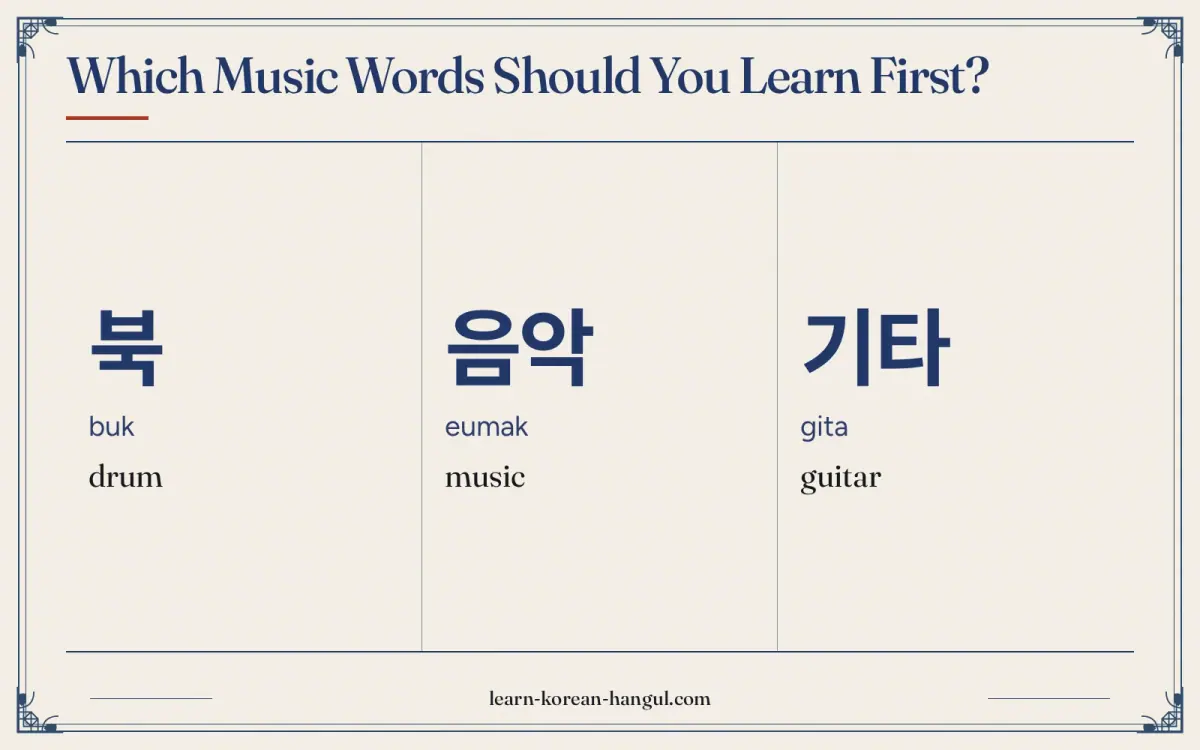
Start with five words: 북, 음악, 노래, 기타 and 가야금. The first three are the words you will use every day. 기타 is a good first instrument word, and 가야금 shows you the traditional side. Press the slow button, say each word, then listen to the sentence.
The scene below shows twelve of the 40 words. Each number matches a word in the lists that follow.
Word · 12
- 1
북
buk
drum
- 2
음악
eumak
music
- 3
기타
gita
guitar
- 4
피아노
piano
piano
- 5
바이올린
baiollin
violin
- 6
드럼
deureom
drums
- 7
플루트
peulluteu
flute
- 8
콘서트
konseoteu
concert
- 9
무대
mudae
stage
- 10
이어폰
ieopon
earphones
- 11
가야금
gayageum
gayageum (plucked zither)
- 12
장구
janggu
janggu (hourglass drum)
Twelve numbered objects match twelve words from the lists. Use the list under the picture if you cannot see the numbers.
Genres
Nine words for music in general and the main genres. Genre names are loanwords, so you can read most of them as soon as you know Hangul. The page on music genres has the full list.
| No. | Hangul | Revised Romanization | Meaning | Example sentence | Audio assetId |
|---|---|---|---|---|---|
| 1 | 음악 | eumak | music | 저는 음악을 자주 들어요. (jeoneun eumageul jaju deureoyo. I often listen to music.) | au-pg-vocabulary-hobbies-music-1; example: au-pg-vocabulary-hobbies-music-101 |
| 2 | 노래 | norae | song | 이 노래가 정말 좋아요. (i noraega jeongmal joayo. I really like this song.) | au-pg-vocabulary-hobbies-music-2; example: au-pg-vocabulary-hobbies-music-102 |
| 3 | 케이팝 | keipap | K-pop | 케이팝 노래를 좋아해요. (keipap noraereul joahaeyo. I like K-pop songs.) | au-pg-vocabulary-hobbies-music-3; example: au-pg-vocabulary-hobbies-music-103 |
| 4 | 발라드 | balladeu | ballad | 발라드는 천천히 불러요. (balladeuneun cheoncheonhi bulleoyo. A ballad is sung slowly.) | au-pg-vocabulary-hobbies-music-4; example: au-pg-vocabulary-hobbies-music-104 |
| 5 | 힙합 | hiphap | hip-hop | 힙합 음악은 리듬이 빨라요. (hiphap eumageun rideumi ppallayo. Hip-hop music has a fast rhythm.) | au-pg-vocabulary-hobbies-music-5; example: au-pg-vocabulary-hobbies-music-105 |
| 6 | 록 | rok | rock | 형은 록 음악을 좋아해요. (hyeongeun rok eumageul joahaeyo. My older brother likes rock music.) | au-pg-vocabulary-hobbies-music-6; example: au-pg-vocabulary-hobbies-music-106 |
| 7 | 재즈 | jaejeu | jazz | 주말에 재즈를 들어요. (jumare jaejeureul deureoyo. I listen to jazz on weekends.) | au-pg-vocabulary-hobbies-music-7; example: au-pg-vocabulary-hobbies-music-107 |
| 8 | 클래식 | keullaesik | classical music | 클래식 음악은 조용해요. (keullaesik eumageun joyonghaeyo. Classical music is quiet.) | au-pg-vocabulary-hobbies-music-8; example: au-pg-vocabulary-hobbies-music-108 |
| 9 | 트로트 | teuroteu | trot | 할머니는 트로트를 좋아하세요. (halmeonineun teuroteureul joahaseyo. My grandmother likes trot.) | au-pg-vocabulary-hobbies-music-9; example: au-pg-vocabulary-hobbies-music-109 |
- 음악: The general word. It is said [으막] because the ㅁ moves onto the empty ㅇ of the next syllable. You listen to it with 듣다.
- 노래: A native Korean word for a song. The verb for singing is 부르다, so 노래를 부르다 is to sing.
- 케이팝: Written phonetically as 케이 plus 팝, the English letters K and pop. It is also written K팝 or K-pop in Korea.
- 발라드: Korean ballads are slow pop love songs. The word has three syllables: bal-la-deu.
- 힙합: Said [히팝]. The ㅂ at the end of 힙 and the ㅎ of 합 blend into one puffed ㅍ sound.
- 록: A one-syllable loanword with a final ㄱ. Do not add a vowel at the end: say rok, not roku.
- 재즈: Said jae-jeu. The final 즈 is a short ㅡ sound with unrounded lips.
- 클래식: From English classic. 클래식 means classical music in general, as a genre.
- 트로트: Trot is a Korean pop style with a lively, repeating rhythm that older listeners often favour. The honorific 좋아하세요 is used for a grandmother.
Example Sentences
Press play and repeat each sentence aloud. Two verbs run through the genre sentences: 듣다 (to listen) and 부르다 (to sing).
저는 음악을 자주 들어요.
jeoneun eumageul jaju deureoyo.
I often listen to music.
이 노래가 정말 좋아요.
i noraega jeongmal joayo.
I really like this song.
발라드는 천천히 불러요.
balladeuneun cheoncheonhi bulleoyo.
A ballad is sung slowly.
할머니는 트로트를 좋아하세요.
halmeonineun teuroteureul joahaseyo.
My grandmother likes trot.
The last example uses the honorific ending 좋아하세요 because the subject is a grandmother. The listening section explains 듣다 and 부르다 in more detail.
Instruments
Eight common instruments. The loanwords match the English names, and 북 is a native Korean word. The page on Korean musical instruments covers 35 instrument words.
| No. | Hangul | Revised Romanization | Meaning | Example sentence | Audio assetId |
|---|---|---|---|---|---|
| 10 | 악기 | akgi | musical instrument | 어떤 악기를 좋아해요? (eotteon akgireul joahaeyo? Which instrument do you like?) | au-pg-vocabulary-hobbies-music-10; example: au-pg-vocabulary-hobbies-music-110 |
| 11 | 피아노 | piano | piano | 저는 피아노를 쳐요. (jeoneun pianoreul chyeoyo. I play the piano.) | au-pg-vocabulary-hobbies-music-11; example: au-pg-vocabulary-hobbies-music-111 |
| 12 | 기타 | gita | guitar | 형은 기타를 배워요. (hyeongeun gitareul baewoyo. My older brother is learning the guitar.) | au-pg-vocabulary-hobbies-music-12; example: au-pg-vocabulary-hobbies-music-112 |
| 13 | 바이올린 | baiollin | violin | 바이올린 소리가 예뻐요. (baiollin soriga yeppeoyo. The violin sound is pretty.) | au-pg-vocabulary-hobbies-music-13; example: au-pg-vocabulary-hobbies-music-113 |
| 14 | 드럼 | deureom | drums | 친구는 드럼을 쳐요. (chinguneun deureomeul chyeoyo. My friend plays the drums.) | au-pg-vocabulary-hobbies-music-14; example: au-pg-vocabulary-hobbies-music-114 |
| 15 | 북 | buk | drum | 북을 크게 쳐요. (bugeul keuge chyeoyo. I hit the drum hard.) | au-pg-vocabulary-hobbies-music-15; example: au-pg-vocabulary-hobbies-music-115 |
| 16 | 플루트 | peulluteu | flute | 플루트는 입으로 불어요. (peulluteuneun ibeuro bureoyo. You blow a flute with your mouth.) | au-pg-vocabulary-hobbies-music-16; example: au-pg-vocabulary-hobbies-music-116 |
| 17 | 첼로 | chello | cello | 첼로는 소리가 깊어요. (chelloneun soriga gipeoyo. The cello has a deep sound.) | au-pg-vocabulary-hobbies-music-17; example: au-pg-vocabulary-hobbies-music-117 |
- 악기: The general word for an instrument. It is said [악끼], with a tense second consonant.
- 피아노: The verb is 치다 (to hit), because you strike the keys.
- 기타: Same spelling as 기타 meaning other. The verb 치다 shows that it is the instrument.
- 바이올린: Four syllables: ba-i-ol-lin. The ㄹ twice makes a long l, written baiollin.
- 드럼: Single word for a drum kit. 드럼 is also used for large oil barrels in industry.
- 북: Native word for a traditional drum. The same spelling means north in 북쪽, so context decides.
- 플루트: Wind instruments take 불다, to blow. The polite form is 불어요.
- 첼로: Two syllables: chel-lo. The ㄹ sounds double into a long l.
Which Verb Goes with Which Instrument?
Korean chooses the verb by how the sound is made. The forms below are the polite present from the site conjugator.
| Verb | Polite present | Meaning | Used with |
|---|---|---|---|
| 치다 | 쳐요 | to hit | 피아노, 기타, 드럼, 북, 장구 |
| 불다 | 불어요 | to blow | 플루트 |
| 켜다 | 켜요 | to bow | 바이올린, 첼로, 해금 |
| 타다 | 타요 | to pluck | 가야금 |
If you are not sure, use 연주하다, whose polite present is 연주해요. For example, 가야금을 연주해요 always works.
Performance
Eight words for stages, shows and the people on them.
| No. | Hangul | Revised Romanization | Meaning | Example sentence | Audio assetId |
|---|---|---|---|---|---|
| 18 | 콘서트 | konseoteu | concert | 콘서트에 가고 싶어요. (konseoteue gago sipeoyo. I want to go to a concert.) | au-pg-vocabulary-hobbies-music-18; example: au-pg-vocabulary-hobbies-music-118 |
| 19 | 공연 | gongyeon | performance, show | 오늘 저녁에 공연이 있어요. (oneul jeonyeoge gongyeoni isseoyo. There is a performance this evening.) | au-pg-vocabulary-hobbies-music-19; example: au-pg-vocabulary-hobbies-music-119 |
| 20 | 무대 | mudae | stage | 가수가 무대에 올라가요. (gasuga mudaee ollagayo. The singer goes up on the stage.) | au-pg-vocabulary-hobbies-music-20; example: au-pg-vocabulary-hobbies-music-120 |
| 21 | 가수 | gasu | singer | 저는 이 가수를 좋아해요. (jeoneun i gasureul joahaeyo. I like this singer.) | au-pg-vocabulary-hobbies-music-21; example: au-pg-vocabulary-hobbies-music-121 |
| 22 | 밴드 | baendeu | band | 학교에서 밴드를 해요. (hakgyoeseo baendeureul haeyo. I am in a band at school.) | au-pg-vocabulary-hobbies-music-22; example: au-pg-vocabulary-hobbies-music-122 |
| 23 | 연주 | yeonju | playing, performance (of music) | 연주가 정말 멋있어요. (yeonjuga jeongmal meosisseoyo. The performance is really cool.) | au-pg-vocabulary-hobbies-music-23; example: au-pg-vocabulary-hobbies-music-123 |
| 24 | 지휘자 | jihwija | conductor | 지휘자가 손을 올려요. (jihwijaga soneul ollyeoyo. The conductor raises their hands.) | au-pg-vocabulary-hobbies-music-24; example: au-pg-vocabulary-hobbies-music-124 |
| 25 | 관객 | gwangaek | audience | 관객이 박수를 쳐요. (gwangaegi baksureul chyeoyo. The audience claps.) | au-pg-vocabulary-hobbies-music-25; example: au-pg-vocabulary-hobbies-music-125 |
- 콘서트: In conversation, the wider word 공연 often replaces 콘서트. Tickets are 표.
- 공연: A show of any kind, including theatre and dance. 공연장 is a performance hall.
- 무대: The stage where performers stand. The verb 올라가다 means to go up.
- 가수: Used for professional singers. 가 (song) plus 수 (person).
- 밴드: A music group. Use 하다 to say you do it or are part of it.
- 연주: The verb 연주하다 fits any instrument and is a safe choice if you do not know the exact verb.
- 지휘자: 지휘 (conducting) plus 자 (person). The suffix 자 appears in many job words.
- 관객: 관 (see) plus 객 (guest). 박수를 치다 means to clap.
Listening
Eight words for listening to music and the things you listen with.
| No. | Hangul | Revised Romanization | Meaning | Example sentence | Audio assetId |
|---|---|---|---|---|---|
| 26 | 듣다 | deutda | to listen, to hear | 저는 매일 음악을 들어요. (jeoneun maeil eumageul deureoyo. I listen to music every day.) | au-pg-vocabulary-hobbies-music-26; example: au-pg-vocabulary-hobbies-music-126 |
| 27 | 부르다 | bureuda | to sing, to call | 친구가 노래를 불러요. (chinguga noraereul bulleoyo. My friend sings a song.) | au-pg-vocabulary-hobbies-music-27; example: au-pg-vocabulary-hobbies-music-127 |
| 28 | 노래방 | noraebang | karaoke room | 주말에 노래방에 가요. (jumare noraebange gayo. I go to a karaoke room on weekends.) | au-pg-vocabulary-hobbies-music-28; example: au-pg-vocabulary-hobbies-music-128 |
| 29 | 이어폰 | ieopon | earphones | 이어폰을 가져와요. (ieoponeul gajyeowayo. I bring my earphones.) | au-pg-vocabulary-hobbies-music-29; example: au-pg-vocabulary-hobbies-music-129 |
| 30 | 스피커 | seupikeo | speaker | 스피커 소리가 커요. (seupikeo soriga keoyo. The speaker sound is loud.) | au-pg-vocabulary-hobbies-music-30; example: au-pg-vocabulary-hobbies-music-130 |
| 31 | 앨범 | aelbeom | album | 새 앨범이 나와요. (sae aelbeomi nawayo. A new album is coming out.) | au-pg-vocabulary-hobbies-music-31; example: au-pg-vocabulary-hobbies-music-131 |
| 32 | 가사 | gasa | lyrics | 가사가 정말 좋아요. (gasaga jeongmal joayo. The lyrics are really good.) | au-pg-vocabulary-hobbies-music-32; example: au-pg-vocabulary-hobbies-music-132 |
| 33 | 플레이리스트 | peulleiriseuteu | playlist | 새 플레이리스트를 만들어요. (sae peulleiriseuteureul mandeureoyo. I make a new playlist.) | au-pg-vocabulary-hobbies-music-33; example: au-pg-vocabulary-hobbies-music-133 |
- 듣다: A ㄷ-irregular verb: the ㄷ becomes ㄹ before a vowel, so the polite present is 들어요, not 듣어요.
- 부르다: An 르 verb: 부르다 becomes 불러요. It means both to sing a song and to call someone by name.
- 노래방: 노래 (song) plus 방 (room). Karaoke rooms are private rooms rented for a group.
- 이어폰: Three syllables: i-eo-pon. The headphones are 헤드폰.
- 스피커: From English speaker. Written with the vowel ㅣ in the second syllable, not ㅓ.
- 앨범: 앨범 is spelled with the vowel ㅐ and a final ㅁ. The verb 나오다 (come out) is used for releases.
- 가사: Do not confuse 가사 (lyrics) with 가사 (housework), a different Sino-Korean word. The context shows which one is meant.
- 플레이리스트: Six syllables: peul-le-i-ri-seu-teu. The verb 만들다 drops its ㄹ before some endings but keeps it in 만들어요.
Traditional Music
Seven words for Korean traditional music. These are Korean or Sino-Korean words, and a few of them are instrument names. Read the traditional culture page for more heritage vocabulary.
| No. | Hangul | Revised Romanization | Meaning | Example sentence | Audio assetId |
|---|---|---|---|---|---|
| 34 | 가야금 | gayageum | gayageum (plucked zither) | 가야금은 열두 줄이 있어요. (gayageumeun yeoldu juri isseoyo. The gayageum has twelve strings.) | au-pg-vocabulary-hobbies-music-34; example: au-pg-vocabulary-hobbies-music-134 |
| 35 | 장구 | janggu | janggu (hourglass drum) | 장구는 양쪽을 쳐요. (jangguneun yangjjogeul chyeoyo. You hit both sides of the janggu.) | au-pg-vocabulary-hobbies-music-35; example: au-pg-vocabulary-hobbies-music-135 |
| 36 | 거문고 | geomungo | geomungo (six-string zither) | 거문고는 술대로 연주해요. (geomungoneun suldaero yeonjuhaeyo. The geomungo is played with a bamboo stick.) | au-pg-vocabulary-hobbies-music-36; example: au-pg-vocabulary-hobbies-music-136 |
| 37 | 해금 | haegeum | haegeum (two-string fiddle) | 해금은 활로 켜요. (haegeumeun hwallo kyeoyo. The haegeum is played with a bow.) | au-pg-vocabulary-hobbies-music-37; example: au-pg-vocabulary-hobbies-music-137 |
| 38 | 대금 | daegeum | daegeum (bamboo flute) | 대금은 대나무로 만들어요. (daegeumeun daenamuro mandeureoyo. The daegeum is made of bamboo.) | au-pg-vocabulary-hobbies-music-38; example: au-pg-vocabulary-hobbies-music-138 |
| 39 | 판소리 | pansori | pansori | 판소리는 소리꾼과 고수가 해요. (pansorineun sorikkungwa gosuga haeyo. Pansori is performed by a singer and a drummer.) | au-pg-vocabulary-hobbies-music-39; example: au-pg-vocabulary-hobbies-music-139 |
| 40 | 사물놀이 | samullori | samulnori (four-instrument percussion) | 사물놀이는 소리가 힘차요. (samullorineun soriga himchayo. Samulnori sounds powerful.) | au-pg-vocabulary-hobbies-music-40; example: au-pg-vocabulary-hobbies-music-140 |
- 가야금: A long zither with twelve strings in its traditional form, played by plucking. The verb is 타다.
- 장구: An hourglass-shaped drum with two heads. Traditionally, the left side is struck with the palm or a mallet and the right side with a thin stick.
- 거문고: A larger zither with six strings. The stick is called 술대.
- 해금: A fiddle with two strings. The verb 켜다 means to bow a string instrument.
- 대금: A large transverse bamboo flute. The verb 만들다 here is 만들어요.
- 판소리: A traditional genre in which one singer tells a long story with a drummer. The singer is called a 소리꾼 and the drummer a 고수.
- 사물놀이: A percussion performance for four instruments: the kkwaenggwari, jing, janggu and buk. Said [사물로리].
How Do You Pronounce These Words?
Most music words are easy loanwords, but a few follow sound rules. The table follows the standard pronunciation rules (표준 발음법) of the 국립국어원 (National Institute of Korean Language).
| Word | Revised Romanization | Said | Rule |
|---|---|---|---|
| 음악 | eumak | [으막] | the final ㅁ moves onto the empty ㅇ of the next syllable |
| 악기 | akgi | [악끼] | ㄱ after a final ㄱ becomes tense |
| 힙합 | hiphap | [히팝] | final ㅂ and ㅎ blend into one ㅍ |
| 사물놀이 | samullori | [사물로리] | ㄴ after a final ㄹ is said as ㄹ |
| 듣다 | deutda | [듣따] | ㄷ after a final ㄷ becomes tense |
Revised Romanization writes a sound change when the letters change, as in 사물놀이 (samullori), but it does not mark tensing: 악기 is written akgi even though it is said [악끼]. The word 힙합 is written hiphap, with the h kept, because it is a noun.
Audio and Slow Playback
Each headword and each example sentence has its own audio clip, and the 5 words in the first-words section also have a slow clip at 0.8 times the speed. Nothing plays until you press a button. Listen to 악기 and 듣다 one after the other and hear how both get a tense second consonant.
What Mistakes Do Learners Make with Music Words?
- Saying 듣어요 for I listen. 듣다 is a ㄷ-irregular verb, and the polite present is 들어요.
- Using 부르다 only for singing. It also means to call a person, so context decides: 이름을 불러요 means I call the name.
- Confusing 북 (drum) with 북 (north). In a music sentence it is the drum.
- Adding a vowel to loanwords ending in a consonant. 록 is rok and 힙합 is hiphap, with no extra u sound.
- Using 치다 for every instrument. Pianos and drums are hit (치다), flutes are blown (불다) and bowed strings use 켜다.
- Mixing up 가수 (singer) with 가사 (lyrics). They differ by one syllable and sound alike at speed.
Practice: Flashcards and Worksheet
Drill all 40 words with the vocabulary flashcard decks: each card shows the Hangul on one side and the meaning on the other, so you can test yourself in both directions. A printable worksheet for these words (word list, matching, writing practice, fill-in-the-blank exercises and answer key) is available in A4 and US Letter from the download card on this page. A simple plan is to learn the genres first, because most are loanwords, then the instruments, then the stage words, and finish with the traditional group. Say each noun with its verb, for example 음악을 들어요 or 북을 쳐요.
Practice · 4
- 01저는 음악을 자주 들어요.
Show answer
jeoneun eumageul jaju deureoyo.
I often listen to music.
- 02이 노래가 정말 좋아요.
Show answer
i noraega jeongmal joayo.
I really like this song.
- 03발라드는 천천히 불러요.
Show answer
balladeuneun cheoncheonhi bulleoyo.
A ballad is sung slowly.
- 04할머니는 트로트를 좋아하세요.
Show answer
halmeonineun teuroteureul joahaseyo.
My grandmother likes trot.
Korean Music Vocabulary Worksheet (PDF)
Quick Quiz
Choose the best answer. The explanation after each question tells you why.
Practice · 5
Which word means song?
Show answer
노래
노래 means song. 음악 is music in general, 가수 is a singer and 가사 is lyrics.
What is the polite present of 듣다 (to listen)?
Show answer
들어요
듣다 is ㄷ-irregular, so the ㄷ becomes ㄹ before a vowel: 들어요.
Which instrument has twelve strings in its traditional form?
Show answer
가야금
The gayageum has twelve strings. The janggu is a drum, the haegeum is a fiddle and the daegeum is a flute.
What does 지휘자 mean?
Show answer
conductor
지휘자 is the person who conducts. 가수 is a singer and 관객 is the audience.
Which word means karaoke room?
Show answer
노래방
노래방 means a karaoke room: 노래 (song) plus 방 (room).
Write two sentences of your own, one about the music you like and one about an instrument you play or want to learn. For example, 저는 재즈를 좋아해요 or 기타를 배우고 싶어요.
Where to Go Next
This music list sits inside Hobbies and Leisure. Go deeper with Korean musical instruments or Korean music genres. For the pop-music side, see K-pop words. Nearby topics are Sports and Movies and TV.
Pages in This Section
These two deeper pages build on the 40 words above.
| Page | What it covers | Level | Words |
|---|---|---|---|
| Korean Musical Instruments Vocabulary | piano, guitar, violin, gayageum and janggu | A1 | 35 |
| Korean Music Genres Vocabulary | K-pop, ballad, hip-hop, trot and classical | A2 | 30 |
FAQ
How Do You Say Drum in Korean?
Say 북 (buk). It is a native Korean word, and the verb is 치다, so 북을 쳐요 means I hit the drum. The same spelling also means north in 북쪽, so look at the sentence to tell which one is meant. A modern drum kit is 드럼.
How Do You Pronounce 가야금 (gayageum)?
Say ga-ya-geum in three even syllables. The ㅡ in the last syllable is an unrounded sound, so keep your lips flat. Revised Romanization writes gayageum. The instrument is a plucked zither, so the verb is 타다.
How Many Music Words Should I Learn First?
Learn the five words in the first-words section: 북, 음악, 노래, 기타 and 가야금. Then add the two verbs 듣다 and 부르다. After that, take one group a day and review the earlier ones.
Where Can I Practise Music Words with Flashcards?
Use the vocabulary flashcard decks. Start with the genres, then add instruments and stage words, and say each noun with its verb.
Is the Romanization on This Page Official?
It follows the Revised Romanization of Korean, the system South Korea has officially used since 2000, as a learning aid. It does not show tensing caused by a neighbouring sound, so 악기 is written akgi but said [악끼]. Always read the Hangul as well.
Is There a Printable Worksheet for Music Words?
A printable worksheet for these words (word list, matching, writing practice, fill-in-the-blank exercises and answer key) is available in A4 and US Letter from the download card on this page. For additional practice, write the Korean name next to each numbered object in the scene above.