What you'll learn
- Match all 35 taekwondo words to their English meanings.
- Understand the commands you hear in a class, such as 차렷 and 경례.
- Say five of the words aloud with the help of the Revised Romanization and the audio.
- Write two original sentences with words such as 태권도 and 도장.
Prerequisites: you can read Hangul, know the sports words in Sports and recognise the polite ending -아요/-어요. Estimated time: about 60 minutes, plus short reviews on the following days.
Korean Taekwondo Vocabulary at a Glance
Taekwondo is a Korean martial art, and many of its terms are used in Korean even in classes taught abroad. 태권도 is built from 태 (foot), 권 (fist) and 도 (way). The names of kicks and strikes are made from a body part plus a verb noun: 앞 (front) plus 차기 (kicking) gives 앞차기, a front kick.
A class has its own sound. The teacher gives short commands such as 차렷 and 경례, students count in native Korean numbers, and ranks use Sino-Korean numbers. This page sits inside Sports and has the single-word companion taekwondo in korean. For the numbers, see native Korean numbers.
| Group | Words | Examples |
|---|---|---|
| Commands | 7 | 차렷, 경례, 준비, 시작 |
| Belts and ranks | 7 | 띠, 단, 급, 품 |
| Stances and strikes | 8 | 앞차기, 옆차기, 돌려차기, 주먹 |
| Training space and gear | 7 | 태권도, 도장, 도복, 호구 |
| Numbers in taekwondo | 6 | 하나, 둘, 셋, 넷 |
By origin, the list has 17 Sino-Korean words, 17 native Korean words (including the kick names and the numbers), and 1 mixed word (품새: the Sino-Korean 품 plus the native 새).
Which Taekwondo and Martial Arts Words Should You Learn First?
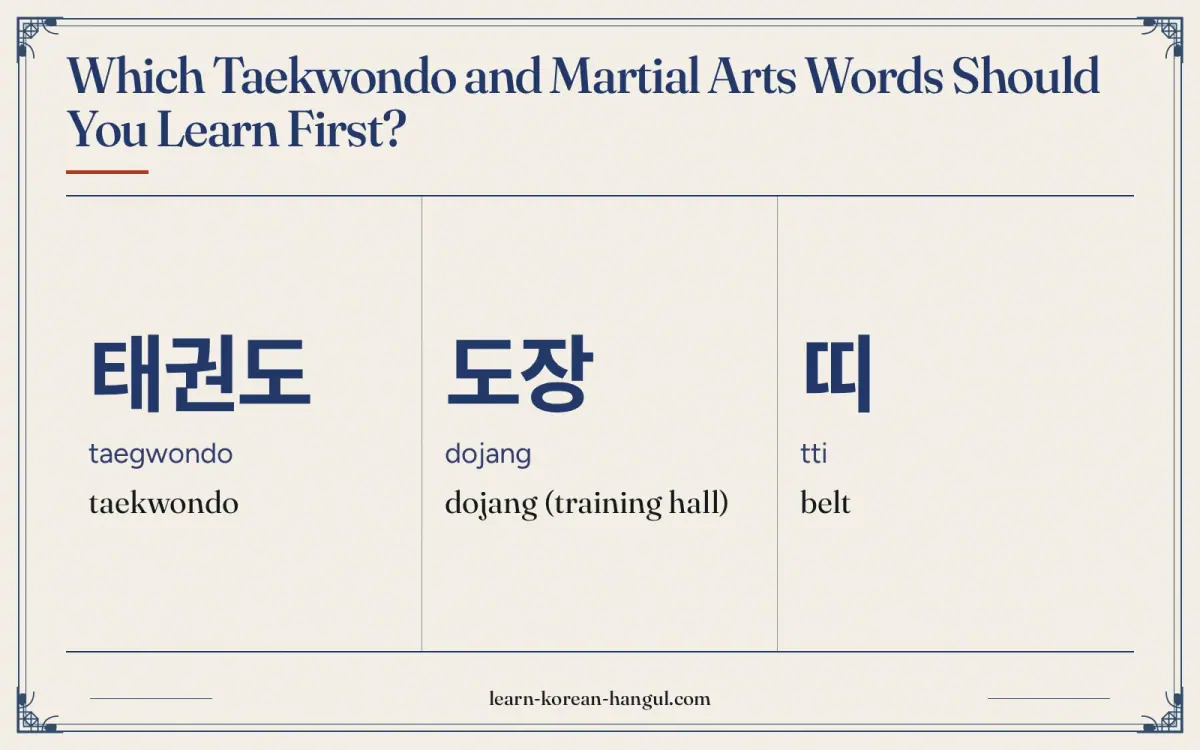
Start with five words: 태권도, 도장, 띠, 차렷 and 경례. They name the art, the hall, the belt and the two commands you hear at every class. Press the slow button, say each word, then listen to the sentence.
The scene below shows twelve of the 35 words. Each number matches a word in the lists that follow.
Word · 12
- 1
태권도
taegwondo
taekwondo
- 2
도장
dojang
dojang (training hall)
- 3
띠
tti
belt
- 4
단
dan
dan (black belt rank)
- 5
사범
sabeom
master, instructor
- 6
앞차기
apchagi
front kick
- 7
주먹
jumeok
fist
- 8
품새
pumsae
poomsae (forms)
- 9
겨루기
gyeorugi
sparring
- 10
도복
dobok
uniform (dobok)
- 11
호구
hogu
chest protector, sparring gear
- 12
격파
gyeokpa
breaking (boards)
Twelve numbered objects match twelve words from the lists. Use the list under the picture if you cannot see the numbers.
Commands
Seven words you hear from the teacher. Commands are short, with no polite ending, because they are shouted to a group. One more command, 바로 (baro), tells students to return to the ready position after a movement.
| No. | Hangul | Revised Romanization | Meaning | Example sentence | Audio assetId |
|---|---|---|---|---|---|
| 1 | 차렷 | charyeot | attention (command) | 사범님이 차렷이라고 말해요. (sabeomnimi charyeosirago malhaeyo. The master says attention.) | au-pg-vocabulary-hobbies-sports-martial-arts-1; example: au-pg-vocabulary-hobbies-sports-martial-arts-101 |
| 2 | 경례 | gyeongnye | bow, salute | 사범님께 경례해요. (sabeomnimkke gyeongnyehaeyo. We bow to the master.) | au-pg-vocabulary-hobbies-sports-martial-arts-2; example: au-pg-vocabulary-hobbies-sports-martial-arts-102 |
| 3 | 준비 | junbi | ready, preparation | 저는 준비됐어요. (jeoneun junbidwaesseoyo. I am ready.) | au-pg-vocabulary-hobbies-sports-martial-arts-3; example: au-pg-vocabulary-hobbies-sports-martial-arts-103 |
| 4 | 시작 | sijak | start | 연습을 시작해요. (yeonseubeul sijakaeyo. We start the practice.) | au-pg-vocabulary-hobbies-sports-martial-arts-4; example: au-pg-vocabulary-hobbies-sports-martial-arts-104 |
| 5 | 그만 | geuman | stop (command) | 이제 그만해요. (ije geumanhaeyo. Stop now.) | au-pg-vocabulary-hobbies-sports-martial-arts-5; example: au-pg-vocabulary-hobbies-sports-martial-arts-105 |
| 6 | 쉬어 | swieo | at ease | 쉬어는 편하게 서는 구령이에요. (swieoneun pyeonhage seoneun guryeongieyo. At ease is the command to stand comfortably.) | au-pg-vocabulary-hobbies-sports-martial-arts-6; example: au-pg-vocabulary-hobbies-sports-martial-arts-106 |
| 7 | 구령 | guryeong | spoken command, count | 구령에 맞춰요. (guryeonge matchwoyo. We keep time with the command.) | au-pg-vocabulary-hobbies-sports-martial-arts-7; example: au-pg-vocabulary-hobbies-sports-martial-arts-107 |
- 차렷: The standing-straight command. You will see it spelled 차렷 in dictionaries and also heard as 차려. Said cha-ryeot.
- 경례: The bow at the start and end of class. 께 is the respectful form of the particle 에게.
- 준비: The command 준비 tells students to take the ready stance. 준비되다 means to be ready.
- 시작: The command to start. The verb 시작하다 is a regular 하다 verb.
- 그만: Also used when you want a person to stop doing something. The verb 그만하다 means to stop.
- 쉬어: The casual command form of 쉬다 (to rest). 서는 is the present modifier of 서다 (to stand).
- 구령: 구 (mouth) plus 령 (order). 맞추다 means to match or keep pace with.
Example Sentences
Press play and repeat each sentence aloud. Commands are short, and the verbs for a class are 말하다, 경례하다, 시작하다 and 맞추다.
사범님이 차렷이라고 말해요.
sabeomnimi charyeosirago malhaeyo.
The master says attention.
사범님께 경례해요.
sabeomnimkke gyeongnyehaeyo.
We bow to the master.
저는 준비됐어요.
jeoneun junbidwaesseoyo.
I am ready.
연습을 시작해요.
yeonseubeul sijakaeyo.
We start the practice.
Notice that 경례해요 joins the noun 경례 and 하다. Many class words follow this pattern.
Belts and Ranks
Seven words for rank and teaching roles. The belt is native Korean, but the ranks are Sino-Korean.
| No. | Hangul | Revised Romanization | Meaning | Example sentence | Audio assetId |
|---|---|---|---|---|---|
| 8 | 띠 | tti | belt | 띠를 매요. (ttireul maeyo. I tie the belt.) | au-pg-vocabulary-hobbies-sports-martial-arts-8; example: au-pg-vocabulary-hobbies-sports-martial-arts-108 |
| 9 | 단 | dan | dan (black belt rank) | 저는 삼 단이에요. (jeoneun sam danieyo. I am third dan.) | au-pg-vocabulary-hobbies-sports-martial-arts-9; example: au-pg-vocabulary-hobbies-sports-martial-arts-109 |
| 10 | 급 | geup | grade, gup (colour belt rank) | 저는 팔 급이에요. (jeoneun pal geubieyo. I am eighth gup.) | au-pg-vocabulary-hobbies-sports-martial-arts-10; example: au-pg-vocabulary-hobbies-sports-martial-arts-110 |
| 11 | 품 | pum | poom (junior black belt rank) | 어린이는 단 대신 품을 받아요. (eorinineun dan daesin pumeul badayo. Children receive a poom instead of a dan.) | au-pg-vocabulary-hobbies-sports-martial-arts-11; example: au-pg-vocabulary-hobbies-sports-martial-arts-111 |
| 12 | 사범 | sabeom | master, instructor | 사범님은 아주 친절해요. (sabeomnimeun aju chinjeolhaeyo. The master is very kind.) | au-pg-vocabulary-hobbies-sports-martial-arts-12; example: au-pg-vocabulary-hobbies-sports-martial-arts-112 |
| 13 | 관장 | gwanjang | head of the school | 관장님이 도장에 계세요. (gwanjangnimi dojange gyeseyo. The head of the school is at the training hall.) | au-pg-vocabulary-hobbies-sports-martial-arts-13; example: au-pg-vocabulary-hobbies-sports-martial-arts-113 |
| 14 | 수련생 | suryeonsaeng | trainee, student | 수련생이 열 명이에요. (suryeonsaengi yeol myeongieyo. There are ten trainees.) | au-pg-vocabulary-hobbies-sports-martial-arts-14; example: au-pg-vocabulary-hobbies-sports-martial-arts-114 |
- 띠: The native word for a belt. In taekwondo the colours go from white to black. 매다 means to tie.
- 단: Black belt ranks are numbered with Sino-Korean numbers: 일 단, 이 단, 삼 단.
- 급: Colour belt grades count down, so a smaller number is a higher grade.
- 품: A rank for young black belts. 받다 means to receive.
- 사범: Add 님 to address him or her. 친절하다 means kind.
- 관장: 관장 plus 님. The honorific verb 계세요 is used for a respected person.
- 수련생: 수련 (training) plus 생 (student). 열 명 means ten people.
Stances and Strikes
Eight words for kicks, punches and drills. Kick names join a body part to 차기 (kicking), from the verb 차다.
| No. | Hangul | Revised Romanization | Meaning | Example sentence | Audio assetId |
|---|---|---|---|---|---|
| 15 | 앞차기 | apchagi | front kick | 앞차기는 발을 앞으로 차요. (apchagineun bareul apeuro chayo. A front kick is kicking the foot forward.) | au-pg-vocabulary-hobbies-sports-martial-arts-15; example: au-pg-vocabulary-hobbies-sports-martial-arts-115 |
| 16 | 옆차기 | yeopchagi | side kick | 옆차기는 옆으로 차요. (yeopchagineun yeopeuro chayo. A side kick goes to the side.) | au-pg-vocabulary-hobbies-sports-martial-arts-16; example: au-pg-vocabulary-hobbies-sports-martial-arts-116 |
| 17 | 돌려차기 | dollyeochagi | roundhouse kick | 돌려차기는 몸을 돌려요. (dollyeochagineun momeul dollyeoyo. In a roundhouse kick you turn your body.) | au-pg-vocabulary-hobbies-sports-martial-arts-17; example: au-pg-vocabulary-hobbies-sports-martial-arts-117 |
| 18 | 주먹 | jumeok | fist | 주먹을 꽉 쥐어요. (jumeogeul kkwak jwieoyo. I squeeze my fist tight.) | au-pg-vocabulary-hobbies-sports-martial-arts-18; example: au-pg-vocabulary-hobbies-sports-martial-arts-118 |
| 19 | 지르기 | jireugi | punch (thrusting strike) | 지르기는 주먹으로 해요. (jireugineun jumeogeuro haeyo. A punch is done with the fist.) | au-pg-vocabulary-hobbies-sports-martial-arts-19; example: au-pg-vocabulary-hobbies-sports-martial-arts-119 |
| 20 | 막기 | makgi | block | 막기는 상대의 공격을 막아요. (makgineun sangdaeui gonggyeogeul magayo. A block stops the partner's attack.) | au-pg-vocabulary-hobbies-sports-martial-arts-20; example: au-pg-vocabulary-hobbies-sports-martial-arts-120 |
| 21 | 품새 | pumsae | poomsae (forms) | 품새를 연습해요. (pumsaereul yeonseupaeyo. I practise poomsae.) | au-pg-vocabulary-hobbies-sports-martial-arts-21; example: au-pg-vocabulary-hobbies-sports-martial-arts-121 |
| 22 | 겨루기 | gyeorugi | sparring | 오늘은 겨루기를 해요. (oneureun gyeorugireul haeyo. We spar today.) | au-pg-vocabulary-hobbies-sports-martial-arts-22; example: au-pg-vocabulary-hobbies-sports-martial-arts-122 |
- 앞차기: 앞 (front) plus 차기. Said [압차기], because the final ㅍ is said as ㅂ.
- 옆차기: 옆 (side) plus 차기. Said [엽차기].
- 돌려차기: 돌려 (turning) plus 차기. The verb 돌리다 becomes 돌려요 in the polite present.
- 주먹: The native word for the closed hand. 쥐다 means to grip.
- 지르기: From the verb 지르다 (to thrust). 주먹으로 means with the fist.
- 막기: From the verb 막다 (to block), said [막끼]. 상대 means the opponent or partner.
- 품새: A fixed pattern of moves done alone. Taekwondo organisations spell it poomsae in English, and Revised Romanization is pumsae.
- 겨루기: From the verb 겨루다 (to compete). 오늘은 means as for today.
Training Space and Gear
Seven words for the art itself, the place and the equipment.
| No. | Hangul | Revised Romanization | Meaning | Example sentence | Audio assetId |
|---|---|---|---|---|---|
| 23 | 태권도 | taegwondo | taekwondo | 태권도는 한국의 무술이에요. (taegwondoneun hangugui musurieyo. Taekwondo is a Korean martial art.) | au-pg-vocabulary-hobbies-sports-martial-arts-23; example: au-pg-vocabulary-hobbies-sports-martial-arts-123 |
| 24 | 도장 | dojang | dojang (training hall) | 도장에 매일 가요. (dojange maeil gayo. I go to the training hall every day.) | au-pg-vocabulary-hobbies-sports-martial-arts-24; example: au-pg-vocabulary-hobbies-sports-martial-arts-124 |
| 25 | 도복 | dobok | uniform (dobok) | 도복을 입어요. (dobogeul ibeoyo. I put on the uniform.) | au-pg-vocabulary-hobbies-sports-martial-arts-25; example: au-pg-vocabulary-hobbies-sports-martial-arts-125 |
| 26 | 호구 | hogu | chest protector, sparring gear | 호구를 착용해요. (hogureul chagyonghaeyo. I wear the protector.) | au-pg-vocabulary-hobbies-sports-martial-arts-26; example: au-pg-vocabulary-hobbies-sports-martial-arts-126 |
| 27 | 보호대 | bohodae | protective pad | 보호대가 필요해요. (bohodaega piryohaeyo. I need protective pads.) | au-pg-vocabulary-hobbies-sports-martial-arts-27; example: au-pg-vocabulary-hobbies-sports-martial-arts-127 |
| 28 | 격파 | gyeokpa | breaking (boards) | 격파는 송판을 깨요. (gyeokpaneun songpaneul kkaeyo. In breaking, you smash a pine board.) | au-pg-vocabulary-hobbies-sports-martial-arts-28; example: au-pg-vocabulary-hobbies-sports-martial-arts-128 |
| 29 | 대회 | daehoe | tournament, competition | 다음 달에 태권도 대회가 있어요. (daeum dare taegwondo daehoega isseoyo. There is a taekwondo tournament next month.) | au-pg-vocabulary-hobbies-sports-martial-arts-29; example: au-pg-vocabulary-hobbies-sports-martial-arts-129 |
- 태권도: The Korean spelling gives the Revised Romanization taegwondo. 무술 means martial art.
- 도장: The same spelling 도장 also means a name stamp or seal. The sentence shows which one is meant.
- 도복: 도 (way) plus 복 (clothes). 입다 is the verb for wearing clothes.
- 호구: Worn in sparring. The verb 착용하다 means to wear equipment.
- 보호대: 보호 (protection) plus 대 (pad or band). Pads are used for shins, arms and the groin.
- 격파: 송판 is a pine board. 깨다 means to break.
- 대회: The word is used for any contest or event.
Numbers in Taekwondo
Six numbers for counting in class. Students count aloud in native Korean numbers, which are used to count repetitions. The full system is on the native Korean numbers page.
| No. | Hangul | Revised Romanization | Meaning | Example sentence | Audio assetId |
|---|---|---|---|---|---|
| 30 | 하나 | hana | one | 구령은 하나부터 시작해요. (guryeongeun hanabuteo sijakaeyo. The count starts from one.) | au-pg-vocabulary-hobbies-sports-martial-arts-30; example: au-pg-vocabulary-hobbies-sports-martial-arts-130 |
| 31 | 둘 | dul | two | 둘이 겨루기를 해요. (duri gyeorugireul haeyo. Two people spar.) | au-pg-vocabulary-hobbies-sports-martial-arts-31; example: au-pg-vocabulary-hobbies-sports-martial-arts-131 |
| 32 | 셋 | set | three | 셋에 앞차기를 해요. (sese apchagireul haeyo. On three, I do a front kick.) | au-pg-vocabulary-hobbies-sports-martial-arts-32; example: au-pg-vocabulary-hobbies-sports-martial-arts-132 |
| 33 | 넷 | net | four | 넷에 옆차기를 해요. (nese yeopchagireul haeyo. On four, I do a side kick.) | au-pg-vocabulary-hobbies-sports-martial-arts-33; example: au-pg-vocabulary-hobbies-sports-martial-arts-133 |
| 34 | 다섯 | daseot | five | 다섯에 주먹을 질러요. (daseose jumeogeul jilleoyo. On five, I punch.) | au-pg-vocabulary-hobbies-sports-martial-arts-34; example: au-pg-vocabulary-hobbies-sports-martial-arts-134 |
| 35 | 열 | yeol | ten | 열에 끝나요. (yeore kkeunnayo. It ends at ten.) | au-pg-vocabulary-hobbies-sports-martial-arts-35; example: au-pg-vocabulary-hobbies-sports-martial-arts-135 |
- 하나: Native Korean one. Before a counter it becomes 한: 한 번 means once.
- 둘: In 둘이 겨루기를 해요, 둘이 means "the two of them", with the subject particle 이. Before a counter 둘 becomes 두.
- 셋: Native Korean three. Before a counter it becomes 세.
- 넷: Native Korean four. Before a counter it becomes 네.
- 다섯: Native Korean five. 질러요 is the polite present of 지르다.
- 열: Native Korean ten. 끝나다 means to end.
How Do You Pronounce These Words?
Most taekwondo words are easy to read, but a few follow sound rules. The table follows the standard pronunciation rules (표준 발음법) of the 국립국어원 (National Institute of Korean Language).
| Word | Revised Romanization | Said | Rule |
|---|---|---|---|
| 앞차기 | apchagi | [압차기] | the final ㅍ is said as ㅂ before another consonant |
| 옆차기 | yeopchagi | [엽차기] | the final ㅍ is said as ㅂ before another consonant |
| 돌려차기 | dollyeochagi | [돌려차기] | no change; ㄹㄹ is one long l, written dollyeochagi |
| 쉬어 | swieo | [쉬어] | no change; ㅟ and ㅓ are two separate syllables |
| 품새 | pumsae | [품새] | no change; the ㅁ stays, written pumsae |
Revised Romanization writes the sound that the letters change into, as in 앞차기 (apchagi), but it does not show tensing caused by a neighbouring sound: 막기 is written makgi but said [막끼]. Taekwondo organisations spell 품새 as poomsae, which differs from Revised Romanization (pumsae).
Audio and Slow Playback
Each headword and each example sentence has its own audio clip, and the 5 words in the first-words section also have a slow clip at 0.8 times the speed. Nothing plays until you press a button. Listen to 앞차기 and 옆차기 one after the other and hear how the ㅍ at the end of the first syllable is said like ㅂ.
What Mistakes Do Learners Make with Taekwondo and Martial Arts Words?
- Mixing up 단 and 급. A 단 is a black belt rank and counts up, while a 급 is a colour belt grade and counts down.
- Using 띠 for the uniform. The belt is 띠 and the uniform is 도복.
- Reading 도장 only as a stamp. Here it is the training hall, and the same spelling also names a name stamp.
- Saying 앞차기 with a plain ㅍ. The final ㅍ is said as ㅂ: [압차기].
- Using Sino-Korean numbers to count repetitions. Classes count aloud in native Korean numbers: 하나, 둘, 셋.
- Adding the polite 요 to commands. Short commands such as 차렷 and 쉬어 are shouted without it.
Practice: Flashcards and Worksheet
Drill all 35 words with the vocabulary flashcard decks: each card shows the Hangul on one side and the meaning on the other. A printable worksheet for these words (word list, matching, writing practice, fill-in-the-blank exercises and answer key) is available in A4 and US Letter from the download card on this page. A simple plan is to run a class in Korean on your own: give each command, count to ten in native Korean numbers and name each kick.
Practice · 4
- 01사범님이 차렷이라고 말해요.
Show answer
sabeomnimi charyeosirago malhaeyo.
The master says attention.
- 02사범님께 경례해요.
Show answer
sabeomnimkke gyeongnyehaeyo.
We bow to the master.
- 03저는 준비됐어요.
Show answer
jeoneun junbidwaesseoyo.
I am ready.
- 04연습을 시작해요.
Show answer
yeonseubeul sijakaeyo.
We start the practice.
Korean Taekwondo Vocabulary Worksheet (PDF)
Quick Quiz
Choose the best answer. The explanation after each question tells you why.
Practice · 5
Which word means belt?
Show answer
띠
띠 is the belt. 단 is a black belt rank and 도복 is the uniform.
What does 경례 mean?
Show answer
bow
경례 is the bow at the start and end of class.
Which word means front kick?
Show answer
앞차기
앞차기 is a front kick. 옆차기 is a side kick.
Which numbers does a class use to count aloud?
Show answer
native Korean numbers
Classes count aloud in native Korean numbers: 하나, 둘, 셋.
How is 앞차기 pronounced?
Show answer
[압차기]
The final ㅍ is said as ㅂ before another consonant.
Write two sentences of your own, one about your rank and one about what you practise. For example, 저는 팔 급이에요 or 품새를 연습해요.
Where to Go Next
This taekwondo list sits inside Sports. For other sport word lists, see sports positions and teams and gym and fitness. For the single-word lesson, see taekwondo in korean.
FAQ
How Do You Say Taekwondo in Korean?
Say 태권도 (taegwondo). The three syllables mean foot (태), fist (권) and way (도). To say you learn it, use 태권도를 배워요 (I learn taekwondo). The school where you practise is a 도장.
How Do You Pronounce 도장 (dojang)?
Say do-jang in two syllables. The ㄷ is a soft d, the ㅗ is rounded, and the ㅇ at the end of the second syllable is the ng sound. Revised Romanization writes it dojang. The same spelling also names a name stamp.
How Many Taekwondo and Martial Arts Words Should I Learn First?
Learn the five words in the first-words section: 태권도, 도장, 띠, 차렷 and 경례. Then add the numbers 하나 to 열, which you hear in every class.
Where Can I Practise Taekwondo and Martial Arts Words with Flashcards?
Use the vocabulary flashcard decks. Start with the commands and the belt words, then add the kicks.
Is the Romanization on This Page Official?
It follows the Revised Romanization of Korean, the system South Korea has officially used since 2000, as a learning aid. It does not show tensing caused by a neighbouring sound. Taekwondo bodies use their own English spellings, such as poomsae for 품새. Always read the Hangul as well.
Is There a Printable Worksheet for Taekwondo and Martial Arts Words?
A printable worksheet for these words (word list, matching, writing practice, fill-in-the-blank exercises and answer key) is available in A4 and US Letter from the download card on this page. For additional practice, write the Korean name next to each numbered object in the scene above.