What you'll learn
- Match all 35 position and team words to their English meanings.
- Spot the 수 ending that marks a position, and the loanwords that do not have it.
- Say five of the words aloud with the help of the Revised Romanization and the audio.
- Write two original sentences with words such as 골키퍼 and 수비수.
Prerequisites: you can read Hangul, know the sports words in Sports and recognise the polite ending -아요/-어요. Estimated time: about 60 minutes, plus short reviews on the following days.
Korean Sports Positions Vocabulary at a Glance
Position names show how Korean borrows from two directions. Baseball positions are mostly Sino-Korean and end in 수 (手, hand or person): 투수 (pitcher), 포수 (catcher), 유격수 (shortstop). Soccer and basketball positions are mostly loanwords from English: 골키퍼, 미드필더, 센터 and 가드. The two groups follow the way each sport entered Korea.
The page also covers team roles such as 감독 (coach), 주장 (captain) and 심판 (referee), and the match terms 전반, 후반 and 연장전 (first half, second half and extra time). It sits inside Sports, next to gym and fitness and taekwondo and martial arts.
| Group | Words | Examples |
|---|---|---|
| Soccer positions | 7 | 골키퍼, 수비수, 미드필더, 공격수 |
| Baseball positions | 8 | 투수, 포수, 타자, 내야수 |
| Basketball and volleyball | 7 | 센터, 가드, 포워드, 슛 |
| Team roles | 7 | 감독, 코치, 주장, 후보 |
| Match terms | 6 | 전반, 후반, 연장전, 승부차기 |
By origin, the list has 19 Sino-Korean words, 14 loanwords, and 2 mixed words (골대: the loanword 골 plus the Sino-Korean 대; 승부차기: the Sino-Korean 승부 plus the native 차기).
Which Sports Position Words Should You Learn First?
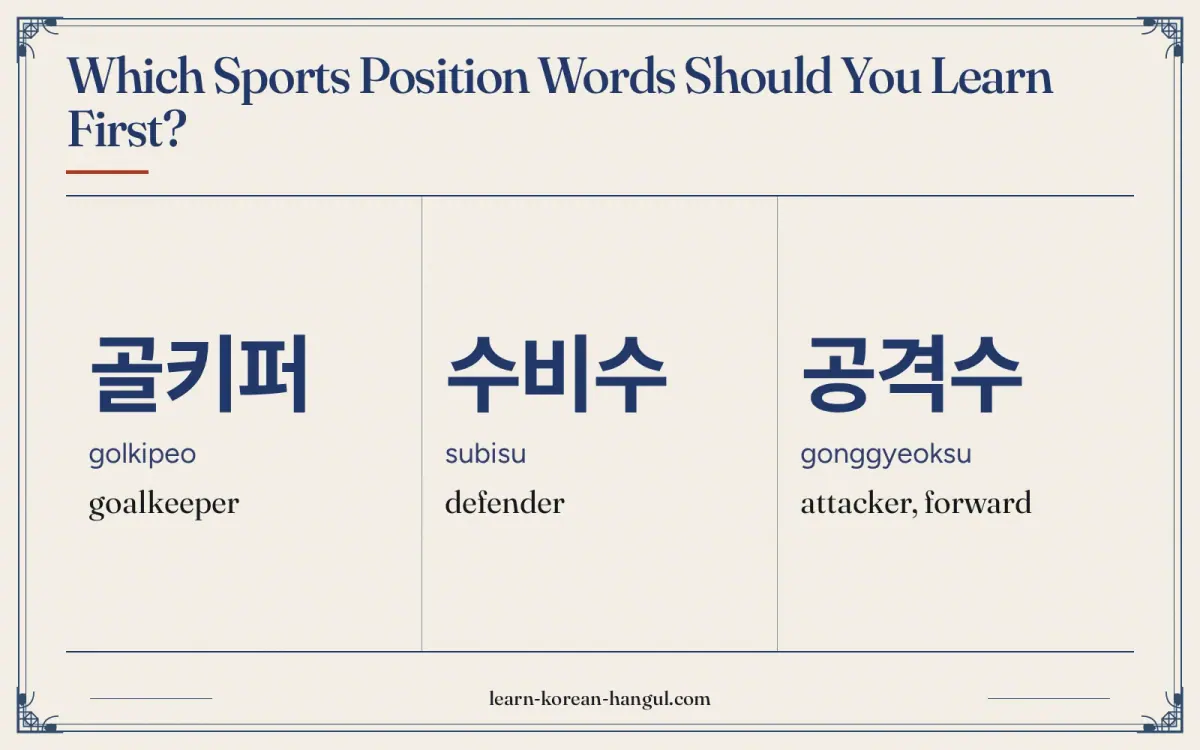
Start with five words: 골키퍼, 수비수, 투수, 감독 and 전반. They give you one soccer position, one defender word, one baseball position, one team role and one match term. Press the slow button, say each word, then listen to the sentence.
The scene below shows twelve of the 35 words. Each number matches a word in the lists that follow.
Word · 12
- 1
골키퍼
golkipeo
goalkeeper
- 2
수비수
subisu
defender
- 3
공격수
gonggyeoksu
attacker, forward
- 4
투수
tusu
pitcher
- 5
포수
posu
catcher
- 6
타자
taja
batter
- 7
마운드
maundeu
pitcher's mound
- 8
센터
senteo
centre (basketball)
- 9
가드
gadeu
guard
- 10
감독
gamdok
coach, manager
- 11
주장
jujang
captain
- 12
심판
simpan
referee, umpire
Twelve numbered objects match twelve words from the lists. Use the list under the picture if you cannot see the numbers.
Soccer Positions
Seven words for soccer. The 수 ending in 수비수 and 공격수 means a person who does the job, and the loanwords have no such ending.
| No. | Hangul | Revised Romanization | Meaning | Example sentence | Audio assetId |
|---|---|---|---|---|---|
| 1 | 골키퍼 | golkipeo | goalkeeper | 골키퍼가 공을 잡아요. (golkipeoga gongeul jabayo. The goalkeeper catches the ball.) | au-pg-vocabulary-hobbies-sports-positions-1; example: au-pg-vocabulary-hobbies-sports-positions-101 |
| 2 | 수비수 | subisu | defender | 수비수가 공을 막아요. (subisuga gongeul magayo. The defender blocks the ball.) | au-pg-vocabulary-hobbies-sports-positions-2; example: au-pg-vocabulary-hobbies-sports-positions-102 |
| 3 | 미드필더 | mideupildeo | midfielder | 미드필더가 공격수에게 공을 줘요. (mideupildeoga gonggyeoksuege gongeul jwoyo. The midfielder gives the ball to the attacker.) | au-pg-vocabulary-hobbies-sports-positions-3; example: au-pg-vocabulary-hobbies-sports-positions-103 |
| 4 | 공격수 | gonggyeoksu | attacker, forward | 공격수가 골을 넣어요. (gonggyeoksuga goreul neoeoyo. The attacker scores a goal.) | au-pg-vocabulary-hobbies-sports-positions-4; example: au-pg-vocabulary-hobbies-sports-positions-104 |
| 5 | 스트라이커 | seuteuraikeo | striker | 우리 팀 스트라이커는 정말 빨라요. (uri tim seuteuraikeoneun jeongmal ppallayo. Our team's striker is really fast.) | au-pg-vocabulary-hobbies-sports-positions-5; example: au-pg-vocabulary-hobbies-sports-positions-105 |
| 6 | 센터백 | senteobaek | centre-back | 센터백은 키가 커요. (senteobaegeun kiga keoyo. The centre-back is tall.) | au-pg-vocabulary-hobbies-sports-positions-6; example: au-pg-vocabulary-hobbies-sports-positions-106 |
| 7 | 골대 | goldae | goalpost | 공이 골대를 맞았어요. (gongi goldaereul majasseoyo. The ball hit the goalpost.) | au-pg-vocabulary-hobbies-sports-positions-7; example: au-pg-vocabulary-hobbies-sports-positions-107 |
- 골키퍼: From English goalkeeper. It is written with the vowel ㅣ in the second syllable. The verb 잡다 means to catch or hold.
- 수비수: 수비 (defence) plus 수 (person). 막다 means to block.
- 미드필더: From English midfielder. 에게 marks the person who receives the ball.
- 공격수: 공격 (attack) plus 수, said [공격쑤]. The phrase 골을 넣다 means to score a goal.
- 스트라이커: A loanword with five syllables: seu-teu-ra-i-keo. 빠르다 changes to 빨라요.
- 센터백: 센터 (centre) plus 백 (back). 키가 크다 means to be tall.
- 골대: 골 plus 대 (post). Said [골때], with a tense ㄷ after the final ㄹ.
Example Sentences
Press play and repeat each sentence aloud. Each position name is followed by the verb that fits its job.
골키퍼가 공을 잡아요.
golkipeoga gongeul jabayo.
The goalkeeper catches the ball.
수비수가 공을 막아요.
subisuga gongeul magayo.
The defender blocks the ball.
공격수가 골을 넣어요.
gonggyeoksuga goreul neoeoyo.
The attacker scores a goal.
우리 팀 스트라이커는 정말 빨라요.
uri tim seuteuraikeoneun jeongmal ppallayo.
Our team's striker is really fast.
The particle 가 or 이 marks the player as the subject, and 을 or 를 marks the ball or the goal as the object. The next group moves to baseball.
Baseball Positions
Eight words for baseball. The three field zones are 내야 (infield), 외야 (outfield) and 마운드 (the pitcher's mound).
| No. | Hangul | Revised Romanization | Meaning | Example sentence | Audio assetId |
|---|---|---|---|---|---|
| 8 | 투수 | tusu | pitcher | 투수가 공을 던져요. (tusuga gongeul deonjyeoyo. The pitcher throws the ball.) | au-pg-vocabulary-hobbies-sports-positions-8; example: au-pg-vocabulary-hobbies-sports-positions-108 |
| 9 | 포수 | posu | catcher | 포수는 투수 뒤에 앉아요. (posuneun tusu dwie anjayo. The catcher sits behind the pitcher.) | au-pg-vocabulary-hobbies-sports-positions-9; example: au-pg-vocabulary-hobbies-sports-positions-109 |
| 10 | 타자 | taja | batter | 타자가 공을 쳐요. (tajaga gongeul chyeoyo. The batter hits the ball.) | au-pg-vocabulary-hobbies-sports-positions-10; example: au-pg-vocabulary-hobbies-sports-positions-110 |
| 11 | 내야수 | naeyasu | infielder | 내야수는 내야에 서요. (naeyasuneun naeyae seoyo. The infielder stands in the infield.) | au-pg-vocabulary-hobbies-sports-positions-11; example: au-pg-vocabulary-hobbies-sports-positions-111 |
| 12 | 외야수 | oeyasu | outfielder | 외야수는 공을 멀리 던져요. (oeyasuneun gongeul meolli deonjyeoyo. The outfielder throws the ball far.) | au-pg-vocabulary-hobbies-sports-positions-12; example: au-pg-vocabulary-hobbies-sports-positions-112 |
| 13 | 유격수 | yugyeoksu | shortstop | 유격수는 수비를 잘해요. (yugyeoksuneun subireul jalhaeyo. The shortstop is good at defence.) | au-pg-vocabulary-hobbies-sports-positions-13; example: au-pg-vocabulary-hobbies-sports-positions-113 |
| 14 | 일루수 | illusu | first baseman | 일루수가 공을 받아요. (illusuga gongeul badayo. The first baseman catches the ball.) | au-pg-vocabulary-hobbies-sports-positions-14; example: au-pg-vocabulary-hobbies-sports-positions-114 |
| 15 | 마운드 | maundeu | pitcher's mound | 투수가 마운드에 올라가요. (tusuga maundeue ollagayo. The pitcher goes up to the mound.) | au-pg-vocabulary-hobbies-sports-positions-15; example: au-pg-vocabulary-hobbies-sports-positions-115 |
- 투수: 투 (throw) plus 수 (person). The verb 던지다 means to throw.
- 포수: 포 (catch) plus 수. Written with ㅍ, not ㅂ.
- 타자: 타 (hit) plus 자 (person). The verb 치다 means to hit.
- 내야수: 내야 (infield) plus 수. 서다 means to stand.
- 외야수: 외야 (outfield) plus 수. Spelled with ㅚ in the first syllable.
- 유격수: The word means a roving fielder between second and third base. Spelled yu-gyeok-su and said [유격쑤].
- 일루수: Also written 1루수 with a numeral. Said il-lu-su, with a long l. The other basemen follow the same numbered pattern: 2루수 (irusu, second baseman) and 3루수 (samnusu, third baseman).
- 마운드: From English mound. 올라가다 means to go up.
Basketball and Volleyball
Seven words for two indoor sports. All of them are English loanwords.
| No. | Hangul | Revised Romanization | Meaning | Example sentence | Audio assetId |
|---|---|---|---|---|---|
| 16 | 센터 | senteo | centre (basketball) | 센터는 골대 가까이에서 뛰어요. (senteoneun goldae gakkaieseo ttwieoyo. The centre plays close to the basket.) | au-pg-vocabulary-hobbies-sports-positions-16; example: au-pg-vocabulary-hobbies-sports-positions-116 |
| 17 | 가드 | gadeu | guard | 가드가 공을 드리블해요. (gadeuga gongeul deuribeulhaeyo. The guard dribbles the ball.) | au-pg-vocabulary-hobbies-sports-positions-17; example: au-pg-vocabulary-hobbies-sports-positions-117 |
| 18 | 포워드 | powodeu | forward | 포워드가 점수를 많이 내요. (powodeuga jeomsureul mani naeyo. The forward scores many points.) | au-pg-vocabulary-hobbies-sports-positions-18; example: au-pg-vocabulary-hobbies-sports-positions-118 |
| 19 | 슛 | syut | shot | 그 선수는 슛이 정확해요. (geu seonsuneun syusi jeonghwakaeyo. That player's shot is accurate.) | au-pg-vocabulary-hobbies-sports-positions-19; example: au-pg-vocabulary-hobbies-sports-positions-119 |
| 20 | 리바운드 | ribaundeu | rebound | 리바운드를 잡아요. (ribaundeureul jabayo. I grab the rebound.) | au-pg-vocabulary-hobbies-sports-positions-20; example: au-pg-vocabulary-hobbies-sports-positions-120 |
| 21 | 세터 | seteo | setter (volleyball) | 세터가 공을 올려요. (seteoga gongeul ollyeoyo. The setter lifts the ball.) | au-pg-vocabulary-hobbies-sports-positions-21; example: au-pg-vocabulary-hobbies-sports-positions-121 |
| 22 | 리베로 | ribero | libero (volleyball) | 리베로는 다른 색 옷을 입어요. (riberoneun dareun saek oseul ibeoyo. The libero wears a different colour of uniform.) | au-pg-vocabulary-hobbies-sports-positions-22; example: au-pg-vocabulary-hobbies-sports-positions-122 |
- 센터: The tallest player usually plays here. Same word as the soccer centre in 센터백.
- 가드: The player who brings the ball up the court. 드리블하다 means to dribble.
- 포워드: Three syllables: po-wo-deu.
- 슛: Said [슏], because the final ㅅ is said as ㄷ. A shot at goal is 슛 in soccer as well.
- 리바운드: Four syllables: ri-ba-un-deu. In basketball you 잡다 (catch) a rebound.
- 세터: The setter passes to the attacker. 올리다 means to raise.
- 리베로: A defensive specialist who wears a different colour from the team. 입다 means to wear.
Team Roles
Seven words for the people around a game. Several are Sino-Korean, and the suffix 님 makes a title polite.
| No. | Hangul | Revised Romanization | Meaning | Example sentence | Audio assetId |
|---|---|---|---|---|---|
| 23 | 감독 | gamdok | coach, manager | 감독님이 작전을 말해요. (gamdongnimi jakjeoneul malhaeyo. The coach tells the players the tactics.) | au-pg-vocabulary-hobbies-sports-positions-23; example: au-pg-vocabulary-hobbies-sports-positions-123 |
| 24 | 코치 | kochi | coach (assistant) | 코치가 선수를 가르쳐요. (kochiga seonsureul gareuchyeoyo. The coach teaches the players.) | au-pg-vocabulary-hobbies-sports-positions-24; example: au-pg-vocabulary-hobbies-sports-positions-124 |
| 25 | 주장 | jujang | captain | 주장이 팀을 이끌어요. (jujangi timeul ikkeureoyo. The captain leads the team.) | au-pg-vocabulary-hobbies-sports-positions-25; example: au-pg-vocabulary-hobbies-sports-positions-125 |
| 26 | 후보 | hubo | substitute, candidate | 후보 선수가 벤치에 앉아요. (hubo seonsuga benchie anjayo. The substitute player sits on the bench.) | au-pg-vocabulary-hobbies-sports-positions-26; example: au-pg-vocabulary-hobbies-sports-positions-126 |
| 27 | 신인 | sinin | rookie, newcomer | 신인 선수가 처음 경기를 뛰어요. (sinin seonsuga cheoeum gyeonggireul ttwieoyo. The rookie plays in a match for the first time.) | au-pg-vocabulary-hobbies-sports-positions-27; example: au-pg-vocabulary-hobbies-sports-positions-127 |
| 28 | 심판 | simpan | referee, umpire | 심판이 호루라기를 불어요. (simpani horuragireul bureoyo. The referee blows the whistle.) | au-pg-vocabulary-hobbies-sports-positions-28; example: au-pg-vocabulary-hobbies-sports-positions-128 |
| 29 | 팬 | paen | fan | 팬들이 경기장에 와요. (paendeuri gyeonggijange wayo. The fans come to the stadium.) | au-pg-vocabulary-hobbies-sports-positions-29; example: au-pg-vocabulary-hobbies-sports-positions-129 |
- 감독: In team sports the head coach. Add 님 to address him. 작전 means tactics.
- 코치: Used for the coaches under the 감독. 가르치다 means to teach.
- 주장: The team captain. 이끌다 means to lead, and 이끌어요 is the polite present.
- 후보: The same word is used for a candidate in an election. 후보 선수 is a reserve.
- 신인: 신 (new) plus 인 (person). Said [시닌].
- 심판: Blow a whistle is 호루라기를 불다.
- 팬: Add 들 to make it plural. 경기장 is the stadium.
How Do You Count Players on a Team?
Korean counts people with the counter 명 and the native Korean numbers. A full team is a different number in each sport, as the table shows. The numbers follow the native Korean pattern: the number changes its form before 명, so 하나 becomes 한 and 열하나 becomes 열한.
| Sport | Players on the field | Korean |
|---|---|---|
| 야구 | 9 | 아홉 명 |
| 축구 | 11 | 열한 명 |
| 농구 | 5 | 다섯 명 |
| 배구 | 6 | 여섯 명 |
To say how many players a team has, use the pattern 선수가 열한 명이에요. For the full counter system, see counters for things and native Korean numbers.
Match Terms
Six words used when reading or listening to a match report.
| No. | Hangul | Revised Romanization | Meaning | Example sentence | Audio assetId |
|---|---|---|---|---|---|
| 30 | 전반 | jeonban | first half | 전반에 한 골을 넣었어요. (jeonbane han goreul neoeosseoyo. We scored one goal in the first half.) | au-pg-vocabulary-hobbies-sports-positions-30; example: au-pg-vocabulary-hobbies-sports-positions-130 |
| 31 | 후반 | huban | second half | 후반에 두 골이 나왔어요. (hubane du gori nawasseoyo. Two goals were scored in the second half.) | au-pg-vocabulary-hobbies-sports-positions-31; example: au-pg-vocabulary-hobbies-sports-positions-131 |
| 32 | 연장전 | yeonjangjeon | extra time | 경기는 연장전까지 갔어요. (gyeonggineun yeonjangjeonkkaji gasseoyo. The match went to extra time.) | au-pg-vocabulary-hobbies-sports-positions-32; example: au-pg-vocabulary-hobbies-sports-positions-132 |
| 33 | 승부차기 | seungbuchagi | penalty shootout | 승부차기로 이겼어요. (seungbuchagiro igyeosseoyo. We won on penalties.) | au-pg-vocabulary-hobbies-sports-positions-33; example: au-pg-vocabulary-hobbies-sports-positions-133 |
| 34 | 무승부 | museungbu | draw (tied match) | 경기는 무승부로 끝났어요. (gyeonggineun museungburo kkeunnasseoyo. The match ended in a draw.) | au-pg-vocabulary-hobbies-sports-positions-34; example: au-pg-vocabulary-hobbies-sports-positions-134 |
| 35 | 반칙 | banchik | foul | 그 선수가 반칙을 했어요. (geu seonsuga banchigeul haesseoyo. That player committed a foul.) | au-pg-vocabulary-hobbies-sports-positions-35; example: au-pg-vocabulary-hobbies-sports-positions-135 |
- 전반: 전 (before) plus 반 (half). The opposite is 후반.
- 후반: 후 (after) plus 반 (half). 나오다 means to come out or occur.
- 연장전: 연장 (extension) plus 전 (match). 가다 shows the match reaching a stage.
- 승부차기: 승부 (win or lose) plus 차기 (kicking). The verb 차다 means to kick.
- 무승부: 무 (no) plus 승부 (win or lose). 끝나다 means to end.
- 반칙: The verb is 반칙을 하다, to commit a foul.
How Do You Pronounce These Words?
Most position words are easy loanwords, but a few Korean words follow sound rules. The table follows the standard pronunciation rules (표준 발음법) of the 국립국어원 (National Institute of Korean Language).
| Word | Revised Romanization | Said | Rule |
|---|---|---|---|
| 골대 | goldae | [골때] | ㄷ after a final ㄹ becomes tense |
| 슛 | syut | [슏] | the final ㅅ is said as ㄷ |
| 신인 | sinin | [시닌] | the final ㄴ moves onto the empty ㅇ of the next syllable |
| 일루수 | illusu | [일루수] | no change; ㄹㄹ is one long l, written illusu |
| 외야수 | oeyasu | [외야수] | no change; Revised Romanization writes ㅚ as oe |
Revised Romanization follows the spoken sound when a consonant moves or changes, as in 신인 (sinin), but it does not show tensing caused by a neighbouring sound: 골대 is written goldae even though it is said [골때]. The final ㅅ of 슛 is written t, so the word is syut.
Audio and Slow Playback
Each headword and each example sentence has its own audio clip, and the 5 words in the first-words section also have a slow clip at 0.8 times the speed. Nothing plays until you press a button. Listen to 슛 and 신인 one after the other and hear how the final consonant of each word behaves.
What Mistakes Do Learners Make with Sports Position Words?
- Dropping the 수 in 투수 and saying only 투. The position name needs the ending: 투수.
- Mixing up 수비수 (defender) and 공격수 (attacker). Both end in 수, and 수비 is defence, 공격 is attack.
- Reading 슛 as two syllables, syu-seu, with an extra vowel. The word is one syllable, said [슏], with no sound after the final t.
- Reading 공격수 as the person who handles the ball (공). The 공 in 공격 belongs to a different word meaning attack.
- Using 팀장 for a team captain. In sports, the captain is 주장.
- Forgetting the tense sound in 골대 [골때].
Practice: Flashcards and Worksheet
Drill all 35 words with the vocabulary flashcard decks: each card shows the Hangul on one side and the meaning on the other. A printable worksheet for these words (word list, matching, writing practice, fill-in-the-blank exercises and answer key) is available in A4 and US Letter from the download card on this page. A simple plan is to watch a match with Korean commentary and listen for 투수, 타자, 골키퍼 and 공격수.
Practice · 4
- 01골키퍼가 공을 잡아요.
Show answer
golkipeoga gongeul jabayo.
The goalkeeper catches the ball.
- 02수비수가 공을 막아요.
Show answer
subisuga gongeul magayo.
The defender blocks the ball.
- 03공격수가 골을 넣어요.
Show answer
gonggyeoksuga goreul neoeoyo.
The attacker scores a goal.
- 04우리 팀 스트라이커는 정말 빨라요.
Show answer
uri tim seuteuraikeoneun jeongmal ppallayo.
Our team's striker is really fast.
Korean Sports Positions Vocabulary Worksheet (PDF)
Quick Quiz
Choose the best answer. The explanation after each question tells you why.
Practice · 5
Which word means goalkeeper?
Show answer
골키퍼
골키퍼 is the goalkeeper. 수비수 is a defender and 공격수 is an attacker.
What does the ending 수 mean in 투수?
Show answer
person (who does the job)
수 marks the person who does the job: a throwing person, a pitcher.
Which word means the pitcher's mound?
Show answer
마운드
마운드 is the mound. 타자 is a batter and 포수 is a catcher.
Which word means first half?
Show answer
전반
전반 is the first half. 후반 is the second half.
How is 골대 pronounced?
Show answer
[골때]
ㄷ after a final ㄹ becomes tense.
Write two sentences of your own, one about a position in your favourite sport and one about the coach. For example, 저는 골키퍼예요 or 감독님이 선수를 가르쳐요.
Where to Go Next
This positions list sits inside Sports. Continue with Korean gym and fitness vocabulary or Korean taekwondo and martial arts vocabulary. To count players, see the counters for things page.
FAQ
How Do You Say Goalkeeper in Korean?
Say 골키퍼 (golkipeo). It is the English word written in Hangul. A goalkeeper catches (잡다) the ball, so 골키퍼가 공을 잡아요 means the goalkeeper catches the ball.
How Do You Pronounce 수비수 (subisu)?
Say su-bi-su in three even syllables. All three vowels are short, and the ㅂ in the middle is a soft b. Revised Romanization writes it subisu.
How Many Sports Position Words Should I Learn First?
Learn the five words in the first-words section: 골키퍼, 수비수, 투수, 감독 and 전반. Then add one group a day and review the older words before new ones.
Where Can I Practise Sports Position Words with Flashcards?
Use the vocabulary flashcard decks. Start with the sport you know best, then add team roles and match terms.
Is the Romanization on This Page Official?
It follows the Revised Romanization of Korean, the system South Korea has officially used since 2000, as a learning aid. It does not show tensing caused by a neighbouring sound, so 골대 is written goldae but said [골때]. Always read the Hangul as well.
Is There a Printable Worksheet for Sports Position Words?
A printable worksheet for these words (word list, matching, writing practice, fill-in-the-blank exercises and answer key) is available in A4 and US Letter from the download card on this page. For additional practice, write the Korean position next to each numbered object in the scene above.