Key facts
- Korean has two words for crane: 두루미 is the everyday word, and 학 is the literary one.
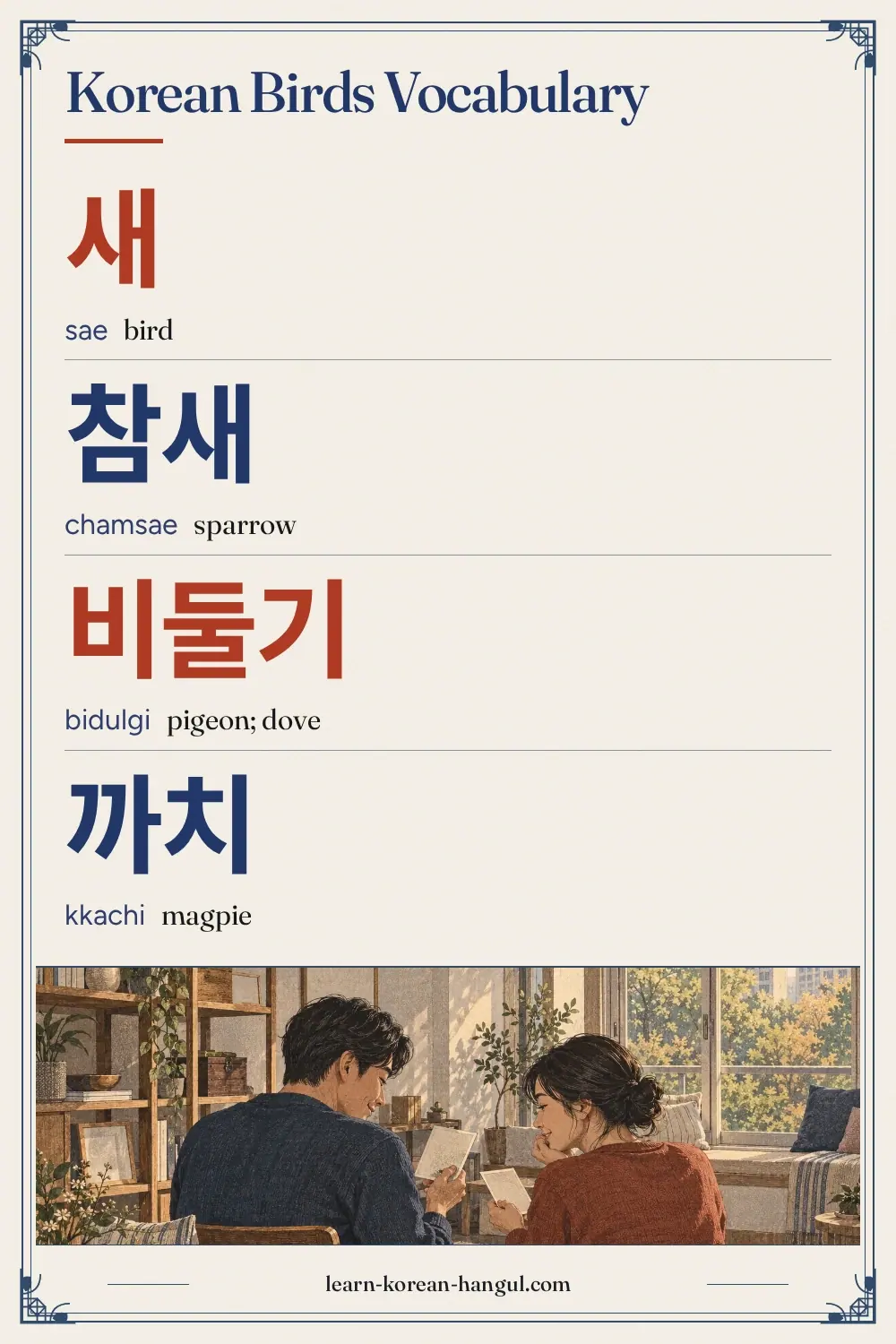
Korean Birds Vocabulary at a Glance
Birds appear in Korean daily life more than the word list might suggest. A 까치 is a familiar bird in songs and picture books, a 제비 returning in spring is a story from a folk tale, and a 닭 is both a farm animal and the base of a popular fried food. This list starts with the birds you see in a park, moves to the birds Koreans talk about in stories and sayings, covers poultry, names the parts of a bird and ends with the sounds birds make. It sits in Animals. Birds that live in the home are on the Korean Pets Vocabulary page.
| Group | Words | Use |
|---|---|---|
| Common birds | 6 | Birds in a park, on a roof or in the sky |
| Birds in culture | 5 | Birds from folk tales, proverbs and paintings |
| Poultry | 5 | Farm birds and what they are called |
| Bird body parts | 5 | Wings, beaks and nests |
| Bird sounds | 4 | How each bird is written in sound |
Which Bird Names Should You Learn First?
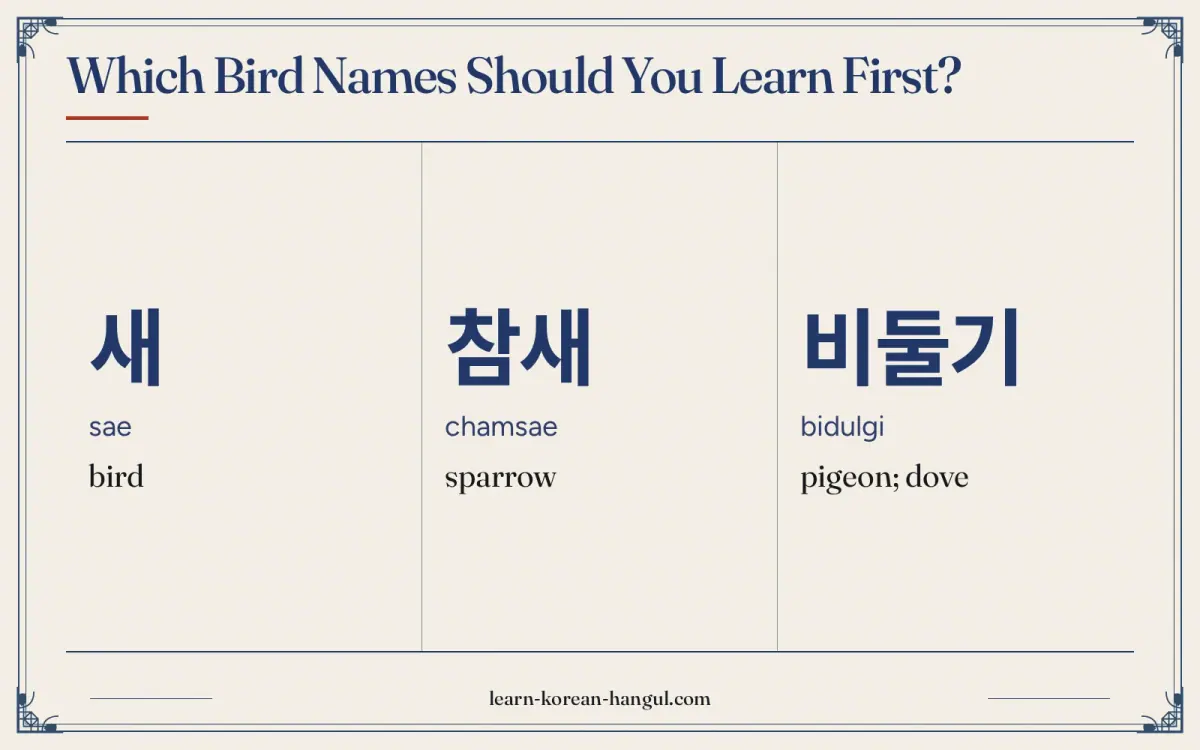
Learn 새, 참새, 비둘기, 까치 and 닭 first. They are the birds you will see and hear most often, and 새 works as a safe general word when you do not know the species. Add 독수리 and 부엉이 when you want to talk about nature programmes, and the poultry words when you read a menu.
- Words to say. 새, 참새, 비둘기, 까치, 닭, 오리.
- Words to recognise. 두루미, 학, 제비, 기러기. They appear in stories, proverbs, paintings and poems.
- Words to match. 날개, 부리, 깃털, 둥지. Match them to the picture of a bird, and the body-part words stay in your head.
One trap to know early: 새 also means new, as in 새 옷 (new clothes). The two are spelled the same and are told apart by context. The scene below shows a tree, a roof and a pond with numbered birds and bird parts that match the list.
Word · 10
- 1
새
sae
bird
- 2
참새
chamsae
sparrow
- 3
비둘기
bidulgi
pigeon; dove
- 4
까치
kkachi
magpie
- 5
두루미
durumi
crane
- 6
닭
dak
chicken; hen
- 7
오리
ori
duck
- 8
날개
nalgae
wing
- 9
부리
buri
beak
- 10
깃털
gitteol
feather
Common Birds
Start with 새, the general word for bird. 참새 is the sparrow, the small brown bird on rooftops, and 비둘기 is the pigeon you see in city squares. 까마귀 is the crow, and 독수리 is the large bird of prey that Koreans call an eagle in everyday speech. 부엉이 is the owl. Most of these words are native Korean words with no Chinese or English origin, so they are short and easy to say.
| No. | Hangul | Revised Romanization | Meaning and note | Example sentence | Audio assetId |
|---|---|---|---|---|---|
| 1 | 새 | sae | bird. The general word. It is also the word for new, so use the sentence to tell them apart. | 새가 날아요. (The bird flies.) | au-pg-vocabulary-nature-animals-birds-1; example: au-pg-vocabulary-nature-animals-birds-26 |
| 2 | 참새 | chamsae | sparrow. 참 means true or genuine, so this is the typical small bird. Often seen on roofs and fences. | 참새가 지붕에 앉아요. (A sparrow sits on the roof.) | au-pg-vocabulary-nature-animals-birds-2; example: au-pg-vocabulary-nature-animals-birds-27 |
| 3 | 비둘기 | bidulgi | pigeon; dove. One word covers both the city pigeon and the dove of peace. | 공원에 비둘기가 많아요. (There are many pigeons in the park.) | au-pg-vocabulary-nature-animals-birds-3; example: au-pg-vocabulary-nature-animals-birds-28 |
| 4 | 까마귀 | kkamagwi | crow. Its call is written 까악까악. In some folk beliefs the crow is a bad sign, the opposite of the magpie. | 까마귀가 나무에 있어요. (The crow is in the tree.) | au-pg-vocabulary-nature-animals-birds-4; example: au-pg-vocabulary-nature-animals-birds-29 |
| 5 | 독수리 | doksuri | eagle. Said [독쑤리]. In everyday speech it is the eagle. Strictly it names a large vulture seen in winter, and 수리 is the general word for eagles. | 독수리가 높이 날아요. (The eagle flies high.) | au-pg-vocabulary-nature-animals-birds-5; example: au-pg-vocabulary-nature-animals-birds-30 |
| 6 | 부엉이 | bueongi | owl. Often seen in children's picture books. 올빼미 is another owl word. | 밤에 부엉이가 울어요. (At night the owl hoots.) | au-pg-vocabulary-nature-animals-birds-6; example: au-pg-vocabulary-nature-animals-birds-31 |
Example Sentences
Bird sentences use three simple frames. The first is bird + 가 + verb, as in 새가 날아요 (the bird flies). The second is place + 에 + bird + 가 + 있어요 / 많아요, as in 공원에 비둘기가 많아요 (there are many pigeons in the park). The third is time + bird + 가 + 울어요, as in 밤에 부엉이가 울어요. The verb 울다 means to cry, and it also covers the calls of birds and insects, which is why the call of a bird is described as crying rather than singing. 노래하다 (to sing a song) also appears in poems about birds, but 울다 is the plain, everyday choice. Read each sentence aloud after its audio, and keep 가 light and quick.
The next group holds the birds that Koreans know from stories rather than from the park.
How Do You Say Birds in Culture in Korean?
These five birds carry a meaning beyond the animal. 까치, the magpie, appears in songs and picture books, and the example below describes its morning call. 제비, the swallow, is the bird in the folk tale of Heungbu, the kind brother whose swallow brought him a gift after he mended its broken leg. 두루미 and 학 are both cranes and stand for long life in traditional paintings. 기러기 is the wild goose, a bird of autumn that flies in a line.
| No. | Hangul | Revised Romanization | Meaning and note | Example sentence | Audio assetId |
|---|---|---|---|---|---|
| 7 | 까치 | kkachi | magpie. A common bird in children's songs and picture books. | 아침에 까치가 울어요. (In the morning a magpie calls.) | au-pg-vocabulary-nature-animals-birds-7; example: au-pg-vocabulary-nature-animals-birds-32 |
| 8 | 두루미 | durumi | crane. The everyday word for crane. Cranes are tall, white and stand on one leg. | 두루미가 한 발로 서 있어요. (The crane stands on one leg.) | au-pg-vocabulary-nature-animals-birds-8; example: au-pg-vocabulary-nature-animals-birds-33 |
| 9 | 학 | hak | crane (literary). A Sino-Korean word used in art and writing. Said [학]; with 이 it is [하기]. A symbol of long life. | 그림에 학이 있어요. (There is a crane in the picture.) | au-pg-vocabulary-nature-animals-birds-9; example: au-pg-vocabulary-nature-animals-birds-34 |
| 10 | 제비 | jebi | swallow. A spring bird, tied to the tale of Heungbu and Nolbu. Swallows nest under eaves. | 봄에 제비가 와요. (In spring the swallows come.) | au-pg-vocabulary-nature-animals-birds-10; example: au-pg-vocabulary-nature-animals-birds-35 |
| 11 | 기러기 | gireogi | wild goose. Flies south in autumn. 기러기 아빠 is a father who stays in Korea while his family lives abroad for school. | 기러기가 줄을 지어 날아요. (The wild geese fly in a line.) | au-pg-vocabulary-nature-animals-birds-11; example: au-pg-vocabulary-nature-animals-birds-36 |
두루미 and 학 are interchangeable only in part. In a nature programme the bird is a 두루미, and in a poem, a painting or a name the same bird is often a 학. Use 두루미 in speech unless you are reading or quoting something old.
Poultry
Poultry words come up on farms, in picture books and on menus. 닭 is the chicken and 병아리 is the chick. 오리 is the duck, 거위 is the goose and 칠면조 is the turkey. The same animal word is often used inside food names: 닭고기 is chicken meat, 오리고기 is duck meat, and 치킨 (a loanword) is fried chicken. Keep the animal word and the food word apart when you talk, and this page teaches the animal words.
| No. | Hangul | Revised Romanization | Meaning and note | Example sentence | Audio assetId |
|---|---|---|---|---|---|
| 12 | 닭 | dak | chicken; hen. Said [닥]. With a particle that starts with a vowel, the ㄹ stays and the ㄱ moves over: 닭이 is [달기]. | 마당에 닭이 있어요. (There is a chicken in the yard.) | au-pg-vocabulary-nature-animals-birds-12; example: au-pg-vocabulary-nature-animals-birds-37 |
| 13 | 병아리 | byeongari | chick. A young chicken, often a spring symbol in children's songs and picture books. | 병아리가 귀여워요. (The chick is cute.) | au-pg-vocabulary-nature-animals-birds-13; example: au-pg-vocabulary-nature-animals-birds-38 |
| 14 | 오리 | ori | duck. Two syllables, both open. Ducks are common on ponds and rivers in cities. | 연못에 오리가 있어요. (There is a duck in the pond.) | au-pg-vocabulary-nature-animals-birds-14; example: au-pg-vocabulary-nature-animals-birds-39 |
| 15 | 거위 | geowi | goose. A large farm bird. The 위 is said as one quick syllable. | 거위가 크게 울어요. (The goose honks loudly.) | au-pg-vocabulary-nature-animals-birds-15; example: au-pg-vocabulary-nature-animals-birds-40 |
| 16 | 칠면조 | chilmyeonjo | turkey. Literally seven-faced bird, from the changing colours of its head. Not a daily food in Korea. | 칠면조는 큰 새예요. (A turkey is a big bird.) | au-pg-vocabulary-nature-animals-birds-16; example: au-pg-vocabulary-nature-animals-birds-41 |
Of the five, 닭 and 오리 are the two you will meet most often. Both appear in cooking words, and both have a spoken sound word in the last group.
How Do You Say Bird Body Parts in Korean?
Five words describe the bird itself and its home. 날개 is the wing, from the verb 날다 (to fly). 부리 is the beak and 깃털 is a feather. 둥지 is the nest, and 알 is the egg that a bird or another animal lays. For a chicken egg that you eat, the usual word is 달걀, and the learner-friendly rule is that 알 is the egg in the nest and 달걀 (or the Sino-Korean 계란) is the food.
| No. | Hangul | Revised Romanization | Meaning and note | Example sentence | Audio assetId |
|---|---|---|---|---|---|
| 17 | 날개 | nalgae | wing. Linked to 날다, to fly. Also used for the wings of a plane. | 새가 날개를 펴요. (The bird spreads its wings.) | au-pg-vocabulary-nature-animals-birds-17; example: au-pg-vocabulary-nature-animals-birds-42 |
| 18 | 부리 | buri | beak. Birds have a 부리 and people have a 입 (mouth). Do not mix them up. | 부리가 뾰족해요. (The beak is pointed.) | au-pg-vocabulary-nature-animals-birds-18; example: au-pg-vocabulary-nature-animals-birds-43 |
| 19 | 깃털 | gitteol | feather. Said [긷털]. Final ㅅ turns into a ㄷ sound before ㅌ. | 깃털이 부드러워요. (The feather is soft.) | au-pg-vocabulary-nature-animals-birds-19; example: au-pg-vocabulary-nature-animals-birds-44 |
| 20 | 둥지 | dungji | nest. Birds build one in a tree or under a roof. | 나무에 둥지가 있어요. (There is a nest in the tree.) | au-pg-vocabulary-nature-animals-birds-20; example: au-pg-vocabulary-nature-animals-birds-45 |
| 21 | 알 | al | egg (laid by a bird or animal). With 이 it is 알이 [아리]. 달걀 is the chicken egg used as food. | 둥지에 알이 있어요. (There are eggs in the nest.) | au-pg-vocabulary-nature-animals-birds-21; example: au-pg-vocabulary-nature-animals-birds-46 |
날개 and 깃털 usually appear together when you describe a bird, as in 날개에 깃털이 많아요 (the wing has many feathers).
Bird Sounds
Korean often writes animal sounds as doubled sound words. They are not random: each one is fixed, and Koreans learn them as children. The sparrow says 짹짹, the crow says 까악까악, the hen says 꼬꼬댁 and the duck says 꽥꽥. A rooster says 꼬끼오, and a pigeon says 구구. The verb that usually follows is 울다 (to cry). You can read more in animal sounds.
| No. | Hangul | Revised Romanization | Meaning and note | Example sentence | Audio assetId |
|---|---|---|---|---|---|
| 22 | 짹짹 | jaekjaek | chirp (small bird sound). The sparrow's sound. Both syllables start with a tense ㅉ and end with ㄱ. | 참새가 짹짹 울어요. (The sparrow chirps.) | au-pg-vocabulary-nature-animals-birds-22; example: au-pg-vocabulary-nature-animals-birds-47 |
| 23 | 까악까악 | kkaakkkaak | caw (crow sound). Each ㄱ at the end of a syllable is held, not released. | 까마귀가 까악까악 울어요. (The crow caws.) | au-pg-vocabulary-nature-animals-birds-23; example: au-pg-vocabulary-nature-animals-birds-48 |
| 24 | 꼬꼬댁 | kkokkodaek | cluck (hen sound). The rooster is 꼬끼오 (kkokkio). Both are used in children's books. | 닭이 꼬꼬댁 울어요. (The hen clucks.) | au-pg-vocabulary-nature-animals-birds-24; example: au-pg-vocabulary-nature-animals-birds-49 |
| 25 | 꽥꽥 | kkwaekkkwaek | quack (duck sound). A loud sound that is also used when someone shouts. | 오리가 꽥꽥 울어요. (The duck quacks.) | au-pg-vocabulary-nature-animals-birds-25; example: au-pg-vocabulary-nature-animals-birds-50 |
These words stay the same in every sentence. Say them clearly and with strong tense consonants.
How Do You Pronounce These Words?
Most bird names are said as they are written, but a few have a sound change. Standard pronunciation follows the National Institute of Korean Language (국립국어원) rules, and the romanization follows the Revised Romanization of Korean, which does not show tensing caused by a neighbouring sound.
| Spelling | Sounds like | What changes |
|---|---|---|
| 독수리 | [독쑤리] | After final ㄱ, ㅅ becomes tense [ㅆ]. |
| 깃털 | [긷털] | The final ㅅ is said as ㄷ before ㅌ. |
| 닭 | [닥] | Of the two final consonants, only ㄱ is said when the word stands alone. |
| 닭이 | [달기] | Before a vowel the ㄱ moves to the next syllable and the ㄹ stays. |
| 학이 | [하기] | The final ㄱ moves over to the vowel of 이. |
| 알이 | [아리] | The final ㄹ links to the vowel of 이. |
| 짹짹 | [짹짹] | The ㅉ is tense and the final ㄱ is held, not released. |
The tense sounds are the hardest part. For 짹짹 and 독수리, tighten your throat slightly and say ㅉ or ㅆ without a puff of air. Compare the plain ㅈ in 제비 and the plain ㅅ in 새.
Audio and Slow Playback
Each word and sentence has its own clip. The five clips below replay the hardest words slowly. Play one, repeat it aloud, then play it again and compare.
What Mistakes Do Learners Make with Bird Names?
Five mistakes come up again and again.
- Confusing 새 (bird) with 새 (new). They share a spelling. 새가 날아요 is the bird flies, and 새 옷 is new clothes.
- Using 학 in speech for every crane. 두루미 is the everyday word. 학 is more literary and shows up in art, poems and names.
- Mixing up 알 and 달걀. 알 is an egg laid by a bird or animal. 달걀 (or 계란) is the chicken egg you cook and eat.
- Saying 닭이 as [닥이]. The right sound is [달기].
- Translating "sing" for a bird. Use 울다 for animal calls. Use 노래하다 for people who sing a song.
The practice section turns the list into drills.
Practice: Flashcards and Worksheet
Use three steps. Run the flashcard deck in recognition mode until the 25 words come quickly. Switch to listening mode, then take the quiz. The deck holds every word on this page with audio, and your progress stays in your browser. The vocabulary flashcard decks page lists the other decks.
Practice · 55
- 01새
Show answer
headword 1: bird
- 02참새
Show answer
headword 2: sparrow
- 03비둘기
Show answer
headword 3: pigeon; dove
- 04까마귀
Show answer
headword 4: crow
- 05독수리
Show answer
headword 5: eagle
- 06부엉이
Show answer
headword 6: owl
- 07까치
Show answer
headword 7: magpie
- 08두루미
Show answer
headword 8: crane
- 09학
Show answer
headword 9: crane (literary)
- 10제비
Show answer
headword 10: swallow
- 11기러기
Show answer
headword 11: wild goose
- 12닭
Show answer
headword 12: chicken; hen
- 13병아리
Show answer
headword 13: chick
- 14오리
Show answer
headword 14: duck
- 15거위
Show answer
headword 15: goose
- 16칠면조
Show answer
headword 16: turkey
- 17날개
Show answer
headword 17: wing
- 18부리
Show answer
headword 18: beak
- 19깃털
Show answer
headword 19: feather
- 20둥지
Show answer
headword 20: nest
- 21알
Show answer
headword 21: egg (laid by a bird or animal)
- 22짹짹
Show answer
headword 22: chirp (small bird sound)
- 23까악까악
Show answer
headword 23: caw (crow sound)
- 24꼬꼬댁
Show answer
headword 24: cluck (hen sound)
- 25꽥꽥
Show answer
headword 25: quack (duck sound)
- 26새가 날아요.
Show answer
example sentence for 새
- 27참새가 지붕에 앉아요.
Show answer
example sentence for 참새
- 28공원에 비둘기가 많아요.
Show answer
example sentence for 비둘기
- 29까마귀가 나무에 있어요.
Show answer
example sentence for 까마귀
- 30독수리가 높이 날아요.
Show answer
example sentence for 독수리
- 31밤에 부엉이가 울어요.
Show answer
example sentence for 부엉이
- 32아침에 까치가 울어요.
Show answer
example sentence for 까치
- 33두루미가 한 발로 서 있어요.
Show answer
example sentence for 두루미
- 34그림에 학이 있어요.
Show answer
example sentence for 학
- 35봄에 제비가 와요.
Show answer
example sentence for 제비
- 36기러기가 줄을 지어 날아요.
Show answer
example sentence for 기러기
- 37마당에 닭이 있어요.
Show answer
example sentence for 닭
- 38병아리가 귀여워요.
Show answer
example sentence for 병아리
- 39연못에 오리가 있어요.
Show answer
example sentence for 오리
- 40거위가 크게 울어요.
Show answer
example sentence for 거위
- 41칠면조는 큰 새예요.
Show answer
example sentence for 칠면조
- 42새가 날개를 펴요.
Show answer
example sentence for 날개
- 43부리가 뾰족해요.
Show answer
example sentence for 부리
- 44깃털이 부드러워요.
Show answer
example sentence for 깃털
- 45나무에 둥지가 있어요.
Show answer
example sentence for 둥지
- 46둥지에 알이 있어요.
Show answer
example sentence for 알
- 47참새가 짹짹 울어요.
Show answer
example sentence for 짹짹
- 48까마귀가 까악까악 울어요.
Show answer
example sentence for 까악까악
- 49닭이 꼬꼬댁 울어요.
Show answer
example sentence for 꼬꼬댁
- 50오리가 꽥꽥 울어요.
Show answer
example sentence for 꽥꽥
- 51독수리
Show answer
slow playback: 독수리
- 52깃털
Show answer
slow playback: 깃털
- 53닭
Show answer
slow playback: 닭
- 54짹짹
Show answer
slow playback: 짹짹
- 55까악까악
Show answer
slow playback: 까악까악
Practice · 5
What does 새 (sae) mean?
Show answer
bird
새 means bird. Example: 새가 날아요. (The bird flies.)
What does 까치 (kkachi) mean?
Show answer
magpie
까치 means magpie. Example: 아침에 까치가 울어요. (In the morning a magpie calls.)
What does 학 (hak) mean?
Show answer
crane (literary)
학 means crane (literary). Example: 그림에 학이 있어요. (There is a crane in the picture.)
What does 깃털 (gitteol) mean?
Show answer
feather
깃털 means feather. Example: 깃털이 부드러워요. (The feather is soft.)
What does 짹짹 (jaekjaek) mean?
Show answer
chirp (small bird sound)
짹짹 means chirp (small bird sound). Example: 참새가 짹짹 울어요. (The sparrow chirps.)
Korean Birds Vocabulary Worksheet (PDF)
A printable worksheet for these words (word list, matching, writing practice, fill-in-the-blank exercises and answer key) is available in A4 and US Letter from the download card on this page. For practice, draw a tree with a nest and label five things in Korean: 새, 날개, 부리, 둥지, 알.
Where to Go Next
After this page, continue with Korean Insects Vocabulary for the small creatures in the same garden, or go back to the animals you keep at home on Korean Pets Vocabulary. To move up a level, return to Animals.
Frequently Asked Questions
How Do You Say Bird in Korean?
Bird is 새 (sae). Say 새가 날아요 for the bird flies. The same spelling also means new, so context tells you which one is meant. Specific birds have their own names, such as 참새 (sparrow) and 까치 (magpie).
How Do You Say Magpie in Korean, and Why Is It Special?
Magpie is 까치 (kkachi). It is a common children's-song and picture-book bird. The example 아침에 까치가 울어요 describes a magpie calling in the morning. Read the bird name with the verb in the sentence to connect the vocabulary with an ordinary action.
What Is the Difference between 두루미 and 학?
Both mean crane. 두루미 is the everyday word you use in conversation and nature talk. 학 is a Sino-Korean word seen more in art, poems and names, where the crane stands for long life.
How Many Bird Words Should I Learn First?
Start with about six: 새, 참새, 비둘기, 까치, 닭 and 오리. The whole list of 25 takes about five days at five new words a day, with review.
Is the Romanization on This Page Official?
It follows the Revised Romanization of Korean, which South Korea adopted on 7 July 2000 and whose rules the National Institute of Korean Language (국립국어원) publishes. It is a learning aid and does not mark every sound change, so rely on the Hangul and the audio.
Is There a Printable Worksheet for Bird Words?
A printable worksheet for these words (word list, matching, writing practice, fill-in-the-blank exercises and answer key) is available in A4 and US Letter from the download card on this page. For practice, use the flashcard deck, which carries the same 25 words, or copy the tables by hand.