
Animals in Korean at a Glance
Animals in Korean are mostly short native words: 소 (cow), 개 (dog), 말 (horse), 닭 (chicken). Most of them have one or two syllables, which makes them some of the easiest nouns in the language to say. The one English loanword in the list, 햄스터 (hamster), keeps a sound close to the English.
The list is arranged by where you meet the animal, not by alphabet. A pet, a farm animal and a sea animal are used in different sentences, so each group has its own table, its own notes and its own examples. The word for animal itself is 동물 (dongmul), and it appears in compounds such as 동물원 (zoo) and 동물병원 (animal hospital).
The list holds 50 words. By origin, the list has 42 native, 5 Sino-Korean, 1 loanword and 2 mixed words. "Mixed" means a word that combines parts of different origins, such as 앵무새, from Sino-Korean 앵무 (鸚鵡, parrot) and native 새 (bird). Most animal names are native Korean, so there is little hanja to learn here. The few Sino-Korean names, such as 양 (sheep), 용 (dragon) and 사자 (lion), are short too.
| Group | Words | Examples |
|---|---|---|
| Pets | 6 | 강아지, 고양이, 개, 햄스터 |
| Farm animals | 7 | 소, 돼지, 닭, 말 |
| Wild animals | 11 | 호랑이, 곰, 사자, 코끼리 |
| Birds | 8 | 새, 참새, 까치, 비둘기 |
| Insects | 8 | 벌레, 나비, 벌, 개미 |
| Sea animals | 10 | 물고기, 고래, 상어, 돌고래 |
This list sits inside Nature and the World, where you can find the other nature topics. Six deeper pages expand the groups: pets, farm animals, wild animals, birds, insects and sea animals.
Which Animal Names Should You Learn First?
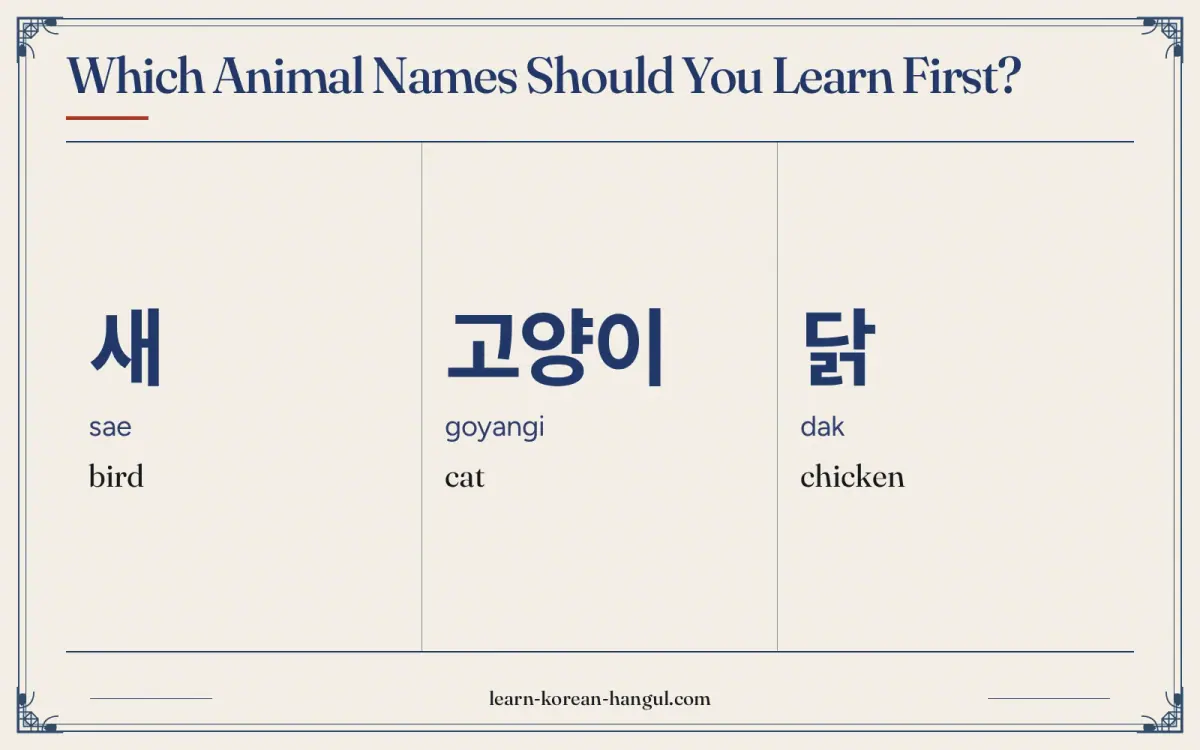
Start with five animals that come up in everyday talk: 새, 고양이, 닭, 소 and 개. Use the scene to see eight animals at once, then press play and the slow button on each of the five and say the word aloud.
Word · 8
- 1
새
sae
bird
- 2
고양이
goyangi
cat
- 3
닭
dak
chicken
- 4
소
so
cow; ox
- 5
개
gae
dog
- 6
호랑이
horangi
tiger
- 7
나비
nabi
butterfly
- 8
물고기
mulgogi
fish
새 (sae) means bird. It is spelled and said like 새 (new). The subject marker 가 after it shows that this one is a bird. Example: 새가 하늘을 날아요. (The bird flies in the sky.)
고양이 (goyangi) means cat. Three syllables are said smoothly as go-yang-i. The ㅇ in the middle is the ng sound, as in English "sing". Example: 고양이가 의자 위에서 자요. (The cat sleeps on the chair.)
닭 (dak) means chicken. The spelling has two final letters, ㄹ and ㄱ. Said alone, only the ㄱ is heard: dak. Before the subject marker 이, both return: 닭이 is said [달기]. Example: 닭이 알을 낳아요. (The chicken lays an egg.)
소 (so) means cow; ox. The same word covers cow, ox and bull. It is one syllable and is said with a round ㅗ vowel. Example: 소가 풀을 먹어요. (The cow eats grass.)
개 (gae) means dog. This is the general word for a dog. It is spelled like the counter 개 (pieces), but it is a separate word. Example: 개가 공원에서 뛰어요. (The dog runs in the park.)
Pets
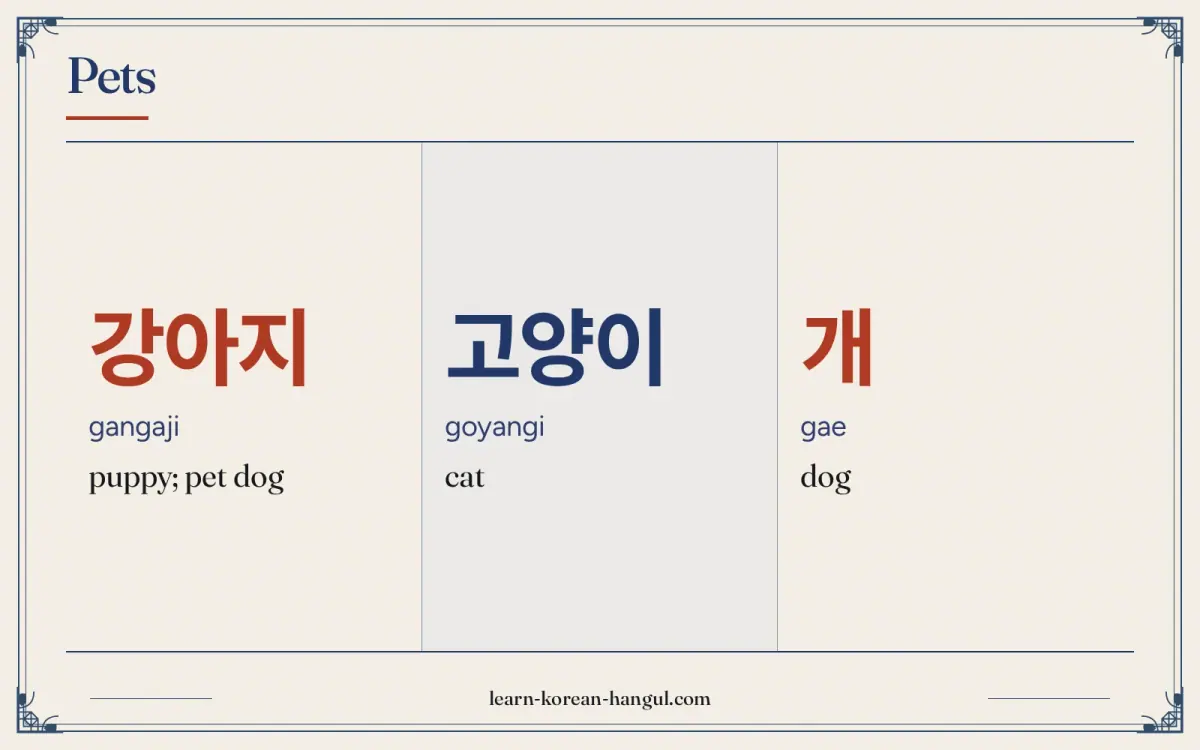
Pets are the animals you are most likely to talk about with a new friend. These six words cover the most common ones. They also help you answer the question 반려동물이 있어요? (Do you have a pet?).
| No. | Hangul | Revised Romanization | Meaning | Origin | Example sentence | Audio assetId |
|---|---|---|---|---|---|---|
| 1 | 강아지 | gangaji | puppy; pet dog | native | 강아지가 귀여워요. (gangajiga gwiyeowoyo; The puppy is cute.) | au-pg-vocabulary-nature-animals-1; example: au-pg-vocabulary-nature-animals-101 |
| 2 | 고양이 | goyangi | cat | native | 고양이가 의자 위에서 자요. (goyangiga uija wieseo jayo; The cat sleeps on the chair.) | au-pg-vocabulary-nature-animals-2; example: au-pg-vocabulary-nature-animals-102 |
| 3 | 개 | gae | dog | native | 개가 공원에서 뛰어요. (gaega gongwoneseo ttwieoyo; The dog runs in the park.) | au-pg-vocabulary-nature-animals-3; example: au-pg-vocabulary-nature-animals-103 |
| 4 | 햄스터 | haemseuteo | hamster | loanword | 햄스터가 밤에 활동해요. (haemseuteoga bame hwaldonghaeyo; The hamster is active at night.) | au-pg-vocabulary-nature-animals-4; example: au-pg-vocabulary-nature-animals-104 |
| 5 | 토끼 | tokki | rabbit | native | 토끼는 귀가 길어요. (tokkineun gwiga gireoyo; Rabbits have long ears.) | au-pg-vocabulary-nature-animals-5; example: au-pg-vocabulary-nature-animals-105 |
| 6 | 앵무새 | aengmusae | parrot | mixed | 앵무새가 말을 해요. (aengmusaega mareul haeyo; The parrot talks.) | au-pg-vocabulary-nature-animals-6; example: au-pg-vocabulary-nature-animals-106 |
- 강아지 is the everyday word for a pet dog, so 강아지가 있어요 means "I have a dog" even if the dog is grown.
- 고양이 has the nickname 냥이, and 개 has the nickname 멍멍이. Both are friendly, and both are explained in the register note below.
- 햄스터 is a loanword from English. Korean writes it as it sounds: haem-seu-teo.
Example Sentences
The simplest animal sentence is animal + 이/가 + verb or adjective. Use 이 after a consonant and 가 after a vowel: 개가 뛰어요 (the dog runs) and 닭이 알을 낳아요 (the chicken lays an egg). To say where an animal is, add 에 or 에서: 사자는 동물원에 있어요 (the lion is at the zoo). For the place where an action happens, use 에서: 오리가 물에서 헤엄쳐요 (the duck swims in the water). To say what an animal likes, use 을/를 좋아해요: 원숭이가 바나나를 좋아해요. The tables below give one such sentence for every word.
How Do You Say Farm Animals in Korean?
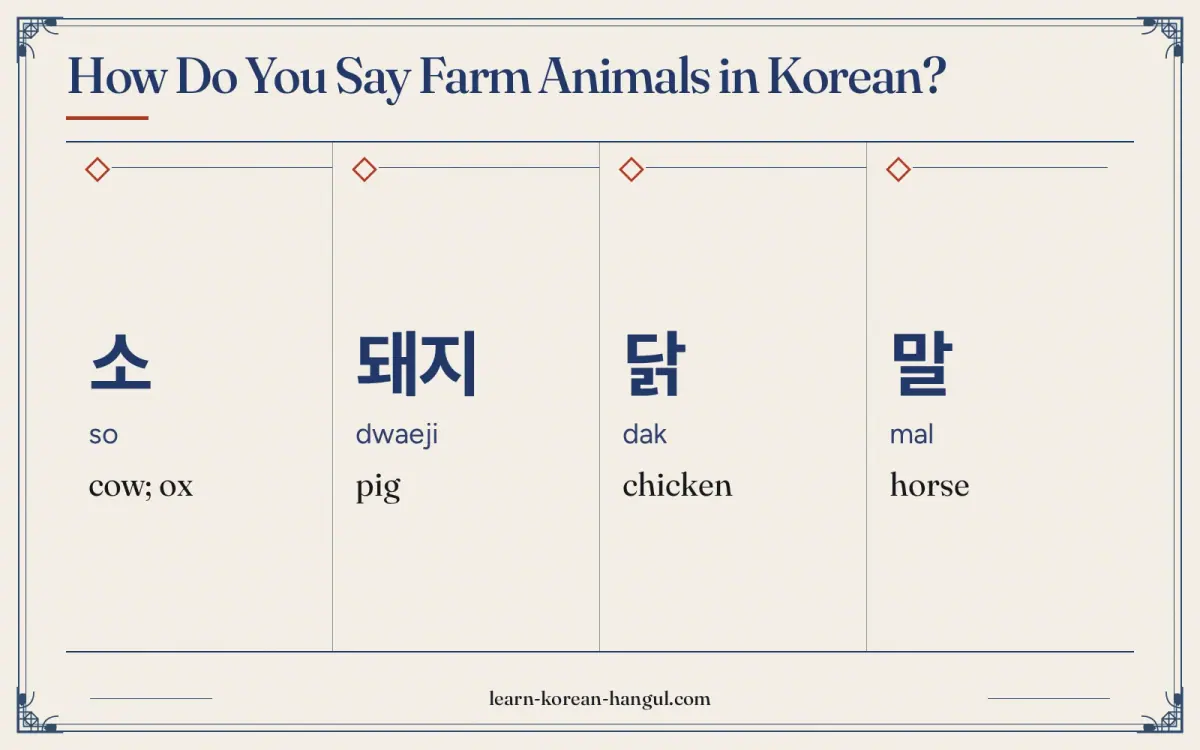
Farm animals are among the first animal words in a child's picture book. The group has seven words. You will meet them again in food words, because the meat names are built from the animal names.
| No. | Hangul | Revised Romanization | Meaning | Origin | Example sentence | Audio assetId |
|---|---|---|---|---|---|---|
| 7 | 소 | so | cow; ox | native | 소가 풀을 먹어요. (soga pureul meogeoyo; The cow eats grass.) | au-pg-vocabulary-nature-animals-7; example: au-pg-vocabulary-nature-animals-107 |
| 8 | 돼지 | dwaeji | pig | native | 돼지가 진흙에서 놀아요. (dwaejiga jinheulgeseo norayo; The pig plays in the mud.) | au-pg-vocabulary-nature-animals-8; example: au-pg-vocabulary-nature-animals-108 |
| 9 | 닭 | dak | chicken | native | 닭이 알을 낳아요. (dalgi areul naayo; The chicken lays an egg.) | au-pg-vocabulary-nature-animals-9; example: au-pg-vocabulary-nature-animals-109 |
| 10 | 말 | mal | horse | native | 말이 빨리 달려요. (mari ppalli dallyeoyo; The horse runs fast.) | au-pg-vocabulary-nature-animals-10; example: au-pg-vocabulary-nature-animals-110 |
| 11 | 양 | yang | sheep | Sino-Korean | 양이 하얘요. (yangi hayaeyo; The sheep is white.) | au-pg-vocabulary-nature-animals-11; example: au-pg-vocabulary-nature-animals-111 |
| 12 | 염소 | yeomso | goat | native | 염소가 울타리 안에 있어요. (yeomsoga ultari ane isseoyo; The goat is inside the fence.) | au-pg-vocabulary-nature-animals-12; example: au-pg-vocabulary-nature-animals-112 |
| 13 | 오리 | ori | duck | native | 오리는 물을 좋아해요. (orineun mureul joahaeyo; Ducks like water.) | au-pg-vocabulary-nature-animals-13; example: au-pg-vocabulary-nature-animals-113 |
- 소 is also the root of 소고기 (beef), 돼지 of 돼지고기 (pork) and 닭 of 닭고기 (chicken meat).
- The pronunciation of 닭 is a good test. Alone it is [닥], and before 이 it becomes [달기].
- 말 (horse) is spelled like 말 (speech). The verb that follows tells you which one is meant: 말을 타요 (I ride a horse) and 말을 해요 (I speak).
Wild Animals
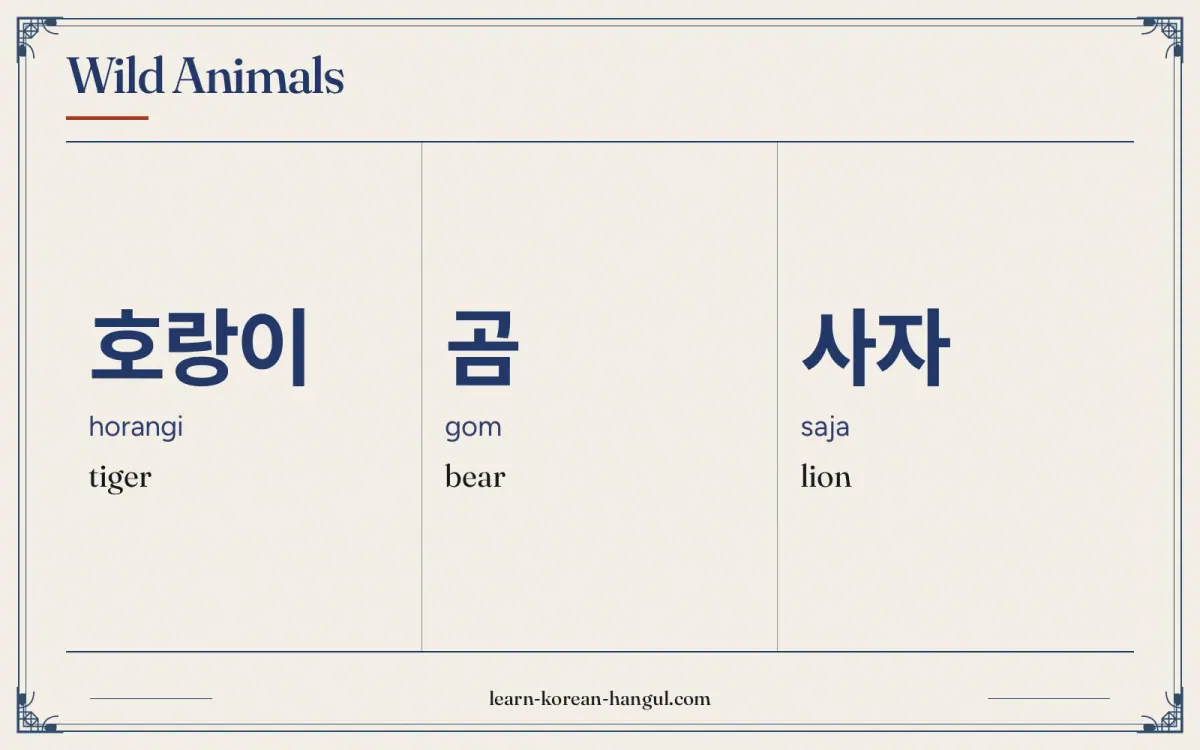
Wild animals are the ones you see at the zoo, in nature films and on hiking trails. The group has eleven words, and it is the longest in the list because many animals belong here. Ten are real animals, and 용 (dragon) is a mythical creature that does not exist in nature.
| No. | Hangul | Revised Romanization | Meaning | Origin | Example sentence | Audio assetId |
|---|---|---|---|---|---|---|
| 14 | 호랑이 | horangi | tiger | mixed | 호랑이는 무서워요. (horangineun museowoyo; Tigers are scary.) | au-pg-vocabulary-nature-animals-14; example: au-pg-vocabulary-nature-animals-114 |
| 15 | 곰 | gom | bear | native | 곰이 숲에 살아요. (gomi supe sarayo; The bear lives in the forest.) | au-pg-vocabulary-nature-animals-15; example: au-pg-vocabulary-nature-animals-115 |
| 16 | 사자 | saja | lion | Sino-Korean | 사자는 동물원에 있어요. (sajaneun dongmurwone isseoyo; The lion is at the zoo.) | au-pg-vocabulary-nature-animals-16; example: au-pg-vocabulary-nature-animals-116 |
| 17 | 코끼리 | kokkiri | elephant | native | 코끼리는 코가 길어요. (kokkirineun koga gireoyo; The elephant has a long trunk.) | au-pg-vocabulary-nature-animals-17; example: au-pg-vocabulary-nature-animals-117 |
| 18 | 원숭이 | wonsungi | monkey | native | 원숭이가 바나나를 좋아해요. (wonsungiga bananareul joahaeyo; The monkey likes bananas.) | au-pg-vocabulary-nature-animals-18; example: au-pg-vocabulary-nature-animals-118 |
| 19 | 늑대 | neukdae | wolf | native | 늑대가 밤에 울어요. (neukdaega bame ureoyo; The wolf howls at night.) | au-pg-vocabulary-nature-animals-19; example: au-pg-vocabulary-nature-animals-119 |
| 20 | 여우 | yeou | fox | native | 여우는 영리해요. (yeouneun yeongnihaeyo; The fox is clever.) | au-pg-vocabulary-nature-animals-20; example: au-pg-vocabulary-nature-animals-120 |
| 21 | 사슴 | saseum | deer | native | 사슴은 뿔이 있어요. (saseumeun ppuri isseoyo; Deer have antlers.) | au-pg-vocabulary-nature-animals-21; example: au-pg-vocabulary-nature-animals-121 |
| 22 | 뱀 | baem | snake | native | 뱀이 풀 속에 있어요. (baemi pul soge isseoyo; The snake is in the grass.) | au-pg-vocabulary-nature-animals-22; example: au-pg-vocabulary-nature-animals-122 |
| 23 | 용 | yong | dragon | Sino-Korean | 용은 전설 속의 동물이에요. (yongeun jeonseol sogui dongmurieyo; The dragon is an animal from legends.) | au-pg-vocabulary-nature-animals-23; example: au-pg-vocabulary-nature-animals-123 |
| 24 | 쥐 | jwi | mouse; rat | native | 쥐가 치즈를 먹어요. (jwiga chijeureul meogeoyo; The mouse eats cheese.) | au-pg-vocabulary-nature-animals-24; example: au-pg-vocabulary-nature-animals-124 |
- 코끼리 and 원숭이 both have three syllables and both end with the vowel ㅣ. Say each syllable evenly: ko-kki-ri and won-sung-i.
How Do You Say Birds in Korean?
Bird names are short, and two of them, 까치 and 까마귀, begin with the tense ㄲ. The group has eight words. Birds also appear in many sayings, so these words are worth knowing early.
| No. | Hangul | Revised Romanization | Meaning | Origin | Example sentence | Audio assetId |
|---|---|---|---|---|---|---|
| 25 | 새 | sae | bird | native | 새가 하늘을 날아요. (saega haneureul narayo; The bird flies in the sky.) | au-pg-vocabulary-nature-animals-25; example: au-pg-vocabulary-nature-animals-125 |
| 26 | 참새 | chamsae | sparrow | native | 참새가 나뭇가지에 앉아요. (chamsaega namutgajie anjayo; The sparrow sits on a branch.) | au-pg-vocabulary-nature-animals-26; example: au-pg-vocabulary-nature-animals-126 |
| 27 | 까치 | kkachi | magpie | native | 까치가 아침에 울어요. (kkachiga achime ureoyo; The magpie calls in the morning.) | au-pg-vocabulary-nature-animals-27; example: au-pg-vocabulary-nature-animals-127 |
| 28 | 비둘기 | bidulgi | pigeon | native | 비둘기가 광장에 많아요. (bidulgiga gwangjange manayo; There are many pigeons in the square.) | au-pg-vocabulary-nature-animals-28; example: au-pg-vocabulary-nature-animals-128 |
| 29 | 갈매기 | galmaegi | seagull | native | 갈매기가 바다 위를 날아요. (galmaegiga bada wireul narayo; Seagulls fly over the sea.) | au-pg-vocabulary-nature-animals-29; example: au-pg-vocabulary-nature-animals-129 |
| 30 | 까마귀 | kkamagwi | crow | native | 까마귀는 까매요. (kkamagwineun kkamaeyo; Crows are black.) | au-pg-vocabulary-nature-animals-30; example: au-pg-vocabulary-nature-animals-130 |
| 31 | 부엉이 | bueongi | owl | native | 부엉이가 밤에 깨어 있어요. (bueongiga bame kkaeeo isseoyo; The owl is awake at night.) | au-pg-vocabulary-nature-animals-31; example: au-pg-vocabulary-nature-animals-131 |
| 32 | 제비 | jebi | swallow | native | 제비가 봄에 와요. (jebiga bome wayo; The swallow comes in spring.) | au-pg-vocabulary-nature-animals-32; example: au-pg-vocabulary-nature-animals-132 |
- 까치 is the magpie, a bird that traditional belief links with good news. Hearing a magpie in the morning is said to bring a guest or a happy message.
- 참새 begins with the aspirated ㅊ, said with a puff of air, and 까치 begins with the tense ㄲ, said without a puff.
- 새 is the general word for bird, and the names above are the specific birds. More are on the Korean Birds Vocabulary page.
Insects
Insects matter in daily life, especially in summer. The group has eight words. 벌레 is the general word, and the others name a particular insect. Summer talk in Korea often includes 모기 and 매미.
| No. | Hangul | Revised Romanization | Meaning | Origin | Example sentence | Audio assetId |
|---|---|---|---|---|---|---|
| 33 | 벌레 | beolle | bug; insect | native | 벌레가 방에 들어왔어요. (beollega bange deureowasseoyo; A bug came into the room.) | au-pg-vocabulary-nature-animals-33; example: au-pg-vocabulary-nature-animals-133 |
| 34 | 나비 | nabi | butterfly | native | 나비가 꽃에 앉아요. (nabiga kkoche anjayo; The butterfly lands on a flower.) | au-pg-vocabulary-nature-animals-34; example: au-pg-vocabulary-nature-animals-134 |
| 35 | 벌 | beol | bee | native | 벌이 꿀을 모아요. (beori kkureul moayo; Bees collect honey.) | au-pg-vocabulary-nature-animals-35; example: au-pg-vocabulary-nature-animals-135 |
| 36 | 개미 | gaemi | ant | native | 개미는 작아요. (gaemineun jagayo; Ants are small.) | au-pg-vocabulary-nature-animals-36; example: au-pg-vocabulary-nature-animals-136 |
| 37 | 파리 | pari | fly | native | 파리가 음식 위에 앉았어요. (pariga eumsik wie anjasseoyo; A fly landed on the food.) | au-pg-vocabulary-nature-animals-37; example: au-pg-vocabulary-nature-animals-137 |
| 38 | 모기 | mogi | mosquito | native | 모기에 물렸어요. (mogie mullyeosseoyo; I got bitten by a mosquito.) | au-pg-vocabulary-nature-animals-38; example: au-pg-vocabulary-nature-animals-138 |
| 39 | 잠자리 | jamjari | dragonfly | native | 잠자리가 가을에 많아요. (jamjariga gaeure manayo; There are many dragonflies in autumn.) | au-pg-vocabulary-nature-animals-39; example: au-pg-vocabulary-nature-animals-139 |
| 40 | 매미 | maemi | cicada | native | 매미가 여름에 울어요. (maemiga yeoreume ureoyo; Cicadas sing in summer.) | au-pg-vocabulary-nature-animals-40; example: au-pg-vocabulary-nature-animals-140 |
- 벌레 is a broad word, and many Koreans use it for any small crawling creature, not only for insects.
- 모기에 물렸어요 uses the passive verb 물리다, so it says "I was bitten". Here the particle 에 marks the thing that did the biting.
- 매미 is the sound of Korean summers: 맴맴 is its call, and it is one of the typical sound words.
How Do You Say Sea Animals in Korean?
Korea has a long coast on three sides, so sea animals are common in food and talk. The group has ten words. Several of them are also on the menu, which makes them useful for travellers.
| No. | Hangul | Revised Romanization | Meaning | Origin | Example sentence | Audio assetId |
|---|---|---|---|---|---|---|
| 41 | 물고기 | mulgogi | fish | native | 물고기가 물속에서 헤엄쳐요. (mulgogiga mulsogeseo heeomchyeoyo; Fish swim underwater.) | au-pg-vocabulary-nature-animals-41; example: au-pg-vocabulary-nature-animals-141 |
| 42 | 고래 | gorae | whale | native | 고래는 아주 커요. (goraeneun aju keoyo; Whales are very big.) | au-pg-vocabulary-nature-animals-42; example: au-pg-vocabulary-nature-animals-142 |
| 43 | 상어 | sangeo | shark | Sino-Korean | 상어는 이빨이 날카로워요. (sangeoneun ippari nalkarowoyo; Sharks have sharp teeth.) | au-pg-vocabulary-nature-animals-43; example: au-pg-vocabulary-nature-animals-143 |
| 44 | 돌고래 | dolgorae | dolphin | native | 돌고래가 점프해요. (dolgoraega jeompeuhaeyo; The dolphin jumps.) | au-pg-vocabulary-nature-animals-44; example: au-pg-vocabulary-nature-animals-144 |
| 45 | 문어 | muneo | octopus | Sino-Korean | 문어는 다리가 여덟 개예요. (muneoneun dariga yeodeol gaeyeyo; An octopus has eight legs.) | au-pg-vocabulary-nature-animals-45; example: au-pg-vocabulary-nature-animals-145 |
| 46 | 오징어 | ojingeo | squid | native | 오징어를 구워 먹어요. (ojingeoreul guwo meogeoyo; I grill squid and eat it.) | au-pg-vocabulary-nature-animals-46; example: au-pg-vocabulary-nature-animals-146 |
| 47 | 게 | ge | crab | native | 게가 옆으로 걸어요. (gega yeopeuro georeoyo; The crab walks sideways.) | au-pg-vocabulary-nature-animals-47; example: au-pg-vocabulary-nature-animals-147 |
| 48 | 새우 | saeu | shrimp | native | 새우를 좋아해요. (saeureul joahaeyo; I like shrimp.) | au-pg-vocabulary-nature-animals-48; example: au-pg-vocabulary-nature-animals-148 |
| 49 | 거북이 | geobugi | turtle | native | 거북이는 느려요. (geobugineun neuryeoyo; Turtles are slow.) | au-pg-vocabulary-nature-animals-49; example: au-pg-vocabulary-nature-animals-149 |
| 50 | 해파리 | haepari | jellyfish | native | 해파리는 투명해요. (haeparineun tumyeonghaeyo; Jellyfish are transparent.) | au-pg-vocabulary-nature-animals-50; example: au-pg-vocabulary-nature-animals-150 |
- 물고기 is the live animal, and 생선 is fish as food. Say 생선구이 for grilled fish and 물고기 for a fish in a tank.
- 오징어 and 새우 are both everyday foods as well as animals, so you will meet them on menus.
- 거북이 is the everyday word for turtle.
Counting Animals with 마리
Korean counts animals with the counter 마리 (mari). The pattern is animal + 이/가 + native number + 마리 + 있어요. Numbers one to four shorten before a counter: 한 마리 (one), 두 마리 (two), 세 마리 (three), 네 마리 (four). From five, the full form stays: 다섯 마리.
| Count | Hangul | Revised Romanization |
|---|---|---|
| one animal | 한 마리 | han mari |
| two animals | 두 마리 | du mari |
| three animals | 세 마리 | se mari |
| four animals | 네 마리 | ne mari |
| five animals | 다섯 마리 | daseot mari |
Example: 강아지가 두 마리 있어요. (gangajiga du mari isseoyo; I have two puppies.) Audio: au-pg-vocabulary-nature-animals-601.
The counter 마리 is used for animals, from a goldfish to an elephant. People are counted with 명, which is a different counter. The lesson on counters for animals covers the full pattern and the number forms.
개, 강아지 and 멍멍이: a Register Ladder
Three words can all point to a dog, and they sit on a ladder from plain to affectionate.
| Word | Revised Romanization | Feel | Use |
|---|---|---|---|
| 개 | gae | plain | the general word for a dog as an animal |
| 강아지 | gangaji | friendly | a puppy, and also the usual word for a pet dog of any age |
| 멍멍이 | meongmeongi | cute, childish | a doggy; it echoes the barking sound 멍멍 |
Say 개 when you describe the animal in general: 개는 동물이에요 (A dog is an animal). Say 강아지 for a pet you love: 우리 강아지 (our puppy). Use 멍멍이 with small children or as a pet nickname. A cat has the same kind of ladder, from 고양이 to the casual nickname 냥이, which is covered on the pets page. One more point: 개 is also a very common counter for things, as in 사과 두 개 (two apples). The animal and the counter are separate words that happen to be spelled the same.
새 (bird) and 새 (new)
새 (sae) means bird, and 새 (sae) also means new. They are spelled the same and said the same. Context tells them apart: the first one is a noun, and the second one stands before a noun like an adjective.
- 새가 날아요. (saega narayo; A bird flies.) The 새 is followed by the subject marker 가, so it is the noun bird.
- 새 가방이에요. (sae gabangieyo; It is a new bag.) The 새 stands before 가방, so it means new.
- 새 새가 날아요. (sae saega narayo; A new bird flies.) Both meanings appear in one short sentence. Audio: au-pg-vocabulary-nature-animals-602.
Other common words have twins too: 말 means horse and also speech (as in 말해요, to speak), 배 means pear, belly and ship, and 눈 means eye and snow. Spoken Korean copes with these twins easily because the rest of the sentence makes the meaning clear.
Animal Sounds
Korean has sound words for animal voices, and they are different from English ones. A dog says 멍멍, not "woof". The sound words are called onomatopoeia, and the language has many more of them. Here are eight to start with.
| Sound word | Revised Romanization | Animal and sound | Audio assetId |
|---|---|---|---|
| 멍멍 | meongmeong | dog barking | au-pg-vocabulary-nature-animals-603 |
| 야옹 | yaong | cat meowing | au-pg-vocabulary-nature-animals-604 |
| 음메 | eumme | cow mooing | au-pg-vocabulary-nature-animals-605 |
| 꿀꿀 | kkulkkul | pig oinking | au-pg-vocabulary-nature-animals-606 |
| 꼬끼오 | kkokkio | rooster crowing | au-pg-vocabulary-nature-animals-607 |
| 꽥꽥 | kkwaekkwaek | duck quacking | au-pg-vocabulary-nature-animals-608 |
| 짹짹 | jjaekjjaek | bird chirping | au-pg-vocabulary-nature-animals-609 |
| 개굴개굴 | gaegulgaegul | frog croaking | au-pg-vocabulary-nature-animals-610 |
A sound word often goes with the verb 울다 (to cry, to call) or with 소리 (sound): 닭이 꼬끼오 울어요 (the rooster crows cock-a-doodle-doo). More animal voices are on the animal sounds page, and the general topic is in onomatopoeia.
How Do You Pronounce These Words?
Animal words are short, so the main trouble is the final consonant and the tense starts. Five words are worth practising. The table follows the Standard Pronunciation rules (표준 발음법) of the 국립국어원.
| Word | Romanization | Said | Rule |
|---|---|---|---|
| 닭 | dak | [닥] | the two final letters ㄹㄱ are reduced to one sound ㄱ at the end of a word |
| 고양이 | goyangi | [고양이] | ㅇ in the middle is the ng sound, and the last 이 is said clearly |
| 까치 | kkachi | [까치] | ㄲ is tense: tighten the throat and say it without a puff of air |
| 원숭이 | wonsungi | [원숭이] | the ㅇ of 숭 is the ng sound, and it links smoothly to the final vowel |
| 토끼 | tokki | [토끼] | ㄲ is tense after the vowel; ㅌ at the start is aspirated |
Revised Romanization is the official romanization system of South Korea, announced on 7 July 2000. It follows most sound changes, such as linking and nasalization, and it spells the written double letters (ㄲ as kk), but it does not show tensing caused by a neighbouring sound: 늑대 is said [늑때] but written neukdae. It is a learning aid, so always read the Hangul as well.
Audio and Slow Playback
Each headword and each example sentence has its own audio clip, and the five words in the learn-first section also have a slow clip at 0.8 times the speed. Nothing plays until you press a button. Listen once, repeat aloud, and only then check the romanization.
What Mistakes Do Learners Make with Animal Names?
- Reading 개 as only a counter. It is also the word for dog, and the context decides.
- Saying 새 for both a bird and anything new without checking the next word. A bird is 새, and new things use 새 before the noun.
- Using 명 to count animals. People use 명, and animals use 마리.
- Calling every pet dog 개. In normal speech a pet dog is a 강아지, which sounds warmer.
- Saying both final letters of 닭 (dalk). Alone it is [닥], and before 이 it is [달기].
- Reading the romanization instead of the sounds. Words such as 늑대 contain a tense sound, [늑때], but Revised Romanization shows only neukdae.
Practice: Flashcards and Worksheet
Drill these 50 words with the vocabulary flashcard decks: each card shows the Hangul on one side and the meaning on the other, so you can test recall instead of recognition. Print a labelling sheet from the vocabulary worksheets and write the Korean word for each numbered animal in the scene above. A simple plan is to learn eight words a day, one group at a time, and to come back to the older groups after a day and after a week.
Korean Animals Worksheet
Try this five-question check, then say the words aloud once more.
Practice · 5
What does 강아지 mean?
Show answer
puppy; pet dog
강아지 (gangaji) means puppy; pet dog.
What does 양 mean?
Show answer
sheep
양 (yang) means sheep.
What does 사슴 mean?
Show answer
deer
사슴 (saseum) means deer.
What does 부엉이 mean?
Show answer
owl
부엉이 (bueongi) means owl.
What does 물고기 mean?
Show answer
fish
물고기 (mulgogi) means fish.
Self-Test: 10 Sentences
Fill each blank with a word from this page. Say the whole sentence aloud when you have it. The answers follow the test.
- ___가 귀여워요. (The puppy is cute.)
- ___는 귀가 길어요. (Rabbits have long ears.)
- ___는 물을 좋아해요. (Ducks like water.)
- ___가 바나나를 좋아해요. (The monkey likes bananas.)
- ___가 나뭇가지에 앉아요. (The sparrow sits on a branch.)
- ___는 까매요. (Crows are black.)
- ___가 방에 들어왔어요. (A bug came into the room.)
- ___에 물렸어요. (I got bitten by a mosquito.)
- ___는 아주 커요. (Whales are very big.)
- ___를 구워 먹어요. (I grill squid and eat it.)
Answers: 1. 강아지; 2. 토끼; 3. 오리; 4. 원숭이; 5. 참새; 6. 까마귀; 7. 벌레; 8. 모기; 9. 고래; 10. 오징어.
A score of 8 or more suggests the words are settling in. If you scored lower, reread the groups where you missed words.
Where to Go Next
After animals, many learners move on to Weather and Seasons. For a deeper look at one group, open a page below. This list sits inside Nature and the World.
Pages in This Section
Six pages sit below Animals. Each one expands a group from this list with more words and more notes.
- Korean Pets Vocabulary: 30 words for dogs, cats, small pets, pet care and pet food, with the register note on 반려동물 and 애완동물. Level A1.
- Korean Farm Animals Vocabulary: 25 words for cattle, pigs, poultry, farm places and farm products. Level A1.
- Korean Wild Animals Vocabulary: 30 words for predators, forest animals, zoo animals and reptiles, with the tiger in Korean folk tales. Level A1.
- Korean Birds Vocabulary: magpies, cranes, sparrows and bird body parts.
- Korean Insects Vocabulary: butterflies, bees, cicadas and household bugs.
- Korean Sea Animals Vocabulary: whales, sharks, octopus, shells and aquarium.
Frequently Asked Questions
How Do You Say Bird in Korean?
Say 새 (sae). It is one syllable. The same spelling also means new, so a bird is 새 on its own or with the subject marker, as in 새가 날아요 (a bird flies), and new is 새 before a noun, as in 새 가방 (a new bag).
How Do You Pronounce 고양이 (goyangi)?
Say go-yang-i with even beats. The first sound is a plain g, the middle ㅇ is the ng sound, as in the English word "sing", and the last syllable is a clear ee. Press the audio button on this page to hear it, then say it slowly twice.
How Many Animal Names Should I Learn First?
Learn the five starter words, 새, 고양이, 닭, 소 and 개, then add one group at a time. Eight new words a day with a short review of the older ones is a steady pace, and the whole list of 50 takes about a week.
Where Can I Practise Animal Names with Flashcards?
Use the vocabulary flashcard decks. Start with the pets and farm animals, then add the wild animals. Review the older cards before you add new ones, so the earlier words do not fade.
Is the Romanization on This Page Official?
Yes, as a learning aid. It follows the Revised Romanization of Korean, the system South Korea has officially used since 7 July 2000, and the page also gives the Hangul for every word. It follows most sound changes but does not show tensing: 늑대 is written neukdae but is said [늑때]. Treat the Hangul as the real spelling.
Is There a Printable Worksheet for Animal Names?
The vocabulary worksheets page lists the printable sheets. The sheet for this topic is a labelling task built on the same illustrated scene as this page, so you write the Korean word next to each numbered animal.