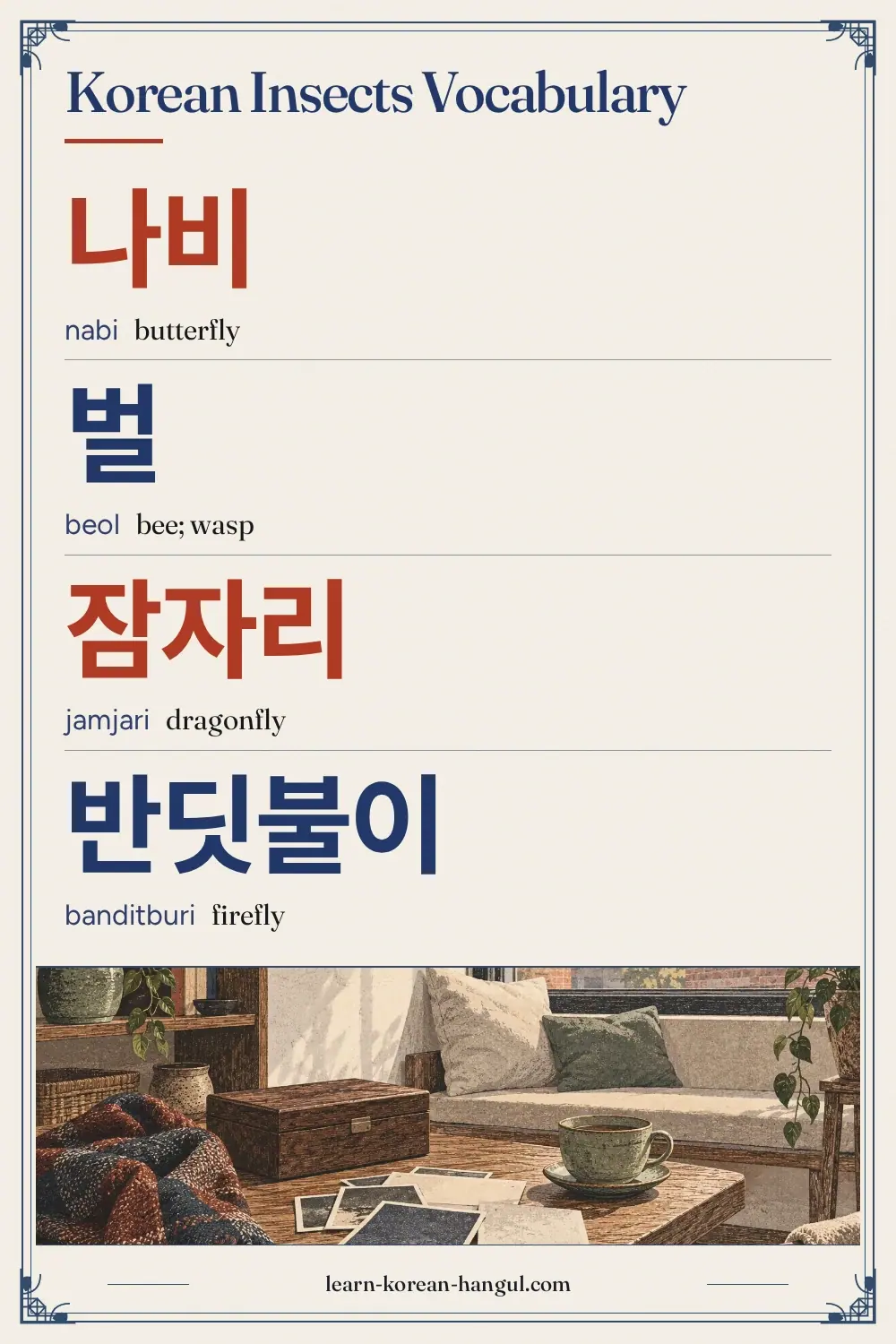
Korean Insects Vocabulary at a Glance
Korean summers are loud and full of insects. Cicadas fill the afternoon with sound, crickets take over the evenings in autumn, and mosquitoes and cockroaches make their way into the vocabulary of everyone who rents an apartment. This list begins with the winged insects of the garden, moves through crawlers and hoppers, gives the sound insects a group of their own, covers the pests you will want to name when you complain or ask for help, and finishes with the general words and body parts. It sits in Animals. For a single-word lookup of the most loved insect, see butterfly in Korean.
| Group | Words | Use |
|---|---|---|
| Flying insects | 6 | Butterflies, bees, dragonflies and night fliers |
| Crawling insects | 5 | Ants, ladybugs, caterpillars and hoppers |
| Summer sounds | 4 | Cicadas, crickets and their sound words |
| Pests | 5 | Mosquitoes, flies, cockroaches and spiders |
| Insect words and body parts | 5 | General words and the parts of an insect |
Which Insect Names Should You Learn First?
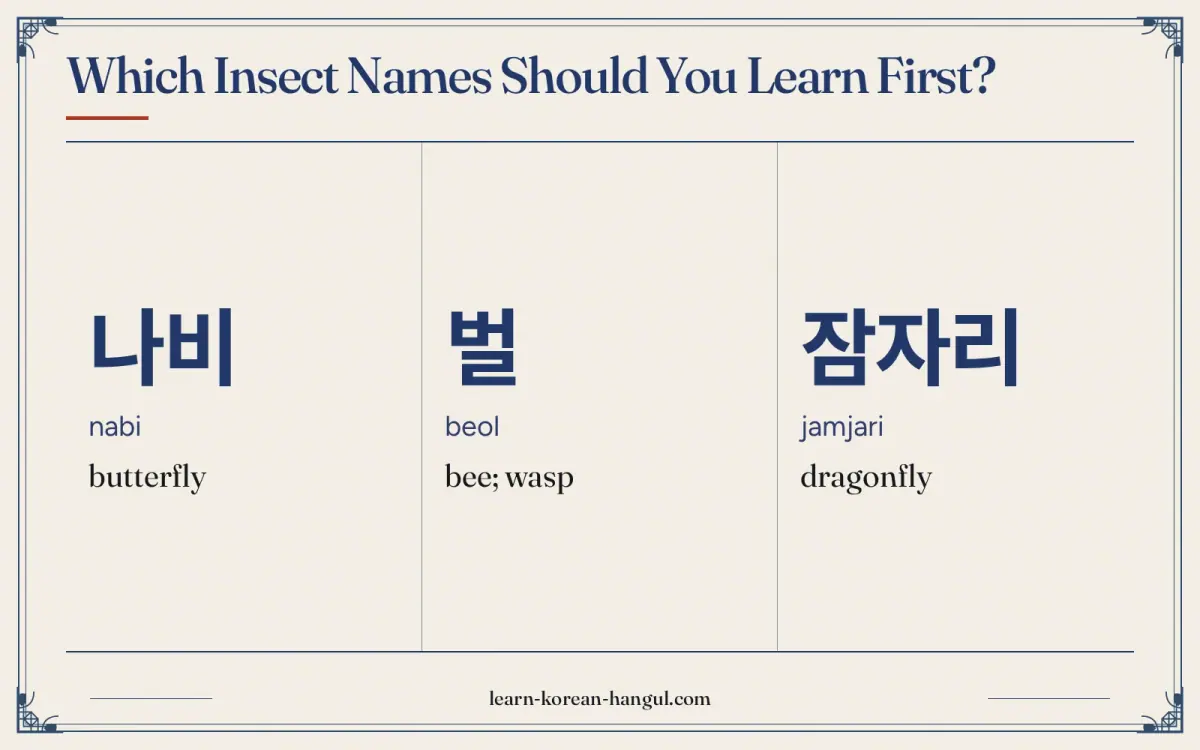
Learn 벌레, 나비, 벌, 개미, 매미 and 모기 first. They name the creatures you notice outdoors and the one you ask about in a hotel room. 벌레 is the most useful word on the page, because it lets you say that there is a bug before you know its name.
- Words to say. 벌레, 나비, 벌, 개미, 매미, 모기.
- Words to recognise. 곤충, 해충, 바퀴벌레, 말벌. They appear in school texts, on pest-control signs and in news about summer.
- Words to match. 더듬이, 고치, 애벌레. Match them to a picture of the life of a butterfly and they stay in your head.
The difference between 곤충 and 벌레 matters at once. 곤충 is the exact word for an animal with six legs and three body parts. 벌레 is wider and warmer: Koreans use it for ants, flies, worms and even spiders, and a parent who says 벌레 is not asking for a lesson in biology. The scene below shows a garden with numbered insects that match the list.
Word · 10
- 1
나비
nabi
butterfly
- 2
벌
beol
bee; wasp
- 3
잠자리
jamjari
dragonfly
- 4
반딧불이
banditburi
firefly
- 5
개미
gaemi
ant
- 6
무당벌레
mudangbeolle
ladybug
- 7
매미
maemi
cicada
- 8
모기
mogi
mosquito
- 9
곤충
gonchung
insect
- 10
벌레
beolle
bug; creepy-crawly
Flying Insects
Six winged insects open the list. 나비 is the butterfly and 나방 is the moth, and the two names are close in sound. 벌 is the bee and 말벌 is the hornet, a larger insect that Koreans treat with care in late summer. 잠자리 is the dragonfly, which fills the sky in early autumn, and 반딧불이 is the firefly, seen on summer nights in places with clean streams.
| No. | Hangul | Revised Romanization | Meaning and note | Example sentence | Audio assetId |
|---|---|---|---|---|---|
| 1 | 나비 | nabi | butterfly. Often paired with 꽃 (flower). The word also appears in poems and children's songs. | 나비가 꽃에 앉아요. (The butterfly sits on the flower.) | au-pg-vocabulary-nature-animals-insects-1; example: au-pg-vocabulary-nature-animals-insects-26 |
| 2 | 벌 | beol | bee; wasp. 벌 also means punishment and is a counter for sets of clothes. The sentence shows which one is meant. | 벌이 꿀을 모아요. (The bee collects honey.) | au-pg-vocabulary-nature-animals-insects-2; example: au-pg-vocabulary-nature-animals-insects-27 |
| 3 | 잠자리 | jamjari | dragonfly. The same spelling means a place to sleep, but that word is said [잠짜리], while the dragonfly is [잠자리]. A dragonfly sentence has a verb of flying or landing. | 가을에 잠자리가 많아요. (There are many dragonflies in autumn.) | au-pg-vocabulary-nature-animals-insects-3; example: au-pg-vocabulary-nature-animals-insects-28 |
| 4 | 반딧불이 | banditburi | firefly. Said [반디뿌리] or [반딛뿌리]. The older name 개똥벌레 is still known. | 여름밤에 반딧불이가 날아요. (On summer nights the fireflies fly.) | au-pg-vocabulary-nature-animals-insects-4; example: au-pg-vocabulary-nature-animals-insects-29 |
| 5 | 나방 | nabang | moth. A night flier that comes to lights. Related in sound to 나비 but a different animal. | 나방이 밤에 날아요. (The moth flies at night.) | au-pg-vocabulary-nature-animals-insects-5; example: au-pg-vocabulary-nature-animals-insects-30 |
| 6 | 말벌 | malbeol | hornet. A large wasp. 말 here means big, as in 말벌 and 말매미, so it is a size word, not the word for horse. | 말벌은 위험해요. (Hornets are dangerous.) | au-pg-vocabulary-nature-animals-insects-6; example: au-pg-vocabulary-nature-animals-insects-31 |
Example Sentences
Insect sentences use three simple frames. The first is insect + 가 + place + 에 + 앉아요 (sits on), as in 나비가 꽃에 앉아요. The second is season + 에 + insect + 가 + 많아요 (there are many), as in 가을에 잠자리가 많아요. The third is insect + 는 + adjective, as in 말벌은 위험해요. The particle 이 or 가 marks the new subject, and 은 or 는 marks the topic you are describing. Read each sentence aloud after its audio.
The next group holds insects that spend most of their time on the ground or on a leaf.
How Do You Say Crawling Insects in Korean?
These five live in grass, on leaves and under stones. 개미 is the ant and 무당벌레 is the ladybug, a red beetle that children like. 애벌레 is a caterpillar, which becomes a 나비 or 나방. 메뚜기 is the grasshopper that jumps in summer fields, and 사마귀 is the praying mantis. Together they cover most of what a child can find in a park, and each is a word that comes up in picture books.
| No. | Hangul | Revised Romanization | Meaning and note | Example sentence | Audio assetId |
|---|---|---|---|---|---|
| 7 | 개미 | gaemi | ant. Ants are shown in sayings as hard workers. 개미가 줄을 서요 describes ants walking in a line. | 개미가 줄을 서요. (The ants form a line.) | au-pg-vocabulary-nature-animals-insects-7; example: au-pg-vocabulary-nature-animals-insects-32 |
| 8 | 무당벌레 | mudangbeolle | ladybug. 벌레 here means bug, and 무당 is a traditional ritual specialist, said to be after the bright colours of her robe. | 무당벌레는 빨개요. (The ladybug is red.) | au-pg-vocabulary-nature-animals-insects-8; example: au-pg-vocabulary-nature-animals-insects-33 |
| 9 | 애벌레 | aebeolle | caterpillar; larva. 애 means young or early. Many larvae are called 애벌레, not only butterfly young. | 애벌레가 잎을 먹어요. (The caterpillar eats a leaf.) | au-pg-vocabulary-nature-animals-insects-9; example: au-pg-vocabulary-nature-animals-insects-34 |
| 10 | 메뚜기 | mettugi | grasshopper. Seen in rice fields. The tense ㄸ makes a firm, short sound. | 메뚜기가 높이 뛰어요. (The grasshopper jumps high.) | au-pg-vocabulary-nature-animals-insects-10; example: au-pg-vocabulary-nature-animals-insects-35 |
| 11 | 사마귀 | samagwi | praying mantis. The same word also means a wart on the skin. The sentence makes the meaning clear. | 사마귀는 앞다리가 길어요. (The mantis has long front legs.) | au-pg-vocabulary-nature-animals-insects-11; example: au-pg-vocabulary-nature-animals-insects-36 |
Note how 무당벌레 and 애벌레 both end in 벌레. When a new bug name ends in 벌레, you can guess it is some kind of small bug or larva.
Summer Sounds (매미)
No insect shapes a Korean summer like the cicada. 매미 is the cicada, and its loud, steady call is written 맴맴. In autumn the cricket, 귀뚜라미, takes the stage and its sound is 귀뚤귀뚤. Korean sound words for insects are usually doubled, so a pair of syllables repeats. You will see them in comics and read them aloud in children's stories. The cicada is also a cultural image of summer heat, and the verb for its call is 울다. For more of this kind of word, see animal sounds.
| No. | Hangul | Revised Romanization | Meaning and note | Example sentence | Audio assetId |
|---|---|---|---|---|---|
| 12 | 매미 | maemi | cicada. The sound of 여름. Cicadas call on trees in the daytime in July and August. | 여름에 매미가 울어요. (In summer the cicadas call.) | au-pg-vocabulary-nature-animals-insects-12; example: au-pg-vocabulary-nature-animals-insects-37 |
| 13 | 맴맴 | maemmaem | cicada sound. A doubled sound word. Both syllables end in ㅁ, so keep your lips closed at the end of each. | 매미가 맴맴 울어요. (The cicada goes maemmaem.) | au-pg-vocabulary-nature-animals-insects-13; example: au-pg-vocabulary-nature-animals-insects-38 |
| 14 | 귀뚜라미 | gwitturami | cricket. An autumn insect. The tense ㄸ in the middle is short and sharp. | 가을에 귀뚜라미가 울어요. (In autumn the crickets chirp.) | au-pg-vocabulary-nature-animals-insects-14; example: au-pg-vocabulary-nature-animals-insects-39 |
| 15 | 귀뚤귀뚤 | gwittulgwittul | cricket sound. The doubled sound of a cricket at night. Each 뚤 ends in ㄹ. | 밤에 귀뚜라미가 귀뚤귀뚤 울어요. (At night the cricket chirps.) | au-pg-vocabulary-nature-animals-insects-15; example: au-pg-vocabulary-nature-animals-insects-40 |
Learn the animal and its sound as a pair. When you know 매미, you can guess 맴맴, and when you know 귀뚜라미, you can guess 귀뚤귀뚤.
How Do You Say Pests in Korean?
Some insects are the ones you want out of the house. 모기 is the mosquito, 파리 is the fly and 바퀴벌레 is the cockroach. 거미 is the spider, which is not an insect in biology, but Koreans group it with 벌레 in daily speech. The general word for all of these is 해충, a harmful insect or pest. Knowing the names helps you read a label on a spray, a notice in an apartment building, or a news item about a mosquito season.
| No. | Hangul | Revised Romanization | Meaning and note | Example sentence | Audio assetId |
|---|---|---|---|---|---|
| 16 | 모기 | mogi | mosquito. Common on summer nights. 모기약 is mosquito repellent or spray. | 여름밤에 모기가 많아요. (On summer nights there are many mosquitoes.) | au-pg-vocabulary-nature-animals-insects-16; example: au-pg-vocabulary-nature-animals-insects-41 |
| 17 | 파리 | pari | fly. The same spelling is Paris, the city. A fly lands on food, and Paris is a place you go to. | 파리가 음식에 앉아요. (A fly lands on the food.) | au-pg-vocabulary-nature-animals-insects-17; example: au-pg-vocabulary-nature-animals-insects-42 |
| 18 | 바퀴벌레 | bakwibeolle | cockroach. 바퀴 is the word for wheel in other contexts. Said as written, with the long ㄹㄹ in the last two syllables. | 바퀴벌레가 무서워요. (Cockroaches are scary.) | au-pg-vocabulary-nature-animals-insects-18; example: au-pg-vocabulary-nature-animals-insects-43 |
| 19 | 거미 | geomi | spider. Not an insect, but part of 벌레 in daily speech. 거미줄 is a spider web. | 거미가 거미줄을 쳐요. (The spider spins a web.) | au-pg-vocabulary-nature-animals-insects-19; example: au-pg-vocabulary-nature-animals-insects-44 |
| 20 | 해충 | haechung | pest; harmful insect. Sino-Korean: 해 is harm and 충 is insect. Used on signs, labels and in news. | 여름에는 해충이 많아요. (In summer there are many pests.) | au-pg-vocabulary-nature-animals-insects-20; example: au-pg-vocabulary-nature-animals-insects-45 |
Each of these words works with the particle 이 or 가 as a subject, so you can say 모기가 있어요 (there is a mosquito) with confidence.
Insect Words and Body Parts
The last group gives the general words and the body vocabulary. 곤충 is the exact word for insect and 벌레 is the everyday word for a bug. 더듬이 is an antenna, 다리 is a leg and 고치 is the cocoon of a larva. Insects have six legs, so the number is a natural way to practise the counter 개. A caterpillar spins a 고치 before it changes, and the same word is used for the silk cocoon of a silkworm.
| No. | Hangul | Revised Romanization | Meaning and note | Example sentence | Audio assetId |
|---|---|---|---|---|---|
| 21 | 곤충 | gonchung | insect. A Sino-Korean word used in school and science. 곤충 채집 is insect collecting. | 곤충을 좋아해요. (I like insects.) | au-pg-vocabulary-nature-animals-insects-21; example: au-pg-vocabulary-nature-animals-insects-46 |
| 22 | 벌레 | beolle | bug; creepy-crawly. The everyday word. It covers insects, worms and other small creatures. | 방에 벌레가 있어요. (There is a bug in the room.) | au-pg-vocabulary-nature-animals-insects-22; example: au-pg-vocabulary-nature-animals-insects-47 |
| 23 | 더듬이 | deodeumi | antenna; feeler. Said [더드미]: the final ㅁ links to the vowel of 이. | 개미는 더듬이가 있어요. (Ants have antennae.) | au-pg-vocabulary-nature-animals-insects-23; example: au-pg-vocabulary-nature-animals-insects-48 |
| 24 | 다리 | dari | leg. The same spelling means a bridge. Insect sentences use the leg meaning. | 곤충은 다리가 여섯 개예요. (Insects have six legs.) | au-pg-vocabulary-nature-animals-insects-24; example: au-pg-vocabulary-nature-animals-insects-49 |
| 25 | 고치 | gochi | cocoon. A silk case in which a larva changes. Not to be confused with 고치다 (to fix). | 애벌레가 고치를 만들어요. (The caterpillar makes a cocoon.) | au-pg-vocabulary-nature-animals-insects-25; example: au-pg-vocabulary-nature-animals-insects-50 |
Use 곤충 when you want to be precise, and 벌레 when you want to sound natural.
How Do You Pronounce These Words?
Insect names are mostly said as written, but a few have a sound change or a tense consonant. Standard pronunciation follows the National Institute of Korean Language (국립국어원) rules, and the romanization follows the Revised Romanization of Korean, which does not show tensing caused by a neighbouring sound.
| Spelling | Sounds like | What changes |
|---|---|---|
| 반딧불이 | [반디뿌리] or [반딛뿌리] | The ㅅ between the two parts makes ㅂ tense [ㅃ]. |
| 더듬이 | [더드미] | The final ㅁ links to the vowel of 이. |
| 앞다리 | [압따리] | The final ㅍ is said as ㅂ, and ㄷ becomes tense [ㄸ]. |
| 여섯 개 | [여섣깨] | The final ㅅ is said as ㄷ, and ㄱ becomes tense [ㄲ]. |
| 벌레 | [벌레] | Two ㄹ sounds in a row make one long, soft l. |
| 귀뚜라미 | [귀뚜라미] | ㄸ is tense. Do not let a puff of air out. |
| 잠자리 | [잠자리] | The ㅈ after ㅁ is plain and slightly voiced. The 잠자리 that means a place to sleep is said [잠짜리]. |
The hardest sounds are the tense ㄸ in 귀뚜라미 and 메뚜기 and the tense ㅃ in 반딧불이. Close your throat slightly and say the sound without a puff of air. Compare the plain ㄷ in 더듬이 and 다리.
Audio and Slow Playback
Each word and sentence has its own clip. The five clips below replay the hardest words slowly. Play one, repeat it aloud, then play it again and compare.
What Mistakes Do Learners Make with Insect Names?
Five mistakes come up again and again.
- Using 곤충 in everyday speech. If you see a bug in your room, say 벌레, not 곤충. 곤충 sounds like a school lesson.
- Mixing up 벌 meanings. 벌 is a bee, but 벌 also means a punishment and is a counter for sets of clothes. 한 벌 means one outfit.
- Mixing up 나비 and 나방. 나비 is the butterfly, and 나방 is the moth. Only the second syllable differs: 비 against 방.
- Treating 다리, 파리 and 사마귀 as one-meaning words. Leg or bridge, fly or Paris, mantis or wart: always check the verb and the sentence.
- Dropping the tense sounds. 귀뚜라미 and 메뚜기 need a tense ㄸ. A plain ㄷ sounds wrong to a Korean listener.
The practice section turns the list into drills.
Practice: Flashcards and Worksheet
Use three steps. Run the flashcard deck in recognition mode until the 25 words come quickly. Switch to listening mode, then take the quiz. The deck holds every word on this page with audio, and your progress stays in your browser. The vocabulary flashcard decks page lists the other decks.
Practice · 55
- 01나비
Show answer
headword 1: butterfly
- 02벌
Show answer
headword 2: bee; wasp
- 03잠자리
Show answer
headword 3: dragonfly
- 04반딧불이
Show answer
headword 4: firefly
- 05나방
Show answer
headword 5: moth
- 06말벌
Show answer
headword 6: hornet
- 07개미
Show answer
headword 7: ant
- 08무당벌레
Show answer
headword 8: ladybug
- 09애벌레
Show answer
headword 9: caterpillar; larva
- 10메뚜기
Show answer
headword 10: grasshopper
- 11사마귀
Show answer
headword 11: praying mantis
- 12매미
Show answer
headword 12: cicada
- 13맴맴
Show answer
headword 13: cicada sound
- 14귀뚜라미
Show answer
headword 14: cricket
- 15귀뚤귀뚤
Show answer
headword 15: cricket sound
- 16모기
Show answer
headword 16: mosquito
- 17파리
Show answer
headword 17: fly
- 18바퀴벌레
Show answer
headword 18: cockroach
- 19거미
Show answer
headword 19: spider
- 20해충
Show answer
headword 20: pest; harmful insect
- 21곤충
Show answer
headword 21: insect
- 22벌레
Show answer
headword 22: bug; creepy-crawly
- 23더듬이
Show answer
headword 23: antenna; feeler
- 24다리
Show answer
headword 24: leg
- 25고치
Show answer
headword 25: cocoon
- 26나비가 꽃에 앉아요.
Show answer
example sentence for 나비
- 27벌이 꿀을 모아요.
Show answer
example sentence for 벌
- 28가을에 잠자리가 많아요.
Show answer
example sentence for 잠자리
- 29여름밤에 반딧불이가 날아요.
Show answer
example sentence for 반딧불이
- 30나방이 밤에 날아요.
Show answer
example sentence for 나방
- 31말벌은 위험해요.
Show answer
example sentence for 말벌
- 32개미가 줄을 서요.
Show answer
example sentence for 개미
- 33무당벌레는 빨개요.
Show answer
example sentence for 무당벌레
- 34애벌레가 잎을 먹어요.
Show answer
example sentence for 애벌레
- 35메뚜기가 높이 뛰어요.
Show answer
example sentence for 메뚜기
- 36사마귀는 앞다리가 길어요.
Show answer
example sentence for 사마귀
- 37여름에 매미가 울어요.
Show answer
example sentence for 매미
- 38매미가 맴맴 울어요.
Show answer
example sentence for 맴맴
- 39가을에 귀뚜라미가 울어요.
Show answer
example sentence for 귀뚜라미
- 40밤에 귀뚜라미가 귀뚤귀뚤 울어요.
Show answer
example sentence for 귀뚤귀뚤
- 41여름밤에 모기가 많아요.
Show answer
example sentence for 모기
- 42파리가 음식에 앉아요.
Show answer
example sentence for 파리
- 43바퀴벌레가 무서워요.
Show answer
example sentence for 바퀴벌레
- 44거미가 거미줄을 쳐요.
Show answer
example sentence for 거미
- 45여름에는 해충이 많아요.
Show answer
example sentence for 해충
- 46곤충을 좋아해요.
Show answer
example sentence for 곤충
- 47방에 벌레가 있어요.
Show answer
example sentence for 벌레
- 48개미는 더듬이가 있어요.
Show answer
example sentence for 더듬이
- 49곤충은 다리가 여섯 개예요.
Show answer
example sentence for 다리
- 50애벌레가 고치를 만들어요.
Show answer
example sentence for 고치
- 51반딧불이
Show answer
slow playback: 반딧불이
- 52무당벌레
Show answer
slow playback: 무당벌레
- 53귀뚤귀뚤
Show answer
slow playback: 귀뚤귀뚤
- 54바퀴벌레
Show answer
slow playback: 바퀴벌레
- 55더듬이
Show answer
slow playback: 더듬이
Practice · 5
What does 나비 (nabi) mean?
Show answer
butterfly
나비 means butterfly. Example: 나비가 꽃에 앉아요. (The butterfly sits on the flower.)
What does 잠자리 (jamjari) mean?
Show answer
dragonfly
잠자리 means dragonfly. Example: 가을에 잠자리가 많아요. (There are many dragonflies in autumn.)
What does 매미 (maemi) mean?
Show answer
cicada
매미 means cicada. Example: 여름에 매미가 울어요. (In summer the cicadas call.)
What does 바퀴벌레 (bakwibeolle) mean?
Show answer
cockroach
바퀴벌레 means cockroach. Example: 바퀴벌레가 무서워요. (Cockroaches are scary.)
What does 더듬이 (deodeumi) mean?
Show answer
antenna; feeler
더듬이 means antenna; feeler. Example: 개미는 더듬이가 있어요. (Ants have antennae.)
Korean Insects Vocabulary Worksheet (PDF)
A printable worksheet for these words (word list, matching, writing practice, fill-in-the-blank exercises and answer key) is available in A4 and US Letter from the download card on this page. For practice, draw a garden and label five things in Korean: 나비, 벌, 개미, 잠자리, 매미.
Where to Go Next
After this page, continue with Korean Sea Animals Vocabulary for the creatures of the water, or return to feathered animals on Korean Birds Vocabulary. To move up a level, return to Animals.
Frequently Asked Questions
How Do You Say Insect in Korean?
Insect is 곤충 (gonchung). In everyday speech, Koreans say 벌레 (beolle) for any small bug. Use 곤충 when you are talking about science or school, and 벌레 when you see something crawling in your room.
What Is the Difference between 벌레 and 곤충?
곤충 is the exact word for an insect, an animal with six legs. 벌레 is a wider, everyday word that also covers worms, spiders and other small creatures. A Korean who finds an ant in the kitchen will say 벌레, not 곤충.
How Do You Say Butterfly, Bee and Ant in Korean?
Butterfly is 나비, bee is 벌 and ant is 개미. You can say 나비가 꽃에 앉아요 for the butterfly sits on the flower. 벌 also means punishment, so check the sentence.
What Sound Does a Cicada Make in Korean?
A cicada says 맴맴 (maemmaem). A cricket says 귀뚤귀뚤 (gwittulgwittul). Both are doubled sound words, and the usual verb is 울다, to cry.
How Many Insect Words Should I Learn First?
Start with about six: 벌레, 나비, 벌, 개미, 매미 and 모기. The whole list of 25 takes about five days at five new words a day, with review.
Is the Romanization on This Page Official?
It follows the Revised Romanization of Korean, which South Korea adopted on 7 July 2000 and whose rules the National Institute of Korean Language (국립국어원) publishes. It is a learning aid and does not mark every sound change, so rely on the Hangul and the audio.