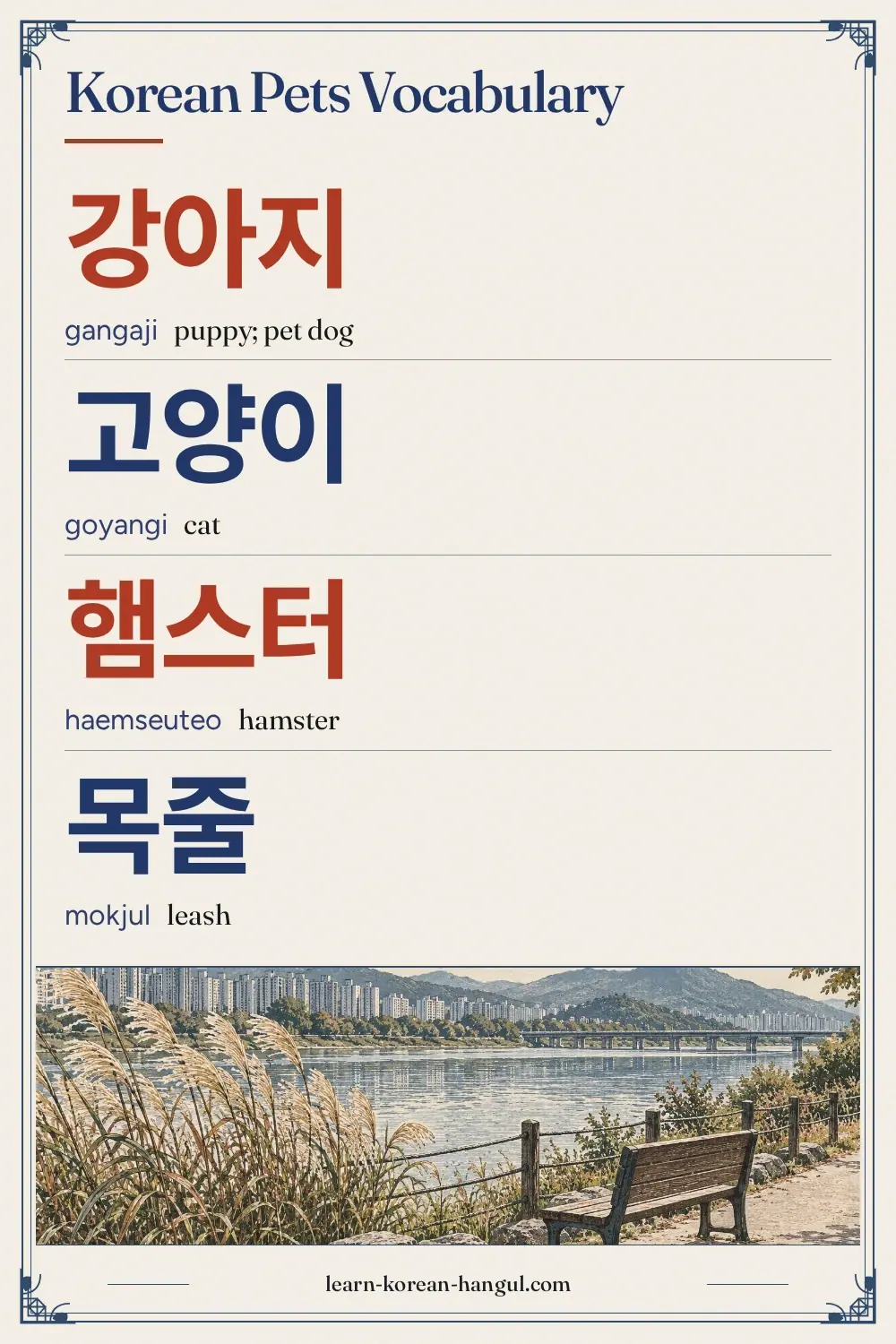
Korean Pets Vocabulary at a Glance
Pets are a friendly topic for beginners because the words are short and the sentences are simple. You can talk about your own pet, ask a new friend about theirs and understand signs at a pet shop or animal hospital. The page begins with the animals, then moves to the care words, and ends with food and items.
Most of the dog and cat words are native Korean, and the care words are mostly Sino-Korean. Both kinds appear together in everyday talk: you walk (산책) a puppy (강아지) in the morning, and you take it to the vet (동물병원) when it is sick.
The list holds 30 words. By origin, the list has 12 native, 13 Sino-Korean, 3 loanword and 2 mixed words. "Mixed" means a word that combines parts of different origins, such as 앵무새, from Sino-Korean 앵무 (鸚鵡, parrot) and native 새 (bird). Several care words, such as 예방접종 (vaccination) and 수의사 (vet), are Sino-Korean and are the same in Korean news and in shop signs.
| Group | Words | Examples |
|---|---|---|
| Dogs and cats | 8 | 반려동물, 애완동물, 강아지, 개 |
| Small pets | 7 | 햄스터, 토끼, 앵무새, 금붕어 |
| Pet care | 8 | 산책, 목줄, 동물병원, 예방접종 |
| Pet food and items | 7 | 사료, 간식, 장난감, 밥그릇 |
This page expands the pets group of Animals, which also has farm animals, wild animals and more. A wider look at the birds and insects of a garden is on the Korean Birds Vocabulary and Korean Insects Vocabulary pages.
Which Pet Words Should You Learn First?
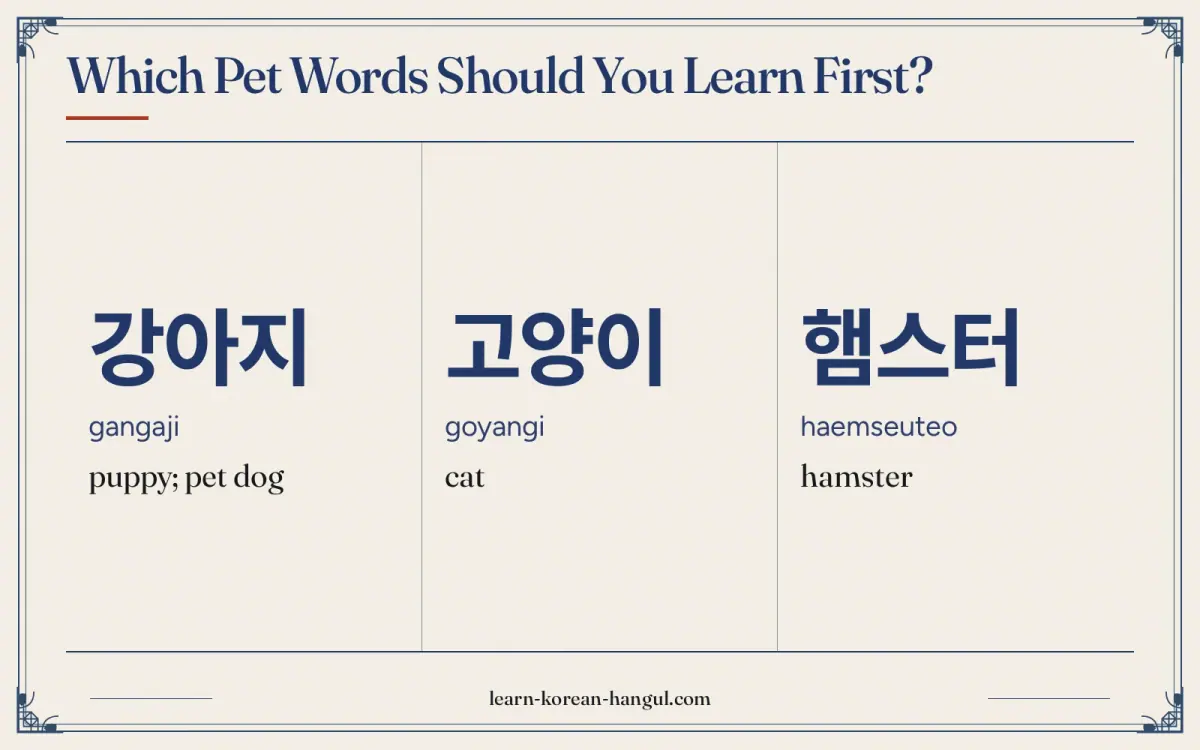
Start with five words that cover most pet talk: 강아지, 고양이, 반려동물, 산책 and 사료. Use the scene to see eight words at once, then press play and the slow button on each of the five and say the word aloud.
Word · 8
- 1
강아지
gangaji
puppy; pet dog
- 2
고양이
goyangi
cat
- 3
햄스터
haemseuteo
hamster
- 4
목줄
mokjul
leash
- 5
밥그릇
bapgeureut
food bowl
- 6
장난감
jangnangam
toy
- 7
동물병원
dongmulbyeongwon
animal hospital; vet clinic
- 8
사료
saryo
pet food; feed
강아지 (gangaji) means puppy; pet dog. It means a young dog, and it is also the usual word for a pet dog at any age. Example: 강아지가 귀여워요. (The puppy is cute.)
고양이 (goyangi) means cat. This three-syllable word is said go-yang-i. The ㅇ in the middle is the ng sound. Example: 고양이가 창가에 앉아 있어요. (The cat is sitting by the window.)
반려동물 (ballyeodongmul) means companion animal; pet. This is the modern word for a pet. Its first part 반려 means a companion who lives with you. Example: 저는 반려동물이 있어요. (I have a pet.)
산책 (sanchaek) means walk. The word is a noun, and adding 하다 makes the verb 산책하다 (to take a walk). Example: 아침에 강아지와 산책해요. (I take a walk with my puppy in the morning.)
사료 (saryo) means pet food; feed. It means food that is made for animals. Food for people is 음식. Example: 사료를 하루에 두 번 줘요. (I give pet food twice a day.)
Dogs and Cats
The first group names the animals and the words people use for them. The group has eight words. Two of them, 반려동물 and 애완동물, mean "pet", and the difference between them is explained in the next sections.
| No. | Hangul | Revised Romanization | Meaning | Origin | Example sentence | Audio assetId |
|---|---|---|---|---|---|---|
| 1 | 반려동물 | ballyeodongmul | companion animal; pet | Sino-Korean | 저는 반려동물이 있어요. (jeoneun ballyeodongmuri isseoyo; I have a pet.) | au-pg-vocabulary-nature-animals-pets-1; example: au-pg-vocabulary-nature-animals-pets-101 |
| 2 | 애완동물 | aewandongmul | pet | Sino-Korean | 애완동물을 키워요. (aewandongmureul kiwoyo; I keep a pet.) | au-pg-vocabulary-nature-animals-pets-2; example: au-pg-vocabulary-nature-animals-pets-102 |
| 3 | 강아지 | gangaji | puppy; pet dog | native | 강아지가 귀여워요. (gangajiga gwiyeowoyo; The puppy is cute.) | au-pg-vocabulary-nature-animals-pets-3; example: au-pg-vocabulary-nature-animals-pets-103 |
| 4 | 개 | gae | dog | native | 개가 짖어요. (gaega jijeoyo; The dog barks.) | au-pg-vocabulary-nature-animals-pets-4; example: au-pg-vocabulary-nature-animals-pets-104 |
| 5 | 고양이 | goyangi | cat | native | 고양이가 창가에 앉아 있어요. (goyangiga changgae anja isseoyo; The cat is sitting by the window.) | au-pg-vocabulary-nature-animals-pets-5; example: au-pg-vocabulary-nature-animals-pets-105 |
| 6 | 멍멍이 | meongmeongi | doggy | native | 우리 멍멍이는 공을 좋아해요. (uri meongmeongineun gongeul joahaeyo; Our doggy likes balls.) | au-pg-vocabulary-nature-animals-pets-6; example: au-pg-vocabulary-nature-animals-pets-106 |
| 7 | 냥이 | nyangi | kitty (casual) | native | 냥이가 밥을 먹어요. (nyangiga babeul meogeoyo; The kitty eats its meal.) | au-pg-vocabulary-nature-animals-pets-7; example: au-pg-vocabulary-nature-animals-pets-107 |
| 8 | 주인 | juin | owner | Sino-Korean | 주인이 강아지와 놀아요. (juini gangajiwa norayo; The owner plays with the puppy.) | au-pg-vocabulary-nature-animals-pets-8; example: au-pg-vocabulary-nature-animals-pets-108 |
- 강아지 is the everyday word for a pet dog, and 개 is the plain animal word. The ladder from 개 to 강아지 to 멍멍이 is explained in the animals page register note.
- 멍멍이 and 냥이 are casual pet names. Use them with friends who also have pets, not in formal writing.
- 주인 is the owner of a pet, and also the owner of a shop or a house. The sentence shows which one is meant.
Example Sentences
Pet sentences use the same few patterns. To say what the pet is or does, use pet + 이/가 + verb: 개가 짖어요 (the dog barks). To say what you do for it, use pet or item + 을/를 + verb: 사료를 줘요 (I give pet food). To say who receives something, add 에게 after the pet: 강아지에게 간식을 줘요 (I give the puppy a treat). To say where, add 에 or 에서: 동물병원에 가요 (I go to the animal hospital).
How Do You Say Small Pets in Korean?
Many people in city flats keep a small pet. The group has seven words. Two of them, 햄스터 and 기니피그, are English loanwords, and the others are native or mixed words.
| No. | Hangul | Revised Romanization | Meaning | Origin | Example sentence | Audio assetId |
|---|---|---|---|---|---|---|
| 9 | 햄스터 | haemseuteo | hamster | loanword | 햄스터는 밤에 활동해요. (haemseuteoneun bame hwaldonghaeyo; Hamsters are active at night.) | au-pg-vocabulary-nature-animals-pets-9; example: au-pg-vocabulary-nature-animals-pets-109 |
| 10 | 토끼 | tokki | rabbit | native | 토끼는 귀가 길어요. (tokkineun gwiga gireoyo; Rabbits have long ears.) | au-pg-vocabulary-nature-animals-pets-10; example: au-pg-vocabulary-nature-animals-pets-110 |
| 11 | 앵무새 | aengmusae | parrot | mixed | 앵무새가 노래를 불러요. (aengmusaega noraereul bulleoyo; The parrot sings a song.) | au-pg-vocabulary-nature-animals-pets-11; example: au-pg-vocabulary-nature-animals-pets-111 |
| 12 | 금붕어 | geumbungeo | goldfish | mixed | 금붕어가 어항에 있어요. (geumbungeoga eohange isseoyo; The goldfish is in the fishbowl.) | au-pg-vocabulary-nature-animals-pets-12; example: au-pg-vocabulary-nature-animals-pets-112 |
| 13 | 거북이 | geobugi | turtle | native | 거북이는 천천히 걸어요. (geobugineun cheoncheonhi georeoyo; Turtles walk slowly.) | au-pg-vocabulary-nature-animals-pets-13; example: au-pg-vocabulary-nature-animals-pets-113 |
| 14 | 고슴도치 | goseumdochi | hedgehog | native | 고슴도치는 가시가 있어요. (goseumdochineun gasiga isseoyo; A hedgehog has spines.) | au-pg-vocabulary-nature-animals-pets-14; example: au-pg-vocabulary-nature-animals-pets-114 |
| 15 | 기니피그 | ginipigeu | guinea pig | loanword | 기니피그는 작아요. (ginipigeuneun jagayo; Guinea pigs are small.) | au-pg-vocabulary-nature-animals-pets-15; example: au-pg-vocabulary-nature-animals-pets-115 |
- 햄스터 and 기니피그 are written as they sound in English: haem-seu-teo and gi-ni-pi-geu.
- 금붕어 joins 금 (gold) and 붕어 (crucian carp), so it is a gold-colored fish. A tank for it is an 어항.
- 거북이 is a pet in many homes, and the same animal appears in the sea animals group of the Animals page.
Pet Care
Care words appear in everyday talk and on signs. The group has eight words, and most of them are Sino-Korean. They join easily with 하다, so 산책 becomes 산책하다 (to walk), 미용 becomes 미용하다 and 훈련 becomes 훈련하다.
| No. | Hangul | Revised Romanization | Meaning | Origin | Example sentence | Audio assetId |
|---|---|---|---|---|---|---|
| 16 | 산책 | sanchaek | walk | Sino-Korean | 아침에 강아지와 산책해요. (achime gangajiwa sanchaekhaeyo; I take a walk with my puppy in the morning.) | au-pg-vocabulary-nature-animals-pets-16; example: au-pg-vocabulary-nature-animals-pets-116 |
| 17 | 목줄 | mokjul | leash | native | 목줄이 길어요. (mokjuri gireoyo; The leash is long.) | au-pg-vocabulary-nature-animals-pets-17; example: au-pg-vocabulary-nature-animals-pets-117 |
| 18 | 동물병원 | dongmulbyeongwon | animal hospital; vet clinic | Sino-Korean | 동물병원에 가요. (dongmulbyeongwone gayo; I go to the animal hospital.) | au-pg-vocabulary-nature-animals-pets-18; example: au-pg-vocabulary-nature-animals-pets-118 |
| 19 | 예방접종 | yebangjeopjong | vaccination | Sino-Korean | 강아지가 예방접종을 맞아요. (gangajiga yebangjeopjongeul majayo; The puppy gets a vaccination.) | au-pg-vocabulary-nature-animals-pets-19; example: au-pg-vocabulary-nature-animals-pets-119 |
| 20 | 미용 | miyong | grooming | Sino-Korean | 강아지 미용을 해요. (gangaji miyongeul haeyo; I get the puppy groomed.) | au-pg-vocabulary-nature-animals-pets-20; example: au-pg-vocabulary-nature-animals-pets-120 |
| 21 | 목욕 | mogyok | bath | Sino-Korean | 강아지를 목욕시켜요. (gangajireul mogyoksikyeoyo; I give the puppy a bath.) | au-pg-vocabulary-nature-animals-pets-21; example: au-pg-vocabulary-nature-animals-pets-121 |
| 22 | 훈련 | hullyeon | training | Sino-Korean | 강아지 훈련이 어려워요. (gangaji hullyeoni eoryeowoyo; Training a puppy is hard.) | au-pg-vocabulary-nature-animals-pets-22; example: au-pg-vocabulary-nature-animals-pets-122 |
| 23 | 수의사 | suuisa | veterinarian | Sino-Korean | 수의사가 강아지를 봐요. (suuisaga gangajireul bwayo; The vet examines the puppy.) | au-pg-vocabulary-nature-animals-pets-23; example: au-pg-vocabulary-nature-animals-pets-123 |
- 산책 is the word you hear most with a dog: 산책 가요? (Shall we go for a walk?)
- 동물병원 joins 동물 (animal) and 병원 (hospital). A doctor for people is a 의사, and a vet is a 수의사.
- 목욕시켜요 means "I give someone a bath", and 목욕해요 means "I take a bath". The verb 시키다 (to make someone do) shows that you bathe the dog, not yourself.
How Do You Say Pet Food and Items in Korean?
The last group lists food and items you buy for a pet. The group has seven words. Most of them are compounds, which makes them easy to learn: 밥 (rice, meal) + 그릇 (bowl) is a food bowl, and 물 (water) + 그릇 (bowl) is a water bowl.
| No. | Hangul | Revised Romanization | Meaning | Origin | Example sentence | Audio assetId |
|---|---|---|---|---|---|---|
| 24 | 사료 | saryo | pet food; feed | Sino-Korean | 사료를 하루에 두 번 줘요. (saryoreul harue du beon jwoyo; I give pet food twice a day.) | au-pg-vocabulary-nature-animals-pets-24; example: au-pg-vocabulary-nature-animals-pets-124 |
| 25 | 간식 | gansik | snack; treat | Sino-Korean | 강아지에게 간식을 줘요. (gangajiege gansigeul jwoyo; I give the puppy a treat.) | au-pg-vocabulary-nature-animals-pets-25; example: au-pg-vocabulary-nature-animals-pets-125 |
| 26 | 장난감 | jangnangam | toy | native | 고양이가 장난감을 좋아해요. (goyangiga jangnangameul joahaeyo; The cat likes toys.) | au-pg-vocabulary-nature-animals-pets-26; example: au-pg-vocabulary-nature-animals-pets-126 |
| 27 | 밥그릇 | bapgeureut | food bowl | native | 밥그릇이 비었어요. (bapgeureusi bieosseoyo; The food bowl is empty.) | au-pg-vocabulary-nature-animals-pets-27; example: au-pg-vocabulary-nature-animals-pets-127 |
| 28 | 물그릇 | mulgeureut | water bowl | native | 물그릇에 물을 채워요. (mulgeureuse mureul chaewoyo; I fill the water bowl with water.) | au-pg-vocabulary-nature-animals-pets-28; example: au-pg-vocabulary-nature-animals-pets-128 |
| 29 | 방석 | bangseok | cushion; pet bed | Sino-Korean | 고양이가 방석 위에서 자요. (goyangiga bangseok wieseo jayo; The cat sleeps on the cushion.) | au-pg-vocabulary-nature-animals-pets-29; example: au-pg-vocabulary-nature-animals-pets-129 |
| 30 | 케이지 | keiji | cage | loanword | 햄스터 케이지를 청소해요. (haemseuteo keijireul cheongsohaeyo; I clean the hamster cage.) | au-pg-vocabulary-nature-animals-pets-30; example: au-pg-vocabulary-nature-animals-pets-130 |
- 사료 is the word on the bag at a pet shop, and 간식 is the treat you use in training.
- The verb 주다 (to give) is the key verb for feeding: 사료를 줘요 means "I give food". The person or animal who receives it takes 에게 or 한테.
- 케이지 is a loanword from English.
반려동물 and 애완동물: Two Words for Pet
Two Korean words mean "pet", and they carry different feelings.
| Word | Revised Romanization | Literal parts | Feel |
|---|---|---|---|
| 애완동물 | aewandongmul | 애완 (to cherish and play with) + 동물 (animal) | older word; it treats the animal as a thing you play with |
| 반려동물 | ballyeodongmul | 반려 (companion) + 동물 (animal) | the modern word; it treats the animal as a family companion |
Today 반려동물 is widely preferred. The older 애완동물 is still understood and appears in older books and shop signs. You can use either in speech, but 반려동물 is the safer word for a new learner. Related words use the same stem: 반려견 (companion dog) and 반려묘 (companion cat). The first part 반려 comes from Chinese-derived syllables, so the whole word is Sino-Korean.
To ask about a pet, say 반려동물이 있어요? (Do you have a pet?). The answer can be as short as 네, 강아지가 있어요 (Yes, I have a puppy).
Counting Your Pets
To say how many pets you have, use the animal counter 마리. The pattern is the pet, then 이/가, then the native number, then 마리, then 있어요.
- 고양이가 한 마리 있어요. (goyangiga han mari isseoyo; I have one cat.)
- 강아지가 두 마리 있어요. (gangajiga du mari isseoyo; I have two puppies.)
- 햄스터가 세 마리 있어요. (haemseuteoga se mari isseoyo; I have three hamsters.)
Numbers one to four shorten before a counter: 한, 두, 세, 네. The full lesson on counters for animals covers the number forms and the other animal counters.
At the Vet
A visit to the 동물병원 (animal hospital) is a common reason to need pet words. The vet is the 수의사, and the vaccination is 예방접종. Four short sentences are enough to explain the problem, ask for a vaccination and follow the advice.
| Sentence | Revised Romanization | Meaning | Audio assetId |
|---|---|---|---|
| 강아지가 아파요. | gangajiga apayo | The puppy is sick. | au-pg-vocabulary-nature-animals-pets-601 |
| 예방접종을 하고 싶어요. | yebangjeopjongeul hago sipeoyo | I want to get a vaccination. | au-pg-vocabulary-nature-animals-pets-602 |
| 하루에 두 번 사료를 줘요. | harue du beon saryoreul jwoyo | I give pet food twice a day. | au-pg-vocabulary-nature-animals-pets-603 |
| 다음 주에 또 오세요. | daeum jue tto oseyo | Please come again next week. | au-pg-vocabulary-nature-animals-pets-604 |
The ending -고 싶어요 means "I want to", and here it follows 하다 (to do): 예방접종을 하고 싶어요. The ending 세요 in 오세요 is the polite request form, so 오세요 means "please come". Both patterns are taught in the grammar pages, and here you only need them as ready phrases.
How Do You Pronounce These Words?
Pet words have a few sound changes to practise. The table lists five words, following the Standard Pronunciation rules (표준 발음법) of the 국립국어원.
| Word | Romanization | Said | Rule |
|---|---|---|---|
| 반려동물 | ballyeodongmul | [발려동물] | ㄴ before ㄹ becomes ㄹ, so 반려 is said bal-lyeo |
| 고양이 | goyangi | [고양이] | ㅇ in the middle is the ng sound, and the last 이 is said clearly |
| 산책 | sanchaek | [산책] | the final ㄱ of 책 is held short and not released |
| 예방접종 | yebangjeopjong | [예방접쫑] | ㅈ after final ㅂ becomes tense |
| 장난감 | jangnangam | [장난깜] | the ㄱ of 감 is said tense in this word |
Revised Romanization is the official romanization system of South Korea, announced on 7 July 2000. It follows most sound changes, such as linking and nasalization, and it spells the written double letters (ㄲ as kk), but it does not show tensing caused by a neighbouring sound: 예방접종 is said [예방접쫑] but written yebangjeopjong. It is a learning aid, so always read the Hangul as well.
Audio and Slow Playback
Each headword and each example sentence has its own audio clip, and the five words in the learn-first section also have a slow clip at 0.8 times the speed. Nothing plays until you press a button. Listen once, repeat aloud, and only then check the romanization.
What Mistakes Do Learners Make with Pet Words?
- Saying 개 for a pet dog in every sentence. 강아지 sounds warmer when you talk about a pet.
- Using 애완동물 as the only word for pet. It is understood, but 반려동물 is the more modern choice.
- Using 명 to count pets. Pets are counted with 마리: 고양이가 한 마리 있어요.
- Dropping 에게 or 한테 for the animal that receives something. Without it, 강아지 간식 can sound like "puppy treats", so say 강아지에게 간식을 줘요 (I give the puppy a treat).
- Reading the romanization instead of the sounds. Words such as 예방접종 contain a tense sound, but Revised Romanization shows only yebangjeopjong.
Practice: Flashcards and Worksheet
Drill these 30 words with the vocabulary flashcard decks: each card shows the Hangul on one side and the meaning on the other, so you can test recall instead of recognition. Print a labelling sheet from the vocabulary worksheets and write the Korean word for each numbered object in the scene above. A simple plan is to learn six words a day, one group at a time.
Korean Pets Worksheet
Try this five-question check, then say the words aloud once more.
Practice · 5
What does 반려동물 mean?
Show answer
companion animal; pet
반려동물 (ballyeodongmul) means companion animal; pet.
What does 냥이 mean?
Show answer
kitty (casual)
냥이 (nyangi) means kitty (casual).
What does 거북이 mean?
Show answer
turtle
거북이 (geobugi) means turtle.
What does 예방접종 mean?
Show answer
vaccination
예방접종 (yebangjeopjong) means vaccination.
What does 간식 mean?
Show answer
snack; treat
간식 (gansik) means snack; treat.
Self-Test: 10 Sentences
Fill each blank with a word from this page. Say the whole sentence aloud when you have it. The answers follow the test.
- 저는 ___이 있어요. (I have a pet.)
- ___가 귀여워요. (The puppy is cute.)
- ___가 밥을 먹어요. (The kitty eats its meal.)
- ___는 귀가 길어요. (Rabbits have long ears.)
- ___는 천천히 걸어요. (Turtles walk slowly.)
- 아침에 강아지와 ___해요. (I take a walk with my puppy in the morning.)
- 강아지가 ___을 맞아요. (The puppy gets a vaccination.)
- 강아지 ___이 어려워요. (Training a puppy is hard.)
- 강아지에게 ___을 줘요. (I give the puppy a treat.)
- ___에 물을 채워요. (I fill the water bowl with water.)
Answers: 1. 반려동물; 2. 강아지; 3. 냥이; 4. 토끼; 5. 거북이; 6. 산책; 7. 예방접종; 8. 훈련; 9. 간식; 10. 물그릇.
A score of 8 or more suggests the words are settling in. If you scored lower, reread the groups where you missed words.
Where to Go Next
After pets, many learners move on to the other animal pages, such as Korean Wild Animals Vocabulary and Korean Farm Animals Vocabulary. This list sits inside Animals.
Related pages:
- dog in korean: a single-word entry with pronunciation notes, usage and more example sentences.
- cat in korean: a single-word entry with pronunciation notes, usage and more example sentences.
- puppy in korean: a single-word entry with pronunciation notes, usage and more example sentences.
Frequently Asked Questions
How Do You Say Puppy in Korean?
Say 강아지 (gangaji). It means a young dog and is also the usual word for a pet dog of any age. The plain animal word is 개 (gae), and the casual nickname is 멍멍이 (meongmeongi). For a full word entry, see puppy in korean.
How Do You Pronounce 고양이 (goyangi)?
Say go-yang-i with even beats. The first sound is a plain g, the middle ㅇ is the ng sound, as in the English word "sing", and the last syllable is a clear ee. Press the audio button to hear it, then say it slowly twice. The word entry is cat in korean.
How Many Pet Words Should I Learn First?
Learn the five starter words, 강아지, 고양이, 반려동물, 산책 and 사료. They let you say that you have a pet and what you do with it. Then add the care and food groups, six words a day, with a short review of the older words.
Where Can I Practise Pet Words with Flashcards?
Use the vocabulary flashcard decks. Start with the dogs and cats, then add one group a day. Review the older cards before you add new ones, so the earlier words do not fade.
Is the Romanization on This Page Official?
Yes, as a learning aid. It follows the Revised Romanization of Korean, the system South Korea has officially used since 7 July 2000, and the page also gives the Hangul for every word. It follows most sound changes but does not show tensing: 예방접종 is written yebangjeopjong but the last ㅈ is said tense. Treat the Hangul as the real spelling.
Is There a Printable Worksheet for Pet Words?
The vocabulary worksheets page lists the printable sheets. The sheet for this topic is a labelling task built on the same illustrated scene as this page, so you write the Korean word next to each numbered object.