Korean Sea Animals Vocabulary at a Glance
Korea is surrounded by water on three sides, so sea animals show up in conversation, school books, markets and menus. A learner who knows the animal names can follow a visit to an aquarium, read a fish-market sign and order seafood with confidence. This list begins with fish, then moves to the large sea mammals, shelled animals, soft-bodied animals and the words for an aquarium visit. It sits in Animals. If your goal is cooking or eating, the Korean Seafood Vocabulary page covers the food side, and the beach and market words are on Korean Ocean and Beach Vocabulary.
| Group | Words | Use |
|---|---|---|
| Fish | 6 | Living fish and the fish that become food |
| Sea mammals | 6 | Whales, dolphins, seals and walruses |
| Shellfish | 6 | Clams, oysters, crabs and shrimp |
| Jellyfish and octopus | 6 | Soft-bodied sea animals |
| Aquarium words | 6 | Tanks, fins, scales, coral and turtles |
Which Sea Animal Names Should You Learn First?
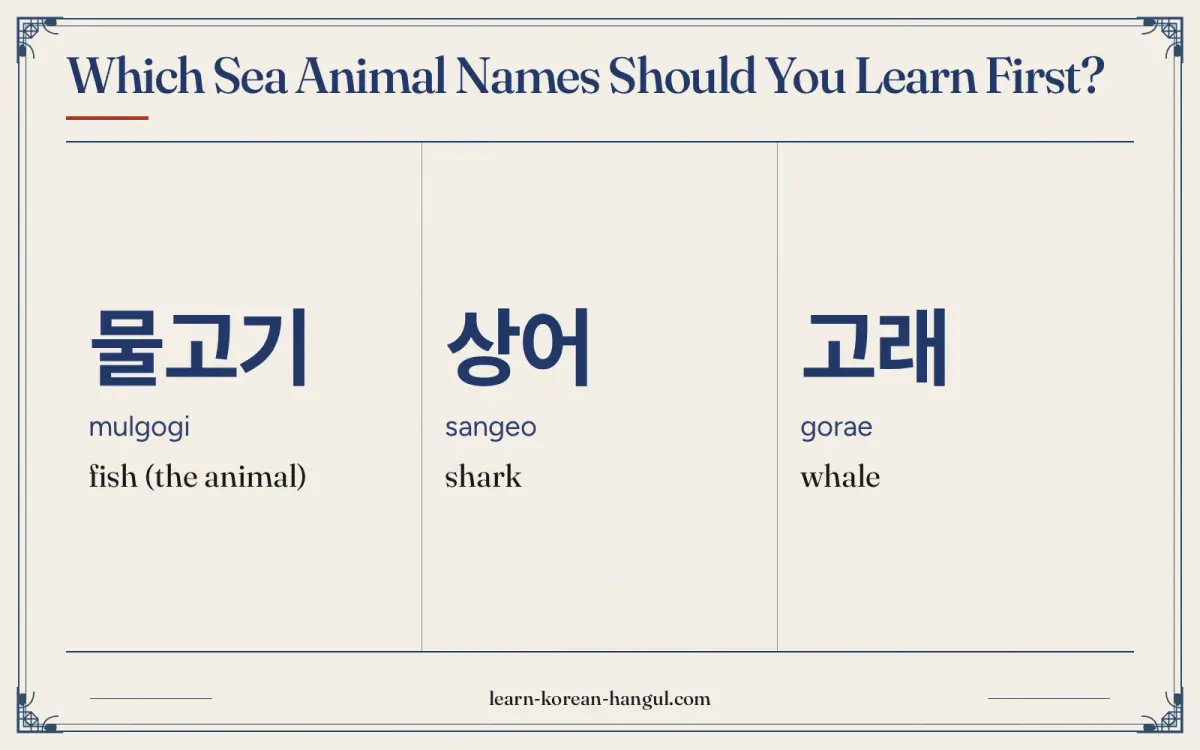
Learn 물고기, 고래, 상어, 게, 새우 and 오징어 first. They are the sea animals that children's books, aquariums and menus mention most, and the first three are easy to say. After that, add 수족관 so that you can talk about where you saw them.
- Words to say. 물고기, 고래, 상어, 게, 새우, 수족관.
- Words to recognise. 생선, 문어, 낙지, 전복. They show up on menus and at fish markets.
- Words to match. 지느러미, 비늘, 산호. Match them to a picture of a reef and they become easy to recall.
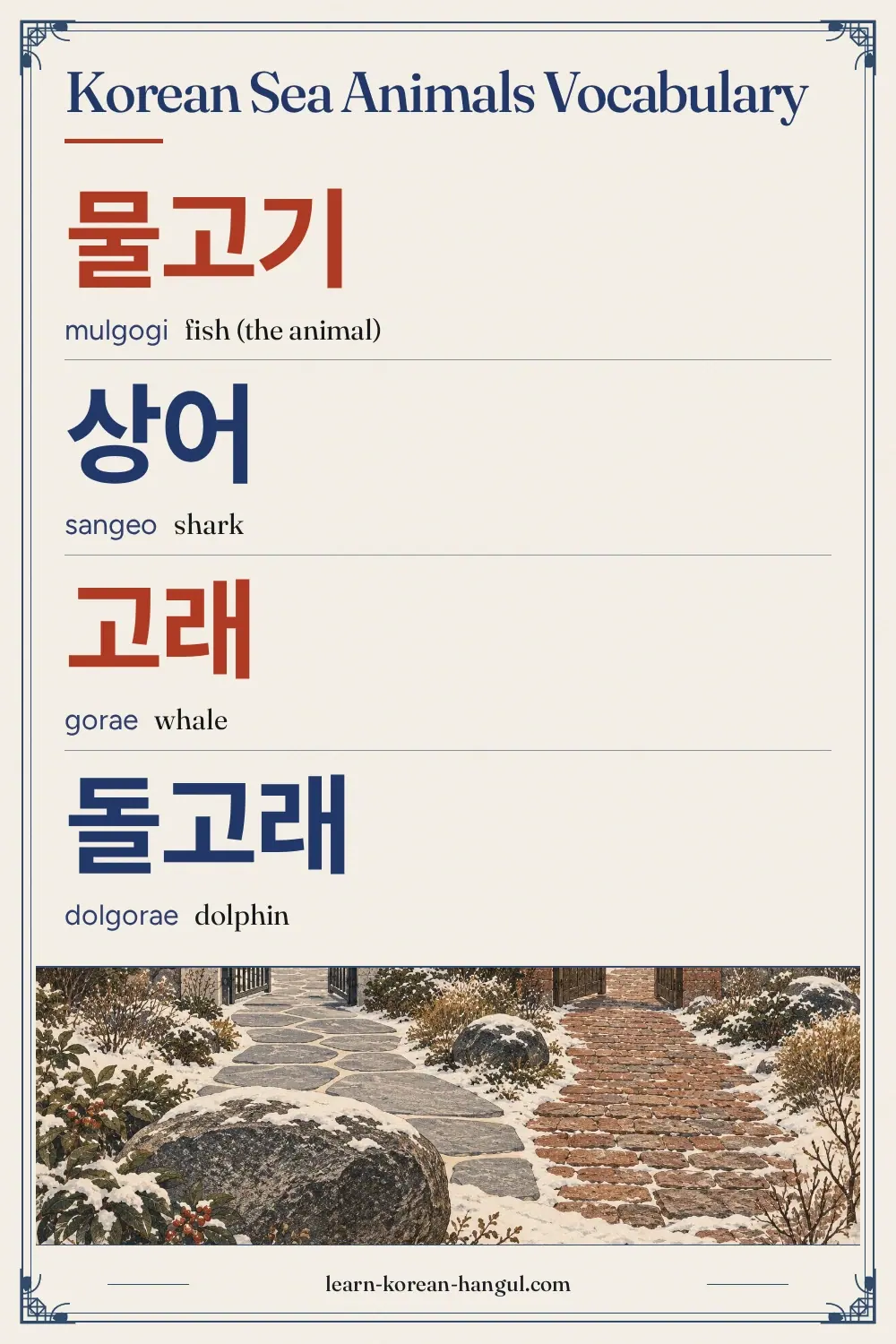
The most important distinction on this page is 물고기 versus 생선. 물고기 is a living fish, the animal in the water. 생선 is a fish that is sold, cooked or eaten. A Korean says 물고기가 헤엄쳐요 for a swimming fish and 생선을 구워요 for grilling a fish. The scene below shows an underwater view with numbered animals that match the list.
Word · 10
- 1
물고기
mulgogi
fish (the animal)
- 2
상어
sangeo
shark
- 3
고래
gorae
whale
- 4
돌고래
dolgorae
dolphin
- 5
물개
mulgae
fur seal; seal
- 6
새우
saeu
shrimp; prawn
- 7
해파리
haepari
jellyfish
- 8
문어
muneo
octopus
- 9
수족관
sujokgwan
aquarium
- 10
바다거북
badageobuk
sea turtle
Fish
Six words cover the fish you meet most. 물고기 is the general word and 생선 is the food word. 상어 is the shark, which is the fish most children want to learn first. 고등어, 연어 and 참치 are the mackerel, the salmon and the tuna, three fish that are as common on a Korean table as in a Korean sea. Notice that these three are fish that people eat, so their names do double duty as the name of an animal and of a dish.
| No. | Hangul | Revised Romanization | Meaning and note | Example sentence | Audio assetId |
|---|---|---|---|---|---|
| 1 | 물고기 | mulgogi | fish (the animal). 물 is water and 고기 is meat or flesh, so the word is literally water meat. The usual word for a living fish. | 물고기가 헤엄쳐요. (The fish swims.) | au-pg-vocabulary-nature-animals-sea-animals-1; example: au-pg-vocabulary-nature-animals-sea-animals-31 |
| 2 | 생선 | saengseon | fish (as food). Used in the market and the kitchen. A grilled fish is 생선구이, a word you will see on menus. | 생선을 구워요. (I grill fish.) | au-pg-vocabulary-nature-animals-sea-animals-2; example: au-pg-vocabulary-nature-animals-sea-animals-32 |
| 3 | 상어 | sangeo | shark. No sound change: 상 ends in the ㅇ sound, so nothing links across. The fin is 지느러미. | 상어는 무서워요. (Sharks are scary.) | au-pg-vocabulary-nature-animals-sea-animals-3; example: au-pg-vocabulary-nature-animals-sea-animals-33 |
| 4 | 고등어 | godeungeo | mackerel. A common home-cooked fish, often grilled or simmered. | 저녁에 고등어를 먹어요. (I eat mackerel in the evening.) | au-pg-vocabulary-nature-animals-sea-animals-4; example: au-pg-vocabulary-nature-animals-sea-animals-34 |
| 5 | 연어 | yeoneo | salmon. The same word is used for the fish in the river and the pink slices at a sushi counter. | 연어를 좋아해요. (I like salmon.) | au-pg-vocabulary-nature-animals-sea-animals-5; example: au-pg-vocabulary-nature-animals-sea-animals-35 |
| 6 | 참치 | chamchi | tuna. 참 means true. A tin of tuna is 참치 캔, and tuna rice rolls are 참치 김밥. | 참치 김밥을 먹어요. (I eat tuna rice rolls.) | au-pg-vocabulary-nature-animals-sea-animals-6; example: au-pg-vocabulary-nature-animals-sea-animals-36 |
Example Sentences
Sea animal sentences use three simple frames. The first is animal + 가 + verb, as in 물고기가 헤엄쳐요 (the fish swims). The second is food + 을 + verb, as in 생선을 구워요 (I grill fish). The third is animal + 는 + adjective, as in 상어는 무서워요 (sharks are scary). The verb 먹다 (to eat) joins the food frame, and the verb 살다 (to live) joins the animal frame: 고래는 바다에 살아요. Read each sentence aloud after its audio.
The next group holds the animals that look like fish but are not.
How Do You Say Mammals in Korean?
Sea mammals breathe air and give birth to live young, though they look like fish at a glance. 고래 is the whale, 돌고래 is the dolphin and 범고래 is the orca. 물개 and 바다표범 are the seals, and 바다코끼리 is the walrus. Look at the compound words: 범고래 is a tiger whale, 바다표범 is a sea leopard and 바다코끼리 is a sea elephant. Korean often builds a new animal name by adding a word for a familiar animal to 바다 or 고래.
| No. | Hangul | Revised Romanization | Meaning and note | Example sentence | Audio assetId |
|---|---|---|---|---|---|
| 7 | 고래 | gorae | whale. The whale is a favourite of children's books. Its name is the base of the dolphin and orca names below. | 고래는 바다에 살아요. (Whales live in the sea.) | au-pg-vocabulary-nature-animals-sea-animals-7; example: au-pg-vocabulary-nature-animals-sea-animals-37 |
| 8 | 돌고래 | dolgorae | dolphin. A dolphin show is 돌고래 쇼. Built on 고래, but a dolphin is a separate animal. | 돌고래가 점프해요. (The dolphin jumps.) | au-pg-vocabulary-nature-animals-sea-animals-8; example: au-pg-vocabulary-nature-animals-sea-animals-38 |
| 9 | 물개 | mulgae | fur seal; seal. The name used at aquarium shows. A seal that performs is usually a 물개. | 물개가 박수를 쳐요. (The seal claps.) | au-pg-vocabulary-nature-animals-sea-animals-9; example: au-pg-vocabulary-nature-animals-sea-animals-39 |
| 10 | 바다표범 | badapyobeom | seal (true seal). Literally sea leopard, since 표범 is leopard. Lives on ice or on coasts in cold regions. | 바다표범은 얼음 위에 있어요. (The seal is on the ice.) | au-pg-vocabulary-nature-animals-sea-animals-10; example: au-pg-vocabulary-nature-animals-sea-animals-40 |
| 11 | 바다코끼리 | badakokkiri | walrus. Literally sea elephant, since 코끼리 is elephant. Famous for its tusks. | 바다코끼리는 크고 무거워요. (The walrus is big and heavy.) | au-pg-vocabulary-nature-animals-sea-animals-11; example: au-pg-vocabulary-nature-animals-sea-animals-41 |
| 12 | 범고래 | beomgorae | orca; killer whale. Literally tiger whale, since 범 is a native Korean word for tiger. | 범고래는 빨라요. (Orcas are fast.) | au-pg-vocabulary-nature-animals-sea-animals-12; example: au-pg-vocabulary-nature-animals-sea-animals-42 |
Learn 고래 first, and the rest of the group builds on it. When you see a new animal ending in 고래, you can guess it is a kind of whale.
Shellfish
Shelled animals are a large part of Korean seafood. 조개 is the general word for clam or shellfish, and 굴, 전복 and 홍합 are the oyster, the abalone and the mussel. 게 is the crab and 새우 is the shrimp, and strictly they are crustaceans, but Koreans group them with the shellfish at a market. These are some of the first words a visitor to a coastal town needs, since a tank outside a restaurant shows them live.
| No. | Hangul | Revised Romanization | Meaning and note | Example sentence | Audio assetId |
|---|---|---|---|---|---|
| 13 | 조개 | jogae | clam; shellfish. The general word for shellfish with two shells. | 조개가 모래 속에 있어요. (The clam is in the sand.) | au-pg-vocabulary-nature-animals-sea-animals-13; example: au-pg-vocabulary-nature-animals-sea-animals-43 |
| 14 | 굴 | gul | oyster. The same spelling is a cave. With 을 it is 굴을 [구를]. | 겨울에 굴을 먹어요. (In winter I eat oysters.) | au-pg-vocabulary-nature-animals-sea-animals-14; example: au-pg-vocabulary-nature-animals-sea-animals-44 |
| 15 | 전복 | jeonbok | abalone. A prized shellfish, often given as a gift or served on special days. | 전복은 비싸요. (Abalone is expensive.) | au-pg-vocabulary-nature-animals-sea-animals-15; example: au-pg-vocabulary-nature-animals-sea-animals-45 |
| 16 | 홍합 | honghap | mussel. 홍합탕 is mussel soup, a simple dish in winter. | 홍합 국물을 마셔요. (I drink the mussel broth.) | au-pg-vocabulary-nature-animals-sea-animals-16; example: au-pg-vocabulary-nature-animals-sea-animals-46 |
| 17 | 게 | ge | crab. A one-syllable word. Crabs walk sideways, as the sentence says. | 게는 옆으로 걸어요. (Crabs walk sideways.) | au-pg-vocabulary-nature-animals-sea-animals-17; example: au-pg-vocabulary-nature-animals-sea-animals-47 |
| 18 | 새우 | saeu | shrimp; prawn. The same word is the animal and the food. | 새우를 먹어요. (I eat shrimp.) | au-pg-vocabulary-nature-animals-sea-animals-18; example: au-pg-vocabulary-nature-animals-sea-animals-48 |
Ask whether a menu item is the animal or the dish only when the sentence is unclear. In most cases the same word covers both.
How Do You Say Jellyfish and Octopus in Korean?
Soft-bodied animals have no shell. 해파리 is the jellyfish and 불가사리 is the starfish. 성게 is the sea urchin, a spiny animal that is also eaten. 문어 is the large octopus, 낙지 is the small octopus and 오징어 is the squid. The three tentacled animals are easy to mix up, and the size rule helps: 문어 is big, 낙지 is small and thin, and 오징어 has a long body with ten arms.
| No. | Hangul | Revised Romanization | Meaning and note | Example sentence | Audio assetId |
|---|---|---|---|---|---|
| 19 | 해파리 | haepari | jellyfish. Jellyfish appear on beaches in summer, and a warning sign is common. | 해파리가 바다에 떠 있어요. (A jellyfish is floating in the sea.) | au-pg-vocabulary-nature-animals-sea-animals-19; example: au-pg-vocabulary-nature-animals-sea-animals-49 |
| 20 | 문어 | muneo | octopus. The large octopus with eight arms. 문어숙회 is a boiled octopus dish. | 문어는 다리가 여덟 개예요. (An octopus has eight legs.) | au-pg-vocabulary-nature-animals-sea-animals-20; example: au-pg-vocabulary-nature-animals-sea-animals-50 |
| 21 | 오징어 | ojingeo | squid. Both the animal and the food. Dried squid is a classic snack. | 오징어는 먹물이 있어요. (Squid have ink.) | au-pg-vocabulary-nature-animals-sea-animals-21; example: au-pg-vocabulary-nature-animals-sea-animals-51 |
| 22 | 낙지 | nakji | small octopus. Said [낙찌]. A thinner octopus eaten in spicy stir-fries. | 낙지는 작아요. (A nakji is small.) | au-pg-vocabulary-nature-animals-sea-animals-22; example: au-pg-vocabulary-nature-animals-sea-animals-52 |
| 23 | 불가사리 | bulgasari | starfish. A star-shaped animal on rocks and in tide pools. | 불가사리는 별 모양이에요. (A starfish is star-shaped.) | au-pg-vocabulary-nature-animals-sea-animals-23; example: au-pg-vocabulary-nature-animals-sea-animals-53 |
| 24 | 성게 | seongge | sea urchin. Round and spiny. The edible part is the orange roe. | 성게는 가시가 있어요. (Sea urchins have spines.) | au-pg-vocabulary-nature-animals-sea-animals-24; example: au-pg-vocabulary-nature-animals-sea-animals-54 |
Both 문어 and 오징어 are also the names of dishes. If you see 오징어 on a menu, it is squid served in some form.
Aquarium Words
The last group gives the words for a visit to an aquarium. 수족관 is the aquarium and 어항 is a fish bowl. 지느러미 is a fin and 비늘 is a scale. 산호 is coral, and 바다거북 is the sea turtle that swims past in the big tank. A school trip to a 수족관 is a common memory for Korean children, and these are the words they use in the drawing they bring home.
| No. | Hangul | Revised Romanization | Meaning and note | Example sentence | Audio assetId |
|---|---|---|---|---|---|
| 25 | 수족관 | sujokgwan | aquarium. Said [수족꽌]. 수족 means water creatures and 관 is a building. | 수족관에서 물고기를 봐요. (I look at fish at the aquarium.) | au-pg-vocabulary-nature-animals-sea-animals-25; example: au-pg-vocabulary-nature-animals-sea-animals-55 |
| 26 | 어항 | eohang | fish bowl; fish tank. A second 어항 means a fishing harbour. The sentence tells you which one. | 어항에 금붕어가 있어요. (There are goldfish in the fish bowl.) | au-pg-vocabulary-nature-animals-sea-animals-26; example: au-pg-vocabulary-nature-animals-sea-animals-56 |
| 27 | 지느러미 | jineureomi | fin. Fish and whales have fins. A shark's fin is the best-known. | 상어는 지느러미가 커요. (Sharks have big fins.) | au-pg-vocabulary-nature-animals-sea-animals-27; example: au-pg-vocabulary-nature-animals-sea-animals-57 |
| 28 | 비늘 | bineul | scale (of a fish). Small, hard plates on the skin of a fish. | 물고기는 비늘이 있어요. (Fish have scales.) | au-pg-vocabulary-nature-animals-sea-animals-28; example: au-pg-vocabulary-nature-animals-sea-animals-58 |
| 29 | 산호 | sanho | coral. Coral reefs form in warm seas. Aquariums show them in colourful tanks. | 산호는 아름다워요. (Coral is beautiful.) | au-pg-vocabulary-nature-animals-sea-animals-29; example: au-pg-vocabulary-nature-animals-sea-animals-59 |
| 30 | 바다거북 | badageobuk | sea turtle. 거북 is turtle. With 이 it is [바다거부기]. | 바다거북이 알을 낳아요. (A sea turtle lays eggs.) | au-pg-vocabulary-nature-animals-sea-animals-30; example: au-pg-vocabulary-nature-animals-sea-animals-60 |
Use 수족관 for a large public aquarium and 어항 for a small tank at home or in a shop.
How Do You Pronounce These Words?
Most sea animal names are said as written. A few have a tense sound or a linking sound (even 물고기, the first word on the list), and 먹물 changes its first consonant to a nasal. Standard pronunciation follows the National Institute of Korean Language (국립국어원) rules, and the romanization follows the Revised Romanization of Korean, which does not show tensing caused by a neighbouring sound.
| Spelling | Sounds like | What changes |
|---|---|---|
| 물고기 | [물꼬기] | The ㄱ of 고기 is said tense [ㄲ] in this compound; the spelling and the romanization mulgogi do not show it. |
| 수족관 | [수족꽌] | After final ㄱ, ㄱ becomes tense [ㄲ]. |
| 낙지 | [낙찌] | After final ㄱ, ㅈ becomes tense [ㅉ]. |
| 먹물 | [멍물] | The final ㄱ becomes ㅇ before ㅁ. |
| 바다거북이 | [바다거부기] | The final ㄱ links to the vowel of 이. |
| 굴을 | [구를] | The final ㄹ links to the vowel of 을. |
| 전복을 | [전보글] | The final ㄱ links to the vowel of 을. |
The tense sounds in 물고기, 수족관 and 낙지 are the hardest. Close your throat slightly and say the sound without a puff of air. Compare the plain ㅈ in 조개.
Audio and Slow Playback
Each word and sentence has its own clip. The five clips below replay the hardest words slowly. Play one, repeat it aloud, then play it again and compare.
What Mistakes Do Learners Make with Sea Animal Names?
Five mistakes come up again and again.
- Using 생선 for a living fish. 생선 is fish as food. For the animal in the water, say 물고기.
- Mixing up 문어, 낙지 and 오징어. 문어 is the big octopus, 낙지 is the small octopus and 오징어 is the squid.
- Calling every seal 물개. 물개 is the fur seal and the aquarium seal, and 바다표범 is the true seal of cold coasts.
- Saying 굴 for both oyster and cave without context. 굴 is both. A sentence about eating means oyster.
- Skipping the tense sound in 수족관. Say [수족꽌], not [수족관].
The practice section turns the list into drills.
Practice: Flashcards and Worksheet
Use three steps. Run the flashcard deck in recognition mode until the 30 words come quickly. Switch to listening mode, then take the quiz. The deck holds every word on this page with audio, and your progress stays in your browser. The vocabulary flashcard decks page lists the other decks.
Practice · 65
- 01물고기
Show answer
headword 1: fish (the animal)
- 02생선
Show answer
headword 2: fish (as food)
- 03상어
Show answer
headword 3: shark
- 04고등어
Show answer
headword 4: mackerel
- 05연어
Show answer
headword 5: salmon
- 06참치
Show answer
headword 6: tuna
- 07고래
Show answer
headword 7: whale
- 08돌고래
Show answer
headword 8: dolphin
- 09물개
Show answer
headword 9: fur seal; seal
- 10바다표범
Show answer
headword 10: seal (true seal)
- 11바다코끼리
Show answer
headword 11: walrus
- 12범고래
Show answer
headword 12: orca; killer whale
- 13조개
Show answer
headword 13: clam; shellfish
- 14굴
Show answer
headword 14: oyster
- 15전복
Show answer
headword 15: abalone
- 16홍합
Show answer
headword 16: mussel
- 17게
Show answer
headword 17: crab
- 18새우
Show answer
headword 18: shrimp; prawn
- 19해파리
Show answer
headword 19: jellyfish
- 20문어
Show answer
headword 20: octopus
- 21오징어
Show answer
headword 21: squid
- 22낙지
Show answer
headword 22: small octopus
- 23불가사리
Show answer
headword 23: starfish
- 24성게
Show answer
headword 24: sea urchin
- 25수족관
Show answer
headword 25: aquarium
- 26어항
Show answer
headword 26: fish bowl; fish tank
- 27지느러미
Show answer
headword 27: fin
- 28비늘
Show answer
headword 28: scale (of a fish)
- 29산호
Show answer
headword 29: coral
- 30바다거북
Show answer
headword 30: sea turtle
- 31물고기가 헤엄쳐요.
Show answer
example sentence for 물고기
- 32생선을 구워요.
Show answer
example sentence for 생선
- 33상어는 무서워요.
Show answer
example sentence for 상어
- 34저녁에 고등어를 먹어요.
Show answer
example sentence for 고등어
- 35연어를 좋아해요.
Show answer
example sentence for 연어
- 36참치 김밥을 먹어요.
Show answer
example sentence for 참치
- 37고래는 바다에 살아요.
Show answer
example sentence for 고래
- 38돌고래가 점프해요.
Show answer
example sentence for 돌고래
- 39물개가 박수를 쳐요.
Show answer
example sentence for 물개
- 40바다표범은 얼음 위에 있어요.
Show answer
example sentence for 바다표범
- 41바다코끼리는 크고 무거워요.
Show answer
example sentence for 바다코끼리
- 42범고래는 빨라요.
Show answer
example sentence for 범고래
- 43조개가 모래 속에 있어요.
Show answer
example sentence for 조개
- 44겨울에 굴을 먹어요.
Show answer
example sentence for 굴
- 45전복은 비싸요.
Show answer
example sentence for 전복
- 46홍합 국물을 마셔요.
Show answer
example sentence for 홍합
- 47게는 옆으로 걸어요.
Show answer
example sentence for 게
- 48새우를 먹어요.
Show answer
example sentence for 새우
- 49해파리가 바다에 떠 있어요.
Show answer
example sentence for 해파리
- 50문어는 다리가 여덟 개예요.
Show answer
example sentence for 문어
- 51오징어는 먹물이 있어요.
Show answer
example sentence for 오징어
- 52낙지는 작아요.
Show answer
example sentence for 낙지
- 53불가사리는 별 모양이에요.
Show answer
example sentence for 불가사리
- 54성게는 가시가 있어요.
Show answer
example sentence for 성게
- 55수족관에서 물고기를 봐요.
Show answer
example sentence for 수족관
- 56어항에 금붕어가 있어요.
Show answer
example sentence for 어항
- 57상어는 지느러미가 커요.
Show answer
example sentence for 지느러미
- 58물고기는 비늘이 있어요.
Show answer
example sentence for 비늘
- 59산호는 아름다워요.
Show answer
example sentence for 산호
- 60바다거북이 알을 낳아요.
Show answer
example sentence for 바다거북
- 61수족관
Show answer
slow playback: 수족관
- 62낙지
Show answer
slow playback: 낙지
- 63바다거북
Show answer
slow playback: 바다거북
- 64지느러미
Show answer
slow playback: 지느러미
- 65바다코끼리
Show answer
slow playback: 바다코끼리
Practice · 5
What does 생선 (saengseon) mean?
Show answer
fish (as food)
생선 means fish (as food). Example: 생선을 구워요. (I grill fish.)
What does 고래 (gorae) mean?
Show answer
whale
고래 means whale. Example: 고래는 바다에 살아요. (Whales live in the sea.)
What does 해파리 (haepari) mean?
Show answer
jellyfish
해파리 means jellyfish. Example: 해파리가 바다에 떠 있어요. (A jellyfish is floating in the sea.)
What does 불가사리 (bulgasari) mean?
Show answer
starfish
불가사리 means starfish. Example: 불가사리는 별 모양이에요. (A starfish is star-shaped.)
What does 어항 (eohang) mean?
Show answer
fish bowl; fish tank
어항 means fish bowl; fish tank. Example: 어항에 금붕어가 있어요. (There are goldfish in the fish bowl.)
Korean Sea Animals Vocabulary Worksheet (PDF)
A printable worksheet for these words (word list, matching, writing practice, fill-in-the-blank exercises and answer key) is available in A4 and US Letter from the download card on this page. For practice, draw the sea and label five things in Korean: 물고기, 고래, 상어, 문어, 해파리.
Where to Go Next
After this page, continue with Korean Wild Animals Vocabulary for land animals, or go back to the small creatures on Korean Insects Vocabulary. For the shore itself, see Korean Ocean and Beach Vocabulary. To move up a level, return to Animals.
Frequently Asked Questions
How Do You Say Whale in Korean?
Whale is 고래 (gorae). Say 고래는 바다에 살아요 for whales live in the sea. A dolphin is 돌고래 and an orca is 범고래, both built from 고래.
What Is the Difference between 물고기 and 생선?
물고기 is a fish as an animal, alive in the water. 생선 is a fish as food, sold in a market or served on a plate. Say 물고기가 헤엄쳐요 for a swimming fish and 생선을 구워요 for grilling a fish.
How Do You Tell 문어, 낙지 and 오징어 Apart?
문어 is the large octopus, 낙지 is the small octopus and 오징어 is the squid. All three also name dishes, so check the context on a menu.
How Do You Say Shark, Crab and Shrimp in Korean?
Shark is 상어, crab is 게 and shrimp is 새우. Use 상어는 무서워요 for sharks are scary, and 새우를 먹어요 for I eat shrimp.
How Many Sea Animal Words Should I Learn First?
Start with about six: 물고기, 고래, 상어, 게, 새우 and 오징어. The whole list of 30 takes about six days at five new words a day, with review.
Is the Romanization on This Page Official?
It follows the Revised Romanization of Korean, which South Korea adopted on 7 July 2000 and whose rules the National Institute of Korean Language (국립국어원) publishes. It is a learning aid and does not mark every sound change, so rely on the Hangul and the audio.