Key facts
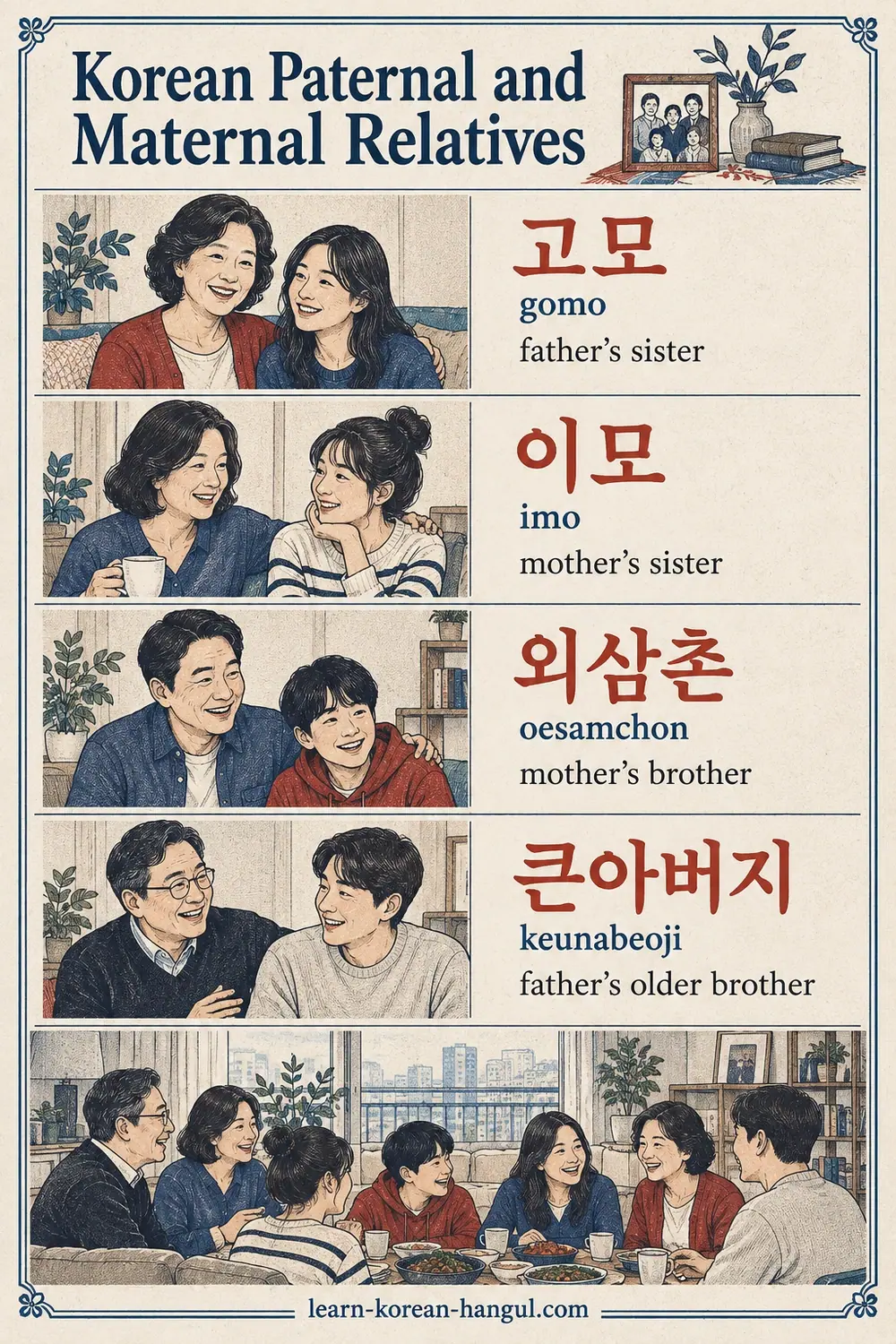
- Topic: Korean paternal and maternal relatives, the words for 친가 (father's side) and 외가 (mother's side).
- Words on the page: 30, in 5 groups.
- Pattern: the prefix 외- marks most mother's-side words, as in 외할머니 and 외삼촌.
What you'll learn
- Match all 30 words to their English meanings and to the correct side of the family.
- Say five of them aloud with the help of the Revised Romanization and the audio.
- Predict a mother's-side word from the 외- prefix, and tell 삼촌 (uncle) from 사촌 (cousin).
- Write two original sentences with words such as 친가 and 외가.
Prerequisites: you can read Hangul and know the core words 어머니 (mother), 아버지 (father), 할머니 (grandmother) and 할아버지 (grandfather) from Family Words. Estimated time: about 60 minutes, plus short reviews on the following days.
Korean Paternal and Maternal Relatives at a Glance
Korean names most relatives by two facts at once: which parent they are related through, and whether they are older or younger than that parent. English folds both facts into "aunt", "uncle" and "cousin", so one English word can need four or five Korean words. The 30 words on this page fall into five groups.
| Group | Words | What the group covers |
|---|---|---|
| Father's side (친가) | 4 | the father's family as a unit, his parents and the eldest son's household |
| Mother's side (외가) | 4 | the mother's family, her parents and their home |
| Aunts and uncles | 11 | each parent's brothers and sisters, and their spouses |
| Cousins | 5 | first cousins, named by the parent they come through |
| In writing and on forms | 6 | formal words used in documents, notices and leave requests |
Most of these words are Sino-Korean, built from syllables borrowed from Chinese characters: 친 (親) means "own", 외 (外) "outside", 고 (姑) "father's sister" and 이 (姨) "mother's sister". The next question is where to start.
Which Paternal and Maternal Relatives Should You Learn First?
Learn six words first: 고모, 이모, 삼촌, 외삼촌, 사촌 and 외할머니. Children speak to these relatives most often, and the six words cover the biggest gap between English and Korean: one English "aunt" becomes 고모 or 이모, and one "uncle" becomes 삼촌 or 외삼촌. Add the rest in this order:
- Week 1: the six core words, plus 친가 and 외가.
- Week 2: your father's brothers and their wives: 큰아버지, 큰어머니, 작은아버지 and 작은어머니.
- Week 3: the cousin words and the aunts and uncles by marriage: 고모부, 이모부 and 외숙모.
- Later: the written words such as 조부 and 외조모, which you need mainly for documents and notices.
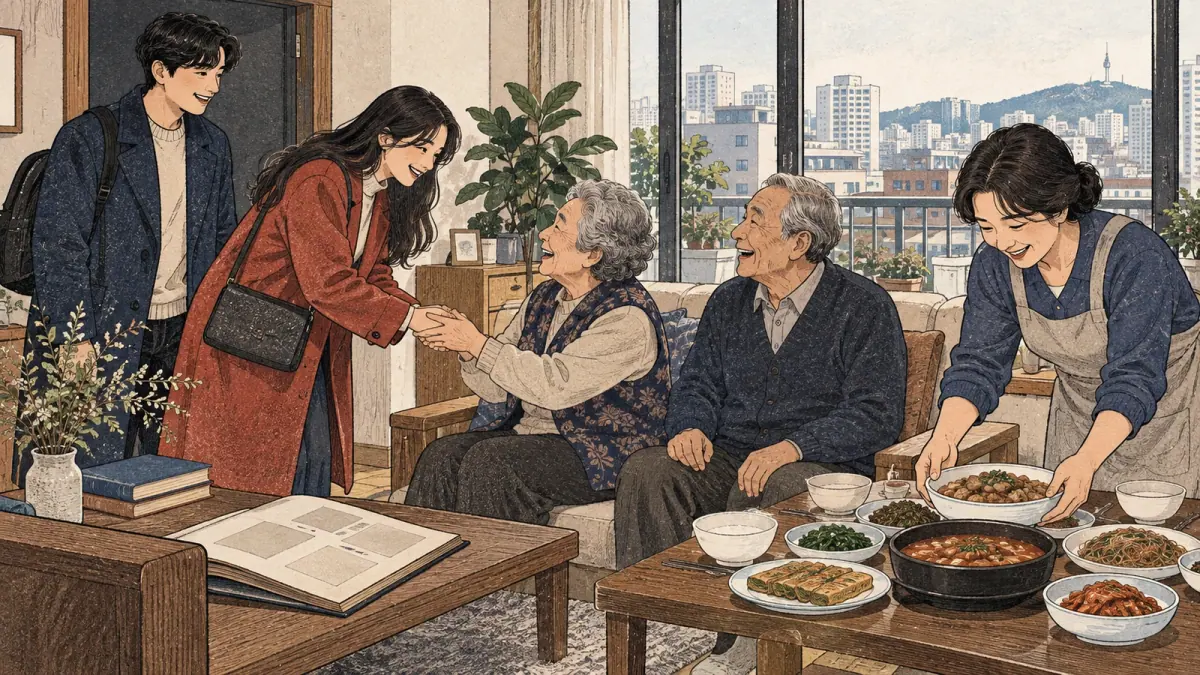
In the scene below, each numbered person matches a word in the lists.
Word · 12
- 1
큰아버지
keunabeoji
father's older brother
- 2
큰어머니
keuneomeoni
wife of your father's older brother
- 3
작은아버지
jageunabeoji
father's younger brother (married)
- 4
삼촌
samchon
uncle; father's unmarried younger brother
- 5
고모
gomo
father's sister
- 6
고모부
gomobu
husband of your father's sister
- 7
외할아버지
oeharabeoji
maternal grandfather (mother's father)
- 8
외할머니
oehalmeoni
maternal grandmother (mother's mother)
- 9
이모
imo
mother's sister
- 10
이모부
imobu
husband of your mother's sister
- 11
외삼촌
oesamchon
mother's brother
- 12
외숙모
oesungmo
wife of your mother's brother
The father's side stands on the left and the mother's side on the right. One prefix explains most of the right-hand side.
How Does the 외- Prefix Work?
The prefix 외- (oe-) turns a family word into its mother's-side version. Put 외 in front of 할머니 (grandmother) and you get 외할머니 (maternal grandmother); put it in front of 삼촌 (uncle) and you get 외삼촌 (mother's brother). One prefix predicts at least eight words on this page:
- 외가: the mother's side of the family (가 means house or family)
- 외할아버지 and 외할머니: the mother's parents
- 외삼촌 and 외숙모: the mother's brother and his wife
- 외사촌: the child of the mother's brother
- 외조부 and 외조모: formal words for the mother's parents
One exception trips learners: 이모 (mother's sister) and 이종사촌 (her children) take no 외-, because 이 already means "mother's sister". The father's side has an optional prefix, 친-, as in 친할머니, used mainly to contrast the two grandmothers; in daily talk most children say 할머니 for both.
Expert tip: many families skip the prefix and tell grandparents apart by where they live, as in 부산 할머니 (Busan grandma) and 서울 할머니 (Seoul grandma). Some speakers prefer this because 외 literally means "outside" and can sound as if the mother's family were less close. The father's side comes first in the word lists.
Father's Side (친가)
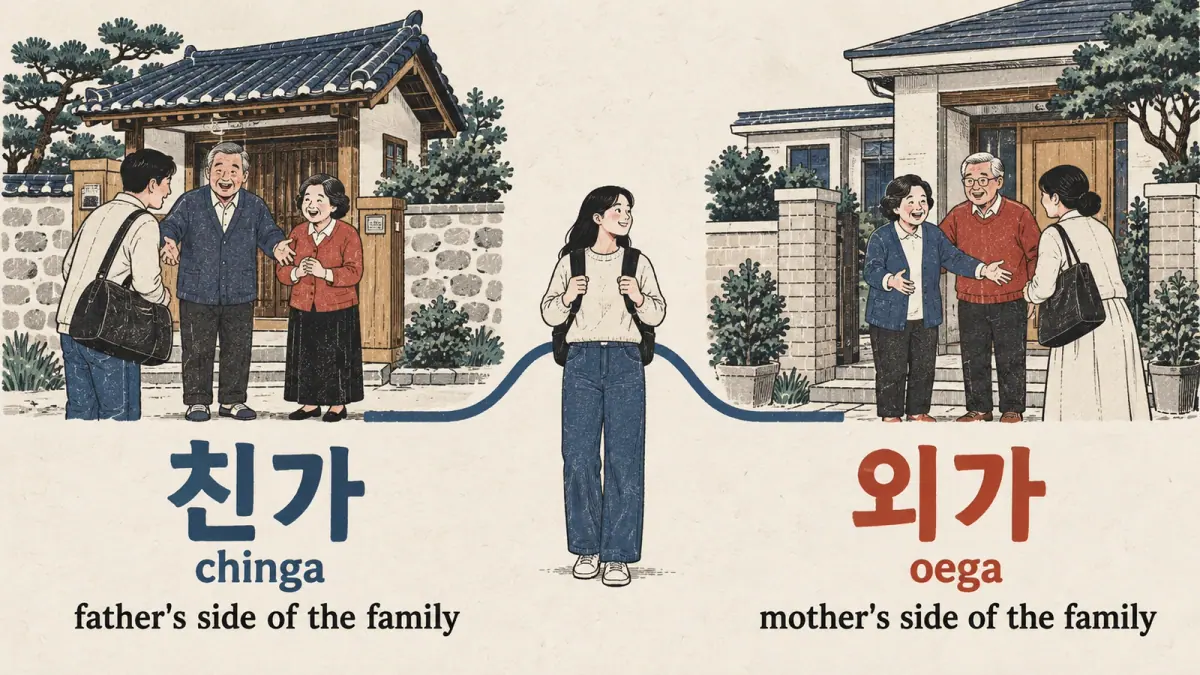
친가 (chinga) is the father's side of the family. On the big holidays, 설날 (Lunar New Year) and 추석 (Chuseok, the autumn harvest holiday), many families gather there first. The 큰집 (keunjip) is the household of the eldest son, usually your father's eldest brother, where the ancestral rites called 차례 are traditionally held.
| No. | Hangul | Revised Romanization | Meaning | Example sentence | Audio assetId |
|---|---|---|---|---|---|
| 1 | 친가 | chinga | father's side of the family | 설날에 친가에 가요. (On Lunar New Year we go to my father's side of the family.) | au-pg-vocabulary-people-family-paternal-maternal-1; example: au-pg-vocabulary-people-family-paternal-maternal-31 |
| 2 | 친할아버지 | chinharabeoji | paternal grandfather (father's father) | 친할아버지는 부산에 사세요. (My paternal grandfather lives in Busan.) | au-pg-vocabulary-people-family-paternal-maternal-2; example: au-pg-vocabulary-people-family-paternal-maternal-32 |
| 3 | 친할머니 | chinhalmeoni | paternal grandmother (father's mother) | 친할머니가 김치를 만드세요. (My paternal grandmother makes kimchi.) | au-pg-vocabulary-people-family-paternal-maternal-3; example: au-pg-vocabulary-people-family-paternal-maternal-33 |
| 4 | 큰집 | keunjip | the eldest son's household, usually the home of your father's eldest brother | 추석에는 큰집에 모여요. (On Chuseok we gather at my eldest uncle's house.) | au-pg-vocabulary-people-family-paternal-maternal-4; example: au-pg-vocabulary-people-family-paternal-maternal-34 |
큰집 literally means "big house", but size does not matter: a small apartment is the 큰집 if the eldest son's family lives there.
Example Sentences
Press play and repeat each sentence aloud. The verbs take the honorific ending -(으)세요, as in 사세요 (lives) and 만드세요 (makes), because Korean shows respect to older relatives in the verb too.
친할아버지는 부산에 사세요.
chinharabeojineun busane saseyo.
My paternal grandfather lives in Busan.
친할머니가 김치를 만드세요.
chinhalmeoniga gimchireul mandeuseyo.
My paternal grandmother makes kimchi.
외할아버지는 낚시를 좋아하세요.
oeharabeojineun naksireul joahaseyo.
My maternal grandfather likes fishing.
외할머니 댁은 시골에 있어요.
oehalmeoni daegeun sigore isseoyo.
My maternal grandmother's house is in the countryside.
Swap the relative and keep the frame: 친할머니가 becomes 외할머니가. The mother's side works the same way.
How Do You Say Mother's Side (외가) in Korean?
Mother's side of the family is 외가 (oega) in Korean. The home of your mother's parents is 외갓집 (oegatjip), an everyday word that many Korean adults link with childhood school vacations.
| No. | Hangul | Revised Romanization | Meaning | Example sentence | Audio assetId |
|---|---|---|---|---|---|
| 5 | 외가 | oega | mother's side of the family | 방학마다 외가에 가요. (I visit my mother's side of the family every school vacation.) | au-pg-vocabulary-people-family-paternal-maternal-5; example: au-pg-vocabulary-people-family-paternal-maternal-35 |
| 6 | 외할아버지 | oeharabeoji | maternal grandfather (mother's father) | 외할아버지는 낚시를 좋아하세요. (My maternal grandfather likes fishing.) | au-pg-vocabulary-people-family-paternal-maternal-6; example: au-pg-vocabulary-people-family-paternal-maternal-36 |
| 7 | 외할머니 | oehalmeoni | maternal grandmother (mother's mother) | 외할머니 댁은 시골에 있어요. (My maternal grandmother's house is in the countryside.) | au-pg-vocabulary-people-family-paternal-maternal-7; example: au-pg-vocabulary-people-family-paternal-maternal-37 |
| 8 | 외갓집 | oegatjip | the home of your mother's parents | 어릴 때 외갓집에서 살았어요. (I lived at my mother's parents' home when I was little.) | au-pg-vocabulary-people-family-paternal-maternal-8; example: au-pg-vocabulary-people-family-paternal-maternal-38 |
외갓집 has an extra ㅅ under 가, called 사이시옷 (the "in-between ㅅ"). It is written when two words join and the first sound of the second word becomes tense, so 집 is said [찝]. The aunts and uncles come next, and they form the largest group.
Aunts and Uncles
Korean has eleven common words for the people English calls aunts and uncles. On the father's side, a brother's title depends on his age compared with your father; on the mother's side, age makes no difference. The table holds all eleven.
| No. | Hangul | Revised Romanization | Meaning | Example sentence | Audio assetId |
|---|---|---|---|---|---|
| 9 | 큰아버지 | keunabeoji | father's older brother | 큰아버지는 아버지의 형이에요. (큰아버지 is my father's older brother.) | au-pg-vocabulary-people-family-paternal-maternal-9; example: au-pg-vocabulary-people-family-paternal-maternal-39 |
| 10 | 큰어머니 | keuneomeoni | wife of your father's older brother | 큰어머니가 송편을 만드셨어요. (My aunt (큰어머니) made songpyeon.) | au-pg-vocabulary-people-family-paternal-maternal-10; example: au-pg-vocabulary-people-family-paternal-maternal-40 |
| 11 | 작은아버지 | jageunabeoji | father's younger brother (married) | 작은아버지는 아버지의 남동생이에요. (작은아버지 is my father's younger brother.) | au-pg-vocabulary-people-family-paternal-maternal-11; example: au-pg-vocabulary-people-family-paternal-maternal-41 |
| 12 | 작은어머니 | jageuneomeoni | wife of your father's younger brother | 작은어머니는 선생님이세요. (My aunt (작은어머니) is a teacher.) | au-pg-vocabulary-people-family-paternal-maternal-12; example: au-pg-vocabulary-people-family-paternal-maternal-42 |
| 13 | 삼촌 | samchon | uncle; father's unmarried younger brother | 삼촌은 아직 결혼을 안 했어요. (My uncle is not married yet.) | au-pg-vocabulary-people-family-paternal-maternal-13; example: au-pg-vocabulary-people-family-paternal-maternal-43 |
| 14 | 고모 | gomo | father's sister | 고모는 아버지의 누나예요. (고모 is my father's older sister.) | au-pg-vocabulary-people-family-paternal-maternal-14; example: au-pg-vocabulary-people-family-paternal-maternal-44 |
| 15 | 고모부 | gomobu | husband of your father's sister | 고모부는 요리를 잘하세요. (My uncle (고모부) is a good cook.) | au-pg-vocabulary-people-family-paternal-maternal-15; example: au-pg-vocabulary-people-family-paternal-maternal-45 |
| 16 | 이모 | imo | mother's sister | 이모는 어머니의 언니예요. (이모 is my mother's older sister.) | au-pg-vocabulary-people-family-paternal-maternal-16; example: au-pg-vocabulary-people-family-paternal-maternal-46 |
| 17 | 이모부 | imobu | husband of your mother's sister | 이모부가 공항에 오셨어요. (My uncle (이모부) came to the airport.) | au-pg-vocabulary-people-family-paternal-maternal-17; example: au-pg-vocabulary-people-family-paternal-maternal-47 |
| 18 | 외삼촌 | oesamchon | mother's brother | 외삼촌은 어머니의 남동생이에요. (외삼촌 is my mother's younger brother.) | au-pg-vocabulary-people-family-paternal-maternal-18; example: au-pg-vocabulary-people-family-paternal-maternal-48 |
| 19 | 외숙모 | oesungmo | wife of your mother's brother | 외숙모가 선물을 주셨어요. (My aunt (외숙모) gave me a present.) | au-pg-vocabulary-people-family-paternal-maternal-19; example: au-pg-vocabulary-people-family-paternal-maternal-49 |
Father's Brothers: 큰아버지, 작은아버지 and 삼촌
A father's older brother is 큰아버지 ("big father"), and a father's younger brother is 작은아버지 ("small father"); their wives are 큰어머니 and 작은어머니. If your father has two older brothers, both are 큰아버지, and families tell them apart with numbers: 첫째 큰아버지 (first), 둘째 큰아버지 (second). A younger brother of your father is usually called 삼촌 while he is single and 작은아버지 after he marries. Many families also call 작은아버지's wife 숙모 (sungmo).
Father's Sister and Mother's Siblings
The father's sister is 고모 whether she is older or younger than your father. The final 부 in 고모부 and 이모부 means "husband", so those two words extend the pattern. A worked example puts the rules together. Ji-woo's mother has an older sister and a younger brother, and Ji-woo's father has an older brother and a younger sister. Each of their spouses also gets a title.
| Person | Side | Title Ji-woo uses |
|---|---|---|
| mother's older sister | mother's | 이모 |
| her husband | mother's | 이모부 |
| mother's younger brother | mother's | 외삼촌 |
| his wife | mother's | 외숙모 |
| father's older brother | father's | 큰아버지 |
| his wife | father's | 큰어머니 |
| father's younger sister | father's | 고모 |
| her husband | father's | 고모부 |
That is eight people and eight different words where English uses only "aunt" and "uncle". Their children are Ji-woo's cousins, the next group.
How Do You Say Cousins in Korean?
Cousin in Korean is 사촌 (sachon), literally "four degrees", and it covers every first cousin on both sides. When the side matters, Korean adds a prefix that names the parent the cousin comes through.
| No. | Hangul | Revised Romanization | Meaning | Example sentence | Audio assetId |
|---|---|---|---|---|---|
| 20 | 사촌 | sachon | cousin (first cousin) | 사촌이 열 명 있어요. (I have ten cousins.) | au-pg-vocabulary-people-family-paternal-maternal-20; example: au-pg-vocabulary-people-family-paternal-maternal-50 |
| 21 | 친사촌 | chinsachon | cousin through your father's brother | 친사촌하고 같은 학교에 다녀요. (I go to the same school as my cousin on my father's side.) | au-pg-vocabulary-people-family-paternal-maternal-21; example: au-pg-vocabulary-people-family-paternal-maternal-51 |
| 22 | 고종사촌 | gojongsachon | cousin through your father's sister | 고종사촌은 고모의 아들이에요. (My 고종사촌 is my 고모's son.) | au-pg-vocabulary-people-family-paternal-maternal-22; example: au-pg-vocabulary-people-family-paternal-maternal-52 |
| 23 | 이종사촌 | ijongsachon | cousin through your mother's sister | 이종사촌 언니가 다음 달에 결혼해요. (My older cousin, my 이모's daughter, gets married next month.) | au-pg-vocabulary-people-family-paternal-maternal-23; example: au-pg-vocabulary-people-family-paternal-maternal-53 |
| 24 | 외사촌 | oesachon | cousin through your mother's brother | 외사촌 동생은 초등학생이에요. (My younger cousin, my 외삼촌's child, is in elementary school.) | au-pg-vocabulary-people-family-paternal-maternal-24; example: au-pg-vocabulary-people-family-paternal-maternal-54 |
In speech, an age title often follows the cousin word: a woman calls her older male cousin 사촌 오빠, and a man calls his older female cousin 사촌 누나. Those titles are explained on the older sibling titles page, and the single word has its own entry at cousin in Korean. The number in 사촌 comes from a counting system, explained next.
Kinship Degrees (촌수) Explained
촌수 (chonsu) is the Korean system for counting how closely two relatives are linked: one 촌 for each step between a parent and a child. You count up to the shared ancestor and down again, so the number grows with every generation you cross.
| Relative | Steps from you | Degree | Word built on it |
|---|---|---|---|
| parent | up 1 | 1촌 | none |
| grandparent | up 2 | 2촌 | none |
| brother or sister | up 1, down 1 | 2촌 | none |
| parent's brother or sister | up 2, down 1 | 3촌 | 삼촌 (uncle) |
| first cousin | up 2, down 2 | 4촌 | 사촌 (cousin) |
| second cousin | up 3, down 3 | 6촌 | 육촌 (second cousin) |
This is why 삼촌 means uncle and 사촌 means cousin: both words are numbers of degrees. Husband and wife have no degree at all, which Koreans call 무촌 (muchon, "no degree"). Legal documents use the same counting, so the formal words come next.
In Writing and on Forms
Formal Sino-Korean words replace the everyday ones in documents, death notices and workplace leave requests. 조부 (jobu) and 조모 (jomo) mean grandfather and grandmother, and 외조부 and 외조모 are the mother's-side versions. Nobody calls a grandmother 조모 at home; the word belongs on paper.
| No. | Hangul | Revised Romanization | Meaning | Example sentence | Audio assetId |
|---|---|---|---|---|---|
| 25 | 친척 | chincheok | relatives; extended family | 명절에 친척들이 모두 모여요. (All our relatives gather on the holidays.) | au-pg-vocabulary-people-family-paternal-maternal-25; example: au-pg-vocabulary-people-family-paternal-maternal-55 |
| 26 | 촌수 | chonsu | degree of kinship, counted in 촌 | 촌수를 세는 방법을 배웠어요. (I learned how to count degrees of kinship.) | au-pg-vocabulary-people-family-paternal-maternal-26; example: au-pg-vocabulary-people-family-paternal-maternal-56 |
| 27 | 조부 | jobu | grandfather (formal, written) | 서류에 조부 성함을 썼어요. (I wrote my grandfather's name on the form.) | au-pg-vocabulary-people-family-paternal-maternal-27; example: au-pg-vocabulary-people-family-paternal-maternal-57 |
| 28 | 조모 | jomo | grandmother (formal, written) | 조모상으로 휴가를 냈어요. (I took leave for my grandmother's funeral.) | au-pg-vocabulary-people-family-paternal-maternal-28; example: au-pg-vocabulary-people-family-paternal-maternal-58 |
| 29 | 외조부 | oejobu | maternal grandfather (formal, written) | 외조부 칠순 잔치에 갔어요. (I went to my maternal grandfather's 70th birthday party.) | au-pg-vocabulary-people-family-paternal-maternal-29; example: au-pg-vocabulary-people-family-paternal-maternal-59 |
| 30 | 외조모 | oejomo | maternal grandmother (formal, written) | 부고에 외조모상이라고 쓰여 있어요. (The death notice says 외조모상, the funeral of a maternal grandmother.) | au-pg-vocabulary-people-family-paternal-maternal-30; example: au-pg-vocabulary-people-family-paternal-maternal-60 |
Two compounds are worth recognising. 조모상 means the death or funeral of a grandmother, and 외조모상 the funeral of a maternal grandmother. They appear in workplace messages and in death notices, called 부고 (bugo), where they tell colleagues whose funeral it is. The written words are rare in speech, but every word on this page needs to be said clearly.
How Do You Pronounce These Words?
Press play to hear each word, then repeat it before you check the romanization. Most of the 30 words are read as written, but the six below change sound, following the standard pronunciation rules (표준 발음법) of the 국립국어원 (National Institute of Korean Language).
| Word | Romanization | Said | Rule |
|---|---|---|---|
| 큰아버지 | keunabeoji | [크나버지] | final ㄴ moves onto the next vowel (liaison) |
| 작은어머니 | jageuneomeoni | [자그너머니] | two liaisons in a row |
| 외숙모 | oesungmo | [외숭모] | ㄱ becomes ㅇ before ㅁ (nasalization) |
| 외갓집 | oegatjip | [외가찝] or [외갇찝] | the in-between ㅅ makes ㅈ tense |
| 촌수 | chonsu | [촌쑤] | ㅅ is said tense in this compound |
| 외 | oe | [외] or [웨] | the standard allows both; most speakers say [웨] |
Expert tip: Korean gives every syllable roughly equal length and stress, so 외할아버지 is five even beats, [외-하-라-버-지], not "oy-HAL-a-bo-ji". In fast speech many speakers soften the ㅎ in 외할머니 and 친할머니, but the standard pronunciation keeps it, so keep it too.
Audio and Slow Playback
Each headword has a normal clip, and five key words also have a slow clip at 0.8 times the speed: 친가, 외가, 고모, 이모 and 외삼촌. Nothing plays until you press a button.
Then listen to a short exchange, with the transcript under the player.
이분은 누구예요?
ibuneun nuguyeyo?
Who is this?
우리 이모예요. 어머니의 언니예요.
uri imoyeyo. eomeoniui eonniyeyo.
That is my aunt, my mother's older sister.
그럼 옆에 계신 분은 이모부세요?
geureom yeope gyesin buneun imobuseyo?
Then is the man next to her your uncle?
네, 맞아요. 이종사촌들도 같이 왔어요.
ne, majayo. ijongsachondeuldo gachi wasseoyo.
Yes, that's right. My cousins came with them too.
With the sounds in place, the last step is to avoid the usual errors.
What Mistakes Do Learners Make with Paternal and Maternal Relatives?
Learners most often pick the right relationship but the wrong side:
- Calling a mother's sister 고모. 고모 is only the father's sister. A mother's sister is always 이모.
- Adding 외- to 이모. 외이모 does not exist, because 이모 already means mother's sister.
- Mixing up 삼촌 and 사촌. 삼촌 (3촌) is an uncle and 사촌 (4촌) is a cousin. Count the degrees if you hesitate.
- Reading 큰 and 작은 as size. 큰아버지 is not a tall father; he is older than your father.
- Using 삼촌 for every uncle. A married younger brother of your father is 작은아버지, and the mother's brother is 외삼촌. Many children say 삼촌 to a mother's brother in casual talk, so use 외삼촌 when you describe him to others.
- Using written words in speech. Say 할머니 to your grandmother and keep 조모 for forms.
Learners often assume 이모 is only a family word; actually, many customers call an older woman working in a small restaurant 이모, because the word sounds warm and familiar. The Korean terms of address guides cover that wider use of family words.
Honest limits: usage varies by family, region and generation. Some families say 삼촌 for every uncle, some use 숙모 instead of 작은어머니, and some never use 친- or 외-. This page gives the standard forms used in the 국립국어원 dictionaries. It does not cover the titles for a spouse's family or for distant clan relatives. Now test yourself.
Practice: Flashcards and Worksheet
Drill all 30 words with the deck below, which uses the same words, order and audio as this page. Progress is saved only in your browser.
Practice · 4
- 01친할아버지는 부산에 사세요.
Show answer
chinharabeojineun busane saseyo.
My paternal grandfather lives in Busan.
- 02친할머니가 김치를 만드세요.
Show answer
chinhalmeoniga gimchireul mandeuseyo.
My paternal grandmother makes kimchi.
- 03외할아버지는 낚시를 좋아하세요.
Show answer
oeharabeojineun naksireul joahaseyo.
My maternal grandfather likes fishing.
- 04외할머니 댁은 시골에 있어요.
Show answer
oehalmeoni daegeun sigore isseoyo.
My maternal grandmother's house is in the countryside.
Drill paternal and maternal relatives with spaced repetition in the vocabulary flashcard decks, including the Korean family words flashcards. A printable worksheet for these words (word list, matching, writing practice, fill-in-the-blank exercises and answer key) is available in A4 and US Letter from the download card on this page.
Paternal and Maternal Relatives Worksheet
Try these five questions, then check the answers below.
- Your mother's younger sister is your ___.
- Your father's married younger brother is your ___.
- What do you call the child of your 외삼촌?
- Which word for a mother's mother belongs on a leave form?
- Say in Korean: "My father's older sister lives in Seoul."
Then write two sentences of your own, one with 친가 and one with 외가. The quiz below checks the same rules.
Practice · 5
Your mother's younger sister is your…
Show answer
이모
이모 is any sister of your mother; 고모 is your father's sister.
Your father's married younger brother is your…
Show answer
작은아버지
작은아버지 is a father's younger brother, usually once he is married.
The child of your 외삼촌 is your…
Show answer
외사촌
외사촌 comes through your mother's brother.
Which word for a mother's mother belongs on a leave form?
Show answer
외조모
외조모 is the formal written word; 외할머니 is the spoken one.
What degree (촌) is a first cousin?
Show answer
4촌
Up two steps to the grandparents and down two to the cousin: 4촌, hence 사촌.
Answers
- 이모, because any sister of your mother is 이모.
- 작은아버지; before he marries, many families call him 삼촌.
- 외사촌, a cousin through your mother's brother.
- 외조모, the formal word; at home you would say 외할머니.
- 고모는 서울에 사세요. The honorific 사세요 shows respect to an older relative.
Where to Go Next
This list sits inside Family Words, where you can find related topics such as siblings and parents. Once you know your own relatives, learn the titles used for a spouse's family (see in-law titles). To talk about relatives politely, read Korean honorifics, and look up 삼촌 on its own at uncle in Korean. Korean paternal and maternal relatives are a small set of words, but a Korean family will notice when you get 고모 and 이모 right.
Frequently Asked Questions
How Do You Say Father's Side Family in Korean?
Father's side family is 친가 (chinga) in Korean. 친 means own or close, and 가 means house or family. The mother's side is 외가 (oega). In casual speech people also say 아빠 쪽 (dad's side), and on big holidays such as 설날 many families visit the 친가 first.
How Do You Pronounce 외가 (oega)?
외가 has two syllables. The first, 외, may be a single rounded vowel, but most speakers say it as the glide [we], so 외가 often sounds like weh-ga. The second syllable starts with a soft, unaspirated g. Give both syllables equal stress, and press the audio button to compare.
How Many Paternal and Maternal Relatives Should I Learn First?
Start with six: 고모, 이모, 삼촌, 외삼촌, 사촌 and 외할머니. They cover the aunt, uncle and cousin words you will hear most. At five new words a day, all 30 words on this page take about a week, with short flashcard reviews on the following days.
Where Can I Practise Paternal and Maternal Relatives with Flashcards?
Use the deck on this page, which holds the same 30 words with audio, or the Korean family words flashcards for the core family list. Both decks show the Hangul first and keep your progress only in your browser. Review each word again one day and three days after you learn it.
Is the Romanization on This Page Official?
It follows the Revised Romanization of Korean, the official system adopted by South Korea on 7 July 2000 and published by the National Institute of Korean Language (국립국어원). It is a learning aid only. It shows some sound changes, as in oesungmo for 외숙모, but hides others, such as the tense [찝] in 외갓집.
Is There a Printable Worksheet for Paternal and Maternal Relatives?
A printable worksheet for these words (word list, matching, writing practice, fill-in-the-blank exercises and answer key) is available in A4 and US Letter from the download card on this page. The vocabulary worksheets page lists available sheets, including the Korean family words worksheet. You can also copy the five tables by hand and cover the English column to test yourself.