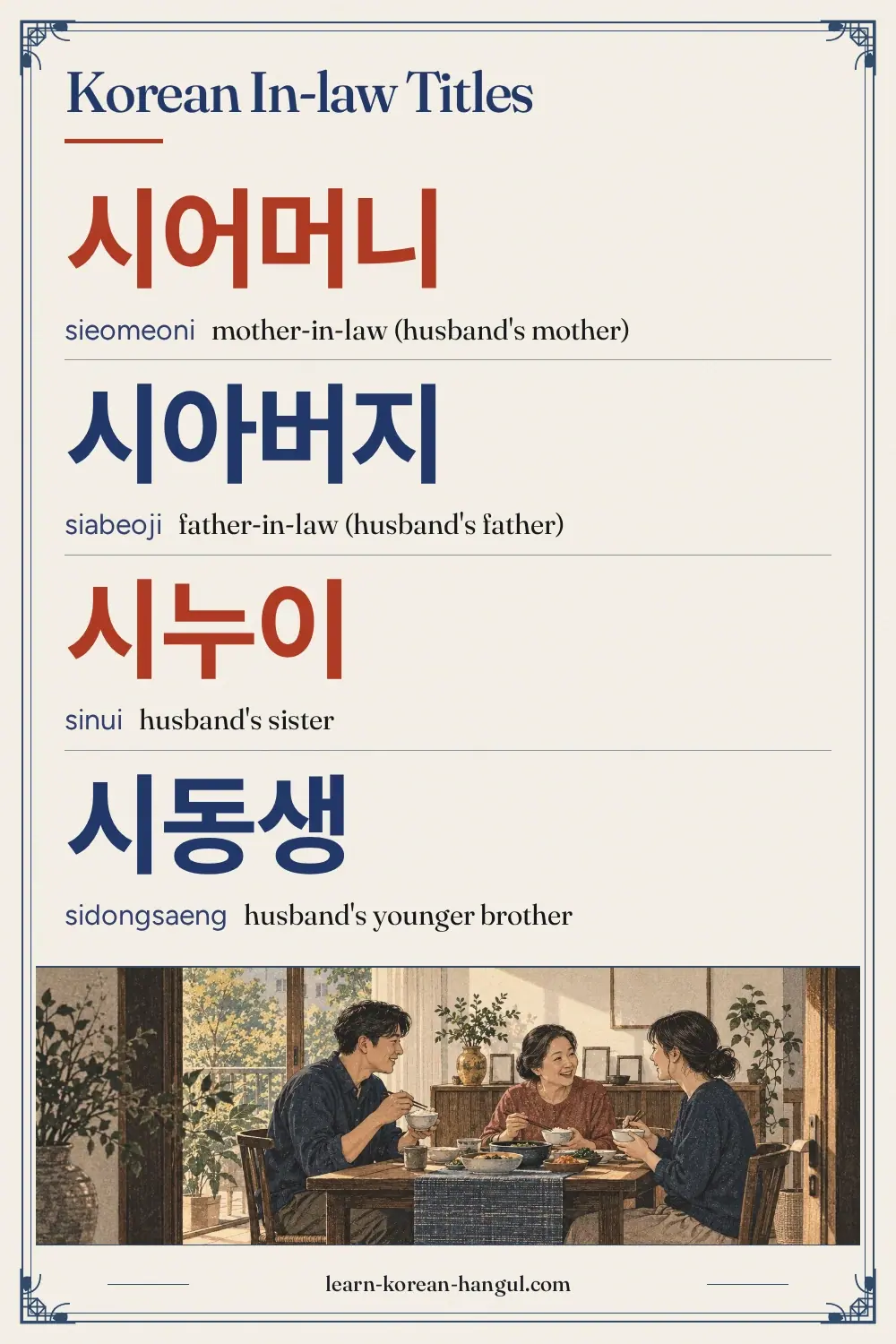
Key facts
- Topic: Korean in-law titles for the husband's family (시댁) and the wife's family (처가).
- Words on the page: 25, in 5 groups.
- Pattern: 시- marks the husband's family, and 처- or 장- marks the wife's family.
- One in-law often has two words: an address form to call them and a reference form to talk about them.
What you'll learn
- Match all 25 titles to their English meanings and to the spouse who uses them.
- Choose the address form or the reference form for a given in-law.
- Say five of the titles aloud with the help of the Revised Romanization and the audio.
- Write two original sentences with words such as 시댁 and 처가.
Prerequisites: you can read Hangul, know the core words in Family Words, and recognise the polite ending -아요/-어요. Estimated time: about 75 minutes, plus short reviews on the following days.
Korean in-Law Titles at a Glance
Korean in-law titles answer two questions that English leaves open: which spouse is speaking, and whether you are calling the person or talking about them. English says "mother-in-law" for either spouse's mother; Korean says 시어머니 for the husband's mother and 장모 for the wife's mother. The 25 words fall into five groups.
| Group | Words | Who uses them |
|---|---|---|
| Husband's family (시댁) | 6 | the wife, about her husband's family |
| Wife's family (처가) | 5 | the husband, about his wife's family |
| Titles used by the spouse | 4 | either spouse, when speaking to in-laws |
| Titles used for others | 5 | brothers and sisters, about their siblings' spouses |
| Marriage words | 5 | parents and couples, about the new family links |
Most in-law words are Sino-Korean: 시 (媤) means "husband's family", 처 (妻) means "wife", and 장 (丈) appears in 장인 and 장모, the wife's parents. The next section gives an order to learn them in.
Which in-Law Titles Should You Learn First?
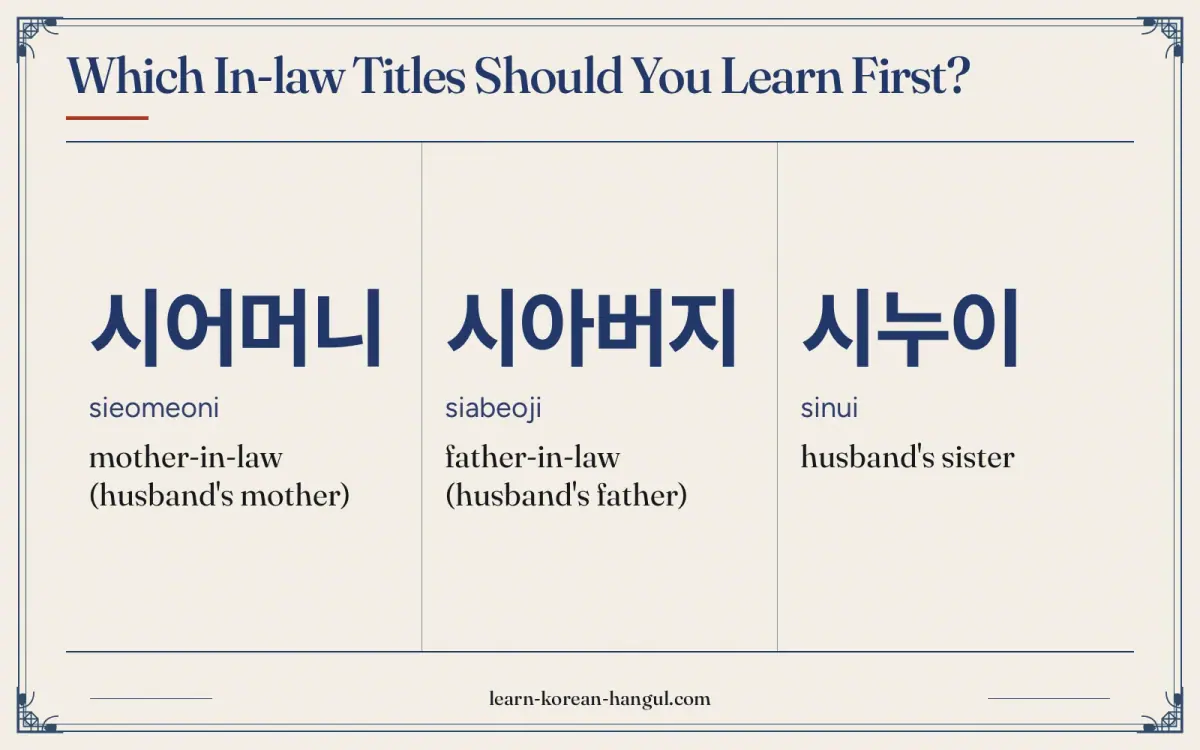
Learn the parents-in-law first: 시어머니, 시아버지, 장인 and 장모, plus the address forms 어머님 and 아버님. These are the in-laws most people speak to, and a wrong word with them is the most noticeable. Then follow this order:
- Step 1: 시댁 and 처가, the two family words.
- Step 2: the parents-in-law and their address forms.
- Step 3: the spouse's brothers and sisters: 시누이, 시동생, 아주버님, 처남 and 처제.
- Step 4: siblings' spouses and the marriage words, such as 형부, 며느리 and 사돈.
Start with the half that fits you: a wife needs the 시댁 words most, a husband the 처가 words. In the scene below, each numbered person matches a word in the lists.
Word · 12
- 1
시어머니
sieomeoni
mother-in-law (husband's mother)
- 2
시아버지
siabeoji
father-in-law (husband's father)
- 3
시누이
sinui
husband's sister
- 4
시동생
sidongsaeng
husband's younger brother
- 5
아주버님
ajubeonim
husband's older brother
- 6
장인
jangin
father-in-law (wife's father)
- 7
장모
jangmo
mother-in-law (wife's mother)
- 8
처남
cheonam
wife's brother
- 9
처제
cheoje
wife's younger sister
- 10
며느리
myeoneuri
daughter-in-law
- 11
사위
sawi
son-in-law
- 12
사돈
sadon
the parents of your child's spouse
The husband's family stands on the left and the wife's family on the right, mirroring the two prefixes that organise the list.
How Do the 시- and 처- Prefixes Work?
The prefixes 시- (si-) and 처- (cheo-) tell you whose family a word belongs to. 시- attaches to the husband's family, so 시 + 어머니 (mother) gives 시어머니, the husband's mother. 처- attaches to the wife's family, as in 처가 (wife's family), 처남 (wife's brother) and 처제 (wife's younger sister).
| Prefix | Side | Who says it | Examples |
|---|---|---|---|
| 시- | husband's family | the wife | 시댁, 시어머니, 시아버지, 시누이, 시동생 |
| 처- | wife's family | the husband | 처가, 처남, 처제, 처형 |
| 장- | wife's parents | the husband | 장인, 장모 |
The wife's parents break the 처- pattern: they are 장인 (wife's father) and 장모 (wife's mother). Learners who build words by analogy sometimes produce forms such as 처어머니, which Koreans do not use. The first group is the husband's family.
Husband's Family (시댁)
시댁 (sidaek) is the husband's family, seen from the wife's side. It is the respectful form of 시가 (siga): 댁 is the honorific word for a house or household, so a wife who says 시댁 shows respect to her husband's family in the word itself.
| No. | Hangul | Revised Romanization | Meaning | Example sentence | Audio assetId |
|---|---|---|---|---|---|
| 1 | 시댁 | sidaek | husband's family (respectful) | 이번 설에는 시댁에 먼저 가요. (This Lunar New Year we go to my husband's family first.) | au-pg-vocabulary-people-family-in-laws-1; example: au-pg-vocabulary-people-family-in-laws-26 |
| 2 | 시어머니 | sieomeoni | mother-in-law (husband's mother) | 시어머니께서 김장을 하세요. (My mother-in-law is making the winter kimchi.) | au-pg-vocabulary-people-family-in-laws-2; example: au-pg-vocabulary-people-family-in-laws-27 |
| 3 | 시아버지 | siabeoji | father-in-law (husband's father) | 시아버지는 매일 아침 산책하세요. (My father-in-law takes a walk every morning.) | au-pg-vocabulary-people-family-in-laws-3; example: au-pg-vocabulary-people-family-in-laws-28 |
| 4 | 시누이 | sinui | husband's sister | 시누이와 같이 쇼핑했어요. (I went shopping with my husband's sister.) | au-pg-vocabulary-people-family-in-laws-4; example: au-pg-vocabulary-people-family-in-laws-29 |
| 5 | 시동생 | sidongsaeng | husband's younger brother | 시동생이 다음 달에 결혼해요. (My husband's younger brother gets married next month.) | au-pg-vocabulary-people-family-in-laws-5; example: au-pg-vocabulary-people-family-in-laws-30 |
| 6 | 아주버님 | ajubeonim | husband's older brother | 아주버님, 식사하세요. (Please come and eat, brother-in-law.) | au-pg-vocabulary-people-family-in-laws-6; example: au-pg-vocabulary-people-family-in-laws-31 |
아주버님 is both the reference and the address word for the husband's older brother, so it never changes. The husband's younger brother is 시동생 when you talk about him, but the traditional address form is 도련님 while he is single and 서방님 after he marries. The husband's sister is 시누이 in reference; a wife calls an older one 형님 and a younger one 아가씨.
Example Sentences
Press play and repeat each sentence aloud. Sentences about parents-in-law use the honorific -(으)시- in the verb, as in 산책하세요, and the particle 께서 in place of 이/가.
시어머니께서 김장을 하세요.
sieomeonikkeseo gimjangeul haseyo.
My mother-in-law is making the winter kimchi.
시아버지는 매일 아침 산책하세요.
siabeojineun maeil achim sanchaekaseyo.
My father-in-law takes a walk every morning.
아주버님, 식사하세요.
ajubeonim, siksahaseyo.
Please come and eat, brother-in-law.
장모님이 반찬을 보내 주셨어요.
jangmonimi banchaneul bonae jusyeosseoyo.
My mother-in-law sent us side dishes.
The fourth sentence uses 장모님, the wife's mother, with 님 added for respect. That word belongs to the next group, the wife's family.
How Do You Say Wife's Family (처가) in Korean?
Wife's family is 처가 (cheoga) in Korean, seen from the husband's side. In speech many men say 처갓집 (cheogatjip), the home of the wife's parents, in the same way that 외갓집 names the mother's parents' home.
| No. | Hangul | Revised Romanization | Meaning | Example sentence | Audio assetId |
|---|---|---|---|---|---|
| 7 | 처가 | cheoga | wife's family | 주말마다 처가에 가요. (We visit my wife's family every weekend.) | au-pg-vocabulary-people-family-in-laws-7; example: au-pg-vocabulary-people-family-in-laws-32 |
| 8 | 장인 | jangin | father-in-law (wife's father) | 장인은 은행에서 일하셨어요. (My father-in-law worked at a bank.) | au-pg-vocabulary-people-family-in-laws-8; example: au-pg-vocabulary-people-family-in-laws-33 |
| 9 | 장모 | jangmo | mother-in-law (wife's mother) | 장모님이 반찬을 보내 주셨어요. (My mother-in-law sent us side dishes.) | au-pg-vocabulary-people-family-in-laws-9; example: au-pg-vocabulary-people-family-in-laws-34 |
| 10 | 처남 | cheonam | wife's brother | 처남하고 축구를 봤어요. (I watched football with my wife's brother.) | au-pg-vocabulary-people-family-in-laws-10; example: au-pg-vocabulary-people-family-in-laws-35 |
| 11 | 처제 | cheoje | wife's younger sister | 처제가 대학교에 입학했어요. (My wife's younger sister started university.) | au-pg-vocabulary-people-family-in-laws-11; example: au-pg-vocabulary-people-family-in-laws-36 |
The wife's older sister is 처형 (cheohyeong). The wife's older brother is 처남 in reference, but the standard address form for him is 형님. The 처가 words in the table are plain reference words; the next group holds the respectful forms you say to an in-law's face.
Titles Used by the Spouse
Four respectful titles cover most direct speech with in-laws: 어머님, 아버님, 장인어른 and 형님. These are address forms, used to call or greet the person, and they sound warmer and more respectful than the reference words in the tables above.
| No. | Hangul | Revised Romanization | Meaning | Example sentence | Audio assetId |
|---|---|---|---|---|---|
| 12 | 어머님 | eomeonim | Mother (respectful address for a parent-in-law) | 어머님, 저희 왔어요. (Mother, we are here.) | au-pg-vocabulary-people-family-in-laws-12; example: au-pg-vocabulary-people-family-in-laws-37 |
| 13 | 아버님 | abeonim | Father (respectful address for a parent-in-law) | 아버님, 건강하세요. (Father, please stay healthy.) | au-pg-vocabulary-people-family-in-laws-13; example: au-pg-vocabulary-people-family-in-laws-38 |
| 14 | 장인어른 | jangineoreun | Father-in-law (a husband's address for his wife's father) | 장인어른, 한 잔 받으세요. (Father-in-law, please have a drink.) | au-pg-vocabulary-people-family-in-laws-14; example: au-pg-vocabulary-people-family-in-laws-39 |
| 15 | 형님 | hyeongnim | respectful title for an older in-law, such as a husband's older sister | 형님, 이건 제가 할게요. (Let me do this, sister-in-law.) | au-pg-vocabulary-people-family-in-laws-15; example: au-pg-vocabulary-people-family-in-laws-40 |
형님 is the most flexible title on the page. A wife uses it for her husband's older sister and for the wife of her husband's older brother; a husband uses it for his wife's older brother and for the husband of his wife's older sister. Outside the family, men also use it for a respected older man. The suffix 님 is what makes these forms respectful, which the ssi vs nim lesson explains.
Who Says What: the Address Grid
The grids show which word each spouse uses for each in-law, split into address (what you call the person) and reference (how you mention them to others). They follow the standard etiquette guide 표준 언어 예절 (2011) of the 국립국어원 (National Institute of Korean Language).
| Wife's in-law | Address (calling) | Reference (talking about) |
|---|---|---|
| husband's father | 아버님 | 시아버지, 시아버님 |
| husband's mother | 어머님 | 시어머니, 시어머님 |
| husband's older brother | 아주버님 | 아주버님 |
| husband's younger brother | 도련님 (single), 서방님 (married) | 시동생 |
| husband's older sister | 형님 | 시누이, 형님 |
| husband's younger sister | 아가씨 | 시누이 |
| Husband's in-law | Address (calling) | Reference (talking about) |
|---|---|---|
| wife's father | 장인어른, 아버님 | 장인 |
| wife's mother | 장모님, 어머님 | 장모, 장모님 |
| wife's older brother | 형님 | 처남, 형님 |
| wife's younger brother | 처남 | 처남 |
| wife's older sister | 처형 | 처형 |
| wife's younger sister | 처제 | 처제 |
A worked example shows the grid in use. Seo-yeon's husband has a father, an older brother and a younger sister. At a family dinner she calls her father-in-law 아버님, greets her husband's older brother with 아주버님, and calls his younger sister 아가씨. When she tells a friend about the dinner later, she says 시아버지, 아주버님 and 시누이. The people are the same; only the word type changes. Siblings' spouses follow a different rule.
What Do You Call Your Siblings' Spouses?
Titles for your siblings' spouses depend on your own gender, the same way the sibling words 오빠 and 형 do. A man calls his older brother's wife 형수 (hyeongsu), but a woman calls her older brother's wife 새언니 or refers to her as 올케. The five words below are the titles you hear most.
| No. | Hangul | Revised Romanization | Meaning | Example sentence | Audio assetId |
|---|---|---|---|---|---|
| 16 | 형수 | hyeongsu | older brother's wife (said by a man) | 형수님은 요리를 정말 잘하세요. (My older brother's wife is a really good cook.) | au-pg-vocabulary-people-family-in-laws-16; example: au-pg-vocabulary-people-family-in-laws-41 |
| 17 | 매형 | maehyeong | older sister's husband (said by a man) | 매형이 차를 빌려줬어요. (My older sister's husband lent me his car.) | au-pg-vocabulary-people-family-in-laws-17; example: au-pg-vocabulary-people-family-in-laws-42 |
| 18 | 형부 | hyeongbu | older sister's husband (said by a woman) | 형부는 언니보다 두 살 많아요. (My older sister's husband is two years older than her.) | au-pg-vocabulary-people-family-in-laws-18; example: au-pg-vocabulary-people-family-in-laws-43 |
| 19 | 올케 | olke | brother's wife (said by a woman) | 올케가 아기를 낳았어요. (My brother's wife had a baby.) | au-pg-vocabulary-people-family-in-laws-19; example: au-pg-vocabulary-people-family-in-laws-44 |
| 20 | 제부 | jebu | younger sister's husband (said by a woman) | 제부는 동생하고 동갑이에요. (My younger sister's husband is the same age as her.) | au-pg-vocabulary-people-family-in-laws-20; example: au-pg-vocabulary-people-family-in-laws-45 |
The full set has eight cells, because each title depends on the speaker's gender and on the sibling's age:
| Sibling's spouse | A man says | A woman says |
|---|---|---|
| older brother's wife | 형수님 | 새언니 (address), 올케 (reference) |
| younger brother's wife | 제수씨 | 올케 |
| older sister's husband | 매형 | 형부 |
| younger sister's husband | 매제 | 제부 |
The sibling words behind these titles are explained in the older sibling titles lesson. The last group names the links a marriage creates between the two families.
Marriage Words
Five words name the links that a marriage creates. Parents call their son's wife 며느리 (myeoneuri) and their daughter's husband 사위 (sawi), and the two sets of parents are 사돈 (sadon) to each other.
| No. | Hangul | Revised Romanization | Meaning | Example sentence | Audio assetId |
|---|---|---|---|---|---|
| 21 | 며느리 | myeoneuri | daughter-in-law | 며느리가 생일 선물을 보냈어요. (Our daughter-in-law sent a birthday present.) | au-pg-vocabulary-people-family-in-laws-21; example: au-pg-vocabulary-people-family-in-laws-46 |
| 22 | 사위 | sawi | son-in-law | 사위가 집을 고쳐 줬어요. (Our son-in-law fixed things around the house for us.) | au-pg-vocabulary-people-family-in-laws-22; example: au-pg-vocabulary-people-family-in-laws-47 |
| 23 | 사돈 | sadon | the parents of your child's spouse | 사돈어른께 인사드렸어요. (I greeted our child's parents-in-law.) | au-pg-vocabulary-people-family-in-laws-23; example: au-pg-vocabulary-people-family-in-laws-48 |
| 24 | 동서 | dongseo | the spouse of your spouse's sibling, e.g. wives of two brothers | 동서하고 같이 전을 부쳤어요. (My sister-in-law and I fried jeon together.) | au-pg-vocabulary-people-family-in-laws-24; example: au-pg-vocabulary-people-family-in-laws-49 |
| 25 | 친정 | chinjeong | a married woman's own parents' home | 명절 다음 날 친정에 가요. (The day after the holiday, I go to my parents' home.) | au-pg-vocabulary-people-family-in-laws-25; example: au-pg-vocabulary-people-family-in-laws-50 |
동서 (dongseo) has two uses: the wives of two brothers are 동서 to each other, and so are the husbands of two sisters. In speech, the younger brother's wife calls the older brother's wife 형님, and the older one calls her 동서. 친정 (chinjeong) is a married woman's own parents' home, the counterpart of 시댁; a married man often calls his own parents' home 본가 (bonga). When the two sets of parents meet, they address each other as 사돈어른 or 사돈. All 25 words now need to be said clearly.
How Do You Pronounce These Words?
Press play to hear each title, then repeat it before you check the romanization. Most in-law words are read as written, but the eight below need care, following the standard pronunciation rules (표준 발음법) of the 국립국어원.
| Word | Romanization | Said | Rule |
|---|---|---|---|
| 장인어른 | jangineoreun | [장이너른] | final ㄴ moves onto the next vowel (liaison) |
| 사돈어른 | sadoneoreun | [사도너른] | liaison again |
| 처갓집 | cheogatjip | [처가찝] or [처갇찝] | the in-between ㅅ makes ㅈ tense |
| 시댁 | sidaek | [시댁] | final ㄱ is unreleased, a short stop |
| 시누이 | sinui | [시누이] | three separate syllables, not "sin-wee" |
| 올케 | olke | [올케] | ㅋ is aspirated, with a strong puff of air |
| 형님 | hyeongnim | [형님] | ng, then a fresh n: hyeong-nim |
| 며느리 | myeoneuri | [며느리] | ㅕ starts with a y glide; ㅡ is unrounded |
Expert tip: Korean gives every syllable about the same length and stress, so 장인어른 is four even beats, [장-이-너-른], not "jang-IN-eo-reun".
Audio and Slow Playback
Each title has a normal clip, and five key words also have a slow clip at 0.8 times the speed: 시댁, 처가, 시어머니, 장모 and 며느리. Nothing plays until you press a button.
Then listen to a wife arriving at her husband's parents' home, with the transcript under the player.
어머님, 저희 왔어요.
eomeonim, jeohui wasseoyo.
Mother, we are here.
어서 와요. 오느라 고생했어요.
eoseo wayo. oneura gosaenghaesseoyo.
Come in. It must have been a long trip.
아버님은 어디 계세요?
abeonimeun eodi gyeseyo?
Where is Father?
거실에 있어요. 아주버님도 곧 오실 거예요.
geosire isseoyo. ajubeonimdo got osil geoyeyo.
He is in the living room. Your brother-in-law will be here soon too.
With the sounds in place, the next step is to avoid the common errors.
What Mistakes Do Learners Make with in-Law Titles?
Learners most often choose the right person but the wrong side, or the right word in the wrong form:
- Using 시- words for the wife's family. A husband's mother-in-law is 장모, never 시어머니.
- Calling a parent-in-law by the reference word. Say 어머님 to your mother-in-law, not 시어머니.
- Saying 장인 to his face. In address, a husband says 장인어른 or 아버님.
- Mixing up 매형 and 형부. Both mean older sister's husband, but men say 매형 and women say 형부.
- Treating 형님 as male-only. A wife calls her husband's older sister 형님 too.
- Hearing 아가씨 only as "miss". In the 시댁 it is the title for the husband's younger sister.
Learners often assume English "in-law" maps to one Korean prefix; actually Korean uses three (시-, 처- and 장-) plus the gendered sibling words, because the speaker's position picks the word. Address forms also follow wider politeness rules, covered in language etiquette.
Recent Changes in in-Law Titles
Several traditional titles are under discussion in Korea. A wife calls her husband's younger siblings 도련님 and 아가씨, respectful words once used for a household's young master and young lady, while a husband uses plain words such as 처남 and 처제 for his wife's younger siblings. Public debate since the late 2010s has questioned this imbalance.
Three practical changes follow from that debate:
- Some families now use a name plus 씨, such as 민수 씨, for a husband's younger siblings.
- Some couples use 어머님 and 아버님 for both sets of parents.
- Many husbands say 어머님 rather than 장모님 to their wife's mother.
The 국립국어원 guide 표준 언어 예절 (2011) still lists the traditional forms, and this page teaches them because you will hear them in families and dramas. The safest rule is to ask your spouse which words their family uses.
Honest limits: usage varies by region, generation and family, so treat these forms as the standard default, not the only correct choice. The page does not cover wedding-day vocabulary, which lives in Korean wedding vocabulary, or the plain words for a spouse, which are at husband in Korean and wife in Korean. Now test yourself.
Practice: Flashcards and Worksheet
Drill all 25 titles with the deck below, which uses the same words, order and audio as this page. Progress is saved only in your browser.
Practice · 4
- 01시어머니께서 김장을 하세요.
Show answer
sieomeonikkeseo gimjangeul haseyo.
My mother-in-law is making the winter kimchi.
- 02시아버지는 매일 아침 산책하세요.
Show answer
siabeojineun maeil achim sanchaekaseyo.
My father-in-law takes a walk every morning.
- 03아주버님, 식사하세요.
Show answer
ajubeonim, siksahaseyo.
Please come and eat, brother-in-law.
- 04장모님이 반찬을 보내 주셨어요.
Show answer
jangmonimi banchaneul bonae jusyeosseoyo.
My mother-in-law sent us side dishes.
Drill in-law titles with spaced repetition in the vocabulary flashcard decks, including the Korean family words flashcards. A printable worksheet for these words (word list, matching, writing practice, fill-in-the-blank exercises and answer key) is available in A4 and US Letter from the download card on this page.
In-Law Titles in Korean Worksheet
Try these five questions, then check the answers below.
- A wife speaking to her husband's mother says ___.
- A man's wife's younger sister is his ___.
- A woman's older sister's husband is her ___, and a man's is his ___.
- What are the wives of two brothers to each other?
- Say in Korean: "My wife's family lives in Daegu."
Then write two sentences of your own, one with 시댁 and one with 처가. The quiz below checks the same rules.
Practice · 5
A wife speaking to her husband's mother says…
Show answer
어머님
어머님 is the address form; 시어머니 is how she mentions her to others.
A man's wife's younger sister is his…
Show answer
처제
처- marks the wife's family, and 처제 is her younger sister.
A man calls his older sister's husband…
Show answer
매형
Men say 매형; women say 형부.
Two women married to two brothers are each other's…
Show answer
동서
동서 links the spouses of siblings.
Which word is a husband's father-in-law, used by the husband in address?
Show answer
장인어른
장인 is the reference word, and 장인어른 is the respectful address form.
Answers
- 어머님, the address form; 시어머니 is for talking about her.
- 처제, because 처- marks the wife's family.
- 형부 for a woman and 매형 for a man.
- 동서, a word that also links the husbands of two sisters.
- 처가는 대구에 있어요. The family as a place takes 있어요.
Where to Go Next
This list sits inside Family Words, where you can find related topics such as parents and siblings. After this, many learners move on to Paternal and Maternal Relatives, which uses the same prefix logic for aunts, uncles and cousins. Korean in-law titles take practice, but a correct 어머님 or 장인어른 at the first family meal is noticed.
Frequently Asked Questions
How Do You Say Husband's Family in Korean?
Husband's family is 시댁 (sidaek) in Korean. A wife uses it for her husband's parents and siblings as a group, and for their home. 시댁 is the respectful form of 시가 (siga), because 댁 is the honorific word for a house. The matching word for a wife's family is 처가 (cheoga).
How Do You Pronounce 처가 (cheoga)?
처가 is two even syllables, cheo-ga. The first starts with an aspirated ㅊ, a ch sound with a clear puff of air, followed by ㅓ, which sounds like the o in son. The second starts with a soft, unaspirated g. Press the audio button and repeat after the clip.
How Many in-Law Titles Should I Learn First?
Learn six first: 시어머니, 시아버지, 장인, 장모, 어머님 and 아버님. They name and address the parents-in-law, the in-laws you will speak to most. If you are the wife, add the 시댁 sibling words next; if you are the husband, add 처남 and 처제. All 25 take about a week.
Where Can I Practise in-Law Titles with Flashcards?
Use the deck on this page, which holds the same 25 titles with audio, in the same order as the tables. The vocabulary flashcard decks page lists the other family and relationship decks. Progress is saved only in your browser. Review each title one day after you learn it, then again after three days.
Is the Romanization on This Page Official?
It follows the Revised Romanization of Korean, the official system adopted by South Korea on 7 July 2000 and published by the National Institute of Korean Language (국립국어원). It is a learning aid, not a full pronunciation guide: 장인어른 is written jangineoreun, but 처갓집 hides its tense [찝]. Learn the Hangul and check with the audio.
Is There a Printable Worksheet for in-Law Titles?
A printable worksheet for these words (word list, matching, writing practice, fill-in-the-blank exercises and answer key) is available in A4 and US Letter from the download card on this page. The vocabulary worksheets page lists available sheets, including the Korean family words worksheet. You can also copy the address grid by hand and fill in the titles for your own spouse's family.