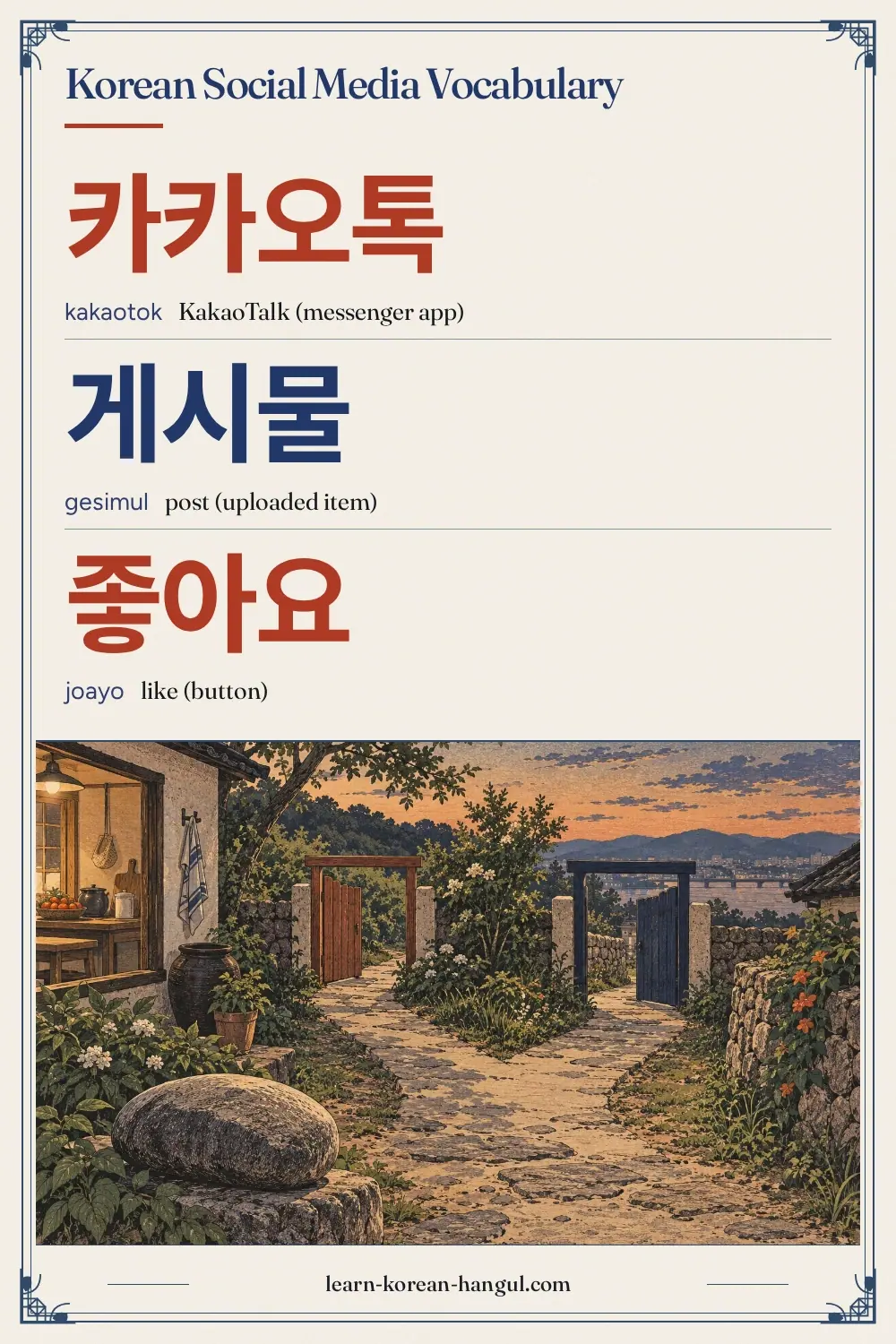
Key facts
Korean Social Media Vocabulary at a Glance
This list has 35 words in five groups of seven. It follows how a person uses a platform: open an app, post something, react to what others share, build an audience and keep the account safe. It belongs to Technology and Internet and builds on Korean Smartphone Vocabulary. Every word has an example sentence, so the page doubles as a ready deck.
| Group | Words | Use |
|---|---|---|
| Platforms and apps | 7 | Naming the apps and the category |
| Posting | 7 | Putting content online |
| Reactions | 7 | Likes, comments, replies and tags |
| Followers | 7 | Following, subscribing and chat rooms |
| Online safety | 7 | Passwords, blocking and reporting |
The words are mostly nouns. Many add 하다 to become verbs, such as 공유하다 and 차단하다. The next section picks the words to learn first.
Which Social Media Words Should You Learn First?
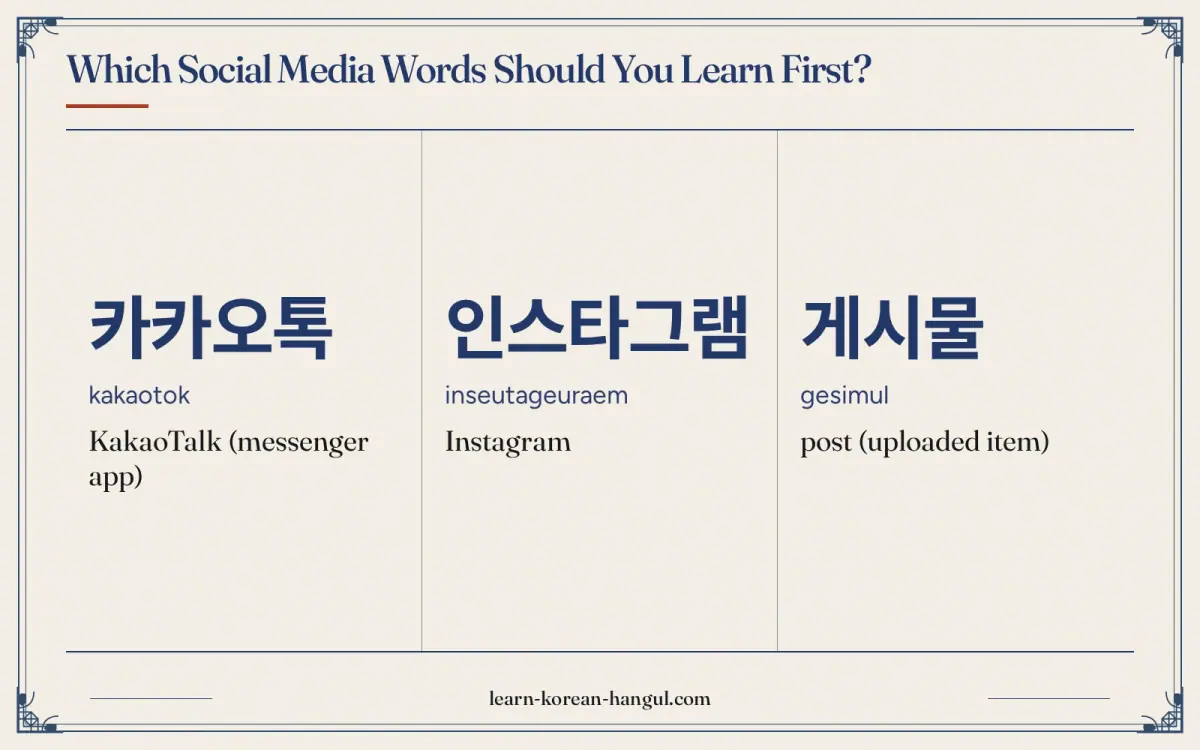
Learn 카카오톡 (KakaoTalk), 인스타그램 (Instagram), 댓글 (comment), 좋아요 (like) and 구독 (subscribe) first. These five appear on almost every screen, and they let you follow a channel, react to a post and understand a chat invitation. After that, add 게시물 and 팔로워, which describe what you and others publish.
- Words to say. 카카오톡, 인스타, 유튜브, 사진, 영상. You use these to tell friends where to reach you.
- Words to recognise. 좋아요, 댓글, 답글, 구독, 알림 설정. These are buttons and labels, so you read them.
- Words to understand when spoken. 단톡방, 읽씹, 인기. Friends use these in casual speech.
Korean uses SNS (read 에스엔에스) for the whole category, not 소셜 미디어, though both are understood. Brand names are written in Hangul as they sound, which makes them a quick practice in reading loanwords. Chat-culture words such as 읽씹 are slang: use them with friends and avoid them in formal writing. The single-word page on social media in korean gives the lookup answer.
Word · 8
- 1
카카오톡
kakaotok
KakaoTalk (messenger app)
- 2
인스타그램
inseutageuraem
Instagram
- 3
게시물
gesimul
post (uploaded item)
- 4
좋아요
joayo
like (button)
- 5
댓글
daetgeul
comment
- 6
팔로우
pallou
follow
- 7
팔로워
pallowo
follower
- 8
비밀번호
bimilbeonho
password
Platforms and Apps
Koreans use a mix of global platforms and local ones. Messaging runs mostly through 카카오톡, search often goes through 네이버, and photos and videos go through 인스타그램 and 유튜브. Brand names are written in Hangul as they sound, so reading them is a good test of your alphabet skills. The generic words for the category come first.
| No. | Hangul | Revised Romanization | Meaning and note | Example sentence | Audio assetId |
|---|---|---|---|---|---|
| 1 | 소셜 미디어 | sosyeol midieo | social media. The English term written in Hangul. Everyday Korean uses the shorter SNS below. | 소셜 미디어를 많이 써요. (I use social media a lot.) | au-pg-vocabulary-daily-life-technology-social-media-1; example: au-pg-vocabulary-daily-life-technology-social-media-36 |
| 2 | 에스엔에스 | eseueneseu | SNS (social media). The letters S, N, S read in Korean. People often write SNS in Latin letters. | 에스엔에스를 해요. (I use social media.) | au-pg-vocabulary-daily-life-technology-social-media-2; example: au-pg-vocabulary-daily-life-technology-social-media-37 |
| 3 | 카카오톡 | kakaotok | KakaoTalk (messenger app). A brand name. Shortened to 카톡 in speech and texts. | 카카오톡으로 연락해요. (I get in touch by KakaoTalk.) | au-pg-vocabulary-daily-life-technology-social-media-3; example: au-pg-vocabulary-daily-life-technology-social-media-38 |
| 4 | 네이버 | neibeo | Naver (portal and search). A brand name. Many Koreans search and read blogs here. | 네이버에서 검색해요. (I search on Naver.) | au-pg-vocabulary-daily-life-technology-social-media-4; example: au-pg-vocabulary-daily-life-technology-social-media-39 |
| 5 | 인스타그램 | inseutageuraem | Instagram. Shortened to 인스타 (inseuta) in daily speech. | 인스타그램에 사진을 올려요. (I upload a photo to Instagram.) | au-pg-vocabulary-daily-life-technology-social-media-5; example: au-pg-vocabulary-daily-life-technology-social-media-40 |
| 6 | 유튜브 | yutyubeu | YouTube. Written as it sounds. Videos on it are called 영상. | 유튜브로 영상을 봐요. (I watch videos on YouTube.) | au-pg-vocabulary-daily-life-technology-social-media-6; example: au-pg-vocabulary-daily-life-technology-social-media-41 |
| 7 | 앱 | aep | app. A short form of 애플리케이션. Said [앱] with a closed p. | 앱을 설치해요. (I install the app.) | au-pg-vocabulary-daily-life-technology-social-media-7; example: au-pg-vocabulary-daily-life-technology-social-media-42 |
Example Sentences
The sentences use three small frames. The first is platform + 에 + noun + 을/를 올려요 (I upload noun to platform). The second is platform + 으로/로 + verb, where 으로 or 로 marks the tool or means: 카카오톡으로 연락해요 (I contact by KakaoTalk). The third is platform + 에서 + verb, where 에서 marks the place of the action: 네이버에서 검색해요. The particle 으로 follows a consonant and 로 follows a vowel, so it is 카카오톡으로 but 유튜브로. Say each sentence aloud after its audio clip.
How Do You Say Posting in Korean?
Posting words tell you what people share and where it goes. Korean uses both native and Sino-Korean words here. A post can be a 게시물, a piece of writing can be a 글, and a short-lived post can be a 스토리. The verb that ties them together is 올리다, to put up.
| No. | Hangul | Revised Romanization | Meaning and note | Example sentence | Audio assetId |
|---|---|---|---|---|---|
| 8 | 게시물 | gesimul | post (uploaded item). 게시 means putting up for display. The standard word for a post on any platform. | 게시물을 지워요. (I delete the post.) | au-pg-vocabulary-daily-life-technology-social-media-8; example: au-pg-vocabulary-daily-life-technology-social-media-43 |
| 9 | 글 | geul | writing; text post. Also used for a blog entry. The verb is 쓰다, to write. | 글을 써요. (I write a post.) | au-pg-vocabulary-daily-life-technology-social-media-9; example: au-pg-vocabulary-daily-life-technology-social-media-44 |
| 10 | 스토리 | seutori | story (24-hour post). A loanword. Appears as the circular icon at the top of the feed. | 스토리에 사진을 올려요. (I put a photo in my story.) | au-pg-vocabulary-daily-life-technology-social-media-10; example: au-pg-vocabulary-daily-life-technology-social-media-45 |
| 11 | 해시태그 | haesitaegeu | hashtag. A loanword. Often shortened to 태그 (tag). | 해시태그를 붙여요. (I add a hashtag.) | au-pg-vocabulary-daily-life-technology-social-media-11; example: au-pg-vocabulary-daily-life-technology-social-media-46 |
| 12 | 업로드 | eomnodeu | upload. Said [엄노드]. The verb form is 업로드하다. | 동영상을 업로드해요. (I upload the video.) | au-pg-vocabulary-daily-life-technology-social-media-12; example: au-pg-vocabulary-daily-life-technology-social-media-47 |
| 13 | 라이브 방송 | raibeu bangsong | live broadcast. 라이브 is "live" and 방송 means broadcast. Streams on any platform. | 라이브 방송을 봐요. (I watch a live broadcast.) | au-pg-vocabulary-daily-life-technology-social-media-13; example: au-pg-vocabulary-daily-life-technology-social-media-48 |
| 14 | 공유 | gongyu | sharing. 공유하다 means to share a link or file with others. | 링크를 공유해요. (I share the link.) | au-pg-vocabulary-daily-life-technology-social-media-14; example: au-pg-vocabulary-daily-life-technology-social-media-49 |
The verb 올리다 (to put up) is the most useful verb on this page. It goes with 사진, 글, 영상 and 게시물, so you can say 사진을 올려요 (I upload a photo) or 영상을 올려요 (I upload a video). Its opposite is 지우다, to erase or delete. For informal abbreviations used in chat, including laughing and crying symbols, see texting shortcuts.
Reactions
Reactions are the small gestures that make up most social media activity: a like, a comment, a reply. The Korean words are short and mix loanwords with plain nouns. Both 좋아요 and 댓글 appear on nearly every platform, so these seven words are among the most useful on the page.
| No. | Hangul | Revised Romanization | Meaning and note | Example sentence | Audio assetId |
|---|---|---|---|---|---|
| 15 | 좋아요 | joayo | like (button). Said [조아요]. Also the plain sentence "I like it", so context decides. | 좋아요를 눌러요. (I press like.) | au-pg-vocabulary-daily-life-technology-social-media-15; example: au-pg-vocabulary-daily-life-technology-social-media-50 |
| 16 | 댓글 | daetgeul | comment. The comment under a post. It pairs with the verb 달다, as in the example. | 댓글을 달아요. (I write a comment.) | au-pg-vocabulary-daily-life-technology-social-media-16; example: au-pg-vocabulary-daily-life-technology-social-media-51 |
| 17 | 답글 | dapgeul | reply (to a comment). Said [답끌]. A reply written under another person's comment. | 답글을 달아요. (I write a reply.) | au-pg-vocabulary-daily-life-technology-social-media-17; example: au-pg-vocabulary-daily-life-technology-social-media-52 |
| 18 | 이모티콘 | imotikon | emoticon; sticker. In Korea, 이모티콘 usually means a chat sticker, not only a text face. | 이모티콘을 보내요. (I send a sticker.) | au-pg-vocabulary-daily-life-technology-social-media-18; example: au-pg-vocabulary-daily-life-technology-social-media-53 |
| 19 | 공감 | gonggam | empathy; "I relate" reaction. 공감 is a reaction label on some Korean platforms. 공감하다 is a verb. | 그 글에 공감해요. (I relate to that post.) | au-pg-vocabulary-daily-life-technology-social-media-19; example: au-pg-vocabulary-daily-life-technology-social-media-54 |
| 20 | 태그 | taegeu | tag. 태그하다 means to tag a person or a topic. | 친구를 태그해요. (I tag a friend.) | au-pg-vocabulary-daily-life-technology-social-media-20; example: au-pg-vocabulary-daily-life-technology-social-media-55 |
| 21 | 인기 | ingi | popularity. 인기가 많다 means to be popular. 인기 게시물 is a popular post. | 이 영상은 인기가 많아요. (This video is popular.) | au-pg-vocabulary-daily-life-technology-social-media-21; example: au-pg-vocabulary-daily-life-technology-social-media-56 |
The verb 달다 (to attach) is the usual partner of 댓글 and 답글. A comment is attached to a post, so Korean says 댓글을 달아요 and not "make a comment". The verb 누르다 (to press) goes with 좋아요, since you press a button. These verb-noun pairs are collocations, and learning them as pairs is faster than learning the nouns alone.
How Do You Say Followers in Korean?
Follower words come mostly from English, but Korean adds two chat words that have no single-word English match. 단톡방 is a group chat room, and 읽씹 describes a message that was read and not answered. The second is slang, so treat it with care.
| No. | Hangul | Revised Romanization | Meaning and note | Example sentence | Audio assetId |
|---|---|---|---|---|---|
| 22 | 팔로우 | pallou | follow. 팔로우하다 means to follow an account. The ㄹ is doubled in the romanization. | 친구를 팔로우해요. (I follow my friend.) | au-pg-vocabulary-daily-life-technology-social-media-22; example: au-pg-vocabulary-daily-life-technology-social-media-57 |
| 23 | 팔로워 | pallowo | follower. A loanword. 팔로워 수 is the number of followers. | 팔로워가 많아요. (There are many followers.) | au-pg-vocabulary-daily-life-technology-social-media-23; example: au-pg-vocabulary-daily-life-technology-social-media-58 |
| 24 | 구독 | gudok | subscription. 구독하다 means to subscribe. Used on video channels and newsletters. | 채널을 구독해요. (I subscribe to the channel.) | au-pg-vocabulary-daily-life-technology-social-media-24; example: au-pg-vocabulary-daily-life-technology-social-media-59 |
| 25 | 구독자 | gudokja | subscriber. Said [구독짜]. 자 marks a person. | 구독자가 늘었어요. (The subscribers have increased.) | au-pg-vocabulary-daily-life-technology-social-media-25; example: au-pg-vocabulary-daily-life-technology-social-media-60 |
| 26 | 채널 | chaeneol | channel. A loanword. A creator's page on a video platform. | 이 채널을 좋아해요. (I like this channel.) | au-pg-vocabulary-daily-life-technology-social-media-26; example: au-pg-vocabulary-daily-life-technology-social-media-61 |
| 27 | 단톡방 | dantokbang | group chat room. Short for 단체 카톡방. Said [단톡빵]. | 단톡방에 친구를 초대해요. (I invite a friend to the group chat.) | au-pg-vocabulary-daily-life-technology-social-media-27; example: au-pg-vocabulary-daily-life-technology-social-media-62 |
| 28 | 읽씹 | ikssip | being left on read (slang). From 읽다 (read) and 씹다 (chew; ignore). Slang; use only with friends. | 읽씹 당했어요. (I was left on read.) | au-pg-vocabulary-daily-life-technology-social-media-28; example: au-pg-vocabulary-daily-life-technology-social-media-63 |
What Do Creators Say at the End of a Video?
Video makers often end with a request that uses three words from this page. You will hear it so often that it is worth recognising as a whole.
| Korean | Meaning | Words used |
|---|---|---|
| 구독, 좋아요, 알림 설정 부탁드려요. | Please subscribe, like and set notifications. | 구독, 좋아요, 알림 설정 |
| 채널 구독하고 가세요. | Subscribe to the channel before you go. | 채널, 구독 |
| 댓글로 알려 주세요. | Please tell me in the comments. | 댓글 |
The word 알림 (notification) is taught in Korean Smartphone Vocabulary. The ending 부탁드려요 is a polite request, and 해 주세요 is a more direct one. The phrase 구독하고 가세요 means "subscribe and then go".
Online Safety
Online safety words matter because they appear in warnings, settings and report forms. You need them to protect an account and to block or report someone who bothers you. Most are Sino-Korean nouns that take 하다 to become verbs.
| No. | Hangul | Revised Romanization | Meaning and note | Example sentence | Audio assetId |
|---|---|---|---|---|---|
| 29 | 비밀번호 | bimilbeonho | password. 비밀 means secret and 번호 means number. The word appears on every login screen. | 비밀번호를 바꿔요. (I change the password.) | au-pg-vocabulary-daily-life-technology-social-media-29; example: au-pg-vocabulary-daily-life-technology-social-media-64 |
| 30 | 로그인 | rogeuin | login. A loanword. 로그인하다 is the verb. | 앱에 로그인해요. (I log in to the app.) | au-pg-vocabulary-daily-life-technology-social-media-30; example: au-pg-vocabulary-daily-life-technology-social-media-65 |
| 31 | 로그아웃 | rogeuaut | logout. A loanword. Check this when you use a shared device. | 앱에서 로그아웃해요. (I log out of the app.) | au-pg-vocabulary-daily-life-technology-social-media-31; example: au-pg-vocabulary-daily-life-technology-social-media-66 |
| 32 | 개인정보 | gaeinjeongbo | personal information. 개인 means individual and 정보 means information. | 개인정보를 보호해요. (I protect my personal information.) | au-pg-vocabulary-daily-life-technology-social-media-32; example: au-pg-vocabulary-daily-life-technology-social-media-67 |
| 33 | 차단 | chadan | block. 차단하다 means to block a person or a number. | 그 사람을 차단해요. (I block that person.) | au-pg-vocabulary-daily-life-technology-social-media-33; example: au-pg-vocabulary-daily-life-technology-social-media-68 |
| 34 | 신고 | singo | report (to authorities or a platform). 신고하다 means to report. A report button uses this word. | 게시물을 신고해요. (I report the post.) | au-pg-vocabulary-daily-life-technology-social-media-34; example: au-pg-vocabulary-daily-life-technology-social-media-69 |
| 35 | 비공개 | bigonggae | private; not public. 공개 means public and 비 is a negative prefix. 비공개 계정 is a private account. | 계정을 비공개로 해요. (I make my account private.) | au-pg-vocabulary-daily-life-technology-social-media-35; example: au-pg-vocabulary-daily-life-technology-social-media-70 |
Look at the syllable 비 in 비공개 and 비밀번호. In 비공개 it is a prefix meaning "not" (non-public), while in 비밀번호 the 비 belongs to 비밀, secret. They look alike but come from different roots, so do not treat 비 as a general negative marker. The safe approach is to learn the whole word. For a summary of how Korean marks words from Chinese roots, see the page on Sino-Korean and native Korean words.
How Do You Pronounce These Words?
Social media words are mostly loanwords and short compounds. Several change sound, and the spelling does not show it. Standard pronunciation follows the National Institute of Korean Language (국립국어원) rules, and the romanization follows the Revised Romanization of Korean, which records some sound changes and ignores others.
| Spelling | Sounds like | What changes |
|---|---|---|
| 업로드 | [엄노드] | ㅂ followed by ㄹ: the ㄹ becomes [ㄴ], then ㅂ becomes [ㅁ]. |
| 답글 | [답끌] | After a final ㅂ, the ㄱ of 글 becomes tense [ㄲ]. |
| 구독자 | [구독짜] | After a final ㄱ, ㅈ becomes tense [ㅉ]. |
| 단톡방 | [단톡빵] | After a final ㄱ, ㅂ becomes tense [ㅃ]. |
| 읽씹 | [익씹] | The cluster ㄺ is said as [ㄱ] before a consonant. |
| 좋아요 | [조아요] | A ㅎ between vowels is not pronounced. |
The tense sounds in 답글, 구독자 and 단톡방 are the ones learners miss most. A tense consonant is said with a tight throat and no puff of air. In 인스타그램, say in-seu-ta-geu-raem, and keep the ㅡ vowel in 스 and 그 flat, with unrounded lips.
Audio and Slow Playback
Every headword and every example sentence has its own audio. The five clips below replay the trickiest words slowly. Play one, repeat it aloud, then play it again and compare.
What Mistakes Do Learners Make with Social Media Words?
These five mistakes come up often with social media words.
- Saying 좋아요 only as a button. It is also the sentence "I like it" or "sounds good". If a friend says 좋아요 in conversation, they are not pressing a button. Context decides.
- Using the wrong verb with 댓글. Korean says 댓글을 달아요 (attach a comment), not 댓글을 해요. Learn the pair together.
- Treating 구독 and 팔로우 as the same. 구독 is a subscription, used for channels and newsletters. 팔로우 is following an account. A video channel offers 구독, while an Instagram account offers 팔로우.
- Using 읽씹 in formal messages. It is slang for being left on read. Use it with friends, never to a teacher or manager.
- Mixing up 신고 and 차단. 신고 reports a post or user to the platform. 차단 blocks the person from contacting you. You can do one without the other.
If you take one habit from this list, learn each verb with its noun, because Korean social media verbs are very specific.
Practice: Flashcards and Worksheet
Study in three steps. First, run the flashcard deck in recognition mode until you know each of the 35 words. Second, switch to listening mode and answer from the audio alone. Third, take the quiz. The deck covers all 35 words with audio, and your progress stays in your browser. The vocabulary flashcard decks page lists the other decks.
Practice · 75
- 01소셜 미디어
Show answer
headword 1: social media
- 02소셜 미디어를 많이 써요.
Show answer
example sentence for 소셜 미디어: I use social media a lot.
- 03에스엔에스
Show answer
headword 2: SNS (social media)
- 04에스엔에스를 해요.
Show answer
example sentence for 에스엔에스: I use social media.
- 05카카오톡
Show answer
headword 3: KakaoTalk (messenger app)
- 06카카오톡으로 연락해요.
Show answer
example sentence for 카카오톡: I get in touch by KakaoTalk.
- 07네이버
Show answer
headword 4: Naver (portal and search)
- 08네이버에서 검색해요.
Show answer
example sentence for 네이버: I search on Naver.
- 09인스타그램
Show answer
headword 5: Instagram
- 10인스타그램에 사진을 올려요.
Show answer
example sentence for 인스타그램: I upload a photo to Instagram.
- 11유튜브
Show answer
headword 6: YouTube
- 12유튜브로 영상을 봐요.
Show answer
example sentence for 유튜브: I watch videos on YouTube.
- 13앱
Show answer
headword 7: app
- 14앱을 설치해요.
Show answer
example sentence for 앱: I install the app.
- 15게시물
Show answer
headword 8: post (uploaded item)
- 16게시물을 지워요.
Show answer
example sentence for 게시물: I delete the post.
- 17글
Show answer
headword 9: writing; text post
- 18글을 써요.
Show answer
example sentence for 글: I write a post.
- 19스토리
Show answer
headword 10: story (24-hour post)
- 20스토리에 사진을 올려요.
Show answer
example sentence for 스토리: I put a photo in my story.
- 21해시태그
Show answer
headword 11: hashtag
- 22해시태그를 붙여요.
Show answer
example sentence for 해시태그: I add a hashtag.
- 23업로드
Show answer
headword 12: upload
- 24동영상을 업로드해요.
Show answer
example sentence for 업로드: I upload the video.
- 25라이브 방송
Show answer
headword 13: live broadcast
- 26라이브 방송을 봐요.
Show answer
example sentence for 라이브 방송: I watch a live broadcast.
- 27공유
Show answer
headword 14: sharing
- 28링크를 공유해요.
Show answer
example sentence for 공유: I share the link.
- 29좋아요
Show answer
headword 15: like (button)
- 30좋아요를 눌러요.
Show answer
example sentence for 좋아요: I press like.
- 31댓글
Show answer
headword 16: comment
- 32댓글을 달아요.
Show answer
example sentence for 댓글: I write a comment.
- 33답글
Show answer
headword 17: reply (to a comment)
- 34답글을 달아요.
Show answer
example sentence for 답글: I write a reply.
- 35이모티콘
Show answer
headword 18: emoticon; sticker
- 36이모티콘을 보내요.
Show answer
example sentence for 이모티콘: I send a sticker.
- 37공감
Show answer
headword 19: empathy; "I relate" reaction
- 38그 글에 공감해요.
Show answer
example sentence for 공감: I relate to that post.
- 39태그
Show answer
headword 20: tag
- 40친구를 태그해요.
Show answer
example sentence for 태그: I tag a friend.
- 41인기
Show answer
headword 21: popularity
- 42이 영상은 인기가 많아요.
Show answer
example sentence for 인기: This video is popular.
- 43팔로우
Show answer
headword 22: follow
- 44친구를 팔로우해요.
Show answer
example sentence for 팔로우: I follow my friend.
- 45팔로워
Show answer
headword 23: follower
- 46팔로워가 많아요.
Show answer
example sentence for 팔로워: There are many followers.
- 47구독
Show answer
headword 24: subscription
- 48채널을 구독해요.
Show answer
example sentence for 구독: I subscribe to the channel.
- 49구독자
Show answer
headword 25: subscriber
- 50구독자가 늘었어요.
Show answer
example sentence for 구독자: The subscribers have increased.
- 51채널
Show answer
headword 26: channel
- 52이 채널을 좋아해요.
Show answer
example sentence for 채널: I like this channel.
- 53단톡방
Show answer
headword 27: group chat room
- 54단톡방에 친구를 초대해요.
Show answer
example sentence for 단톡방: I invite a friend to the group chat.
- 55읽씹
Show answer
headword 28: being left on read (slang)
- 56읽씹 당했어요.
Show answer
example sentence for 읽씹: I was left on read.
- 57비밀번호
Show answer
headword 29: password
- 58비밀번호를 바꿔요.
Show answer
example sentence for 비밀번호: I change the password.
- 59로그인
Show answer
headword 30: login
- 60앱에 로그인해요.
Show answer
example sentence for 로그인: I log in to the app.
- 61로그아웃
Show answer
headword 31: logout
- 62앱에서 로그아웃해요.
Show answer
example sentence for 로그아웃: I log out of the app.
- 63개인정보
Show answer
headword 32: personal information
- 64개인정보를 보호해요.
Show answer
example sentence for 개인정보: I protect my personal information.
- 65차단
Show answer
headword 33: block
- 66그 사람을 차단해요.
Show answer
example sentence for 차단: I block that person.
- 67신고
Show answer
headword 34: report (to authorities or a platform)
- 68게시물을 신고해요.
Show answer
example sentence for 신고: I report the post.
- 69비공개
Show answer
headword 35: private; not public
- 70계정을 비공개로 해요.
Show answer
example sentence for 비공개: I make my account private.
- 71인스타그램
Show answer
slow playback of headword 5: Instagram
- 72좋아요
Show answer
slow playback of headword 15: like (button)
- 73구독
Show answer
slow playback of headword 24: subscription
- 74단톡방
Show answer
slow playback of headword 27: group chat room
- 75개인정보
Show answer
slow playback of headword 32: personal information
Practice · 5
What does 카카오톡 (kakaotok) mean?
Show answer
KakaoTalk (messenger app)
카카오톡 means KakaoTalk (messenger app). Example: 카카오톡으로 연락해요. (I get in touch by KakaoTalk.)
What does 게시물 (gesimul) mean?
Show answer
post (uploaded item)
게시물 means post (uploaded item). Example: 게시물을 지워요. (I delete the post.)
What does 좋아요 (joayo) mean?
Show answer
like (button)
좋아요 means like (button). Example: 좋아요를 눌러요. (I press like.)
What does 구독 (gudok) mean?
Show answer
subscription
구독 means subscription. Example: 채널을 구독해요. (I subscribe to the channel.)
What does 신고 (singo) mean?
Show answer
report (to authorities or a platform)
신고 means report (to authorities or a platform). Example: 게시물을 신고해요. (I report the post.)
Korean Social Media Vocabulary Worksheet (PDF)
A printable worksheet for these words (word list, matching, writing practice, fill-in-the-blank exercises and answer key) is available in A4 and US Letter from the download card on this page. For practice, switch one app on your phone to Korean and match the buttons to the words in this list. Reading a real feed is the best exercise.
Where to Go Next
After this page, continue with Korean Smartphone Vocabulary, which teaches the settings and notification words, or Korean Computer and Internet Vocabulary. For chat abbreviations, see texting shortcuts. To move up a level, return to Technology and Internet.
Frequently Asked Questions
How Do You Say KakaoTalk in Korean?
KakaoTalk is 카카오톡 (kakaotok). In speech and texts people shorten it to 카톡 (katok). To say "I will message you on KakaoTalk", say 카톡 보낼게요 (katok bonaelgeyo). It is a brand name, so Korean spells it as it sounds.
How Do You Pronounce 인스타그램 (inseutageuraem)?
Say in-seu-ta-geu-raem, with five syllables. The vowel ㅡ in 스 and 그 is flat, with lips spread. Many people shorten it to 인스타 (inseuta). Press the audio button on this page for the normal and slow versions.
How Many Social Media Words Should I Learn First?
Five first: 카카오톡, 인스타그램, 댓글, 좋아요 and 구독. At five new words a day, the whole list of 35 takes seven days plus review. Add the posting words 게시물 and 올리다 next, since they describe the most common action.
Where Can I Practise Social Media Words with Flashcards?
Use the vocabulary flashcard decks. The deck for this page holds all 35 words with Hangul, romanization and audio, and it offers recognition and listening modes. Your progress stays in your browser, so return daily and review the cards you missed.
Is the Romanization on This Page Official?
It follows the Revised Romanization of Korean, which South Korea adopted on 7 July 2000 and whose rules the National Institute of Korean Language (국립국어원) publishes. It is a learning aid and does not mark every sound change, so rely on the Hangul and the audio.
Is There a Printable Worksheet for Social Media Words?
A printable worksheet for these words (word list, matching, writing practice, fill-in-the-blank exercises and answer key) is available in A4 and US Letter from the download card on this page. For practice, copy the tables on this page by hand or use the flashcard deck, which carries the same 35 words.