What you'll learn
- Match all 35 car and driving words to their English meanings.
- Say five of them aloud with the help of the Revised Romanization and the audio.
- Write two original sentences that use words such as 자동차 (car) and 핸들 (steering wheel).
- Tell apart words that look alike, such as 벌금 and 과태료, and 운전하다 and 타다.
Prerequisites: you can read Hangul and know the basic transport words on Transportation. Estimated time: about 90 minutes, plus short reviews on the following days.
Korean Car and Driving Vocabulary at a Glance
The list has 35 words in five groups of seven. It follows a drive: you start with the car and its controls, move onto roads and traffic, stop for fuel and parking, learn the rules and fines, and finish with the words you need to rent a car. It belongs to Transportation.
| Group | Words | Use |
|---|---|---|
| Car parts | 7 | The car and its controls |
| Roads and traffic | 7 | Roads, signals and tolls |
| Fuel and parking | 7 | Fuel, charging and parking |
| Rules and fines | 7 | Safety rules and penalties |
| Rental cars | 7 | Renting and returning a car |
This page is a themed word list. If you want the single word for car with its meaning and one use, the dedicated page on car in Korean gives that answer. For signs you read from the driver's seat, continue with road signs.
Which Car and Driving Words Should You Learn First?
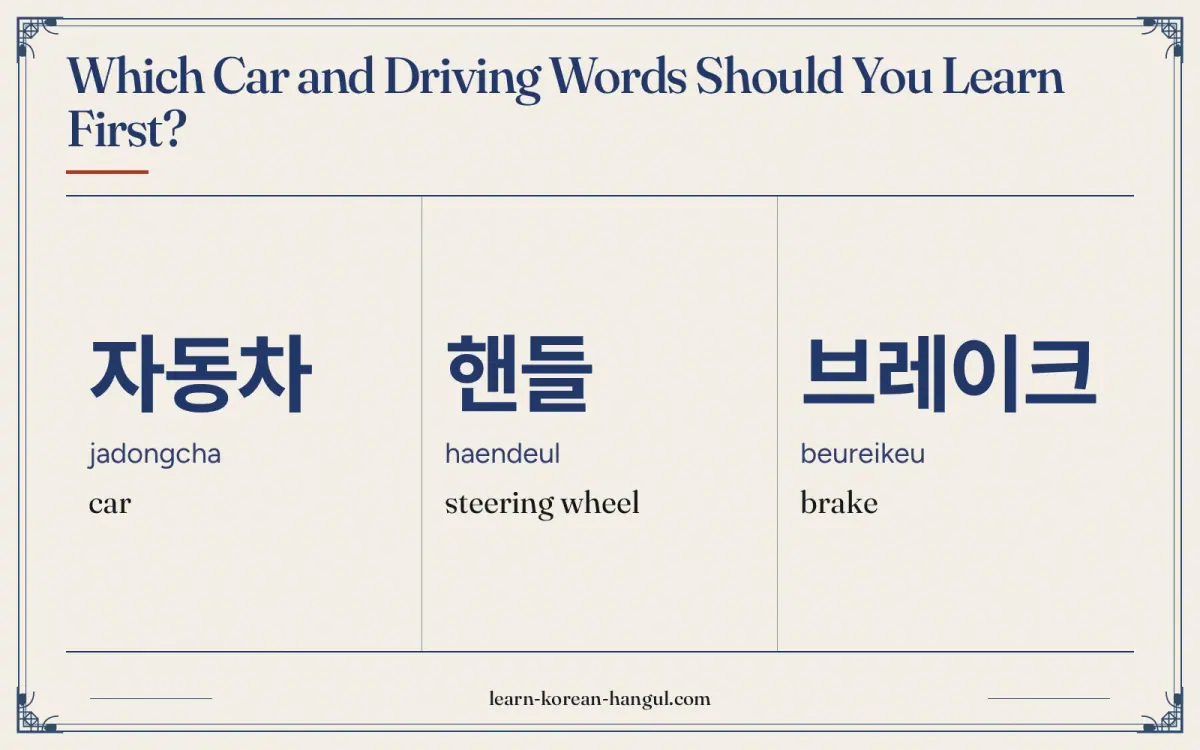
Learn 자동차 (car), 운전 (driving), 주유소 (gas station), 주차장 (parking lot) and 렌터카 (rental car) first. With these five you can ask where to park, where to buy fuel and how to rent a car. A short question such as 주차장이 어디예요? (Where is the parking lot?) needs just one noun and the question word. Then follow this order:
- Step 1: the five words above.
- Step 2: the controls: 핸들, 브레이크 and 액셀.
- Step 3: roads: 신호등, 횡단보도 and 고속도로.
- Step 4: rules and rental words: 벌금, 과태료, 운전면허증 and 보험.
The scene below numbers ten of the objects on a street and in a car, so you can tie each word to something you can point at.
Word · 10
- 1
자동차
jadongcha
car
- 2
핸들
haendeul
steering wheel
- 3
브레이크
beureikeu
brake
- 4
타이어
taieo
tire
- 5
신호등
sinhodeung
traffic light
- 6
횡단보도
hoengdanbodo
crosswalk
- 7
고속도로
gosokdoro
expressway
- 8
주유소
juyuso
gas station
- 9
주차장
juchajang
parking lot
- 10
렌터카
renteoka
rental car
Tap a number to hear the word. Notice how many are loanwords from English: 핸들, 브레이크, 타이어, 렌터카 and 내비게이션 sound close to their English source, but not always with the same meaning.
Car Parts
The first group names the car, the act of driving and the parts you touch. 자동차 is the full word for a car, 운전 is driving, and the controls are 핸들, 브레이크 and 액셀. 타이어 and 트렁크 are the parts you see from outside. Most of the part names are loanwords.
| No. | Hangul | Revised Romanization | Meaning and note | Example sentence | Audio assetId |
|---|---|---|---|---|---|
| 1 | 자동차 | jadongcha | car. Sino-Korean 자동 (automatic) + 차 (vehicle). The full word for a car. | 자동차를 운전해요. (I drive a car.) | au-pg-vocabulary-places-transportation-driving-1; example: au-pg-vocabulary-places-transportation-driving-36 |
| 2 | 운전 | unjeon | driving. Takes 하다: 운전하다 means to drive. Also the person is 운전자. | 저는 매일 운전해요. (I drive every day.) | au-pg-vocabulary-places-transportation-driving-2; example: au-pg-vocabulary-places-transportation-driving-37 |
| 3 | 핸들 | haendeul | steering wheel. From English handle, but only the steering wheel. A door handle is 손잡이. | 핸들을 잡아요. (I hold the steering wheel.) | au-pg-vocabulary-places-transportation-driving-3; example: au-pg-vocabulary-places-transportation-driving-38 |
| 4 | 브레이크 | beureikeu | brake. Loanword from English. The final 크 is a full syllable, keu, not a stopped k. | 브레이크를 밟아요. (I step on the brake.) | au-pg-vocabulary-places-transportation-driving-4; example: au-pg-vocabulary-places-transportation-driving-39 |
| 5 | 액셀 | aeksel | accelerator. Short for 액셀러레이터. The gas pedal. Said [액쎌]. | 액셀을 천천히 밟아요. (I press the accelerator slowly.) | au-pg-vocabulary-places-transportation-driving-5; example: au-pg-vocabulary-places-transportation-driving-40 |
| 6 | 타이어 | taieo | tire. Loanword from English. Also used for a spare, 스페어 타이어. | 타이어에 바람이 빠졌어요. (The tire has gone flat.) | au-pg-vocabulary-places-transportation-driving-6; example: au-pg-vocabulary-places-transportation-driving-41 |
| 7 | 트렁크 | teureongkeu | trunk. The rear storage space. The front cover over the engine is 보닛. | 트렁크에 짐을 넣어요. (I put luggage in the trunk.) | au-pg-vocabulary-places-transportation-driving-7; example: au-pg-vocabulary-places-transportation-driving-42 |
The verb for driving is 운전하다, not 타다. 타다 means to ride in or on something, as in 버스를 타요, while 운전하다 means to drive it yourself. The two verbs often pair with 자동차: 자동차를 운전해요 (I drive a car) and 자동차를 타요 (I ride in a car). 밟다 is the verb for stepping on a pedal, as in 브레이크를 밟아요. The dictionary form is said [밥따], and the polite form 밟아요 is said [발바요]. The sentence 타이어에 바람이 빠졌어요 literally says that air has come out of the tire, and it is the normal way to say a flat tire.
How Do You Say Roads and Traffic in Korean?
Roads and traffic have their own group. 도로 is the road, 차선 is the lane, 신호등 is the traffic light, and 횡단보도 is the crosswalk. 고속도로, 톨게이트 and 하이패스 belong to the expressway: the road, the toll booth and the electronic toll system.
| No. | Hangul | Revised Romanization | Meaning and note | Example sentence | Audio assetId |
|---|---|---|---|---|---|
| 8 | 도로 | doro | road. The general word for a paved road. Also seen on signs. | 도로가 넓어요. (The road is wide.) | au-pg-vocabulary-places-transportation-driving-8; example: au-pg-vocabulary-places-transportation-driving-43 |
| 9 | 신호등 | sinhodeung | traffic light. 신호 (signal) + 등 (light). Red is 빨간불; green is 파란불 or 초록불. | 신호등이 빨간색이에요. (The traffic light is red.) | au-pg-vocabulary-places-transportation-driving-9; example: au-pg-vocabulary-places-transportation-driving-44 |
| 10 | 횡단보도 | hoengdanbodo | crosswalk. 횡단 (crossing) + 보도 (sidewalk). The painted stripes. | 횡단보도를 건너요. (I cross the crosswalk.) | au-pg-vocabulary-places-transportation-driving-10; example: au-pg-vocabulary-places-transportation-driving-45 |
| 11 | 고속도로 | gosokdoro | expressway. 고속 (high speed) + 도로. Said [고속또로]. | 고속도로로 가요. (I take the expressway.) | au-pg-vocabulary-places-transportation-driving-11; example: au-pg-vocabulary-places-transportation-driving-46 |
| 12 | 톨게이트 | tolgeiteu | tollgate. Loanword from English. The toll booth on a highway. | 톨게이트에서 요금을 내요. (I pay the toll at the tollgate.) | au-pg-vocabulary-places-transportation-driving-12; example: au-pg-vocabulary-places-transportation-driving-47 |
| 13 | 하이패스 | haipaeseu | Hi-Pass (electronic toll). The name of the electronic toll system. Cars with a device pass without stopping. | 하이패스 차선으로 가요. (I go in the Hi-Pass lane.) | au-pg-vocabulary-places-transportation-driving-13; example: au-pg-vocabulary-places-transportation-driving-48 |
| 14 | 차선 | chaseon | lane. 차 (vehicle) + 선 (line). Also the line painted on the road. | 차선을 바꿔요. (I change lanes.) | au-pg-vocabulary-places-transportation-driving-14; example: au-pg-vocabulary-places-transportation-driving-49 |
신호등 has a useful pair of colour words: 빨간불 (red light) and 파란불 (green light). Koreans often say 파란불, literally blue light, for the go signal, because 파랗다 has long covered the green of a traffic light, and 초록불 is also heard. At a crosswalk, pedestrians wait for the 파란불. On a drive, you will also hear the verb 막히다 (to be blocked), as in 길이 막혀요 (the road is jammed). The word 톨게이트 comes from English tollgate, and the toll itself is called 통행료 (tonghaengnyo). The 하이패스 lane is a special lane for cars with a device, and other cars use the regular lanes.
Fuel and Parking
Fuel and parking words are the ones you use most outside the car. 주유소 is the gas station, 휘발유 is gasoline, and 경유 is diesel. 충전소 is a charging station for electric cars. 주차장 is the parking lot, 주차비 is the parking fee, and 세차 is the car wash.
| No. | Hangul | Revised Romanization | Meaning and note | Example sentence | Audio assetId |
|---|---|---|---|---|---|
| 15 | 주유소 | juyuso | gas station. 주유 (filling with oil) + 소 (place). | 주유소에서 기름을 넣어요. (I put fuel in at the gas station.) | au-pg-vocabulary-places-transportation-driving-15; example: au-pg-vocabulary-places-transportation-driving-50 |
| 16 | 휘발유 | hwibaryu | gasoline. The fuel for most cars. People also say 기름 for fuel in general. | 휘발유가 비싸요. (Gasoline is expensive.) | au-pg-vocabulary-places-transportation-driving-16; example: au-pg-vocabulary-places-transportation-driving-51 |
| 17 | 경유 | gyeongyu | diesel. The fuel for diesel cars. | 이 차는 경유를 써요. (This car uses diesel.) | au-pg-vocabulary-places-transportation-driving-17; example: au-pg-vocabulary-places-transportation-driving-52 |
| 18 | 충전소 | chungjeonso | charging station. 충전 (charging) + 소 (place). For electric cars. | 전기차 충전소가 어디 있어요? (Where is the EV charging station?) | au-pg-vocabulary-places-transportation-driving-18; example: au-pg-vocabulary-places-transportation-driving-53 |
| 19 | 주차장 | juchajang | parking lot. 주차 (parking) + 장 (place). | 주차장이 지하에 있어요. (The parking lot is underground.) | au-pg-vocabulary-places-transportation-driving-19; example: au-pg-vocabulary-places-transportation-driving-54 |
| 20 | 주차비 | juchabi | parking fee. 주차 (parking) + 비 (fee). | 주차비가 얼마예요? (How much is the parking fee?) | au-pg-vocabulary-places-transportation-driving-20; example: au-pg-vocabulary-places-transportation-driving-55 |
| 21 | 세차 | secha | car wash. The noun and the verb with 하다: 세차하다. | 주말에 세차해요. (I wash the car on the weekend.) | au-pg-vocabulary-places-transportation-driving-21; example: au-pg-vocabulary-places-transportation-driving-56 |
기름 is the everyday word for fuel: 기름을 넣다 means to fill up. 휘발유 is the specific word for gasoline and 경유 for diesel, so at a station you may be asked which one. The same -소 and -장 endings appear in the names of places: -소 in 주유소 and 충전소, -장 in 주차장 and 운동장 (playground or sports field). The pattern 장소 (place) is hidden inside them. In the question 전기차 충전소가 어디 있어요?, 가 marks the charging station as the subject, and 어디 있어요 asks where it is.
How Do You Say Rules and Fines in Korean?
Driving rules come with penalties, and the words appear in news and on signs. 안전벨트 is the seat belt, 과속 is speeding, and 음주운전 is drunk driving. 벌금 and 과태료 are two kinds of fines. 주차 위반 is a parking violation, and 교통사고 is a traffic accident.
| No. | Hangul | Revised Romanization | Meaning and note | Example sentence | Audio assetId |
|---|---|---|---|---|---|
| 22 | 안전벨트 | anjeonbelteu | seat belt. 안전 (safety) + 벨트 (belt). Also 안전띠. | 안전벨트를 매세요. (Please fasten your seat belt.) | au-pg-vocabulary-places-transportation-driving-22; example: au-pg-vocabulary-places-transportation-driving-57 |
| 23 | 벌금 | beolgeum | fine (court penalty). A penalty set by a court for a crime. Said [벌금]. | 벌금을 냈어요. (I paid a fine.) | au-pg-vocabulary-places-transportation-driving-23; example: au-pg-vocabulary-places-transportation-driving-58 |
| 24 | 과태료 | gwataeryo | fine (administrative). A penalty set by an office for a minor rule, such as a parking ticket. | 주차 과태료를 받았어요. (I got a parking fine.) | au-pg-vocabulary-places-transportation-driving-24; example: au-pg-vocabulary-places-transportation-driving-59 |
| 25 | 과속 | gwasok | speeding. 과 (over) + 속 (speed). Takes 하다: 과속하다. | 과속하면 위험해요. (It is dangerous if you speed.) | au-pg-vocabulary-places-transportation-driving-25; example: au-pg-vocabulary-places-transportation-driving-60 |
| 26 | 주차 위반 | jucha wiban | parking violation. 주차 (parking) + 위반 (violation). Written with a space. | 여기는 주차 위반이에요. (Parking here is a violation.) | au-pg-vocabulary-places-transportation-driving-26; example: au-pg-vocabulary-places-transportation-driving-61 |
| 27 | 음주운전 | eumjuunjeon | drunk driving. 음주 (drinking) + 운전 (driving). Usually written as one word; 음주 운전 with a space is also seen. | 음주운전은 법으로 금지돼요. (Drunk driving is banned by law.) | au-pg-vocabulary-places-transportation-driving-27; example: au-pg-vocabulary-places-transportation-driving-62 |
| 28 | 교통사고 | gyotongsago | traffic accident. 교통 (traffic) + 사고 (accident). Used with 나다. | 교통사고가 났어요. (A traffic accident happened.) | au-pg-vocabulary-places-transportation-driving-28; example: au-pg-vocabulary-places-transportation-driving-63 |
벌금 and 과태료 look alike but are different. 벌금 is a criminal fine decided by a court. 과태료 is an administrative fine for a lighter breach, such as a parking violation, and it is sent by an office. Learners often use 벌금 for both, which is understood but not exact. A traffic ticket that a police officer hands you on the spot has a third name, 범칙금. The common phrase for having an accident uses 나다: 교통사고가 났어요. The verb 매다 (to tie, to fasten) goes with 안전벨트, and the polite request 매세요 appears on signs and in announcements. For exact amounts and rules, check an official source such as the national traffic authority, because they change.
Rental Cars
Visitors who rent a car need seven words. 렌터카 is the rental car, 운전면허증 is the driver's licence, and 국제운전면허증 is the international driving permit. 보험 is insurance, 내비게이션 is the navigation system, 대여 is the rental, and 반납 is the return.
| No. | Hangul | Revised Romanization | Meaning and note | Example sentence | Audio assetId |
|---|---|---|---|---|---|
| 29 | 렌터카 | renteoka | rental car. Loanword from English rent-a-car. Rental companies are called 렌터카 회사. | 공항에서 렌터카를 빌렸어요. (I rented a car at the airport.) | au-pg-vocabulary-places-transportation-driving-29; example: au-pg-vocabulary-places-transportation-driving-64 |
| 30 | 운전면허증 | unjeonmyeonheojeung | driver's licence. 운전 (driving) + 면허증 (licence card). | 운전면허증을 보여 주세요. (Please show your driver's licence.) | au-pg-vocabulary-places-transportation-driving-30; example: au-pg-vocabulary-places-transportation-driving-65 |
| 31 | 국제운전면허증 | gukjeunjeonmyeonheojeung | international driving permit. 국제 (international) + 운전면허증. Said [국쩨운전면허증]. | 국제운전면허증이 필요해요. (An international driving permit is needed.) | au-pg-vocabulary-places-transportation-driving-31; example: au-pg-vocabulary-places-transportation-driving-66 |
| 32 | 보험 | boheom | insurance. Rental cars usually come with insurance options. | 보험에 가입했어요. (I took out insurance.) | au-pg-vocabulary-places-transportation-driving-32; example: au-pg-vocabulary-places-transportation-driving-67 |
| 33 | 내비게이션 | naebigeisyeon | navigation system. Loanword from English. Often shortened to 내비. | 내비게이션이 길을 안내해요. (The navigation system guides the way.) | au-pg-vocabulary-places-transportation-driving-33; example: au-pg-vocabulary-places-transportation-driving-68 |
| 34 | 대여 | daeyeo | rental. Sino-Korean 대 (lend) + 여 (give). The act of renting out. | 하루 대여는 얼마예요? (How much is a one-day rental?) | au-pg-vocabulary-places-transportation-driving-34; example: au-pg-vocabulary-places-transportation-driving-69 |
| 35 | 반납 | bannap | return. The act of giving something back. Used for cars, books and keys. | 차를 내일 반납해요. (I return the car tomorrow.) | au-pg-vocabulary-places-transportation-driving-35; example: au-pg-vocabulary-places-transportation-driving-70 |
When you rent a car, ask the rental company which documents you need before you travel, because the rules about licences and permits depend on your home country. The verb for renting a car as a customer is 빌리다, as in 렌터카를 빌렸어요, while 대여 is the noun the company uses on forms. 반납 is the word for bringing the car back, and the place you bring it to is the 반납 장소. The shortened form 내비 is the everyday word, and many people say 내비 켜 (turn on the navigation) in the car.
How Do You Pronounce Korean Car and Driving Words?
Many car words are loanwords and are easy to say, but several native and Sino-Korean words change their sound. The National Institute of Korean Language (국립국어원) sets these changes in its standard pronunciation rules. Revised Romanization follows the spoken sound for linking, but it does not show tensing caused by a neighbouring sound.
| Spelling | Sounds like | What changes |
|---|---|---|
| 고속도로 | [고속또로] | ㄷ is tensed after a final ㄱ. |
| 액셀 | [액쎌] | ㅅ is tensed after a final ㄱ. |
| 벌금 | [벌금] | No tensing: in Sino-Korean words ㄹ tenses only a following ㄷ, ㅅ or ㅈ. |
| 밟아요 | [발바요] | The cluster ㄼ splits: ㄹ stays and ㅂ moves to the next syllable. |
| 국제운전면허증 | [국쩨운전면허증] | ㅈ is tensed after a final ㄱ. |
Audio and Slow Playback
Each word and sentence has its own clip. The five clips below play the harder words slowly. Play a clip, say the word, then play it again and compare the ends of the syllables.
What Mistakes Do Learners Make with Car and Driving Words?
Five patterns catch learners when they talk about cars.
- Taking 핸들 for a door handle. 핸들 is only the steering wheel. A door handle or a bag handle is 손잡이.
- Using 타다 for driving. 타다 means to ride. To drive a car yourself, use 운전하다: 자동차를 운전해요.
- Using 벌금 for every fine. 벌금 is a court fine, and 과태료 is an administrative fine such as a parking ticket.
- Reading 고속도로 as written. The sound is [고속또로]. The ㄷ after a final ㄱ is tense.
- Calling the front hood 트렁크. 트렁크 is the rear storage space. The front cover over the engine is 보닛.
If you keep the verb 운전하다 and the two fines apart, most of the trouble goes away. The practice section turns the list into drills.
Practice: Flashcards and Worksheet
Study in three steps. First, run the deck in recognition mode until the 35 words feel familiar. Second, switch to listening mode and tap the clip before the card turns. Third, take the five-question quiz below. The deck stores your progress in your browser. The vocabulary flashcard decks page lists the other decks.
Practice · 75
- 01자동차
Show answer
headword 1: car
- 02운전
Show answer
headword 2: driving
- 03핸들
Show answer
headword 3: steering wheel
- 04브레이크
Show answer
headword 4: brake
- 05액셀
Show answer
headword 5: accelerator
- 06타이어
Show answer
headword 6: tire
- 07트렁크
Show answer
headword 7: trunk
- 08도로
Show answer
headword 8: road
- 09신호등
Show answer
headword 9: traffic light
- 10횡단보도
Show answer
headword 10: crosswalk
- 11고속도로
Show answer
headword 11: expressway
- 12톨게이트
Show answer
headword 12: tollgate
- 13하이패스
Show answer
headword 13: Hi-Pass (electronic toll)
- 14차선
Show answer
headword 14: lane
- 15주유소
Show answer
headword 15: gas station
- 16휘발유
Show answer
headword 16: gasoline
- 17경유
Show answer
headword 17: diesel
- 18충전소
Show answer
headword 18: charging station
- 19주차장
Show answer
headword 19: parking lot
- 20주차비
Show answer
headword 20: parking fee
- 21세차
Show answer
headword 21: car wash
- 22안전벨트
Show answer
headword 22: seat belt
- 23벌금
Show answer
headword 23: fine (court penalty)
- 24과태료
Show answer
headword 24: fine (administrative)
- 25과속
Show answer
headword 25: speeding
- 26주차 위반
Show answer
headword 26: parking violation
- 27음주운전
Show answer
headword 27: drunk driving
- 28교통사고
Show answer
headword 28: traffic accident
- 29렌터카
Show answer
headword 29: rental car
- 30운전면허증
Show answer
headword 30: driver's licence
- 31국제운전면허증
Show answer
headword 31: international driving permit
- 32보험
Show answer
headword 32: insurance
- 33내비게이션
Show answer
headword 33: navigation system
- 34대여
Show answer
headword 34: rental
- 35반납
Show answer
headword 35: return
- 36자동차를 운전해요.
Show answer
example sentence for 자동차
- 37저는 매일 운전해요.
Show answer
example sentence for 운전
- 38핸들을 잡아요.
Show answer
example sentence for 핸들
- 39브레이크를 밟아요.
Show answer
example sentence for 브레이크
- 40액셀을 천천히 밟아요.
Show answer
example sentence for 액셀
- 41타이어에 바람이 빠졌어요.
Show answer
example sentence for 타이어
- 42트렁크에 짐을 넣어요.
Show answer
example sentence for 트렁크
- 43도로가 넓어요.
Show answer
example sentence for 도로
- 44신호등이 빨간색이에요.
Show answer
example sentence for 신호등
- 45횡단보도를 건너요.
Show answer
example sentence for 횡단보도
- 46고속도로로 가요.
Show answer
example sentence for 고속도로
- 47톨게이트에서 요금을 내요.
Show answer
example sentence for 톨게이트
- 48하이패스 차선으로 가요.
Show answer
example sentence for 하이패스
- 49차선을 바꿔요.
Show answer
example sentence for 차선
- 50주유소에서 기름을 넣어요.
Show answer
example sentence for 주유소
- 51휘발유가 비싸요.
Show answer
example sentence for 휘발유
- 52이 차는 경유를 써요.
Show answer
example sentence for 경유
- 53전기차 충전소가 어디 있어요?
Show answer
example sentence for 충전소
- 54주차장이 지하에 있어요.
Show answer
example sentence for 주차장
- 55주차비가 얼마예요?
Show answer
example sentence for 주차비
- 56주말에 세차해요.
Show answer
example sentence for 세차
- 57안전벨트를 매세요.
Show answer
example sentence for 안전벨트
- 58벌금을 냈어요.
Show answer
example sentence for 벌금
- 59주차 과태료를 받았어요.
Show answer
example sentence for 과태료
- 60과속하면 위험해요.
Show answer
example sentence for 과속
- 61여기는 주차 위반이에요.
Show answer
example sentence for 주차 위반
- 62음주운전은 법으로 금지돼요.
Show answer
example sentence for 음주운전
- 63교통사고가 났어요.
Show answer
example sentence for 교통사고
- 64공항에서 렌터카를 빌렸어요.
Show answer
example sentence for 렌터카
- 65운전면허증을 보여 주세요.
Show answer
example sentence for 운전면허증
- 66국제운전면허증이 필요해요.
Show answer
example sentence for 국제운전면허증
- 67보험에 가입했어요.
Show answer
example sentence for 보험
- 68내비게이션이 길을 안내해요.
Show answer
example sentence for 내비게이션
- 69하루 대여는 얼마예요?
Show answer
example sentence for 대여
- 70차를 내일 반납해요.
Show answer
example sentence for 반납
- 71고속도로
Show answer
slow playback of 고속도로
- 72횡단보도
Show answer
slow playback of 횡단보도
- 73국제운전면허증
Show answer
slow playback of 국제운전면허증
- 74하이패스
Show answer
slow playback of 하이패스
- 75음주운전
Show answer
slow playback of 음주운전
Practice · 5
What does 핸들 (haendeul) mean?
Show answer
steering wheel
핸들 means steering wheel. A door handle is 손잡이. Example: 핸들을 잡아요. (I hold the steering wheel.)
Which verb means to drive a car yourself?
Show answer
운전하다
운전하다 means to drive. 타다 means to ride. Example: 저는 매일 운전해요. (I drive every day.)
What does 주차장 (juchajang) mean?
Show answer
parking lot
주차장 means parking lot. Example: 주차장이 지하에 있어요. (The parking lot is underground.)
Which word is an administrative fine, such as a parking ticket?
Show answer
과태료
과태료 is an administrative fine. 벌금 is a court fine. Example: 주차 과태료를 받았어요. (I got a parking fine.)
What does 렌터카 (renteoka) mean?
Show answer
rental car
렌터카 means rental car. Example: 공항에서 렌터카를 빌렸어요. (I rented a car at the airport.)
Korean Car and Driving Vocabulary Worksheet (PDF)
A printable worksheet for these words (word list, matching, writing practice, fill-in-the-blank exercises and answer key) is available in A4 and US Letter from the download card on this page. For additional practice, draw a car and label the parts you know in Korean.
Where to Go Next
After this page, continue with Korean Train and KTX Vocabulary for long-distance travel, or with the road signs page to read the signs you see from the driver's seat.
Frequently Asked Questions
How Do You Say Car in Korean?
Car is 자동차 (jadongcha). In daily speech people shorten it to 차 (cha), which also means tea or vehicle depending on context. The full word is common in writing and on forms. The single-word page on car in Korean gives more detail.
How Do You Say Steering Wheel in Korean?
Steering wheel is 핸들 (haendeul). It comes from the English word handle, but in Korean it means only the steering wheel. For a door handle or the handle of a bag, use 손잡이. The verb is 잡다, so 핸들을 잡아요 means I hold the steering wheel.
How Do You Say Driving in Korean?
Driving is 운전 (unjeon), and the verb is 운전하다. Say 운전해요 for I drive. The driver is 운전자 or 운전기사 when it is a paid job. Do not use 타다, which means to ride in a vehicle.
How Many Car and Driving Words Should I Learn First?
Five first: 자동차, 운전, 주유소, 주차장 and 렌터카. They let you ask where to park, where to buy fuel and how to rent a car. At five new words a day the 35 words take about a week with review. Add the road and rule words next.
Where Can I Practise Car and Driving Words with Flashcards?
Use the vocabulary flashcard decks. The deck for this page holds all 35 words with Hangul, romanization and audio, in recognition and listening modes. Your progress stays in your browser. Give the rental car group extra time in listening mode.
Is There a Printable Worksheet for Car and Driving Words?
A printable worksheet for these words (word list, matching, writing practice, fill-in-the-blank exercises and answer key) is available in A4 and US Letter from the download card on this page. For practice, the tables on this page can be copied by hand, and the deck carries the same 35 words.