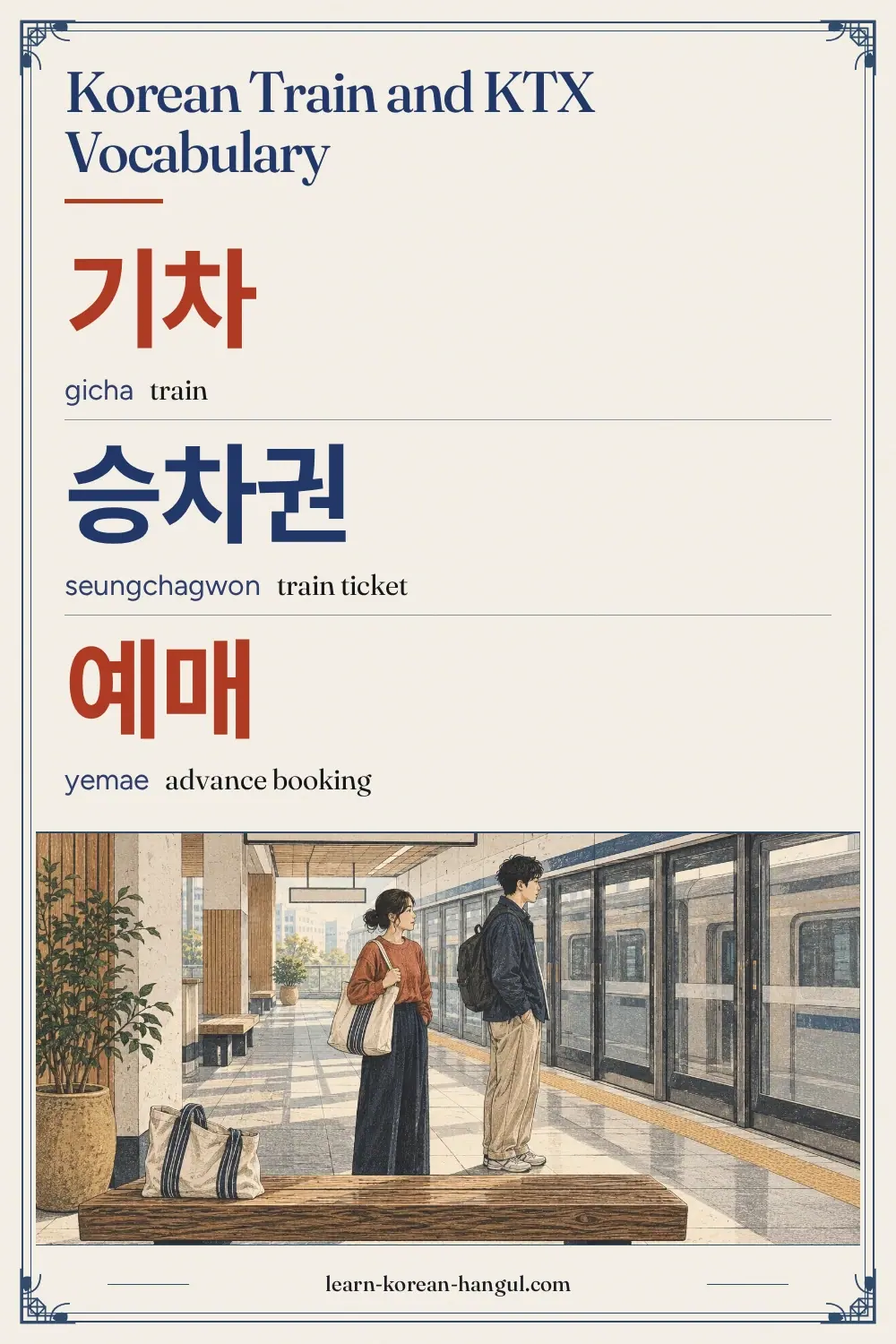
Korean Train and KTX Vocabulary at a Glance
The list has 30 words in five groups of six. It follows a rail journey in order: the kind of train, the ticket and seat, the station, the carriage and what happens when plans change. It belongs to Transportation and it is the intercity partner of the city lists in Korean Bus and Taxi Vocabulary. Most words are Sino-Korean nouns, and the stems repeat: 승 means riding, 착 means arriving and 권 means a ticket.
| Group | Words | Use |
|---|---|---|
| Train types | 6 | Kinds of train and service |
| Tickets and seats | 6 | Booking, fares and seats |
| Stations and platforms | 6 | Where to buy, wait and board |
| On board | 6 | Cars, racks and announcements |
| Delays and refunds | 6 | When plans change |
Which Train and KTX Words Should You Learn First?

Learn 기차 (train), 역 (station), 표 (ticket), 편도 (one way) and 왕복 (round trip) first. They let you ask for a ticket and find your way. Add 승차권 and 예매 as soon as you start booking, and 승강장 (platform) before your first trip.
- Words to say. 기차, 역, 표, 편도, 왕복.
- Words to recognise. 승차권, 예매, 좌석, 승강장. They are printed on tickets and signs.
- Words for trouble. 지연, 연착, 취소, 환불, 수수료.
The scene below numbers ten of the 30 words, from the booking screen to the luggage rack. Play the clip on each item to hear the headword.
Word · 10
- 1
기차
gicha
train
- 2
KTX
keitiekseu
KTX; high-speed train
- 3
승차권
seungchagwon
train ticket
- 4
예매
yemae
advance booking
- 5
편도
pyeondo
one way (trip)
- 6
좌석
jwaseok
seat
- 7
승강장
seunggangjang
platform
- 8
매표소
maepyoso
ticket office
- 9
선반
seonban
luggage rack; shelf
- 10
환불
hwanbul
refund
Train Types
Korean has three common words for the same vehicle, and which one you read depends on where you are. 기차 is what people say, 열차 is what the timetable and the loudspeaker say, and KTX is the name of the high-speed service, so every KTX is a 기차 but not every 기차 is a KTX. The last two words of the group describe how a train stops: a 급행 skips small stations and a 완행 calls at all of them.
| No. | Hangul | Revised Romanization | Meaning and note | Example sentence | Audio assetId |
|---|---|---|---|---|---|
| 1 | 기차 | gicha | train. The everyday word for an intercity train of any kind. | 기차가 곧 와요. (The train is coming soon.) | au-pg-vocabulary-places-transportation-train-ktx-1; example: au-pg-vocabulary-places-transportation-train-ktx-31 |
| 2 | 열차 | yeolcha | train (formal). Same meaning as 기차, but it is the word of timetables and announcements. | 열차 번호를 확인해요. (I check the train number.) | au-pg-vocabulary-places-transportation-train-ktx-2; example: au-pg-vocabulary-places-transportation-train-ktx-32 |
| 3 | KTX | keitiekseu | KTX; high-speed train. The letters are read by their English names, [케이티엑스]. | KTX는 빨라요. (The KTX is fast.) | au-pg-vocabulary-places-transportation-train-ktx-3; example: au-pg-vocabulary-places-transportation-train-ktx-33 |
| 4 | 고속철도 | gosokcheoldo | high-speed rail. 고속 (high speed) plus 철도 (railway). The word for the network. | 고속철도로 부산에 가요. (I go to Busan by high-speed rail.) | au-pg-vocabulary-places-transportation-train-ktx-4; example: au-pg-vocabulary-places-transportation-train-ktx-34 |
| 5 | 급행 | geuphaeng | express. A service that skips small stops. Said [그팽], and the romanization keeps the h. | 급행은 작은 역에 안 서요. (The express does not stop at small stations.) | au-pg-vocabulary-places-transportation-train-ktx-5; example: au-pg-vocabulary-places-transportation-train-ktx-35 |
| 6 | 완행 | wanhaeng | local (stopping at every station). The opposite of 급행. | 완행은 모든 역에 서요. (The local stops at every station.) | au-pg-vocabulary-places-transportation-train-ktx-6; example: au-pg-vocabulary-places-transportation-train-ktx-36 |
The KTX is run by the national rail operator Korail (한국철도공사), and a second operator, SR, runs a high-speed service under the name SRT. Service names and train classes change over time, so check the current timetable on the operator's official site or app before you plan. The words in this table do not change with the names. The verb for riding any of them is 타다, whose polite present form is 타요, as in 기차를 타요 (I take the train). The place you board is marked with 에서, as in 서울역에서 타요 (I board at Seoul Station). Also notice the spelling 급행: it is written with an h even though it is said [그팽], because Revised Romanization keeps the h in nouns (geuphaeng).
How Do You Say Tickets and Seats in Korean?
A train trip in Korea starts with a booking. You buy a 승차권 (or say 표, the general word for ticket) with 예매, which means buying before the day of travel, and you choose between 편도 and 왕복 before you pay. Seats are numbered, and the number is printed on the ticket beside the car number. Most visitors book with the operator's app or website, and the Korean words below are the ones on those screens.
| No. | Hangul | Revised Romanization | Meaning and note | Example sentence | Audio assetId |
|---|---|---|---|---|---|
| 7 | 승차권 | seungchagwon | train ticket. Said [승차꿘]. 승차 is boarding and 권 is a ticket or voucher. | 승차권을 사요. (I buy a train ticket.) | au-pg-vocabulary-places-transportation-train-ktx-7; example: au-pg-vocabulary-places-transportation-train-ktx-37 |
| 8 | 예매 | yemae | advance booking. Buying a ticket before the day. The verb is 예매하다. | 인터넷으로 예매해요. (I book online.) | au-pg-vocabulary-places-transportation-train-ktx-8; example: au-pg-vocabulary-places-transportation-train-ktx-38 |
| 9 | 편도 | pyeondo | one way (trip). One direction of a journey. | 편도 한 장 주세요. (One one-way ticket, please.) | au-pg-vocabulary-places-transportation-train-ktx-9; example: au-pg-vocabulary-places-transportation-train-ktx-39 |
| 10 | 왕복 | wangbok | round trip. The opposite of 편도. | 왕복으로 예매했어요. (I booked a round trip.) | au-pg-vocabulary-places-transportation-train-ktx-10; example: au-pg-vocabulary-places-transportation-train-ktx-40 |
| 11 | 좌석 | jwaseok | seat. The seat number is printed on the ticket. | 좌석 번호를 확인해요. (I check the seat number.) | au-pg-vocabulary-places-transportation-train-ktx-11; example: au-pg-vocabulary-places-transportation-train-ktx-41 |
| 12 | 입석 | ipseok | standing ticket. Said [입썩]. Some services sell it when seats sell out. | 자리가 없어서 입석을 샀어요. (There were no seats, so I bought a standing ticket.) | au-pg-vocabulary-places-transportation-train-ktx-12; example: au-pg-vocabulary-places-transportation-train-ktx-42 |
Two small patterns help here. Tickets are counted with the counter 장, so 편도 한 장 means one one-way ticket. The departure time is said with native-Korean hours, and the telling time page explains 오후 세 시 and other times. Notice that 승차권 and 입석 both have tense sounds that the spelling does not show: [승차꿘] and [입썩]. The word 표 is shorter and used in speech, while 승차권 is the written word on the ticket itself, so listen for 표 at the counter and read 승차권 on the paper. For the single-word entry, see train in Korean.
Stations and Platforms
A Korean train station has the same parts as a station anywhere, but the names of its parts are worth knowing because they appear on signs. You buy at the 매표소, wait in the 대합실, pass the 개찰구 and walk to your 승강장. The word 역 (station) also goes at the end of every station name, so 서울역, 부산역 and 대전역 are all stations. The group ends with 종착역, the last stop of a line.
| No. | Hangul | Revised Romanization | Meaning and note | Example sentence | Audio assetId |
|---|---|---|---|---|---|
| 13 | 역 | yeok | station. Follows a name: 서울역 (Seoul Station), said [서울력]. | 서울역에서 만나요. (Let's meet at Seoul Station.) | au-pg-vocabulary-places-transportation-train-ktx-13; example: au-pg-vocabulary-places-transportation-train-ktx-43 |
| 14 | 승강장 | seunggangjang | platform. The boarding area, with a number: 삼 번 승강장. | 삼 번 승강장으로 가요. (I go to platform 3.) | au-pg-vocabulary-places-transportation-train-ktx-14; example: au-pg-vocabulary-places-transportation-train-ktx-44 |
| 15 | 매표소 | maepyoso | ticket office. 소 means a place, as in 휴게소 (rest stop). | 매표소는 어디예요? (Where is the ticket office?) | au-pg-vocabulary-places-transportation-train-ktx-15; example: au-pg-vocabulary-places-transportation-train-ktx-45 |
| 16 | 개찰구 | gaechalgu | ticket gate. The gate where tickets are checked. | 개찰구를 통과해요. (I pass through the ticket gate.) | au-pg-vocabulary-places-transportation-train-ktx-16; example: au-pg-vocabulary-places-transportation-train-ktx-46 |
| 17 | 대합실 | daehapsil | waiting room. Said [대합씰]. | 대합실에서 기다려요. (I wait in the waiting room.) | au-pg-vocabulary-places-transportation-train-ktx-17; example: au-pg-vocabulary-places-transportation-train-ktx-47 |
| 18 | 종착역 | jongchangnyeok | terminal station; final stop. Said [종창녁]. The romanization shows the added ㄴ. | 종착역은 부산역이에요. (The last stop is Busan Station.) | au-pg-vocabulary-places-transportation-train-ktx-18; example: au-pg-vocabulary-places-transportation-train-ktx-48 |
In station names, 역 follows the place, with no space: 서울역, not 서울 역. When the name ends in ㄹ, a ㄴ is added before 역 and then changes to ㄹ, so 서울역 is said [서울력] and Revised Romanization writes Seoullyeok. After a name that ends in ㄴ, the added ㄴ is often heard as it is: 부산역 is commonly said [부산녁]. Platform numbers use Sino-Korean numbers with 번, as in 삼 번 승강장, while car numbers use 호차, as in 삼 호차. Do not mix the two: the platform is where you wait and the car is where you sit. The subway has its own list of station words in Korean Subway Vocabulary.
How Do You Say on Board in Korean?
Once you are on the train, a smaller set of words covers what you see and hear. The train is divided into 객차, each with a number, and your 좌석 is inside one of them. Bags go on the 선반 above the seats, and the 차장 or the recorded 안내 방송 tells you which 정차역 comes next. Most announcements are short and repeat the same pattern, so the same words come around again and again.
| No. | Hangul | Revised Romanization | Meaning and note | Example sentence | Audio assetId |
|---|---|---|---|---|---|
| 19 | 객차 | gaekcha | passenger car; carriage. One car of the train. | 객차 문이 열려요. (The carriage door opens.) | au-pg-vocabulary-places-transportation-train-ktx-19; example: au-pg-vocabulary-places-transportation-train-ktx-49 |
| 20 | 호차 | hocha | car number. Follows a number: 삼 호차 is car 3. | 제 좌석은 삼 호차에 있어요. (My seat is in car 3.) | au-pg-vocabulary-places-transportation-train-ktx-20; example: au-pg-vocabulary-places-transportation-train-ktx-50 |
| 21 | 선반 | seonban | luggage rack; shelf. Above the seats. | 짐을 선반에 올려요. (I put my bag on the rack.) | au-pg-vocabulary-places-transportation-train-ktx-21; example: au-pg-vocabulary-places-transportation-train-ktx-51 |
| 22 | 차장 | chajang | conductor. Spelled like the company rank 차장, so context decides. | 차장이 표를 확인해요. (The conductor checks tickets.) | au-pg-vocabulary-places-transportation-train-ktx-22; example: au-pg-vocabulary-places-transportation-train-ktx-52 |
| 23 | 안내 방송 | annae bangsong | announcement. 안내 (guidance) plus 방송 (broadcast). | 안내 방송을 들어요. (I listen to the announcement.) | au-pg-vocabulary-places-transportation-train-ktx-23; example: au-pg-vocabulary-places-transportation-train-ktx-53 |
| 24 | 정차역 | jeongchayeok | stopping station; stop on the route. 정차 means a train stopping. | 다음 정차역은 대전이에요. (The next stop is Daejeon.) | au-pg-vocabulary-places-transportation-train-ktx-24; example: au-pg-vocabulary-places-transportation-train-ktx-54 |
The announcement for the next stop usually names the station and says it is coming up, so the word you listen for is the station name. On many services the announcement is repeated in English after the Korean. The word 차장 deserves a note. As a train word it means the conductor, but 차장 is also a company rank, one step below 부장, and the rank is a different word with the same spelling. Context separates them: 차장이 표를 확인해요 is clearly about a train. The same trap appears in Korean Company Ranks and Job Titles. The verb 올리다 in the luggage sentence gives 올려요, and 열리다 (to open, of a door) gives 열려요.
Delays and Refunds
The last group is for the moment a plan changes. Trains are usually on time, but when snow or a signal fault delays one, the screen and the announcement use 지연 or 연착. If you decide to change the trip yourself, you ask to 취소 (cancel) or 변경 (change) it, and you may meet a 수수료 (fee) before the 환불 (refund). These are formal nouns and they are used at the counter and on apps.
| No. | Hangul | Revised Romanization | Meaning and note | Example sentence | Audio assetId |
|---|---|---|---|---|---|
| 25 | 지연 | jiyeon | delay. The verb is 지연되다: be delayed. | 눈 때문에 열차가 지연돼요. (The train is delayed because of snow.) | au-pg-vocabulary-places-transportation-train-ktx-25; example: au-pg-vocabulary-places-transportation-train-ktx-55 |
| 26 | 연착 | yeonchak | late arrival. Arriving late, said of trains and flights. | 열차가 십 분 연착했어요. (The train arrived ten minutes late.) | au-pg-vocabulary-places-transportation-train-ktx-26; example: au-pg-vocabulary-places-transportation-train-ktx-56 |
| 27 | 취소 | chwiso | cancellation. Add 하다 to cancel a ticket. | 표를 취소하고 싶어요. (I want to cancel my ticket.) | au-pg-vocabulary-places-transportation-train-ktx-27; example: au-pg-vocabulary-places-transportation-train-ktx-57 |
| 28 | 환불 | hwanbul | refund. Money paid back. | 환불해 주세요. (Please refund it.) | au-pg-vocabulary-places-transportation-train-ktx-28; example: au-pg-vocabulary-places-transportation-train-ktx-58 |
| 29 | 수수료 | susuryo | fee; commission. A cancellation often carries one. | 취소 수수료가 있어요. (There is a cancellation fee.) | au-pg-vocabulary-places-transportation-train-ktx-29; example: au-pg-vocabulary-places-transportation-train-ktx-59 |
| 30 | 변경 | byeongyeong | change; alteration. Changing the time or seat of a booking. | 시간을 변경하고 싶어요. (I want to change the time.) | au-pg-vocabulary-places-transportation-train-ktx-30; example: au-pg-vocabulary-places-transportation-train-ktx-60 |
The difference between 지연 and 연착 is small. 지연 is a general delay that can be a late start or a slow journey, while 연착 is specifically late arrival. The refund rules, fees and deadlines depend on the ticket and the operator and change over time, so read the conditions on the booking screen or ask at the counter. The useful polite requests are built from the nouns: 환불해 주세요 (please refund it) and 변경하고 싶어요 (I want to change it). The ending -고 싶어요 means "I want to", and it attaches to the verb stem: 취소하고 싶어요, 변경하고 싶어요.
How Do You Pronounce These Words?
Train words are full of tense sounds and of ㄴ added between words, so the spelling is a poor guide. A plain consonant becomes tense after some final sounds, a ㄴ is added before 역 in a compound, and ㅂ followed by ㅎ merges into ㅍ. Standard pronunciation follows the National Institute of Korean Language (국립국어원) rules. Revised Romanization shows the added ㄴ but not the tensing.
| Spelling | Sounds like | What changes |
|---|---|---|
| 승차권 | [승차꿘] | The ㄱ of 권 is said as tense ㄲ. |
| 입석 | [입썩] | After the final ㅂ, the ㅅ of 석 is said as tense ㅆ. |
| 대합실 | [대합씰] | After the final ㅂ of 합, the ㅅ is tense. |
| 서울역 | [서울력] | A ㄴ is added before 역, then it becomes ㄹ after the ㄹ of 울. |
| 종착역 | [종창녁] | A ㄴ is added before 역, and the final ㄱ of 착 becomes ㅇ before it. |
| 급행 | [그팽] | ㅂ and ㅎ merge into the aspirated ㅍ, though the romanization keeps the h. |
Audio and Slow Playback
Each word and example has its own clip, and five more replay the hardest words slowly. Play 승차권 first and listen for the tense ㄲ in the last syllable, then say 종착역 slowly, pausing before 역.
What Mistakes Do Learners Make with Train and KTX Words?
Five slips are common at Korean stations.
- Calling every train a KTX. KTX is one high-speed service. 기차 is the general word, and 열차 is the formal one on timetables.
- Mixing 편도 and 왕복. 편도 is one way and 왕복 is a round trip. At the counter, say the number of tickets after it: 왕복 두 장.
- Confusing 승강장 and 역. 역 is the whole station and 승강장 is the platform. Ask 승강장이 어디예요? when you need the platform.
- Reading 호차 as a platform. 삼 호차 is car 3, and 삼 번 승강장 is platform 3. The first is inside the train and the second is outside.
- Pronouncing 종착역 as written. It is said [종창녁], with an added ㄴ. A plain [종착역] sounds like two words.
Check the counter word before the noun: 번 for platforms, 호차 for cars and 장 for tickets. Rail services, ticket types and fare rules change from time to time, so treat this page as a guide to the vocabulary and the operator's own site as the authority for the service.
Practice: Flashcards and Worksheet
Study in three steps. First, run the deck in recognition mode until the 30 words feel familiar. Second, switch to listening mode and play the clip before you flip each card. Third, take the five-question quiz. Your deck progress stays in your browser, and the vocabulary flashcard decks page lists the other decks.
Practice · 65
- 01기차
Show answer
headword 1: train
- 02열차
Show answer
headword 2: train (formal)
- 03KTX
Show answer
headword 3: KTX; high-speed train
- 04고속철도
Show answer
headword 4: high-speed rail
- 05급행
Show answer
headword 5: express
- 06완행
Show answer
headword 6: local (stopping at every station)
- 07승차권
Show answer
headword 7: train ticket
- 08예매
Show answer
headword 8: advance booking
- 09편도
Show answer
headword 9: one way (trip)
- 10왕복
Show answer
headword 10: round trip
- 11좌석
Show answer
headword 11: seat
- 12입석
Show answer
headword 12: standing ticket
- 13역
Show answer
headword 13: station
- 14승강장
Show answer
headword 14: platform
- 15매표소
Show answer
headword 15: ticket office
- 16개찰구
Show answer
headword 16: ticket gate
- 17대합실
Show answer
headword 17: waiting room
- 18종착역
Show answer
headword 18: terminal station; final stop
- 19객차
Show answer
headword 19: passenger car; carriage
- 20호차
Show answer
headword 20: car number
- 21선반
Show answer
headword 21: luggage rack; shelf
- 22차장
Show answer
headword 22: conductor
- 23안내 방송
Show answer
headword 23: announcement
- 24정차역
Show answer
headword 24: stopping station; stop on the route
- 25지연
Show answer
headword 25: delay
- 26연착
Show answer
headword 26: late arrival
- 27취소
Show answer
headword 27: cancellation
- 28환불
Show answer
headword 28: refund
- 29수수료
Show answer
headword 29: fee; commission
- 30변경
Show answer
headword 30: change; alteration
- 31기차가 곧 와요.
Show answer
example sentence for 기차
- 32열차 번호를 확인해요.
Show answer
example sentence for 열차
- 33KTX는 빨라요.
Show answer
example sentence for KTX
- 34고속철도로 부산에 가요.
Show answer
example sentence for 고속철도
- 35급행은 작은 역에 안 서요.
Show answer
example sentence for 급행
- 36완행은 모든 역에 서요.
Show answer
example sentence for 완행
- 37승차권을 사요.
Show answer
example sentence for 승차권
- 38인터넷으로 예매해요.
Show answer
example sentence for 예매
- 39편도 한 장 주세요.
Show answer
example sentence for 편도
- 40왕복으로 예매했어요.
Show answer
example sentence for 왕복
- 41좌석 번호를 확인해요.
Show answer
example sentence for 좌석
- 42자리가 없어서 입석을 샀어요.
Show answer
example sentence for 입석
- 43서울역에서 만나요.
Show answer
example sentence for 역
- 44삼 번 승강장으로 가요.
Show answer
example sentence for 승강장
- 45매표소는 어디예요?
Show answer
example sentence for 매표소
- 46개찰구를 통과해요.
Show answer
example sentence for 개찰구
- 47대합실에서 기다려요.
Show answer
example sentence for 대합실
- 48종착역은 부산역이에요.
Show answer
example sentence for 종착역
- 49객차 문이 열려요.
Show answer
example sentence for 객차
- 50제 좌석은 삼 호차에 있어요.
Show answer
example sentence for 호차
- 51짐을 선반에 올려요.
Show answer
example sentence for 선반
- 52차장이 표를 확인해요.
Show answer
example sentence for 차장
- 53안내 방송을 들어요.
Show answer
example sentence for 안내 방송
- 54다음 정차역은 대전이에요.
Show answer
example sentence for 정차역
- 55눈 때문에 열차가 지연돼요.
Show answer
example sentence for 지연
- 56열차가 십 분 연착했어요.
Show answer
example sentence for 연착
- 57표를 취소하고 싶어요.
Show answer
example sentence for 취소
- 58환불해 주세요.
Show answer
example sentence for 환불
- 59취소 수수료가 있어요.
Show answer
example sentence for 수수료
- 60시간을 변경하고 싶어요.
Show answer
example sentence for 변경
- 61승차권
Show answer
slow playback: train ticket
- 62종착역
Show answer
slow playback: terminal station; final stop
- 63급행
Show answer
slow playback: express
- 64대합실
Show answer
slow playback: waiting room
- 65입석
Show answer
slow playback: standing ticket
Practice · 5
What does KTX (keitiekseu) mean?
Show answer
KTX; high-speed train
KTX is the name of the high-speed train service. Example: KTX는 빨라요. (The KTX is fast.)
What does 편도 (pyeondo) mean?
Show answer
one way (trip)
편도 means one way (trip). Example: 편도 한 장 주세요. (One one-way ticket, please.)
What does 승강장 (seunggangjang) mean?
Show answer
platform
승강장 means platform. Example: 삼 번 승강장으로 가요. (I go to platform 3.)
What does 선반 (seonban) mean?
Show answer
luggage rack; shelf
선반 means luggage rack; shelf. Example: 짐을 선반에 올려요. (I put my bag on the rack.)
What does 환불 (hwanbul) mean?
Show answer
refund
환불 means refund. Example: 환불해 주세요. (Please refund it.)
Korean Train and KTX Vocabulary Worksheet (PDF)
A printable worksheet for these words (word list, matching, writing practice, fill-in-the-blank exercises and answer key) is available in A4 and US Letter from the download card on this page. Meanwhile, write one request for each of the five groups, such as 왕복 두 장 주세요 and 환불해 주세요, and say each aloud.
Where to Go Next
After this page, continue with Korean Bus and Taxi Vocabulary for city and intercity buses, or with Korean Car and Driving Vocabulary for the car. To move up a level, return to Transportation.
Frequently Asked Questions
How Do You Say Train in Korean?
Train is 기차 (gicha) in speech and 열차 (yeolcha) in timetables and announcements. KTX, said [케이티엑스], is the name of one high-speed service. To ride a train, use 타다, so 기차를 타요 means I take the train. The single-word page on train in Korean gives more detail.
How Do You Pronounce 승차권 (seungchagwon)?
Say seung-cha-gwon with a tense sound at the end. The standard pronunciation is [승차꿘], so the ㄱ of 권 is said as a tense ㄲ, close to "kkwon". Revised Romanization writes seungchagwon and does not show the tense sound. Press the audio button to hear it.
How Many Train and KTX Words Should I Learn First?
Five: 기차, 역, 표, 편도 and 왕복. They cover asking for a ticket and finding the station. At five new words a day the full 30 take six days plus review. Add 승차권, 예매 and 승강장 before your first trip.
Where Can I Practise Train and KTX Words with Flashcards?
Use the vocabulary flashcard decks. The deck for this page holds all 30 words with Hangul, romanization and audio. Your progress stays in your browser. Try listening mode on the station and ticket words, because [서울력] and [종창녁] sound different from the spelling.
Is the Romanization on This Page Official?
It follows the Revised Romanization of Korean, which South Korea adopted on 7 July 2000 and whose rules the National Institute of Korean Language (국립국어원) publishes. It is a learning aid. It shows added sounds such as Seoullyeok, but it does not show tensing that the spelling does not write, such as the [ㄲ] in 승차권 [승차꿘], so rely on the Hangul and the audio.
Is There a Printable Worksheet for Train and KTX Words?
A printable worksheet for these words (word list, matching, writing practice, fill-in-the-blank exercises and answer key) is available in A4 and US Letter from the download card on this page. For practice, copy the tables by hand and write one example sentence for each of the five groups.