
Korean Places Vocabulary at a Glance
This section teaches the words you need to move through a Korean city and a trip. It is a part of Korean Vocabulary and it holds five lists: Around the City, Korean Directions Vocabulary, Transportation, Travel and Airport and Hotel. The lists contain nouns, short expressions and position words. Verbs and adjectives are not in these lists, because they change shape when you conjugate them. They live in the verbs section.
| List | Words | Best for |
|---|---|---|
| Around the City | 50 | Reading signs and naming places |
| Korean Directions Vocabulary | 40 | Asking and giving directions |
| Transportation | 45 | Subways, buses, trains and taxis |
| Travel and Airport | 40 | Planning, booking, luggage and money |
| Hotel | 35 | Booking and checking in |
Which Places List Should You Study First?
For a first trip, study in the order a trip happens: transport and directions first, then city places, then the hotel. This order works because you can point at a menu or mime at a counter, but you cannot easily mime a destination. If you can read a station name and ask 어디예요? (where is it?), you can find everything else.
- For a first trip. Start with Transportation, then Korean Directions Vocabulary, then Around the City.
- For staying in a hotel. Take the Hotel list the week before you travel, and the airport words before you fly.
- For living in Korea. Start with Around the City, because bank, post office, hospital and pharmacy words are daily errands.
- For watching dramas. Take Around the City first. Scenes in a 학교 (school), 병원 (hospital) and 회사 (company) use these words constantly.
The same sentence frames work for every list, so you can learn the frame once and swap in new nouns. To go to a place, say [place]에 가요. To say where something is, say [place]에 있어요. The location particles page explains 에 and 에서, and the travel sentences are on the asking directions page.
What Are the Five Place Lists?
Each list below has its own page, and every page gives each word Hangul, Revised Romanization, audio and an example sentence.
Around the City
Fifty words for the places you see on a city street: banks, hospitals, schools, parks and shops, grouped by the endings that predict their shape. It also covers the places that are special to Korean cities, such as the 찜질방, the 노래방 and the 편의점. It has two deeper pages: one for post office words and one for shops and buildings.
Korean Directions Vocabulary
Forty words for left, right, straight, up, down, in front of, behind, near and far, the four points of the compass and the landmarks people point to. It teaches the pattern for giving a position with a landmark, such as 편의점 앞에서 오른쪽, which is how Koreans actually give directions.
Transportation
Forty-five words in six groups: subway and bus, trains, taxis, cars and bikes, planes and ships, and fares and cards. Five deeper pages cover the subway, buses and taxis, trains and the KTX, driving, and road signs. Take this list before a trip, because station names and exit numbers are the first thing you read when you arrive.
Travel and Airport
Forty words in six groups for planning, booking, luggage, sightseeing, money and documents. Three deeper pages cover the airport, immigration and visas, and tourist attractions. It pairs with the travel phrases section for the sentences you say at a counter.
Hotel
Thirty-five words for booking a room, checking in, room types and front-desk requests. It also explains what a 모텔 and a 펜션 are in Korea, since these are not the same as in English.
How Does a Korean Address Work?
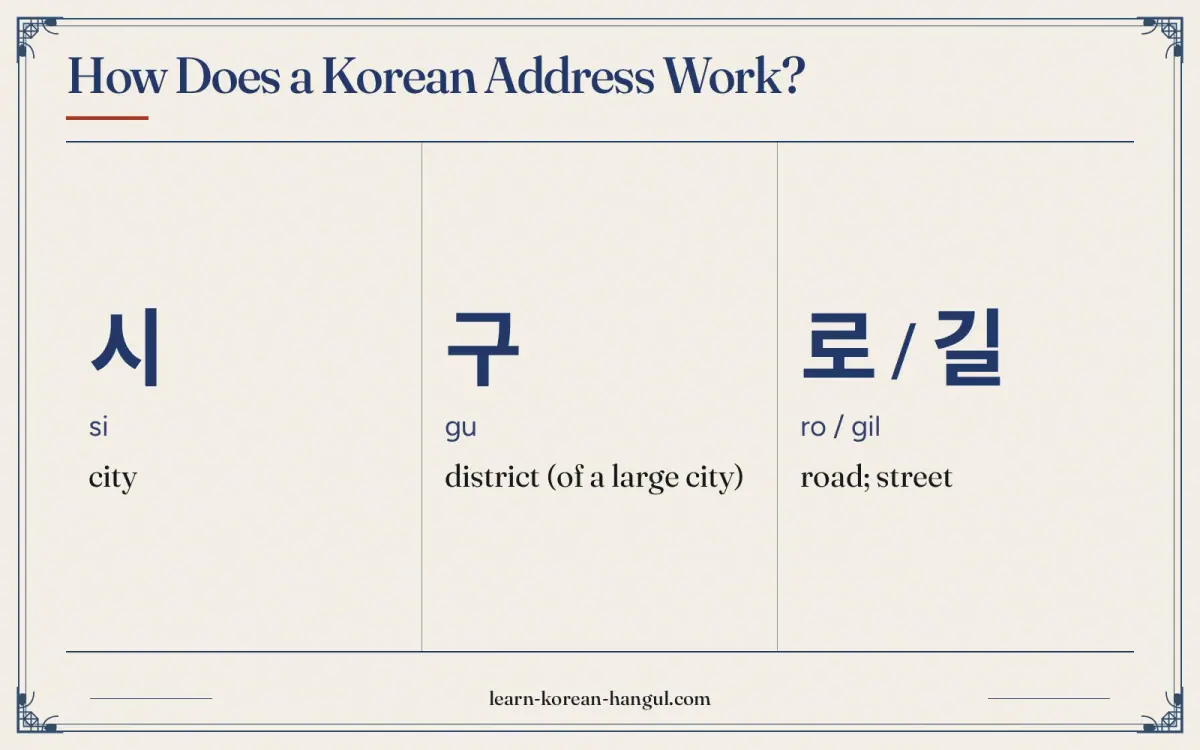
A Korean address runs from the largest unit to the smallest, the reverse of English. The units are the city (시), the district (구), the road (로 or 길) and the building number. An example of the pattern is 서울시 강남구 테헤란로 123: the city Seoul, the district Gangnam, the road Teheran-ro and building number 123. This is an example of the format, not a real address.
| Unit | Hangul | Revised Romanization | Meaning |
|---|---|---|---|
| City | 시 | si | city |
| District | 구 | gu | district (of a large city) |
| Road | 로 / 길 | ro / gil | road; street |
| Building number | (number) | — | written as a plain number, as in 123 |
Korea moved to this road-name system (도로명 주소) for official addresses in 2014, replacing the older lot-number system, which named a neighbourhood (동) and a lot number (번지). You will still see lot-number addresses on older signs and documents, so recognise both. In everyday speech the city is often shortened: the official name 서울특별시 is usually written or said 서울시 or simply 서울. When you tell a taxi driver where you are going, a landmark is often faster than a full address.
How Do Place-Word Endings Help You?
Most place nouns end in one of four short suffixes. Learning them lets you guess the meaning of a new word before you look it up. The table shows each ending with two examples.
| Word | Revised Romanization | Meaning | Ending | Audio assetId |
|---|---|---|---|---|
| 도서관 | doseogwan | library | -관 (hall) | au-pg-vocabulary-places-1 |
| 박물관 | bangmulgwan | museum | -관 (hall) | au-pg-vocabulary-places-2 |
| 식물원 | singmurwon | botanical garden | -원 (garden, institute) | au-pg-vocabulary-places-3 |
| 학원 | hagwon | private academy | -원 (garden, institute) | au-pg-vocabulary-places-4 |
| 교실 | gyosil | classroom | -실 (room) | au-pg-vocabulary-places-5 |
| 화장실 | hwajangsil | toilet; restroom | -실 (room) | au-pg-vocabulary-places-6 |
| 서점 | seojeom | bookstore | -점 (shop) | au-pg-vocabulary-places-7 |
| 편의점 | pyeonuijeom | convenience store | -점 (shop) | au-pg-vocabulary-places-8 |
The ending -관 (gwan) means a hall or building for public use, as in 도서관 and 박물관. The ending -원 (won) is a garden, a park or an institute. The ending -실 (sil) is a room, and -점 (jeom) is a shop. The ending -원 hides two different characters: the 원 of 공원 (park) and 식물원 means a garden, while the 원 of 학원 and 병원 (hospital) means an institution. The pattern is useful but not perfect: 은행 (bank) uses none of the four endings. Treat the endings as a guide, not a rule.
How Do You Ask Where a Place Is?
The most useful sentence in this section is [place]이/가 어디예요? (Where is [place]?). Use 이 after a consonant and 가 after a vowel. For example, 도서관이 어디예요? means "Where is the library?". Answer with a position and 에 있어요: 은행 옆에 있어요 (It is next to the bank).
Two frames carry most of the section:
- Going. [place]에 가요 means "I go to [place]". Example: 은행에 가요.
- Being at a place. [place]에 있어요 means "I am at [place]" or "it is at [place]". Example: 은행에 있어요.
What Mistakes Do Learners Make with Place Words?
- Using 에 for an action place. To say "I study at the library", use 에서 (도서관에서 공부해요). The particle 에 marks a destination or a place of being.
- Expecting English hotel words to match. A 모텔 in Korea is a basic city hotel, often used for short stays, and is not the same as a roadside motel in English, so check the Hotel list before you book.
- Writing the address in English order. Korean puts the largest unit first. Write 서울시 강남구 ..., not the building first.
- Ignoring the ending -관, -원, -실 or -점. The ending often carries the meaning, so a word such as 서점 is easier to remember as 서 (book) + 점 (shop).
Where to Practise
Each list has a flashcard deck and a short quiz,; consult the vocabulary worksheets page for printable practice. Open the vocabulary flashcard decks to study a list in recognition and listening modes, and check the vocabulary worksheets page for the printable sheets as they are added. Related lists include Time Words and School and Work.
Frequently Asked Questions
Do These Lists Include Verbs and Adjectives?
No. The place lists hold nouns, short expressions and position words. Verbs such as 가다 (to go) and 오다 (to come) change shape when conjugated, so they are taught in the verbs section. Each list still shows them in its example sentences, such as 은행에 가요 (I go to the bank).
Which List Should a First-Time Visitor Study First?
Start with Transportation and Korean Directions Vocabulary, then Around the City, and take the Hotel list before you book. This follows the order of a trip, because you need to find your way before you need to name a shop.
What Level Is Each List?
All five topic lists are A1. Among the deeper pages, shops, subway, bus and taxi, and airport are A1, while post office, train and KTX, driving, road signs, immigration and attractions are A2. These are editorial estimates, not official levels, and they do not match a TOPIK level exactly.
Are There Flashcards for Place Words with Audio?
Yes. Each list has a flashcard deck with Hangul, romanization and audio, with a recognition mode and a listening mode, and your progress stays in your browser. Use the vocabulary flashcard decks page to open them, and start with the deck for the list you are studying now.
Is the Romanization on This Page Official?
It follows the Revised Romanization of Korean, which South Korea adopted on 7 July 2000 and whose rules the National Institute of Korean Language (국립국어원) publishes. It is a learning aid and does not mark every sound change, so rely on the Hangul and the audio.