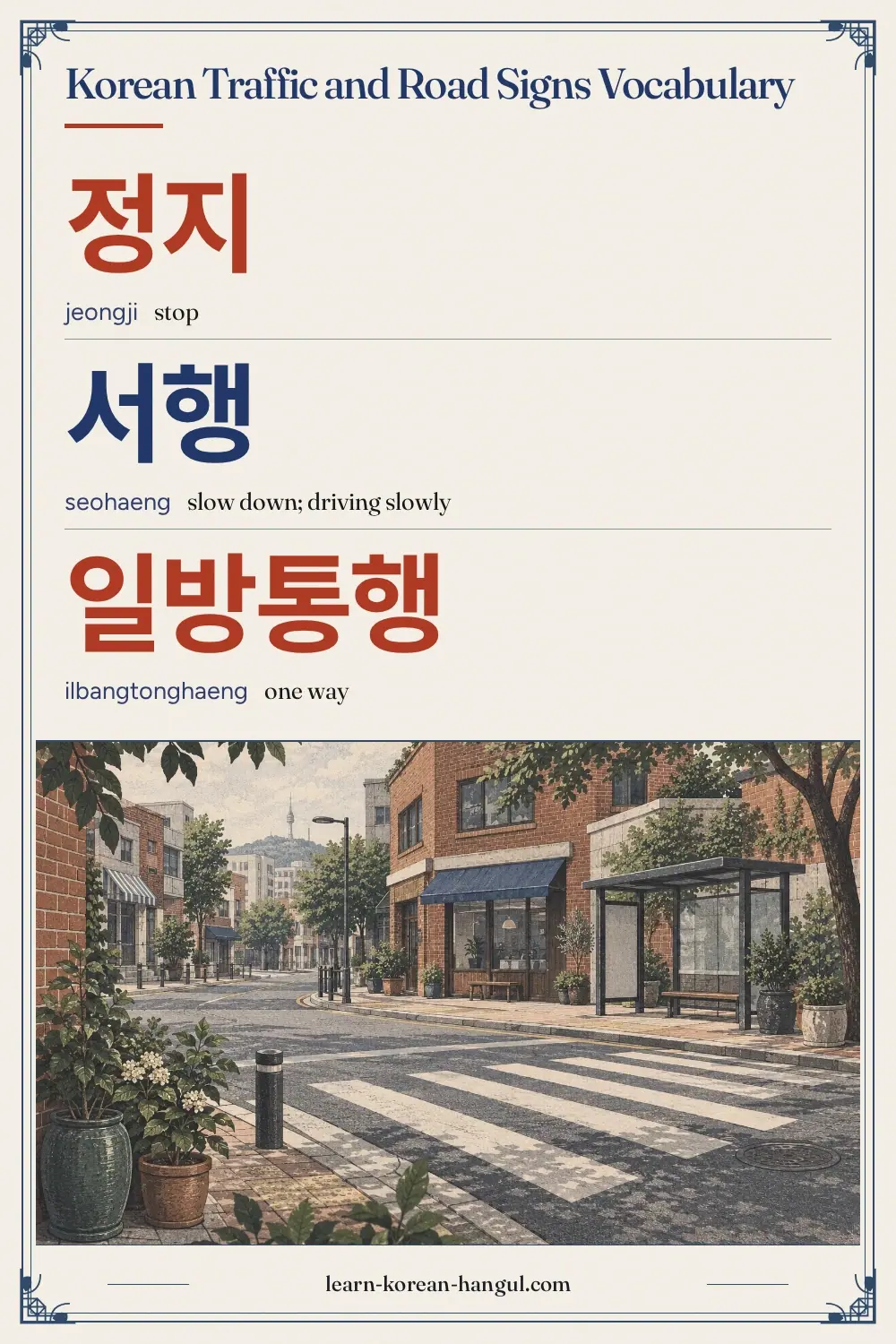
Korean Traffic and Road Signs Vocabulary at a Glance
The list has 30 words in five groups of six. It follows what a driver or a walker meets on the road: a warning, an arrow, a ban, a parking or speed rule and the name of the road itself. It belongs to Transportation, next to the words for the vehicles that use these roads. Nearly all the words are nouns, and many are Sino-Korean, built from short parts that you can reuse.
| Group | Words | Use |
|---|---|---|
| Warning signs | 6 | Stop, slow, caution and danger |
| Direction signs | 6 | Arrows, turns and detours |
| Prohibition signs | 6 | Bans on entry, passing and stopping |
| Parking and speed | 6 | Parking lots, limits and cameras |
| Street and highway names | 6 | Roads, junctions and crossings |
Which Road Sign Words Should You Learn First?
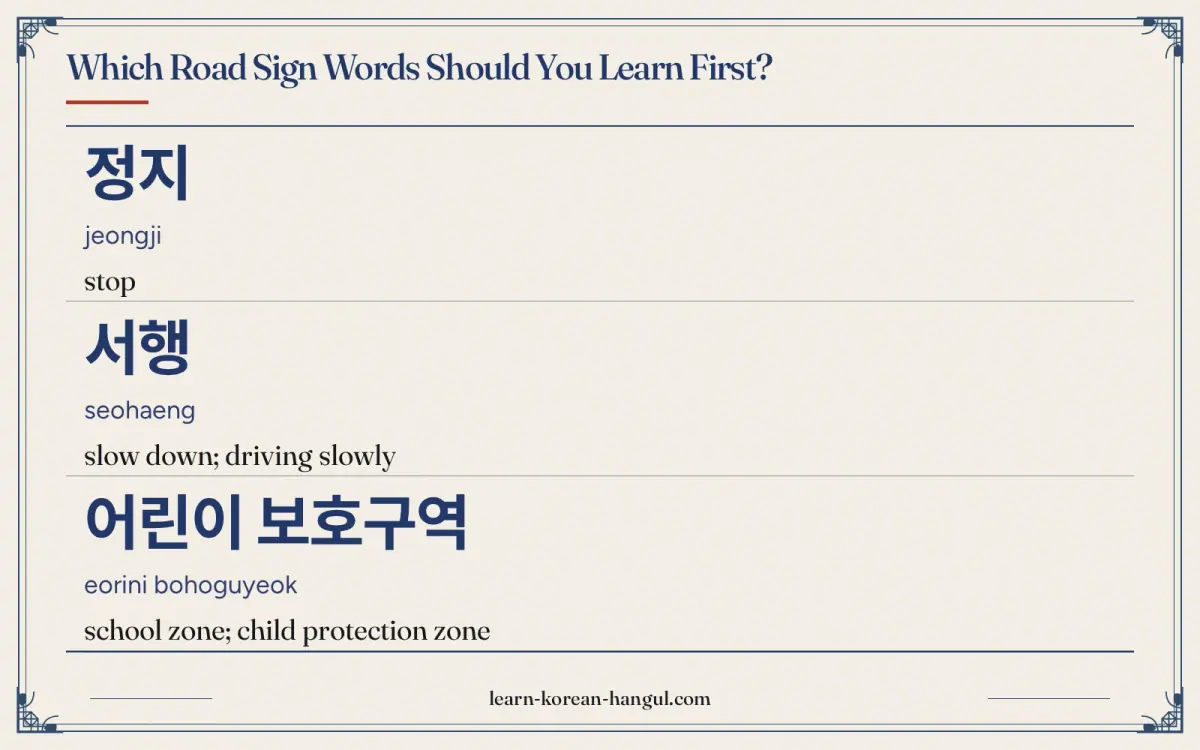
Learn 정지 (stop), 서행 (slow down), 주의 (caution), 일방통행 (one way) and 금지 (banned) first. They cover most signs you see in a first week on Korean roads, whether you drive, ride a bike or walk. Together with 주차 (parking), they also let you read parking signs, which cause most trouble for visitors.
- Words to say. 정지, 서행, 주의, 주차.
- Words to recognise. 일방통행, 진입 금지, 출입 금지, 공사 중. They are written, not spoken.
- Words for drivers. 제한 속도, 단속 카메라, 고속도로, 교차로, 좌회전, 우회전.
The scene below numbers ten of the 30 words, and the audio on each item plays the headword. The learner who only walks can skip the driving words and still read every crossing.
Word · 10
- 1
정지
jeongji
stop
- 2
서행
seohaeng
slow down; driving slowly
- 3
어린이 보호구역
eorini bohoguyeok
school zone; child protection zone
- 4
일방통행
ilbangtonghaeng
one way
- 5
좌회전
jwahoejeon
left turn
- 6
진입 금지
jinip geumji
no entry (for vehicles)
- 7
주차 금지
jucha geumji
no parking
- 8
제한 속도
jehan sokdo
speed limit
- 9
단속 카메라
dansok kamera
enforcement camera
- 10
횡단보도
hoengdanbodo
crosswalk
Warning Signs
Warning signs tell you to do something now: stop, slow down or take care. They use the shortest words in the list, often just two syllables, because a driver has a second to read them. The same words are painted on the road surface, which is why you meet 서행 and 정지 at school gates and junctions. The sixth word is a place, but it works like a warning, because it tells drivers to expect children.
| No. | Hangul | Revised Romanization | Meaning and note | Example sentence | Audio assetId |
|---|---|---|---|---|---|
| 1 | 정지 | jeongji | stop. A noun; add 하다 for the verb. Signs also use the longer 일시정지, a short full stop. | 빨간불에는 정지해요. (At a red light, I stop.) | au-pg-vocabulary-places-transportation-road-signs-1; example: au-pg-vocabulary-places-transportation-road-signs-31 |
| 2 | 서행 | seohaeng | slow down; driving slowly. Painted on the road and shown at bends and school gates. | 학교 앞에서는 서행해요. (I drive slowly in front of the school.) | au-pg-vocabulary-places-transportation-road-signs-2; example: au-pg-vocabulary-places-transportation-road-signs-32 |
| 3 | 주의 | juui | caution. Often follows another word, as in 낙석 주의 (watch for falling rocks). Said [주의] or [주이]. | 길이 미끄러우니까 주의하세요. (The road is slippery, so be careful.) | au-pg-vocabulary-places-transportation-road-signs-3; example: au-pg-vocabulary-places-transportation-road-signs-33 |
| 4 | 위험 | wiheom | danger. The adjective 위험하다 means dangerous. | 여기는 위험해요. (It is dangerous here.) | au-pg-vocabulary-places-transportation-road-signs-4; example: au-pg-vocabulary-places-transportation-road-signs-34 |
| 5 | 공사 중 | gongsa jung | under construction. 중 marks something in progress. Signs often write it as one word, 공사중. | 앞 도로가 공사 중이에요. (The road ahead is under construction.) | au-pg-vocabulary-places-transportation-road-signs-5; example: au-pg-vocabulary-places-transportation-road-signs-35 |
| 6 | 어린이 보호구역 | eorini bohoguyeok | school zone; child protection zone. Literally "child protection zone". Said [어리니 보호구역]. | 어린이 보호구역에서는 천천히 가요. (In a school zone, I go slowly.) | au-pg-vocabulary-places-transportation-road-signs-6; example: au-pg-vocabulary-places-transportation-road-signs-36 |
Signs write the noun, not a sentence, so 서행 is enough to mean "drive slowly". If you want to say it as a sentence, add 하다 to make 서행해요. Most of these words work the same way: 정지해요 (I stop) and 주의해요 (I take care) follow the pattern noun + 해요. The word 중 in 공사 중 is a handy suffix. It turns a noun into "in the middle of", so 사용 중 means in use and 영업 중 means open for business. The adjective 위험하다 changes to 위험해요, while 미끄럽다 (be slippery) changes to 미끄러우니까 before -니까, with the ㅂ turning into 우.
How Do You Say Direction Signs in Korean?
Direction signs show which way traffic moves. Their words are built the same way: a direction plus 회전 (turning), or a short noun for the move itself. Learning 좌 (left) and 우 (right) lets you read two signs at once. You will meet these words on overhead boards at junctions and in car navigation voices.
| No. | Hangul | Revised Romanization | Meaning and note | Example sentence | Audio assetId |
|---|---|---|---|---|---|
| 7 | 일방통행 | ilbangtonghaeng | one way. 일방 (one side) plus 통행 (passage). | 이 길은 일방통행이에요. (This street is one way.) | au-pg-vocabulary-places-transportation-road-signs-7; example: au-pg-vocabulary-places-transportation-road-signs-37 |
| 8 | 직진 | jikjin | straight ahead. Said [직찐]. Shown beside a straight arrow. | 교차로에서 직진하세요. (Go straight at the intersection.) | au-pg-vocabulary-places-transportation-road-signs-8; example: au-pg-vocabulary-places-transportation-road-signs-38 |
| 9 | 좌회전 | jwahoejeon | left turn. 좌 (left) plus 회전 (turning). | 다음 신호에서 좌회전해요. (I turn left at the next light.) | au-pg-vocabulary-places-transportation-road-signs-9; example: au-pg-vocabulary-places-transportation-road-signs-39 |
| 10 | 우회전 | uhoejeon | right turn. 우 (right) plus 회전 (turning). | 앞에서 우회전하면 병원이 있어요. (If you turn right ahead, there is a hospital.) | au-pg-vocabulary-places-transportation-road-signs-10; example: au-pg-vocabulary-places-transportation-road-signs-40 |
| 11 | 유턴 | yuteon | U-turn. A loanword; the verb is 유턴하다. | 저 앞에서 유턴해요. (I make a U-turn up ahead.) | au-pg-vocabulary-places-transportation-road-signs-11; example: au-pg-vocabulary-places-transportation-road-signs-41 |
| 12 | 우회 | uhoe | detour. Also a verb noun: 우회하다. | 공사 때문에 우회해야 해요. (Because of the construction, we have to take a detour.) | au-pg-vocabulary-places-transportation-road-signs-12; example: au-pg-vocabulary-places-transportation-road-signs-42 |
Navigation apps and in-car voices use the same nouns with 하세요, as in 좌회전하세요 (turn left). In everyday speech people more often say the plain direction words 왼쪽 (left side) and 오른쪽 (right side), as in 오른쪽으로 가세요 (go to the right). Sign words are written, while the plain words are spoken, so learn both. For help with plain directions and position words, see the directions list.
Prohibition Signs
A ban in Korean is almost always the banned thing followed by 금지 (geumji). That one pattern gives you six signs from this table and dozens more. 금지 itself means prohibition, and a sign that says 추월 금지 is saying "overtaking: banned". Learn the pattern once and you can read a sign you have never seen, as long as you know the first word.
| No. | Hangul | Revised Romanization | Meaning and note | Example sentence | Audio assetId |
|---|---|---|---|---|---|
| 13 | 금지 | geumji | prohibition; banned. Placed after the banned thing: 주차 금지, 수영 금지. | 여기는 수영 금지예요. (Swimming is banned here.) | au-pg-vocabulary-places-transportation-road-signs-13; example: au-pg-vocabulary-places-transportation-road-signs-43 |
| 14 | 진입 금지 | jinip geumji | no entry (for vehicles). 진입 means driving or walking into a place. | 진입 금지 표지판이 있어요. (There is a no-entry sign.) | au-pg-vocabulary-places-transportation-road-signs-14; example: au-pg-vocabulary-places-transportation-road-signs-44 |
| 15 | 출입 금지 | churip geumji | no admittance. For people, on doors and building sites. Said [추립 금지]. | 공사장은 출입 금지예요. (The building site is off limits.) | au-pg-vocabulary-places-transportation-road-signs-15; example: au-pg-vocabulary-places-transportation-road-signs-45 |
| 16 | 추월 금지 | chuwol geumji | no overtaking. 추월 means passing another vehicle. | 이 구간은 추월 금지예요. (Overtaking is banned on this stretch.) | au-pg-vocabulary-places-transportation-road-signs-16; example: au-pg-vocabulary-places-transportation-road-signs-46 |
| 17 | 정차 금지 | jeongcha geumji | no stopping. 정차 means a vehicle stopping, even briefly. | 여기는 정차 금지예요. (Stopping is banned here.) | au-pg-vocabulary-places-transportation-road-signs-17; example: au-pg-vocabulary-places-transportation-road-signs-47 |
| 18 | 통행 금지 | tonghaeng geumji | no passage. 통행 means passing through a road. | 밤에는 통행 금지예요. (Passage is banned at night.) | au-pg-vocabulary-places-transportation-road-signs-18; example: au-pg-vocabulary-places-transportation-road-signs-48 |
The first word tells you who the ban applies to. 진입 금지 is for vehicles going into a road, 출입 금지 is for people going in and out of a place, 정차 금지 is for any vehicle stopping and 통행 금지 stops everything passing through. Signs often write the pair without a space, as 진입금지 or 정차금지, while dictionaries and this page space the two words. Both forms are understood. The pattern also works outside traffic: 흡연 금지 (no smoking) and 촬영 금지 (no filming) use the same ending. In speech people say 안 돼요 (it is not allowed) instead.
How Do You Say Parking and Speed in Korean?
Parking and speed have the most words that appear in news and conversation, not only on signs. People complain about 주차 (parking) in crowded neighbourhoods, and drivers talk about 과속 and the cameras that catch it. The words below are written on signs, parking lots and car navigation screens, so they come with the most chances to hear them.
| No. | Hangul | Revised Romanization | Meaning and note | Example sentence | Audio assetId |
|---|---|---|---|---|---|
| 19 | 주차 | jucha | parking. A noun; 주차하다 is to park. | 주차가 어려워요. (Parking is difficult.) | au-pg-vocabulary-places-transportation-road-signs-19; example: au-pg-vocabulary-places-transportation-road-signs-49 |
| 20 | 주차장 | juchajang | parking lot. 장 means a place for something. | 주차장은 지하에 있어요. (The parking lot is underground.) | au-pg-vocabulary-places-transportation-road-signs-20; example: au-pg-vocabulary-places-transportation-road-signs-50 |
| 21 | 주차 금지 | jucha geumji | no parking. Two words from this page joined in one sign. | 이 앞은 주차 금지예요. (No parking in front of here.) | au-pg-vocabulary-places-transportation-road-signs-21; example: au-pg-vocabulary-places-transportation-road-signs-51 |
| 22 | 제한 속도 | jehan sokdo | speed limit. Said [제한 속또]. 제한 is a limit and 속도 is speed. | 이 도로의 제한 속도를 확인해요. (I check the speed limit on this road.) | au-pg-vocabulary-places-transportation-road-signs-22; example: au-pg-vocabulary-places-transportation-road-signs-52 |
| 23 | 과속 | gwasok | speeding. 과 means too much. The verb is 과속하다. | 과속하면 위험해요. (It is dangerous if you speed.) | au-pg-vocabulary-places-transportation-road-signs-23; example: au-pg-vocabulary-places-transportation-road-signs-53 |
| 24 | 단속 카메라 | dansok kamera | enforcement camera. 단속 means a crackdown or enforcement; speed cameras are 과속 단속 카메라. | 앞에 단속 카메라가 있어요. (There is an enforcement camera ahead.) | au-pg-vocabulary-places-transportation-road-signs-24; example: au-pg-vocabulary-places-transportation-road-signs-54 |
The tense sounds in this group are worth hearing. In 제한 속도 the ㄷ of 도 is said as a tense [ㄸ], because it follows the final ㄱ of 속. The same happens in 고속도로 in the next group. Revised Romanization writes sokdo and gosokdoro, so it does not show the tense sound. The verb 주차하다 gives 주차해요, as in 여기에 주차해요 (I park here). Notice the particle 에 in 주차장은 지하에 있어요, which marks where something is; for where an action happens, use 에서, as in 주차장에서 기다려요 (I wait in the parking lot). For the vehicles themselves, see Korean Car and Driving Vocabulary.
Street and Highway Names
The last group names the road itself and the places where people cross it. It also explains the endings you see in Korean street names. In the road-name address system, 대로 marks the widest roads, 로 is used for mid-sized roads and 길 for smaller streets, so 세종대로 is a wide road in Seoul, while a name ending in 길 is a smaller street. Learning the endings tells you the size of a road before you arrive.
| No. | Hangul | Revised Romanization | Meaning and note | Example sentence | Audio assetId |
|---|---|---|---|---|---|
| 25 | 도로 | doro | road. The general word, used on signs and in news. | 이 도로는 넓어요. (This road is wide.) | au-pg-vocabulary-places-transportation-road-signs-25; example: au-pg-vocabulary-places-transportation-road-signs-55 |
| 26 | 고속도로 | gosokdoro | expressway. Said [고속또로]. 고속 means high speed. | 고속도로로 서울에 가요. (I go to Seoul by expressway.) | au-pg-vocabulary-places-transportation-road-signs-26; example: au-pg-vocabulary-places-transportation-road-signs-56 |
| 27 | 대로 | daero | boulevard. A wide road, written -daero in street names such as 세종대로. | 대로를 따라 걸어요. (I walk along the boulevard.) | au-pg-vocabulary-places-transportation-road-signs-27; example: au-pg-vocabulary-places-transportation-road-signs-57 |
| 28 | 교차로 | gyocharo | intersection. The junction where roads cross. | 다음 교차로에서 우회전하세요. (Turn right at the next intersection.) | au-pg-vocabulary-places-transportation-road-signs-28; example: au-pg-vocabulary-places-transportation-road-signs-58 |
| 29 | 횡단보도 | hoengdanbodo | crosswalk. Literally "crossing walkway". | 횡단보도를 건너요. (I cross at the crosswalk.) | au-pg-vocabulary-places-transportation-road-signs-29; example: au-pg-vocabulary-places-transportation-road-signs-59 |
| 30 | 보행자 | bohaengja | pedestrian. 보행 is walking and 자 is a person. | 보행자를 조심하세요. (Watch out for pedestrians.) | au-pg-vocabulary-places-transportation-road-signs-30; example: au-pg-vocabulary-places-transportation-road-signs-60 |
A Korean address ends with the road name and a building number, as in 세종대로 110. The name comes first and the number last, and a landmark is often easier than the full address when you talk to a driver. The word 길 has two meanings, road and way, and it appears in the common question 길을 몰라요 (I do not know the way). Compare 도로, which is the road as a thing, with 길, which is the road as a route. Foot traffic has its own words: 횡단보도 is the marked crossing and 보행자 is the person who walks across it. The related word 신호등 (traffic light) names the lights that control both.
How Do You Pronounce These Words?
Road sign words are short, so the sounds that change are easy to spot. Final consonants move to the next syllable, a plain consonant becomes tense after a final ㄱ, and ㄹ does not tense a following ㅂ. Standard pronunciation follows the National Institute of Korean Language (국립국어원) rules. Revised Romanization shows some of these changes and ignores the tensing, so use the audio for the rest.
| Spelling | Sounds like | What changes |
|---|---|---|
| 직진 | [직찐] | After the final ㄱ of 직, the ㅈ is said as tense ㅉ. |
| 제한 속도 | [제한 속또] | After the final ㄱ of 속, the ㄷ is said as tense ㄸ. |
| 고속도로 | [고속또로] | The same tensing: ㄱ then ㄷ gives ㄱ then ㄸ. |
| 출입 금지 | [추립 금지] | The final ㄹ of 출 links to the vowel of 입. |
| 어린이 보호구역 | [어리니 보호구역] | The final ㄴ of 린 links to the vowel of 이. |
| 일방통행 | [일방통행] | No tensing: Sino-Korean ㄹ tenses only a following ㄷ, ㅅ or ㅈ, so the ㅂ stays plain. |
Audio and Slow Playback
Each word and example has its own clip, and five more replay the hardest words slowly. Play 일방통행 first and check that your ㅂ is plain, not tense, then compare the tense sounds in 제한 속도 and 고속도로 with the clip.
What Mistakes Do Learners Make with Road Sign Words?
Five slips are common when reading Korean signs.
- Reading 금지 as a word on its own. 금지 needs a first word. A sign with only 금지 is unusual, so look for the thing before it, such as 주차 or 추월.
- Mixing 진입 금지 with 출입 금지. 진입 금지 is for vehicles entering a road, and 출입 금지 is for people entering a place. Mix them up and you misread who the ban applies to.
- Saying the tense sound as plain. 제한 속도 is [제한 속또], not [제한 속도]. A plain ㄷ there sounds unnatural.
- Treating 길 and 도로 as the same. 도로 is the road as an object, and 길 is the way or street, including in street names. Both can be "road" in English.
- Forgetting the verb ending in speech. On a sign 서행 is enough. In speech you add 해요, as in 서행해요, or use a plain verb such as 천천히 가요 (I go slowly).
Check the first word of every 금지 sign, and say the tense sounds aloud when you practise. Sign wording on real roads can differ in small ways from the dictionary spellings used here, so treat the sign in front of you as the authority.
Practice: Flashcards and Worksheet
Study in three steps. First, run the deck in recognition mode until the 30 words feel familiar. Second, switch to listening mode and play the clip before you flip each card. Third, take the five-question quiz. Your deck progress stays in your browser, and the vocabulary flashcard decks page lists the other decks.
Practice · 65
- 01정지
Show answer
headword 1: stop
- 02서행
Show answer
headword 2: slow down; driving slowly
- 03주의
Show answer
headword 3: caution
- 04위험
Show answer
headword 4: danger
- 05공사 중
Show answer
headword 5: under construction
- 06어린이 보호구역
Show answer
headword 6: school zone; child protection zone
- 07일방통행
Show answer
headword 7: one way
- 08직진
Show answer
headword 8: straight ahead
- 09좌회전
Show answer
headword 9: left turn
- 10우회전
Show answer
headword 10: right turn
- 11유턴
Show answer
headword 11: U-turn
- 12우회
Show answer
headword 12: detour
- 13금지
Show answer
headword 13: prohibition; banned
- 14진입 금지
Show answer
headword 14: no entry (for vehicles)
- 15출입 금지
Show answer
headword 15: no admittance
- 16추월 금지
Show answer
headword 16: no overtaking
- 17정차 금지
Show answer
headword 17: no stopping
- 18통행 금지
Show answer
headword 18: no passage
- 19주차
Show answer
headword 19: parking
- 20주차장
Show answer
headword 20: parking lot
- 21주차 금지
Show answer
headword 21: no parking
- 22제한 속도
Show answer
headword 22: speed limit
- 23과속
Show answer
headword 23: speeding
- 24단속 카메라
Show answer
headword 24: enforcement camera
- 25도로
Show answer
headword 25: road
- 26고속도로
Show answer
headword 26: expressway
- 27대로
Show answer
headword 27: boulevard
- 28교차로
Show answer
headword 28: intersection
- 29횡단보도
Show answer
headword 29: crosswalk
- 30보행자
Show answer
headword 30: pedestrian
- 31빨간불에는 정지해요.
Show answer
example sentence for 정지
- 32학교 앞에서는 서행해요.
Show answer
example sentence for 서행
- 33길이 미끄러우니까 주의하세요.
Show answer
example sentence for 주의
- 34여기는 위험해요.
Show answer
example sentence for 위험
- 35앞 도로가 공사 중이에요.
Show answer
example sentence for 공사 중
- 36어린이 보호구역에서는 천천히 가요.
Show answer
example sentence for 어린이 보호구역
- 37이 길은 일방통행이에요.
Show answer
example sentence for 일방통행
- 38교차로에서 직진하세요.
Show answer
example sentence for 직진
- 39다음 신호에서 좌회전해요.
Show answer
example sentence for 좌회전
- 40앞에서 우회전하면 병원이 있어요.
Show answer
example sentence for 우회전
- 41저 앞에서 유턴해요.
Show answer
example sentence for 유턴
- 42공사 때문에 우회해야 해요.
Show answer
example sentence for 우회
- 43여기는 수영 금지예요.
Show answer
example sentence for 금지
- 44진입 금지 표지판이 있어요.
Show answer
example sentence for 진입 금지
- 45공사장은 출입 금지예요.
Show answer
example sentence for 출입 금지
- 46이 구간은 추월 금지예요.
Show answer
example sentence for 추월 금지
- 47여기는 정차 금지예요.
Show answer
example sentence for 정차 금지
- 48밤에는 통행 금지예요.
Show answer
example sentence for 통행 금지
- 49주차가 어려워요.
Show answer
example sentence for 주차
- 50주차장은 지하에 있어요.
Show answer
example sentence for 주차장
- 51이 앞은 주차 금지예요.
Show answer
example sentence for 주차 금지
- 52이 도로의 제한 속도를 확인해요.
Show answer
example sentence for 제한 속도
- 53과속하면 위험해요.
Show answer
example sentence for 과속
- 54앞에 단속 카메라가 있어요.
Show answer
example sentence for 단속 카메라
- 55이 도로는 넓어요.
Show answer
example sentence for 도로
- 56고속도로로 서울에 가요.
Show answer
example sentence for 고속도로
- 57대로를 따라 걸어요.
Show answer
example sentence for 대로
- 58다음 교차로에서 우회전하세요.
Show answer
example sentence for 교차로
- 59횡단보도를 건너요.
Show answer
example sentence for 횡단보도
- 60보행자를 조심하세요.
Show answer
example sentence for 보행자
- 61어린이 보호구역
Show answer
slow playback: school zone; child protection zone
- 62일방통행
Show answer
slow playback: one way
- 63제한 속도
Show answer
slow playback: speed limit
- 64고속도로
Show answer
slow playback: expressway
- 65횡단보도
Show answer
slow playback: crosswalk
Practice · 5
What does 정지 (jeongji) mean?
Show answer
stop
정지 means stop. Example: 빨간불에는 정지해요. (At a red light, I stop.)
What does 직진 (jikjin) mean?
Show answer
straight ahead
직진 means straight ahead. Example: 교차로에서 직진하세요. (Go straight at the intersection.)
What does 진입 금지 (jinip geumji) mean?
Show answer
no entry (for vehicles)
진입 금지 means no entry (for vehicles). Example: 진입 금지 표지판이 있어요. (There is a no-entry sign.)
What does 제한 속도 (jehan sokdo) mean?
Show answer
speed limit
제한 속도 means speed limit. Example: 이 도로의 제한 속도를 확인해요. (I check the speed limit on this road.)
What does 횡단보도 (hoengdanbodo) mean?
Show answer
crosswalk
횡단보도 means crosswalk. Example: 횡단보도를 건너요. (I cross at the crosswalk.)
Korean Traffic and Road Signs Vocabulary Worksheet (PDF)
A printable worksheet for these words (word list, matching, writing practice, fill-in-the-blank exercises and answer key) is available in A4 and US Letter from the download card on this page. Meanwhile, write a ban for each of the five prohibition patterns, such as 주차 금지 and 추월 금지, and say each aloud.
Where to Go Next
After this page, continue with Korean Car and Driving Vocabulary for the car itself, or go back to Transportation for subway, bus and train lists. For the plain words you use to give directions in speech, see directions.
Frequently Asked Questions
How Do You Say Stop in Korean?
Stop is 정지 (jeongji) on a sign, and 일시정지 is a brief full stop. As a verb, 정지하다 gives 정지해요. In speech people also say 서요 (it stops) or 멈춰요 (it halts). Signs are written forms, so a sign usually shows just the noun.
How Do You Pronounce 서행 (seohaeng)?
Say seo-haeng in two even beats. The first vowel is ㅓ, an open sound made with unrounded lips, a little like the u in "bus". The second syllable starts with a light h and ends with the ng sound, as in "sing". The standard pronunciation is [서행], with no sound change. Press the audio button to hear it.
How Many Road Sign Words Should I Learn First?
Five: 정지, 서행, 주의, 일방통행 and 금지. They cover warnings, directions and bans. At five new words a day the full 30 take six days plus review. Add 주차 and 횡단보도 if you walk or park.
Where Can I Practise Road Sign Words with Flashcards?
Use the vocabulary flashcard decks. The deck for this page holds all 30 words with Hangul, romanization and audio. Your progress stays in your browser. Try listening mode for the ban signs, because the tense sounds are easier to hear than to read.
Is the Romanization on This Page Official?
It follows the Revised Romanization of Korean, which South Korea adopted on 7 July 2000 and whose rules the National Institute of Korean Language (국립국어원) publishes. It is a learning aid. It writes tense letters such as ㅉ when they are spelled, but it does not show tensing caused by a neighbouring sound, such as the [ㅉ] in 직진 [직찐], so rely on the Hangul and the audio.
Is There a Printable Worksheet for Road Sign Words?
A printable worksheet for these words (word list, matching, writing practice, fill-in-the-blank exercises and answer key) is available in A4 and US Letter from the download card on this page. For practice, copy the tables by hand and write one example sentence for each of the five groups.