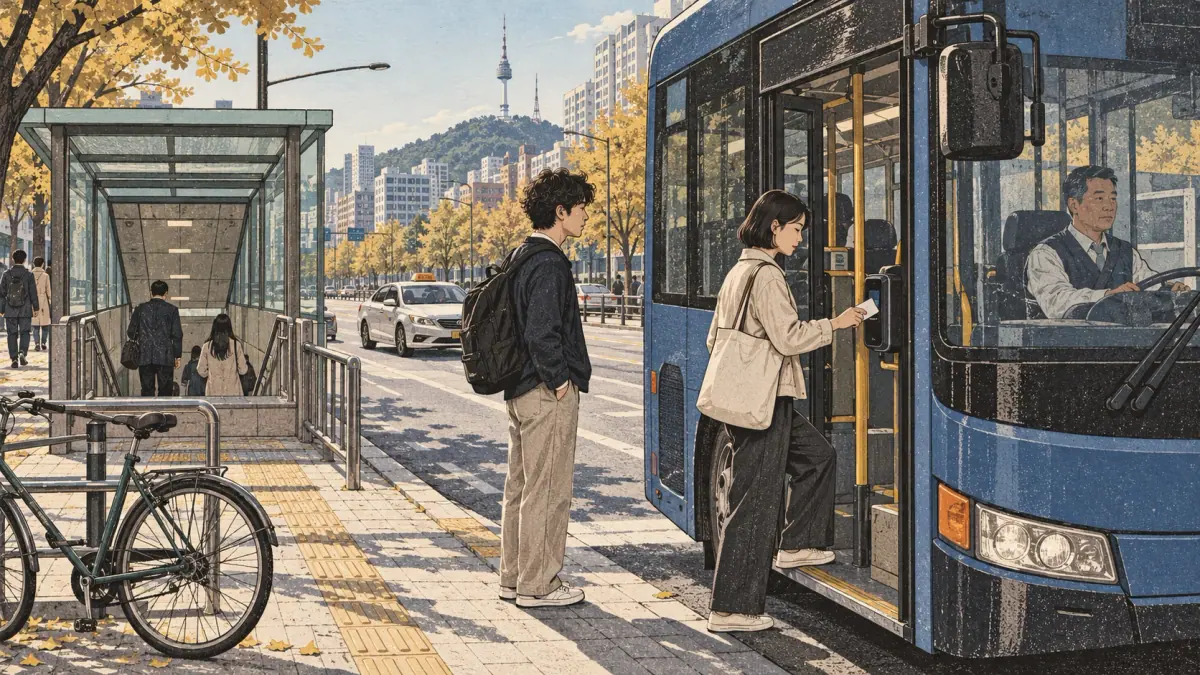
Korean Transportation Vocabulary at a Glance
The list has 45 words in six groups, from the umbrella word 교통 to the cards that pay for every mode. It is the hub of Korean Subway Vocabulary, Korean Bus and Taxi Vocabulary, and three more pages, and it gives the one or two words you need for each mode before you go deeper. It belongs to Places and Travel.
| Group | Words | Use |
|---|---|---|
| Subway and bus | 8 | The umbrella words and city transit |
| Trains | 8 | Intercity trains and booking |
| Taxis | 7 | Kinds of taxi and the driver |
| Cars and bikes | 7 | Private transport and the counter 대 |
| Airplanes and ships | 8 | Planes, boats and ports |
| Fares and cards | 7 | Fares, costs and the transit card |
For a single entry on the topic word, see transportation in Korean. The pages for the deeper lists are named in the section at the bottom.
Which Transportation Words Should You Learn First?
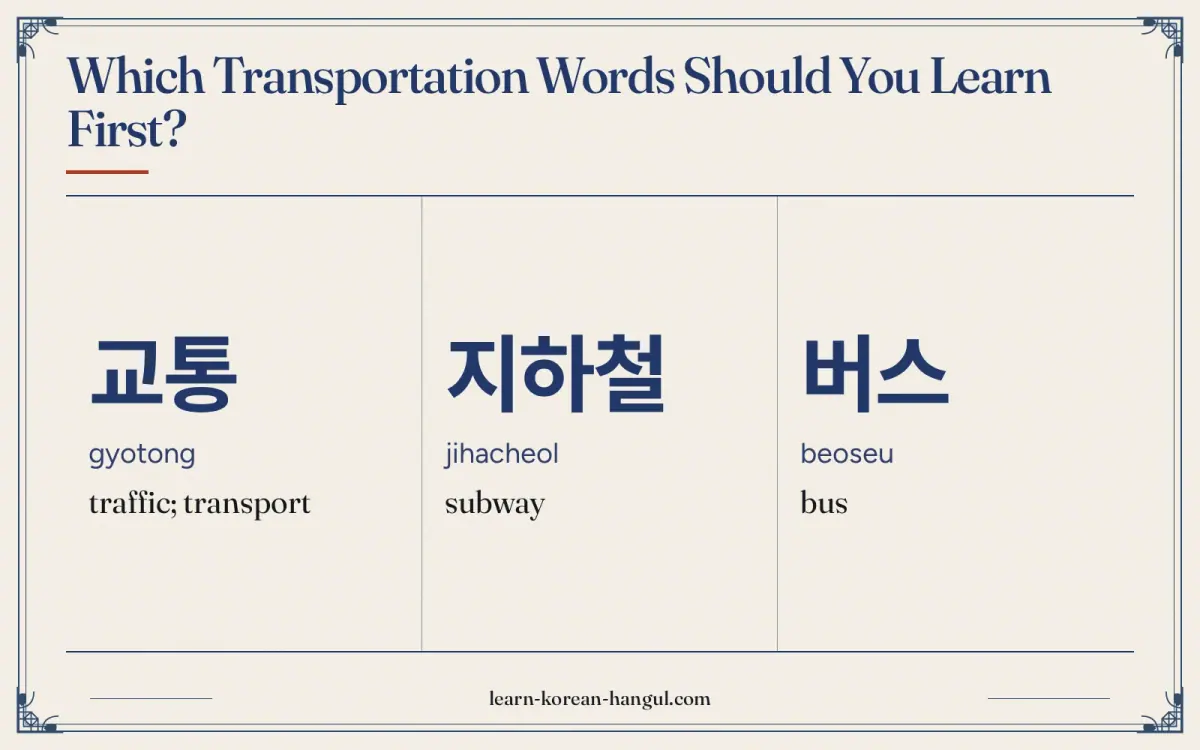
Learn 지하철 (subway), 버스 (bus), 택시 (taxi), 기차 (train) and 자전거 (bicycle) first. They name the five modes that you will see in every Korean city, and the verb for all of them is 타다 (ride), whose polite present form is 타요.
- Words to say. 지하철, 버스, 택시, 기차, 자전거.
- Words to recognise. 교통카드, 환승, 편도, 왕복, 요금. They appear at gates and counters.
- Patterns to learn with them. The particle 로 for means of travel, and 대 for counting vehicles.
The scene below shows a street with ten vehicles and places, numbered to match the list.
Word · 10
- 1
교통
gyotong
traffic; transport
- 2
지하철
jihacheol
subway
- 3
버스
beoseu
bus
- 4
기차
gicha
train
- 5
KTX
keitiekseu
KTX; high-speed train
- 6
택시
taeksi
taxi
- 7
차
cha
car
- 8
자전거
jajeongeo
bicycle
- 9
전동 킥보드
jeondong kikbodeu
electric scooter
- 10
비행기
bihaenggi
airplane
Subway and Bus
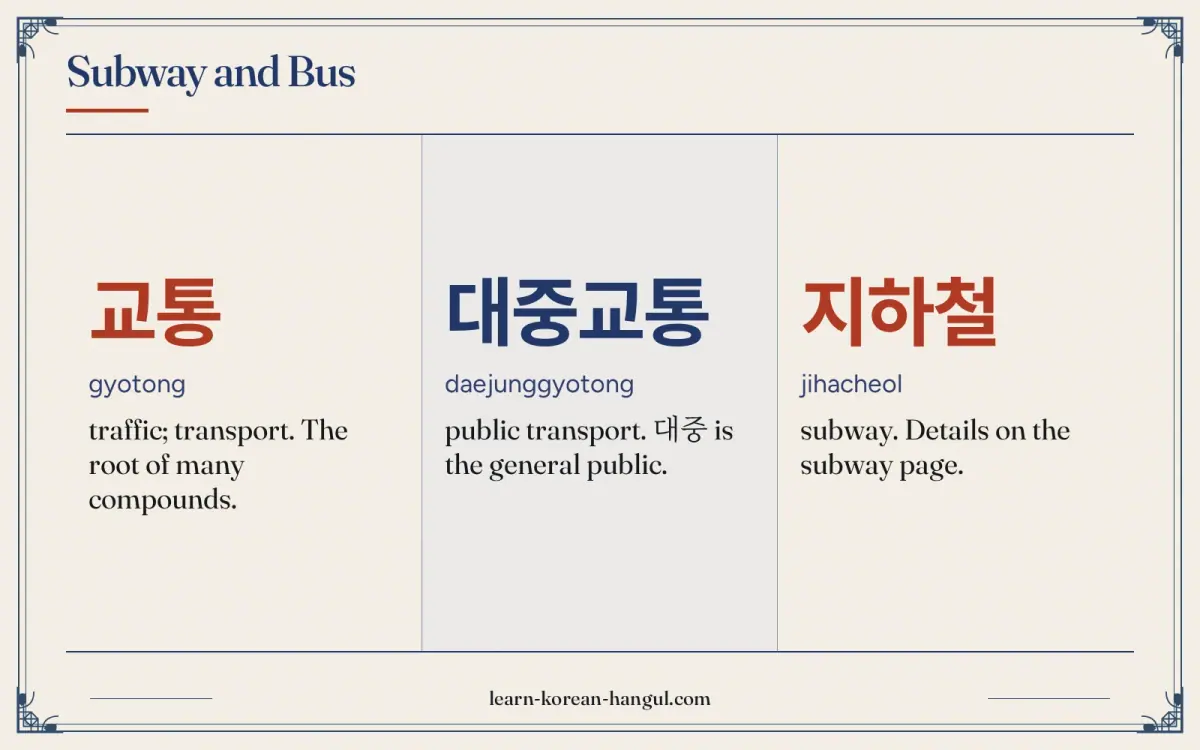
Public transport is the first topic because most city trips in Korea use it. The umbrella word is 교통 (traffic, transport), and the mass-transit version is 대중교통. Starting here gives you the frame for every later word: you go by something (로), from a place (에서) to a place (에).
| No. | Hangul | Revised Romanization | Meaning and note | Example sentence | Audio assetId |
|---|---|---|---|---|---|
| 1 | 교통 | gyotong | traffic; transport. The root of many compounds. | 교통이 복잡해요. (The traffic is complicated.) | au-pg-vocabulary-places-transportation-1; example: au-pg-vocabulary-places-transportation-46 |
| 2 | 대중교통 | daejunggyotong | public transport. 대중 is the general public. | 대중교통이 편리해요. (Public transport is convenient.) | au-pg-vocabulary-places-transportation-2; example: au-pg-vocabulary-places-transportation-47 |
| 3 | 지하철 | jihacheol | subway. Details on the subway page. | 지하철로 학교에 가요. (I go to school by subway.) | au-pg-vocabulary-places-transportation-3; example: au-pg-vocabulary-places-transportation-48 |
| 4 | 버스 | beoseu | bus. Details on the bus page. | 버스로 회사에 가요. (I go to work by bus.) | au-pg-vocabulary-places-transportation-4; example: au-pg-vocabulary-places-transportation-49 |
| 5 | 정류장 | jeongnyujang | bus stop. Said [정뉴장]. | 정류장에서 만나요. (Let's meet at the bus stop.) | au-pg-vocabulary-places-transportation-5; example: au-pg-vocabulary-places-transportation-50 |
| 6 | 역 | yeok | station. Used for subway and train stations. | 역 앞에서 만나요. (Let's meet in front of the station.) | au-pg-vocabulary-places-transportation-6; example: au-pg-vocabulary-places-transportation-51 |
| 7 | 노선 | noseon | route; line. Applies to buses and trains. | 노선이 많아요. (There are many routes.) | au-pg-vocabulary-places-transportation-7; example: au-pg-vocabulary-places-transportation-52 |
| 8 | 출퇴근 | chultoegeun | commuting. 출근 is going to work; 퇴근 is leaving it. | 출퇴근 시간에는 사람이 많아요. (At commuting time there are many people.) | au-pg-vocabulary-places-transportation-8; example: au-pg-vocabulary-places-transportation-53 |
The particle 로 (by, with) marks the means of travel: 지하철로, 버스로. It is the first pattern to learn from this topic, because it works with every vehicle on the page. The verb is usually 가요 (go) or 타요 (ride). The verb 이용하다 (use) appears in the formal sentence 대중교통을 이용해요 (I use public transport). The full word lists for the two modes are on Korean Subway Vocabulary and Korean Bus and Taxi Vocabulary.
How Do You Say Trains in Korean?
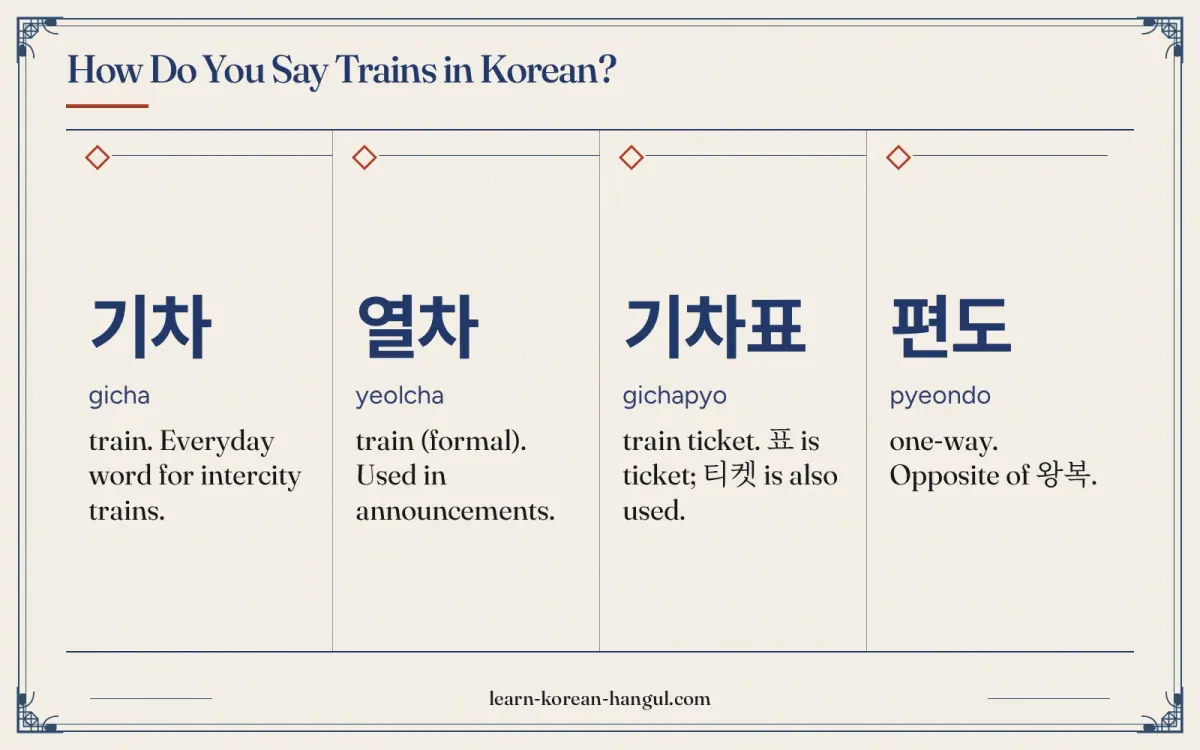
Korean has three common words for a train. 기차 is the everyday word for an intercity train, 열차 is the same thing in the language of announcements and timetables, and KTX is the name of the high-speed service. Booking brings its own words: you buy a 기차표 ahead of time, choose one-way or round trip and hope the train is not sold out.
| No. | Hangul | Revised Romanization | Meaning and note | Example sentence | Audio assetId |
|---|---|---|---|---|---|
| 9 | 기차 | gicha | train. Everyday word for intercity trains. | 기차가 곧 와요. (The train comes soon.) | au-pg-vocabulary-places-transportation-9; example: au-pg-vocabulary-places-transportation-54 |
| 10 | KTX | keitiekseu | KTX; high-speed train. Said letter by letter: [케이티엑스]. | KTX는 빨라요. (The KTX is fast.) | au-pg-vocabulary-places-transportation-10; example: au-pg-vocabulary-places-transportation-55 |
| 11 | 열차 | yeolcha | train (formal). Used in announcements. | 열차가 도착해요. (The train arrives.) | au-pg-vocabulary-places-transportation-11; example: au-pg-vocabulary-places-transportation-56 |
| 12 | 기차표 | gichapyo | train ticket. 표 is ticket; 티켓 is also used. | 기차표를 예매해요. (I book a train ticket.) | au-pg-vocabulary-places-transportation-12; example: au-pg-vocabulary-places-transportation-57 |
| 13 | 편도 | pyeondo | one-way. Opposite of 왕복. | 편도 한 장 주세요. (One one-way ticket, please.) | au-pg-vocabulary-places-transportation-13; example: au-pg-vocabulary-places-transportation-58 |
| 14 | 왕복 | wangbok | round trip. Both directions. | 왕복으로 사요. (I buy a round trip.) | au-pg-vocabulary-places-transportation-14; example: au-pg-vocabulary-places-transportation-59 |
| 15 | 매진 | maejin | sold out. Printed on a sold-out train. | 표가 매진이에요. (The tickets are sold out.) | au-pg-vocabulary-places-transportation-15; example: au-pg-vocabulary-places-transportation-60 |
| 16 | 예매 | yemae | advance booking. 미리 is beforehand. | 미리 예매해요. (I book in advance.) | au-pg-vocabulary-places-transportation-16; example: au-pg-vocabulary-places-transportation-61 |
The ticket word is 표, and learners also meet the loanword 티켓 (tiket), which is more common for concerts and flights. For trains, 표 and 기차표 are the usual words. The counter for tickets is 장, so 편도 한 장 (one one-way ticket) is a complete request. See Korean Train and KTX Vocabulary.
Taxis
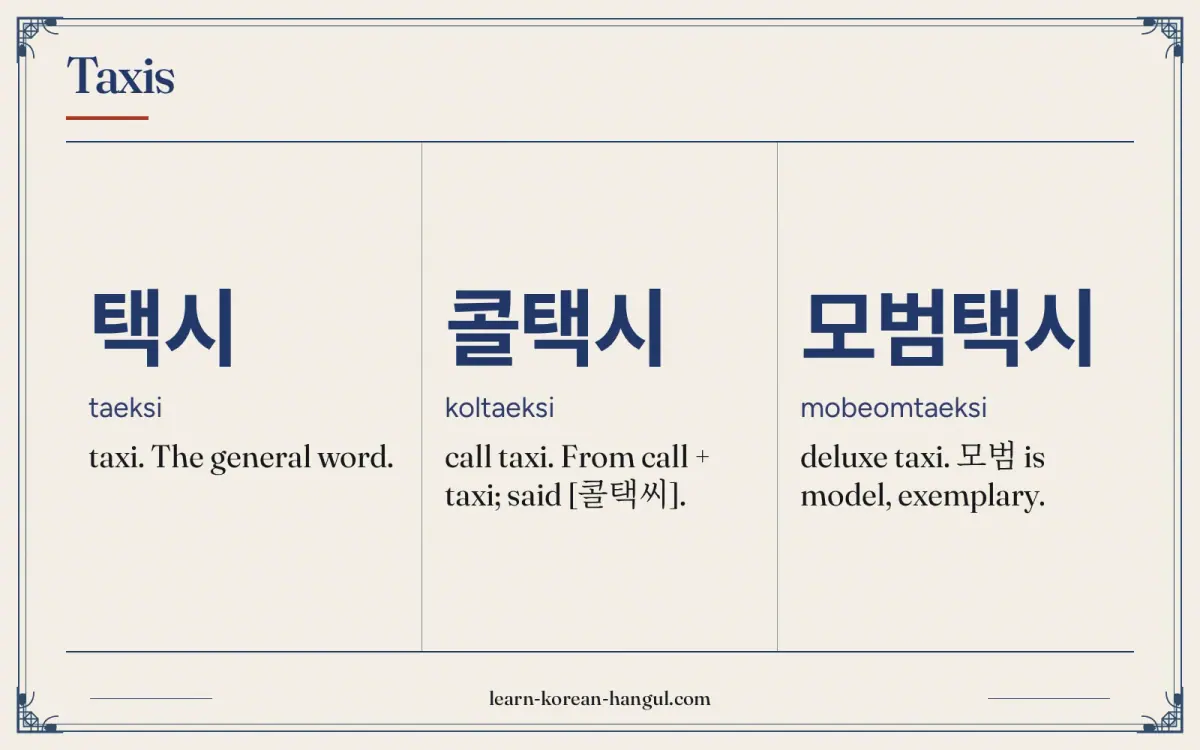
Taxis come in three kinds that you can tell by name. An ordinary 택시 can be hailed or found at a stand, a 콜택시 is booked by phone or app, and a 모범택시 is a deluxe taxi with a higher fare and a more experienced driver. In all three you address the driver as 기사님.
| No. | Hangul | Revised Romanization | Meaning and note | Example sentence | Audio assetId |
|---|---|---|---|---|---|
| 17 | 택시 | taeksi | taxi. The general word. | 택시가 와요. (The taxi comes.) | au-pg-vocabulary-places-transportation-17; example: au-pg-vocabulary-places-transportation-62 |
| 18 | 콜택시 | koltaeksi | call taxi. From call + taxi; said [콜택씨]. | 콜택시를 불러요. (I call a taxi.) | au-pg-vocabulary-places-transportation-18; example: au-pg-vocabulary-places-transportation-63 |
| 19 | 모범택시 | mobeomtaeksi | deluxe taxi. 모범 is model, exemplary. | 모범택시는 비싸요. (The deluxe taxi is expensive.) | au-pg-vocabulary-places-transportation-19; example: au-pg-vocabulary-places-transportation-64 |
| 20 | 기사님 | gisanim | driver (polite). 님 adds respect. | 기사님, 감사합니다. (Thank you, driver.) | au-pg-vocabulary-places-transportation-20; example: au-pg-vocabulary-places-transportation-65 |
| 21 | 거스름돈 | geoseureumdon | change (money back). From 거슬러 주다. | 거스름돈을 받아요. (I get my change.) | au-pg-vocabulary-places-transportation-21; example: au-pg-vocabulary-places-transportation-66 |
| 22 | 정차 | jeongcha | stopping (a vehicle). A formal word. | 택시가 정차해요. (The taxi stops.) | au-pg-vocabulary-places-transportation-22; example: au-pg-vocabulary-places-transportation-67 |
| 23 | 대기 | daegi | waiting; standby. Used for a taxi or a passenger waiting in line. The lit sign of a free taxi says 빈차 (empty car). | 택시가 대기해요. (The taxi is waiting.) | au-pg-vocabulary-places-transportation-23; example: au-pg-vocabulary-places-transportation-68 |
Taxi fares, surcharges and ride-app screens are on Korean Bus and Taxi Vocabulary, and the spoken requests, such as asking to stop at a corner, are on the taxi and transport phrases. 감사합니다 in the driver sentence is the formal thank-you, the usual choice with a driver; 고마워요 is polite too but sounds more familiar, so keep it for people you know.
How Do You Say Cars and Bikes in Korean?
Private transport has the widest range of everyday words. A car is a 자동차 on paper and a 차 in speech, and the same sound 차 also means tea. Bikes are 자전거, motorbikes are 오토바이, and the electric scooters you rent by the minute are 전동 킥보드. Counters matter here: every vehicle is counted with 대.
| No. | Hangul | Revised Romanization | Meaning and note | Example sentence | Audio assetId |
|---|---|---|---|---|---|
| 24 | 자동차 | jadongcha | car (formal). Written form; speech says 차. | 자동차를 운전해요. (I drive a car.) | au-pg-vocabulary-places-transportation-24; example: au-pg-vocabulary-places-transportation-69 |
| 25 | 차 | cha | car. Also means tea. | 차가 막혀요. (The traffic is jammed.) | au-pg-vocabulary-places-transportation-25; example: au-pg-vocabulary-places-transportation-70 |
| 26 | 자전거 | jajeongeo | bicycle. 자전 is turning by itself. | 자전거를 타요. (I ride a bicycle.) | au-pg-vocabulary-places-transportation-26; example: au-pg-vocabulary-places-transportation-71 |
| 27 | 오토바이 | otobai | motorcycle. From auto + bicycle. | 오토바이가 빨라요. (The motorcycle is fast.) | au-pg-vocabulary-places-transportation-27; example: au-pg-vocabulary-places-transportation-72 |
| 28 | 전동 킥보드 | jeondong kikbodeu | electric scooter. Rented by app. | 전동 킥보드를 빌려요. (I rent an electric scooter.) | au-pg-vocabulary-places-transportation-28; example: au-pg-vocabulary-places-transportation-73 |
| 29 | 주차 | jucha | parking. Add 장 for parking lot. | 주차할 곳이 없어요. (There is nowhere to park.) | au-pg-vocabulary-places-transportation-29; example: au-pg-vocabulary-places-transportation-74 |
| 30 | 운전 | unjeon | driving. Add 하다 for the verb. | 운전을 배워요. (I am learning to drive.) | au-pg-vocabulary-places-transportation-30; example: au-pg-vocabulary-places-transportation-75 |
The counter 대 is used for cars, bicycles, motorcycles and machines: 차 한 대 (one car), 자전거 두 대 (two bicycles). Use it with native numbers. The two meanings of 차 are separated by the verb: 차가 막혀요 is about traffic, and 차를 마셔요 is about drinking tea. The 막히다 (be blocked) verb gives 막혀요. For more, see Korean car and driving vocabulary for car parts, fuel, parking and rental cars, and Korean road signs vocabulary for stop, one-way and school zone signs. See counters for things.
Airplanes and Ships
Long-distance travel by air and sea adds two sets of words. For flying, 비행기 is the plane and 항공편 is the particular flight. For the sea, a 배 is any boat or ship, a 여객선 is a passenger ship, and a 페리 is a ferry. Jeju Island, reached by plane or ferry, is the destination most learners will meet first.
| No. | Hangul | Revised Romanization | Meaning and note | Example sentence | Audio assetId |
|---|---|---|---|---|---|
| 31 | 비행기 | bihaenggi | airplane. 비행 is flight. | 비행기 표를 사요. (I buy a plane ticket.) | au-pg-vocabulary-places-transportation-31; example: au-pg-vocabulary-places-transportation-76 |
| 32 | 항공편 | hanggongpyeon | flight (service). The specific flight. | 항공편을 찾아요. (I look for a flight.) | au-pg-vocabulary-places-transportation-32; example: au-pg-vocabulary-places-transportation-77 |
| 33 | 공항 | gonghang | airport. Airport words have their own page. | 공항은 멀어요. (The airport is far.) | au-pg-vocabulary-places-transportation-33; example: au-pg-vocabulary-places-transportation-78 |
| 34 | 배 | bae | ship; boat. Also means pear and stomach. | 배를 타요. (I take a boat.) | au-pg-vocabulary-places-transportation-34; example: au-pg-vocabulary-places-transportation-79 |
| 35 | 여객선 | yeogaekseon | passenger ship. 여객 is traveller. | 여객선이 커요. (The passenger ship is big.) | au-pg-vocabulary-places-transportation-35; example: au-pg-vocabulary-places-transportation-80 |
| 36 | 항구 | hanggu | port; harbour. The place ships leave from. | 항구에서 배가 떠나요. (The ship leaves from the port.) | au-pg-vocabulary-places-transportation-36; example: au-pg-vocabulary-places-transportation-81 |
| 37 | 페리 | peri | ferry. Loanword. | 페리는 제주도에 가요. (The ferry goes to Jeju Island.) | au-pg-vocabulary-places-transportation-37; example: au-pg-vocabulary-places-transportation-82 |
| 38 | 뱃멀미 | baenmeolmi | seasickness. Said [밴멀미]. | 뱃멀미가 심해요. (My seasickness is bad.) | au-pg-vocabulary-places-transportation-38; example: au-pg-vocabulary-places-transportation-83 |
The word 배 has three meanings: ship, pear and stomach. In a travel context only the ship reading fits. For the airport itself, with check-in, security and baggage, go to Korean Airport Vocabulary. The adjective 멀다 (be far) gives 멀어요, and 심하다 (be serious, severe) gives 심해요.
How Do You Say Fare and Cards in Korean?
Money for travel has three layers: the price of one trip, what you spend over a month and the card that pays for it. A single ride has a 요금, a train or ship ride uses the more formal 운임, and a month of rides becomes the 교통비. The card is charged up once and then used on every mode.
| No. | Hangul | Revised Romanization | Meaning and note | Example sentence | Audio assetId |
|---|---|---|---|---|---|
| 39 | 교통비 | gyotongbi | transport costs. 비 is cost. | 교통비가 많이 들어요. (Transport costs a lot.) | au-pg-vocabulary-places-transportation-39; example: au-pg-vocabulary-places-transportation-84 |
| 40 | 요금 | yogeum | fare; fee. For one ride. | 요금이 올라요. (The fare goes up.) | au-pg-vocabulary-places-transportation-40; example: au-pg-vocabulary-places-transportation-85 |
| 41 | 운임 | unim | fare (formal). Said [우님]. | 운임을 내요. (I pay the fare.) | au-pg-vocabulary-places-transportation-41; example: au-pg-vocabulary-places-transportation-86 |
| 42 | 교통카드 | gyotongkadeu | transit card. One card for all modes. | 교통카드가 있어요. (I have a transit card.) | au-pg-vocabulary-places-transportation-42; example: au-pg-vocabulary-places-transportation-87 |
| 43 | 충전 | chungjeon | top-up. Add money to the card. | 교통카드를 충전해요. (I top up the transit card.) | au-pg-vocabulary-places-transportation-43; example: au-pg-vocabulary-places-transportation-88 |
| 44 | 환승 할인 | hwanseung harin | transfer discount. Applied when you transfer within the time limit. | 환승 할인이 있어요. (There is a transfer discount.) | au-pg-vocabulary-places-transportation-44; example: au-pg-vocabulary-places-transportation-89 |
| 45 | 현금 | hyeongeum | cash. Not accepted everywhere. | 현금도 돼요. (Cash is fine too.) | au-pg-vocabulary-places-transportation-45; example: au-pg-vocabulary-places-transportation-90 |
A pattern to notice is 비 (cost) in 교통비, which also appears in 식비 (food cost) and 학비 (school fees). The verb 들다 (cost, take) in 교통비가 많이 들어요 is a different sense from 들다 (hold), though both conjugate to 들어요. The verb 오르다 (rise) makes 올라요 with the 르 pattern. For the card itself, with the deposit and balance, see Korean Subway Vocabulary.
How Do You Pronounce Korean Transport Words?
Transport words are mostly regular, with three sound habits to learn. A final consonant moves to the next syllable when a vowel follows, a final ㅅ is said as ㄷ and then can turn to a nasal, and the letters of an acronym are read by their English names. The National Institute of Korean Language (국립국어원) standard pronunciation rules cover the first two. Revised Romanization leaves some of these changes unmarked.
| Spelling | Sounds like | What changes |
|---|---|---|
| KTX | [케이티엑스] | The three letters are read by their English names. |
| 뱃멀미 | [밴멀미] | Final ㅅ is said as ㄷ, then ㄷ becomes ㄴ before ㅁ. |
| 운임 | [우님] | The final ㄴ links to the vowel of 임. |
| 기차표 | [기차표] | No change; use it as a model of plain pronunciation. |
| 콜택시 | [콜택씨] | After final ㄱ, the ㅅ is tense. |
Audio and Slow Playback
Each word and example has its own clip, and five more replay the harder ones slowly. Play KTX first and say the three letters in order, then compare with the clip.
What Mistakes Do Learners Make with Transportation Words?
Five points confuse learners again and again.
- Counting vehicles with 개. Cars, bicycles and machines take 대: 차 한 대, 자전거 두 대. 개 works for small objects, not for vehicles.
- Mixing the two meanings of 차. 차 is a car and also tea. The verb separates them: 차가 막혀요 (traffic) and 차를 마셔요 (drink tea).
- Using 운전해요 for a passenger. 운전하다 is to drive. If you ride, say 타요: 버스를 타요, not 버스를 운전해요.
- Calling every train a KTX. KTX is one high-speed service. 기차 is the general word, and 열차 is the formal one in announcements.
- Buying 왕복 when you want 편도. 편도 is one way and 왕복 is both ways. At a counter, say the count of tickets after it: 편도 한 장.
Check the counter and the verb before you check the noun. The same noun works with both 타요 and 운전해요, and only the verb tells the listener whether you drive or ride.
Practice: Flashcards and Worksheet
Study in three steps. First, run the deck in recognition mode until the 45 words are familiar. Second, switch to listening mode and tap the clip before the card turns. Third, take the five-question quiz. Progress stays in your browser, and the vocabulary flashcard decks page lists the other decks.
Practice · 95
- 01교통
Show answer
headword 1: traffic; transport
- 02대중교통
Show answer
headword 2: public transport
- 03지하철
Show answer
headword 3: subway
- 04버스
Show answer
headword 4: bus
- 05정류장
Show answer
headword 5: bus stop
- 06역
Show answer
headword 6: station
- 07노선
Show answer
headword 7: route; line
- 08출퇴근
Show answer
headword 8: commuting
- 09기차
Show answer
headword 9: train
- 10KTX
Show answer
headword 10: KTX; high-speed train
- 11열차
Show answer
headword 11: train (formal)
- 12기차표
Show answer
headword 12: train ticket
- 13편도
Show answer
headword 13: one-way
- 14왕복
Show answer
headword 14: round trip
- 15매진
Show answer
headword 15: sold out
- 16예매
Show answer
headword 16: advance booking
- 17택시
Show answer
headword 17: taxi
- 18콜택시
Show answer
headword 18: call taxi
- 19모범택시
Show answer
headword 19: deluxe taxi
- 20기사님
Show answer
headword 20: driver (polite)
- 21거스름돈
Show answer
headword 21: change (money back)
- 22정차
Show answer
headword 22: stopping (a vehicle)
- 23대기
Show answer
headword 23: waiting; standby
- 24자동차
Show answer
headword 24: car (formal)
- 25차
Show answer
headword 25: car
- 26자전거
Show answer
headword 26: bicycle
- 27오토바이
Show answer
headword 27: motorcycle
- 28전동 킥보드
Show answer
headword 28: electric scooter
- 29주차
Show answer
headword 29: parking
- 30운전
Show answer
headword 30: driving
- 31비행기
Show answer
headword 31: airplane
- 32항공편
Show answer
headword 32: flight (service)
- 33공항
Show answer
headword 33: airport
- 34배
Show answer
headword 34: ship; boat
- 35여객선
Show answer
headword 35: passenger ship
- 36항구
Show answer
headword 36: port; harbour
- 37페리
Show answer
headword 37: ferry
- 38뱃멀미
Show answer
headword 38: seasickness
- 39교통비
Show answer
headword 39: transport costs
- 40요금
Show answer
headword 40: fare; fee
- 41운임
Show answer
headword 41: fare (formal)
- 42교통카드
Show answer
headword 42: transit card
- 43충전
Show answer
headword 43: top-up
- 44환승 할인
Show answer
headword 44: transfer discount
- 45현금
Show answer
headword 45: cash
- 46교통이 복잡해요.
Show answer
example sentence for 교통
- 47대중교통이 편리해요.
Show answer
example sentence for 대중교통
- 48지하철로 학교에 가요.
Show answer
example sentence for 지하철
- 49버스로 회사에 가요.
Show answer
example sentence for 버스
- 50정류장에서 만나요.
Show answer
example sentence for 정류장
- 51역 앞에서 만나요.
Show answer
example sentence for 역
- 52노선이 많아요.
Show answer
example sentence for 노선
- 53출퇴근 시간에는 사람이 많아요.
Show answer
example sentence for 출퇴근
- 54기차가 곧 와요.
Show answer
example sentence for 기차
- 55KTX는 빨라요.
Show answer
example sentence for KTX
- 56열차가 도착해요.
Show answer
example sentence for 열차
- 57기차표를 예매해요.
Show answer
example sentence for 기차표
- 58편도 한 장 주세요.
Show answer
example sentence for 편도
- 59왕복으로 사요.
Show answer
example sentence for 왕복
- 60표가 매진이에요.
Show answer
example sentence for 매진
- 61미리 예매해요.
Show answer
example sentence for 예매
- 62택시가 와요.
Show answer
example sentence for 택시
- 63콜택시를 불러요.
Show answer
example sentence for 콜택시
- 64모범택시는 비싸요.
Show answer
example sentence for 모범택시
- 65기사님, 감사합니다.
Show answer
example sentence for 기사님
- 66거스름돈을 받아요.
Show answer
example sentence for 거스름돈
- 67택시가 정차해요.
Show answer
example sentence for 정차
- 68택시가 대기해요.
Show answer
example sentence for 대기
- 69자동차를 운전해요.
Show answer
example sentence for 자동차
- 70차가 막혀요.
Show answer
example sentence for 차
- 71자전거를 타요.
Show answer
example sentence for 자전거
- 72오토바이가 빨라요.
Show answer
example sentence for 오토바이
- 73전동 킥보드를 빌려요.
Show answer
example sentence for 전동 킥보드
- 74주차할 곳이 없어요.
Show answer
example sentence for 주차
- 75운전을 배워요.
Show answer
example sentence for 운전
- 76비행기 표를 사요.
Show answer
example sentence for 비행기
- 77항공편을 찾아요.
Show answer
example sentence for 항공편
- 78공항은 멀어요.
Show answer
example sentence for 공항
- 79배를 타요.
Show answer
example sentence for 배
- 80여객선이 커요.
Show answer
example sentence for 여객선
- 81항구에서 배가 떠나요.
Show answer
example sentence for 항구
- 82페리는 제주도에 가요.
Show answer
example sentence for 페리
- 83뱃멀미가 심해요.
Show answer
example sentence for 뱃멀미
- 84교통비가 많이 들어요.
Show answer
example sentence for 교통비
- 85요금이 올라요.
Show answer
example sentence for 요금
- 86운임을 내요.
Show answer
example sentence for 운임
- 87교통카드가 있어요.
Show answer
example sentence for 교통카드
- 88교통카드를 충전해요.
Show answer
example sentence for 충전
- 89환승 할인이 있어요.
Show answer
example sentence for 환승 할인
- 90현금도 돼요.
Show answer
example sentence for 현금
- 91열차
Show answer
slow playback of 열차
- 92예매
Show answer
slow playback of 예매
- 93대기
Show answer
slow playback of 대기
- 94자전거
Show answer
slow playback of 자전거
- 95뱃멀미
Show answer
slow playback of 뱃멀미
Practice · 5
What does 교통 (gyotong) mean?
Show answer
traffic; transport
교통 means traffic; transport. Example: 교통이 복잡해요. (The traffic is complicated.)
What does 기차 (gicha) mean?
Show answer
train
기차 means train. Example: 기차가 곧 와요. (The train comes soon.)
What does KTX (keitiekseu) mean?
Show answer
KTX; high-speed train
KTX means KTX; high-speed train. Example: KTX는 빨라요. (The KTX is fast.)
What does 모범택시 (mobeomtaeksi) mean?
Show answer
deluxe taxi
모범택시 means deluxe taxi. Example: 모범택시는 비싸요. (The deluxe taxi is expensive.)
What does 전동 킥보드 (jeondong kikbodeu) mean?
Show answer
electric scooter
전동 킥보드 means electric scooter. Example: 전동 킥보드를 빌려요. (I rent an electric scooter.)
Korean Transportation Vocabulary Worksheet (PDF)
A printable worksheet for these words (word list, matching, writing practice, fill-in-the-blank exercises and answer key) is available in A4 and US Letter from the download card on this page. For practice, list how you get to school or work in Korean, using 로 for the means.
Where to Go Next
After this page, choose the mode you need: Korean Subway Vocabulary or Korean Train and KTX Vocabulary. For places in a city, see Around the City, and for trips, see Travel and Airport.
Pages in This Section
- Korean Subway Vocabulary: stations, platforms, lines, exits, cards and announcements for the Seoul-style subway.
- Korean Bus and Taxi Vocabulary: bus kinds and stops, fares, taxi talk, ride apps and intercity terminals.
- Korean Train and KTX Vocabulary: KTX, tickets, seats, platforms and on-board words.
- Korean Car and Driving Vocabulary: car parts, fuel, parking, traffic and rental cars.
- Korean Road Signs Vocabulary: stop, slow, one-way, no parking and school zone signs.
Frequently Asked Questions
How Do You Say Bicycle in Korean?
Bicycle is 자전거 (jajeongeo). You ride it with 타다, so 자전거를 타요 means I ride a bicycle, and you count bicycles with 대, as in 자전거 한 대. The single-word page on bicycle in Korean gives more detail.
How Do You Pronounce 버스 (beoseu)?
Say beo-seu in two beats. The first vowel is close to the u in the English word bus, and the second is eu, a flat vowel made with the lips spread. The b is soft and the s is plain. It means bus. Press the audio button on a bus entry to hear it.
How Many Transportation Words Should I Learn First?
Five: 지하철, 버스, 택시, 기차 and 자전거. At five new words a day the 45 words take nine days plus review. Add the counter 대 and the particle 로 as soon as you know the five.
What Is the Difference between 기차, 열차 and KTX?
기차 is the everyday word for an intercity train. 열차 means the same and is used in announcements and timetables. KTX is the name of one high-speed service, so every KTX is a 기차, but not every 기차 is a KTX.
Where Can I Practise Transportation Words with Flashcards?
Use the vocabulary flashcard decks. The deck for this page holds all 45 words with Hangul, romanization and audio. Your progress stays in your browser. Run the listening mode on the five mode words first, since you will hear 지하철, 버스 and 택시 in station announcements.
Is There a Printable Worksheet for Transportation Words?
A printable worksheet for these words (word list, matching, writing practice, fill-in-the-blank exercises and answer key) is available in A4 and US Letter from the download card on this page. For practice, copy the tables on this page by hand or use the deck. A quick paper drill is to write how you travel to school or work, using 로 for each mode, as in 버스로 and 지하철로.